Assassin of Gor, published in 1970, is the fifth of John Norman’s Gor novels. The Gor series needs to be read in publication order so I’m going to be very careful not to hint at any spoilers for the earlier books.
Tarl Cabot is from Earth. He ends up on Gor, a hitherto unknown planet in out solar system. Gorean society is quite primitive. The technological level seems to be roughly equivalent to that of the classical world. There are no cars or aircraft or firearms or radio. But it’s actually more complicated than that. There is high technology on Gor. Very advanced technology indeed. But the Goreans do not have access to it
There are competing and often warring city-states. The Goreans are human but the animals are not those of the Earth. The animals include tarns - gigantic carnivorous birds that can be tamed (up to a point) and ridden. They constitute a kind of flying mediaeval heavy cavalry.
Tarl Cabot is in the city of Ar. He has gone there to kill a man, but he has another more important mission. He is accompanied by Elizabeth Caldwell, an Earth girl who appeared in an earlier Gor novel. Tarl and Elizabeth have to infiltrate themselves into the retinue of the current ruler of the city.
The situation in Ar is in reality not quite as it appears to Tarl and Elizabeth. They’re in more danger than they think. And they haven’t been quite as clever as they thought.
There will be lots of betrayals and lots of mayhem including an epic blood-drenched tarn race which is a bit like the chariot races in Ancient Rome but with gigantic flying birds.
John Norman (born John Frederick Lange Jr in 1931) is a philosophy professor. With the Gor novels he created a thrilling world of sword-and-planet adventure owing quite a bit to Edgar Rice Burroughs but he was also sneaking in various philosophical and cultural influences. Norman cited Homer, Freud, and Nietzsche as his major influences.
There’s more to these novels than there appears to be on the surface.
It is also very important not to be tempted into knee-jerk reactions by the controversial elements. It’s also important not to take these books at face value and jump to the conclusion that Norman was advocating the cultural practices he described. If you avoid those knee-jerk reactions it’s obvious that Tarl Cabot is very ambivalent indeed about Gorean culture.
One of the things Norman was trying to do was to create fictional societies that are genuinely alien. In this series there are two - the Goreans (who are human) and the Priest-Kings (who are very very non-human). Both societies are culturally very different from societies on Earth. He was intent on examining Gorean society in a great deal of detail. We get a huge amount of information about the taming of the tarns and their use in both sport and war. And having created culturally different fictional societies he was prepared to explore the ramifications of those cultural differences.
Which brings us to the slavery issue. In Gor female slavery is taken for granted. Of course in most human societies for most of human history slavery was taken for granted but on Gor the female slaves are unequivocally sex slaves. It’s the suggestion that some (not most, but some) are not entirely unhappy about the arrangement that shocks many people. Norman explains the workings of slavery on Gor in enormous detail. In this book Elizabeth has to play the role of Tarl’s slave. And he really does, to an extent, train her as a slave. They both enjoy it, and she certainly enjoys being tied up. But of course they are in fact playing a game.
Norman is exploring some of the sides of both masculinity and femininity that make people today so uncomfortable.
The Gor books are certainly provocative but sometimes we need provocative fiction. Assassin of Gor is highly recommended but you must read the earlier books first.
I’ve reviewed all the earlier books in this series - Tarnsman of Gor, Outlaw of Gor, Priest-Kings of Gor and Nomads of Gor.
pulp novels, trash fiction, detective stories, adventure tales, spy fiction, etc from the 19th century up to the 1970s
Showing posts with label sword and sorcery. Show all posts
Monday, August 4, 2025
Thursday, August 8, 2024
Leigh Brackett's The Ginger Star
The Ginger Star is a 1974 science fiction novel by Leigh Brackett. It is the first volume in a loose trilogy featuring her hero Eric John Stark.
Eric John Stark had actually made his first appearance back in 1949 in Brackett’s novellas Queen of the Martian Catacombs, Enchantress of Venus and Black Amazon of Mars. They were sword-and-planet tales set on various planets within the solar system. By the 1970s using Mars and Venus as settings was no longer plausible so Brackett relocated her hero’s adventures to a distant planet orbiting a distant star.
The overall background was also changed slightly. These 1970s stories take place within a vast Galactic Union. Eric John Stark’s background remains more or less the same. He was born on Mercury and raised as a barbarian. He is both a civilised man and a barbarian.
The Ginger Star begins with the disappearance of Simon Ashton. Simon was a kind of mentor, substitute father and best friend to Stark. Simon was on a diplomatic mission to the planet Skaith. Skaith is a newly discovered world, not yet part of the Galactic Union, and very backward. In fact it was once an advanced technological society but the technology has been lost and it is becoming more and more backward.
There is now a spaceport in the south, in the city of Skeg. Relations between the representative of the Galactic Union and the authorities on Skaith are uneasy, a problem exacerbated by the fact that it’s not entirely clear who is really in charge on Skaith. The Galactic Union is really not all that interested in Skaith. It’s not a priority. If Stark wants to find Simon Ashton he’s going to be on his own.
Stark just wants to find Simon Ashton (assuming he is still alive), rescue him and get out. It turns out not to be so simple. Simon may be in the Citadel. No-one is sure where the Citadel is. It is probably in or near Worldheart, but no-one is sure where that is. It is probably in the north. The Citadel is where the Lords Protector are to be found, although very little is known about the nature of the Lords Protector. The inhabitants of Skaith regard them as somewhat akin to gods.
Another complication for Stark is the prophecy made by the wise woman Gerrith. It is assumed that Stark is the Dark Man mentioned in the prophecy. That prophecy brought about Gerrith’s death. To some the Dark Man is a symbol of hope. To others he represents a threat. Or an opportunity. Everybody seems to want to get hold of Eric John Stark, for their own purposes.
It’s a quest story of a sort, with the true nature of the quest only gradually revealed. It’s a quest that involves many dangers, a great deal of bloodshed and many betrayals. The only person Stark is confident of being able to trust is Gerrith, the beautiful daughter of the deceased prophetess. The younger Gerrith has gifts as well, but her powers of prophecy are strictly limited.
There’s a fine adventure plot here but it’s fair to say that Brackett is more interested in the motivations of those who either wish to assist Stark or to oppose him.
The arrival of starships on Skaith provoked mixed reactions. To some the stars represent a possibility of escape from a decaying stultifying world. To others the starships represent a hope for the rebirth of Skaith. And to others again the starships are a threat. They are something to be feared. Fear is a major driving force in this novel. Those who have wealth fear losing that wealth as a result of the starships’ arrival. Those who have fear fear losing their power. Many people simply fear the unknown. Since the starships arrived the future has become unpredictable.
That’s not to say that Brackett neglects the action side of the story. She spent years writing for pulp magazines. She understood the importance of loading a story with entertainment value and she certainly did not despise the action and adventure aspects of pulp fiction tales. She loved those action and adventure elements and handled them with great skill.
Leigh Brackett had many strengths as a writer but her greatest strength of all was her ability to create the melancholy atmosphere of ruined or decaying civilisations, or once-great civilisations that are now obscure backwaters. Skaith is just the sort of setting at which she excelled.
This can be seen as a sword-and-planet tale with some sword-and-sorcery elements as well. There is magic. Or at least it appears to be magic. On a planet that was once home to an advanced technological society there’s always the possibility that the magic is simply remnants of lost technologies. There are monsters, but they were in all probability created by misguided technological experiments.
Eric John Stark is a fine square-jawed action hero. His barbarian heritage is very useful at times. The barbarian mind can cope with things that would paralyse a civilised mind.
This novel is obviously a species of first contact story but it’s made more interesting by the fact that Skaith comprises lots of very different societies and lots of warring factions.
The Ginger Star is typical Leigh Brackett - well-written, fast-moving, action-packed, atmospheric. Highly recommended.
I’ve also reviewed quite a few other Leigh Brackett books - the short story collection Sea-Kings of Mars and Otherworldly Stories, Enchantress of Venus, Black Amazon of Mars, Last Call from Sector 9G, The Sword of Rhiannon, The Last Days of Shandakor and The Secret of Sinharat.
Eric John Stark had actually made his first appearance back in 1949 in Brackett’s novellas Queen of the Martian Catacombs, Enchantress of Venus and Black Amazon of Mars. They were sword-and-planet tales set on various planets within the solar system. By the 1970s using Mars and Venus as settings was no longer plausible so Brackett relocated her hero’s adventures to a distant planet orbiting a distant star.
The overall background was also changed slightly. These 1970s stories take place within a vast Galactic Union. Eric John Stark’s background remains more or less the same. He was born on Mercury and raised as a barbarian. He is both a civilised man and a barbarian.
The Ginger Star begins with the disappearance of Simon Ashton. Simon was a kind of mentor, substitute father and best friend to Stark. Simon was on a diplomatic mission to the planet Skaith. Skaith is a newly discovered world, not yet part of the Galactic Union, and very backward. In fact it was once an advanced technological society but the technology has been lost and it is becoming more and more backward.
There is now a spaceport in the south, in the city of Skeg. Relations between the representative of the Galactic Union and the authorities on Skaith are uneasy, a problem exacerbated by the fact that it’s not entirely clear who is really in charge on Skaith. The Galactic Union is really not all that interested in Skaith. It’s not a priority. If Stark wants to find Simon Ashton he’s going to be on his own.
Stark just wants to find Simon Ashton (assuming he is still alive), rescue him and get out. It turns out not to be so simple. Simon may be in the Citadel. No-one is sure where the Citadel is. It is probably in or near Worldheart, but no-one is sure where that is. It is probably in the north. The Citadel is where the Lords Protector are to be found, although very little is known about the nature of the Lords Protector. The inhabitants of Skaith regard them as somewhat akin to gods.
Another complication for Stark is the prophecy made by the wise woman Gerrith. It is assumed that Stark is the Dark Man mentioned in the prophecy. That prophecy brought about Gerrith’s death. To some the Dark Man is a symbol of hope. To others he represents a threat. Or an opportunity. Everybody seems to want to get hold of Eric John Stark, for their own purposes.
It’s a quest story of a sort, with the true nature of the quest only gradually revealed. It’s a quest that involves many dangers, a great deal of bloodshed and many betrayals. The only person Stark is confident of being able to trust is Gerrith, the beautiful daughter of the deceased prophetess. The younger Gerrith has gifts as well, but her powers of prophecy are strictly limited.
There’s a fine adventure plot here but it’s fair to say that Brackett is more interested in the motivations of those who either wish to assist Stark or to oppose him.
The arrival of starships on Skaith provoked mixed reactions. To some the stars represent a possibility of escape from a decaying stultifying world. To others the starships represent a hope for the rebirth of Skaith. And to others again the starships are a threat. They are something to be feared. Fear is a major driving force in this novel. Those who have wealth fear losing that wealth as a result of the starships’ arrival. Those who have fear fear losing their power. Many people simply fear the unknown. Since the starships arrived the future has become unpredictable.
That’s not to say that Brackett neglects the action side of the story. She spent years writing for pulp magazines. She understood the importance of loading a story with entertainment value and she certainly did not despise the action and adventure aspects of pulp fiction tales. She loved those action and adventure elements and handled them with great skill.
Leigh Brackett had many strengths as a writer but her greatest strength of all was her ability to create the melancholy atmosphere of ruined or decaying civilisations, or once-great civilisations that are now obscure backwaters. Skaith is just the sort of setting at which she excelled.
This can be seen as a sword-and-planet tale with some sword-and-sorcery elements as well. There is magic. Or at least it appears to be magic. On a planet that was once home to an advanced technological society there’s always the possibility that the magic is simply remnants of lost technologies. There are monsters, but they were in all probability created by misguided technological experiments.
Eric John Stark is a fine square-jawed action hero. His barbarian heritage is very useful at times. The barbarian mind can cope with things that would paralyse a civilised mind.
This novel is obviously a species of first contact story but it’s made more interesting by the fact that Skaith comprises lots of very different societies and lots of warring factions.
The Ginger Star is typical Leigh Brackett - well-written, fast-moving, action-packed, atmospheric. Highly recommended.
I’ve also reviewed quite a few other Leigh Brackett books - the short story collection Sea-Kings of Mars and Otherworldly Stories, Enchantress of Venus, Black Amazon of Mars, Last Call from Sector 9G, The Sword of Rhiannon, The Last Days of Shandakor and The Secret of Sinharat.
Thursday, August 1, 2024
Berkeley Livingston’s Queen of the Panther World
Berkeley Livingston’s science fiction novel Queen of the Panther World was published in Fantastic Adventures in July 1948.
It starts with a guy named Berkeley Livingston (yes the author has made himself a character in the book) visiting the zoo with his buddy Hank. They’re looking at the panthers. One of the panthers is much bigger than the others and seems different somehow. Hank has the crazy idea that the panther is communicating with him.
There’s a woman named Luria and Hank thinks she can communicate with him by some sort of telepathy. Luria decides to take Hank on a journey and Berk agrees to tag along. She’s going to take them to her world. Berk naturally thinks it’s all crazy talk, until suddenly the three of them are not in Chicago any more. They’re on a strange planet and there are giant lizard-like creatures with human riders.
The idea of transporting a story’s hero to another planet by simply hand-waving it away as “mind over matter” had already been used many times. It’s not a satisfying solution if you’re trying to write hard science fiction but if you’re writing what is essentially a fantasy novel it’s an acceptable technique and at least you don’t have to bother with a lot of unconvincing techno-babble. It’s basically magic but it does the job.
This strange planet is very strange indeed. The sun never sets. There are other odd things about it. Everybody falls asleep at exactly the same moment.
Luria’s society is a society run by women. The men do the housework and obey orders. The problem is that there’s a villain named Loko planning to establish his rule over the whole planet by force. While Luria’s amazons are brave enough she’s not convinced that they can stand up to Loko’s army. The men of Luria’s tribe are passive and helpless but they will have to be persuaded to fight against Loko. Things will have to change. The men will have to regain their self-respect. In reality you’d expect such a social revolution to be difficult to achieve but in this book it just happens overnight because the plot demands it.
Berk and Hank have various narrow escapes from danger. They get captured by Loko’s minions, as does Luria. There are various battles between the opposing forces. It’s all basic fantasy adventure stuff.
There’s also a bird. A parrot. But he’s no ordinary parrot.
Naturally Hank and Luria fall in love, and Berk falls in love with one of Luri’s amazon warriors.
Although we’re told that the inhabitants of this planet once had advanced technology this novel does not really qualify as a sword-and-planet story. It just doesn’t have quite the right feel, even though there are obvious Edgar Rice Burroughs influences. It doesn’t quite have a sword-and-sorcery feel either.
The tone is something of a problem. At times it seems to be veering towards a tongue-in-cheek approach but it lacks the lightness of touch needed to pull it off, and at other times it seems to be playing things rather straight.
It all seems like a rehashing of ideas culled from better stories by better writers. The world-building is not overly impressive. The interestingly strange things about this world are never explored in depth or explained in any way.
The social and psychological implications of a society having to undergo a total social revolution are not explored at all.
There’s also a lack of any emotional depth. We feel that the romances between the two heroes and their amazon girlfriends are necessary for the plot so they just happen without any real emotional tension ever being developed.
This is the kind of story that I usually enjoy but in this case it’s not handled well and the book is rather shoddily written. It all falls rather flat. I really cannot recommend this novel.
This novella has been paired with Jack Williamson’s truly excellent novella Hocus-Pocus Universe in an Armchair Fiction two-novel paperback edition. Hocus-Pocus Universe is so good that the paperback is worth buying for that reason alone.
It starts with a guy named Berkeley Livingston (yes the author has made himself a character in the book) visiting the zoo with his buddy Hank. They’re looking at the panthers. One of the panthers is much bigger than the others and seems different somehow. Hank has the crazy idea that the panther is communicating with him.
There’s a woman named Luria and Hank thinks she can communicate with him by some sort of telepathy. Luria decides to take Hank on a journey and Berk agrees to tag along. She’s going to take them to her world. Berk naturally thinks it’s all crazy talk, until suddenly the three of them are not in Chicago any more. They’re on a strange planet and there are giant lizard-like creatures with human riders.
The idea of transporting a story’s hero to another planet by simply hand-waving it away as “mind over matter” had already been used many times. It’s not a satisfying solution if you’re trying to write hard science fiction but if you’re writing what is essentially a fantasy novel it’s an acceptable technique and at least you don’t have to bother with a lot of unconvincing techno-babble. It’s basically magic but it does the job.
This strange planet is very strange indeed. The sun never sets. There are other odd things about it. Everybody falls asleep at exactly the same moment.
Luria’s society is a society run by women. The men do the housework and obey orders. The problem is that there’s a villain named Loko planning to establish his rule over the whole planet by force. While Luria’s amazons are brave enough she’s not convinced that they can stand up to Loko’s army. The men of Luria’s tribe are passive and helpless but they will have to be persuaded to fight against Loko. Things will have to change. The men will have to regain their self-respect. In reality you’d expect such a social revolution to be difficult to achieve but in this book it just happens overnight because the plot demands it.
Berk and Hank have various narrow escapes from danger. They get captured by Loko’s minions, as does Luria. There are various battles between the opposing forces. It’s all basic fantasy adventure stuff.
There’s also a bird. A parrot. But he’s no ordinary parrot.
Naturally Hank and Luria fall in love, and Berk falls in love with one of Luri’s amazon warriors.
Although we’re told that the inhabitants of this planet once had advanced technology this novel does not really qualify as a sword-and-planet story. It just doesn’t have quite the right feel, even though there are obvious Edgar Rice Burroughs influences. It doesn’t quite have a sword-and-sorcery feel either.
The tone is something of a problem. At times it seems to be veering towards a tongue-in-cheek approach but it lacks the lightness of touch needed to pull it off, and at other times it seems to be playing things rather straight.
It all seems like a rehashing of ideas culled from better stories by better writers. The world-building is not overly impressive. The interestingly strange things about this world are never explored in depth or explained in any way.
The social and psychological implications of a society having to undergo a total social revolution are not explored at all.
There’s also a lack of any emotional depth. We feel that the romances between the two heroes and their amazon girlfriends are necessary for the plot so they just happen without any real emotional tension ever being developed.
This is the kind of story that I usually enjoy but in this case it’s not handled well and the book is rather shoddily written. It all falls rather flat. I really cannot recommend this novel.
This novella has been paired with Jack Williamson’s truly excellent novella Hocus-Pocus Universe in an Armchair Fiction two-novel paperback edition. Hocus-Pocus Universe is so good that the paperback is worth buying for that reason alone.
Wednesday, April 3, 2024
Vampirella Archive volume 2
I of course knew of the iconic comic-strip character Vampirella but until now I had never seen an actual Vampirella comic. I’ve never been much of a comics fan. I have recently developed a taste for European comics such as Jean-Claude Forest's Barbarella and Guido Crepax’s surreal erotically charged comics (in collections such as Evil Spells) and even more recently I’ve become a major fan of the British Modesty Blaise comics. But my exposure to American comics has been limited to a couple of 90s graphic novels and my exposure to American comics of earlier periods has been totally non-existent.
So on a whim I bought one of the hardcover Vampirella Archive collections (volume 2 in fact) which includes half a dozen of the original Vampirella comic books which first appeared around 1969.
Vampirella the character was at least partly the creation of science fiction super-fan Forrest J. Ackerman. Each issue of the comic included half a dozen or so comic-strip adventures plus various other features. Disappointingly Vampirella herself only features in one story per issue. This volume begins with issue 8 of the comic. Lots of different writers and artists contributed.
There are also fairly regular sword-and-sorcery stories and they’re pretty good as well. The other stories in each comic are the problem. The stories are often just too short so although the ideas are often very good there’s no time to develop them. By the time you start getting interested they’re over. Some of the non-Vampirella stories work; some don’t.
The comic was definitely aiming to be sexy. There’s quite a bit of nudity. There seemed to be a gradual increase in the level of nudity. In the first few issues in this volume there’s nudity but with the woman’s hair always artfully concealing her nipples. The later issues are not quite so coy. The publishers had evidently figured out that by 1971 they could get away with quite a lot and so they decided to ramp up the nudity quotient. Which I think was a good move. If you’re going to do a sexy comic you might as well make it genuinely sexy.
The Vampirella stories are very good and they’re linked which makes them more interesting. Vampirella is up against a deadly cult. She does have one advantage. She has found out how to survive without having to kill humans for their blood. Vampirella has no desire to hurt humans, unless she is forced to. She is an alien rather than a straightforward vampire and she is cast as heroine rathe than villainess.
In the lead story of issue 8 Vampirella is finding life on Earth to be rather difficult. On her home planet Drakulon blood is easy to obtain but on Earth the only way to get blood is by attacking humans. And Vampirella must have blood to survive. She ends up in a clinic where a kindly doctor tells her that he can solve this problem for her. Vampirella is not quite sure about this clinic - she’s rather suspicious of the doctor’s nurse. With good reason. Vampirella finds herself in a bizarre and terrifying nightmare world of demons. A good action-packed fun story.
In issue 9 Vampirella continues to hunt for the evil cultists but she is in turn being hunted by the Van Helsings (yes, descendants of that Van Helsing). They naturally assume that she is an ordinary vampire and therefore evil.
Vampirella is drawn to a decaying carnival in Carnival of the Damned. It’s not just decaying. There is an atmosphere of misery. And there is magic afoot, and the cult of chaos against which Vampirella has been battling may be involved. Meanwhile the Van Helsings are closing in on Vampirella. Vampirella acquires an ally, a broken-down stage magician named Pendragon who becomes a recurring character. A great story.
In Isle of the Huntress Vampirella and Pendragon are marooned on an island which is inhabited by a werewolf. Or perhaps not a werewolf. Just as Vampirella is not a conventional vampire so this werewolf is not a conventional werewolf. Vampirella could end up as either the hunted or the huntress. A good story.
Lurker in the Deep pits Vampirella and Pendragon against a very nasty aquatic demon. Fun.
As for the non-Vampirella stories, the sword-and-sorcery stories are pretty good. Gardner Fox wrote many such tales and his first story featuring the word-wielding queen Amazonia is excellent. A demon wants to claim Amazonia’s throne. He also wants to kill her but he makes a mistake that makes that impossible. He is however confident that he has neutralised her. This warrior babe is however not all that easy to neutralise. A short but entertaining tale.
War of Wizards is fairly good - a barbarian warrior is caught in a conflict between rival wizards. The barbarian wants to save himself, save his lady love and destroy the empire.
Amazonia and the Eye of Ozirios is a pretty decent sword-and-sorcery tale.
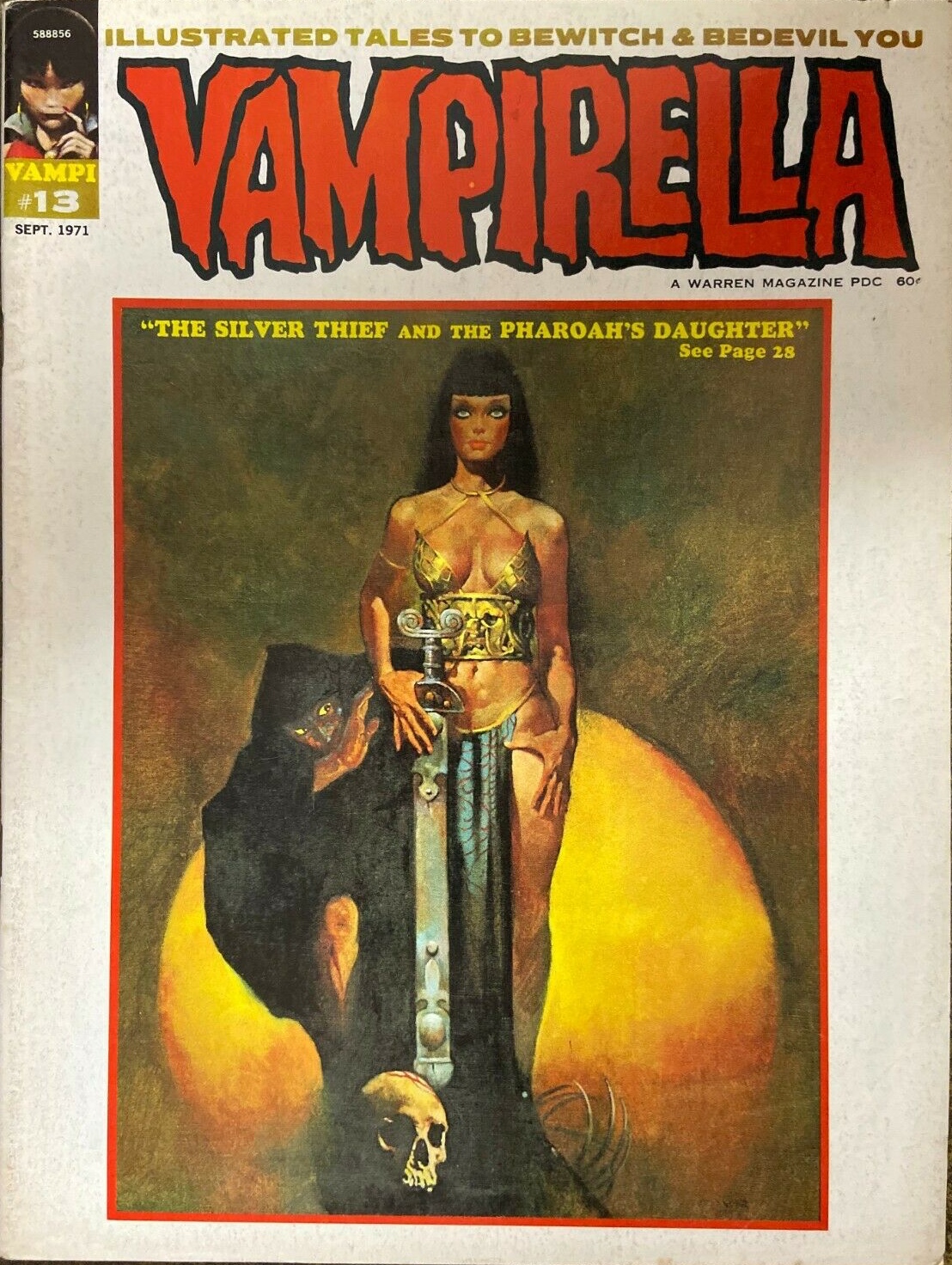
The Silver Thief and the Pharaoh’s Daughter benefits from a properly developed plot with some decent twists. The ancient Egypt setting works extremely well. A very good story.
Eye of the Beholder is the grisly tale of a medieval countess who will take any steps necessary to make herself attractive to men. Possibly inspired very vaguely by the legends surrounding Elizabeth Bathory? It’s a good story anyway.
To Kill a God takes place in Egypt. A Roman officer seeks to save a beautiful princess. She is threatened by a high priest, or perhaps the threat comes from a god. This tale plays fast and loose with both history and Egyptian mythology but it does so in a very enjoyable way.
Prisoner in the Pool is set 3,000 years in the past. A greek hero has to free a maiden confined to a pool by a magic spell. A story that just needed a bit more plot.
In The Sword of Light a beautiful young queen must defend her realm against an evil magic warrior. One man could aid her, except that he’s a coward. A good fun story with mayhem, magic and a feisty heroine.
The stories with contemporary settings and the science fiction stories are more of a mixed bag. The Curse is promising - a man without a memory meets a half-naked girl who tells him they’ve both been cursed by a witch. It’s rather good.
Snake Eyes is a decent story of a girl named Sara who looks like a reptile girl, despite which she has managed to find a boyfriend. He has plans to launch her career as a side-show attraction but he needs money for publicity. If only he could persuade her to sell that strange pendant. It turns out that there is more to Sara than meets the eye, and there’s another twist as well.
Regeneration Gap is a successful sci-fi story in which an astronaut returns to Earth to find that 128 years have passed. Whether life still survives on Earth depends on how you define life.
The Escape concerns a glamorous female jewel thief in the 26th century. Her costume is even more revealing than Vampirella’s. She’s on the run and takes a desperate chance. Not a bad idea but with an overly obvious ending.
Quest is a very short but very good story. It’s very minimalist. There’s no dialogue and we don’t know where or when it takes place. It has a nicely nasty little twist at the end.
Final Thoughts
Given that so many different writers and artists were involved it’s inevitable that this collection is very uneven. Each issue did however contain a good Vampirella and usually a couple of other very good stories. And each issue contained two or three stories that were either disappointing because they were not fully developed or complete misfires.
That’s not such a terrible success/failure ratio. On the whole I thoroughly enjoyed this collection. Recommended, and Vampirella is such an icon that you really do need to sample some of her early adventures and that’s probably enough to bump this volume up to highly recommended status.
So on a whim I bought one of the hardcover Vampirella Archive collections (volume 2 in fact) which includes half a dozen of the original Vampirella comic books which first appeared around 1969.
Vampirella the character was at least partly the creation of science fiction super-fan Forrest J. Ackerman. Each issue of the comic included half a dozen or so comic-strip adventures plus various other features. Disappointingly Vampirella herself only features in one story per issue. This volume begins with issue 8 of the comic. Lots of different writers and artists contributed.
There are also fairly regular sword-and-sorcery stories and they’re pretty good as well. The other stories in each comic are the problem. The stories are often just too short so although the ideas are often very good there’s no time to develop them. By the time you start getting interested they’re over. Some of the non-Vampirella stories work; some don’t.
The comic was definitely aiming to be sexy. There’s quite a bit of nudity. There seemed to be a gradual increase in the level of nudity. In the first few issues in this volume there’s nudity but with the woman’s hair always artfully concealing her nipples. The later issues are not quite so coy. The publishers had evidently figured out that by 1971 they could get away with quite a lot and so they decided to ramp up the nudity quotient. Which I think was a good move. If you’re going to do a sexy comic you might as well make it genuinely sexy.
The Vampirella stories are very good and they’re linked which makes them more interesting. Vampirella is up against a deadly cult. She does have one advantage. She has found out how to survive without having to kill humans for their blood. Vampirella has no desire to hurt humans, unless she is forced to. She is an alien rather than a straightforward vampire and she is cast as heroine rathe than villainess.
In the lead story of issue 8 Vampirella is finding life on Earth to be rather difficult. On her home planet Drakulon blood is easy to obtain but on Earth the only way to get blood is by attacking humans. And Vampirella must have blood to survive. She ends up in a clinic where a kindly doctor tells her that he can solve this problem for her. Vampirella is not quite sure about this clinic - she’s rather suspicious of the doctor’s nurse. With good reason. Vampirella finds herself in a bizarre and terrifying nightmare world of demons. A good action-packed fun story.
In issue 9 Vampirella continues to hunt for the evil cultists but she is in turn being hunted by the Van Helsings (yes, descendants of that Van Helsing). They naturally assume that she is an ordinary vampire and therefore evil.
Vampirella is drawn to a decaying carnival in Carnival of the Damned. It’s not just decaying. There is an atmosphere of misery. And there is magic afoot, and the cult of chaos against which Vampirella has been battling may be involved. Meanwhile the Van Helsings are closing in on Vampirella. Vampirella acquires an ally, a broken-down stage magician named Pendragon who becomes a recurring character. A great story.
In Isle of the Huntress Vampirella and Pendragon are marooned on an island which is inhabited by a werewolf. Or perhaps not a werewolf. Just as Vampirella is not a conventional vampire so this werewolf is not a conventional werewolf. Vampirella could end up as either the hunted or the huntress. A good story.
Lurker in the Deep pits Vampirella and Pendragon against a very nasty aquatic demon. Fun.
As for the non-Vampirella stories, the sword-and-sorcery stories are pretty good. Gardner Fox wrote many such tales and his first story featuring the word-wielding queen Amazonia is excellent. A demon wants to claim Amazonia’s throne. He also wants to kill her but he makes a mistake that makes that impossible. He is however confident that he has neutralised her. This warrior babe is however not all that easy to neutralise. A short but entertaining tale.
War of Wizards is fairly good - a barbarian warrior is caught in a conflict between rival wizards. The barbarian wants to save himself, save his lady love and destroy the empire.
Amazonia and the Eye of Ozirios is a pretty decent sword-and-sorcery tale.
The Silver Thief and the Pharaoh’s Daughter benefits from a properly developed plot with some decent twists. The ancient Egypt setting works extremely well. A very good story.
Eye of the Beholder is the grisly tale of a medieval countess who will take any steps necessary to make herself attractive to men. Possibly inspired very vaguely by the legends surrounding Elizabeth Bathory? It’s a good story anyway.
To Kill a God takes place in Egypt. A Roman officer seeks to save a beautiful princess. She is threatened by a high priest, or perhaps the threat comes from a god. This tale plays fast and loose with both history and Egyptian mythology but it does so in a very enjoyable way.
Prisoner in the Pool is set 3,000 years in the past. A greek hero has to free a maiden confined to a pool by a magic spell. A story that just needed a bit more plot.
In The Sword of Light a beautiful young queen must defend her realm against an evil magic warrior. One man could aid her, except that he’s a coward. A good fun story with mayhem, magic and a feisty heroine.
The stories with contemporary settings and the science fiction stories are more of a mixed bag. The Curse is promising - a man without a memory meets a half-naked girl who tells him they’ve both been cursed by a witch. It’s rather good.
Snake Eyes is a decent story of a girl named Sara who looks like a reptile girl, despite which she has managed to find a boyfriend. He has plans to launch her career as a side-show attraction but he needs money for publicity. If only he could persuade her to sell that strange pendant. It turns out that there is more to Sara than meets the eye, and there’s another twist as well.
Regeneration Gap is a successful sci-fi story in which an astronaut returns to Earth to find that 128 years have passed. Whether life still survives on Earth depends on how you define life.
The Escape concerns a glamorous female jewel thief in the 26th century. Her costume is even more revealing than Vampirella’s. She’s on the run and takes a desperate chance. Not a bad idea but with an overly obvious ending.
Quest is a very short but very good story. It’s very minimalist. There’s no dialogue and we don’t know where or when it takes place. It has a nicely nasty little twist at the end.
Final Thoughts
Given that so many different writers and artists were involved it’s inevitable that this collection is very uneven. Each issue did however contain a good Vampirella and usually a couple of other very good stories. And each issue contained two or three stories that were either disappointing because they were not fully developed or complete misfires.
That’s not such a terrible success/failure ratio. On the whole I thoroughly enjoyed this collection. Recommended, and Vampirella is such an icon that you really do need to sample some of her early adventures and that’s probably enough to bump this volume up to highly recommended status.
Monday, March 6, 2023
Renegade Swords
Renegade Swords is a sword-and-sorcery anthology from DMR Press and as usual they’ve come up with an interesting mix of stories.
The House of Arabu is a fairly early Robert E. Howard story. It was apparently written in 1929 but was unpublished during his lifetime, eventually seeing the light of day (under the title Witch from Hell's Kitchen) in the Avon Fantasy Reader in 1952. At this stage Howard was still experimenting with the new sword-and-sorcery genre (which he had more or less invented).
The House of Arabu takes place in a quasi-historical rather than a fantasy setting, Mesopotamia during the Bronze Age. This is the only story Howard wrote featuring Pyrrhas the Argive. This was almost certainly not because there was anything wrong with the character (he’s a colourful proto-Conan) but because Howard realised that sword-and-sorcery tales were going to work better in a more overtly fantasy setting rather than an historical setting.
And this is definitely a sword-and-sorcery tale. There’s the loner barbarian hero, there’s an atmosphere of supernatural menace.
Other sword-and-sorcery writers have equalled or even surpassed Robert E. Howard in some areas but nobody has ever matched the raw vitality of Howard’s writing, and no-one has ever created barbarian heroes as convincingly barbarian as Howard’s. Pyrrhas is not a civilised man. He has the mercurial nature, the superstitious outlook and the casual almost innocent cruelty that typifies a Howard barbarian hero.
Necromancy in Naat is one of Clark Ashton Smith’s best-known stories. Nobody could match Smith when it came to creating an atmosphere of decadence, decay, degeneracy and doom. A prince’s search for his beloved, kidnapped by slavers, takes him to Naat, the dread island of the necromancers from which no man has ever escaped alive. He finds his beloved but it’s not the joyous reunion for which he had hoped. And he faces an almost unimaginably horrible fate. Nobody’s sorcerers were as evil and depraved as Smith’s. A superb story. This is claimed to be the complete text of the story, unpublished until recently. The original published version appeared in Weird Tales in 1936.
The Woman of the Wood by A. Merritt (published in Weird Tales in 1926) is about a scientist named McKay who talks to trees. And they talk back to him. He is drawn into their world, a world of strange tree-women. The trees are at war with three men. The men want to destroy the trees. The trees want to destroy the men. McKay wants to help the tree-women. He’ll do anything for them. Maybe even kill.
Merritt was one of the greatest and most imaginative of the pulp writers. This is a very strange story and maybe nobody else could have pulled it off.
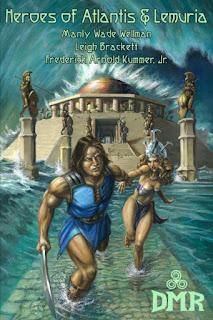
Slaughter of the Gods, dating from the late 80s, was the final story written by Manly Wade Wellman featuring his hero Kardios, the last survivor of Atlantis. The other five Kardios tales are included in the excellent DMR Press volume Heroes of Atlantis & Lemuria. The Kardios stories are fine examples of sword-and-sorcery and Slaughter of the Gods is excellent. Kardios arrives in a city that has no kings, only gods. The real ruler seems to be a goddess. Kardios has his suspicions about the nature of these gods and his suspicions are well-founded. The goddess worries him a little as well. He has sex with her and it’s very nice but then she gets the idea that she now owns him. A neat little story.
Lin Carter’s People of the Dragon (1976) is a prehistoric tale of a tribe migrating southwards to escape from a land that is increasingly a nightmare of snow and ice. A young hunter named Junga sets out to find his father and brothers who failed to return from a hunt. Junga encounters an unimaginable horror but it teaches him a number of things that are essential to the tribe’s survival. A fairly decent story.
Lin Carter’s The Pillars of Hell (1977) is a kind of sequel to People of the Dragon. Carter intended to write a series of stories about the prehistoric tribe who called themselves the People of the Dragon, with each story taking place one generation later. Characters who were young men in one story would appear as old men in the following story. It was an idea with potential and it’s perhaps a pity that he ended up writing just these two stories. The hero of The Pillars of Hell is the son of Junga, the protagonist of People of the Dragon.
The tribe’s southward trek has taken them into barren desert country where fresh horrors await them. Members of the tribe start wandering off into the desert and are never seen again. The hero discovers that they face an appalling unseen enemy. An excellent story.
The Rune-Sword of Jutenheim by Glenn Rahman and Richard L. Tierney dates from 1985 and includes everything you’d want in a sword-and-sorcery tale - a doom-laden atmosphere, a brave Viking warrior, a sexy giantess, an evil sorcerer, magic swords, an epic struggle between the gods. It’s all pretty conventional but it’s done with style and energy and it’s fun.
Princess of Chaos by Bryce Walton appeared in Planet Stories in 1947. It takes place on Venus. Moljar is half-Terran half-Martian gladiator. He belongs to the Princess Alhone. Alhone is not entirely human. She’s covered in fur. She’s a kind of catwoman. Moljar lives for one thing only. One day he intends to kill Princess Alhone, skin her and present her pelt to his tribe as a trophy.
In the arena Moljar meets Mahra. She’s a gladiator (should that be gladiatrix?) She’s a Terran but she’s also a mutant. Nobody likes half-breeds like Moljar and nobody likes mutants so they should get along, but they don’t. Then the Mistmen attack and Alhone offers Muljar a mission. Mahra accompanies him because she figures they have a better chance of survival together.
There’s a lot Muljar doesn’t know about Venus and there’s a great deal he doesn’t know about Princess Alhone. Almost everything he thought he did know turns out to be wrong.
There’s action in generous quantities and a few cool science fictional ideas. This is obviously a sword-and-planet rather than a sword-and-sorcery tale, and it’s a very good one.
Final Thoughts
This is a fairly strong collection embracing both conventional sword-and-sorcery stories and stories that either fit into related genres or don’t fit neatly into any genre. Either way it’s highly recommended.
The House of Arabu is a fairly early Robert E. Howard story. It was apparently written in 1929 but was unpublished during his lifetime, eventually seeing the light of day (under the title Witch from Hell's Kitchen) in the Avon Fantasy Reader in 1952. At this stage Howard was still experimenting with the new sword-and-sorcery genre (which he had more or less invented).
The House of Arabu takes place in a quasi-historical rather than a fantasy setting, Mesopotamia during the Bronze Age. This is the only story Howard wrote featuring Pyrrhas the Argive. This was almost certainly not because there was anything wrong with the character (he’s a colourful proto-Conan) but because Howard realised that sword-and-sorcery tales were going to work better in a more overtly fantasy setting rather than an historical setting.
And this is definitely a sword-and-sorcery tale. There’s the loner barbarian hero, there’s an atmosphere of supernatural menace.
Other sword-and-sorcery writers have equalled or even surpassed Robert E. Howard in some areas but nobody has ever matched the raw vitality of Howard’s writing, and no-one has ever created barbarian heroes as convincingly barbarian as Howard’s. Pyrrhas is not a civilised man. He has the mercurial nature, the superstitious outlook and the casual almost innocent cruelty that typifies a Howard barbarian hero.
Necromancy in Naat is one of Clark Ashton Smith’s best-known stories. Nobody could match Smith when it came to creating an atmosphere of decadence, decay, degeneracy and doom. A prince’s search for his beloved, kidnapped by slavers, takes him to Naat, the dread island of the necromancers from which no man has ever escaped alive. He finds his beloved but it’s not the joyous reunion for which he had hoped. And he faces an almost unimaginably horrible fate. Nobody’s sorcerers were as evil and depraved as Smith’s. A superb story. This is claimed to be the complete text of the story, unpublished until recently. The original published version appeared in Weird Tales in 1936.
The Woman of the Wood by A. Merritt (published in Weird Tales in 1926) is about a scientist named McKay who talks to trees. And they talk back to him. He is drawn into their world, a world of strange tree-women. The trees are at war with three men. The men want to destroy the trees. The trees want to destroy the men. McKay wants to help the tree-women. He’ll do anything for them. Maybe even kill.
Merritt was one of the greatest and most imaginative of the pulp writers. This is a very strange story and maybe nobody else could have pulled it off.
Slaughter of the Gods, dating from the late 80s, was the final story written by Manly Wade Wellman featuring his hero Kardios, the last survivor of Atlantis. The other five Kardios tales are included in the excellent DMR Press volume Heroes of Atlantis & Lemuria. The Kardios stories are fine examples of sword-and-sorcery and Slaughter of the Gods is excellent. Kardios arrives in a city that has no kings, only gods. The real ruler seems to be a goddess. Kardios has his suspicions about the nature of these gods and his suspicions are well-founded. The goddess worries him a little as well. He has sex with her and it’s very nice but then she gets the idea that she now owns him. A neat little story.
Lin Carter’s People of the Dragon (1976) is a prehistoric tale of a tribe migrating southwards to escape from a land that is increasingly a nightmare of snow and ice. A young hunter named Junga sets out to find his father and brothers who failed to return from a hunt. Junga encounters an unimaginable horror but it teaches him a number of things that are essential to the tribe’s survival. A fairly decent story.
Lin Carter’s The Pillars of Hell (1977) is a kind of sequel to People of the Dragon. Carter intended to write a series of stories about the prehistoric tribe who called themselves the People of the Dragon, with each story taking place one generation later. Characters who were young men in one story would appear as old men in the following story. It was an idea with potential and it’s perhaps a pity that he ended up writing just these two stories. The hero of The Pillars of Hell is the son of Junga, the protagonist of People of the Dragon.
The tribe’s southward trek has taken them into barren desert country where fresh horrors await them. Members of the tribe start wandering off into the desert and are never seen again. The hero discovers that they face an appalling unseen enemy. An excellent story.
The Rune-Sword of Jutenheim by Glenn Rahman and Richard L. Tierney dates from 1985 and includes everything you’d want in a sword-and-sorcery tale - a doom-laden atmosphere, a brave Viking warrior, a sexy giantess, an evil sorcerer, magic swords, an epic struggle between the gods. It’s all pretty conventional but it’s done with style and energy and it’s fun.
Princess of Chaos by Bryce Walton appeared in Planet Stories in 1947. It takes place on Venus. Moljar is half-Terran half-Martian gladiator. He belongs to the Princess Alhone. Alhone is not entirely human. She’s covered in fur. She’s a kind of catwoman. Moljar lives for one thing only. One day he intends to kill Princess Alhone, skin her and present her pelt to his tribe as a trophy.
In the arena Moljar meets Mahra. She’s a gladiator (should that be gladiatrix?) She’s a Terran but she’s also a mutant. Nobody likes half-breeds like Moljar and nobody likes mutants so they should get along, but they don’t. Then the Mistmen attack and Alhone offers Muljar a mission. Mahra accompanies him because she figures they have a better chance of survival together.
There’s a lot Muljar doesn’t know about Venus and there’s a great deal he doesn’t know about Princess Alhone. Almost everything he thought he did know turns out to be wrong.
There’s action in generous quantities and a few cool science fictional ideas. This is obviously a sword-and-planet rather than a sword-and-sorcery tale, and it’s a very good one.
Final Thoughts
This is a fairly strong collection embracing both conventional sword-and-sorcery stories and stories that either fit into related genres or don’t fit neatly into any genre. Either way it’s highly recommended.
Monday, December 26, 2022
Lin Carter's The Wizard of Lemuria
Lin Carter (1930-1988) was an American science fiction/fantasy writer and editor. As editor of the Ballantine Adult Fantasy series in the early 70s he did much to rekindle interest in some of the great fantasy writers whose works had been all but forgotten.
The Wizard of Lemuria, published in 1965, was his first published novel and the first instalment of his Thongor the Barbarian series. It’s very obviously heavily influenced by Robert E. Howard.
This series takes place in a world very reminiscent of Robert E. Howard’s Hyboria. The premise is that the first human civilisations arose half a million years ago on the vanished continent of Lemuria. The world had been dominated by the Dragon Kings, a race of lizard-men, until they were defeated and destroyed by humans. Human civilisations then rose and fell.
Thongor, a barbarian swordsman from the Northland, is employed as a mercenary until he quarrels with his captain and is forced to kill him. Thongor is thrown into a dungeon and escapes by stealing a new invention cooked up by a master alchemist. It is an air boat constructed of a metal that is lighter than air and it is propelled by rotors powered by springs.
Thongor’s escape seems destined to end in disaster. His air boat is attacked by gigantic flying lizards and after it crashes he is pursued by even more gigantic and more terrifying ground-dwelling lizards. It would have been the end of the line for Thongor had he not been rescued by an elderly sorcerer, Sharajsha. Sharajsa has need of Thongor’s fighting skills. The Dragon Kings were vanquished thousand of years earlier but the Dragon Wizards still survive, patiently awaiting their chance to wreak vengeance and destruction on the human race. Only a magic sword can defeat them. Only Sharajsa can forge that sword. And only a mighty warrior like Thongor can wield that sword. The sword can only be forged in one place and it will be a perilous journey to reach the sacred mountain.
Thongor and Sharajsa get into various scrapes before they can complete their mission, Thongor finds a valiant comrade-in-arms and of course along the way he has time to rescue a beautiful slave girl who is in reality a beautiful princess.
Carnivorous flying lizards are just one of the hazards Thongor encounters. The vampire flowers are even nastier.
The chief villains are the mysterious Dragon Wizards but there are plenty of subsidiary villains to worry about as well - over-ambitious princes and unscrupulous druids all of whom take an intense dislike to Thongor.
This is clearly a Robert E. Howard imitation, with Thongor being a less interesting version of Conan. It’s pretty much stock-standard sword-and-sorcery. Lin Carter was just not quite in the same league as Howard. His prose lacks the astonishing vitality and dynamism of Howard’s work. The story is fairly conventional.
That sounds like I’m dismissing this book as sub-standard but that would be unfair. Carter understood the sword-and-sorcery genre extremely well. He has assembled all the right ingredients - a world of magic and monsters, a brave noble barbarian hero, sorcerers both good and evil, a beautiful princess and lots and lots of action. And he’s blended these ingredients with a reasonable amount of skill. He also understood the vital importance of pacing - the action doesn’t let up for a moment. The action scenes are vivid and exciting.
The Wizard of Lemuria might be second-tier sword-and-sorcery compared to the works of Robert E. Howard, Catherine L. Moore and Fritz Leiber but it’s good solid entertaining second-tier sword-and-sorcery. If you’ve read everything written by the giants of sword-and-sorcery and you still want more then this novel will provide reasonable entertainment. Recommended.
The Wizard of Lemuria, published in 1965, was his first published novel and the first instalment of his Thongor the Barbarian series. It’s very obviously heavily influenced by Robert E. Howard.
This series takes place in a world very reminiscent of Robert E. Howard’s Hyboria. The premise is that the first human civilisations arose half a million years ago on the vanished continent of Lemuria. The world had been dominated by the Dragon Kings, a race of lizard-men, until they were defeated and destroyed by humans. Human civilisations then rose and fell.
Thongor, a barbarian swordsman from the Northland, is employed as a mercenary until he quarrels with his captain and is forced to kill him. Thongor is thrown into a dungeon and escapes by stealing a new invention cooked up by a master alchemist. It is an air boat constructed of a metal that is lighter than air and it is propelled by rotors powered by springs.
Thongor’s escape seems destined to end in disaster. His air boat is attacked by gigantic flying lizards and after it crashes he is pursued by even more gigantic and more terrifying ground-dwelling lizards. It would have been the end of the line for Thongor had he not been rescued by an elderly sorcerer, Sharajsha. Sharajsa has need of Thongor’s fighting skills. The Dragon Kings were vanquished thousand of years earlier but the Dragon Wizards still survive, patiently awaiting their chance to wreak vengeance and destruction on the human race. Only a magic sword can defeat them. Only Sharajsa can forge that sword. And only a mighty warrior like Thongor can wield that sword. The sword can only be forged in one place and it will be a perilous journey to reach the sacred mountain.
Thongor and Sharajsa get into various scrapes before they can complete their mission, Thongor finds a valiant comrade-in-arms and of course along the way he has time to rescue a beautiful slave girl who is in reality a beautiful princess.
Carnivorous flying lizards are just one of the hazards Thongor encounters. The vampire flowers are even nastier.
The chief villains are the mysterious Dragon Wizards but there are plenty of subsidiary villains to worry about as well - over-ambitious princes and unscrupulous druids all of whom take an intense dislike to Thongor.
This is clearly a Robert E. Howard imitation, with Thongor being a less interesting version of Conan. It’s pretty much stock-standard sword-and-sorcery. Lin Carter was just not quite in the same league as Howard. His prose lacks the astonishing vitality and dynamism of Howard’s work. The story is fairly conventional.
That sounds like I’m dismissing this book as sub-standard but that would be unfair. Carter understood the sword-and-sorcery genre extremely well. He has assembled all the right ingredients - a world of magic and monsters, a brave noble barbarian hero, sorcerers both good and evil, a beautiful princess and lots and lots of action. And he’s blended these ingredients with a reasonable amount of skill. He also understood the vital importance of pacing - the action doesn’t let up for a moment. The action scenes are vivid and exciting.
The Wizard of Lemuria might be second-tier sword-and-sorcery compared to the works of Robert E. Howard, Catherine L. Moore and Fritz Leiber but it’s good solid entertaining second-tier sword-and-sorcery. If you’ve read everything written by the giants of sword-and-sorcery and you still want more then this novel will provide reasonable entertainment. Recommended.
Tuesday, November 22, 2022
The Savage Tales of Solomon Kane by Robert E. Howard
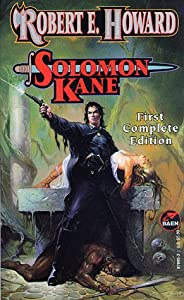
The Savage Tales of Solomon Kane is a collection of all of Robert E. Howard’s stories featuring 17th century Puritan adventurer Solomon Kane.
Solomon Kane considers himself to be a Puritan but he’s not quite what you might think of when you hear the word. He is a man with a very high sense of duty and he can be ruthless. He’s a man driven by conscience. He is however prepared to entertain the possibility that sometimes duty is complicated and sometimes it ends up feeling like the wrong thing to do. He is a man who understands moral complexity. And it’s something he worries about a lot.
Kane is a hard man but he’s as hard on himself as he is on others and he detests cruelty. He particularly detests people who try to find spurious moral justifications for cruelty and injustice.
This is Robert E. Howard, a man some would dismiss as a mere pulp writer, creating a fascinatingly complex character capable of a degree of self-doubt and self-analysis.
Solomon Kane sees himself as an agent of God, as God’s avenger. His mission in life is to destroy evil men. He is a fanatic, but unlike most fanatics he possesses a capacity for kindness.
One of the things I like about Solomon Kane is that he’s not Conan in 17th century garb. He’s a very different kind of character. He’s more serious-minded, a bit more introspective, and he has a strong sense of moral purpose.
These stories sometimes involve the supernatural, and sometimes not.
In Skulls in the Stars Kane is on his way to Torkertown. He is warned to take the swamp road rather than the much shorter much easier road across the moor. Danger and death lurk on the moor road. Naturally Kane takes the moor road.
And he encounters something uncanny and terrifying. Can an emotion be made flesh? Perhaps some emotions can. Emotions like hate. Kane finds an answer to the danger but it makes him uneasy. Good story.
The Right Hand of Doom is a neat little tale of a necromancer who promises to exact revenge on the man who betrayed him. A story in which Kane wants to see justice done but in which he recognises that justice can be used as an excuse for mere revenge, or hate, or cruelty. A solid story.
Red Shadows (originally titled Solomon Kane) is a novelette. Kane encounters a dying girl. She had been raped and brutalised. Kane has never set eyes on this girl before but now he has appointed himself her avenger. Avenging her will take Kane across the seas and all the way to Africa where he will encounter some formidable magic. Interesting that the African voodoo witch-doctor/black magician N’Longa turns out to be one of the good guys. Howard gives this novelette a certain epic quality - Kane doesn’t care if it takes him years and he has to visit every corner of the globe. He has promised vengeance and he keeps his promises. N’Longa also gives Kane a wooden stuff. It is fabulously old, made of an unknown wood, with magical powers. That staff will crop up in later Solomon Kane stories. Great story.
Rattle of Bones begins with Kane and a Frenchman he has met on the road through the forest taking a room at an inn. It is the Cleft Skull Inn and it looks as inviting as its name suggests. I can’t tell you much more without revealing spoilers except that Solomon Kane will not get much sleep this night. And it’s a revenge story with a twist. Good story.
The novella The Moon of Skulls takes Kane back to Africa. It is the last stage in an epic quest that has taken years. Kane is searching for an English girl kidnapped by slavers. He has reached the fabled kingdom of Negari, ruled by the dreaded black queen Nakari.
He discovers that Negari has a bizarre history, a history that goes back to another land, a time of legend, a vanished civilisation. He finds a city in the heart of Africa but dark deeds are done there. And the Moon of Skulls, the full moon, is approaching. After that there will be no way to save that English maiden.
Kane will be offered immense power and will be tempted, although only for a moment.
Kane will be captured, he will witness scenes of torture and depravity and he will inflame the lusts of Queen Nakari.
There’s action aplenty, there are chases through secret passageways, there are horrific secrets to be revealed. A splendid tale of adventure.
The Blue Flame of Vengeance begins with a duel. A young man named Jack Hollinster has challenged Sir George Banway, a nobleman with an evil reputation. The duel ends inconclusively but indirectly it leads to a meeting between Jack and Solomon Kane. Kane is out for revenge as well but Sir George is not his target. Kane has been pursuing the notorious pirate Jonas Hardraker.
Jack’s lady love is kidnapped so Kane will have to rescue her as well as settling his account with Hardraker.
Plenty of action in this tale and a second duel, this time with knives. A fine story.
The Hills of the Dead takes Kane back to Africa, but he can’t explain why. He has no mission to fulfil. He is simply drawn to the place. An encounter with a frightened young African girl named Junna will however present him with a mission. Her tribe is being menaced by the dead. They are the dead of a vanished tribe and they are vampires of a sort. Junna’s tribe lives in terror. Ridding the land of these vampire-like creatures is task worthy of Solomon Kane.
It is however a task that is beyond him. Kane fears no living man but these walking dead are impervious to both sword and pistol. Kane reluctantly comes to the conclusion that magic must be fought with magic. He knows nothing of magic, but N’Longa knows a great deal. N’Longa is a mighty ju-ju man. He is also, as a result of the events recounted in Red Shadows, Kane’s blood brother. N’Longa might have the magic necessary. And while Kane abhors magic he knows that N’Longa is a good magician.
This is unequivocally a tale of the supernatural and a full-blown horror story. And a very very good one.
Wings in the Night is a very dark story, even for Robert E.Howard. Kane is in Africa, being pursued by cannibals. He comes across a village that has been ravaged and devastated and he finds unspeakable horrors. Flying creatures like men with wings, vicious and bloodthirsty.
He takes refuge in a village where the priest tells him of the full horrors of the bird-men.
The tribe sees Kane as a god who will deliver them from the evil of the bird-men. That’s what Kane fully intends to do but his fine resolutions lead to further horrors and to madness. A great story.
The Footfalls Within is a very simple tale. Kane is tramping through the jungle in Africa. He sees a party of Arab slavers driving a group of African slaves. The slavers are just about to commit an unspeakable act of cruelty towards a young girl. There are fifteen Arabs accompanied by seventy armed African guards. The odds against Kane are impossible. Kane attacks anyway and is captured.
The slavers, dragging Kane along with them bound and tied, find an ancient mausoleum. Kane knows that opening the mausoleum would be a mistake - he can hear footfalls within the tomb although nobody else hears them. It turns out that opening that mausoleum is a very big mistake indeed. Probably the weakest Solomon Kane story but still at least moderately creepy.
Final Thoughts
The weaker stories in this collection are still very good. The better stories are superb, Robert E. Howard at his best. And the better stories outnumber the weaker ones by a comfortable margin.
These tales are definitely sword-and-sorcery but being set in the 17th century and more often than not in Africa give them a unique feel. Very highly recommended.
Solomon Kane considers himself to be a Puritan but he’s not quite what you might think of when you hear the word. He is a man with a very high sense of duty and he can be ruthless. He’s a man driven by conscience. He is however prepared to entertain the possibility that sometimes duty is complicated and sometimes it ends up feeling like the wrong thing to do. He is a man who understands moral complexity. And it’s something he worries about a lot.
Kane is a hard man but he’s as hard on himself as he is on others and he detests cruelty. He particularly detests people who try to find spurious moral justifications for cruelty and injustice.
This is Robert E. Howard, a man some would dismiss as a mere pulp writer, creating a fascinatingly complex character capable of a degree of self-doubt and self-analysis.
Solomon Kane sees himself as an agent of God, as God’s avenger. His mission in life is to destroy evil men. He is a fanatic, but unlike most fanatics he possesses a capacity for kindness.
One of the things I like about Solomon Kane is that he’s not Conan in 17th century garb. He’s a very different kind of character. He’s more serious-minded, a bit more introspective, and he has a strong sense of moral purpose.
These stories sometimes involve the supernatural, and sometimes not.
In Skulls in the Stars Kane is on his way to Torkertown. He is warned to take the swamp road rather than the much shorter much easier road across the moor. Danger and death lurk on the moor road. Naturally Kane takes the moor road.
And he encounters something uncanny and terrifying. Can an emotion be made flesh? Perhaps some emotions can. Emotions like hate. Kane finds an answer to the danger but it makes him uneasy. Good story.
The Right Hand of Doom is a neat little tale of a necromancer who promises to exact revenge on the man who betrayed him. A story in which Kane wants to see justice done but in which he recognises that justice can be used as an excuse for mere revenge, or hate, or cruelty. A solid story.
Red Shadows (originally titled Solomon Kane) is a novelette. Kane encounters a dying girl. She had been raped and brutalised. Kane has never set eyes on this girl before but now he has appointed himself her avenger. Avenging her will take Kane across the seas and all the way to Africa where he will encounter some formidable magic. Interesting that the African voodoo witch-doctor/black magician N’Longa turns out to be one of the good guys. Howard gives this novelette a certain epic quality - Kane doesn’t care if it takes him years and he has to visit every corner of the globe. He has promised vengeance and he keeps his promises. N’Longa also gives Kane a wooden stuff. It is fabulously old, made of an unknown wood, with magical powers. That staff will crop up in later Solomon Kane stories. Great story.
Rattle of Bones begins with Kane and a Frenchman he has met on the road through the forest taking a room at an inn. It is the Cleft Skull Inn and it looks as inviting as its name suggests. I can’t tell you much more without revealing spoilers except that Solomon Kane will not get much sleep this night. And it’s a revenge story with a twist. Good story.
The novella The Moon of Skulls takes Kane back to Africa. It is the last stage in an epic quest that has taken years. Kane is searching for an English girl kidnapped by slavers. He has reached the fabled kingdom of Negari, ruled by the dreaded black queen Nakari.
He discovers that Negari has a bizarre history, a history that goes back to another land, a time of legend, a vanished civilisation. He finds a city in the heart of Africa but dark deeds are done there. And the Moon of Skulls, the full moon, is approaching. After that there will be no way to save that English maiden.
Kane will be offered immense power and will be tempted, although only for a moment.
Kane will be captured, he will witness scenes of torture and depravity and he will inflame the lusts of Queen Nakari.
There’s action aplenty, there are chases through secret passageways, there are horrific secrets to be revealed. A splendid tale of adventure.
The Blue Flame of Vengeance begins with a duel. A young man named Jack Hollinster has challenged Sir George Banway, a nobleman with an evil reputation. The duel ends inconclusively but indirectly it leads to a meeting between Jack and Solomon Kane. Kane is out for revenge as well but Sir George is not his target. Kane has been pursuing the notorious pirate Jonas Hardraker.
Jack’s lady love is kidnapped so Kane will have to rescue her as well as settling his account with Hardraker.
Plenty of action in this tale and a second duel, this time with knives. A fine story.
The Hills of the Dead takes Kane back to Africa, but he can’t explain why. He has no mission to fulfil. He is simply drawn to the place. An encounter with a frightened young African girl named Junna will however present him with a mission. Her tribe is being menaced by the dead. They are the dead of a vanished tribe and they are vampires of a sort. Junna’s tribe lives in terror. Ridding the land of these vampire-like creatures is task worthy of Solomon Kane.
It is however a task that is beyond him. Kane fears no living man but these walking dead are impervious to both sword and pistol. Kane reluctantly comes to the conclusion that magic must be fought with magic. He knows nothing of magic, but N’Longa knows a great deal. N’Longa is a mighty ju-ju man. He is also, as a result of the events recounted in Red Shadows, Kane’s blood brother. N’Longa might have the magic necessary. And while Kane abhors magic he knows that N’Longa is a good magician.
This is unequivocally a tale of the supernatural and a full-blown horror story. And a very very good one.
Wings in the Night is a very dark story, even for Robert E.Howard. Kane is in Africa, being pursued by cannibals. He comes across a village that has been ravaged and devastated and he finds unspeakable horrors. Flying creatures like men with wings, vicious and bloodthirsty.
He takes refuge in a village where the priest tells him of the full horrors of the bird-men.
The tribe sees Kane as a god who will deliver them from the evil of the bird-men. That’s what Kane fully intends to do but his fine resolutions lead to further horrors and to madness. A great story.
The Footfalls Within is a very simple tale. Kane is tramping through the jungle in Africa. He sees a party of Arab slavers driving a group of African slaves. The slavers are just about to commit an unspeakable act of cruelty towards a young girl. There are fifteen Arabs accompanied by seventy armed African guards. The odds against Kane are impossible. Kane attacks anyway and is captured.
The slavers, dragging Kane along with them bound and tied, find an ancient mausoleum. Kane knows that opening the mausoleum would be a mistake - he can hear footfalls within the tomb although nobody else hears them. It turns out that opening that mausoleum is a very big mistake indeed. Probably the weakest Solomon Kane story but still at least moderately creepy.
Final Thoughts
The weaker stories in this collection are still very good. The better stories are superb, Robert E. Howard at his best. And the better stories outnumber the weaker ones by a comfortable margin.
These tales are definitely sword-and-sorcery but being set in the 17th century and more often than not in Africa give them a unique feel. Very highly recommended.
Thursday, September 29, 2022
Gardner Francis Fox's The Druid Stone
The Druid Stone is a novel of black magic by Gardner Francis Fox, using the pseudonym Simon Majors. It was published in 1967.
Brian Creoghan is in his mid-thirties but he’s packed a lot of action into his life. That life has been spent roaming the globe in search of adventure, and perhaps (we will come to suspect) in search of something more. His globe-trotting has not taken him to places like Paris and Rome. He’s always been interested in more remote and exotic places. His journeyings have brought him into contact with strange religions, esoteric sects, secret rites and other aspects of what could be described as the weird and the occult.
Now he’s settled down in a farmhouse in New Hampshire. The first sign that his adventuring days might not be over is the patch of blackness in the woods. It just didn’t look natural. That female voice he heard was a bit mysterious as well.
He gets an invitation to dinner with his new neighbours. Moira and Ugony MacArt are brother and sister. Moira is disturbingly alluring. Ugony has spent his life investigating the occult and he has amassed a collection of ritual objects. His interest in the subject is intense but whether it’s healthy remains to be seen. Now he wants Brian to join him in a little experiment. All Brian has to do is to place his hands on a druid stone.
At which point everything changes.
At first it’s reasonable to assume that we’re going to get an occult thriller. This was a hugely popular genre at the time with Dennis Wheatley’s Black Magic books being massive sellers. But before The Druid Stone actually gets underway we’re offered a tantalising hint that this story might be more science fictional than we expect.
And when Brian Creoghan touches that druid stone we find that the book has become a sword-and-sorcery tale. Brian Creoghan is no longer Brian Creoghan. He’s a great warrior named Kalgorrn, he’s in another land which doesn’t seem to be Earth at all, and he’s a different person. Or rather he’s now two people in the same body. And the action starts to really kick in.
He’s now a warrior, a lord whose lands were stolen from him by an evil sorcerer. As a result of a spell he’s been sleeping. Possibly for centuries. But now he’s found his lover, the beautiful witch-woman Red Fann, and they have a quest for revenge to undertake. And lots of terrifying monsters to battle.
To now assume that this is going to be a straightforward sword-and-sorcery adventure would however be a mistake. The author has more tricks up his sleeve.
The story continually switches back and forth between the ordinary world of the present day and the fantastic magical world. Soon Brian Geoghan is no longer sure if he really is Brian Geoghan or if he’s the hero Kalgorrn. He has other complications to worry about. Kalgorrn is in love with Red Fann but Brian is falling in love with Moira. These two women are liable to be a bit unhappy about sharing him.
He also realises that the two worlds he inhabits are liked in some way. What happens in one world could have consequences in the other. In fact the fate of both worlds could hang in the balance. And there’s still that science fiction element lurking in the background.
There’s also the problem that he’s starting to wonder exactly what Ugony MacArt is up to. There was a murder a while back and while Brian is sure that Ugony is not capable of being involved in murder the locals have strong suspicions that Ugony is the murder. So we get a mystery sub-plot as well.
Fox had a real knack for producing thoroughly enjoyable fast-paced pulp tales in multiple genres. He wrote both the Cherry Delight series of sexy sleazy spy/crime thrillers (beginning with The Italian Connection) and the equally entertaining The Lady from L.U.S.T. sexy spy thrillers (beginning with Lust, Be a Lady Tonight). There is however no sleaze at all in The Druid Stone.
The Druid Stone is a very entertaining read. Highly recommended.
Brian Creoghan is in his mid-thirties but he’s packed a lot of action into his life. That life has been spent roaming the globe in search of adventure, and perhaps (we will come to suspect) in search of something more. His globe-trotting has not taken him to places like Paris and Rome. He’s always been interested in more remote and exotic places. His journeyings have brought him into contact with strange religions, esoteric sects, secret rites and other aspects of what could be described as the weird and the occult.
Now he’s settled down in a farmhouse in New Hampshire. The first sign that his adventuring days might not be over is the patch of blackness in the woods. It just didn’t look natural. That female voice he heard was a bit mysterious as well.
He gets an invitation to dinner with his new neighbours. Moira and Ugony MacArt are brother and sister. Moira is disturbingly alluring. Ugony has spent his life investigating the occult and he has amassed a collection of ritual objects. His interest in the subject is intense but whether it’s healthy remains to be seen. Now he wants Brian to join him in a little experiment. All Brian has to do is to place his hands on a druid stone.
At which point everything changes.
At first it’s reasonable to assume that we’re going to get an occult thriller. This was a hugely popular genre at the time with Dennis Wheatley’s Black Magic books being massive sellers. But before The Druid Stone actually gets underway we’re offered a tantalising hint that this story might be more science fictional than we expect.
And when Brian Creoghan touches that druid stone we find that the book has become a sword-and-sorcery tale. Brian Creoghan is no longer Brian Creoghan. He’s a great warrior named Kalgorrn, he’s in another land which doesn’t seem to be Earth at all, and he’s a different person. Or rather he’s now two people in the same body. And the action starts to really kick in.
He’s now a warrior, a lord whose lands were stolen from him by an evil sorcerer. As a result of a spell he’s been sleeping. Possibly for centuries. But now he’s found his lover, the beautiful witch-woman Red Fann, and they have a quest for revenge to undertake. And lots of terrifying monsters to battle.
To now assume that this is going to be a straightforward sword-and-sorcery adventure would however be a mistake. The author has more tricks up his sleeve.
The story continually switches back and forth between the ordinary world of the present day and the fantastic magical world. Soon Brian Geoghan is no longer sure if he really is Brian Geoghan or if he’s the hero Kalgorrn. He has other complications to worry about. Kalgorrn is in love with Red Fann but Brian is falling in love with Moira. These two women are liable to be a bit unhappy about sharing him.
He also realises that the two worlds he inhabits are liked in some way. What happens in one world could have consequences in the other. In fact the fate of both worlds could hang in the balance. And there’s still that science fiction element lurking in the background.
There’s also the problem that he’s starting to wonder exactly what Ugony MacArt is up to. There was a murder a while back and while Brian is sure that Ugony is not capable of being involved in murder the locals have strong suspicions that Ugony is the murder. So we get a mystery sub-plot as well.
Fox had a real knack for producing thoroughly enjoyable fast-paced pulp tales in multiple genres. He wrote both the Cherry Delight series of sexy sleazy spy/crime thrillers (beginning with The Italian Connection) and the equally entertaining The Lady from L.U.S.T. sexy spy thrillers (beginning with Lust, Be a Lady Tonight). There is however no sleaze at all in The Druid Stone.
The Druid Stone is a very entertaining read. Highly recommended.
Sunday, August 7, 2022
John Norman’s Priest-Kings of Gor
Priest-Kings of Gor, published in 1968, is the third of John Norman’s Gor novels. It differs slightly from the first two books. They had very much the feel of high fantasy with sword & sorcery overtones. Priest-Kings of Gor is more of a science fiction novel.
I’m going to be vague about the plot in order to avoid revealing spoilers for the first two books.
Tarl Cabot is from Earth but he spends much of his time on Gor, which is the Counter-Earth. It’s a planet, almost identical to Earth, within our solar system. Its orbit has made it undetectable from Earth. Gor is also inhabited by humans, identical in every way to ourselves. The differences between the two planets are societal and cultural and those differences are quite profound. Gorean society is hierarchical and divided strictly into castes. Slavery is taken for granted. What made the Gor novels controversial is that on Gor female slavery is taken for granted. Not all the women are slaves, but some are.
Gor is ruled by the Priest-Kings. Nobody knows what kinds of beings the Priest-Kings are. Are they supernatural beings, are they men with supernatural powers, are they men with technology so advanced that they appear to all intents and purposes to be gods, or are they gods? Nobody has ever seen a Priest-King and lived to tell the tale so nobody knows. But the Priest-Kings are feared and obeyed.
In the first two books it was obvious that Tarl Cabot strongly disapproved of many aspects of Gorean society, especially the keeping of women as slaves. In this third book he still disapproves of slavery, but has become more tolerant of Gorean cultural practices.
Now Tarl Cabot is back on Gor and, after the events of the previous book, he wants revenge. He wants to meet the Priest-Kings face to face. More than that, he wants to destroy them.
In this book we find out what the Priest-Kings really are.
Tarl reaches the Sardar, the abode of the Priest-Kings. He meets Parp, who claims to be a Priest-King. Tarl is somewhat sceptical. Tarl finds himself a prisoner and encounters the slave girl Vika. Vika is beautiful and seductive. She might be a slave, but she has a reputation for enslaving men with her beauty. Tarl is not at all sure whether Vika can be trusted.
His third encounter is with one of the Priest-Kings, Misk.
Tarl becomes embroiled in power struggles which he does not fully understand. He cannot be sure of Vika’s motivations, or of Misk’s, in fact he cannot be sure of the motivations of any of the characters with whom he becomes involved.
There’s a good deal of action with full-scale battles and a threat to destroy the entire planet.
Tarl is going to have to trust somebody. He thinks he can trust Misk. He’s fairly sure he cannot trust Vika, but he’s not absolutely certain, and he feels vaguely responsible for her. Friendship and love complicate things for Tarl, but friendship and love make us human, an idea which seems obvious to Tarl but puzzling to Misk. His encounter with the Priest-Kings makes humanness suddenly very important to Tarl Cabot.
John Norman is a philosopher and he used the Gor novels as a means of playing around with various philosophical, political, social, cultural and sexual ideas. He claims to be most heavily influenced by Homer, Freud and Nietzsche. Nietzsche is the most obvious influence on the Gor series.
Having a character who divides his time between two radically different societies offers the obvious opportunity to question certain aspects of our own society, and the assumptions behind our social structure. But Norman is not entirely uncritical of Gorean society. He simply offers an alternative social model but whether we, the readers, approve of disapprove is up to us. He seems keen to question, rather than lecture us with his own ideas.
In this book he offers a third social alternative, that of the Priest-Kings, and again it’s left to us to decide how we feel about it. The Priest-Kings have a rational social model, but given that humans are not particularly rational creatures we may be inclined to consider the ideas of the Priest-Kings to be inapplicable to humans. The Priest-Kings have a very alien outlook.
Questions of free will versus compulsion, and conformity versus freedom, and the nature of historical destiny are raised.
If you put aside the sexual aspects (which some people are not going to be able to do) then the Gor books have enough interest to make them worth checking out. The sexual stuff is really a very minor feature of the early Gor novels. Norman is more interested in philosophical questions.
Priest-Kings of Gor might not be to everyone’s tastes but it’s still worth a look.
I’m going to be vague about the plot in order to avoid revealing spoilers for the first two books.
Tarl Cabot is from Earth but he spends much of his time on Gor, which is the Counter-Earth. It’s a planet, almost identical to Earth, within our solar system. Its orbit has made it undetectable from Earth. Gor is also inhabited by humans, identical in every way to ourselves. The differences between the two planets are societal and cultural and those differences are quite profound. Gorean society is hierarchical and divided strictly into castes. Slavery is taken for granted. What made the Gor novels controversial is that on Gor female slavery is taken for granted. Not all the women are slaves, but some are.
Gor is ruled by the Priest-Kings. Nobody knows what kinds of beings the Priest-Kings are. Are they supernatural beings, are they men with supernatural powers, are they men with technology so advanced that they appear to all intents and purposes to be gods, or are they gods? Nobody has ever seen a Priest-King and lived to tell the tale so nobody knows. But the Priest-Kings are feared and obeyed.
In the first two books it was obvious that Tarl Cabot strongly disapproved of many aspects of Gorean society, especially the keeping of women as slaves. In this third book he still disapproves of slavery, but has become more tolerant of Gorean cultural practices.
Now Tarl Cabot is back on Gor and, after the events of the previous book, he wants revenge. He wants to meet the Priest-Kings face to face. More than that, he wants to destroy them.
In this book we find out what the Priest-Kings really are.
Tarl reaches the Sardar, the abode of the Priest-Kings. He meets Parp, who claims to be a Priest-King. Tarl is somewhat sceptical. Tarl finds himself a prisoner and encounters the slave girl Vika. Vika is beautiful and seductive. She might be a slave, but she has a reputation for enslaving men with her beauty. Tarl is not at all sure whether Vika can be trusted.
His third encounter is with one of the Priest-Kings, Misk.
Tarl becomes embroiled in power struggles which he does not fully understand. He cannot be sure of Vika’s motivations, or of Misk’s, in fact he cannot be sure of the motivations of any of the characters with whom he becomes involved.
There’s a good deal of action with full-scale battles and a threat to destroy the entire planet.
Tarl is going to have to trust somebody. He thinks he can trust Misk. He’s fairly sure he cannot trust Vika, but he’s not absolutely certain, and he feels vaguely responsible for her. Friendship and love complicate things for Tarl, but friendship and love make us human, an idea which seems obvious to Tarl but puzzling to Misk. His encounter with the Priest-Kings makes humanness suddenly very important to Tarl Cabot.
John Norman is a philosopher and he used the Gor novels as a means of playing around with various philosophical, political, social, cultural and sexual ideas. He claims to be most heavily influenced by Homer, Freud and Nietzsche. Nietzsche is the most obvious influence on the Gor series.
Having a character who divides his time between two radically different societies offers the obvious opportunity to question certain aspects of our own society, and the assumptions behind our social structure. But Norman is not entirely uncritical of Gorean society. He simply offers an alternative social model but whether we, the readers, approve of disapprove is up to us. He seems keen to question, rather than lecture us with his own ideas.
In this book he offers a third social alternative, that of the Priest-Kings, and again it’s left to us to decide how we feel about it. The Priest-Kings have a rational social model, but given that humans are not particularly rational creatures we may be inclined to consider the ideas of the Priest-Kings to be inapplicable to humans. The Priest-Kings have a very alien outlook.
Questions of free will versus compulsion, and conformity versus freedom, and the nature of historical destiny are raised.
If you put aside the sexual aspects (which some people are not going to be able to do) then the Gor books have enough interest to make them worth checking out. The sexual stuff is really a very minor feature of the early Gor novels. Norman is more interested in philosophical questions.
Priest-Kings of Gor might not be to everyone’s tastes but it’s still worth a look.
I’ve reviewed the two earlier Gor books, Tarnsman of Gor and Outlaws of Gor. It might be worth pointing out that these novels absolutely have to be read in sequence.
Thursday, July 7, 2022
Heroes of Atlantis & Lemuria
Heroes of Atlantis & Lemuria is a collection of sword & sorcery tales from DMR Books. There are five stories by Manly Wade Wellman, all dating from the late 1970s. There are three stories from the late 1930s by Frederick Arnold Kummer Jr. And there’s a single 1941 story by Leigh Brackett. The unifying thread is that all these stories are in some way concerned with the lost worlds of Atlantis or Lemuria.
The Manly Wade Wellman stories features as their hero Kardios, the sole survivor of the disaster that engulfed Atlantis (a disaster he may have unwittingly brought about). He is now a solitary wandering adventurer who is very good at slaying monsters. When you slay a monster the people who were being victimised by the said monster are usually pretty grateful so Kardios manages to survive pretty well.
Straggler from Atlantis introduces the character, washed up on a beach in a strange land. He has been adrift since the destruction of Atlantis. When he wakes up he finds himself face-to-face with a giant. Not just a really big guy, but an actual giant, twice as tall as a man. And there are lots more giants where this one came from.
The giants turn out to be reasonably good-natured. And they need Kardios’s help. There is something that needs to be done and it cannot be done by a giant. It involves a monster. Or a god. Fith could be either. In the world of these 1970s Manly Wade Wellman stories gods and monsters seem to be interchangeable. In any case, whatever Fith is, the giants are really sick of him. That’s why they want Kardios’s help. This is a competent but fairly routine sword & sorcery tale.
The Dweller in the Temple is more interesting. Kardios is just wandering down the road minding his own business when he gets waylaid by a bunch of guys. They don’t want to rob him. They want to crown him as their king. Kardios figures that being a king might be a pretty good gig. Apart from being offered the usual selection of fine wines and good food and fancy clothes he is also to be permitted to choose a girl from among a very luscious assortment presented for his inspection. In fact he can choose two girls if he likes. Kardios is quite happy with the idea of being presented by a lovely female bed partner but his choice strikes his advisers as a trifle eccentric. He chooses a shy servant girl. It proves to be a good choice. Yola is a really sweet girl and once they return to the bedroom she turns out not to be shy after all.
Kardios finds that being a king isn’t hard work and is actually extremely pleasant. Especially with Yola to share his bed.
Of course all this really is too good to be true. There has to be a catch, and there is. Kardios’s monster-slaying skills will be needed after all, and Wellman gives us a fairly cleverly conceived monster in this tale. A pretty good story.
In The Guest from Dzinganji Kardios finds that the road he has been travelling leads nowhere. It ends in a mighty chasm. There is no way across. At least that’s how it seems at first. There is however a way to cross the chasm but Kardios is warned that across the chasm lies Flaal, a city from which no-one was ever returned. Many are lured by the promise of treasure. Kardios is not interested in treasure but he makes the perilous crossing anyway.
Flaal is ruled by Dzinganji. Kardios is informed that nobody ever has to work in Flaal. Every luxury imaginable is provided. All you have to do is to agree to perform one very small service, and you have to agree to submit. Kardios certainly has no intention of doing any such thing. Even the fabulously beautiful Tanda cannot persuade him.
The revelation of the secret behind Dzinganji, and of course there is a secret, is reasonably satisfying. This is a story that gleefully mixes science fiction, fantasy, horror and adventure. A good story.
The Seeker in the Fortress pits Kardios against a powerful wizard. The wizard Tromboll controls the surrounding countryside from his impregnable fortress. The local lord Feothro has grown tired of the wizard’s depredations and is besieging his fortress, but Tromboll is holding Feothro’s fiancée Yann hostage. It seems to be a standoff, until Kardios offers to rescue Yann. It won’t be easy. Tromboll is protected by human guards, monsters and magical powers. A reasonably entertaining story.
The Edge of the World takes Kardios to a city perched on a mountainside. Beyond the mountain there is nothing. It is the edge of the world. At least that’s what the priests tell the people. The queen makes Kardios welcome. Very welcome indeed. But there is a price to be paid for sharing the queen’s bed, and Kardios isn’t keen on paying it. He escapes with the help of a slave girl, but the only way to left to run is up the mountain and that means falling off the edge of the world.
It has to be said that these five Manly Wade Wellman stories have nothing to do with Atlantis. Kardios is just your stock-standard wandering adventurer. But they’re lively and fairly inventive, there’s action and a touch of romance, there are monsters and beautiful but evil queens, there are sinister sorcerers and murderous gods. They’re very decent sword & sorcery tales.
We now move on to the stories by Frederick Arnold Kummer Jr. Adventure in Lemuria appeared in Fantastic Adventures in 1939. Khor is a Cretan and he’s a long way from home when he helps out a young man who’s been set upon by toughs. The young man, Jador, has had his throne usurped by his malevolent half-sister, the witch-queen Lalath. Khor agrees to infiltrate himself into the citadel to open the gate for Jador’s rebel troops. Unfortunately Khor catches the eye of Queen Lalath. She invites Khor to share her bed. He refuses, on account of the fact that he’s getting seriously evil vibes from her, and Lalath takes his rejection rather badly.
So at a time when he should be opening the gate for Jador Khor finds himself about to be sacrificed to the evil god Molech. It’s an entertaining story.
A sequel of sorts, Intrigue in Lemuria, appeared in Fantastic Adventures in 1939. Khor the Wanderer is no longer an ancient Cretan. He is now a 20th century American named Kirk the Wanderer. But by some means which are never explained Kirk seems to be able to transport himself into the world of ancient Lemuria.
In a tavern he encounters a wizard who shows him a vision in a wineglass, a vision of an extraordinarily lovely girl. The next thing he knows he’s waking up in the bedroom of this very girl, but she’s the queen and she’s in a lot of trouble and so is he. He’s been set up to put the queen in a compromising situation.
Volcano Slaves of Mu is great fun with slaves toiling away inside a volcano which is a kind of ancient power generation plant.
The three Kummer stories are energetic and imaginative and generally highly enjoyable stuff. The action is inventive, the villains come up with some truly dastardly plots to dispose of the hero, there’s as much sexiness as you expect in the late 30s.
This brings us to the final tale in the collection, Leigh Brackett’s Lord of the Earthquake, from 1941. Two archaeologists are using a submarine to search for the fabled lost continent of Mu. They find an ancient pyramid and then they’re swept into a kind of cosmic hole. When they emerge the pyramid is no longer submerged beneath the sea.
You’d expect the Leigh Brackett story to be the strongest in the collection and you’d be right. She doesn’t just give us time travel, she gives us time as something that goes in cycles and yet it doesn’t go in cycles, it repeats itself but it doesn’t, you can’t change the past but then again maybe you can. There’s a hero who is flawed but maybe he can still change, there are sacrifices that cannot be avoided, but perhaps they can. Maybe it’s possible to learn to live, and learn to love.
And there’s a genuinely interesting villain with complex motivations. He’s a god. At least he’s pretty sure he’s a god. And since he’s a god he can save the land of Mu. He’s insane and he’s evil but his insanity and his evil are not unreasonable given the circumstances.
This is a thoroughly enjoyable collection of sword-and-sorcery tales. They’re very good second-tier stuff, not in the Robert E. Howard league but still plenty of fun. The Leigh Brackett story on the other hand is absolutely superb and is more than sufficient justification for buying this book.
The Manly Wade Wellman stories features as their hero Kardios, the sole survivor of the disaster that engulfed Atlantis (a disaster he may have unwittingly brought about). He is now a solitary wandering adventurer who is very good at slaying monsters. When you slay a monster the people who were being victimised by the said monster are usually pretty grateful so Kardios manages to survive pretty well.
Straggler from Atlantis introduces the character, washed up on a beach in a strange land. He has been adrift since the destruction of Atlantis. When he wakes up he finds himself face-to-face with a giant. Not just a really big guy, but an actual giant, twice as tall as a man. And there are lots more giants where this one came from.
The giants turn out to be reasonably good-natured. And they need Kardios’s help. There is something that needs to be done and it cannot be done by a giant. It involves a monster. Or a god. Fith could be either. In the world of these 1970s Manly Wade Wellman stories gods and monsters seem to be interchangeable. In any case, whatever Fith is, the giants are really sick of him. That’s why they want Kardios’s help. This is a competent but fairly routine sword & sorcery tale.
The Dweller in the Temple is more interesting. Kardios is just wandering down the road minding his own business when he gets waylaid by a bunch of guys. They don’t want to rob him. They want to crown him as their king. Kardios figures that being a king might be a pretty good gig. Apart from being offered the usual selection of fine wines and good food and fancy clothes he is also to be permitted to choose a girl from among a very luscious assortment presented for his inspection. In fact he can choose two girls if he likes. Kardios is quite happy with the idea of being presented by a lovely female bed partner but his choice strikes his advisers as a trifle eccentric. He chooses a shy servant girl. It proves to be a good choice. Yola is a really sweet girl and once they return to the bedroom she turns out not to be shy after all.
Kardios finds that being a king isn’t hard work and is actually extremely pleasant. Especially with Yola to share his bed.
Of course all this really is too good to be true. There has to be a catch, and there is. Kardios’s monster-slaying skills will be needed after all, and Wellman gives us a fairly cleverly conceived monster in this tale. A pretty good story.
In The Guest from Dzinganji Kardios finds that the road he has been travelling leads nowhere. It ends in a mighty chasm. There is no way across. At least that’s how it seems at first. There is however a way to cross the chasm but Kardios is warned that across the chasm lies Flaal, a city from which no-one was ever returned. Many are lured by the promise of treasure. Kardios is not interested in treasure but he makes the perilous crossing anyway.
Flaal is ruled by Dzinganji. Kardios is informed that nobody ever has to work in Flaal. Every luxury imaginable is provided. All you have to do is to agree to perform one very small service, and you have to agree to submit. Kardios certainly has no intention of doing any such thing. Even the fabulously beautiful Tanda cannot persuade him.
The revelation of the secret behind Dzinganji, and of course there is a secret, is reasonably satisfying. This is a story that gleefully mixes science fiction, fantasy, horror and adventure. A good story.
The Seeker in the Fortress pits Kardios against a powerful wizard. The wizard Tromboll controls the surrounding countryside from his impregnable fortress. The local lord Feothro has grown tired of the wizard’s depredations and is besieging his fortress, but Tromboll is holding Feothro’s fiancée Yann hostage. It seems to be a standoff, until Kardios offers to rescue Yann. It won’t be easy. Tromboll is protected by human guards, monsters and magical powers. A reasonably entertaining story.
The Edge of the World takes Kardios to a city perched on a mountainside. Beyond the mountain there is nothing. It is the edge of the world. At least that’s what the priests tell the people. The queen makes Kardios welcome. Very welcome indeed. But there is a price to be paid for sharing the queen’s bed, and Kardios isn’t keen on paying it. He escapes with the help of a slave girl, but the only way to left to run is up the mountain and that means falling off the edge of the world.
It has to be said that these five Manly Wade Wellman stories have nothing to do with Atlantis. Kardios is just your stock-standard wandering adventurer. But they’re lively and fairly inventive, there’s action and a touch of romance, there are monsters and beautiful but evil queens, there are sinister sorcerers and murderous gods. They’re very decent sword & sorcery tales.
We now move on to the stories by Frederick Arnold Kummer Jr. Adventure in Lemuria appeared in Fantastic Adventures in 1939. Khor is a Cretan and he’s a long way from home when he helps out a young man who’s been set upon by toughs. The young man, Jador, has had his throne usurped by his malevolent half-sister, the witch-queen Lalath. Khor agrees to infiltrate himself into the citadel to open the gate for Jador’s rebel troops. Unfortunately Khor catches the eye of Queen Lalath. She invites Khor to share her bed. He refuses, on account of the fact that he’s getting seriously evil vibes from her, and Lalath takes his rejection rather badly.
So at a time when he should be opening the gate for Jador Khor finds himself about to be sacrificed to the evil god Molech. It’s an entertaining story.
A sequel of sorts, Intrigue in Lemuria, appeared in Fantastic Adventures in 1939. Khor the Wanderer is no longer an ancient Cretan. He is now a 20th century American named Kirk the Wanderer. But by some means which are never explained Kirk seems to be able to transport himself into the world of ancient Lemuria.
In a tavern he encounters a wizard who shows him a vision in a wineglass, a vision of an extraordinarily lovely girl. The next thing he knows he’s waking up in the bedroom of this very girl, but she’s the queen and she’s in a lot of trouble and so is he. He’s been set up to put the queen in a compromising situation.
Volcano Slaves of Mu is great fun with slaves toiling away inside a volcano which is a kind of ancient power generation plant.
The three Kummer stories are energetic and imaginative and generally highly enjoyable stuff. The action is inventive, the villains come up with some truly dastardly plots to dispose of the hero, there’s as much sexiness as you expect in the late 30s.
This brings us to the final tale in the collection, Leigh Brackett’s Lord of the Earthquake, from 1941. Two archaeologists are using a submarine to search for the fabled lost continent of Mu. They find an ancient pyramid and then they’re swept into a kind of cosmic hole. When they emerge the pyramid is no longer submerged beneath the sea.
You’d expect the Leigh Brackett story to be the strongest in the collection and you’d be right. She doesn’t just give us time travel, she gives us time as something that goes in cycles and yet it doesn’t go in cycles, it repeats itself but it doesn’t, you can’t change the past but then again maybe you can. There’s a hero who is flawed but maybe he can still change, there are sacrifices that cannot be avoided, but perhaps they can. Maybe it’s possible to learn to live, and learn to love.
And there’s a genuinely interesting villain with complex motivations. He’s a god. At least he’s pretty sure he’s a god. And since he’s a god he can save the land of Mu. He’s insane and he’s evil but his insanity and his evil are not unreasonable given the circumstances.
This is a thoroughly enjoyable collection of sword-and-sorcery tales. They’re very good second-tier stuff, not in the Robert E. Howard league but still plenty of fun. The Leigh Brackett story on the other hand is absolutely superb and is more than sufficient justification for buying this book.
Saturday, January 29, 2022
Poul Anderson's Swordsmen from the Stars
Poul Anderson (1926-2001) became one of the most celebrated of American science fiction writers. Early in his career he wrote stories for the pulp magazines, including sword-and-sorcery and sword-and-planet tales. Swordsmen from the Stars collects three such novellas, all published in Planet Stories in 1951.
At this stage Anderson was clearly channelling Robert E. Howard and hadn’t quite found his own voice. By 1954, when he published his fantasy masterpiece The Broken Sword, he had most definitely found his own style. But the youthful Anderson was already a talented writer and these early sword-and-sorcery novellas are bursting with energy and imagination. They’re also perhaps just a little sexier than Howard’s stories.
These stories appear to be sword-and-sorcery but on closer examination they are really sword-and-planet stories. There’s magic, but it’s strongly suggested that all the magic has a rational scientific explanation. There are monstrous beasts but the first two stories clearly take place on other planets (a planet with two moons in the second story) so presumably they’re just the strange native fauna of those planets. The third novella takes place on Earth, in a very distant and very strange future, which explains the apparent alienness.
Witch of the Demon Seas
Witch of the Demon Seas is the story of Corun, a pirate whose career seems destined to end with death in the arena of the thalassocracy of Achaera. His one-man war against the Achaerans, against who he has a personal grudge, seems to have ended with his capture. It comes as quite a surprise when the old sorcerer Shorzon offers him a deal in exchange for his freedom. Khroman is king of Achaera but Shorzon is generally assumed to be the real power in the land, along with his granddaughter Chryseis. Shorzon and Chryseis need Corun to guide a ship to the Demon Sea, home of the dreaded amphibious reptile-men the Xanthi. They have some grand scheme in mind. Corun doesn’t trust them.
Chryseis is reputed to be a witch. Her sexual appetites are legendary. The rumour is that her lovers do not live long - she simply wears them out. She is dangerous and probably evil but she is astoundingly beautiful. Corun decides she’s his kind of woman.
Shorzun, Chryseis and Corun embark on a fast galley and head for the Demon Sea. Chryseis and Corun soon become lovers. The captain of the ship warns Corun that she may have bewitched him. Which is true enough, although given her beauty and rampant sexuality she may not have needed any supernatural powers to achieve this.
There are epic sea battles with the aquatic reptile-men, there is captivity in a gloomy castle, there is the revelation of the staggering scale of the plot that Shorzon and Chryseis have cooked up. There is action a plenty, and there is love and suspicion and betrayal.
Corun is your typical barbarian sword-and-sorcery hero, although perhaps more driven by sexual lusts than most. Shorzon is your typical sinister sorcerer although in this case we don’t at first know what he is planning or whether his plans are truly evil or not. It’s Chryseis who provides most of the interest. Women who are dangerous, possibly evil, incredibly beautiful and driven by sexual hunger do tend to provide plenty of interest.
The handling of magic in the story is interesting. Magic can unbalance a story if it’s made too powerful but Anderson solves that problem neatly.
A fast-moving action-filled tale with enough ambiguity in the romantic subplot to make things interesting. A very fine story.
The Virgin of Valkarion
Alfric is a barbarian warrior whose wanderings have brought him to the ancient imperial capital of Valkarion. He may stay for a while, if he can find someone willing to hire his sword. He finds an inn and is pleasantly surprised by the extremely low price he is asked to pay for a room for the night. Especially since the price includes breakfast in the morning and a whore for the night. He’s even more surprised when he sees the whore.
Freha is not just stunningly beautiful. She has class. She has an aristocratic bearing. She could almost be a great lady. But as he finds out that night she knows as much about the art of love as the most experienced whore in the land.
There is trouble brewing in Valkarion. The old emperor is dying. His son has a beautiful wife, Queen Hildaborg, but he has been unable to get her with child. There are rumours that the young queen has been forced to look elsewhere to satisfy her normal womanly physical desires. There has long been a power struggle between the throne and the priests of the temple.
Alfric cares little of all this. What he does care about is that on his way to Valkarion he was set upon by assassins. And now assassins have broken into the room in the inn to make another attempt on his life, just as he was having such a nice time with the very willing and very enthusiastic Freha. These assassins appear to be temple slaves. Alfric and Freha are forced to flee.
They find themselves caught up in a power struggle that could finally destroy the long-decaying empire of Valkarion but there are things that Alfric does not know. He does not know about the prophecy and that he is destined to play a part in it. As will Freha.
As in Witch of the Demon Seas there’s a strong interesting female character who is central to the plot but Freha is a woman very different from Chryseis. Anderson demonstrates his ability to create a variety of fascinating women characters.
Not quite as good as Witch of the Demon Seas but the action is non-stop and it’s still a very good story.
Swordsman of Lost Terra
Swordsman of Lost Terra takes place on Earth (as the title makes clear and as quickly becomes obvious). Things have changed. The Earth no longer rotates. One face is always presented to the sun. Half the world is in permanent night, the other half in permanent day, except for the Twilight Lands which are, obviously, parts of the planet in a perpetual twilight.
Barbarians from the north have been driven south by hunger. They encounter terrifying enemies from the Dark Lands, humans adapted to a world of moonlight and starlight. The barbarians make an uneasy alliance with the city of Ryvan, ruled by the young and beautiful Queen Sathi (another strong female character with whom the hero will of course become romantically involved). The hero is Kery, a young barbarian whose sorcerer father is the keeper of the pipes of the god. These appear to be bagpipes with terrifying magical powers. One day Kery will be keeper of the pipes.
There’s treachery and betrayal in Ryvan, there are epic battles and sieges, Kery and Queen Sathi fall into the hands of their enemies.
It’s an exciting tale but notable mostly for some very clever world-building.
Final Thoughts
The three novellas that comprise Swordsmen from the Stars are all hugely enjoyable tales of adventure and romance, with a bit of subtlety and some economical but interesting world-building. This collection, from DMR Press, is very highly recommended.
At this stage Anderson was clearly channelling Robert E. Howard and hadn’t quite found his own voice. By 1954, when he published his fantasy masterpiece The Broken Sword, he had most definitely found his own style. But the youthful Anderson was already a talented writer and these early sword-and-sorcery novellas are bursting with energy and imagination. They’re also perhaps just a little sexier than Howard’s stories.
These stories appear to be sword-and-sorcery but on closer examination they are really sword-and-planet stories. There’s magic, but it’s strongly suggested that all the magic has a rational scientific explanation. There are monstrous beasts but the first two stories clearly take place on other planets (a planet with two moons in the second story) so presumably they’re just the strange native fauna of those planets. The third novella takes place on Earth, in a very distant and very strange future, which explains the apparent alienness.
Witch of the Demon Seas
Witch of the Demon Seas is the story of Corun, a pirate whose career seems destined to end with death in the arena of the thalassocracy of Achaera. His one-man war against the Achaerans, against who he has a personal grudge, seems to have ended with his capture. It comes as quite a surprise when the old sorcerer Shorzon offers him a deal in exchange for his freedom. Khroman is king of Achaera but Shorzon is generally assumed to be the real power in the land, along with his granddaughter Chryseis. Shorzon and Chryseis need Corun to guide a ship to the Demon Sea, home of the dreaded amphibious reptile-men the Xanthi. They have some grand scheme in mind. Corun doesn’t trust them.
Chryseis is reputed to be a witch. Her sexual appetites are legendary. The rumour is that her lovers do not live long - she simply wears them out. She is dangerous and probably evil but she is astoundingly beautiful. Corun decides she’s his kind of woman.
Shorzun, Chryseis and Corun embark on a fast galley and head for the Demon Sea. Chryseis and Corun soon become lovers. The captain of the ship warns Corun that she may have bewitched him. Which is true enough, although given her beauty and rampant sexuality she may not have needed any supernatural powers to achieve this.
There are epic sea battles with the aquatic reptile-men, there is captivity in a gloomy castle, there is the revelation of the staggering scale of the plot that Shorzon and Chryseis have cooked up. There is action a plenty, and there is love and suspicion and betrayal.
Corun is your typical barbarian sword-and-sorcery hero, although perhaps more driven by sexual lusts than most. Shorzon is your typical sinister sorcerer although in this case we don’t at first know what he is planning or whether his plans are truly evil or not. It’s Chryseis who provides most of the interest. Women who are dangerous, possibly evil, incredibly beautiful and driven by sexual hunger do tend to provide plenty of interest.
The handling of magic in the story is interesting. Magic can unbalance a story if it’s made too powerful but Anderson solves that problem neatly.
A fast-moving action-filled tale with enough ambiguity in the romantic subplot to make things interesting. A very fine story.
The Virgin of Valkarion
Alfric is a barbarian warrior whose wanderings have brought him to the ancient imperial capital of Valkarion. He may stay for a while, if he can find someone willing to hire his sword. He finds an inn and is pleasantly surprised by the extremely low price he is asked to pay for a room for the night. Especially since the price includes breakfast in the morning and a whore for the night. He’s even more surprised when he sees the whore.
Freha is not just stunningly beautiful. She has class. She has an aristocratic bearing. She could almost be a great lady. But as he finds out that night she knows as much about the art of love as the most experienced whore in the land.
There is trouble brewing in Valkarion. The old emperor is dying. His son has a beautiful wife, Queen Hildaborg, but he has been unable to get her with child. There are rumours that the young queen has been forced to look elsewhere to satisfy her normal womanly physical desires. There has long been a power struggle between the throne and the priests of the temple.
Alfric cares little of all this. What he does care about is that on his way to Valkarion he was set upon by assassins. And now assassins have broken into the room in the inn to make another attempt on his life, just as he was having such a nice time with the very willing and very enthusiastic Freha. These assassins appear to be temple slaves. Alfric and Freha are forced to flee.
They find themselves caught up in a power struggle that could finally destroy the long-decaying empire of Valkarion but there are things that Alfric does not know. He does not know about the prophecy and that he is destined to play a part in it. As will Freha.
As in Witch of the Demon Seas there’s a strong interesting female character who is central to the plot but Freha is a woman very different from Chryseis. Anderson demonstrates his ability to create a variety of fascinating women characters.
Not quite as good as Witch of the Demon Seas but the action is non-stop and it’s still a very good story.
Swordsman of Lost Terra
Swordsman of Lost Terra takes place on Earth (as the title makes clear and as quickly becomes obvious). Things have changed. The Earth no longer rotates. One face is always presented to the sun. Half the world is in permanent night, the other half in permanent day, except for the Twilight Lands which are, obviously, parts of the planet in a perpetual twilight.
Barbarians from the north have been driven south by hunger. They encounter terrifying enemies from the Dark Lands, humans adapted to a world of moonlight and starlight. The barbarians make an uneasy alliance with the city of Ryvan, ruled by the young and beautiful Queen Sathi (another strong female character with whom the hero will of course become romantically involved). The hero is Kery, a young barbarian whose sorcerer father is the keeper of the pipes of the god. These appear to be bagpipes with terrifying magical powers. One day Kery will be keeper of the pipes.
There’s treachery and betrayal in Ryvan, there are epic battles and sieges, Kery and Queen Sathi fall into the hands of their enemies.
It’s an exciting tale but notable mostly for some very clever world-building.
Final Thoughts
The three novellas that comprise Swordsmen from the Stars are all hugely enjoyable tales of adventure and romance, with a bit of subtlety and some economical but interesting world-building. This collection, from DMR Press, is very highly recommended.
Sunday, May 9, 2021
Conan of Aquilonia
I’m a huge fan of Robert E. Howard’s Conan stories but I haven’t read any of the many Conan pastiches by other authors. Since I happen to own a copy of L. Sprague de Camp and Lin Carter’s 1978 Conan of Aquilonia (which cost me the princely sum of twenty-five cents) I figured it was time to remedy that situation.
Conan of Aquilonia is a collection of four longish short stories. It’s either a collection of linked stories or it’s an episodic novel, depending on how you look at it.
This is an older Conan, nearing sixty but still a formidable warrior. He is now a king and he has a twelve-year-old son and heir, Conn. Conn has gone missing. He’s fallen into the hands of a circle of evil sorcerers led by the most evil of them all, Thoth-Amon. The sorcerers have reason to hate Conan and they want revenge.
In the first story, The Witch of the Mists, Conan (now secure on the throne of Aquilonia) faces a formidable challenge. Not just a circle of evil sorcerers but a coalition of several circles of thoroughly nasty black magicians. The leader is an old enemy of Conn’s, the sorcerer Thoth-Amon.
Black Sphinx of Nebthu is Conan’s second encounter with Thoth-Amon, an encounter which involves an epic fight between black magic and white magic and ends with the unleashing of an appalling monster which nobody, not even Thoth-Amon, can control.
Conan’s struggle against Thoth-Amon continues in Red Moon of Zembabwei. Leading the Aquilonian army through trackless wastes he encounters the horror of the wyverns, prehistoric flying reptiles trained by the Zembabweians. Conan and Conn are carried off by the these flying horrors to an ancient city, built before the beginnings of history by a pre-human race. They are held captive in the infamous black towers, with no doors and no windows. There seems to no escape for them.
The pursuit of Thoth-Amon continues in Shadows in the Skull and takes Conan to a palace-city carved into a cliff, a fortress carved in the likeness of a gigantic human skull. It’s surrounded by some kind of invisible barrier. Having penetrated the barrier Conan and his companions find something quite unexpected. In fact there are quite a few surprises in store for Conan and Conn.
Conan of Aquilonia is a collection of four longish short stories. It’s either a collection of linked stories or it’s an episodic novel, depending on how you look at it.
This is an older Conan, nearing sixty but still a formidable warrior. He is now a king and he has a twelve-year-old son and heir, Conn. Conn has gone missing. He’s fallen into the hands of a circle of evil sorcerers led by the most evil of them all, Thoth-Amon. The sorcerers have reason to hate Conan and they want revenge.
In the first story, The Witch of the Mists, Conan (now secure on the throne of Aquilonia) faces a formidable challenge. Not just a circle of evil sorcerers but a coalition of several circles of thoroughly nasty black magicians. The leader is an old enemy of Conn’s, the sorcerer Thoth-Amon.
Black Sphinx of Nebthu is Conan’s second encounter with Thoth-Amon, an encounter which involves an epic fight between black magic and white magic and ends with the unleashing of an appalling monster which nobody, not even Thoth-Amon, can control.
Conan’s struggle against Thoth-Amon continues in Red Moon of Zembabwei. Leading the Aquilonian army through trackless wastes he encounters the horror of the wyverns, prehistoric flying reptiles trained by the Zembabweians. Conan and Conn are carried off by the these flying horrors to an ancient city, built before the beginnings of history by a pre-human race. They are held captive in the infamous black towers, with no doors and no windows. There seems to no escape for them.
The pursuit of Thoth-Amon continues in Shadows in the Skull and takes Conan to a palace-city carved into a cliff, a fortress carved in the likeness of a gigantic human skull. It’s surrounded by some kind of invisible barrier. Having penetrated the barrier Conan and his companions find something quite unexpected. In fact there are quite a few surprises in store for Conan and Conn.
These two stories ares a marked improvement on the first two.
Conn gets to do a few heroic things but he’s a thoroughly lifeless character.
Thoth-Amon is an effective enough chief villain and there are a few good subsidiary villains as well.
All the correct ingredients are there and the stories are reasonably entertaining sword & sorcery tales but they just don’t have that Robert E. Howard touch. It’s a touch that no other writer has ever been able to emulate successfully. The vitality and the masculine energy that Howard imparted to his stories is just not there, Howard’s matchless ability to evoke an atmosphere of doom or menace is not there either.
It’s not that the ideas behind the stories are bad and it’s not that they’re badly plotted. They’re perfectly competent. They just don’t leap off the page into the reader’s imagination the way Howard’s stories do.
Making Conan old was both a good idea and a bad idea. It was a good idea in the sense that if Conan doesn’t seem quite right the reader can rationalise that away by telling himself that people do change as they get older. It was a bad idea in the sense that it makes Conan too much a man with normal family responsibilities. He’s just not enough of a barbarian.
There’s nothing particularly wrong with Conan of Aquilonia. It’s perfectly decent second-tier sword & sorcery with plenty of action and quite a bit of creepiness. The wyverns, the serpent-folk and the serpent-god are all nice touches. It’s just not Robert E. Howard and this Conan is not quite the authentic Conan. Maybe worth a look if you’re a very keen sword & sorcery fan and you’ve read everything by the major writers in the genre.
Conn gets to do a few heroic things but he’s a thoroughly lifeless character.
Thoth-Amon is an effective enough chief villain and there are a few good subsidiary villains as well.
All the correct ingredients are there and the stories are reasonably entertaining sword & sorcery tales but they just don’t have that Robert E. Howard touch. It’s a touch that no other writer has ever been able to emulate successfully. The vitality and the masculine energy that Howard imparted to his stories is just not there, Howard’s matchless ability to evoke an atmosphere of doom or menace is not there either.
It’s not that the ideas behind the stories are bad and it’s not that they’re badly plotted. They’re perfectly competent. They just don’t leap off the page into the reader’s imagination the way Howard’s stories do.
Making Conan old was both a good idea and a bad idea. It was a good idea in the sense that if Conan doesn’t seem quite right the reader can rationalise that away by telling himself that people do change as they get older. It was a bad idea in the sense that it makes Conan too much a man with normal family responsibilities. He’s just not enough of a barbarian.
There’s nothing particularly wrong with Conan of Aquilonia. It’s perfectly decent second-tier sword & sorcery with plenty of action and quite a bit of creepiness. The wyverns, the serpent-folk and the serpent-god are all nice touches. It’s just not Robert E. Howard and this Conan is not quite the authentic Conan. Maybe worth a look if you’re a very keen sword & sorcery fan and you’ve read everything by the major writers in the genre.
Wednesday, June 17, 2020
Clifford Ball’s sword & sorcery tales
Clifford Ball (1896-1947) was an American writer who had half a dozen stories published in Weird Tales between 1937 and 1941 after which he vanished into obscurity. The reason he matters is that after the death of Robert E. Howard in 1936 Ball was one of the first writers to pick up the sword & sorcery torch that Howard had dropped. Ball’s first three stories fall firmly within the sword & sorcery genre.
The first story, Duar the Accursed, was published in Weird Tales in May 1937.
Duar, a barbarian warrior who has been in his time a king and a pirate, is brought in chains before Queen Nione of Ygoth. Later, in her dungeon, an apparition of light appears to him, reminding him of things he has forgotten. It seems that he has forgotten much. The apparition, in the shape of a beautiful woman, commands him to go to the Black Tower of Goth wherein he will find the Rose of Gaon. The Black Tower is where the worst of criminals are sent, to await an unknown but doubtless horrible fate.
Duar would seem to be a man with a destiny, if only he could remember what that destiny might be. What he does know is that he was once a king and he wants to be a king again. He would also like a queen to possess and Nione is beautiful and she is definitely a queen. Whether Duar discovers his destiny, whether he gets to possess Nione and what the secret of the Rose of Gaon might be - you’ll have to read the story yourself.
This is a decent enough sword & sorcery tale. Obviously it lacks the driving energy of Robert E. Howard’s stories, it lacks the decadent strangeness of Clark Ashton Smith’s tales and the imagination of C. L. Moore’s. It’s something of a by-the-numbers attempt at the genre but it’s enjoyable. And Duar has the potential to be an interesting hero. For sword & sorcery fans it’s worth a look.
The Thief of Forthe appeared in the July 1937 issue of Weird Tales. The magician Karlk and the thief Rald have hatched a plan to steal something that will rock the kingdom of Forthe to its foundations - they intend to steal nothing less than the kingdom itself. Or at least to steal the means whereby to gain the kingdom. For Karlk it will mean being the power behind the throne. For Rald it will mean the throne itself. And he might, if he’s lucky, even get to possess the king’s sister as well. The Lady Thrine is both beautiful and spirited. To possess her would be every bit as pleasant as to possess the kingdom.
When you have both a beautiful woman and a wizard to deal with things are apt to become a mite unpredictable.
Rald will also have cause to wonder if some of the more terrible rumours about Karlk might be true.
This story confirms the impression made by Duar the Accursed. Ball does not attempt anything in the way of full-blooded action scenes, which may have been a wise decision. To do so would have meant trying to match Robert E. Howard’s mastery of such scenes and that’s something very few writers have been able to do. Compared to Howard the eroticism is not quite there either. Having said that I have to add that it’s another perfectly competent sword & sorcery adventure.
The Goddess Awakes, published in Weird Tales in February 1938, is the third instalment of the adventures of thief-adventurer Rald. Rald and his comrade Thwaine have been serving the king of Livia as mercenaries but now the king’s army has been destroyed and the survivors, including Rald and Thwaine, are being hunted by the victors. They find themselves captured by an army of women, in a land ruled by women.
Queen Cene rules here, or does she actually rule? Is there another power here? Perhaps a supernatural power and perhaps not, but certainly malevolent. Is it some hitherto unknown goddess? Rald and Thwaine do not yet know what fate they are about to confront in the arena in this strange queendom.
This is the strongest of the three stories, with genuine menace and weirdness. The nature of the goddess is a clever idea. There’s also real tension.
While Ball might not have been another Robert E. Howard he did have talent. The potential was certainly there, each story is better than the preceding one, and overall these three tales (especially The Goddess Awakes) are actually pretty good. It’s a great pity that this author’s career was so short-lived.
Clifford Ball's half-dozen published stories, including these three sword & sorcery tales, have been reprinted by DMR Books as The Thief of Forthe and Other Stories.
The first story, Duar the Accursed, was published in Weird Tales in May 1937.
Duar, a barbarian warrior who has been in his time a king and a pirate, is brought in chains before Queen Nione of Ygoth. Later, in her dungeon, an apparition of light appears to him, reminding him of things he has forgotten. It seems that he has forgotten much. The apparition, in the shape of a beautiful woman, commands him to go to the Black Tower of Goth wherein he will find the Rose of Gaon. The Black Tower is where the worst of criminals are sent, to await an unknown but doubtless horrible fate.
Duar would seem to be a man with a destiny, if only he could remember what that destiny might be. What he does know is that he was once a king and he wants to be a king again. He would also like a queen to possess and Nione is beautiful and she is definitely a queen. Whether Duar discovers his destiny, whether he gets to possess Nione and what the secret of the Rose of Gaon might be - you’ll have to read the story yourself.
This is a decent enough sword & sorcery tale. Obviously it lacks the driving energy of Robert E. Howard’s stories, it lacks the decadent strangeness of Clark Ashton Smith’s tales and the imagination of C. L. Moore’s. It’s something of a by-the-numbers attempt at the genre but it’s enjoyable. And Duar has the potential to be an interesting hero. For sword & sorcery fans it’s worth a look.
The Thief of Forthe appeared in the July 1937 issue of Weird Tales. The magician Karlk and the thief Rald have hatched a plan to steal something that will rock the kingdom of Forthe to its foundations - they intend to steal nothing less than the kingdom itself. Or at least to steal the means whereby to gain the kingdom. For Karlk it will mean being the power behind the throne. For Rald it will mean the throne itself. And he might, if he’s lucky, even get to possess the king’s sister as well. The Lady Thrine is both beautiful and spirited. To possess her would be every bit as pleasant as to possess the kingdom.
When you have both a beautiful woman and a wizard to deal with things are apt to become a mite unpredictable.
Rald will also have cause to wonder if some of the more terrible rumours about Karlk might be true.
This story confirms the impression made by Duar the Accursed. Ball does not attempt anything in the way of full-blooded action scenes, which may have been a wise decision. To do so would have meant trying to match Robert E. Howard’s mastery of such scenes and that’s something very few writers have been able to do. Compared to Howard the eroticism is not quite there either. Having said that I have to add that it’s another perfectly competent sword & sorcery adventure.
The Goddess Awakes, published in Weird Tales in February 1938, is the third instalment of the adventures of thief-adventurer Rald. Rald and his comrade Thwaine have been serving the king of Livia as mercenaries but now the king’s army has been destroyed and the survivors, including Rald and Thwaine, are being hunted by the victors. They find themselves captured by an army of women, in a land ruled by women.
Queen Cene rules here, or does she actually rule? Is there another power here? Perhaps a supernatural power and perhaps not, but certainly malevolent. Is it some hitherto unknown goddess? Rald and Thwaine do not yet know what fate they are about to confront in the arena in this strange queendom.
This is the strongest of the three stories, with genuine menace and weirdness. The nature of the goddess is a clever idea. There’s also real tension.
While Ball might not have been another Robert E. Howard he did have talent. The potential was certainly there, each story is better than the preceding one, and overall these three tales (especially The Goddess Awakes) are actually pretty good. It’s a great pity that this author’s career was so short-lived.
Clifford Ball's half-dozen published stories, including these three sword & sorcery tales, have been reprinted by DMR Books as The Thief of Forthe and Other Stories.
Sunday, May 24, 2015
Robert E. Howard's Marchers of Valhalla
Marchers of Valhalla contains eight tales by Robert E. Howard. Both the title and the cover suggest that these will be sword and sorcery stories but actually they’re a rather varied collection. This volume is in fact a good example of Howard’s ability to write an exciting story in just about any pulp genre.
The Grey God Passes and the title story are really the only pure sword and sorcery stories in this 1977 Sphere paperback. Out of the Deep and Sea Curse are horror fantasy tales linked with the lives of those who live by and for the sea. A Thunder of Trumpets takes us to British India during the Raj, whilst The Valley of the Lost and The Thunder-Rider are western stories, although very different western stories.
Both The Thunder-Rider and ‘For the Love of Barbara Allen’ involve the idea of reincarnation and past lives, an idea that seems to have interested Howard deeply.
Most of the stories here deal with the past. Not in the sense of being set in the past, but in the sense of the past being something that still exists in some way. A past that refuses to die. A past that can come back and haunt the living. And not just haunt individuals, but even whole societies.
While none of these stories can be considered to be part of the Cthulhu Mythos it’s still quite obvious why Howard and Lovecraft admired each other’s work and influenced each other considerably. While their styles were quite different they were clearly on the same wavelength. The conflict of civilisations, the struggle between civilised societies and barbarism, the fragility of civilisation, the sense of the past as a living entity, the common interest in the reactions of the civilised mind to sudden eruptions of horror or violence or to events that are disturbing and not rationally explicable - all these factors serve to illustrate how close these two writers were in the way they viewed the world.
Howard could never have written a dull story if he tried. Everything he wrote grabs the reader right from the start and he knows how to keep the reader’s interest. Highly recommended.
Monday, May 26, 2014
Robert E. Howard’s The Hour of the Dragon
The Hour of the Dragon (also published as Conan the Conqueror) was Robert E. Howard’s only Conan novel. Written in 1934, it reworks some material from earlier short stories and was published in serial form in Weird Tales in late 1935 and early 1936. It shows that Howard was quite capable of writing in the longer format although for a pulp writer a novel was not a particularly attractive proposition, short stories being much easier to sell.
The novel takes place during the period after Conan had become King of Aquilonia. Conan loses his kingdom and spends most of the book trying to regain it. This has the advantage for the author of offering opportunities to show Conan as a king commanding armies and also undertaking the kinds of solitary adventures we expect from a sword and sorcery hero, in which he must rely entirely on his own wits and his own strength and indomitable courage. The Hour of the Dragon was written at the suggestion of a British publisher and Howard’s idea was presumably to offer an overview of Conan’s character and accomplishments as both monarch and lone hero.
Conan’s problems begin with a plot by ambitious neighbouring rules and would-be rulers and a sorcerer who undertakes a particularly daring feat of magic - he brings back to life an infamous sorcerer, Xaltotun, who had died three thousand years earlier. The world of Hyboria had been very different in Xaltotun’s day. The dominant kingdom had been Archeron, a kingdom now only dimly remembered for its cruelties. Xaltotun is a sorcerer of immense powers, powers that exceed those of any sorcerer living in Conan’s age.
Xaltotun is restored to life by a magical gem, the Heart of Ahriman, a gem that ironically provides the only possible counter to the long-dead wizard’s magic. The gem can nullify Xaltotun’s sorceries, which is why the newly revived wizard is determined to keep it in his own possession. He would prefer to destroy it but unfortunately for him such a thing is impossible.
With the aid of Xaltotun’s evil magic Conan is stricken grievously ill on the eve of a crucial battle and Conan’s armies are defeated and routed. Valerius is placed on the throne of Aquilonia. Valerius and the king of neighbouring Nemedia plunder the land unmercifully. They believe they are safe to do so, Conan having perished in the decisive battle that lost him his throne. They would be a good deal uneasier if they knew the truth, that Conan is most certainly not dead.
Conan might be alive but regaining his throne seems all but impossible. Even a mighty hero like Conan is powerless against Xaltotun’s evil magic. Conan will find however that he has some unlikely allies in the shape of an elderly witch and a shunned religious cult.
In the process of trying to regain his kingdom Conan will find himself having to take up some of his old occupations, such as thieving and piracy.
In the person of Xaltotun The Hour of the Dragon has a memorably nasty villain who proves to be a very formidable opponent indeed. There are some notable lesser villains as well but they are overshadowed by Xaltotun, and indeed they are themselves very much afraid of Xaltotun.
There’s everything you expect in a Conan tale - an abundance of action, some romance, plenty of hints of sex and it’s all done in Howard’s inimitable style. Very few writers have ever approached Howard’s ability to handle action scenes or his ability to maintain a breakneck narrative pace. Almost as impressive are his knack for achieving a mood of brooding evil and his skill in creating an atmosphere of extravagant barbaric savagery and splendour.
Howard was very much a pulp writer and he can be accused of the usual sins of pulp writers - he wrote quickly and was not overly concerned with polish. Nonetheless this is a well-constructed and immensely entertaining adventure tale by the greatest of all sword and sorcery writers. Highly recommended.
Subscribe to:
Comments (Atom)