Showing posts with label leigh brackett. Show all posts

Thursday, August 8, 2024

Leigh Brackett's The Ginger Star

The Ginger Star is a 1974 science fiction novel by Leigh Brackett. It is the first volume in a loose trilogy featuring her hero Eric John Stark.

Eric John Stark had actually made his first appearance back in 1949 in Brackett’s novellas Queen of the Martian Catacombs, Enchantress of Venus and Black Amazon of Mars. They were sword-and-planet tales set on various planets within the solar system. By the 1970s using Mars and Venus as settings was no longer plausible so Brackett relocated her hero’s adventures to a distant planet orbiting a distant star.

The overall background was also changed slightly. These 1970s stories take place within a vast Galactic Union. Eric John Stark’s background remains more or less the same. He was born on Mercury and raised as a barbarian. He is both a civilised man and a barbarian.

The Ginger Star begins with the disappearance of Simon Ashton. Simon was a kind of mentor, substitute father and best friend to Stark. Simon was on a diplomatic mission to the planet Skaith. Skaith is a newly discovered world, not yet part of the Galactic Union, and very backward. In fact it was once an advanced technological society but the technology has been lost and it is becoming more and more backward.

There is now a spaceport in the south, in the city of Skeg. Relations between the representative of the Galactic Union and the authorities on Skaith are uneasy, a problem exacerbated by the fact that it’s not entirely clear who is really in charge on Skaith. The Galactic Union is really not all that interested in Skaith. It’s not a priority. If Stark wants to find Simon Ashton he’s going to be on his own.

Stark just wants to find Simon Ashton (assuming he is still alive), rescue him and get out. It turns out not to be so simple. Simon may be in the Citadel. No-one is sure where the Citadel is. It is probably in or near Worldheart, but no-one is sure where that is. It is probably in the north. The Citadel is where the Lords Protector are to be found, although very little is known about the nature of the Lords Protector. The inhabitants of Skaith regard them as somewhat akin to gods.

Another complication for Stark is the prophecy made by the wise woman Gerrith. It is assumed that Stark is the Dark Man mentioned in the prophecy. That prophecy brought about Gerrith’s death. To some the Dark Man is a symbol of hope. To others he represents a threat. Or an opportunity. Everybody seems to want to get hold of Eric John Stark, for their own purposes.

It’s a quest story of a sort, with the true nature of the quest only gradually revealed. It’s a quest that involves many dangers, a great deal of bloodshed and many betrayals. The only person Stark is confident of being able to trust is Gerrith, the beautiful daughter of the deceased prophetess. The younger Gerrith has gifts as well, but her powers of prophecy are strictly limited.

There’s a fine adventure plot here but it’s fair to say that Brackett is more interested in the motivations of those who either wish to assist Stark or to oppose him.

The arrival of starships on Skaith provoked mixed reactions. To some the stars represent a possibility of escape from a decaying stultifying world. To others the starships represent a hope for the rebirth of Skaith. And to others again the starships are a threat. They are something to be feared. Fear is a major driving force in this novel. Those who have wealth fear losing that wealth as a result of the starships’ arrival. Those who have fear fear losing their power. Many people simply fear the unknown. Since the starships arrived the future has become unpredictable.

That’s not to say that Brackett neglects the action side of the story. She spent years writing for pulp magazines. She understood the importance of loading a story with entertainment value and she certainly did not despise the action and adventure aspects of pulp fiction tales. She loved those action and adventure elements and handled them with great skill.

Leigh Brackett had many strengths as a writer but her greatest strength of all was her ability to create the melancholy atmosphere of ruined or decaying civilisations, or once-great civilisations that are now obscure backwaters. Skaith is just the sort of setting at which she excelled.

This can be seen as a sword-and-planet tale with some sword-and-sorcery elements as well. There is magic. Or at least it appears to be magic. On a planet that was once home to an advanced technological society there’s always the possibility that the magic is simply remnants of lost technologies. There are monsters, but they were in all probability created by misguided technological experiments.

Eric John Stark is a fine square-jawed action hero. His barbarian heritage is very useful at times. The barbarian mind can cope with things that would paralyse a civilised mind.

This novel is obviously a species of first contact story but it’s made more interesting by the fact that Skaith comprises lots of very different societies and lots of warring factions.

The Ginger Star is typical Leigh Brackett - well-written, fast-moving, action-packed, atmospheric. Highly recommended.

I’ve also reviewed quite a few other Leigh Brackett books - the short story collection Sea-Kings of Mars and Otherworldly Stories, Enchantress of Venus, Black Amazon of Mars, Last Call from Sector 9G, The Sword of Rhiannon, The Last Days of Shandakor and The Secret of Sinharat.

Thursday, July 7, 2022

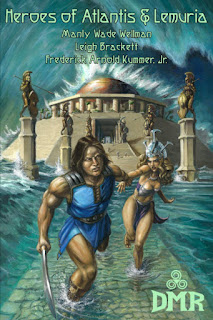
Heroes of Atlantis & Lemuria

Heroes of Atlantis & Lemuria is a collection of sword & sorcery tales from DMR Books. There are five stories by Manly Wade Wellman, all dating from the late 1970s. There are three stories from the late 1930s by Frederick Arnold Kummer Jr. And there’s a single 1941 story by Leigh Brackett. The unifying thread is that all these stories are in some way concerned with the lost worlds of Atlantis or Lemuria.

The Manly Wade Wellman stories features as their hero Kardios, the sole survivor of the disaster that engulfed Atlantis (a disaster he may have unwittingly brought about). He is now a solitary wandering adventurer who is very good at slaying monsters. When you slay a monster the people who were being victimised by the said monster are usually pretty grateful so Kardios manages to survive pretty well.

Straggler from Atlantis introduces the character, washed up on a beach in a strange land. He has been adrift since the destruction of Atlantis. When he wakes up he finds himself face-to-face with a giant. Not just a really big guy, but an actual giant, twice as tall as a man. And there are lots more giants where this one came from.

The giants turn out to be reasonably good-natured. And they need Kardios’s help. There is something that needs to be done and it cannot be done by a giant. It involves a monster. Or a god. Fith could be either. In the world of these 1970s Manly Wade Wellman stories gods and monsters seem to be interchangeable. In any case, whatever Fith is, the giants are really sick of him. That’s why they want Kardios’s help. This is a competent but fairly routine sword & sorcery tale.

The Dweller in the Temple is more interesting. Kardios is just wandering down the road minding his own business when he gets waylaid by a bunch of guys. They don’t want to rob him. They want to crown him as their king. Kardios figures that being a king might be a pretty good gig. Apart from being offered the usual selection of fine wines and good food and fancy clothes he is also to be permitted to choose a girl from among a very luscious assortment presented for his inspection. In fact he can choose two girls if he likes. Kardios is quite happy with the idea of being presented by a lovely female bed partner but his choice strikes his advisers as a trifle eccentric. He chooses a shy servant girl. It proves to be a good choice. Yola is a really sweet girl and once they return to the bedroom she turns out not to be shy after all.

Kardios finds that being a king isn’t hard work and is actually extremely pleasant. Especially with Yola to share his bed.

Of course all this really is too good to be true. There has to be a catch, and there is. Kardios’s monster-slaying skills will be needed after all, and Wellman gives us a fairly cleverly conceived monster in this tale. A pretty good story.

In The Guest from Dzinganji Kardios finds that the road he has been travelling leads nowhere. It ends in a mighty chasm. There is no way across. At least that’s how it seems at first. There is however a way to cross the chasm but Kardios is warned that across the chasm lies Flaal, a city from which no-one was ever returned. Many are lured by the promise of treasure. Kardios is not interested in treasure but he makes the perilous crossing anyway.

Flaal is ruled by Dzinganji. Kardios is informed that nobody ever has to work in Flaal. Every luxury imaginable is provided. All you have to do is to agree to perform one very small service, and you have to agree to submit. Kardios certainly has no intention of doing any such thing. Even the fabulously beautiful Tanda cannot persuade him.

The revelation of the secret behind Dzinganji, and of course there is a secret, is reasonably satisfying. This is a story that gleefully mixes science fiction, fantasy, horror and adventure. A good story.

The Seeker in the Fortress pits Kardios against a powerful wizard. The wizard Tromboll controls the surrounding countryside from his impregnable fortress. The local lord Feothro has grown tired of the wizard’s depredations and is besieging his fortress, but Tromboll is holding Feothro’s fiancée Yann hostage. It seems to be a standoff, until Kardios offers to rescue Yann. It won’t be easy. Tromboll is protected by human guards, monsters and magical powers. A reasonably entertaining story.

The Edge of the World takes Kardios to a city perched on a mountainside. Beyond the mountain there is nothing. It is the edge of the world. At least that’s what the priests tell the people. The queen makes Kardios welcome. Very welcome indeed. But there is a price to be paid for sharing the queen’s bed, and Kardios isn’t keen on paying it. He escapes with the help of a slave girl, but the only way to left to run is up the mountain and that means falling off the edge of the world.

It has to be said that these five Manly Wade Wellman stories have nothing to do with Atlantis. Kardios is just your stock-standard wandering adventurer. But they’re lively and fairly inventive, there’s action and a touch of romance, there are monsters and beautiful but evil queens, there are sinister sorcerers and murderous gods. They’re very decent sword & sorcery tales.

We now move on to the stories by Frederick Arnold Kummer Jr. Adventure in Lemuria appeared in Fantastic Adventures in 1939. Khor is a Cretan and he’s a long way from home when he helps out a young man who’s been set upon by toughs. The young man, Jador, has had his throne usurped by his malevolent half-sister, the witch-queen Lalath. Khor agrees to infiltrate himself into the citadel to open the gate for Jador’s rebel troops. Unfortunately Khor catches the eye of Queen Lalath. She invites Khor to share her bed. He refuses, on account of the fact that he’s getting seriously evil vibes from her, and Lalath takes his rejection rather badly.

So at a time when he should be opening the gate for Jador Khor finds himself about to be sacrificed to the evil god Molech. It’s an entertaining story.

A sequel of sorts, Intrigue in Lemuria, appeared in Fantastic Adventures in 1939. Khor the Wanderer is no longer an ancient Cretan. He is now a 20th century American named Kirk the Wanderer. But by some means which are never explained Kirk seems to be able to transport himself into the world of ancient Lemuria.

In a tavern he encounters a wizard who shows him a vision in a wineglass, a vision of an extraordinarily lovely girl. The next thing he knows he’s waking up in the bedroom of this very girl, but she’s the queen and she’s in a lot of trouble and so is he. He’s been set up to put the queen in a compromising situation.

Volcano Slaves of Mu is great fun with slaves toiling away inside a volcano which is a kind of ancient power generation plant.

The three Kummer stories are energetic and imaginative and generally highly enjoyable stuff. The action is inventive, the villains come up with some truly dastardly plots to dispose of the hero, there’s as much sexiness as you expect in the late 30s.

This brings us to the final tale in the collection, Leigh Brackett’s Lord of the Earthquake, from 1941. Two archaeologists are using a submarine to search for the fabled lost continent of Mu. They find an ancient pyramid and then they’re swept into a kind of cosmic hole. When they emerge the pyramid is no longer submerged beneath the sea.

You’d expect the Leigh Brackett story to be the strongest in the collection and you’d be right. She doesn’t just give us time travel, she gives us time as something that goes in cycles and yet it doesn’t go in cycles, it repeats itself but it doesn’t, you can’t change the past but then again maybe you can. There’s a hero who is flawed but maybe he can still change, there are sacrifices that cannot be avoided, but perhaps they can. Maybe it’s possible to learn to live, and learn to love.

And there’s a genuinely interesting villain with complex motivations. He’s a god. At least he’s pretty sure he’s a god. And since he’s a god he can save the land of Mu. He’s insane and he’s evil but his insanity and his evil are not unreasonable given the circumstances.

This is a thoroughly enjoyable collection of sword-and-sorcery tales. They’re very good second-tier stuff, not in the Robert E. Howard league but still plenty of fun. The Leigh Brackett story on the other hand is absolutely superb and is more than sufficient justification for buying this book.

Thursday, April 1, 2021

Leigh Brackett’s Last Call from Sector 9G

Leigh Brackett’s Last Call from Sector 9G is a science fiction novella first published in Planet Stories in 1955 (Planet Stories really was an astoundingly good pulp magazine).

I guess you could call Last Call from Sector 9G a science fiction spy story. Lloyd Durham is all washed up. He lost his job, nobody will employ him and things didn’t work out with his girl. All he has left is the booze. Maybe it was the booze that got him into trouble in the first place. Durham doesn’t think so but then he doesn’t like to admit that the mess he’s in may have been all his fault. Now a senior diplomat from the Federation, Hawtree, is giving him a second chance. Or at least that’s what Durham thinks. Hawtree has offered him a diplomatic mission to Nanta Dik, one of the two inhabited planets in Sector 9G.

The Federation covers half the galaxy and embraces both human and non-human worlds. Sector 9G is not yet part of the Federation. Both planets in Sector 9G are most definitely non-human. There are those who want Sector 9G to become part of the Federation and there are those who are bitterly opposed. There are major advantages for corporations in operating outside the jurisdiction of the Federation, if those corporations happen to be unscrupulous.

What Durham doesn’t realise is that he was picked for the mission because he was a drunken loser who could be relied on to make a mess of it. But what happens when you pick someone for a mission based on such an assumption and that someone decides, for once in his life, to try really hard not to mess up?

Durham manages, quite accidentally, to get his ex-girlfriend mixed up in this whole situation. And Susan just happens to be Hawtree’s daughter.

Brackett packs plenty of action into her story. There are space hijackings, Durham falls into the hands of various warring factions, there’s a real war brewing in Sector 9G, and maybe civil war as well. There are quite a few players representing quite a few factions involved and it’s not easy for Durham to tell the god guys from the bad guys. He really had no desire to get mixed up in wars and inter-planetary intrigues. He just wanted to prove he could stay sober long enough to carry out one simple assignment so he could get his life back together again. Now he’s in such a mess that staying sober seems like a really bad idea. And staying alive looks like being a real challenge.

He’d also like to keep Susan alive although there are times he’s so infuriated he’d like to strangle her. Maybe he hates her. Maybe he still loves her.

He will discover the terrifying secret of the Bitter Star and he will encounter the darkbirds. The darkbirds are alive and they’re intelligent, although they’re not alive in a sense that is comprehensible to a human. They’re not composed of matter. He has no idea whose side the darkbirds are on. All he knows is that they scare him.

He’s also not sure whether the alien Jubb is a good guy or a bad guy he he does know that Jubb is pretty important.

This is a future universe that is very much like ours - there’s good and there’s bad in it, there’s corruption and there’s idealism, there’s shady politics and there are crooked businessmen and there are honest people (both human and non-human) trying to do the right thing. All of Brackett’s imaginary future societies have a fair degree of moral complexity, with plenty of shades of grey. In this case there are shades of grey to both the human and non-human characters.

Durham is a man who has no desire to be a hero. He has no desire to be a villain either. He’d just like to survive. He’d also like to get a drink.

Although I’m a major fan of Leigh Brackett’s work I hadn’t heard of this novella until I came across this review of it on the Ontos blog.

It’s been reissued in paperback in one of Armchair Fiction’s two-novel editions, paired with H. Beam Piper’s Time Crime (which I’ll be reviewing in the near future).

I’d previously only read Brackett’s sword-and-planet stories so this is my first encounter with her space opera. I do prefer her sword-and-planet stuff (very few people could match her in that genre) but Last Call from Sector 9G is not a bad little tale. Since this is Leigh Brackett it goes without saying that it’s well-written. Recommended.

Wednesday, May 2, 2018

Leigh Brackett’s The Secret of Sinharat

Leigh Brackett’s 1964 novel The Secret of Sinharat is an expanded version of her 1949 novella Queen of the Martian Catacombs.

There is a rebellion brewing on Mars. The ruthless and clever Kynon has persuaded a number of warring tribes to set aside their differences to follow him. The army he is collecting is drawn from the Drylands (the Martian deserts) and from the low-canal country. Kynon has employed mercenaries to train his armies, dangerous men like Luhar the Venusian and Eric John Stark. To weld his army together he holds out a fabulous promise - eternal life (of a sort anyway).

Eric John Stark is Brackett’s best-known character, appearing in quite a number of stories from the 1940s right through to the 1970s. He is an Earthman but was raised by barbarians on Mercury. He is a Tarzan-like figure, belonging wholly neither to the world of civilisation nor to the world of the barbarian but able to move freely and confidently in both worlds.

In this story Stark is in fact a spy. Unknown to the rebels he is working for the Earth Police Control, his job being to find out just how dangerous the rebellion is likely to be and how it can be thwarted. Stark has a twenty-year prison sentence hanging over his head, which is why he was so willing to turn spy (Earth Police Control will wipe the slate clean in exchange for his help).

It is a dangerous task that Stark has taken on, much more dangerous than he’d expected. Among Kynon’s followers is at least one man with a longstanding grudge against Stark, a man who will be satisfied only by Stark’s death. And within days Stark finds that he has made other deadly enemies. Delgaun, the leader of the contingent from the low-canal city of Valkis, clearly wants Stark dead although Stark has no idea why this should be. Stark can handle himself well enough and would be quite capable of disposing of these enemies but that is exactly what he cannot do - to do so would jeopardise his mission.

Adding to his worries is the woman Berild. Is she Kynon’s woman or Delgaun’s? Does she have plans to be Stark’s woman? She is intelligent, ambitious and entirely lacking in scruples but there’s more to her than that. Stark has seen her in the moonlight, tracing the walls of a long-dead palace, walls that no longer exist even in ruins. Those walls crumbled into dust aeons ago but Berild knew every inch of that palace. It’s a particularly effective scene showing Brackett at her most effectively moody and disturbing.

The climax of the drama will come in the city of Sinharat. Sinharat is the sort of city that Brackett loved to create. It is a dead city, the capital of a dead civilisation, but is the past ever really dead? On Leigh Brackett’s Mars you can never be sure. Sometimes the past is more real than the present. Sinharat is not just a dead city. It is a city of evil. It is a vague formless nameless evil, and it is a very ancient evil. In Brackett’s universe ancient evils are the most deadly of all.

This is a story fuelled more by atmosphere and a sense of foreboding than by action. Brackett could and did write fine action stories but her sword-and-planet tales are more often exercises in style and mood. And some of the very best of her stories are entirely lacking in action.

There is however plenty of menace in this tale. The threat of violence is ever-present, although there are things that are more to be feared than mere violence.

Berild is a typical Brackett anti-heroine. She is beautiful, fascinating and clever but trusting her is likely to prove to be unwise, to say the least. Fianna, the servant of Berild, seems like she’s going to be a typical Brackett feisty good girl but she turns out to be much more complex than that.

The ending is especially good, being not quite what we expect and yet it feels right.

The original novella, Queen of the Martian Catacombs, is included in Gollancz’s Fantasy Masterworks volume Sea-Kings of Mars and Otherworldly Stories (a volume well worth buying).

The Secret of Sinharat is a fine display of Leigh Brackett’s mastery of the sword-and-planet genre. Highly recommended.

Thursday, January 4, 2018

Leigh Brackett's The Last Days of Shandakor

The Last Days of Shandakor is a novelette by Leigh Brackett. It first appeared in the April 1952 issue of Startling Stories. It’s typical of the very best of her sword-and-planet tales.

It’s set on Brackett’s Mars, a once-green planet that is now mostly desert. The great Martian civilisations, civilisations that were ancient aeons before the beginning of recorded history on Earth, have fallen into decay. Most have vanished almost entirely, leaving just a few tantalising traces.

A planetary anthropologist from Earth, John Ross, encounters a man named Corin. Corin fascinates him because he seems to belong to no known surviving race. Corin claims to have left the dying city of Shandakor, a city as unknown as the race to which Corin belongs.

Corin wants to return to Shandakor and John Ross, realising that he could be on the brink of discoveries that could make his professional reputation, wants to accompany him.

Shandakor is a city that knew times of greatness. Now it is dying, or is it already a dead city? It depends on what you mean by dead. What John Ross finds is a shadow of that greatness but it’s a very peculiar shadow.

This is the sort of thing that Brackett did supremely well. It’s a story that relies absolutely on mood and it’s a mood of loss, of melancholy, of doom both feared and welcomed. There is physical death, and there is the death of the will to survive.

Brackett was obsessed by the idea of lost civilisations and the death and decay of civilisations. She was obsessed by what might be called the idea of historical deep time, of the past as something incredibly vast and majestic and terribly sad. It’s a subject she approached with sensitivity and compassion but without sentimentality. Civilisations live and they die, that’s just the way things are. men live and they die as well. There is a time to die.

John Ross will make his anthropological discoveries and he will make discoveries about himself as well. He will find love but it seems to be an impossible love. Is love stronger than death? John Ross will find the answer to that question.

This novelette is included in the excellent Gollancz Fantasy Masterworks volume Sea Kings of Mars.

The Last Days of Shandakor is one of Brackett’s most successful stories. Very highly recommended.

Friday, December 1, 2017

Leigh Brackett’s The Sword of Rhiannon

Leigh Brackett’s sword-and-planet adventure The Sword of Rhiannon was published in book form in 1953. It had originally been serialised in Thrilling Wonder Stories in 1949, under the title Sea-Kings of Mars.

Planetary archaeologist Matt Carse is from Earth but has spent most of his life on Mars. Mars is now largely a desert planet but it had a glorious past and was once green and lush.

Carse encounters a thief (he has many friends among the thieves of Mars) who offers him an artifact of stupendous value. It is nothing less than the sword of Rhiannon. Rhiannon is a dim figure from the planet’s distant past, a member of a race known as Quiru. Rhiannon committed some grievous sin and was consigned to a lonely tomb, a tomb that has never been discovered. Although now it appears that a Martian thief has found the tomb.

Carse is excited by the archaeological significance of the find but he is equally excited by the prospect of making a very great deal of money out of the find. The tomb however conceals a terrifying secret and Carse finds himself transported back a million years in time, to a green and verdant Mars. It’s also a very dangerous Mars, for Matt Carse. He is mistaken for a Khond spy which is irritating since he doesn’t even know what a Khond is.  He is condemned to the galleys.

Even worse, he is in the power of the beautiful but deadly Queen of Sark, Ywain.

Something else happened when Carse entered Rhiannon’s tomb. Rhiannon had been imprisoned there for a million years, but Rhiannon is not dead. At least his mind is not dead.

Carse is caught up in the struggle between Sark and the sea kings. The outcome of the struggle hinges on certain terrifying weapons possessed by Sark but Rhiannon had even more formidable weapons and Carse believes he knows how to unlock the power of those weapons. His difficulty will lie in persuading the sea kings to trust him.

There’s action and there’s treachery and betrayal, there are dark secrets that perhaps should have remained secret, and there’s a strange love-hate relationship between Carse and Ywain. She is evil but he cannot bring himself to desire her death. Perhaps it is something else that he desires. She is cruel and ruthless but to some men that can make a woman strangely attractive.

The world of Mars in the distant past is a barbarian world, a world of oared galleys and swords and spears and battles, but mixed with some ultra-high technology that serves the role that magic serves in sword-and-sorcery tales. It’s not quite as interesting and exotic as the worlds Brackett created in some of her other tales of the 1940s. The Mars of her other stories is more interesting as a desert world littered with ruins of ancient civilisations. The Mars of The Sword of Rhiannon is a bit more of a generic heroic fantasy world.

Matt Carse is a slightly ambiguous hero, a man who has in the past been motivated by greed. Now he has found a cause but does he really believe in it or is it simply a matter of survival for him to throw in his lot with the sea kings? Ywain is pretty much your standard beautiful but evil queen (with perhaps just a shade more depth), a type of character that is to be found in countless adventure stories. The cynical and treacherous but clever and resourceful Boghaz, Carse’s reluctant ally, is a much more entertaining personality.

Brackett was a fine prose stylist and her plotting was always skilful. She builds the suspense slowly. We cannot be sure of Carse’s motives and we certain cannot be sure of the motives of Rhiannon.

The climax is fairly exciting as we discover the nature of Rhiannon’s super-weapons and his true motivations.

I reviewed some of Brackett’s excellent earlier sword-and-planet novellas (collected in Gollancz’s Fantasy Masterworks volume Sea-Kings of Mars and Otherworldly Stories) in an earlier post and Ive also reviewed her 1949 novella Enchantress of Venus.

The Sword of Rhiannon can certainly be unhesitatingly recommended to fans of the genre.

Sunday, October 8, 2017

Leigh Brackett’s Enchantress of Venus

Leigh Brackett’s 1949 novella Enchantress of Venus introduced her most famous series character, Eric John Stark. It’s a fairly typical sword-and-planet adventure but it’s a well-crafted example of the breed. It appeared in the pulp magazine Planet Stories in 1949.

Eric John Stark is both a barbarian and a civilised man. He comes from the savage world of Mercury but he has picked up most of the arts of civilisation living on Earth. The barbarian spirit is however still very strong within him. He’s a fairly typical hero of the sword-and-sorcery/sword-and-planet type. He is possessed of enormous physical strength, he is brave, virile and resourceful. He is quick-tempered and can be impulsive but he is gentle towards women. Unless of course they turn out to be beautiful but evil and dangerous women and of course this story just happens to feature such a woman.

The setting is Venus. Leigh Brackett’s Venus is a world that never sees the sun, a semi-barbaric world of clouds and mists. In this novella the specific setting is even stranger. The Red Sea is not an ordinary sea. It is not a liquid but a gaseous sea, composed of a gas so heavy and so dense that ships can sail upon it. It also differs from ordinary seas in that although moving through it is not unlike swimming you can speak and breathe even at the bottom of the sea.

The Venusians who live in the region of the Red Sea are pale and blonde and at best semi-civilised. Like all of Brackett’s Martians and Venusians they are very close to being human, but with a few subtle differences. The women are attractive but have the disconcerting habit of always being naked from the waist up (this is a story written for the pulps so there has to be some sexual titillation factor).

After ship’s captain Malthor tries to kill him for no apparent reason Stark ends up in a city on a gulf in the Red Sea, a city renowned for piracy and slavery and assorted debaucheries but it is now a city under the shadow of a much more serious malevolent influence. The evil of the Lhari. They are a different race and there are only a handful left but they dominate city and their potential for evil is vast. They are breathtakingly cruel and obsessed with their own imminent demise which they intend to avoid by any means no matter how ruthless. And there is a secret that may allow them not merely to survive but to dominate the whole planet. Stark will have to stop them and in any case he has his own personal grievance against them.

Two women will play important parts in this story. Zareth is Malthor’s daughter, a gentle girl who has stoically endured repeated whippings from her father but who now sees in Stark a chance to escape. And perhaps a chance for love. She is timid and frightened but she has an unexpected inner strength and courage. Varra is a whole different ball game. Even by the standards of the Lhari she is dangerous. She tells Stark that he is the first real man she has encountered in a very long time and she is obviously the sort of woman who is very interested indeed in real men.

The secret mentioned earlier lies at the bottom of the Red Sea, in a ruined city built by yet another race.

This is a novella so there’s not much scope for complex plotting but it’s a decent enough story, although perhaps not quite as dazzlingly imaginative as some of Brackett’s other tales from this period of her career. This is more a fairly routine sword-and-planet adventure, but executed very competently.

There’s a genuine sense of evil, and of decadence. There’s also a decidedly bleak and tragic edge to the tale.

The settings are the most impressive part of this story. Brackett was very good at creating worlds that were clearly alien whilst still seeming reasonably plausible.

There isn’t a great deal of depth to Stark but he’s an effective action hero. The two women, Varra and Zareth, are more interesting.

Enchantress of Venus is enjoyable and fairly stylish pulp fiction. Recommended.

Sunday, May 21, 2017

Leigh Brackett’s Sea-Kings of Mars and Otherworldly Stories, review part one

Leigh Brackett (1915-1978) was one of the more notable practitioners in the popular pulp genre of sword and planet stories. The sword and planet genre began with Edgar Rice Burroughs. It’s interesting that two of the best writers in this genre were women, Catherine L. Moore (author of the Northwest Smith stories and Leigh Brackett. Brackett enjoyed even greater success as a screenwriter, in which connection she is best known for her contributions to some of the best movies of Howard Hawks including The Big Sleep and Rio Bravo. She was also the co-writer of The Empire Strikes Back (or at least she wrote the first draft).

Gollancz have collected Brackett’s early sword-and-planet adventures in their Fantasy Masterworks volume Sea-Kings of Mars and Otherworldly Stories. Since the twelve stories included in this volume are mostly novella-length and a couple just about qualify as short novels a review is inevitably going to be rather lengthy. As a result I’m going to split this review into two (or it might possibly end up being three) parts.

First up, her very early sword-and-planet stories from the period 1942-48. 

The Sorcerer of Rhiannon is a very early story, dating to 1942. The hero, Max Brandon, is a kind of Indiana Jones-style archaeologist/adventurer and he’s searching for lost treasures on the now dry bed of one of the seas of Mars. He finds the wreck of a ship that sank aeons ago. At the time he finds the wreck he is in deep trouble, hopelessly lost and without food or water. Finding the wreck can’t help him now. There’s not going to be anyone alive to help him there. And there isn’t anyone alive. Not exactly alive. But there are two people there. They’re not alive but they’re not dead either, and they have things they wish to do and they need Max Brandon’s help and saying no isn’t going to do him any good.

The ideas of mind control and possession seemed to have a good deal for attraction for Brackett, popping up in many of her early stories. The idea is handled competently enough in The Sorcerer of Rhiannon. It is obviously an early effort but it has a reasonably good blend of action and atmosphere.

The Jewel of Bas dates from 1944 and mind control is again a central concern. It’s handled more ambitiously and more interestingly this time. The hero is a kind of gypsy, a wandering minstrel who, along with his wife, is captured by rather creepy grey beast-men. They live on a very strange planet on which even stranger things are starting to happen. The planet is experiencing moments of darkness, a frightening thing on a world that has never ever experienced a single moment of darkness. There are megalomaniacal androids, a hidden world inside a mountain and an immortal wizard who may or may not be able (or willing) to save them. 

Again there’s some nice otherworldly atmosphere and some genuinely weird and disturbing moments, and overall it’s an exiting and enjoyable story.

Terror Out of Space takes us to Venus where a cop has been given an assignment that has turned into a nightmare. He has to take into custody an alien being about which little is known except that it is very female and she has the power to enslave men in a very complete way. She is also telepathic. Her voice can drive a man mad but if he looks into her eyes he is truly lost, even though she does not actually have eyes. This is a tale that veers into horror territory and can be considered as an early and very fine example of the mind vampire genre.

The novella Lorelei of the Red Mist was half completed when Brackett was offered a job she couldn’t refuse, as screenwriter on Howard Hawks’ production of The Big Sleep. Ray Bradbury completed the story, apparently without having any idea how Brackett had intended to end it.

A race of man-like creatures lives beneath the Red Sea on Venus. Some of these aquatic men have left the sea to live on land, and have enslaved the humans living near the sea. Those who have left the sea and those who reman hate each other. Another race has appeared on the scene, basically human sea rovers, and they’re engaged in a ferocious war with the formerly sea-dwelling man-creatures.

This sea is not an ordinary sea. It’s a very very strange sea indeed.

All this takes place in a more or less unknown land beyond the a mighty range on Venus. Hugh Starke, a daring thief, is on the run and his only hope of escape is to take his rocket aircraft over that mountain range where no-one will dare to pursue him.

Now he’s in the strange and primitive world beyond the mountains, a world of heroism and war. And he has a new body to get used to. That’s tricky enough but he doesn’t have complete control of this body. There is another mind contesting his control. Also there are people trying to kill him for things that the previous owner of the body did.

So this is another variation on Brackett’s favourite theme of mind control, and a very interesting variation it is. It’s a violent, dark and quite macabre tale. And it’s an extremely good story.

The Moon That Vanished, from 1948, concerns the moon of Venus. Venus of course does not have a moon, but we learn that in the remote past it did have a moon. That moon may have been destroyed or it may have crashed into the surface of Venus, or perhaps it was the moon god that crashed into the planet. The legend is not clear on this point but it is clear about one thing - if a man can reach the Moonfire he can become a god. No-one knows what the Moonfire is and no-one knows where it is. In any case it is forbidden by the priests to seek the Moonfire.

There is one man who knows where the Moonfire is to be found. David Heath is from Earth and he found the Moonfire. Actually many men have found the Moonfire but what makes David Heath unique is that he returned from his quest alive. Alive he certainly is but he is a wreck of a human being, haunted by the shadows in his mind and find temporary oblivion in drugs. And now someone wants him to take them to the Moonfire.

This is a tale of adventure, with a plentiful supply of perilous obstacles to be overcome in order to reach the Moonfire. It becomes something much more interesting when David Heath and his two companions reach their destination to find that what they were seeking was not what they expected even if perhaps it was the fate for which they were destined.

This story does not involve mind control as such but it does deal with the powers of the mind as well as the nature of dreams and reality. It’s another ambitious story (a novella really) that succeeds extremely well.

It’s obvious that at this stage of her career Brackett was still finding her feet but she was doing so very quickly and very impressively. The Moon That Vanished is a very accomplished novella indeed. Brackett has a strong feel for atmosphere. She has her hobby horse, the powers of the mind and the ways in which those powers can be controlled and manipulated, but if it’s a fixation it’s one she makes very effective use of and in each story she manages to find a slightly different angle from which to attack the problem. Being a pulp writer she understands the necessity for keeping the plot moving along at all times. She is (at this stage of her career at least) a pulp writer but she’s a skillful and thoughtful pulp writer. On the basis of these early tales I’m pretty impressed. More to follow in a later post.