Showing posts with label ian fleming. Show all posts

Wednesday, April 27, 2022

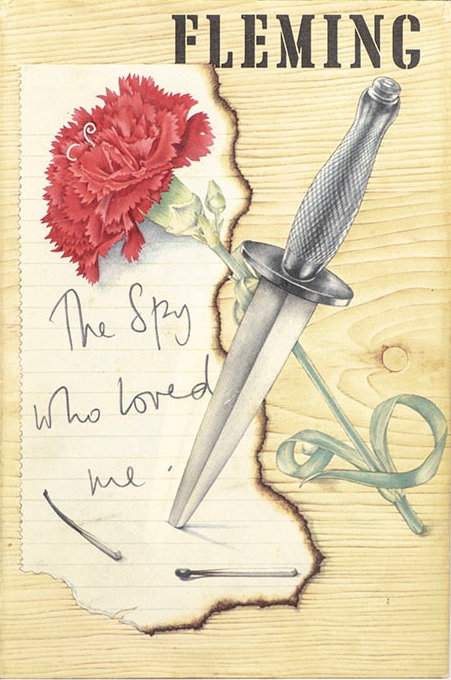
Ian Fleming's The Spy Who Loved Me

The Spy Who Loved Me was the ninth of Ian Fleming's James Bond novels, published in 1962. By this stage Fleming was clearly wanting to vary the formula, to find ways to keep the Bond series fresh and exciting. The Spy Who Loved Me was very much an experiment. It’s told in the first person, and the narrator is a woman.

The novel was hated by the critics. Critics had at best grudgingly accepted the popularity of Fleming’s books but they strongly disapproved. It just seemed somehow wrong that ordinary readers should be allowed to make up their own minds what books they enjoyed, rather than liking the books that critics told them to like. It seemed especially wrong that the public should insist on enjoying exciting books and sexy books rather than the worthy but dreary books that critics loved. So critics were desperately anxious for Fleming to make a misstep so that they could pile on and put the boot into him.

The Spy Who Loved Me seemed to be that misstep. Even better, from the point of view of critics, it was more sexually explicit than previous Bond books. That meant the critics could accuse Fleming of spreading moral degeneracy.

The novel has been treated even more venomously by modern critics and reviewers. I have a theory that if you approach a book with enough prejudices and preconceptions you can end up not actually reading the book at all. You end up reading the book that your prejudices convinced you that the author had written. What you have to do with The Spy Who Loved Me is something modern readers find very difficult to do - you have to just sit down and read what Fleming actually wrote, without making any assumptions about his attitudes towards women, towards sex or towards violence.

The subject of the book is an encounter between James Bond and a young French-Canadian woman named Vivianne Michel but that encounter does not happen until roughly the halfway point. The first half of the book gives us Vivianne’s backstory and explains what she’s doing in a run-down motel in the Adirondacks.

Despite what some reviewers would have you believe this first half does not dwell obsessively on Vivianne’s sex life. In fact she doesn’t have very much of a sex life. She’s had a couple of tentative unsuccessful relationships with men. Fleming thought that in 1962 it would be possible for a British writer to approach the subject of sex in a calm and fairly grown-up way. He was wrong. Britain in 1962 was still a repressed guilt-ridden puritan society eager to condemn anyone who wanted to suggest that maybe sex wasn’t dirty and wrong. Fleming is not the least bit judgmental towards Vivianne. He describes her emotional life sympathetically. It’s the guilt-ridden puritanism of society that has made Vivianne unable to have a successful relationship with a man.
So does James Bond suddenly come along and magically awaken her sexually? Well, sort of, but that’s not quite what happens. What really happens is that having faced death and torture and terror at the hands of two thugs Vivianne realises that it’s a bit silly to make such a fuss about sex. Having faced death she now wants to embrace life and what better way to embrace life than by making love? It’s really the peculiar circumstances, rather than Bond’s super-manliness, that allows Vivianne to enjoy sex for the first time.

While there is no action at all until halfway through the book when the action does start it’s fast and furious. The second half of the book is pretty much action scene after action scene. And by making us wait Fleming has built up the tension very effectively. We know this is a Bond novel. We know there’s going to be action. We know that Vivianne will be caught in the middle of it. And once the two thugs make their appearance it’s obvious that this is going to be a kill-or-be-killed situation. Bond and Vivianne are not going to be able to talk their way out of this situation, and they’re going to have to handle it themselves.

And while Vivianne is a kind of damsel in distress, she’s not entirely passive. Bond gives her his spare gun and she gets to use it.

There’s actually a lot more action in this book than in You Only Live Twice. By Bond novel standards The Spy Who Loved Me is not at all deficient when it comes to mayhem. The long wait gives the action scenes extra impact.

How successful is Fleming in telling the story from a female point of view? I’d say that he’s a lot more successful than you might expect. What a lot of modern readers object to is that Vivianne is not a 21st century feminist and the book is not a 21st century feminist powergirl tract. Vivianne belongs to the world of 1962. She feels guilty about sex because in 1962 people (especially women) were raised to feel bad about sex. Up to a point she understands that her upbringing has damaged her and has prevented her from living her life fully. But she still feels guilty. Perhaps the shock of the events at the motel will make her more determined to embrace life.

The Spy Who Loved Me is certainly an experiment but I think it’s an experiment that succeeded. Fleming was shocked by the hostile reception the book received and later described it as a failed experiment. I think he was being much too hard on himself and on the book. It’s not quite true to say that Bond is reduced to the status of a supporting character, but it is true to some extent. Having Bond viewed so completely from outside was an intriguing idea.

So I’m going to swim against the tide and say that I rather enjoyed The Spy Who Loved Me. It is an untypical Bond novel and you should not even contemplate reading this one until you’re read half a dozen of the earlier Bond books, but if you have read the earlier books then I recommend giving The Spy Who Loved Me a chance.

Saturday, April 2, 2022

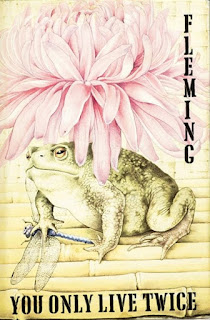
Ian Fleming's You Only Live Twice

You Only Live Twice, published in 1964, was the last Bond novel completed by Ian Fleming (he had written only the first draft of The Man with the Golden Gun when he died later that year). You Only Live Twice was the closing instalment of what became known as the Blofeld trilogy.

After the disastrous events of the previous novel, On Her Majesty’s Secret Service, Bond seems to be all washed up. He’s moody and depressed, he’s making mistakes, he’s drinking too much and gambling too much. M has decided that he’s going to have to fire him but is persuaded that what Bond needs is an impossible mission, or at least a mission that is so unlikely to succeed that Bond will simply have to stop brooding about himself. The mission is to persuade the Japanese to give the British access to their MAGIC 44 top-secret intelligence material, and there is no logical reason why the Japanese would want to do that. In fact the Japanese would have very strong reasons to refuse. Bond’s job is to find a way to change their minds. M has no idea how this could be done. That’s up to Bond. It will be a formidable challenge that will require cleverness rather than action, and Bond needs to start using his brain in a productive way again.

Bond meets (and befriends) the head of the Japanese intelligence service, a man named Tiger Tanaka and discovers that as far as the Japanese are concerned the British Secret Service has no secrets worth trading for. But there is one possibility. If Bond would agree to carry out a mission for them they might trade. They want him to assassinate a Swiss scientist.

The scientist has created what Tanaka calls a garden of death. He has bought a large estate and filled it with deadly plants and animals. Japanese intent on suicide are using it to kill themselves. The Japanese want this Swiss scientist eliminated quietly.

Bond has to pose as a Japanese. Apparently a bit of skin dye and some work on the eyebrows will transform a Scotsman into a convincing Japanese. Bond’s base of operations is an Ama island, the Ama being a distinct tribe who exist by diving for shellfish and are best known for the fact that the diving is done by naked women, a practice of which Bond thoroughly approves. He naturally gets involved with pretty Ama diver Kissy Suzuki, his love interest in this novel.

And he will of course encounter Blofeld again.

The novel includes many of the themes that run through Fleming’s work, especially nostalgia for Britain’s lost greatness and bitterness about the contempt with which the U.S. now treated Britain. The story begins with the British Secret Service sending Bond on a delicate and embarrassing mission, to beg the Japanese to give them access to high-grade intelligence material. The Japanese have some extraordinarily valuable material but the C.I.A. will not allow it to be passed on to the British. M is hoping the Japanese will agree to pass on their intelligence material to Britain secretly. Bond arrives thinking that he has something worthwhile to trade, the Macau Blue Route material of which M is so proud, only to discover that the Japanese already have all of this material. Bond comes face to face with the harsh reality that Britain is a second-rate power and that the Japanese do not consider Britain to be an ally worth cultivating.

In the later Bond stories Bond is becoming just a little sad and disillusioned. An edge of cynicism and melancholy had been creeping into the Bond stories for a while. We get the feeling that perhaps Bond is getting ready to call it a day and retire. Fleming of course was increasingly conscious of his own failing health and knew that he was not likely to live very much longer. He apparently expected The Man with the Golden Gun to be the final Bond novel. When he wrote You Only Live Twice it’s possible that he was already aware that his career as a thriller writer was drawing to a close.

Personally I think this makes late Bond quite interesting. He’s starting to do things that his younger self would never have done. In the novel that preceded You Only Live Twice, On Her Majesty’s Secret Service, he does a number of things that the younger Bond would certainly not have done. In the later stories he seems to be often thinking about resigning from the Secret Service. He’s also developing a bit more emotional depth. He’s finding himself thinking about the future and about the consequences of his actions in a way that would have been out of character for the Bond of the glory years of the mid-1950s. But it’s done quite convincingly. Bond is getting older.

Fleming was also experimenting with downbeat endings. Casino Royale had ended on a note of bitterness, but it was a defiant bitterness. Bond had been hurt but he was a big boy and he’d get over it. A decade or so later later Fleming would end a Bond novel on a note of abject defeat and despair. In some of the later short stories the endings are rather cynical (The Living Daylights), or melancholy (Octopussy).

I think it’s simplistic to say that Fleming was growing tired of Bond, but he was growing tired of writing Bond stories to a rigid formula. After the modest success of his debut novel Casino Royale Fleming had found an incredibly successful formula and proceeded to write six brilliant spy thrillers one after the other. The 60s saw Fleming experimenting with variations on the formula.

The biggest problem with You Only Live Twice is the pacing. We have to wait a long long time for the action scenes. When they finally arrive they’re good but a bit perfunctory.

Bond completists will want to read this one. If you’re new to the world of the Bond novels you should definitely start wth the 1950s books. You Only Live Twice is recommended, with reservations.

Wednesday, March 2, 2022

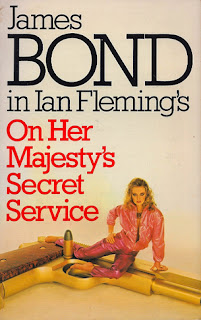
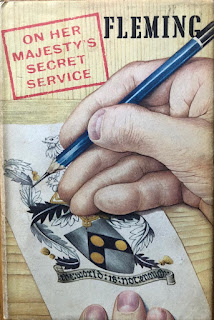
Ian Fleming’s On Her Majesty's Secret Service

On Her Majesty's Secret Service was the tenth of Ian Fleming’s James Bond novels and was published in 1963.

By this time Fleming’s health was definitely failing. He would complete just one more Bond novel, You Only Live Twice, in 1964. Fleming had completed only the first draft of The Man with the Golden Gun when he died in 1964.

Fleming had been on a roll in the 50s, producing six successive top-notch Bond novels - Live and Let Die, Moonraker, Diamonds Are Forever, From Russia, with Love, Dr. No and Goldfinger. After that it was not that he seemed to be growing tired of Bond but he did seem to be growing tired of just churning out Bond novels to the same basic formula. In 1962 he wrote The Spy Who Loved Me, a highly experimental Bond novel (an experiment which Fleming considered to be a total failure), and he wrote several short stories which were also somewhat experimental.

In some of the stories (notably For Your Eyes Only and The Living Daylights) we see Bond becoming bitter and disillusioned. In For Your Eyes Only he loses respect for M. In The Living Daylights he hopes to get fired.

There are traces of this taste for doing something slightly different in On Her Majesty's Secret Service, which opens with Bond drafting a letter of resignation from the Secret Service. The novel also focuses quite a bit on Bond’s emotional life. He has fallen in love before, but not like this. In fact the love story proves to be more important than the spy story and we really do get to see a different side of Bond.

On Her Majesty's Secret Service is the second novel in the Blofeld Trilogy. After the events recounted in Thunderball Ernst Stavro Blofeld appears to have vanished off the face of the Earth. He may well be dead. His sinister criminal organisation, SPECTRE, has ceased to exist. But the Secret Service is not satisfied. They want to be able to close the file definitively. So Bond finds himself spending a boring frustrating year hunting Blofeld even though he personally thinks Blofeld is dead. This is the reason for his letter of resignation.


Then he meets Tracy. She speeds past him in her Lancia sports car. Pretty girls who speed past him in sports cars are always of interest to Bond. Pretty girls who drive so well that he cannot catch them are even more fascinating.

He then encounters her in the casino (it’s the Casino Royale). Pretty girls who gamble with money they don’t have also interest Bond. And women who react in the bizarre fashion that Tracy reacts after he beds her are really intriguing.

Then Bond discovers who Tracy is. Her father Marc-Ange Draco is the head of the Union Corse, the Corsican equivalent of the Mafia. Bond meets Draco and likes him. Draco asks him for a favour, a favour involving Tracy, which Bond is willing to grant at least partially. In return Draco gives Bond some information. Blofeld is alive and he’s in Switzerland.

Fleming loved researching obscure subjects for his novels (after doing the research for Diamonds Are Forever he wrote a non-fiction book on diamond smuggling). In this book the obscure subject is heraldry. Blofeld has decided he wants the respectability that a title will bring and he may even genuinely believe that he is a member of the nobility. To track Blofeld down Bond goes undercover as Sir Hilary Bray, a member of the College of Arms. Bond has to take a crash course in heraldry.

When he arrives at Blofeld’s new headquarters in the Alps he gets to meet the girls. There are ten of them. They are all young and pretty. They’re patients at Blofeld’s private clinic where they are being treated for their allergies. Ten pretty girls are always going to attract Bond’s attention but it won’t be until much later that he realises their significance.

Bond’s cover is quickly blown and he faces a battle for survival.

This is a fine spy thriller, not quite up to the standard of those six earlier books I mentioned earlier but still with plenty of excitement.

And then there’s the ending about which I can say nothing without revealing spoilers other than to say that it packs a punch.

On Her Majesty's Secret Service is highly recommended.

Monday, October 4, 2021

Ian Fleming’s Dr No

Dr No, published in 1958, is the sixth of Ian Fleming’s James Bond novels.

Dr No takes Bond back to Jamaica which had been the setting for the second Bond novel, Live and Let Die. Bond would return to Jamaica once again in The Man with the Golden Gun. Fleming had owned a house in Jamaica since 1945. His first-hand knowledge of the island was obviously an advantage but to Fleming it offered other attractions as a setting, being one of the last outposts of the British Empire (Jamaica did not achieve independence until four years after the publication of Dr No). One of the recurring themes of the Bond novels is Fleming’s bitterness at the loss of the Empire and the declining power and influence of Britain in the post-war world. The Bond novels were in some ways Fleming’s attempt to deal with this unpleasant reality by denying it, and by creating a fantasy world in which it’s always the British Secret Service that saves the day.

Dr No begins with the murder of a man named Strangways, the Secret Service’s Head of Station in Jamaica. His secretary, Mary Trueblood, also a Secret Service agent, is also murdered. The reader certainly knows they were murdered but the reasons for the murder are entirely unknown.

The Secret Service doesn’t even know they were murdered. M assumes that they simply ran off together. Their disappearance will have to be investigated but to M it seems to be an absurdly trivial matter. In fact it would be an ideal matter for James Bond to investigate. Bond is still recuperating after receiving shocking injuries in his previous case so a bit of sunshine and a very routine case will be a good way of getting him slowly back into the swing of things.

As soon as he arrives in Jamaica someone tries to kill him. To Bond that’s a pretty clear indication that this is no routine case. He also has a feeling that there might be something to the bird angle after all. There’s a sanctuary for rare birds on Crab Key, an island thirty miles north of Jamaica, and various ornithologists sent to check up on the birds have met violent deaths. And Crab Key’s only significance is that it contains immense amounts of guano, and there’s big money to be made from bird poo.

Bond hooks up with his old friend Quarrel, a Cayman Islander who was very useful to him on an earlier case, and decides to take a closer look at Crab Key. He’d also like to find out more about the man who owns the island, a half-German half-Chinese chap by the name of Dr No.

When Bond reaches the island we get the scene that became such an iconic part of the Dr No movie - Bond’s encounter on the beach with a beautiful naked blonde girl (in the movie she naturally isn’t naked but wears a bikini). The girl is Honeychile Rider. Bond will also encounter Dr No’s dragon. And eventually Bond and Honey will get to meet Dr No.

By the time this book was published Fleming was already starting to become something of a pop culture phenomenon. He was also starting to make enemies among the critics. Fleming was starting to be accused not just of relying on sex and violence but also on sadism and snobbery. There’s also no doubt that many critics hated the fact that the Bond books were so popular - it just didn’t seem right that an author could achieve so much success by writing books that people wanted to read, rather than by writing the kinds of books that critics thought that people should read.

There’s plenty in this novel for the anti-Bond crowd to hate. There’s torture, and in particular there’s the torture awaiting Honeychile Rider. Once you get to that scene, which doesn’t play out at all the way you might expect, you can’t help feeling that Fleming was having some fun with his critics.

The interesting thing about Honeychile Rider in the novel (compared to the film) is that her beauty is not quite perfect. She has a badly deformed nose, the result of a broken nose that was never set properly. Oddly enough Bond finds that this imperfection in her beauty makes her more appealing. Honey is a rather interesting Bond Girl - she’s both intelligent and naïve, and both gentle and wild.

By the time Fleming wrote Dr No he was really on a roll. The books from Live and Let Die (1954) to Goldfinger (1959) saw him at the peak of his powers. Dr No has all the essential ingredients to make a great Bond novel, and it is a great Bond novel. Highly recommended.

I’ve reviewed the 1962 Dr No movie at Cult Movie Reviews.

Wednesday, August 4, 2021

Ian Fleming's Octopussy and The Living Daylights

When Ian Fleming died in 1964 he left behind one unfinished Bond novel (The Man with the Golden Gun of which he had only completed the first draft) and a few short stories that had not been collected in book form. The Man with the Golden Gun was published in 1965 and the following year Fleming’s publishers, Jonathan Cape, released Octopussy which contains two of the short stories, Octopussy and The Living Daylights. For the paperback edition another story, Property of a Lady (a story Fleming absolutely hated and was embarrassed by) was added. Much later editions included a fourth story, 007 in New York.

The Living Daylights

The Living Daylights was originally published in The Sunday Times colour supplement in early 1962. It’s an interesting story because it focuses almost entirely on Bond’s motivations and his feelings about his work. That’s not to say that it’s by any means plotless (and there is a very neat twist at the end) but the events of the plot are used to tell us something about Bond the man.

Bond has been given a new assignment and he’s very unhappy about it. A British spy, code-named 272, is making his escape from East Berlin. Unfortunately the East Germans know all about the escape attempt from a double agent (a double agent that the British discovered too late). 272 will have to cross an area of open ground to reach the border and it is certain that a KGB sniper will be there to kill him as he crosses that open ground. Bond’s job is to kill the KGB sniper first.

Bond can see that his job is necessary but it still seems to him to be too much like cold-blooded murder. And after all, that KGB sniper will simply be doing his duty by killing a dangerous enemy of the state, just as Bond will simply be doing his duty by killing the sniper.

Bond has three days to wait in Berlin. He spends those days desperately trying to keep occupied. He visits museums and art galleries. He visits the zoo. He amuses himself by watching (from his assassin’s perch) the young ladies in a women’s orchestra trooping in and out of the Ministry of Culture building just across the border. There’s a very pretty young lady ’cellist who catches his eye. She reminds Bond of the joys of life at a time when he is waiting to kill a man.

Bond decides that if he’s going to do this killing he’s going to have a very large Scotch first. His spotter, Captain Sender, gets all prissy about this and tells Bond he’s going to put him on report for drinking on the job. Bond expresses the hope that he will lose his Double-0 number as a result so he won’t have to do any more killing.

Sender represents a totally different approach to the job compared to Bond. Sender is the kind of man who loves following orders to the letter. Bond dislikes him intensely.

Much has been made of Bond’s sadism but this story shows a different side to his character. He can be ruthless but killing in cold blood really does affect him.

The Living Daylights could easily have been made into an episode of Callan. It has the same atmosphere of disillusionment.

The Property of a Lady

The Property of a Lady was written for Sotheby’s for their house journal and obviously they wanted an auction room story. The story concerns a double agent and a fabulously valuable Fabergé terrestrial globe about to be auctioned at Sotheby’s. In typical Fleming style the jewels being auctioned are described in loving detail.

But this is just a nothing story. It’s easy to see why Fleming considered it to be an abject failure. It’s just a way to pad out the collection. It would have been better to just forget this story which was what Fleming wanted to do.

007 in New York

007 in New York is a very short throwaway story (which was later incorporated into Fleming’s non-fiction book Thrilling Cities). It’s mostly just Bond’s impressions of New York - what he likes and dislikes about the city. There is a very very thin spy plot. Almost non-existent. You get one thing you don’t expect - a whimsical humorous ending. And you get James Bond’s recipe for scrambled eggs. It’s hardly a story at all, just a literary trifle, but it’s moderately diverting.

Octopussy

Fleming wasn’t entirely comfortable with the short story format and it didn’t really suit his talents as a writer. What he did do with some of his short stories was to take a less conventional approach compared to his novels. And that’s the case with Octopussy, written in early 1962. Bond is merely a peripheral character and the story would have worked perfectly well without him. Octopussy is the story of Major Dexter Smythe, described as the wreck of a Secret Service man.

Smythe’s utterly futile existence in Jamaica is divided between drinking too much and communing with his only real friends, the fish that live in the waters near his little estate. His favourite of all the marine creatures is an octopus he is trying to tame. He has christened her Octopussy. He hopes to find out what will happen if he can catch a scorpion fish for her. The scorpion fish is deadly to humans, but possibly not to an octopus.

Then a chap from the Ministry of Defence turns up. His name is Bond. James Bond. Smythe realises immediately that Bond is an MI6 man, and that means the game is up. His secret has been discovered. That’s very bad news but perhaps it doesn’t matter. Smythe has a bad heart and is living on borrowed time anyway (which of course was true of Ian Fleming in 1962).

Most of the story is a flashback to the end of the war, relating to certain events in the mountains of Austria. Those events have now caught up with Major Smythe.

It’s an odd story but an interesting one. Like Captain Sender in The Living Daylights Major Smythe is an example of a spy gone wrong. Sender is officious, petty and spiteful in a cowardly sort of way. Smythe was a decent enough chap who succumbed to temptation, which corrupted his soul. Octopussy is a study of the psychology of a spy gone to the bad.

Final Thoughts

Of the four stories here one is worthless and one is a mere piece of fluff. That leaves us with just two stories worthy of consideration, The Living Daylights and Octopussy. Are they good enough to make the book worth buying? I’d say yes, if you’re a hardcore Fleming fan and you’ve read all (or at least most) of the novels. Recommended, but read the novels first.

Tuesday, September 5, 2017

Ian Fleming's Thunderball

Thunderball was the ninth of Ian Fleming's James Bond novels and was published in 1961.

It started life as a treatment for a proposed Bond film in the late 50s which was turned into a screenplay by Kevin McClory and Jack Whittingham. When the film deal fell through Fleming believed there was no reason not to turn the story into a Bond novel, especially given that it was part of the original deal that Fleming should produce a tie-in novel based on the film. McClory and Whittingham disagreed and took Fleming to court. A complicated settlement was eventually negotiated. Thunderball was published as a novel by Fleming, based on a screenplay by McClory and Whittingham, and McClory gained the rights to do a remake of the Thunderball film (which would eventually result in the ill-fated Never Say Never Again). In the midst of the extreme stress caused by the court case Fleming had a massive heart attack.

Unhappy though the experience may have been for Fleming Thunderball is still a fine story. It’s the book that introduces SPECTRE and the most iconic of all Bond villains, Ernst Stavro Blofeld.

A British bomber disappears over the Atlantic, along with two nuclear bombs. A letter is delivered to the British prime minister and the US president, demanding 100 million pounds in bullion. If the bullion is not handed over a major city will be destroyed.

Acting on one of M’s hunches Bond is despatched to the Bahamas where he will be working with his old friend Felix Leiter from the CIA. Bond finds what could be a lead, but it’s a very slender one. If the British bomber went down in the sea near the Bahamas then SPECTRE would have to have a sea-going vessel of some sort. It just so happens that a yacht has recently arrived in port. It’s ostensibly engaged in hunting for sunken treasure, which of course requires just the sorts of diving equipment that could be used to retrieve the two missing nuclear bombs. the yacht is owned by the rather colourful and rather mysterious Emilio Largo.

Largo’s mistress, a beautiful Italian girl named Domino, seems likely to offer the best opportunities for finding out what Largo is up to. The more Bond finds out the more convinced he is that he’s on the right track. It builds to an exciting climax beneath the sea.

Thunderball ticks the right boxes for a Bond novel. Bond makes use of a beautiful woman to uncover the villain’s nefarious scheme, there’s a torture scene, there’s the exotic setting, there’s a threat to Destroy Civilisation As We Know it, the villain is a villain on the grand scale, there’s some cool technology (although there’s not as much emphasis on this as there is in the films), there’s plenty of action, there’s sex, and Bond makes a few mistakes. It’s also typical of the novels (and this is another key difference in comparison with the films) that there’s a slightly dark and very ruthless edge to the story. Bond knowingly and deliberately risks Domino’s life because the job has to be done and she’s expendable. There’s also a hint that there things about the job that Bond doesn’t like at all, such as putting a charming girl’s life in danger.

This was the book in which Fleming started to move away from the Cold War themes of the earlier books. The chief enemy is now SPECTRE, a gigantic criminal organisation, rather than the Soviet intelligence agency SMERSH. Fleming, quite correctly, realised that an obsession with the Cold War would date the books if the Cold War started to fade in significance.

Blofeld appears in the story but he hasn’t yet taken centre stage. Largo is the primary bad guy but it’s clear that both SPECTRE and Blofeld had great possibilities for future books.

As is customary in the Bond books the first encounter between Bond and the chief villain takes place over the gambling table.

As is also customary, there are subtle hints of all kinds of politically incorrect aspects to the sexual relationships.

As you might expect with a story that started life as a film treatment it’s all very cinematic, with action scenes that are ideally suited to become movie action set-pieces.

Largo’s hydrofoil yacht, The Disco Volante (Flying Saucer), is a very cool piece of technology. The hijacking of the nuclear bomber is a superb touch. It’s an idea that McClory claimed was his but Fleming handles it with great skill.

Thunderball is the kind of thing that Fleming did so well, a story that is far-fetched but not too far-fetched. It’s just plausible enough. This is all great fun. Not the best of the Bond books by any means but still highly recommended.

Tuesday, December 13, 2016

Ian Fleming’s For Your Eyes Only

For Your Eyes Only was Ian Fleming’s first volume of James Bond short stories. This 1959 collection includes five stories.

The first story is From a View to a Kill. It’s not a bad idea. British motorcycle despatch riders carrying top-secret documents are being killed. There seems to be no explanation - no trace of the killers or their crimes. The secret to how these slayings are carried out is clever enough. The main problem is that there’s no memorable villain.

I have to say that after reading this first story I was not convinced that the short story format really suited Fleming. One of the strengths of the novels is the subtle and patient battle of wills (and wits) between Bond Bond the villain and this takes time to develop. The relationships between Bond and the various women who figure so largely in the novels also need to be woven together gradually. 

For Your Eyes Only opens in Jamaica. With Castro poised to take power rich Cubans are trying to get their money out of Cuba and are buying up properties in Jamaica. One of these rich Cubans wants a property belonging to a Colonel Havelock and the Colonel is made an offer that he literally cannot refuse. A month later a slightly embarrassed and  hesitant M asks Bond to take on a case that is a purely personal matter of no official interest to the Secret Service. This is more than unusual, it is unprecedented. 

One thing that has always struck me about Bond is that he’s a man out of sync with his age. He really doesn’t approve of the modern world at all. This aspect of his character (which might surprise those who are more familiar with the Bond movies than the books) comes through quite strongly in this story. Bond is irritated by the sound of lawn mowers because they’re motor mowers - he doesn’t approve of such horrors. He has to fly to Canada by jet and he dislikes it because it’s too fast - he liked flying the Atlantic in the old piston-engined aircraft because the journey was leisurely and civilised. 

It’s not just modern technology that bothers Bond. He is uncomfortable with the changes in British society since the war. He is in some surprising ways a very old-fashioned man. He likes craftsmanship. He likes good manners. He admires stability and he believes in hierachies. He even, oddly enough, believes in marriage (in theory at least). He is a traditionalist and the Britain that he loved, the Britain in which he grew up, is passing away. His tragedy is that he knows he does not fit in in the modern world. This old-fashioned outlook is implicit in the novels but, unusually, in this short story it is made quite explicit. 

For Your Eyes Only works rather well. It has an effective build-up and an excellent action climax. It also has (within the limitations of the short story format) a reasonably sinister villain and an interesting heroine. 

Risico is a nicely plotted tale. M, much against his wishes, has been forced to send Bond on an operation targeting a drug smuggling operation in Italy. M strongly disapproves of having the Service used for straightforward criminal investigations. This mission turns out to be not quite so straightforward after all. There’s a good little plot twist and another well executed action climax. And there’s a hint of piracy!

The Hildebrand Rarity is something of an odd man out here, not really a typical James Bond story. Bond, having completed a very routine case in the Seychelles, is invited to spend several days on the luxury yacht of American tycoon Milton Krest. The yacht ostensibly belongs to the Krest Foundation, to be used for scientific purposes. In this case the scientific purpose is to find a specimen of a very rare fish, known as the Hildebrand Rarity. Milton Krest turns out to be a decidedly unpleasant individual and his beautiful young English wife has discovered that marrying a man for his money is not always such a great idea. Of course the last thing Bond needs is to get mixed up in someone else’s marital dramas but it seems increasingly likely that this is just what is going to happen.

So where does the action adventure part of the story come in? Where indeed? An odd little story that may have been intended as something of an experiment. It has the typical Fleming atmosphere and the typical Fleming touches of sadism and cruelty but this time mixed with perhaps just a dash of black comedy. Milton Krest is certainly going to get his rare fish but he may get more than he intended. It’s a throwaway story that gives the impression of having been included in the collection as a filler.

Quantum of Solace is even more unusual. In 1928 W. Somerset Maugham had broken new ground with his classic spy thriller Ashenden, or the British Agent. Based on Maugham’s own experiences as a British spy in the First World War this was the world of espionage without the glamour, and with a certain ruthlessness and cynicism and a degree of blundering. Fleming’s approach to spy thrillers may seem to have been the polar opposite of Maugham’s but no-one of Fleming’s age setting out to write spy fiction could have avoided being influenced to some extent by Ashenden. Quantum of Solace has been described as Fleming doing an homage to Maugham.

It certainly has a very Somerset Maugham flavour although it’s the flavour of Maugham’s short stories rather than his spy fiction. Maugham was a master of melodrama in the tropics. Not just melodrama, but a very superior variety of literary melodrama. And tropical melodrama is exactly what Quantum of Solace is. While Bond makes an appearance the story is not about Bond at all, and it’s not a spy story. It’s a tale of domestic unhappiness set against the background of the diplomatic service. Maugham was so good at what he did that trying to equal him at his own game was a risky undertaking but Fleming carries it off pretty well. Perhaps Fleming was trying to prove that his literary range was greater than  critics supposed or perhaps he just thought it would be amusing to try something different. I liked Quantum of Solace but as I said, it’s not a spy story.

This is overall a slightly curious collection. Of the five stories only three are true spy stories and two of them (For Your Eyes Only and Risico) are extremely good. The two non-spy stories are Fleming experimenting a little and they’re certainly interesting. While it’s not as good as the novels For Your Eyes Only is still worth a look.

Friday, August 15, 2014

Ian Fleming’s Goldfinger

Goldfinger was the seventh of Ian Fleming’s James Bond spy thrillers. The popularity of the Bond books had grown steadily since the publication of the first, Casino Royale, in 1953. By 1959, when Goldfinger was published, they were well on their way to being an international rather than a purely British publishing phenomenon. 

The Bond novels started out as reasonably realistic espionage thrillers but by the time Goldfinger appeared they were starting to become rather more fantastic and to feature villains who were more in the diabolical criminal mastermind mould rather than the evil super-spy mould. It could be argued that this tendency first became apparent in the third book, Moonraker.

Goldfinger begins with Bond conducting a very minor investigation of his own. Waiting for a flight out of Miami he encounters a wealthy American businessman named Du Pont with whom he had become acquainted a few years earlier. Du Pont has been playing cards with a mysterious British millionaire named Auric Goldfinger. He is convinced that Goldfinger has been cheating him and he wants Bond to find out how it is being done. The curious thing is that Goldfinger is fabulously wealthy and has no reason to be cheating at cards for relatively insignificant amounts of money. Bond is intrigued by the psychological implications of this.

Bond and Goldfinger are destined to cross swords again. Soon after the events in Miami Bond finds himself assigned to investigate gold smuggling. The Bank of England is concerned that this is going on on a very large scale and they suspect that Goldfinger is involved.

Bond’s next meeting with Goldfinger sets up a characteristic Ian Fleming literary set-piece. Games play a key role in many of the Bond stories. Most often the games involve gambling on the grand scale. In some cases (as in Casino Royale) the games are crucial to the plot. More often these games have a psychological importance. They are the means by which Bond takes the measure of his opponents. They are tests of will power and nerve as well as skill. They are in fact bloodless duels, and they are usually the prelude to actual duels. In this case the bloodless duel takes place on the gold course, for very high stakes. It was a literary device that Fleming utilised with immense skill and it produced much of his best, and most gripping, writing. 

Goldfinger has another game in mind, for stakes that stagger the imagination. He is planning a robbery on a scale that no criminal in history had ever contemplated. It will require the co-operation of half a dozen of the world’s most notorious organised crime organisations, including the infamous New York lesbian gang leader Pussy Galore.

Auric Goldfinger himself is one of Fleming’s great creations, an outrageously larger-than-life criminal genius whose obsession with gold is both a strength and a potential weakness. His chief henchman Oddjob is equally memorable.

The Bond novels are remarkably politically incorrect and Goldfinger may well be the most politically incorrect of them all. It’s not just a matter of a few details - the  political incorrectness is woven into the very fabric of the novel. It is Fleming’s entire worldview that will upset the PC crowd. There is absolutely no way such a novel could ever be edited to make it PC. You can either take it or leave it. 

I would not consider this book to be top-flight Bond. It has breath-taking imaginative scope but I felt that the climax was just a little contrived. I think Live and Let Die and Moonraker are better and more completely satisfactory novels. Nonetheless Goldfinger is a great deal of fun. Even second-tier Fleming is very very good. Highly recommended.

Thursday, May 1, 2014

Ian Fleming’s Diamonds Are Forever

Diamonds Are Forever was the fourth of Ian Fleming’s James Bond novels. By this time Fleming was well and truly in the groove and had things humming along like a well-oiled machine. Fleming, like all thriller writers, worked to a formula but in his case the formula allowed for a surprising (and often overlooked) degree of psychological and moral complexity.

This time Bond is not facing Russian spies or international super-criminals. His enemies are American gangsters and most of the story takes place in the US. No less an authority than Raymond Chandler was impressed by Fleming’s handling of the US setting.

As the title suggests diamonds are at the heart of this case. Large quantities of diamonds are being smuggled out of Africa. From there they apparently make their way to London and then on to the United States. Diamonds being one of Britain’s major exports the matter has been deemed important enough to be put in the hands of the Secret Intelligence Service. M is not entirely happy about this but he has his orders and he assigns Bond to the case.

The trail will eventually lead Bond to Las Vegas, allowing Fleming to include the gambling scenes which were one of the trade-marks of the Bond novels. Fleming was no gambler himself but he had very quickly decided that high-stakes gambling added exactly the right touch of glamour and danger to his stories. Here, as always, Fleming handles the gambling sequences with consummate skill.

Initially Bond finds it difficult to take American gangsters altogether seriously despite the warnings of his old CIA buddy Felix Leiter. Bond’s contempt for men he considers to be little more than jumped-up small-time hoodlums will prove to be something of a mistake.

Bond villains need to be colourful and larger-than-life and so Fleming gives his chief villain these necessary characteristics by making him a wild west fanatic who owns his own western town including an 1870 steam locomotive called the Cannonball. This locomotive provides a suitably inventive ingredient for the book’s major action set-piece.

There is a girl of course, and Tiffany Case is by any standards a very suitable Bond girl. She is blonde, beautiful, possibly dangerous and psychologically damaged. The James Bond of the movies has a casual attitude towards women and this is one of the major differences between the novels and the films. The Bond of the books is in fact a man who falls in love rather easily, and he falls hard. He also has, surprisingly (if you’re only familiar with the movies), a rather old-fashioned and romantic view of women. Bond not only believes in marriage, he also yearns for children. That he has not married (at this stage of the Bond cycle) is due primarily to the fact that he takes marriage very seriously and he fears that his career is not likely to be compatible with such a commitment. Those who glibly assume that Bond is something of a misogynist will find Diamonds Are Forever rather a surprise. Bond’s view of women might not fit today’s politically correct climate but they are far from misogynistic. Bond is protective of Tiffany Case but also in many ways far more respectful to her than are most modern movie thriller heroes.

The Bond of the books is also a long way from the wise-cracking Bond of the movies. He has little time for wise-cracks, and little inclination for them. He is also far from being a sadistic killer. He will kill without hesitation and without compunction, but only when it is necessary. It is an unpleasant but unavoidable part of the job. On occasions, when dealing with particularly vicious enemies, he may take a certain grim satisfaction in killing but it is never a matter for glib wise-cracks. The books are violent, violent to an extent that outraged many contemporary reviewers, but the violence (on Bond’s part at least) is never casual.

Fleming took spy fiction quite seriously and while he may not have deluded himself that he was writing literature he certainly believed that it was possible to write what he called  “thrillers designed to be read as literature” and that is what he attempted to do, with considerable success. Fleming was no hack writer. His books are polished and superbly constructed. The action scenes are important and skillfully executed but he gives even more attention to the process of building up the tension, this giving the action scenes the impact they require.

Fleming was always a believer in the virtues of properly researching a novel and his researches for this one were extensive enough to form the basis for his 1957 non-fiction book The Diamond Smugglers.

The story is nicely book-ended by scenes set in the thorn scrub of west Africa, providing a neat contrast to the glamour of Las Vegas and the opportunity for some philosophical musing on death, diamonds and eternity. The opening scene with the scorpion establishes the book’s mood particularly well.

Those who like their thrillers well-laced with unfashionable political incorrectness will not be disappointed but here again Fleming proves to be more complex than he is usually given credit for being. While their morality may not be today’s morality they are from being amoral.

Diamonds Are Forever is spy fiction done with both skill and style (not to mention a great deal of entertainment value) and his James Bond is a fascinatingly complex and contradictory hero. Highly recommended.

Saturday, April 6, 2013

Live and Let Die

Live and Let Die was Ian Fleming’s second James Bond novel and it’s a considerable improvement over his first effort, Casino Royale.

This time Bond finds himself not only up against his old foe, the Russian spy assassination agency SMERSH (Death To Spies), but against a new and even more formidable enemy, voodoo. And these two threats are combined in one man, the sinister Mr Big.

Mr Big is a half-French and half-black giant of a man who runs the underworld in Harlem, and in fact controls the black underworld throughout the United States and in the Caribbean as well. Mr Big had worked with Allied intelligence agencies during the war but switched his allegiance to Moscow and now combines espionage with crime.

Mr Big can rely on unquestioning obedience from his black underlings since they believe him to be the dreaded Baron Samedi himself, the most feared of all the voodoo gods. Or at the very least they believe him to be Baron Samedi’s Zombie.

Mr Big has come to the attention of the British Secret Service in a rather curious way. Huge numbers of gold coins have started turning up, mostly in the US. The coins date from the fifteenth to the seventeenth centuries but none were minted later than 1650. This has led M to the conclusion that someone has discovered the legendary treasure trove of the infamous English pirate Sir Henry Morgan, believed to be buried somewhere in Jamaica. What’s really causing concern is that this vast treasure seems to be being used to finance Russian espionage in the US, and there are indications that the notorious black crime lord and known SMERSH agent Mr Big is behind the plot.

The possible Jamaican connection is the reason the CIA have called on the help of the British Secret Service. This will be a joint operation with the CIA, which is likely to cause some problems since the CIA is not supposed to work within the US itself and the FBI is likely to be at best unhelpful, at worst openly hostile.

But Bond will be working with his old friend Felix Leiter of the CIA which should make things somewhat easier.

Finding Mr Big is easy enough but there’s a complication in the form of a beautiful white Haitian woman known as Solitaire. Solitaire is the descendent of French colonial planters and is believed to have the second sight. Mr Big employs her to check on whether his underlings are being truthful with him or not. Solitaire can always tell if a person is lying. She is so valuable to him that Mr Big intends to marry her. Solitaire is being kept by him as a virtual prisoner and Bond soon discovers that she wants out. But can he trust her? And what kind of hold does Mr Big have over her?

Mr Big has agents everywhere and Bond has only been in New York for a short while before it is obvious that he is being shadowed, and when Solitaire flees with him it is obvious that Mr Big will stop at nothing to get her back, and to arrange a suitably artistic death for Bond. Mr Big considers himself to be a true artist of crime.

The action moves from New York to Florida and eventually to Jamaica. As in so many of the Bond adventures there will be plenty of action both on land and at sea, and under the sea. Bond will have to run the gauntlet of sharks and barracuda driven mad with blood lust (caused by Mr Big’s habit of throwing large quantities of blood and offal into the sea around his island lair with just that intention).

Fleming pulls off a real tour-de-force of an ending in this one. The action is non-stop and voodoo is an ever-present threat.

Fleming prided himself on the quantity and quality of research he did for his novels. Not being an American I can’t myself say how accurate his research on the US was but he certainly makes great use of American locations, and especially of American railroads (which Fleming considered to be far more exciting and far more romantic than the railways of Britain). Trains always make great locations for thrillers and Fleming uses them with great skill in Live and Let Die.

Of all the Bond novels this is probably the least politically correct - much more so than the 1970s movie adaptation of the novel. But political incorrectness is not something that bothers me and Mr Big is a superbly realised villain, a true diabolical criminal mastermind, intelligent and exceptionally dangerous. And I adore any thriller that involves voodoo.

Solitaire is a memorable heroine. Fleming liked his heroines to be exotic and she certainly fits the bill in that respect. He also liked his heroines to be somewhat ambiguous - Bond has to take a very big chance indeed in trusting her. And Bond’s interest in her is certainly more than merely professional - he is captivated by her beauty and by her mystery.

Live and Let Die was adapted for film in 1973 as the first of the Roger Moore Bond movies.

Live and Let Die sees Fleming really hit his stride with the Bond series. The plot is outrageous but is combined with Fleming’s habit of describing espionage in a grittily realistic way, and with generous helpings of sex and violence. It’s a potent cocktail and one that Fleming was exceptionally good at mixing and this is a real crackerjack of a spy thriller. Highly recommended.

Sunday, April 8, 2012

Ian Fleming's Moonraker

Moonraker was the third of Ian Fleming’s James Bond novels, appearing in 1955. By that time Fleming had the formula well and truly nailed and the result is wonderful entertainment.

A mysterious businessman has announced plans to build a missile that will ensure Britain’s defences. He is prepared to finance the project himself as a kind of gift to the nation. The rocker, known as the Moonraker, will be able to reach any city in Europe (which in 1955 made it a super-weapon).

Sir Hugo Drax is very mysterious indeed. In fact no-one is absolutely certain of his identity. During the German breakthrough in the Ardennes in 1944 a British headquarters was destroyed, and a badly burned man was found among the wreckage claiming to have total amnesia. He was tentatively identified as a former dockworker from Liverpool. After the war this man made a fortune speculating on precious metals and by the early 50s he had been knighted and with the announcement of his Moonraker project had become a sort of national hero.

Sir Hugo Drax just happens to belong to the same club as M, the head of the British Secret Service, and M had noticed something peculiar and disturbing- Sir Hugo cheats at cards. It’s peculiar because he is so wealthy he has no need to do something so petty, and it’s disturbing because in 1955 being exposed a card cheat could still mean social ruin. So it has the potential to become a matter of national security and M asks James Bond as a personal favour to find out how he does it and find a way to cure him of this unfortunate habit before a scandal erupts.

This sets up the obligatory gambling scene without which no Bond novel would be complete. Fleming was fascinated by the dangerous glamour of high-stakes gambling and always liked to find a way not only to include such a scene but also to make it integral to the plot.

The very next day a double murder takes place at the headquarters of the Moonraker project and Bond finds himself working undercover as Drax’s chief of security. Naturally there’s a beautiful woman involved, in this case a policewoman from Special Branch also working undercover in Drax’s operation. Her name is Gala Brand. At this stage of course it is still assumed that Drax is a patriotic hero and that some outside group is trying to sabotage the Moonraker. Bond will soon discover there’s more to Sir Hugo Drax than meets the eye.

Fleming’s success with the Bond novels was based on making use the traditional ingredients of the spy thriller but adding extra sex and violence and most importantly, adding extra glamour. He more or less created the stereotypical secret agent as handsome, charming, sophisticated, witty, cultured and as an all-round bon vivant. Fleming loved to drop the names, not of famous people, but of famous and luxurious products. The pages of the Bond novels are littered with references to luxury products. He was sometimes mocked for this but on the whole it was a very effective technique. Spy thrillers are after all escapist fantasies so you might as well make the fantasy as exciting as possible.

Bond also differed from earlier heroes of this type such as Richard Hannay and Bulldog Drummond in being sexually amoral. Bond is as patriotic and as courageous as Hannay and Drummond but you can’t imagine those earlier spy heroes indulging in the sexual adventures that Bond gets up to.

Fleming’s Moonraker bears little resemblance to the outrageous 1979 Bond movie of the same name. By 1979 technology had moved on and the Moonraker rocket of the novel would have seemed very dated.

The novel is immense fun and if you’ve never sampled the delights of Fleming’s spy fiction it’s as good a place to start as anywhere since there’s no particular need to read the novels in sequence. Highly recommended.

Wednesday, September 8, 2010

From Russia with Love, Ian Fleming


Recently I’ve found myself involved in an extraordinary number of discussions on the topic of James Bond, and more specifically on the subject of Ian Fleming’s original novels. Since it as years since I’d read any of the novels I got hold of a copy of From Russia with Love (one of the bond novels that I’d never read) and sat down and read it.

Fleming’s spy novels are not quite as I’d remembered them. While they certainly emphasise a fairly glamorous and action-packed side to espionage I found this one to be darker than I’d remembered.

And while the 1960s espionage thrillers of people like John le Carré and Len Deighton were in many ways a reaction against the glamorous depiction of spies it’s worth pointing out that Fleming was just as obsessed as they were with making the background as authentic as possible. While an organisation like the Soviet SMERSH (an acronym for Death To Spies) which served as Bond’s nemesis sounds lie something goofy the author made up it wasn’t. SMERSH really did exist.

One thing that was more or less as I’d remembered it was Fleming’s somewhat bizarre attitude towards women. It’s long been rumoured that Fleming’s sexual tastes were a trifle outré. The scene where the two gypsy girls must fight to the death to decide who gets to marry the man they both love tends to support this.

But once again it’s not quite that simple. The mistakes Bond makes in this adventure come about because he is unable to treat the Russian spy Tatiana as a mere sex object. He goes and falls in love with her.

And while there’s a pulpiness to the content at times the style isn’t really pulpy. Fleming was more than just a hack.

Overall From Russia with Love was a rather better book than I’d been expecting. Yes there is sexism there that will make modern readers a bit uncomfortable, but compared to the sexism in some of the other crime and espionage writers of the 50s (Mickey Spillane comes to mind) I think it’s possible to overlook it and still enjoy the ride. The 1963 movie version is one of the best of the Bond films.