Android Armageddon is a 1974 dystopian science fiction novel by Robert Tralins.
Sandor Robert Tralins (1926-2010) was an immensely prolific American writer of pulp novels, published under his own name and a variety of pseudonyms.
The story takes place on Earth’s colony planet Pulsar 143, in the city of Mnemosyne, several centuries in the future. Mnemosyne was the classical goddess of memory and that’s important.
It begins with an attempted alien invasion. The hero of the successful resistance, Doyle, is given a plum job as commandant of the Orrery. But is this a reward or a punishment? Or a means of controlling him? Mnemosyne is ruled by the Secretariat. It’s a totalitarian regime in which supreme power is vested in a super-computer. An artificial intelligence.
Dissent is brutally suppressed. As Commandant of the Orrery Doyle has his thoughts probed. He must agree to show unswerving unquestioning loyalty to the Secretariat. In reality Doyle abhors the Secretariat and everything it stands for. He has reluctantly accepted this post since it might offer possibilities for undermining the totalitarian regime in Mnemosyne. The post gives him some powers but involves huge risks.
Perhaps there are other rebels. Perhaps there is hope.
Firstly he needs to now if he can trust his girlfriend Petra. She’s been getting very close to Kagan and Kagan is definitely a man not to be trusted.
There is a secret concealed in the Orrery, a secret Doyle needs to discover. Memory is the key. An important part of the training of leaders like Doyle is mnemonics, specifically the mnemonic technique of the memory room in which objects in a room are the mnemonic code keys. Which is cool because this is a very ancient technique not used for centuries but Tralins uses it in a far future high-tech setting. In this story it’s part of the mind code, the mental training given to the elites. It’s one of a number of very cool touches in this novel.
Doyle will need to find a way to destroy, disable or neutralise the central computer but in the meantime he has to stay alive and stay out of trouble. Dissenters in this world face worse fates than prison.
There are several nice little touches. The building housing the master computer is called the Orrery, an orrery being a mechanical model of the solar system.
There are android servants everywhere, known as servomen and servomaids. Only they’re not androids. They’re human beings who have been modified to reduce their intelligence dramatically so they can function as mindless zombie drones. It’s creepy, but then this is a sinister future dystopia.
Having spent much of his career in spaceships on the Frontier, traveling at near light speed, Doyle has aged only seventeen years in the past century. This is significant because it means that Doyle remembers the past, he remembers Earth before the space colonisation began. This is one of the reasons he is determined to oppose the Secretariat. He knows from personal experience that the past was better.
For an obscure book by an obscure author Android Armageddon is a lot more complex and clever and interesting than you might expect. This is not a shoot ’em up space opera. There’s not much action but there’s suspense, lots of paranoia and a well-realised future world. The ending has a few odd touches.
Android Armageddon is above-average pulp science fiction. Highly recommended.
I’ve also reviewed Tralins’ fairly interesting 1966 sci-fi novel The Cosmozoids which deals with aliens and the paranormal and his hugely enjoyable 1966 sexy lady spy romp The Chic Chick Spy.
pulp novels, trash fiction, detective stories, adventure tales, spy fiction, etc from the 19th century up to the 1970s
Showing posts with label dystopian fiction. Show all posts
Tuesday, August 4, 2026
Thursday, June 12, 2025
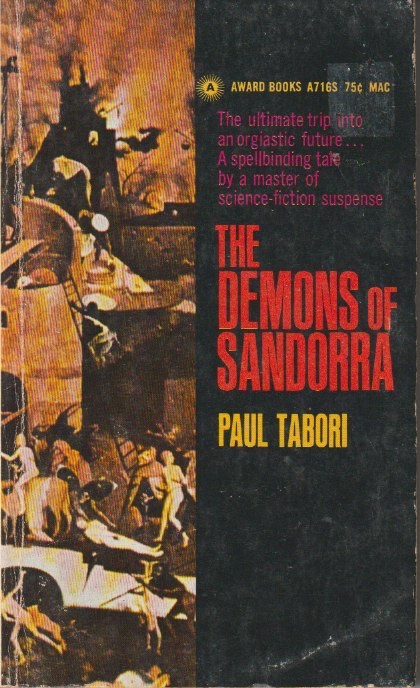
Paul Tabori's Demons of Sandorra
Demons of Sandorra is a 1970 science fiction novel by Paul Tabori.
Paul Tabori (1908- 1974) was a prolific Hungarian-born British writer who also occasionally used the pseudonym Peter Stafford.
There’s quite a bit of sexual content in Demons of Sandorra but this is definitely not a sci-fi sleaze novel. It’s a dystopian novel with some post-apocalyptic overtones. The setting is one of those utopias that is really a dystopia (of course all utopias inevitably become dystopias) but no-one will admit that their society is dystopian.
The setting is Sandorra, a tiny independent country only it isn’t really independent because there’s a single global government, but nobody admits that. Everybody pretends that independent nations still exist.
This is the story of an attractive young woman named Yolanda Vernon who seems to have a bright future in front of her. She has however started to display disturbing and distressing signs of sanity. Sanity is of course a disorder that usually responds well to therapy. The important thing is to spot the symptoms early and seek treatment immediately.
This is a world that, in the wake of a nuclear war, proceeded to build a perfect new society. The basis of this society would be Synthetism, a psychological theory which rejects reason entirely. Instinct rather than reason should be the guiding principle of both individual and group behaviour. This is also a society that has rejected normality. In this society sanity and normality are regarded as serious mental illnesses.
Marriage and monogamy are also regarded as dangerous deviations. Heterosexuality is tolerated although exclusive heterosexuality is considered dangerously eccentric.
The Synthetists have created a society in which all sexual pleasures can be indulged. Even sexual predation is permitted although you do have to buy a licence. The Synthetist have found ways in which all citizens can open the Gates, the Gates being the pathway to fulfilment. This includes the ultimate Gate.
The end result is a soft totalitarian society in which non-conformism has become compulsory, so non-conformism is now conformism. Sanity is insanity and insanity is sanity. Normality is abnormal and abnormality is normal.
Paul Tabori (1908- 1974) was a prolific Hungarian-born British writer who also occasionally used the pseudonym Peter Stafford.
There’s quite a bit of sexual content in Demons of Sandorra but this is definitely not a sci-fi sleaze novel. It’s a dystopian novel with some post-apocalyptic overtones. The setting is one of those utopias that is really a dystopia (of course all utopias inevitably become dystopias) but no-one will admit that their society is dystopian.
The setting is Sandorra, a tiny independent country only it isn’t really independent because there’s a single global government, but nobody admits that. Everybody pretends that independent nations still exist.
This is the story of an attractive young woman named Yolanda Vernon who seems to have a bright future in front of her. She has however started to display disturbing and distressing signs of sanity. Sanity is of course a disorder that usually responds well to therapy. The important thing is to spot the symptoms early and seek treatment immediately.
This is a world that, in the wake of a nuclear war, proceeded to build a perfect new society. The basis of this society would be Synthetism, a psychological theory which rejects reason entirely. Instinct rather than reason should be the guiding principle of both individual and group behaviour. This is also a society that has rejected normality. In this society sanity and normality are regarded as serious mental illnesses.
Marriage and monogamy are also regarded as dangerous deviations. Heterosexuality is tolerated although exclusive heterosexuality is considered dangerously eccentric.
The Synthetists have created a society in which all sexual pleasures can be indulged. Even sexual predation is permitted although you do have to buy a licence. The Synthetist have found ways in which all citizens can open the Gates, the Gates being the pathway to fulfilment. This includes the ultimate Gate.
The end result is a soft totalitarian society in which non-conformism has become compulsory, so non-conformism is now conformism. Sanity is insanity and insanity is sanity. Normality is abnormal and abnormality is normal.
This is a world of therapy, but the therapy is intended to keep people insane.
Privacy has been abolished. It’s considered undemocratic.
Yolanda has a good job at the Lethe Institute. It’s very satisfying being able to help people. Her job is to open the ultimate Gate to those who have passed the appropriate tests and have waited patiently for their turn. The ultimate Gate is of course Death.
This is clearly satire. It’s meant to be amusing and it is. But there’s a serious purpose as well. It does raise all kinds of questions about conformity and authoritarianism and social engineering, and sexual indulgence versus sexual repression. And what it means to be sane or insane, and the conflict between the overwhelming human desires for both freedom and conformity. Also the ticklish problem that there is a need for order but order always leads to repression.
As the story progresses it becomes crazier, but in interesting ways.
This future society does of course have some unsettling resemblances to the world of today.
Demons of Sandorra is wild stuff but it’s inspired wildness and I was sufficiently impressed to order several more of Tabori’s books. Highly recommended.
The author’s witchcraft potboiler, The Wild White Witch (written as Peter Stafford), has a similar deceptive feel - it seems trashy on the surface but has more substance to it than you’re expecting. I recommend it as well.
Privacy has been abolished. It’s considered undemocratic.
Yolanda has a good job at the Lethe Institute. It’s very satisfying being able to help people. Her job is to open the ultimate Gate to those who have passed the appropriate tests and have waited patiently for their turn. The ultimate Gate is of course Death.
This is clearly satire. It’s meant to be amusing and it is. But there’s a serious purpose as well. It does raise all kinds of questions about conformity and authoritarianism and social engineering, and sexual indulgence versus sexual repression. And what it means to be sane or insane, and the conflict between the overwhelming human desires for both freedom and conformity. Also the ticklish problem that there is a need for order but order always leads to repression.
And it develops these ideas in surprisingly complex and nuanced ways. It doesn’t present the various opposing concepts in a simplistic black-and-white manner. Readers are left to make up their own minds. Life is messy and every attempt to reduce the messiness of life just creates new problems. And revolutions don’t always turn out they way you’d hoped, and you can’t predict where they’ll lead.
This future society does of course have some unsettling resemblances to the world of today.
Demons of Sandorra is wild stuff but it’s inspired wildness and I was sufficiently impressed to order several more of Tabori’s books. Highly recommended.
The author’s witchcraft potboiler, The Wild White Witch (written as Peter Stafford), has a similar deceptive feel - it seems trashy on the surface but has more substance to it than you’re expecting. I recommend it as well.
Tuesday, March 24, 2020
Will N. Harben's The Land of the Changing Sun
The Land of the Changing Sun is a lost world science fiction novel originally published in 1894.
The author, William N. Harben (1858-1919), was an American whose literary output was rather varied. It included science fiction, religious tales, detective stories, rural comedic sketches and what might be termed early social problem novels.
The Land of the Changing Sun is the tale of two adventurers, an American named Johnston and an Englishman named Thorndyke, whose balloon is lost somewhere over the Atlantic. They are fortunate to reach an island, but this island is so small and so remote that their long-term prospects seem grim. Then they are rescued, but in a very surprising way. They are taken aboard a highly advanced submarine of mysterious origins. It takes them to the land of Alpha, which they will soon discover is located deep beneath the Earth. Alpha has its own sun, which changes colours throughout the day (hence the book’s title) and has a wholly unique climate which never changes at all.
The kingdom of Alpha is very advanced technologically. Socially it’s a little disturbing. It’s too perfect. The Alphans practise eugenics in a rather ruthless manner. Everyone is physically perfect. The men are tall and athletic, the women are stunningly beautiful.
Of course now that our heroes are in Alpha the question is whether they will ever be allowed to leave. The king seems welcoming but the Alphans do insist on physical perfection. Will our heroes be able to measure up to such exacting standards and if not will they still be welcome?
There’s no doubting the physical perfection of the king’s daughter and so it’s hardly surprising that Thorndyke seems inclined to fall for her.
Like Jules Verne Harben takes technologies which existed at the time and extrapolates from them. Submarines existed in 1894 but they were still crude experimental types. Electricity was is use so Harben assumes that it will be used for just about everything in the future. Evolution was still big news and social Darwinism was gaining a following, and eugenics was becoming a matter of debate. The telegraph and telephone were making long-distance communication practicable so Harben in his novel assumes that it will be possible to transmit images over long distances. Motion pictures were not yet a practical proposition but in 1894 experiments were already being made, and motion pictures of a sort exist in Alpha. Airships already existed and the idea of heavier-than-air flight was attracting interest so the sophisticated flying machines in the novel would have seemed vaguely plausible.
The land of Alpha itself is inhabited by and was created by humans who left the world on the surface several centuries earlier. It is an artificial world. It is in fact a new Creation, the work of men who saw themselves as perhaps the equal of God. It is significant that Alpha is a world without religion. It is a materialistic technological society run along utilitarian lines. The greatest good of the greatest number, that sort of thing. There is nothing deliberately cruel about the Alphans (cruelty would be irrational and unscientific), it’s just that sometimes in order to ensure the greatest good of the greatest number sacrifices have to be made.
Harben’s intention is clearly to take a somewhat acerbic look at the logical consequences of materialism and utilitarianism, and he does so from what is clearly a Christian perspective.
The strength of the book is the ingenuousness of the author’s technological extrapolations. The changing sun itself is a fine example. I won’t explain the details - it’s better to discover them as Thorndyke and Johnston discover them. Harben is also quite good on the social implications of technology - the king is essentially a decent and dedicated man but the technology at his disposal does give him a degree of social control over his subjects and there are hints that maybe this is not entirely a good thing.
This is not exactly a dystopian novel. The Alphans are pleasant and generally happy and their king genuinely desires their welfare. It’s more of a flawed utopia. Science can create a potentially perfect society but do we really want to live in a perfect society? And this perfection comes at a price.
Don’t expect much in the way of characterisation. Thorndyke and Johnston as personalities are utterly conventional heroes, the most interesting thing about them being that they’re a bit more ineffectual than most late Victorian or Edwardian heroes. The princess is your stock standard princess, beautiful and noble. The king is perhaps marginally more interesting as he grows to doubt his ability to keep everything under control.
There is adventure here. There are no battles or fistfights or gun duels. The battles are against nature, and to some extent against nature modified by human actions. But there is excitement at the climax.
The Land of the Changing Sun is by no means in the top rank of lost world stories but it is an interesting one with a genuinely interesting artificial world. Worth a look for lost world fans.
The author, William N. Harben (1858-1919), was an American whose literary output was rather varied. It included science fiction, religious tales, detective stories, rural comedic sketches and what might be termed early social problem novels.
The Land of the Changing Sun is the tale of two adventurers, an American named Johnston and an Englishman named Thorndyke, whose balloon is lost somewhere over the Atlantic. They are fortunate to reach an island, but this island is so small and so remote that their long-term prospects seem grim. Then they are rescued, but in a very surprising way. They are taken aboard a highly advanced submarine of mysterious origins. It takes them to the land of Alpha, which they will soon discover is located deep beneath the Earth. Alpha has its own sun, which changes colours throughout the day (hence the book’s title) and has a wholly unique climate which never changes at all.
The kingdom of Alpha is very advanced technologically. Socially it’s a little disturbing. It’s too perfect. The Alphans practise eugenics in a rather ruthless manner. Everyone is physically perfect. The men are tall and athletic, the women are stunningly beautiful.
Of course now that our heroes are in Alpha the question is whether they will ever be allowed to leave. The king seems welcoming but the Alphans do insist on physical perfection. Will our heroes be able to measure up to such exacting standards and if not will they still be welcome?
There’s no doubting the physical perfection of the king’s daughter and so it’s hardly surprising that Thorndyke seems inclined to fall for her.
Like Jules Verne Harben takes technologies which existed at the time and extrapolates from them. Submarines existed in 1894 but they were still crude experimental types. Electricity was is use so Harben assumes that it will be used for just about everything in the future. Evolution was still big news and social Darwinism was gaining a following, and eugenics was becoming a matter of debate. The telegraph and telephone were making long-distance communication practicable so Harben in his novel assumes that it will be possible to transmit images over long distances. Motion pictures were not yet a practical proposition but in 1894 experiments were already being made, and motion pictures of a sort exist in Alpha. Airships already existed and the idea of heavier-than-air flight was attracting interest so the sophisticated flying machines in the novel would have seemed vaguely plausible.
The land of Alpha itself is inhabited by and was created by humans who left the world on the surface several centuries earlier. It is an artificial world. It is in fact a new Creation, the work of men who saw themselves as perhaps the equal of God. It is significant that Alpha is a world without religion. It is a materialistic technological society run along utilitarian lines. The greatest good of the greatest number, that sort of thing. There is nothing deliberately cruel about the Alphans (cruelty would be irrational and unscientific), it’s just that sometimes in order to ensure the greatest good of the greatest number sacrifices have to be made.
Harben’s intention is clearly to take a somewhat acerbic look at the logical consequences of materialism and utilitarianism, and he does so from what is clearly a Christian perspective.
The strength of the book is the ingenuousness of the author’s technological extrapolations. The changing sun itself is a fine example. I won’t explain the details - it’s better to discover them as Thorndyke and Johnston discover them. Harben is also quite good on the social implications of technology - the king is essentially a decent and dedicated man but the technology at his disposal does give him a degree of social control over his subjects and there are hints that maybe this is not entirely a good thing.
This is not exactly a dystopian novel. The Alphans are pleasant and generally happy and their king genuinely desires their welfare. It’s more of a flawed utopia. Science can create a potentially perfect society but do we really want to live in a perfect society? And this perfection comes at a price.
Don’t expect much in the way of characterisation. Thorndyke and Johnston as personalities are utterly conventional heroes, the most interesting thing about them being that they’re a bit more ineffectual than most late Victorian or Edwardian heroes. The princess is your stock standard princess, beautiful and noble. The king is perhaps marginally more interesting as he grows to doubt his ability to keep everything under control.
There is adventure here. There are no battles or fistfights or gun duels. The battles are against nature, and to some extent against nature modified by human actions. But there is excitement at the climax.
The Land of the Changing Sun is by no means in the top rank of lost world stories but it is an interesting one with a genuinely interesting artificial world. Worth a look for lost world fans.
Friday, May 17, 2019
Larry Niven’s A Gift from Earth
A Gift from Earth is one of Larry Niven’s very early Known Space novels. Larry Niven (born 1938) is considered to be a writer of hard SF but in this case he seems to be just as interested in the social and political implications of technology as in the technology itself. A Gift from Earth is also a dystopian novel of sorts.
The setting is bizarre but it’s also pretty cool. Mount Lookitthat is a plateau about half the size of California and it roses 40 miles above the surface of a planet that is otherwise about as hostile and uninhabitable as a planet can be. The atmosphere is boiling hot and poisonous and the atmospheric pressure at the surface is crushing.
Why would anyone colonise such a planet? The answer is simple. It was colonised at a time when interstellar travel was in its infancy. It could only be achieved using starships that travelled at around half the speed of light. There being very few star systems with habitable planets close enough to Earth to be reached by such technology any planet that is even marginally habitable has been colonised.
What’s more interesting even than the planet is the strange social system that has evolved there. The starships (of which there were originally two) that reached the planet each carried a crew of six and fifty colonists in suspended animation. Five hundred years later the descendants of the crew and the descendants of the colonists have become separate social castes. The crew have become a kind of aristocracy ruling Mount Lookitthat with the colonists being more or less the peasantry.
And then there are the organ banks. The technology to extend life to an extraordinary degree exists but it is dependant on a supply of organs for transplants. An enormous supply or organs is required, and an effective system has been devised to provide that supply. Just about every crime, no matter how trivial, is punishable by execution. The executed criminals supply the organs for the organ banks.
It is almost exclusively colonists who are executed and it is mostly (but not entirely) crew who benefit from the organ banks. The system survives because the crew have all the weapons and they control the supply of power to everybody. The colonists naturally are not happy with the system but on the other hand it does keep the crime rate down! And colonists who are coöperative and useful do receive at least some of the transplants.
Everything changes with the arrival of Ramrobot #143 from Earth, bearing a number of very important gifts.
Matt Keller gets mixed up, very reluctantly, with a colonist resistance group known as the Sons of Earth. Matt is very useful to them, and potentially the key to all sorts of possible futures, since he has an odd psionic power.
The political aspects of the story are absolutely central and they’re complex and at times subtle. Niven understands that politics is about power. There are a number of significant political actors in the story. They are motivated by the desire to promote their own group interests, and by a desire for power. Principles are of no interest to them whatsoever. And in this story politics and technology are intricately entangled. One of Niven’s more disturbing ideas is that technology changes morality. It’s not an idea that I’m comfortable with but it has to be admitted that he argues his case pretty well.
One of the curious features of science fiction in its so-called golden age was the interest in psionic or paranormal abilities such as telepathy. Of course back in the 1930s and 1940s such ideas still seemed to be at least vaguely plausible but it surprises me to find such ideas still going strong in a 1968 novel by someone who was at the time one of the rising young stars of the genre. Psionics are of course remarkably useful as plot devices which may be why science fiction writers clung to such ideas so tenaciously.
A Gift from Earth is an interesting and provocative science fiction novel with dystopian overtones. Recommended.
The setting is bizarre but it’s also pretty cool. Mount Lookitthat is a plateau about half the size of California and it roses 40 miles above the surface of a planet that is otherwise about as hostile and uninhabitable as a planet can be. The atmosphere is boiling hot and poisonous and the atmospheric pressure at the surface is crushing.
Why would anyone colonise such a planet? The answer is simple. It was colonised at a time when interstellar travel was in its infancy. It could only be achieved using starships that travelled at around half the speed of light. There being very few star systems with habitable planets close enough to Earth to be reached by such technology any planet that is even marginally habitable has been colonised.
What’s more interesting even than the planet is the strange social system that has evolved there. The starships (of which there were originally two) that reached the planet each carried a crew of six and fifty colonists in suspended animation. Five hundred years later the descendants of the crew and the descendants of the colonists have become separate social castes. The crew have become a kind of aristocracy ruling Mount Lookitthat with the colonists being more or less the peasantry.
And then there are the organ banks. The technology to extend life to an extraordinary degree exists but it is dependant on a supply of organs for transplants. An enormous supply or organs is required, and an effective system has been devised to provide that supply. Just about every crime, no matter how trivial, is punishable by execution. The executed criminals supply the organs for the organ banks.
It is almost exclusively colonists who are executed and it is mostly (but not entirely) crew who benefit from the organ banks. The system survives because the crew have all the weapons and they control the supply of power to everybody. The colonists naturally are not happy with the system but on the other hand it does keep the crime rate down! And colonists who are coöperative and useful do receive at least some of the transplants.
Everything changes with the arrival of Ramrobot #143 from Earth, bearing a number of very important gifts.
Matt Keller gets mixed up, very reluctantly, with a colonist resistance group known as the Sons of Earth. Matt is very useful to them, and potentially the key to all sorts of possible futures, since he has an odd psionic power.
The political aspects of the story are absolutely central and they’re complex and at times subtle. Niven understands that politics is about power. There are a number of significant political actors in the story. They are motivated by the desire to promote their own group interests, and by a desire for power. Principles are of no interest to them whatsoever. And in this story politics and technology are intricately entangled. One of Niven’s more disturbing ideas is that technology changes morality. It’s not an idea that I’m comfortable with but it has to be admitted that he argues his case pretty well.
One of the curious features of science fiction in its so-called golden age was the interest in psionic or paranormal abilities such as telepathy. Of course back in the 1930s and 1940s such ideas still seemed to be at least vaguely plausible but it surprises me to find such ideas still going strong in a 1968 novel by someone who was at the time one of the rising young stars of the genre. Psionics are of course remarkably useful as plot devices which may be why science fiction writers clung to such ideas so tenaciously.
A Gift from Earth is an interesting and provocative science fiction novel with dystopian overtones. Recommended.
Thursday, March 23, 2017
The Space Merchants
The Space Merchants is a science fiction novel written by Frederik Pohl and C.M. Kornbluth and published in 1953. It’s also one of the great dystopian novels of the modern era.
The future world of The Space Merchants is controlled entirely by huge corporations. Government functions merely as a rubber stamp for the decisions of the corporations. Congress is owned lock, stock and barrel by these corporations and the President is a figurehead with no power at all. By far the most powerful companies are the advertising agencies, and the most powerful agencies are Taunton Associates and Fowler Schocken.
This is a horrifically overpopulated world but population growth is still enthusiastically encouraged. More population means more cheap labour and more consumers and therefore more sales, and that means more profit. No-one questions the assumption that this is a good thing.
This is also a totalitarian society but it’s what we would today call a soft totalitarianism, enforced mostly by propaganda and social pressure. The iron fist beneath the velvet glove is only revealed when a consumer commits a really serious crime, such as questioning the value of advertising.
Competition between corporations is fierce but out-and-out murder is frowned upon unless proper notification has been given that a state of commercial feud exists. Corporations have gone beyond the stage of running the state - they now function as states themselves. There are no police forces - law enforcement has been entirely privatised.
Art and popular entertainment no longer exist apart from their role in providing opportunities for advertising.
The story is narrated by Mitch Courtenay, a star class copysmith with Fowler Schocken. Mitch has just been given a new assignment. He has been put in charge of the Venus account. An immense rocket has been constructed which will transport the first Earth colonists to Venus. The colony will of course be run by Fowler Schocken entirely for the benefit of Fowler Schocken and its associated companies.
One minor problem is that nobody in their right mind would want to be a colonist on Venus. But this isn’t really a problem at all. By the time Fowler Schocken’s Venus advertising campaign is in full swing everyone will want to be a Venus colonist.
Mitch Courtenay’s life is going pretty well, apart from his marriage. He’d like to make the marriage permanent but Kathy won’t agree. In fact she wants to end the agreement before the end of the trial period. And there is one other minor irritant in Mitch’s life - someone is trying to kill him. This is puzzling since as far as he knows no other corporation has declared a commercial feud against Fowler Schocken.
Mitch soon finds himself on a roller coaster ride of terror and misery. Having people trying to kill you is bad enough but he finds that his identity has been stolen and he now faces the most appalling fate imaginable - having to live as a consumer.
He also gets mixed up with the consies. The consies are the Conservationists. These are dangerous fanatics who believe that overpopulation is out of control, that life has become sterile and meaningless and that deurbanisation and a return to a more traditional lifestyle are essential. They are so extreme that they even question whether increasing consumption is a good thing.
The plot has some rather wild twists and turnings as Mitch discovers that all his assumptions about the world and about the people he knows may be quite wrong.
While this novel doesn’t have the literary polish of the great dystopian novels of Huxley and Orwell it does feature a dystopian which is every bit as fully worked out and every bit as convincing. If 1984 was the great communist dystopian novel then The Space Merchants is the great capitalist dystopian novel. There is however one feature that both dystopias have in common - they are societies in which the elites have absolute power while the mass of the people have no power at all. And, interestingly enough, the capitalist elites of The Space Merchants maintain their control by much the same methods as the communist elites in 1984 - through the control of language, by rewriting the past, by encouraging people to denounce dissidents and through endless and all-pervasive propaganda. And the consies serve much the same purpose as Emmanuel Goldstein in 1984 - it seems that every totalitarianism has to have an enemy as a focus of fear and hatred.
Pohl and Kornbluth are careful not to introduce any radical new technologies into their tale. Every technology is this novel is merely an extrapolation of technologies that existed in the early 1950s such as rocketry, radio and television. The intention was obviously to make this dystopia as plausible as possible. What makes the book truly terrifying today is not this plausibility but the fact that so much of what the authors predict has already come true.
The Space Merchants is also very amusing (in a sometimes very dark way) and highly entertaining. It’s very pulpy but in a way that’s a strength - the crassness of a world run by advertising agencies lends itself to a pulpy treatment.
Very highly recommended.
Friday, June 10, 2016
The City of the Living Dead
The City of the Living Dead, a short story by Laurence Manning and Fletcher Pratt originally published in Science Wonder Stories in 1930, has sometimes been claimed as an influence on The Matrix. In fact the story incorporates a number of concepts that would later be hailed as revolutionary when the cyberpunk writers rediscovered them half a century later.
The world of Alvrosdale is a very small world. It is a close-knit agricultural community, presumably somewhere in northern Europe. Alvrosdale is entirely cut off from the rest of the world and has been for a couple of thousand years. It was cut off suddenly and completely by a geological cataclysm that raised an impassable mountain barrier.
The people live what might seem to be a primitive life, without machines of any kind. In fact they hate and fear the very idea of the Machine. They are aware, in a vague way, of the existence of Machines and have an even vague awareness that elsewhere in the world the Machine has reached an extraordinary degree of sophistication, fueled by a demon the people of the dale fear above all else - the Demon Power.
Each year a number of young people set off in their gliders (gliders are allowed since they have no connection with the Demon Power) to cross the mountain barrier. Before they leave the wise old Hal Hallstrom tells them his story. It is an incredibly story of what he found in the lands beyond the mountain.
He found a world dominated by the Machine, but a dead world. Not quite dead though. Something worse than dead. A living death. And he discovers that the people of Alvrosdale have good reason to fear the Machines. The Machines are not evil in themselves but they lead to evil results.
One of the many ideas that Manning and Pratt anticipated in this tale is virtual reality. It is not just a vague approximation to the idea - it is the idea fully developed, in some ways perhaps even more fully developed that anything to be found in the cyberpunk writers. This is not virtual reality that mimics life - it replaces life. Cyborgs are also anticipated in this story and again the idea is impressively well thought through.
Science fiction authors are sometimes good at predicting technologies but not so good at predicting the social consequences of those technologies. Very few science fiction authors have been successfully able to imagine just how trivial and futile would be the uses to which human beings would put advanced technologies. In this instance the authors cannot be accused of this failing - the self-destructiveness of technology used purely for pleasure and amusement is vividly described. Manning and Pratt would not have been the slightest bit surprised by the tragic misuse of the internet.
This is very much ideas-based science fiction with absolutely zero interest in characterisation. I was going to say that it displays zero interest in emotion but that’s not quite true - it displays no interest in individual emotions but it does deal in at least general terms with the emotional and psychological consequences of unlimited access to unlimited power and technology.
The City of the Living Dead would have been an impressive enough achievement had it been published thirty years later, but appearing as it did in 1930 it’s breathtakingly prescient and a truly remarkable work of speculative science fiction. Highly recommended.
Subscribe to:
Posts (Atom)