Showing posts with label swashbuckling adventure. Show all posts

Sunday, February 5, 2023

Johnston McCulley’s King of Chaos

Steeger Press have reprinted five Johnston McCulley novels in a mammoth omnibus edition, King of Chaos. It’s a great chance to discover just how interesting a writer McCulley was.

American writer Johnston McCulley (1883-1958) is an important figure in the history of adventure fiction and pulp fiction who is now sadly neglected. He is remembered mainly as the creator of Zorro but while the various Zorro movies and the 1960s TV series have kept Zorro alive as a pop culture icon McCulley’s original Zorro novels and stories are all but forgotten.

McCulley wrote several Zorro novels and numerous short stories but they were only a part of his vast output. He created a number of memorable pulp heroes, most notably The Black Star, The Spider and The Crimson Clown.

The title story, King of Chaos, was originally published in Argosy in 1912. This novel belongs more to the tradition of late Victorian and Edwardian adventure fiction than to what we would normally think of as the pulp tradition. It has a definite Ruritanian flavour. In fact the theme of a man playing a royal role to which he may or may not be entitled is fairly obviously going to remind readers of Anthony Hope’s 1894 adventure classic The Prisoner of Zenda. And the tone is also not dissimilar.

Carl Henderson is twenty-one years old and he’s an obscure clerk in a brokerage office in Seattle. He’s rather surprised to find himself kidnapped. He awakes on board a steam yacht heading out to sea. He does not awaken in a filthy hold or a cell. He awakens in a luxuriously appointed stateroom. And everyone keeps referring to him as Your Majesty.

A certain Lord Bellan claims to be Carl’s prime minister. He assures Carl that the young man is in fact a king, but he cannot tell him where his realm is. The yacht’s secret destination is Carl’s kingdom.

Being a king turns out to be a rather difficult and wearisome task. There are two factions on board the yacht. One faction follows Lord Bellan. The other follows the yacht’s master, Captain Barrington. There is bad blood between Bellan and Barrington. The reason for this is Lady Elizabeth Bellan, Lord Bellan’s sister. There’s a romantic triangle in which Carl has become unwittingly involved but Lord Bellan’s ambitions play a part as well. An experienced king would have trouble keeping the peace between these two factions. Carl does his best, with some assistance from the ship’s doctor (who is also the court physician), an Irishman named Michael Murphy. Carl also gets some unexpected aid from Lady Elizabeth Bellan’s charming younger sister Grace.

While the two factions are constantly at each other’s throats Lord Bellan still refuses to tell anyone what is actually going on, where the yacht is headed and how a humble clerk like Carl Henderson could possibly be a king.

Bellan eventually does have to reveal the truth, and it’s the kind of outrageous story you expect in a late Victorian/Edwardian adventure tale. Carl had a suspicion there might be pirates involved (there was a rumour in his family that his great grandfather had been a pirate), and that turns out to be correct.

When the royal yacht arrives at Carl’s kingdom there is more trouble for the young king to sort out.

His kingdom is perhaps not quite the kingdom he might have hoped for.

And being a king is not all fun and games. In fact Carl finds it to be a nightmare. He makes mistakes but the subsequent disasters are by no means all his fault. He learns about betrayal, and he learns to be a bit more wary about trusting people. He does learn about kingship along the way.

Anyone who has read McCulley’s original novel of Zorro is aware that McCulley disliked injustice and he particularly disliked abuse of power. These themes surface in King of Chaos as well.

The obvious influences on this tale would be Anthony Hope’s great Ruritanian adventure romances The Prisoner of Zenda (1894) and Rupert of Hentzau (1898), both of which I’ve reviewed here. There’s also a certain kinship with Rudyard Kipling’s magnificent 1888 short story The Man Who Would Be King.

I’ve also reviewed McCulley’s most famous book, The Mark of Zorro (1924, originally serialised as The Curse of Capistrano in 1919).

It’s a rather outlandish tale and it’s best not to think about the plausibility of the plot. King of Chaos is however quite entertaining and it’s recommended.

Tuesday, November 22, 2022

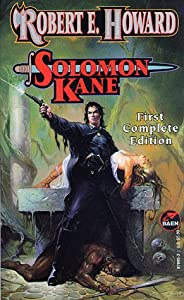
The Savage Tales of Solomon Kane by Robert E. Howard

The Savage Tales of Solomon Kane is a collection of all of Robert E. Howard’s stories featuring 17th century Puritan adventurer Solomon Kane.

Solomon Kane considers himself to be a Puritan but he’s not quite what you might think of when you hear the word. He is a man with a very high sense of duty and he can be ruthless. He’s a man driven by conscience. He is however prepared to entertain the possibility that sometimes duty is complicated and sometimes it ends up feeling like the wrong thing to do. He is a man who understands moral complexity. And it’s something he worries about a lot.

Kane is a hard man but he’s as hard on himself as he is on others and he detests cruelty. He particularly detests people who try to find spurious moral justifications for cruelty and injustice.

This is Robert E. Howard, a man some would dismiss as a mere pulp writer, creating a fascinatingly complex character capable of a degree of self-doubt and self-analysis.

Solomon Kane sees himself as an agent of God, as God’s avenger. His mission in life is to destroy evil men. He is a fanatic, but unlike most fanatics he possesses a capacity for kindness.

One of the things I like about Solomon Kane is that he’s not Conan in 17th century garb. He’s a very different kind of character. He’s more serious-minded, a bit more introspective, and he has a strong sense of moral purpose.

These stories sometimes involve the supernatural, and sometimes not.

In Skulls in the Stars Kane is on his way to Torkertown. He is warned to take the swamp road rather than the much shorter much easier road across the moor. Danger and death lurk on the moor road. Naturally Kane takes the moor road.

And he encounters something uncanny and terrifying. Can an emotion be made flesh? Perhaps some emotions can. Emotions like hate. Kane finds an answer to the danger but it makes him uneasy. Good story.

The Right Hand of Doom is a neat little tale of a necromancer who promises to exact revenge on the man who betrayed him. A story in which Kane wants to see justice done but in which he recognises that justice can be used as an excuse for mere revenge, or hate, or cruelty. A solid story.

Red Shadows (originally titled Solomon Kane) is a novelette. Kane encounters a dying girl. She had been raped and brutalised. Kane has never set eyes on this girl before but now he has appointed himself her avenger. Avenging her will take Kane across the seas and all the way to Africa where he will encounter some formidable magic. Interesting that the African voodoo witch-doctor/black magician N’Longa turns out to be one of the good guys. Howard gives this novelette a certain epic quality - Kane doesn’t care if it takes him years and he has to visit every corner of the globe. He has promised vengeance and he keeps his promises. N’Longa also gives Kane a wooden stuff. It is fabulously old, made of an unknown wood, with magical powers. That staff will crop up in later Solomon Kane stories. Great story.

Rattle of Bones begins with Kane and a Frenchman he has met on the road through the forest taking a room at an inn. It is the Cleft Skull Inn and it looks as inviting as its name suggests. I can’t tell you much more without revealing spoilers except that Solomon Kane will not get much sleep this night. And it’s a revenge story with a twist. Good story.

The novella The Moon of Skulls takes Kane back to Africa. It is the last stage in an epic quest that has taken years. Kane is searching for an English girl kidnapped by slavers. He has reached the fabled kingdom of Negari, ruled by the dreaded black queen Nakari.

He discovers that Negari has a bizarre history, a history that goes back to another land, a time of legend, a vanished civilisation. He finds a city in the heart of Africa but dark deeds are done there. And the Moon of Skulls, the full moon, is approaching. After that there will be no way to save that English maiden.

Kane will be offered immense power and will be tempted, although only for a moment.

Kane will be captured, he will witness scenes of torture and depravity and he will inflame the lusts of Queen Nakari.

There’s action aplenty, there are chases through secret passageways, there are horrific secrets to be revealed. A splendid tale of adventure.

The Blue Flame of Vengeance begins with a duel. A young man named Jack Hollinster has challenged Sir George Banway, a nobleman with an evil reputation. The duel ends inconclusively but indirectly it leads to a meeting between Jack and Solomon Kane. Kane is out for revenge as well but Sir George is not his target. Kane has been pursuing the notorious pirate Jonas Hardraker.

Jack’s lady love is kidnapped so Kane will have to rescue her as well as settling his account with Hardraker.

Plenty of action in this tale and a second duel, this time with knives. A fine story.

The Hills of the Dead takes Kane back to Africa, but he can’t explain why. He has no mission to fulfil. He is simply drawn to the place. An encounter with a frightened young African girl named Junna will however present him with a mission. Her tribe is being menaced by the dead. They are the dead of a vanished tribe and they are vampires of a sort. Junna’s tribe lives in terror. Ridding the land of these vampire-like creatures is task worthy of Solomon Kane.

It is however a task that is beyond him. Kane fears no living man but these walking dead are impervious to both sword and pistol. Kane reluctantly comes to the conclusion that magic must be fought with magic. He knows nothing of magic, but N’Longa knows a great deal. N’Longa is a mighty ju-ju man. He is also, as a result of the events recounted in Red Shadows, Kane’s blood brother. N’Longa might have the magic necessary. And while Kane abhors magic he knows that N’Longa is a good magician.

This is unequivocally a tale of the supernatural and a full-blown horror story. And a very very good one.

Wings in the Night is a very dark story, even for Robert E.Howard. Kane is in Africa, being pursued by cannibals. He comes across a village that has been ravaged and devastated and he finds unspeakable horrors. Flying creatures like men with wings, vicious and bloodthirsty.

He takes refuge in a village where the priest tells him of the full horrors of the bird-men.

The tribe sees Kane as a god who will deliver them from the evil of the bird-men. That’s what Kane fully intends to do but his fine resolutions lead to further horrors and to madness. A great story.

The Footfalls Within is a very simple tale. Kane is tramping through the jungle in Africa. He sees a party of Arab slavers driving a group of African slaves. The slavers are just about to commit an unspeakable act of cruelty towards a young girl. There are fifteen Arabs accompanied by seventy armed African guards. The odds against Kane are impossible. Kane attacks anyway and is captured.

The slavers, dragging Kane along with them bound and tied, find an ancient mausoleum. Kane knows that opening the mausoleum would be a mistake - he can hear footfalls within the tomb although nobody else hears them. It turns out that opening that mausoleum is a very big mistake indeed. Probably the weakest Solomon Kane story but still at least moderately creepy.

Final Thoughts

The weaker stories in this collection are still very good. The better stories are superb, Robert E. Howard at his best. And the better stories outnumber the weaker ones by a comfortable margin.

These tales are definitely sword-and-sorcery but being set in the 17th century and more often than not in Africa give them a unique feel. Very highly recommended.

Friday, November 1, 2019

L. Ron Hubbard's Typewriter in the Sky

Typewriter in the Sky is an intriguing and unconventional 1940 science fiction/fantasy/adventure novel by L. Ron Hubbard (1911-1986).

Yes, that L. Ron Hubbard. The inventor of Dianetics, the founder of the Church of Scientology. Everyone knows that Hubbard was a science fiction writer but it’s easy to fall into the trap of assuming that he was probably a bad science fiction writer and that nobody apart from Scientologists bothers to read his novels, or should bother to read them. And the fact that people tend to have very strong views on the subject of Scientology makes it very hard for them to approach anything he did without either idolatry or extreme hostility. In fact feelings on the subject can run so high that it might be advisable at this point for me to state that I am not a Scientologist, I know very little about Scientology and I have no particular axe to grind one way or the other.

The truth is that, leaving Scientology aside, on the evidence of Typewriter in the Sky Hubbard was a very good and very interesting science fiction writer. And he was also a highly successful one.

Typewriter in the Sky is a clever and very unconventional novel. The ideas that Hubbard is playing around with have become quite familiar having been used many times since. It has to be kept in mind that when Hubbard wrote this novel in 1940 those ideas were fresh and wildly original.

Horace Hackett is a pulp writer. Like most pulp writers he works in various genres but he is best known for his adventure stories. He has received a generous advance from his publisher Jules Montcalm for his latest potboiler. Being a writer he naturally spent the money immediately.

Hackett’s problem is that he has not actually written the novel. He has not even started writing it. He has not even given the matter any real thought. And now his publisher wants the manuscript and he wants it yesterday. If not yesterday, then he certainly wants it now. Montcalm confronts him in his apartment, where he’s idly chatting with his buddy Mike de Wolf, and demands to be given at the very least an outline of the plot. Hackett has to think fast and he bluffs his way through by making up an outlandish plot on the spot. Montcalm is particularly anxious to know about the villain. Since Hackett does not yet have a villain he bluffs again by constructing a villain, a Spanish admiral named Miguel de Lobo, based on his buddy Mike.

And then Mike suddenly finds himself wading ashore on a Caribbean island with dim memories of standing on the poop deck of his flagship which has just fought an unsuccessful action against English pirates. When confronted by a couple of pirates on the beach he dispatches them with his rapier. Which is odd because a moment ago he was unarmed. Mike is taken in by a beautiful young woman, the daughter of the English governor of the island, but the locals want to hang him as a damned Spanish Papist. In 1640 the English were not fond of Spanish Papists. For it seems that Mike is no longer in the year 1940 but the year 1640.

The other odd thing is a strange sound that he hears in the sky. It almost sounds like a typewriter.

A horrible realisation hits Mike. He is a character in a Horace Hackett pirate story. Being a fictional character is bad enough but being a character in a Horace Hackett novel is much worse - it means he is a fictional character in a very bad novel. Which explains why some of the historical details seem to be totally wrong - Hackett is a hack writer notorious for his lack of interest in historical accuracy. It also explains why Mike finds himself speaking in pulp fiction clichés - he’s talking like a character in a Horace Hackett novel. And then the worst point of all strikes Mike - he’s not just a fictional charter, he’s the villain, and he knows what happens to Horace Hackett’s villains.

It’s a good premise but what’s really impressive is how cleverly and how wittily Hubbard exploits it. The reader is in on the joke right from the start. Hubbard is not trying to bamboozle the reader - it’s poor Mike who is bewildered. He knows from the start that he’s become a fictional character but he doesn’t know the rules. Is he a mere puppet, dancing to Hackett’s tune? Does he have any actual control over the outcome of events? Can he determine his own destiny? Is he even speaking his own lines or just the lines that Hackett feeds him? Of course the question of how much control we have over our destinies applies to all of us to some extent, not just fictional characters. Maybe we’re all just playing parts written for us by a typewriter in the sky. The problem is that we’re never sure if we’re playing a rôle in a farce or a tragedy, or just a meaningless pulp tale cranked out by a hack writer.

Hubbard explores these existential questions but he never gets pompous or tedious about it. It’s clever and occasionally quite thought-provoking but the tone remains playful. Life is just a pulp fiction story so why get worked up about it?

The basic idea had been tentatively explored in experimental fiction but I think it’s true to say that Hubbard was the first to see its potential for a science fiction story. And although these ideas have been tackled many times since I don’t think they’ve ever been done with quite such lightness of touch.

Typewriter in the Sky is both an adventure story and a parody of adventure stories, both an existential tale and a science fiction tale, and it works equally well on all these levels. It’s amusing and intelligent and immense fun. Very highly recommended.

Monday, May 14, 2018

Stanley J. Weyman's A Gentleman of France

Stanley J. Weyman (1855-1928) was an immensely popular author of historical romances. He was best known for his tales of swashbuckling adventure written in the early part of his career prior to 1904. Weyman enjoyed the esteem of both critics and the reading public and his admirers included Graham Greene.

One word of caution should be offered at this point. Whilst all of Weyman’s books can be regarded as historical romances not all can be regarded as swashbucklers. Of the novels that do most certain qualify as swashbucklers one of the most successful was A Gentleman of France, published in 1893.

Weyman was particularly attracted by sixteenth and seventeenth century French history. A Gentleman of France opens in 1588. This was the period of the Wars of Religion in France, between the Catholics and the Huguenots. It was also the time of the succession crisis, with the Protestant King Henri IV of Navarre being the heir to the throne and with conspiracies afoot to prevent him from succeeding to the throne of France in the event of the death of the current king Henri III. In fact there were countless potential conspiracies complicated even further by foreign meddling.

Gaston, Sieur de Marsac, faces a grim future. He is a Huguenot, he is forty years old and he is penniless. He has the pride of a gentleman but he lacks the financial resources that such a station in life requires. The death of his patron, the Prince de Condé, has left him in desperate straights.

He is therefore overjoyed to receive a summons from the King of Navarre. He is entrusted with a mission, to convey a young woman who is presently being held against her will to a place of safety. Henri of Navarre cannot possibly be seen to be openly involved in this rescue mission which is why the poverty-stricken luckless de Marsac is such an ideal choice to carry it out. He is expendable, and if things go wrong Henri can plausibly claim to have known nothing whatever about the scheme.

The young woman is Mademoiselle de la Vire, a maid of honour at the court of Henri of Henri of Navarre. She proves to be quite a handful of de Marsac. In fact she proves to be a complete nightmare, being wilful, spoilt, impetuous, unpredictable, vindictive and entirely uncooperative. The band of ruffians de Marsac has hired to help carry out his task are another problem. They prove to be even more treacherous than he’d anticipated. In addition it seems that various political crises are all coming to a head and de Marsac is going to be caught in the middle.

Worst of all it turns out that Mademoiselle de la Vire is much more important than de Marsac had been led to believe. In fact it turns out that by a twist of fate she is now more important than anyone could have suspected.

This is a moderately long novel but there are so many plot twists and de Marsac’s path is strewn with so many obstacles and pitfalls and false turnings and there are so many betrayals and counter-betrayals that there’s never any danger of boredom. There’s plenty of action and the sense of danger never lets up for a moment.

While de Marsac is not totally lacking in allies they’re not necessarily allies on whom one wold want to rely absolutely. They have their own agendas. This is even more true of the powerful men who are willing to make use of de Marsac - it’s not that they bear him the slightest ill-will but they are playing for very high stakes and he is a very insignificant very poor very minor petty nobleman and his wellbeing is not exactly their highest priority.

There is, as you might expect in a 19th century English novel, a certain anti-Catholic bias. The Catholic characters are not all wicked but the villains do tend to be Catholics. The Protestant characters do tend to be virtuous and noble. This was such a pervasive feature of English popular culture at the time that Weyman may not even have been conscious of his bias.

Gaston de Marsac is a fine and reasonably complex hero. He is brave and determined but he makes a lot of mistakes and his judgment is erratic. It’s not that he is unintelligent. Far from it. He simply has a tendency, at times, to be a little careless and perhaps inclined to underestimate the difficulties that he faces.

This is very much a swashbuckling adventure. There is a love story here but it takes a definite back seat to the action adventure story.

This is thoroughly enjoyable stuff in the slightly literary tradition of Victorian writers of adventure such as Anthony Hope and Rider Haggard. Highly recommended.

This is thoroughly enjoyable stuff in the slightly literary tradition of Victorian writers of adventure such as Anthony Hope and Rider Haggard. Highly recommended. Pan Books issued this one along with several other Weyman titles in paperback in the early 70s so used copies can be found at very reasonable prices.

Weyman’s 1894 adventure Under the Red Robe is also very much worth reading.

Saturday, August 5, 2017

Sir Walter Scott’s The Talisman

The Talisman is the second of Sir Walter Scott’s Tales of the Crusaders. It was published in 1825. It deals with the adventures of a brave but penniless Scottish knight, Kenneth of the Leopard, during the Third Crusade (1189-92). It also deals with the intrigues among the Crusaders which played a major part in the crusade’s failure.

Sir Kenneth of the Couchant Leopard had set out on crusade with a small retinue and high hopes. Now most of his retinue are dead or dispersed. Kenneth’s hopes remain as high as ever. For some obscure reason Kenneth had been sent on a secret mission, connected with peace negotiations with Saladin. Kenneth encounters a young Saracen emir on the road, they fight, and the fight having ended in an honourable draw they become firm friends. 

King Richard I of England, Richard Coeur de Lion, is the military leader of the crusading forces but the other crusading kings and princes all have their own agendas and their own ambitions as combined with various petty jealousies and secret betrayals the crusade has the potential to become a chaotic farce. To make thing worse Richard is seriously ill with fever. Kenneth returns to Richard’s camp with a Muslim physician, sent by Saladin to minister to the ailing Coeur de Lion. Can a doctor sent by the crusaders’ most dangerous enemy be trusted? King Richard has reason to think that he can.

The idea of Saladin and Richard as worthy adversaries, each in his own way representative of the very highest ideals of his respective culture, is one of the book’s major themes. 

For Sir Kenneth there are many misfortunes in store. He has, in accordance with the  ideals of chivalry (another major theme of the novel), pledged himself to the service of a noble lady. He has perhaps set his sights too high, the lady in question being of royal birth, a close kinswoman of King Richard, a certain Edith Plantagenet. This is only the beginning of Kenneth’s woes. Dishonour and slavery await him.

King Richard has his problems as well. The alliance of princes who launched the Crusade is falling apart, torn by jealousies, conflicting ambitions and outright treachery. A wise physician can heal the King’s bodily infirmities, and some physicians seem to have other talents as well.

There’s also a bold, perhaps overbold, plan to bring the wars between Christians and Saracens to an end in a most surprising way, by means of an extraordinary marriage alliance.

The plot is certainly extravagant, with all manner of surprising revelations and unexpected twists. Modern readers may be disappointed that there’s very little in the way of actual action. There is however plenty of tension and intrigue. There’s also a focus on questions of honour, matters of critical importance to the medieval mind (and not entirely forgotten even in the Britain of 1825). There’s also romance of course, in the form of the hopeless love between Kenneth and Edith.

Sir Walter Scott (1771-1832) more or less invented modern historical fiction. He remained immensely popular until well into the 20th century although his critical reputation plummeted as the idea of reading books for enjoyment became anathema to critics. Scott was everything modernist critics hated - his political views were unacceptable, he was patriotic, his novels had coherent plots and worst of all his books were exciting and entertaining. His Tales of the Crusaders committed the further sin of being extremely sympathetic to the ideals of chivalry.

The Talisman is very much a product of the Romantic Movement although Scott is brutally realistic in his treatment of the cynical, scheming and treacherous leadership of the crusade. Both Sir Kenneth and King Richard personify the ideals of chivalry, as does Richard’s enemy Saladin. The novel is remarkably even-handed on the subject of religion. Amusingly both Christian and Muslim characters betray the same profound misunderstandings of each other’s faiths.

One thing Scott did understand about historical fiction - there’s no point in writing such fiction if you populate your stories with anachronistically modern characters. You have to make an effort to capture the spirit, and the prejudices, and the obsessions, of another historical epoch. This lesson has now been all but forgotten, with catastrophic consequences for historical fiction. Scott does make the effort to make his characters convincingly medieval. Perhaps he doesn’t always succeed, but he does try. And there are times when you almost want to strangle Sir Kenneth because of what seems to a modern reader to be a monumentally stubborn refusal to compromise on matters that he believes to be essential to honour or religion. The fact that we grow exasperated with him demonstrates that Scott has managed to make him reasonably believable as a man of his times.

King Richard is the most interesting character. Scott portrays him as a great and charismatic hero but one with very definite flaws, although he remains a sympathetic character. He’s a man destined not to achieve his great objectives, partly through his own failings.

If you have any interest at all in historical fiction you have to at least sample Sir Walter Scott’s work. Even if it’s somewhat lacking in the degree of action you might expect The Talisman is an absorbing and entertaining tale, somewhat far-fetched but all the more enjoyable as a result. Recommended.

Sunday, July 2, 2017

Conan Doyle's The Exploits of Brigadier Gerard

In 1894, having finished (as he thought) with Sherlock Holmes, Sir Arthur Conan Doyle had to find some sort of replacement. He still had a living to make as a writer and he was now very much in demand. The Strand Magazine wanted more short stories. A new series character was needed. Conan Doyle came up with one, a character who was very different indeed from Sherlock Holmes. At the end of 1894 the first of his Brigadier Gerard stories appeared in the Strand Magazine. In 1896 the Gerard stories were published in book form, as The Exploits of Brigadier Gerard (a second collection would follow in 1903).

Conan Doyle was very enthusiastic about his historical fiction, considering it to be his best work. He may well have been right. His medieval adventure novel The White Company is one of the classics of the genre. The Gerard stories differ in tone from his medieval stories but they are every bit as good.

Etienne Gerard is a dashing hussar officer in Napoleon’s Grand Army. The stories are narrated in the first person and it is immediately apparent that Gerard has a very high opinion of himself. He is in fact a very brave officer, a skillful horseman and a fine swordsman. He is conscientious and keen. He is unfortunately a man of strictly mediocre intelligence and very limited imagination. His greatest fault is his absurd over-confidence. His faith in his own judgment is unlimited, and sadly misplaced. The Emperor himself has described Gerard as having the thickest head but the stoutest heart in his army.

A conceited dimwit could have been a rather unattractive character but Gerard is someone we cannot help liking. He means well and he tries so hard. Mostly though it’s his total lack of self-awareness that makes him so endearing. 

The Gerard stories may well have been part of the inspiration for George MacDonald Fraser’s Flashman novels. That might seem like an odd claim since Flashman and Gerard are very different types of men. Both sets of stories do have one major thing in common though, a kind of mock-heroic tone. Both Flashman and Gerard appear to the world to be the very quintessence of the hero, but in both cases it’s an illusion. Flashman is actually a bully, a coward and a cad. If he does anything heroic it is quite by accident. Gerard is an honourable and gallant soldier but the combination of his limited intelligence and his ludicrous over-confidence makes him a slightly dubious asset to Napoleon’s army. Like Flashman he is more likely to commit his feats of heroism, by blundering into them.

There is another similarity between the two characters. Both have an enormous liking for the ladies. Both are in fact breathtakingly promiscuous although of course Conan Doyle is somewhat coy about describing Gerard’s conquests in detail (and it is possible that Gerard’s vast ego has inflated his success with the ladies somewhat).

The other quality that the Gerard stories and the Flashman stories have in common is that they are extraordinarily enjoyable. Conan Doyle took historical fiction seriously but he never made the mistake of thinking that good writing does not need to be entertaining.

Blending humour with action is quite a tricky balancing act. The humour cannot just be a gratuitous addition. It must flow naturally from the story. In this case Brigadier Gerard, our narrator, believes he is simply recounting his adventures and his amazing feats of heroism. He is not trying to be amusing. The humour comes from his own absurdities of which Gerard remains blissfully unaware. At the same time Conan Doyle cannot allow Gerard to become too ridiculous. We must be able to admire his very genuine daring and courage and his formidable determination. It’s a balancing act that Conan Doyle manages with superb skill.

The Medal of Brigadier Gerard was the first of the Gerard stories to appear in the Strand Magazine. It is 1814 and Napoleon is fighting desperately to save what is left of his empire. He is hopelessly outnumbered but he has devised a plan which may yet save the day. It is essential that the details of the plan should reach Paris as soon as possible. Two brave officers are selected for this dangerous mission. To ensure that at least one copy of the message gets through they will follow different routes. One of the two officers is Brigadier Gerard. Gerard understands the vital importance of his mission. Except that he doesn’t understand at all, which is what makes the story so clever and entertaining.

In How the Brigadier Held the King it is 1810 and Gerard, at this point a very young colonel of hussars, is serving with the Emperor’s forces in Spain. He has an unfortunate encounter with Spanish guerillas, an encounter that has the potential to be not merely fatal but fatal in a particularly unpleasant way. It is a situation that demands coolness, subtle intelligence and fine judgment. Gerard possesses none of these qualities, but luckily he is a skilled card player.

This story also marks Gerard’s first encounter with British officers and there is a good deal of amusement to be derived from Gerard’s extraordinary capacity for entirely misunderstanding everything to do with English life, culture and social habits.

How the King Held the Brigadier tells the story of Gerard’s period as a prisoner-of-war at Dartmoor. He is determined to escape but as usual, despite his boldness and courage, his plans go disastrously awry. his one is great fun.

The excellent How the Brigadier Slew the Brothers of Ajaccio is one of several stories in which Gerard undertakes a secret mission on the Emperor’s personal instructions. It is 1807, Gerard is a young lieutenant, and the emperor’s past threatens to catch up to him.

How the Brigadier Came to the Castle of Gloom shows us another side to Gerard. This time he is engaged in a purely private adventure and he will need to use his brains to get out of a particularly awkward predicament. This could be a problem since brains are not really Gerard’s strong point. We find however that although Gerard lacks imagination and intellectual subtlety he is not after all a complete fool. He does have perseverance, mental toughness, a certain amount of resourcefulness and is quite good when it comes to finding immediate practical solutions. We know that Gerard, despite his own fantasies on the matter, would have been a catastrophically incompetent general but as a junior officer he is reasonably efficient and effective. It adds some depth to the character to see him confronted by the sort of problem that demands the very qualities that he does possess. It’s also a wonderfully action-packed little story.

How the Brigadier Took the Field Against the Marshal Millefleurs has Gerard hunting for a notorious brigand, a renegade English aristocrat. Gerard has a surprising ally this time - the captain of a troop of British dragoons. The brigand, known popularly as Marshal Millefleurs, has his headquarters in a very sturdy castle. This brigand also has the advantage of being both clever and unscrupulous, surely too clever for poor Gerard. But Gerard can be ruthless as well and he can show occasional flashes of very good sense. A fine stirring story.

In How the Brigadier was Tempted by the Devil it is 1814 and the end has come for Napoleon, but the Emperor has hopes that perhaps one day he will have a chance to retrieve his throne, in which case there are certain papers that must be secured at all costs. Gerard and two other officers must ensure that those papers are safe. Not one of the stronger stories in the collection but still reasonably entertaining.

In How the Brigadier Played for a Kingdom it is 1813 and events are turning against Napoleon. Gerard is caught up in a dangerous game with the highest possible stakes, the very survival of Napoleon’s empire. His opponent in this game is a beautiful and very clever woman. A more serious story and perhaps not a great Gerard story but it does provide a suitable conclusion to the first collection of Gerard stories.

Each of these stories has a plot twist. The reader will see the twist coming. The reader is supposed to see it coming. The fun comes from the fact that not once does poor old Gerard see it coming.

These are generally light-hearted rollicking tales of adventure very liberally laced with humour but they have the occasional grim moment - at times surprisingly grim.

Conan Doyle was one of the grand masters of the genre. A couple of the stories are slightly weak but six of the eight stories are true classics of historical fiction as well as terrific swashbuckling adventure tales. The Exploits of Brigadier Gerard is superlative entertainment. Highly recommended.

Thursday, April 28, 2016

The Chevalier d'Auriac by S. Levett-Yeats

The Chevalier d'Auriac, published in 1897, was one of the novels that made S. Levett-Yeats one of the most popular Victorian writers of swashbuckling adventure tales.

Sidney Kilner Levett-Yeats (c. 1858–1916) had been a soldier and later a civil servant in India before his growing success as a writer allowed him to return to England. 

The Chevalier d'Auriac is set in the late sixteenth century during the final stages of the French Wars of Religion. The eponymous hero is serving in the armies of the Catholic League against the Protestant King Henri IV although in fact his sympathies lie more with the king.

The chevalier has been in trouble over duelling before and now he is in hot water again after a drunken quarrel ends with an affair of honour. Our hero has been told that instead of being executed out of hand he will be permitted to take part in the battle on the following day but that win or lose he will not be permitted to live out the day. Events however will (naturally) take an unexpected turn.

The drunken quarrel arose over an insult to a female prisoner. Although d’Auriac has no idea who the woman is she is certainly a high-born lady and he has certainly fallen in love with her. Falling in love can however have even more dangerous consequences than a duel.

You won’t be surprised to learn that our hero stumbles upon a plot. A particularly dastardly plot that is a threat not only to France but to the king himself. And that high-born lady mentioned earlier has some connection to it. She’s also been promised in marriage to two different men, both of whom she despises, and one of the people trying to force her into an unwelcome marriage is her guardian - King Henri IV. This puts the Chevalier d'Auriac in a bit of a dilemma, torn between his loyalty to the king and his desire to marry his lady love. 

The young chevalier soon has other problems - he becomes a hunted man, ordered into exile. Needless to say he disregards the order to leaver France and gets embroiled in countless adventures and narrow escapes. 

The author does assume that the reader will have at least a very basic knowledge of the background - the French Wars of Religion, the conflict between Catholic and Huguenot and Henri IV’s own contradictory and changeable religious policy. Readers without this background knowledge might be advised to do a bit of research first although most of it becomes reasonably clear from the context.

There’s no shortage of action and the mix of adventure and romance is always a good recipe for success for any author. Levett-Yeats handles the combination adroitly and the result is fine entertainment. Levett-Yeats might not be in the very top rank of Victorian adventure writers (he’s not quite in the same league as H. Rider Haggard and Anthony Hope) but he still qualifies as a very skillful practitioner of the art. Highly recommended.

Wednesday, December 16, 2015

Under the Red Robe by Stanley J. Weyman

Stanley J. Weyman (1855-1928) was an extremely popular writer of swashbuckling adventure novels. While other writers of such works from that era (like Anthony Hope and Rafael Sabatini) still retain a following for some odd reason Weyman is now entirely forgotten. His biggest success came in 1894 with Under the Red Robe, a tale of adventure set in France in 1630, during the Thirty Years War.

The book’s hero, M. de Berault, is a bit of a rogue. Which is putting it mildly. He’s a gambler and a notorious duellist. He has now killed yet another man in a duel. As it happens Cardinal Richelieu is determined to stamp out duelling. Anyone guilty of duelling is to be hanged. He is looking for someone to make an example of and de Berault would be ideal. M. de Berault can almost feel the hangman’s rope tightening about his neck. However de Berault did at one time dave Richelieu’s life so the cardinal decides to give him one last chance - on the condition that de Berault does as small favour for him.

This small favour turns out to be extremely dangerous and rather complicated. He has to bring M. de Cocheforêt back to Paris. M. de Cocheforêt has been involved in the plottings of Richelieu’s enemy, the duc d'Orléans (the brother of the king). M. de Cocheforêt will certainly not come willingly and the cardinal wants him alive. 

It is with some misgivings that de Berault sets off for Béarn to carry out the task. On arrival his misgivings are strengthened considerably. Somehow he will have to find a way to gain admittance to de Cocheforêt’s house and at a time when the man is actually there - de Cocheforêt is in hiding in Spain but he is known to be crossing the border secretly at regular intervals to visit his wife. It will be necessary to gain the trust of Madame de Cocheforêt and her sister but the women and their servants are understandably very much on their guard.

As de Berault feared things do not go smoothly and there is a further problem. Our hero might be a gambler and a ruffian and even a bit of a scoundrel but he is still a gentleman. In fact he is very conscious of his honour and taking advantage of a lady is something that in normal circumstances her would never consider doing. These are however not normal circumstances - if he fails in his task he knows that the hangman’s rope awaits him in Paris. Of course he could simply slip over the border to Spain, but running away is also something that a gentleman cannot do and moreover he has given his word to Richelieu and breaking his word is yet another thing that a gentleman cannot do. Being a gentleman is not always easy, and being a scoundrel and a gentleman can get very complicated indeed.

There’s not a huge amount of actual action but it’s a well-plotted tale of betrayal, divided loyalties and political intrigue with a dash of romance. Highly recommended.

Wednesday, November 11, 2015

Conan Doyle's Micah Clarke

It was the Sherlock Holmes detective stories that made Sir Arthur Conan Doyle world famous and it is these stories that have assured his lasting fame. This would have surprised and vexed him since he himself believed that his greatest literary achievements lay in the field of historical fiction. In fact Conan Doyle’s belief was not unreasonable. His mastery of the historical fiction genre may well have exceeded his mastery of the detective story. The first of his historical romances, Micah Clarke, was published in 1889.

Micah Clarke is set against the backdrop of the ill-fated rebellion of the Duke of Monmouth in 1685. The accession to the English throne of the Catholic James II earlier that year had sparked fears that the new monarch intended to impose the Catholic faith upon the country. The rebellion went badly from the start and ended in abject failure.

The story is narrated by its eponymous hero to his grandchildren many years later. Micah Clarke is a brawny but intelligent and devout young man of twenty-one, the son of a junior officer in Cromwell’s famous cavalry in the Civil War. Micah’s own family is not immune from the religious divisions - his mother adheres to the Church of England while his father is a Dissenter. A chance encounter with a roguish soldier of fortune named Decimus Saxon leads Micah Clarke to set off to join Monmouth’s rebel army. The rebels being desperately short of competent officers Micah is soon appointed captain in a regiment of foot, although initially the regiment is little more than a ragtag band of enthusiastic rustics. The regiment is commanded by Decimus Saxon, now holding the rank of colonel.

The regiment is on its way to join Monmouth’s main army. Most of the action of the novel is concerned with the various adventures that befall Micah along the way, and those adventures include being kidnapped by smugglers, cast into a dungeon, pursued by the King’s dragoons, pursued by a pack of savage hounds and assorted other scrapes from which Micah barely escapes with his life. The culmination of the story is the bloody and disastrous (from the rebels’ point of view) Battle of Sedgemoor. Although the battle is not quite the end of Micah’s story - he has still to survive, if he can, the ferocious vengeance wreaked by James II on the rebels.

Micah is a devout Protestant but he is increasingly disturbed by the ferocity of the religious divisions among Monmouth’s supporters. Micah becomes more and more convinced that these quarrels are futile and destructive and that tolerance would be more Christian. He is also made somewhat uneasy by the fiery preaching of the more extreme Dissenters. Decimus Saxon on the other hand believes that this is a good thing - he believes that fanatics make the best soldiers. 

The characterisation is rather more subtle than you might expect in a novel of adventure. Decimus Saxon in particular is a fascinating and complex character. He is greedy, grasping, unprincipled, violent and ruthless. He is also a brave and intelligent soldier. He is also capable of surprising loyalty and generosity. He is a rogue but he is not a mere clichéd loveable rogue. Micah Clarke never can decide if his fondness for Saxon outweighs his disapproval of him. He respects him, grudgingly, and eventually learns simply to accept him with his grievous faults and his compensating virtues.

Monmouth, as seen through Micah’s eyes, is equally complex. He is feckless, indecisive, unstable and cowardly but also well-meaning and generous. He is basically a reasonably decent man who happens to be hopelessly unsuited for the role he tries to play and catastrophically out of his depth.

Micah himself has a certain complexity. He is brave and keen to do what he conceives to be his duty but he has much to learn about life and about human nature, and about himself. 

Like most historical novelists of his day Conan Doyle has his characters speak in a slightly archaic manner. If taken to excess this can be tiresome but Conan Doyle exercises a welcome restraint in this respect. The archaisms are just enough to give the flavour of bygone days without being distracting. They might not be terribly authentic but I personally  feel that they are necessary, in moderation. It’s important in historical novels to make some attempt to convey the idea to the reader that these are not people of our own time. Their values and beliefs are not quite the same as ours. Their values and beliefs are not necessarily superior or inferior to ours but they are different. Conan Doyle was always able to capture this essential quality of historical fiction, of making us aware that we are dealing with a world just a little different from our own, and he was always able to do it subtly and unobtrusively. 

On the whole his prose is lucid and lively with a good deal of wit. All of his historical novels contain a good deal of humour, and Micah Clarke is no exception. Conan Doyle took his historical fiction very seriously but he also intended it to be entertaining, and he succeeded admirably in that endeavour.

Don’t be put off reading this book if you know nothing about Monmouth’s rebellion. The author gives you all the historical background you need.

The White Company remains Conan Doyle’s greatest historical novel but Micah Clarke is an impressive example of the genre. It’s intelligent, complex and hugely enjoyable. Highly recommended.

Tuesday, September 22, 2015

The Scarlet Pimpernel

Baroness Orczy’s The Scarlet Pimpernel was published in 1905 and was, as the saying goes, a publishing phenomenon. So successful was it that she produced no less than thirteen sequels. With this novel she also created a new type of hero, a hero who would have countless successors.

Baroness Emma Magdolna Rozália Mária Jozefa Borbála Orczy de Orci, usually known as Emmuska, was born in Hungary in 1865. Her family were forced to leave Hungary and eventually settled in London where the fifteen-year-old Emmuska began to learn English, the language in which her vast output of novels and stories would be written. Initially her literary endeavours met with mixed success. The Scarlet Pimpernel, her second novel, was rejected by a dozen publishers. She turned it into a play which became a hit after which the novel finally found a publisher and promptly became a bestseller. As well as the many Pimpernel sequels she wrote many other works of historical and spy fiction as well as a considerable number of detective stories (of which the Old Man in the Corner series is very highly regarded).

Baroness Orczy was an aristocratic lady by both birth and inclination so that when she decided to try her hand at historical adventure fiction it’s perhaps not surprising that the grim fate of the French aristocracy after the Revolution should have attracted her attention. Her hero, an English aristocrat, would be a man with a dual identity. To outward appearances Sir Percy Blakeney is one of the biggest fools in England, an effete dandy who would be even more widely despised if he were not so rich. In reality Blakeney is a bold, brave, daring and very intelligent man who works as a kind of freelance secret agent. With a group of other young English noblemen he rescues French aristocrats from the shadow of the guillotine at the height of the Terror in the early 1790s.

The hero with a secret identity would go on to become one of the most ubiquitous devices in popular fiction. Zorro, Batman, the Green Hornet - these heroes were all based directed on Orczy’s model. 

The Scarlet Pimpernel is as much a romance as a tale of adventure. Sir Percy Blakeney has a wife named Marguerite, a Frenchwoman. Lady Blakeney is, ironically suspected of betraying French aristocrats into the hands of the dreaded Committee of Public Safety and thus leading them to the guillotine. This has soured her marriage although she has no idea that her inane good-natured husband is really the Scarlet Pimpernel. Of course things are not so simple as they appear to be. The resolution of their romantic difficulties occupies a good deal of the author’s time. 

It has to be admitted that these two strands of the story, the romantic and the adventurous, are woven together with great dexterity. 

In this first adventure the Scarlet Pimpernel must not only rescue aristocrats from the guillotine, he must also keep himself out of the clutches of the dangerous and determined representative of the Committee of Public Safety, Chauvelin. While he is thus occupied Marguerite must find a way to save her husband from the consequences of her own indiscretions.

A modern reader may find that there’s not as much action as might be expected. In fact there’s rather less action than can  be found in other contemporary swashbucklers such as  Anthony Hope’s 1894 The Prisoner of Zenda. While Orczy might be a little weak on action scenes she’s undeniably skillful when it comes to building suspense, and she’s very skillful indeed in putting her hero in situations from which we feel he cannot possibly escape (but of course he does). The Scarlet Pimpernel relies on his wits rather than on swordsmanship or fisticuffs. In that respect he is of course a quite plausible hero; real-life spies are likely to find that cunning is rather more useful than fighting skills.

Sir Percy Blakeney is one of the great popular fiction heroes. He was the template for later similar heroes but none surpassed him for sheer heroic bravado or for the skill with which he wore the mask of the fool.

In Chauvelin he has a worthy adversary - an implacable fanatic of great intelligence and extraordinary deviousness and one of the great literary villains.

Sir Percy Blakeney’s own political views are never explicitly mentioned - his passionate opposition to the French Revolutionaries is moral rather than political. For all their high talk of liberty, equality and brotherhood they have only succeeded in creating a bloodbath and a police state. Both the author and her hero also have a shrewd understanding of the way that Revolutions inevitably devour their own. It is made quite clear that those who live in greatest fear are the Revolutionaries themselves - at any moment they may be denounced for a lack of revolutionary zeal and find themselves facing the guillotine themselves. Terror breeds more terror and no-one is safe.

This story is pure melodrama but there’s nothing wrong with melodrama when it’s well executed, as it is here. The mix of suspense, romance and humour is consistently engaging. The Scarlet Pimpernel has a great deal of historical importance as having inspired so much of the adventure fiction of the 20th century and for that reason alone it is essential reading for fans of the genre. It’s also a highly entertaining tale in its own right. Recommended.

Sunday, May 24, 2015

Robert E. Howard's Marchers of Valhalla

Marchers of Valhalla contains eight tales by Robert E. Howard. Both the title and the cover suggest that these will be sword and sorcery stories but actually they’re a rather varied collection. This volume is in fact a good example of Howard’s ability to write an exciting story in just about any pulp genre.

The Grey God Passes and the title story are really the only pure sword and sorcery stories in this 1977 Sphere paperback. Out of the Deep and Sea Curse are horror fantasy tales linked with the lives of those who live by and for the sea. A Thunder of Trumpets takes us to British India during the Raj, whilst The Valley of the Lost and The Thunder-Rider are western stories, although very different western stories. 

Both The Thunder-Rider and ‘For the Love of Barbara Allen’ involve the idea of reincarnation and past lives, an idea that seems to have interested Howard deeply.

Most of the stories here deal with the past. Not in the sense of being set in the past, but in the sense of the past being something that still exists in some way. A past that refuses to die. A past that can come back and haunt the living. And not just haunt individuals, but even whole societies.

While none of these stories can be considered to be part of the Cthulhu Mythos it’s still quite obvious why Howard and Lovecraft admired each other’s work and influenced each other considerably. While their styles were quite different they were clearly on the same wavelength. The conflict of civilisations, the struggle between civilised societies and barbarism, the fragility of civilisation, the sense of the past as a living entity, the common interest in the reactions of the civilised mind to sudden eruptions of horror or violence or to events that are disturbing and not rationally explicable - all these factors serve to illustrate how close these two writers were in the way they viewed the world.

Howard could never have written a dull story if he tried. Everything he wrote grabs the reader right from the start and he knows how to keep the reader’s interest. Highly recommended.

Monday, September 1, 2014

Anthony Hope’s Rupert of Hentzau

Anthony Hope’s The Prisoner of Zenda appeared in 1894 and was an immediate and immense success, establishing itself as a classic tale of adventure and creating its own sub-genre, the Ruritanian romance. It was therefore no surprise that the author should have succumbed to the temptation to produce a sequel and Rupert of Hentzau was published in 1898.

While Rupert of Hentzau was unable to match the enormous popularity and reputation of its predecessor it was nonetheless an extremely successful novel in its own right and it remains in print.

While the sensational success of The Prisoner of Zenda could not have been foretold and its author when writing it could have had no thoughts of a possible future sequel it is nevertheless true that the ending does in some ways invite a sequel. 

Since I have no desire to ruin the first of Hope’s Ruritanian adventures for anyone who has not yet read it I will be as scrupulous as I can in this review in avoiding any significant spoilers for The Prisoner of Zenda. It is certainly no spoiler to state that this book deals with the adventures of an English gentleman named Rudolf Rassendyll who bears an uncanny resemblance to the King of Ruritania, and that as a result he is persuaded to impersonate the king. He does this in the king’s own best interests, and in order to attempt to foil a plot against the king. All this is revealed very early on in The Prisoner of Zenda.

While the ending of The Prisoner of Zenda is perfectly satisfying it does leave several matters in a slightly ambiguous condition, most notably the relationship between Rudolf Rassendyll and the Queen of Ruritania and the fate of the arch-villain Rupert of Hentzau. These ambiguities are sufficient to justify a sequel and to provide the ingredients for its plot. 

Rupert of Hentzau was not really one of the central players in the drama of The Prisoner of Zenda, although he was certainly an important supporting character. Rupert was however the most colourful character in the book, an unscrupulous villain whose courage and daring gave him an appeal that few readers could resist. Putting him at the centre of a sequel was a very obvious step.

The ending of The Prisoner of Zenda also makes it relatively easy for Hope to bring many of the main characters together again in a satisfyingly plausible way.  

As sequels go this feels less contrived than most. Hope is able to convince us that the story really did need to continue. The difficulty was to make the second installment just as exciting as the first had been. Perhaps the author does not quite succeed (it’s very hard to equal the nail-biting tension of the climactic scenes in the palace in the first book) but he gives it his best shot and the results are satisfying enough.

It’s Rupert of Hentzau himself who makes this sequel worth reading. He is an unusual character to find in 19th century fiction. He is in many ways an anticipation of the anti-heroes who would play such a large role in 20th century fiction. Both his vices and his virtues are on the grand scale. He is also undeniably sexy, making him in some ways a very modern character. The one thing that distinguishes him from modern anti-heroes is that he is entirely lacking in self-pity and does not waste precious time in brooding. He was obviously one of the major inspirations for George MacDonald Fraser’s Flashman. Flashman is a kind of cowardly Rupert of Hentzau.

The danger of such characters is that they can be so attractive that they overshadow the hero, and to some extent this does happen in both of Hope’s Ruritanian adventures. Rudolf Rassendyll is however a fairly interesting hero in his own way, and he is also surprisingly modern. He is brave and noble but he is also genuinely tempted to take advantage of his peculiar situation. Again we find a moral ambiguity we don’t expect in a Victorian adventure tale. Rupert of Hentzau has if anything more of this moral ambiguity than The Prisoner of Zenda. While Rudolf Rassendyll and his fellow-conspirators believe in the nobility of their cause but they are aware that their actions could be interpreted as self-serving and opportunistic, and they do experience some misgivings about the moral rightness of some of their actions.

Rupert of Hentzau is a very enjoyable adventure yarn, made more interesting by the complexity of the characters. Highly recommended.

Sunday, July 20, 2014

Anthony Hope’s The Prisoner of Zenda

Anthony Hope’s The Prisoner of Zenda was published in 1894 and was an immediate immense success. It has remained in print ever since and is widely regarded as one of the immortal classics of adventure fiction.

Sir Anthony Hope Hawkins (1863–1933) had divided his time between his writing and his career as a barrister. The success of The Prisoner of Zenda led him to devote himself to writing as a full-time career. He prospered as a writer although he would never again achieve the same level of success that The Prisoner of Zenda had brought him. Inevitably he produced a sequel, Rupert of Hentzau, which appeared in 1898 and sold extremely well.

The fictional central European country that provided the setting for the novel, Ruritania, became as famous as the novel itself and indeed gave its name to an entire sub-genre of adventure fiction - the “Ruritanian romance” sub-genre.

The Prisoner of Zenda has been filmed so many times and has been copied, homaged  and parodied so often that it’s easy to forget that in 1894 the plot was fresh and fairly original. An English gentleman, Rudolf Rassendyll, visiting the central European Kingdom of Ruritania has a chance encounter with the king of that country. As it happens Rassendyll and the king are distant cousins and it is immediately apparent that their resemblance is startling, almost uncannily so. This resemblance will have fateful consequences.

The king’s brother, Duke Michael, is plotting to usurp the throne and in order to further this plan he is determined to prevent the king’s coronation from taking place. The king is drugged and it seems that Duke Michael’s plan must succeed. At the last moment the king’s advisers hatch a desperate plan - Rudolf Rassendyll will impersonate the king at the  coronation. This is dangerous enough but when Duke Michael kidnaps the king Rudolf Rassendyll finds himself having to go on with his impersonation until some means can be devised to free the king. Rassendyll also finds himself having to play the role of suitor to the Princess Flavia, the intended bride of the king. This proves distinctly awkward when Rassendyll realises he really is falling in love with the princess.

The plottings and counter-plottings of the king’s supporters and Duke Michael’s adherents and the desperate attempts to free the king provide plenty of excitement. 

Rudolf Rassendyll is an interesting hero, a brave and noble chap but one who is sorely tempted to take advantage of his situation. He is therefore a surprisingly complex and potentially at least a flawed hero. Duke Michael is a sinister but shadowy presence. Both the major hero and the major villain are however totally overshadowed by a subsidiary villain, Rupert of Hentzau. Rupert’s villainy is exceeded only by his courage and daring. In fact his courage and daring are of such a high order that on more than one occasion when Rudolf Rassendyll has the opportunity to end Rupert’s career of villainy he cannot bring himself to kill such a charming scoundrel. Rupert is a magnificent character and it is no surprise at all that Hope went on to feature him as the leading character in the sequel.

Although no-one could have predicted it at the time, within twenty years of the publication of the novel the world it so lovingly describes, a world of kings who put the welfare of their kingdom ahead of their own interests, of princesses who are willing to sacrifice happiness for the sake of duty, of noble courtiers who cheerfully risk their lives for king and country, of subjects who are devoted to the person of their monarch - all of this would be swept away. Ruritania is a fictional country but it is a country that could have existed in 1894. It is not a country that could exist in the post-Great War world of dictators and democracies. This lost world feel gives an added piquancy to the tale. 

The Prisoner of Zenda is a fast-paced tale of adventure and romance that lives up to its reputation. Highly recommended.

Friday, August 16, 2013

Conan Doyle's Sir Nigel

Sir Nigel, published in 1906, was Sir Arthur Conan Doyle’s prequel to his very successful 1891 historical novel, The White CompanySir Nigel tells us of the early career of Sir Nigel Loring.

Conan Doyle believed that his historical novels represented his best work and as much as I adore Sherlock Holmes I’m inclined to agree with him.

In 1349 England had just endured the ravages of the Black Death. Young Nigel Loring is the only son of the celebrated knight Sir Neil Loring. The Loring family has fallen on hard times. Nigel lives with his mother and a handful of servants. A large proportion of the family estates has been lost to the neighbouring Waverley Abbey in a series of disastrous law suits. Not surprisingly Nigel nurses a considerable resentment towards the monks.

The conflict between the Abbey and the Loring family takes a strange and fateful turn when Nigel saves the life of one of the Abbey’s servants. As a reward he is given the very horse, an immensely large and powerful horse, that has just gone close to killing the servant. The sacrist of the Abbey, Brother Samuel, believes the horse to be so wild that no man could possible ride it. Nigel Loring, despite his slight stature, is a young man of exceptional spirit and courage. He tames the horse. Nigel now has a horse that would serve as a very fine war horse.

Nigel yearns to follow in the footsteps of his distinguished ancestors and to make a name for himself as a brave soldier and a noble knight. Unfortunately, although he has a horse, he has no armour and no money to buy a suit of armour. Without armour he can scarcely hope for an opportunity to join the wars in France and fulfill his ambitions, but fate is about to step in. As an indirect consequence of his quarrel with the Abbey he makes the acquaintance of Sir John Chandos, the most renowned knight in England (who also happens to be a most skillful military leader). Nigel is off to the wars as Sir John’s squire.

Nigel is accompanied by the archer Samkin Aylward, an archer of formidable skill who is destined to be a faithful follower and lifelong friend to Nigel.

Before leaving England Nigel vows to perform three deeds of honour in order to prove himself worthy of the love of Mary, the daughter of a jovial but aged knight

Nigel’s sea journey to France proves to be very eventful indeed, involving the pursuit of a French spy and an encounter with a Spanish fleet. It also offers Nigel the opportunity to perform the first of the three noble deeds in furtherance of his vow.

Many further adventures await Nigel in France. The glorious English victory at Crecy in 1346 had by no means diminished the military strength of France and the Hundred Years War had scarcely begun. The adventures of the young squire will find their culmination at the Battle of Poitiers in 1356, the epic victory won by a half-starved and heavily outnumbered English army commanded by Edward, the Black Prince.

Historical novels of the 19th century had all too often focused entirely on the glory and adventure of medieval warfare whilst ignoring the brutalities and cruelties that were part and parcel of medieval life. The writers of our own day who attempt historical fiction in a medieval setting tend to make the opposite mistake, concentrating on the brutality whilst ignoring the virtues of the medieval period. Conan Doyle struck precisely the right balance. In the pages of this novel you will certainly find brutality and cruelty, but you will also find honour and indeed chivalry. The people of the Middle Ages did not view the world in a way we view it. Medieval warriors were capable of a ruthlessness that shocks modern sensibilities but they were equally capable of acts of quixotic mercy and humanity that seem equally strange when viewed from the vantage point of the 21st century.

Conan Doyle was (quite rightly) contemptuous of historical novels that, in his words, draw the 20th century and label it the 14th. Unlike modern practitioners of historical fiction Conan Doyle wanted to capture the spirit of the 14th century. He did not want his medieval Englishmen to behave like contemporary Englishmen. Whether he succeeded in truly making his characters faithful to the reality of the Middle Ages there is no question whatsoever that he succeeded in making them very unlike the people of his own day.

There is equally no question of his ability to write magnificently entertaining historical novels. Sir Nigel is absolutely packed to the rafters with action and adventure, and with colourful and immensely fascinating characters.

Conan Doyle was one of the greatest writers of historical fiction of his own or any other age. I cannot think of anyone who has excelled him at this art and I consider myself to be reasonably well read in the genre.

Sir Nigel is very highly recommended indeed.

Thursday, August 2, 2012

Conan Doyle's The White Company

Of all the genres in which Sir Arthur Conan Doyle wrote (and he wrote in just about all of them from science fiction to gothic horror) it was historical fiction in which he considered he had done his finest work. It was Sherlock Holmes who made him a household name but it was books like The White Company for which he hoped to be remembered.

The White Company was published in 1891 and was an immediate success. It remained extremely popular for many years. True devotees of historical fiction are inclined to think that perhaps Conan Doyle wasn’t so far from the mark in his fondness for his works in this genre.

In 1360 the Treaty of Brétigny brought about a temporary cessation of hostilities in the Hundred Years’ War. It left large numbers of soldiers of various nationalities more or less unemployed and many of them banded together in free companies. These free companies fought as mercenaries but many were no better than well-organised gangs of bandits. The most famous by far was The White Company. Under Sir John Hawkwood they hired themselves out, very successfully, as condottieri in the wars in Italy.

Conan Doyle’s novel was inspired rather loosely by the adventures of the real-life White Company but shifts the scene of action to Spain. The idea is that part of the White Company was left behind in the English-occupied parts of France and spent their time merrily pillaging and plundering whilst awaiting the arrival of a new commander, Sir Nigel Loring.

The White Company and Sir Nigel Loring are not however the book’s initial focus. Conan Doyle’s story begins in the Cistercian Abbey at Beaulieu where two novices leave the order, for very different reasons. Hordle John is thrown out of the order while the departure of Alleyne, regarded as a very promising novice, is a source of great regret to the Abbot. 

Alleyne, through whose eyes the events of the books are seen (although it is actually narrated in the third person) is the brother of the Socman of Minstead. His is a very old and distinguished family now fallen on somewhat hard times. Alleyne’s father had made a rather curious will. Alleyne was to be brought up by the monks but upon reaching his twentieth year he was to spend a year in the outside world before making his choice between the monastic life and the secular world.

That time has now come and Alleyne, a good-natured and rather pious young man, sets off to find his brother. He is rather shocked by life outside the cloisters but soon finds himself with two travelling companions who are destined to play a very large part in his life. One is the aforementioned Hordle John, a hot-tempered but fundamentally decent giant of a man. The other is Samkin Aylward, a tough old English archer and a member of the White Company, who has been despatched to England with a message to Sir Nigel Loring inviting him to take command of the remnant of the company.

Aylward has little trouble in persuading Hordle John to return to France with him to take up the life of a member of the famous free company. He makes the same offer to Alleyne who initially refuses, but after the meeting with his brother goes very badly indeed Alleyne decides to accept the offer as well.

Sir Nigel Loring turns out to be a very remarkable character indeed, a small middle-aged balding man who is nonetheless one of the fiercest fighters in Christendom. He is also a man of very high chivalric ideals, and a man of considerable if rather eccentric charm. He is happy to take the command but he has no intention of leading a rabble of freebooters. He intends to offer his sword once again to Edward, the Black Prince. Loring had served the prince at the great battle of Poitiers and his devotion to the prince knows no bounds. The Black Prince is about to embark on another bold adventure, to restore Don Pedro to the throne of Castile.

On their way to join the Black Prince Sir Nigel and his followers (a small troop of men-at-arms and archers that now includes Sam Aylward and Hordle John with Alleyne acting as squire to the famous knight) will encounter many adventures and it is this journey that comprises the bulk of the book. They will, amongst other things, battle pirates and find themselves in the middle of a peasant uprising. When they finally reach Spain the White Company will find itself fighting for its very survival against overwhelming odds.

In real life the Black Prince’s Spanish venture would have unhappy consequences. Pedro, known as Pedro the Cruel, was a bad king and the entire campaign turned out to be an exercise in futility since Pedro was no sooner restored to his throne than he was murdered. One of the interesting features of the novel is that it avoids taking an overly patriotic or excessively pro-English point of view. The devastation that English armies wrought on the French countryside and the viciousness of the free companies are not glossed over. The Black Prince was, sad to say, one of the pioneers of the concept of total war and his methods left a trail of misery behind them, a point Conan Doyle also does not attempt to evade. Conan Doyle does not try to disguise the basic cynicism of the Black Prince’s Castilian adventure and Pedro is portrayed as a particularly nasty piece of work.

Conan Doyle had an unsurpassed gift for creating extraordinary larger-than-life characters whose faults are as fascinating as their virtues and Sir Nigel Loring is one of his greatest creations. Loring is certainly a valiant and virtuous hero but at times it’s difficult to avoid the feeling that Conan Doyle is rather gently mocking him and his obsession with chivalry. As the novel makes clear, idealistic views of chivalry all too often come up against brutal realities. That’s not to say that the tone of the book is cynical. Sir Nigel is an admirable character and if at times he is being gently mocked it is done with affection. Sir Nigel is at times almost like Don Quixote - he thinks he sees a brave knight on a great warhorse approaching with whom he can contend for honour but it usually just turns out to be a peaceable merchant on a mule. Sir Nigel’s eyesight is not what it was!

Conan Doyle also does his best to capture the more naïve aspects of the medieval mindset - even tough grizzled old warriors are only too willing to believe fake holy men with  bogus relics to sell. It never seems to occur to them that if every nail from the True Cross that is offered for sale were real than the cross must have had many many thousands of nails! The medieval world encompassed both extreme violence and extreme piety and a kind of child-like innocence that went hand-in-glove with greed and cynicism. Maybe the novel doesn’t show us the Middle Ages as they really were but it does show us another world, a world where people’s motivations are very different from our own. Even if it’s the Middle Ages as legend it’s a vivid and fascinating picture, and perhaps the Middle Ages of the imagination is preferable to the Middle Ages of reality.

There is action aplenty, there is some sly humour and there is friendship and camaraderie, and there is love, both of the courtly variety and of the more profane variety. There is heroism and there is villainy and there are characters who combine both attributes in an uneasy mixture.

This is one of the great classics of historical fiction and it’s a must-read for any lover of the genre.