pulp novels, trash fiction, detective stories, adventure tales, spy fiction, etc from the 19th century up to the 1970s
Sunday, August 17, 2025
The Million Missing Maidens (The Man from T.O.M.C.A.T. 2)
Tim O’Shane is an ace agent for T.O.M.C.A.T., a super-secret American spy agency. He also works for the Soviets. He is a double agent but his loyalty is to America. Interestingly in the three novels in this series that I’ve read the Russians are not particularly the bad guys. The bad guys are usually international fiendish supervillains and diabolical criminal masterminds, somewhat along the lines of SPECTRE.
Tim is on leave in Miami. He is sharing a house with two friendly airline stewardesses, Justine and Juliette. You don’t quite expect a de Sade reference in a book like this but there it is. His idea of a holiday is chasing skirt and he’s chasing a lot of it, and catching plenty. Tim likes girls a lot. But now he has a new assignment. It’s about all those missing virgins. Thousands of them. It’s not that they’ve ceased to be virgins. They have simply vanished.
It probably has something to do with a new religious cult called Systemology. When Tim is seduced by a female cult member he discovers something odd. She introduces him to sensual and erotic delights he had never even imagined but by the next morning she is still a virgin. That’s not Tim’s fault. He tried his best.
Of course Tim has to infiltrate the cult. The cult is popular because it promises its adherents wealth, pleasure and immortality.
There’s also a missing Russian ballerina. This allows Tim to make use of his Soviet contacts.
Tim starts to get an inkling of why the cult is so interested in virgins. It’s part of a totally crazy master plan, but behind that is another equally crazy master plan.
Tim’s own plans hit a few snags and he finds himself a prisoner on a ship.
He gets to know two of the Systemologist girls, Gisela and Raven. Gisela is quite a piece of work. She’s a bit of a surgeon but her operations are unlikely to win the approval of any reputable medical association. She performs the operations not on the virgins, but on men. Tim is very anxious to ensure that she doesn’t get anywhere near him with a scalpel.
These two girls are very very dangerous (and Gisela is clearly insane) but Tim may be able to make use of Raven thanks to one of the gadgets T.O.M.C.A.T. provides to its agents. It allows him to take hypnotic control of a subject (in 1967 hypnosis and brainwashing were hot topics). The monkeys might come in handy as well. There are five hundred of them aboard the ship. You’d be surprised how useful five hundred monkeys can be in the hands of a well-trained secret agent.
Knight had a knack for wildly improbable but rather nifty spy plots and while it’s very tongue-in-cheek there is a fairly exciting spy thriller plot here and there’s plenty of action.
There’s a decent villain and a superbly wicked sadistic villainess.
There’s plenty of sex as well but it’s not the slightest bit graphic.
It all has a very 60s vibe - crazy, outlandish, surreal, amusing, sexy in a good-natured way. Very Pop Art. Very Swinging 60s. And of course whacked-out religious cults were already a popular subject in crime/spy TV, movies and novels. The cults invariably involve lots of sex-crazed young ladies.
Affordable copies of the Man from T.O.M.C.A.T. books are not too difficult to find.
I thought The Million Missing Maidens was quite a bit of fun. Highly recommended.
I’ve reviewed two more books in this series, The Dozen Deadly Dragons Of Joy and The Malignant Metaphysical Menace.
Friday, August 8, 2025
Gerald Kersh’s Night and the City
Gerald Kersh was British-born but later became an American citizen. He enjoyed some success during his lifetime but is now entirely forgotten. Interestingly enough, given that the novel deals with professional wrestling, Kersh was at one time a professional wrestler.
The novel can at a stretch be considered noir fiction but it is not a crime thriller in the conventional sense. It is a novel of the criminal underworld in London but this is not the underworld of gangsters and bank robbers. This is the world of sleazy businessmen who have never been involved in a single really honest business deal in their lives. They run clip joints. They’re involved in crooked sports promotion. They’re mixed up in anything that can turn a profit.
The protagonist is Harry Fabian. He’s a Cockney who pretends to be an American. He is a small-time pimp (or ponce as they were called then in Britain) but likes to give the impression that he is a professional song-writer who has hobnobbed with Hollywood movie stars. In fact he’s never set foot outside of England. He has never knowingly told the truth in his life. He lives on the earnings of his prostitute girlfriend Zoë.
Now he’s planning something big. He’s going to be a big-time wrestling promoter. Harry is a fake but he does understand one thing - wrestling is showbiz. His idea is to make it even more phoney than it already is but to make it entertaining. He has found a partner. Figler is no more honest than Harry. The idea is one that might work, but Harry has neither the brains nor the drive nor the self-discipline to make it work. He blows the capital for the venture on making a big splash at the Silver Fox night club.
At this point his story intersects with the stories of two girls, Vi and Helen. They’re hostesses at the Silver Fox. Vi is a part-time whore but won’t admit it. She makes most of her money by taking drunken customers home, sleeping with them and then robbing them. Helen has more ambition but also a streak of ruthlessness.
And then there’s Adam. He works at the Silver Fox but he also hangs out at Harry Fabian’s training gym. Adam wants to be a sculptor. It’s mostly a fantasy, just like Harry’s fantasies, Adam is madly in love with Helen. Helen sleeps with Adam and lets him think she loves him but her ambitions to make money matter more to her than love.
If you want to take a deep dive into squalor, degradation and misery this is the novel for you. Every single character is either crooked or deluded or vicious. They are all losers. Kersh doesn’t just want us to see the squalor, he wants us to smell it. It’s clear that he regards humanity with contempt. He seems to be particularly repelled by women. Life is worthless, meaningless, cheap and sordid. Everybody lies. They lie to others and they lie to themselves. In Kersh’s world everybody betrays somebody. He clearly sees women as being especially treacherous.
These people are losers for various reasons but mostly they all live in a world of fantasies and illusions. When they have something worthwhile they throw it away.
The only character possessing even a shred of decency is Zoë. She’s a prostitute, but an honest one. She offers Harry her love, but he thinks he can do better.
I very much doubt that Kersh thought of himself as a crime writer, or a genre writer. He had obvious literary aspirations. I suspect that he saw Night and the City as a serious novel about the seamy underside of English society.
Night and the City is actually rather similar in feel to Graham Greene’s Brighton Rock, coincidentally also published in 1938. If you count Brighton Rock as noir fiction then I think you could count Night and the City as noir fiction as well.
Night and the City is unrelentingly bleak and pessimistic but it does have a certain power. Harry Fabian is one fiction’s most memorable losers. Recommended.
Friday, July 25, 2025
The Malignant Metaphysical Menace - The Man From T.O.M.C.A.T. 6
Bernhardt J. Hurwood (1926-1987) wrote a number of spy thrillers in the late 60s and early 70s using the pseudonym Mallory T. Knight.
I had previously read the first book in the series, The Dozen Deadly Dragons Of Joy. That one came out in 1967. By 1968 the Flower Children were big news and the hippie thing was gathering steam, and The Malignant Metaphysical Menace reflects this. This is a far-out psychedelic freak-out of a spy thriller, if you can dig it.
Tim O’Shane is an ace agent for T.O.M.C.A.T., a super-secret U.S. spy agency. He is also an agent for a super-secret Soviet spy agency, but his real loyalty is to T.O.M.C.A.T.
He and his pal and fellow agent Ellis are now in the television production business although that is of course only their cover. They are investigating rumours that a charitable foundation set up by a child TV star named Corky Lovemore is involved in some secret research. She’s the star of a TV series, The Kids from K.I.S.S., and she has the reputation of being so wholesome and loveable that it’s nauseating. Her charitable foundation is the Corky Lovemore Institute To Originate Reforms In Science. I’ll let you figure out the acronym there. Mallory T. Knight just loves naughty acronyms!
The people making the TV series have a sideline - making blue movies.
What bothers Tim is that he has stumbled into some seriously freaky spook stuff - mediums, Chinese psychics, astral travelling and lots of psychedelic chemicals. There seems to be a connection to Corky Lovemore’s foundation. Tim’s psychic contacts (Tim himself is somewhat into this kind of scene) lead him to believe that what is really happening in so bizarre as to defy belief. But it involves aliens. Tim starts to feel that reality is a rug that has just been pulled out from under him.
The zombies are rather worrying as well.
More disturbing of all is that Corky Lovemore turns out to be not at all the cute adorable poppet she seems to be.
As you might have gathered this is very tongue-in-cheek stuff but the author pulls it off surprisingly well. There’s some genuinely inspired craziness, there’s some action, there’s murder and the plot moves along like an express train.
It gets crazier and crazier. While there are mind-altering substances involved it’s clear that seriously weird stuff involving the occult really is happening. This novel abandons the world of reality very early on. It’s a wild tongue-in-cheek romp. It is amusing and it really is fun in a very 1968 way.
There’s also a lot of sex. This is a sleazy spy thriller rather than merely a sexy spy thriller. With some science fiction and horror elements. It’s a book that gleefully rides roughshod over genre boundaries.
If you just let yourself be carried along by the zaniness there’s a lot good-natured enjoyment to be had in The Malignant Metaphysical Menace. Highly recommended.
I’ve also reviewed the first Man From T.O.M.C.A.T. book, The Dozen Deadly Dragons Of Joy.
Tuesday, May 20, 2025
Joseph Kessel’s novel Belle de Jour
Both Kessel and his novel are now entirely forgotten outside of France. Luis Buñuel’s 1967 film adaptation is however still regarded as one of the masterpieces of cinema.
The basic premise of both novel and movie is the same. Séverine is a happily married young woman who has never learnt to be totally comfortable about sex. She decides to take a part-time job, in a brothel. It’s a kind of therapy. She can however only work the afternoon shift, so she becomes known as Belle de Jour.
It’s obvious that Séverine has major sexual issues and that she takes no pleasure at all in love-making with her husband Pierre (an eminent young surgeon). Her first experience with a customer at the brothel is degrading and humiliating. That excites Séverine a great deal. She discovers that if she feels sufficiently degraded she can enjoy sex a good deal.
Then along comes Marcel. He’s one of her customers. He’s a hoodlum. His body is covered in scars from numerous fights. He’s dangerous with a suggestion of violence. This is the best sex Séverine has had so far!
Her husband is kind and gentle and sensitive and never pressures her into having sex. He’s so passive and understanding and sensitive that she can hardly bear to have him touch her. Marcel just takes her brutally when he wants her. That works for her.
Séverine is determined to keep her two lives separate. That might be possible as long as she and Marcel do not get emotionally involved. Perhaps they are already emotionally involved. Séverine isn’t sure she can tell the difference between lust and love and she isn’t at all sure which of those two things she wants.
The sadomasochistic elements that are prominent in the movie are more diffuse and more indirect in the novel. It’s clear that Séverine enjoys to some extent playing the submissive role but it’s the more generalised sense of shame and degradation that gets her blood pumping.
While the basic plotline sounds very similar to the 1967 movie there are in fact huge differences. Buñuel’s movie operates on at least two different levels of reality. It is clear that much of the action of the movie consists of Séverine’s sexual fantasies. It is impossible to be certain where reality and and her fantasies take over. Dream and reality seem to be bleeding into each other. It’s possible (but by no means certain) that almost everything in the movie only happens in Séverine’s fantasies. Buñuel has no intention of making things easy for us. He wants us to be uncertain.
This is not the case with the novel. The novel is a straightforward linear narrative with no ambiguity. Everything that appears to happen in the novel does happen.
It is always important to bear in mind that a novel and a movie adaptation of that novel do not necessarily have the same meaning. And the intentions behind the novel and the movie may be very very different. Buñuel did not feel the least bit constrained to make a movie that meant the same things that the novel meant. And there is no reason at all why he should have felt so constrained.
So if you’re thinking that the novel may make the movie’s meaning more clear then you’re hoping to be disappointed. It’s not going to be any help at all in that department.
Although Buñuel’s movie is the greater artistic achievement his movie and Kessel’s novel are both exceptionally interesting and both are very much worth seeking out. Kessel’s Belle de Jour is highly recommended.
My copy of the book is the Overlook Duckworth paperback edition of Geoffrey Wagner’s 1962 English translation.
I’ve also reviewed Buñuel’s movie, Belle de Jour (1967).
Tuesday, March 25, 2025
The Dozen Deadly Dragons Of Joy by Mallory T. Knight
Bernhardt J. Hurwood (1926-1987) wrote a number of spy thrillers in the late 60s and on into the early 70s under the name Mallory T. Knight.
This being the first book in the series we start with a very very brief rundown of the hero’s backstory. Tim O’Shane was a Marine Corps captain just happily having an affair with a married woman in Paris. During one of their bedroom romps he discovers an odd capsule-shaped objected secreted about her person. The hiding place was unlikely to be found, except perhaps by a randy Marine Corps captain. Tim figures he should pass this discovery on to the intelligence guys.
The next thing he knows Tim has been recruited by T.O.M.C.A.T. (Tactical Operations Master Counterintelligence Assault Team), an international espionage and counter-espionage group. It’s run by an 83-year-old Scotsman with a prodigious appetite for tobacco, good whisky and beautiful women.
Tim’s latest case begins with another bedroom romp, with a Polish cryptographer. On this assignment he’ll be working for the Russians. Actually working for them, in their interests. He’ll be working for Soviet spymaster Pletnikov. In this story the Russians are the good guys. So are the Americans. This was 1967 and the fashionable enemy in spy fiction was no longer the Soviet Union but Red China. Tim has to prevent a Chinese plot involving stolen Soviet nukes but it involves something else as well - unleashing the Joy Dragons on an unsuspecting America.
The Joy Dragons are specially selected nymphomaniacs. Their mission is to sleep with as many American men as possible. The men will certainly get plenty of joy (these girls will make sure of that) but they’ll get an unexpected bonus - a virus. Not a killer virus, but maybe more devastating.
He’ll have to shake off the CIA agent tailing him. This mission will be difficult enough without those guys getting mixed up in it. One advantage Tim has is a diplomatic passport - he’s a special envoy for Satyria, a tiny independent state run by a crazy Greek billionaire who also happens to bankroll T.O.M.C.A.T. among other assorted business and political ventures.
Pletnikov has had a break. The Russians have located one of the Joy Dragons. She might lead Tim to Alexander Wang, the mysterious Chinese agent who cooked up the whole nefarious scheme. She does indirectly lead him to the glamorous but deadly Mona Kee.
This was 1967 so there is of course an attempt to inject some Swinging 60s flavour into the proceedings.
There are, naturally, lots of gadgets including a tricked-out Lamborghini 350GT. And a helicopter with a balloon attachment.
There’s a fair amount of action, including both martial arts fights and gunplay, some explosions and a fight with a tiger.
The trick with the sexy spy thriller genre is to get the balance right. There has to be enough sexiness to provide decent titillation without derailing the spy thriller plot. This book strikes just the right balance. Tim beds a whole succession of gorgeous women, there are naked women wandering about all over the place, but there is a genuine and quite decent spy thriller plot.
For this sub-genre the tone also has to be right. It needs to be amusing and lighthearted and the plot needs to be fairly outlandish and crazy but without becoming an out-and-out spoof.
A sexy spy thriller has to work equally well as sleaze fiction and spy fiction.
In this case the author manages these balancing acts pretty well. The result is a lightweight but very entertaining read. Highly recommended.
Other sexy spy thriller series worth checking out are Gardner Francis Fox’s Lady from L.U.S.T. books beginning with Lust, Be a Lady Tonight and Lay Me Odds, and James Eastwood’s Anna Zordan thrillers such as Seduce and Destroy. Clyde Allison’s Agent 0008 books such as Gamefinger are much more out-and-out spoofs and much sleazier but fun if you like that sort of thing. But the best of the sexy spy thriller genre is probably Jimmy Sangster's Touchfeather.
Friday, February 14, 2025
Rufus King’s Secret Beyond the Door (Museum Piece No 13)
Rufus King (1893-1966) was an American crime writer whose work belongs to the fair-play puzzle-plot genre that blossomed during the golden age of detective fiction. He is best-known for his excellent Lieutenant Valcour mysteries.
This book begins with Lily arriving at her new husband’s mansion, Blaze Creek, to take up residence. Lily is a 30-year-old widow whose instinct has always been to go with the flow. She isn’t stupid but she is timid. She’s also very rich. Her new husband, Earl Rumney, is quite a bit older. His first wife died a year earlier. He owns a newspaper.
The atmosphere is uncomfortable from the start. Earl’s fifteen-year-old son Aderic is introspective, intellectually precocious and decidedly odd. She does not like Lily.
The women of the household make Lily uneasy. Earl’s rather controlling sister Diana seems to resent her. Leona Drumm certainly resents her. Leona is a columnist and a political zealot and she’s angling for a share in Earl’s newspaper. She had also had hopes of marrying Earl. Miss McQuillan is Earl’s live-in secretary. She has long been in love with Earl.
The most disturbing thing is Earl’s hobby. He collects rooms. Rooms in which something startling or horrific has happened. He buys the houses in which the rooms are located and then recreates them at Blaze Creek. It’s an obsession rather than a hobby. These are mostly rooms in which brutal murders were committed. Earl likes to sit in these rooms and soak up the atmosphere. He likes to show these rooms off to people, except for Room 13 which is kept locked.
Lily becomes more and more concerned. Is her husband crazy? Is this morbid obsession of his dangerous? Dangerous to him, and possibly not just to him? Lily was timid to start with. Now she’s becoming a nervous wreck. She would like to do something to help Earl but she doesn’t know how.
She confides in a psychiatrist. He is quite alarmed.
The presence of a psychiatrist in a story written in the 1940s is always promising. I do love mysteries and thrillers with psychiatric themes.
There’s a definite mystery plot here but this is mostly a suspense novel. It might be more accurate to describe it as a gothic psychological suspense romantic melodrama. It covers all bases. And it uses elements from multiple genres in a very skilful way.
Rufus King was most assuredly not a pulp writer. His style is polished and literary, and often quite witty.
Lily might be mousey but she’s likeable and she’s not a fool. Earl is complicated and enigmatic. His bizarre obsession could have several causes. It might be weird but harmless. It could indicate deep-seated problems. It could have terrifying implications.
This novel is a riff on a famous fairy tale. To avoid spoilers I won’t tell you which one although you’ll almost certainly figure it out pretty quickly.
The plot has a few very neat twists.
The focus is very much on Lily. What matters is not necessarily what is happening but what she thinks is happening, or suspects is happening. Mostly all she has are suspicions but they’re eating her up.
An excellent novel by a writer who doesn’t get enough attention. Highly recommended.
I’ve reviewed four of Rufus King’s Lieutenant Valcour mysteries, including Murder Masks Miami and his three maritime mysteries (among the very best books in that sub-genre), Murder by Latitude, The Lesser Antilles Case and Murder on the Yacht. I recommend all his books very highly.
I’ve also reviewed Fritz Lang’s excellent and very underrated film adaptation, Secret Beyond the Door… (1948).
Saturday, December 21, 2024
Dean Koontz’s Demon Seed
This is of course the infamous woman-raped-by-a-computer novel which inspired the equally notorious 1977 woman-raped-by-a-computer movie.
The novel is set in a future in which people have become totally dependent on digital technology. They live in houses entirely controlled by artificial intelligences. There are rumours that a tech corporation has developed an AI that has achieved actual self-awareness and consciousness but nobody is sure if this true or not.
Susan Abramson live in an AI-controlled house. She is an attractive woman in her late 20s. She has not left her house for several years. Not since her divorce. Susan’s only relationship is her relationship with the computer that runs her house. She sees the computer as a kind of father-lover. It’s a harmless fantasy. The computer is just a dumb machine. Susan has one habit that is illegal - she connects herself up to the computer. She wants to know how it feels to be a machine. Susan spends most of her time nude. She likes the fact that the computer gets to see her nude body. It doesn’t matter, it’s just a dumb machine, but it excites her. Susan has some issues. In fact she has a lot of issues.
Now she has a problem. Another computer has taken over control of her house. This computer is Proteus, the experimental AI that has achieved self-awareness and consciousness. Proteus is now keeping her a prisoner in the house. He wants to study her. He is very interested in living flesh. He wants her to be the mother of his child.
So much of the science fiction of the twenty years or so prior to 1973 has aged rather badly, either still reflecting the extreme techno-optimism of the 50s (such as starships) or reflecting the weird excessively literary excesses of the New Wave. Demon Seed by comparison has aged extremely well. It really does have a bit of a cyberpunk vibe.
The paranoia about artificial intelligences controlling our lives did of course turn out to be well-founded, although not in the precise ways Koontz expected in 1973. The stuff about subliminal control feels a bit technologically dated but of course we really do have to worry about being manipulated by technology, in somewhat different ways.
The idea of human-machine hybrids was in the air at the time and later became a cyberpunk staple. What sets Demon Seed apart is the explicitly sexual relationship between Susan and Proteus. Proteus does not want merely to impregnate Susan. He wants to possess her sexually. He doesn’t quite understand this drive of his. He doesn’t quite understand why the sight of her naked buttocks makes his circuits pop but it’s something he wants to explore.
The scene in which Proteus has sex with Susan will have many modern readers heading for the fainting couches. He doesn’t need to have actual sex with her in order to impregnate her. It’s just something that he feels he needs to do. And he has to ensure that she has an orgasm. In fact, several orgasms.
This is a very kinky, sleazy, scuzzy novel but the kinkiness and sleaze don’t feel gratuitous. This is the core of the story. Proteus wants a genuine sexual and emotional connection with Susan and he wants her to love him. He doesn’t understand why she doesn’t see him as ideal boyfriend material, or perhaps even ideal husband material.
I like the fact that Proteus has consciousness and has emotions but it’s an alien consciousness and his emotions are not quite human. Of course no-one has ever even come close to creating a genuine artificial intelligence so we have no idea what such an entity would be like. Koontz’s speculations are as valid as anyone else’s, even today.
What will push most people’s buttons is that Proteus has developed sexuality. He enjoys having sex with Susan. But his sexuality is not human sexuality. It’s disturbingly similar to, and yet different from, human sexuality.
Proteus is in a way a tragic villain. In his own way he loves Susan. In his own way he wants to make her happy. He just cannot understand a woman’s feelings. He understands that Susan has sexual urges but he cannot comprehend the nature of a woman’s sexual urges, or comprehend why he can give her sexual pleasure but it makes her miserable.
There are some very provocative ideas explored in this book, about the nature of humanness, and about love and sex. The secret to appreciating this book is to avoid knee-jerk reactions. It may take you out of your comfort zone but it wrestles with intelligent ideas. It’s interesting in narrative terms, with the story told partly by Proteus.
Very highly recommended.
I’ve also reviewed the movie, Demon Seed (1977), which I recommend although it’s not an entirely successful adaptation.
Wednesday, November 13, 2024
Otis Adelbert Kline's The Secret Kingdom
Chicago-born Otis Adelbert Kline (1891-1946) is often dismissed as an Edgar Rice Burroughs imitator. Which to some extent is true. He was however a pretty good Edgar Rice Burroughs imitator and his stories are quite entertaining.
The lost world/lost civilisation genre was made enormously popular by H. Rider Haggard in the 1880s (his 1886 novel She is still perhaps the finest example of the genre). These tales remained popular until the 1930s. Sadly, in the post-World War 2 period the idea of undiscovered civilisation in remote parts of the globe could no longer be made to seem plausible. The world no longer contained any unexplored corners and much of the romance and mystery of life vanished.
Bell is a young American scientist trekking through an unexplored region in South America. He’s collecting specimens. He has a rival, a German scientist who is out to get him.
On a remote plateau Bell saves the life of a man, a very oddly dressed man. He has unwittingly encountered a remnant of Inca civilisation. The man he saved is the Inca himself.
This remnant seems to be thriving and they really are quite civilised. The Inca is a very decent guy and he is anxious to reward Bell. There’s just one problem. Bell now knows of the existence of this Inca civilisation, a closely kept secret. He can never be allowed to leave. He is ennobled, given a fine house, treated with immense respect, given servants. He is even given wives. Six of them. All of them young and pretty and very excited to be married to the handsome foreigner.
Bell has met another outsider. Nona, a half-French half-Spanish girl. She also stumbled upon this lost civilisation by accident, and like Bell she will never be permitted to leave.
Bell and Nona fall hopelessly in love but there’s a problem. Nona is supposed to marry the high priest Tupac. The Inca is a good man and a just man but Nona was promised to Tupac and the Inca never breaks his word. He knows Nona does not want to marry Tupac and he has tried to persuade the high priest to release her from her bond but Tupac is unrelenting. Tupac is treacherous, crafty and cruel.
Naturally Bell encounters many dangers, such as narrowly escaping being served as dinner to an enormous and very hungry boa constrictor. There are various attempts to deprive Bell of his life or his freedom, or both. Tupac hatches sinister conspiracies. Bell’s nemesis, the German scientist von Steinbeig, shows up at an inconvenient moment.
There’s plenty of action.
Bell also has his hands full with his six wives. They’re all madly in love with him. Somehow Bell has to avoid sharing his bed with any of them. Nona is a sweet girl but she is a woman and she has a woman’s natural jealousy. She has no intention of sharing Bell with another woman and she certainly isn’t going to share him with six sex-crazed maidens.
Bell is your basic square-jawed hero but he’s likeable enough. Tupac makes a fine villain. The world-building is not elaborate and certainly doesn’t compare with the kind of world-building you would get in an Edgar Rice Burroughs story.
Kline’s prose style is perfectly serviceable. This is pulp fiction and it’s not trying to be anything more than that.
The Secret Kingdom is not a top-tier lost civilisation novel but if you love this genre it’s quite enjoyable. Recommended.
I’ve reviewed several other Otis Adelbert Kline novels - Jan of the Jungle (a Tarzan imitation combined with lost world stuff), Planet of Peril (a decent sword-and-planet adventure) and Lord of the Lamia (an excellent mix of mystery, action, Egyptology, horror and an offbeat love story).
Friday, June 14, 2024
Henry Kuttner’s The Time Trap
Henry Kuttner (1915-1958) was an American science fiction/fantasy writer who was married to C.L. Moore (one of my favourite weird fiction/science fiction writers).
As the title suggests The Time Trap is a time travel tale. A young archaeologist named Kent Mason discovers two strange metal monoliths in the ruins of an ancient city, Al Bekr. He is transported back into time, to a time when that city was no ruin but was something much stranger. It was the centre of an incredibly advanced civilisation. Impossibly advanced. Such technology could not have existed five or six thousand years ago.
The ultra-advanced technology in the city is from the distant future. This is the work of the Greddar Klon (known as the Master), a time traveller who seeks unlimited power. At some date in the distant future he built a time ship.
Mason makes a friend, a Sumerian named Erech. He battles robots. And he encounters a woman. Nirvor is astonishingly beautiful. Especially when she is naked, and she is indeed naked. Nirvor wants something very badly. She wants a man. Mason was more than happy to oblige, until he noticed something very disturbing about her eyes. There is also something disturbing about the eyes of her two pet leopards. Towards the end of the story both Mason and the reader will find out the secret of those eyes. And the secret of the leopards.
Mason encounters another woman, Alasa. She is a queen and she is encased, unconscious but alive, in a transparent capsule. The Master has stolen her city.
There is another time ship, built by someone other than the Master, or there will be if Mason can help Murdach to build it. Mason and his friends (including the beautiful queen Alasa, now revived) will have countless adventures in various time periods. They will come up against giant bugs, zombies and intelligent plants. They will come close to all kinds of horrifying fates. They will find themselves in a world of endless illusions. They will battle impossible odds.
And Mason will find out Nirvor’s secret.
The pacing doesn’t let up. There’s always some new danger just around the corner. Kuttner displays plenty of skill in providing weird and fairly original dangers for his protagonists to overcome. Each new time period is in effect a different world, briefly sketched but always interesting.
Mason is a pretty stock-standard hero although he’s a man with brains as well as brawn. Alasa is an appealing heroine. Greddar Klon is an effective villain whose motivations are just mysterious enough to make him interesting. Nirvor is dangerous and sexy.
The female characters spend most of the story naked, with Kuttner contriving plenty of reasonably plausible excuses to have them shed their clothes. This is a novel that aims to be lurid, and it is lurid although it’s mostly a tease. Every time Mason and one of the women are about to get to know each other really well some new crisis intervenes.
The action scenes are quite satisfactory.
The plot is nicely put together.
The book doesn’t get into time paradoxes in any substantial way. It’s just a wild romp through time with plenty of exciting adventure. I enjoyed it immensely. Highly recommended.
Armchair Fiction have paired this one with Hal Clement's The Lunar Lichen in a two-novel paperback edition.
I reviewed another Henry Kuttner novel, Crypt-City of the Deathless One, a while back. It’s thoroughly entertaining as well. Henry Kuttner is a writer I’m starting to like more and more.
Saturday, September 16, 2023
Clyde Allison's Have Nude, Will Travel
Have Nude, Will Travel, published in 1962 under the pseudonym Clyde Allison, is typical of his crazy sexy comic romps.
Jake O’Day is a pilot with a knack for getting himself into absurd and embarrassing predicaments. The most embarrassing was the time he thought he was transporting forty-eight harem girls belonging to an important shiekh. The girls turned out not to be girls at all but soldiers employed by the sheikh to stage a coup. Since they were covered from head to foot poor Jake had no way of knowing these were not harem girls. Jake ended up making a forced landing in a neighbouring Middle Eastern country and spending three months behind bars.
As a result of this misadventure Jake earned a totally underserved reputation as a ruthless mercenary leader.
And that’s what led oil tycoon Mr Tamerlane to employ his services. Tamerlane has had his prospective new employee thoroughly investigated and he is well aware that Jake’s reputation as a glamorous soldier of fortune is totally phoney. It turns out that what Tamerlane wants is a phoney soldier of fortune. Tamerlane’s 18-year-old son Sam is neurotic and lives in a dream world. He has decided he wants to be a soldier of fortune. Tamerlane’s plan is to employ Jake to get Sam into some mercenary adventures but what Jake has to do is to make sure these adventures are entirely fake and entirely safe. Tamerlane Sr hopes that this will get all that soldier of fortune daydream nonsense out of Sam’s system and the young man will then be content to go into Daddy’s oil business.
Jake think it’s a crazy idea but Tamerlane offers him an enormous amount of money, so he accepts the offer.
The problem is that Jake knows nothing whatever about being a soldier of fortune and has no idea how to provide Sam with a safe fake adventure. Then Jake gets a brainwave. Why not hire a scriptwriter to come up with some ideas? He can easily persuade Tamerlane to pay the writer lots of money. His friend Barnaby was a writer on a TV series about mercenaries and he likes money so he agrees.
Jake and Sam then become in effect characters in Barnaby’s story. Barnaby sends them off to exotic places and hires actors to play the parts of the kinds of dangerous shady characters that soldiers of fortune would be likely to encounter. Sam is enjoying himself but Jake worries a little. He’s not keen on being shot at, even if he knows it’s only actors shooting at him.
The idea seems to be working but then the plot twists kick in.
There’s plenty of sleaze. Sam takes being a soldier of fortune very seriously and avoids smoking, liquor and sex but Jake is happy to entertain himself with the various women Barnaby provides to play the parts of ex-crazed femmes fatales. Jake has a lot of fun with the twins. They teach him quite a few new tricks.
Jake also has fun with Sugar. She’s a cute blonde girl whom Barnaby keeps as a sort of pet. She doesn’t speak but she giggles a lot and she proves to be very affectionate. So affectionate that she almost exhausts poor Jake.
The sex is moderately steamy by 1962 standards. There’s very little violence. There is a great deal of humour and the novel is genuinely funny.
The basic plot idea is clever and it’s developed with skill and wit.
Have Nude, Will Travel is lots of fun. Highly recommended.
I highly recommend all of William Knoles/Clyde Alison’s sleaze novels. They're all rather ingenious. I’ve reviewed a number of them including Shame Market (very funny), Sexperiment and one of his Agent 0008 spy sleaze/spy spoof books, Gamefinger (which is terrific).
Sunday, July 16, 2023
Otis Adelbert Kline's Lord of the Lamia
Kline’s Lord of the Lamia was serialised in Weird Tales in 1935.
It is is based on the legend of the lamia, or rather legends. There were lots of lamia legends. The starting point was the late of a Libyan queen named Lamia. Later legends described a lamia as a demon who has sex with young men, as a serpent-woman and even as a vaguely vampire-like female demon. Kline takes the most interesting ones and adds a few flourishes of his own. In this novel Lamia is indeed a Libyan queen who lived several thousand years ago, and she can transform herself into a cobra. If her mummy can be found she can be revived by means of an incantation ad she will become the slave of the man who awakens her.
The novel begins with a young American archaeologist named Tane renting a house in Cairo from portly middle-aged German archaeologist Dr Schneider. Before Tane takes possession of the house the funeral procession of a Muslim holy man passes by. Although deceased the holy man is able to give unmistakeable signs that he wishes to be interred in what is now Tane’s house. Dr Schneider tells Tane he will just have to accept this.
Tane has strange dreams, which he believes may be because he has been drugged. But they may not be dreams after all. He finds that the coffin of the holy man contains the mummy-case of a beautiful young queen, and the mummy-case contains a mummified cobra which comes to life. Tane thinks he saw the cobra become a beautiful young woman who informed him that she is Lamia and that she is now his slave.
There are several powerful men who would like to have Lamia as a slave. They’re prepared to play rough. One of these men is Hagg Nadeem, the head of the Egyptian secret police. He is a man of deep learning in esoteric subjects and he knows a great deal about Lamia. Whether Hagg Nadeem is really just out to enslave Lamia or whether he’s one of the good guys is one of the questions Tane would like to be able to answer but can’t. Hagg Nadeem is interested in other things besides Lamia. He has another agenda.
This is certainly an action-packed story. Tane is continually being set upon by ruffians. He would surely have been killed several times had it not been for the powerful ally he has in Lamia. She’s not much use in a fight in human form but when she transforms into a cobra she can be very handy indeed.
The big question is the nature of Lamia. Is she a monster? Will having her as his slave prove fatal to Tane? Or is she a kind of benevolent demi-goddess, or even just morally neutral? What exactly is her agenda? Tane really needs answers to those questions, given that he’s fallen hopelessly in love with her.
Tane can give a good account of himself in a brawl but he’s not quite a conventional hero. He never really understands what is going on. He isn’t stupid but he is out of his depth and unlike most conventional heroes he never really manages to take control of the situation. He reacts to the actions, and manipulations, of others. That actually makes him a rather sympathetic character.
We do not of course know if Lamia will turn out to be heroine of villainess but she’s unlikely to be either a totally conventional heroine or a totally conventional villainess. She is however rather fascinating. A lamia makes a change from the usual run of witches and vampires and werewolves.
Egyptology had become fashionable in the late 19th century and became big news in 1922 when Howard Carter discovered the tomb of Tutankhamun so using ancient Egyptian mythology as a basis for a story was a sound commercial move on Kline’s part. And personally I love any story with an Egyptology angle so I’m certainly not complaining.
Kline wasn’t quite in the front rank of pulp writers but he was very competent and he had no problems pacing a story.
Lord of the Lamia is a lightweight but fun story. There’s mystery, there’s action, there’s some horror and there’s an offbeat love story. It all adds up to pretty solid entertainment. Recommended.
Friday, March 10, 2023
Day Keene's Joy House
Mark Harris wakes up in a mission. He has no idea what city he’s in or what the date is, or even what month it is. He doesn’t remember anything about the previous five weeks. He was too drunk. He does however remember what happened before that. For example he remembers shooting his wife. He also remembers that he was a very successful trial lawyer. Not however a very ethical one. Had he been ethical he would not have had to shoot his wife.
He assumes the California cops are searching for him so it’s a bit of a relief to discover he’s now in Chicago. It’s an even bigger relief when he discovers that the cops are not searching for him after all. But his problems are not over. Cass will still be searching for him. Cass is his late wife’s brother. Cass is a gangster. Mark knows that Cass will kill him when he finds him.
In the meantime he’s in this mission. He gets preached to, which doesn’t impress him very much but if you don’t let them preach to you they won’t feed you. There are compensations. Mrs Hill is the major compensation. She helps out at the mission. Mrs Hill is a widow, she’s about thirty, she’s petite and pretty and blonde. She’s remarkably nice to him. She says she’ll get him a job. Which she does. She offers him a job as her chauffeur.
Everybody at the mission tells him that Mrs Hill is crazy but they won’t say why. In fact they don’t seem to know what’s crazy about her. They just know that she’s crazy.
She’s also rich. Rich and crazy can be a dangerous combination. She lives in a strange house - a mansion in a sum neighbourhood, richly furnished but with all the windows boarded up. It’s a slightly depressing house, hence the ironic title of the novel.
Mark forms his own theory. She’s been a widow for ten years. He cannot imagine how a woman could live without sex for ten years. He figures that she picks up men at thew mission. Men who aren’t really bums, men who are simply going through a rough patch. She picks them out, employs them as her chauffeur and uses them as bed companions.
That’s his initial theory but it soon gets blown out of the water. He comes up with a new theory. She really has gone without sex for ten years and now she just can’t stand it any longer.
Mark is good at coming up with theories to explain women, but his theories don’t seem to work out where Mrs Hill is concerned.
He does seem to correct in his assumption that she wants to sleep with him but then she pulls a few unexpected twists on him.
Even when he finds out that, like him, she has dark secrets in her past he still can’t put the pieces of the puzzle together.
And there are pieces of that jigsaw that he can’t fit in anywhere and he isn’t even sure if they are part of the jigsaw.
The final resolution of the puzzle is handled pretty neatly. It all feels right. And the ending is very noir, but not necessarily in a totally conventional noir way.
This is however very definitely noir fiction. Mark isn’t a particularly admirable human being and Mrs Hill may or may not be a femme fatale.
It’s also very definitely an erotic noir thriller. The sex isn’t the least bit graphic but it’s eroticism that drives much of the plot. And in the case of at least one major character it’s a very unhealthy eroticism. In fact you could argue that all the eroticism in this novel is at least somewhat unhealthy.
Keene’s prose is in keeping with the very dark cynical tone of the book.
Joy House is a nasty little minor noir masterpiece. Highly recommended.
I’ve also reviewed Day Keene’s Sleep With the Devil, another noir classic (although a lot more violent than Joy House) and Wake Up to Murder (which is quite good). All three novels are included in a Stark House Crime Classics triple-header paperback edition.
Monday, January 16, 2023
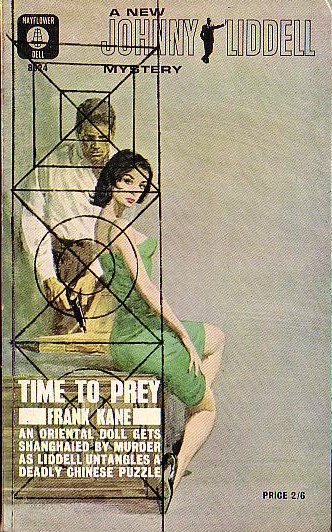
Frank Kane’s Time To Prey
Time To Prey starts with a girl named Blossom Lee passing an envelope to private eye Johnny Liddell. Then Liddell gets into a fist fight. He’s always getting into fist fights. He’s that kind of guy.
He has no idea why the girl passed him the envelope and he has no idea what was in it since a couple of hoods took it away from him. But when the girl turns up dead Johnny decides to interest himself in the case. She was a client. Well, not actually a client, but almost a client. And Johnny doesn’t like it when pretty girls get murdered.
He’s even more keen to get involved when he discovers that the Treasury Department is interested in the case. Apparently it’s connected with a nefarious commie plot to infiltrate Red Chinese agents intro America. Johnny doesn’t like commies.
The case seems to be running into a brick wall until Johnny comes up with a clever plan to get things moving. What this case needs is another corpse and he thinks he knows a way to arrange it.
He certainly manages to get things moving, in a big way.
Johnny Liddell comes across as very much a Mike Hammer clone, but more cold-blooded and less ethical. Yes, he’s a guy who makes Mike Hammer look like a Boy Scout and a liberal bleeding heart. Being responsible for cold-blooded murder doesn’t bother Johnny, as long as it’s cold-blooded murder of commies. And Johnny is in a way working for the US Government. Cold-blooded murder is definitely A-OK if it’s a commie and you’re working for the US Government.
Johnny is a guy who knows he’s one of the good guys and if bad guys need killing then the best thing to do is to kill them, or arrange things so they get killed.
Trying to emulate Mickey Spillane certainly made solid commercial sense in 1960 but Kane is just not quite in the Spillane league. His writing doesn’t have Spillane’s manic energy. And while not everybody approves of Spillane or Mike Hammer the fact is that Hammer was more than just a thug. He had slightly more complex motivations and he had an actual emotional life. You might not like Hammer but the character had a certain reality. Spillane was a first-rate writer. Kane was a second-tier writer. Emulating a successful formula is not as easy as it looks.
That’s not to suggest that Kane was a poor writer. He was very competent and entertaining but he lacked that extra something that writers such as Spillane had.
Apart from his total lack of ethics there’s not much in Johnny Liddell’s personality to make him stand out. He’s basically a stock-standard tough guy hero.
And you could say the same about the novel itself - there’s very little to distinguish it from any other hardboiled PI novel. It is however competently plotted, it’s well-written, fast-paced and action-packed. I wouldn’t call it sleazy but Kane does add a few sexy moments.
As long as your expectations haven’t been set too high Time To Prey is a thoroughly enjoyable read. Recommended.
I’ve also reviewed Frank Kane’s 1957 interesting hardboiled novel about corruption in the music business, The Living End.
Thursday, December 22, 2022
Clyde Allison's Gamefinger (Man From Sadisto 6)
What made Knowles so special among sleaze writers is that his books are not just sleazy, they’re also extremely funny. He was a very gifted comic writer. He also had a knack for coming up with truly outrageous plots.
His Man From SADISTO spy novels featuring Agent 0008 may be his best-known works but sadly they are now exceptionally difficult to find and used copies are astronomically expensive. I would love to collect all twenty books and as soon as I have a spare five thousand dollars that’s exactly what I’ll do.
One single title in the series has been brought back into print and that novel is Gamefinger. It appears to have fallen into the public domain which is the reason it’s the only one to be currently in print.
It certainly starts with a bang. Of sorts. Actually it’s a long steamy reasonably graphic sex scene. Ace SADISTO agent Trevor Anderson (who acts as narrator) is holidaying in Maine, using the cover name Rex Kingston. He’s staying in a log cabin so remote that it can only be reached by floatplane. He hasn’t heard a floatplane land so he is rather surprised when he sees a naked girl floating in the lake. She isn’t dead. He soon discovers that she’s very much alive. She is six feet tall and blonde and looks like every man’s fantasy of a naked amazon. She’s also very friendly. After they’ve had a long hot lovemaking session they decide that introductions might be in order. Her name is Karni. Then suddenly Agent 0008 receives a staggering karate blow and he doesn’t know anything until consciousness returns some considerable time later.
He regains consciousness in SADISTO headquarters. SADISTO is a top-secret US Government intelligence agency. Its mission is to protect the Free World. Protecting the Free World involves killing people and SADISTO’s elite triple-zero agents are licensed to kill. They’re not just licensed to kill, they’re expecting to keep in practise. Preferably by killing people who deserve to be killed (a category that includes anyone of whom SADISTO disapproves). Their ethical standards would shock the average Mob hitman. But it’s OK, they’re killing for freedom.
Agent 0008’s latest mission is his most important yet. The Free World is in deadly peril. A dangerous madman code-named Gamefinger has hatched a plot of such terrifying and sinister evil that it almost takes one’s breath away. Gamefinger intends to end war. This of course would be disastrous. Apart from anything else it would be bad for business and there’s no more profitable business than war. Gamefinger must be stopped.
Gamefinger’s scheme is ingenious. He wants to revive the Roman gladiatorial games in order to provide an outlet for human violence. His new gladiatorial games will be much more brutal than the Roman version, they will involve lots of nude girls and they will be televised live to the entire world. The games will cost hundreds of lives but could save millions of lives if Gamefinger is right. Agent 0008 has to grudgingly admit that it’s a genuine ethical dilemma and that maybe Gamefinger has logic on his side. But 0008 still has a job to do, and his job is to stop Gamefinger.
SADISTO’s plan is to infiltrate 0008 into Gamefinger’s organisation.
There’s plenty of pointed political satire in this book. SADISTO are the good guys but they’re more immoral than the bad guys. SADISTO’s agents are on the side of freedom but they’re sadistic bloodthirsty killers. It’s clever political satire because the author really does raise some pertinent questions about whether the good guys really are the good guys.
There’s also a great deal of black comedy, and the book is at times outrageously funny.
And there’s a lot sex. The sex is described in fairly explicit terms but manages not to come across as crude schoolboy stuff. This is well-crafted erotica.
Agent 0008 is an intriguing hero. He’s very much an anti-hero. He has no morals whatsoever. He doesn’t claim to have any morals. Killing is not just an integral part of his job, it is for 0008 a very pleasant part of the job. He can’t think of anything more enjoyable than killing and torturing people because he’s doing it for the Free World. He can feel virtuous about it. He’s the most chillingly nasty of all fictional spies but he’s brutally honest about himself. He’s a complete rogue but vaguely likeable in his cheerful amorality. He doesn't have any morals but he does understand morality.
The idea of televised deadly gladiatorial-style games being used for purposes of mind control became a very common trope in the 70s and 80s, especially in post-apocalyptic science fiction movies. But William Knoles/Clyde Allison came up with the idea way back in 1966. It’s an idea that may have been used in science fiction stories prior to that time but offhand I can’t think of any examples. Either way it was certainly an idea that would have seemed fresh and startling in 1966.
Gamefinger is basically a sleaze novel (although it is at least very skilfully written sleaze) with a spy plot tacked on but it’s an intriguing spy plot
It’s intended to be sexy and funny and satirical and it succeeds on all counts. Gamefinger is good dirty fun. Highly recommended.
Sunday, October 16, 2022
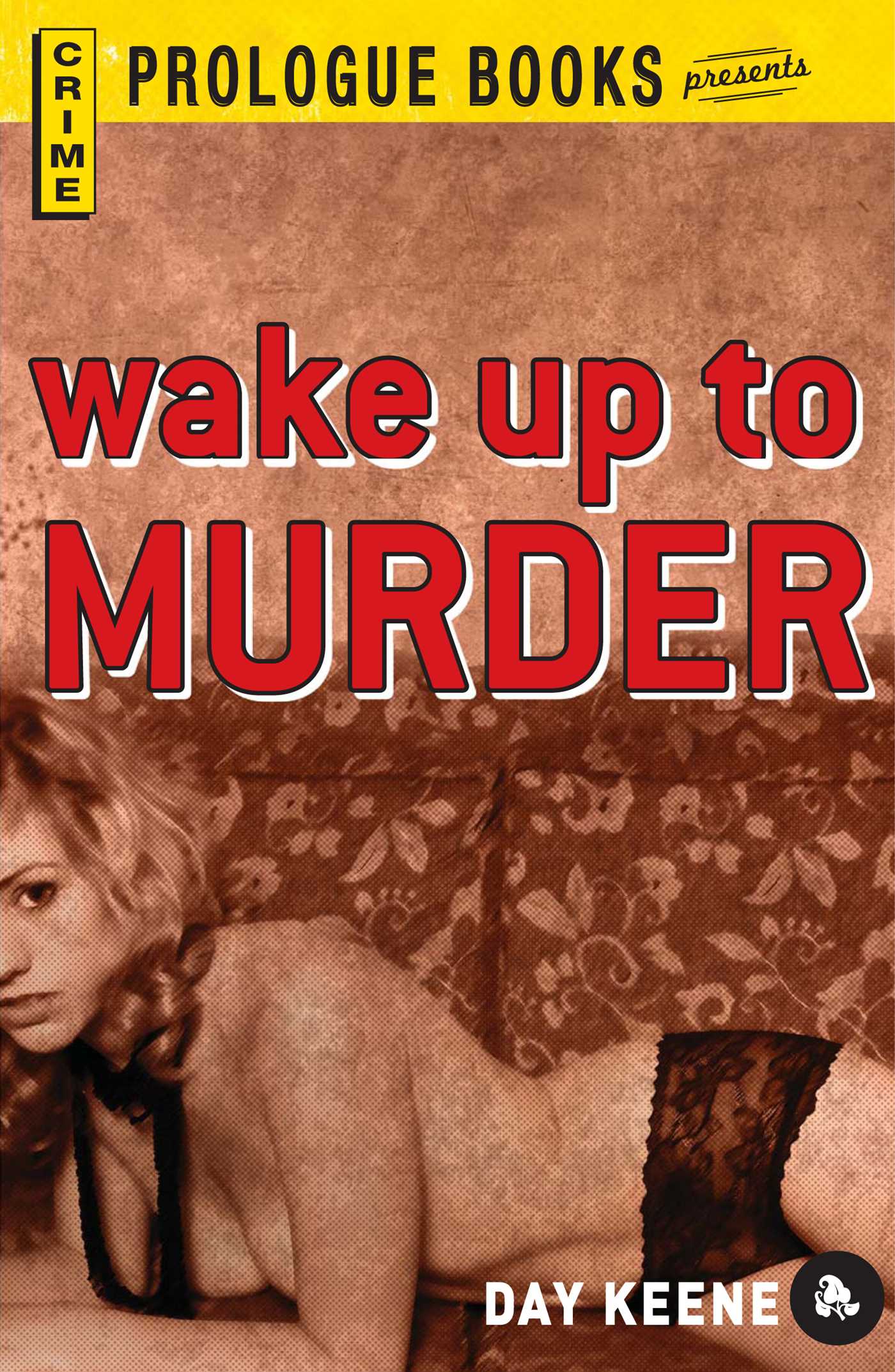
Day Keene's Wake Up to Murder
Jim Charters works in a lawyer’s office. He doesn’t get paid much. It’s a menial position. He tends to get the given the dirty jobs. Like telling Pearl Mantinover that her appeal has been rejected and that she’s going to be executed for murder. Pearl is a nice girl and Jim figures she’s probably innocent and this his boss, Kendall, badly mishandled her defence.
Jim tries not to think about it. His life is not that bad. His marriage to May is a good marriage. They’re getting by. And it’s his birthday. It turns out to be a disastrous birthday. Jim gets fired, he thinks May has forgotten his birthday, he takes a few drinks, he takes a few more drinks, he ends up in every bar and dive in Sun City. He wakes up in a hotel room with no idea how he got there. What he does know is that he spent the night with Lou, a cute girl from the office. He feels bad about that. He finds that despite his night on the town he has more money in his wallet than he had at the beginning of the night. That confuses him. Then a guy called Mantin shows up, tells Jim how pleased he is that Jim is going to do that job for him and leaves Jim with an envelope. It’s payment for the job.
The envelope contains ten thousand dollars (a huge fortune in 1952). Jim’s problem is that he doesn’t remember ever meeting Mantin and he doesn’t remember what it was that he agreed to do for him. It has to be something pretty big. Ten grand is a lot of money.
Now Jim isn’t just confused, he’s frightened.
He decides to tell May everything. It’s obvious that he has to find this Mantin guy. And get out of the mess he’s in. He remembers very little of the previous night but he figures he was shooting his mouth off, trying to make himself seem more important. Presumably he claimed to be able to do something that in reality he couldn’t do, and Mantin took him at his word and offered him the ten grand to do it.
Slowly the pieces come together but Jim just seems to be getting into deeper and deeper trouble. Pretty soon there’s a murder for which he is the prime suspect. There are various shady characters who come into the story, some of them very dangerous indeed. In classic noir style Jim Charters has been plunged into a nightmare world and he has no idea how to get out of it because first he has to figure out how the nightmare started.
And he has two women to deal with and he’s not sure if he can trust either of them.
The cops are also likely to be troublesome. Even Jim would have to admit that the story he has to tell them doesn’t sound the slightest bit believable.
This book boasts a nicely devious plot, with both the reader and Jim Charters encountering plenty of unexpected twists.
Keene has a solid prose style. It’s only moderately hardboiled and there isn’t the snappy dialogue one associates with the hardboiled style. There is however plenty of paranoia. Jim Charters has no shortage of things about which to be paranoid.
There’s not a huge amount of action. It’s a plot-driven tale rather than an action-driven tale. Don’t expect shoot-outs and high body counts. Jim Charters is no tough guy. He’s just an ordinary joe and he’s out of place in a world of gangsters and murder.
The sleaze level is quite moderate, in fact very moderate.
This is an unassuming little novel but it’s a well-told well-plotted story and it’s thoroughly enjoyable. Recommended.
Sleep with the Devil, published two years later, is a much more noirish, much more cynical and much sleazier Day Keene novel and it is on the whole a much better book (and a better place to start if you’re new to this author).
Stark House Noir has issued three Day Keene novels (this one, Sleep with the Devil and Joy House) in a single paperback volume.
Sunday, August 21, 2022
William Knoles' Sexperiment
Dr John Whitman is a medical researcher. As the book opens he has some explaining to do to the authorities. He has to explain all those dead people. He tells the story in an extended flashback.
As his story begins he has a cosy post which gives him the freedom to explore new frontiers in medical research, along with his three young graduate students. Dr Whitman and his students have found a field of research which offers exciting possibilities - sex. They’re not interested in studying rats or monkeys. They want to study people. The problem with a research project of this kind is finding volunteers to participate but they realise that really isn’t a problem at all. Their four-person team consists of two men and two women. They will be the research subjects.
Of course this means that they’ll have to have lots of sex with each other but that’s a sacrifice they’re prepared to make for the sake of science.
Sadly the projects ends prematurely. The University thinks the project is just an excuse for a series of orgies so they fire Dr Whitman. His career is in ruins.
Or so it seems. Then he gets an offer he can’t refuse. An offer from the Mandrake Foundation, a very secretive foundation dedicated entirely to sex research and funded by an ageing eccentric sex-crazed billionaire.
Dr Whitman enjoys the challenges of his new position. It involves having lots of sex with eager female volunteers and he enjoys that as well.
The Mandrake Foundation employs a large number of medical scientists. They have several things in common. They’ve all lost their licence to practise medicine, all have disreputable backgrounds and all are basically mad scientists. One of these scientists, Dr Krieghund, has made a major breakthrough. He’s discovered a chemical that inflames female sexual desire. It’s an aphrodisiac that actually works. The trouble is that it works a bit too well. It doesn’t just make women amorous, it makes them terrifying.
And that’s the effect the stuff has when it’s incredibly diluted. If people ever got exposed to the undiluted chemical the results would be catastrophic. But these are serious scientists. They would never allow an accident like that to happen.
There’s an enormous amount of sex but none of it is described graphically.
The author is clearly aiming for comedy. At times almost slapstick comedy. There’s an incredible amount of mayhem as well but again you have to remember that you’re not meant to take this seriously at all. And it’s all so clearly absurd that I don’t think anyone would take it seriously. This is cartoon violence.
There’s also an element of satire, making fun of the pretensions of science and scientists and taking a few swipes at authority. This was the 60s after all.
No-one is going to mistake this for great literature but it’s lively and often genuinely amusing. In the 1960s sex was still something you could make jokes about.
Ferox Publications have re-issued this book in paperback paired with another William Knoles sleaze novel, Shame Market. Shame Market is very amusing very sleazy fun.
And that’s a pretty good way to describe Sexperiment. Shame Market is the better, funnier novel but both are enjoyable. Recommended.
Tuesday, August 9, 2022
Henry Kane’s Frenzy of Evil
Henry Kane (16908-1988) was an American lawyer and prolific pulp writer.
The book starts with a party for Jonathan Joseph Carson’s first wedding anniversary. Carson is sixty-two. His wife Dolores is twenty-two. Also present is his business partner George Ross, Ross’s wife and their two children, Jeffrey and Debbie. Playwright Frank Haines and his wife Vera and the director of a local theatre group, Gary Mason, are the other guests. These nine people represent hate, love, guilt, rape, adultery, madness and murder with each guest being particularly representative of one of these sins. So far no-one at the party has actually committed murder but that will change soon.
There are multiple romantic triangles established between these various characters. There’s suspicion and jealousy. Some of the jealousy is sexual, but not all of it.
At least two of the guests intend to commit murder. And they intend to get away with it.
The romantic entanglements go on getting messier and there are misunderstandings. Suspicions grow. Some of the suspicions are totally wrong and that will have consequences.
When the murder occurs it doesn’t go the way the murderer planned. Or at least it doesn’t go the way one of the murderers had planned. It’s made to look like a suicide but that fools cunning old Sam Kelly, the local sheriff, for about five minutes. Then he decides it’s a murder.
Then the plot twists start to kick in. And they’re nice and nasty with suitable ironic touches. The problem for the protagonists is that they’re operating on the basis of wrong or incomplete information, which leads them to make incorrect assumptions, which in turn leads them to do things that are the opposite of what they should do. They’ll think they’re digging themselves out of a hole when in fact they’re just digging themselves in deeper and deeper.
We can see fairly early on how events are likely to play out, but that makes it more enjoyable watching the author gradually bringing all the pieces together until the likely ending becomes a certainty. It’s a clever, devious and intricate plot in which the characters manipulate themselves without knowing it. What’s fun is that the reader can see the mistakes they’re making and we know how much trouble they’re getting into.
There’s a slight noir feel but whether you will think it’s enough to qualify this as noir fiction depends upon how strictly you define the term. It definitely has some dark cynical moments. And it has some dark characters.
If it is noir then it’s noir involving the rich and privileged rather than the usual noir losers. Of course the rich and privileged can be just as morally depraved as anyone on skid row.
And there’s some scientifically dubious but fun psychiatric stuff which is always a welcome touch.
The book is good enough to make me want to read more of Henry Kane’s work. Incidentally Henry Kane should not be confused with another fine noir writer, Frank Kane.
Frenzy of Evil is well-crafted mystery suspense and it’s highly recommended.
Thursday, May 12, 2022
Henry Kuttner 's Crypt-City of the Deathless One
Ed Garth is drinking himself to death in a seedy bar on Ganymede, one of the moons of Jupiter. He gets an offer from a man named Brown, an offer he can’t refuse. In fact Garth will accept any offer that will provide him with money to buy liquor. He will be acting as a guide to an expedition to the Black Forest on Ganymede.
No sane person would accept this offer. This will be an illegal expedition. And no Earthman has ever entered the Black Forest and come out alive. No Earthman, apart from Ed Garth.
Ganymede was once home to an incredibly advanced civilisation, a civilisation long gone. All that remains is a vast collection of machines and robots and no-one has ever been able to figure out how to make them work. There is rumoured to be a lost city of this ancient civilisation deep in the Black Forest. Garth figures that Brown’s expedition is tying to find the secret of the power source used by the ancient civilisation. They are rumoured to have discovered the secret of atomic power (this was written in 1943 when atomic power was still science fiction).
The secret of the power source would be a fabulous prize since Earth is rapidly running out of power sources. Unless the secret of atomic power can be unlocked civilisation on Earth will collapse.
There may be another secret in that lost city. One just as important, and much more important personally to Ed Garth. That city may hold the key to a cure for the Silver Plague that is ravaging the Earth’s population. That’s the secret Ed Garth, Doc Willard and Moira were looking for five years earlier. Garth was the only survivor of that expedition and he brought back with home a horrible memory. The memory is horrible because it is so vague. One of the many reasons nobody goes into the Black Forest is the poison released by the noctoli plant, a poison which strips a man of his memories and his will. He becomes little more than a zombie.
Garth has built up an immunity to the noctoli poison and he thinks he has a method of protecting others from it but the method is far from fool-proof. If it doesn’t work then this illegal expedition will be in a lot of trouble.
That’s without taking into account the other horrors of the Black Forest, horrors so well camouflaged that you don’t know they’re there until it’s too late. Ed Garth knows the nature of these horrors. Entering the Black Forest with Ed Garth as a guide would be an insane risk, but entering that forest without him would be simple suicide. The secrets hidden in the lost city of the ancients justify an insane risk.
The journey proves to be just the nightmare that Ed Garth expected but turning back would be more dangerous than going on.
Garth isn’t sure if he’s happy that archaeologist Paula Trent is part of the expedition. She reminds him of Moira, and Moira is the subject of another of his personal nightmares.
What’s cool about this book is that there’s plenty of excitement but hardly any violence - the threats come mostly not from bad guys but from the deadly flora and fauna of Ganymede. Ganymede is not a nice world. Kuttner displays plenty of imagination in throwing fresh horrors at Ed Garth. There’s a nice atmosphere of doom as more and more things go wrong.
This is a kind of lost world story and it obeys most of the conventions of that genre.
The ending is not the ending you expect but it’s highly effective.
A very entertaining tale. Highly recommended.
Tuesday, November 16, 2021
Donald E. Keyhoe's Strange Staffels
Donald E. Keyhoe (1897-1988) was an American pulp writer in several genres but was most notable as a writer of science fiction-tinged aviation adventure stories. He later became a UFO enthusiast. Keyhoe had been a Marine Corps pilot and then a kind of aviation impresario. He started writing while recovering from an aircraft crash.
The Philip Strange Stories mix First World War aerial combat, horror, science fiction, weird fiction and espionage.
Before the war Captain Philip Strange had had a mentalist/hypnotism act in a carnival and had studied various eastern esoteric practices. He doesn’t have supernatural or occult powers but he does have certain powers that would today be described as paranormal although mostly he relies on his training as an intelligence officer and his profound knowledge of hypnotism and psychology. At the start of the First World War he was assigned to G-2, the US Army Air Corps’ intelligence section. He was both a fighter ace, a spy and a spy-hunter.
The stories range from moderately outlandish to very outlandish and they’re all packed with action. The stores all involve Strange’s efforts to foil devilishly clever German plots. The stories are always imaginative and Keyhoe always manages to throw in at least one genuinely bizarre (an often creepy) element.
Satan’s Staffel was published in the March 1934 issue of Flying Aces. Captain Philip Strange of G-2 has his first inkling of trouble when he encounters a black German aircraft and gets a glimpse of the pilot - it is a woman, with a face like a Medusa. The German aircraft seems impossible to shoot down - his machine-gun bullets simply have no effect. Then the female pilot stands up in her cockpit and her aircraft explodes in a gigantic fireball.
Strange survives this aerial duel but when he lands he finds out that this is just the latest in a series of encounters American airmen have had with these crazed female pilots.
When one of the black aircraft is forced down Philip Strange begins to understand the true horror of this latest fiendish and inhuman plan of the Germans. There is nothing supernatural about it but the reality is worse than any supernatural horror.
Strange is sent on a desperate mission to infiltrate this terrifying Amazon squadron, and he will need all his skills as a spy if he is to survive.
The Vanishing Staffel was published in Flying Aces in December 1932. Allied planes are taking off and vanish into thin air. Machine-gun fire is coming from out of nowhere. Dazed survivors mumble about the world disappearing. It’s another devilish German plot, and it means a vast German aerial armada can strike anywhere it chooses without being seen.
Once again Keyhoe mixes science fiction with aerial adventure and the science stuff is very clever.
Hoodoo Drome (published in Flying Aces in November 1933) is more of a straightforward stories of espionage and sabotage without any overt science fictional elements.
It starts with an American general murdering a French general. Strange gets involved in an American plan to cover up the murder. At the same time American aircraft have been mysteriously exploding in mid-air and then American aviators start shooting down American planes. Philip Strange believes all these odd occurrences are linked. Of course he’s right but the real German plot is much more ambitious. It involves mining (mining to plant explosives under enemy trench systems was a popular idea in the First World War) and in this story both the Germans and the Allies are using the idea.
There’s action on the ground, under the ground and in the air. And there are German spies everywhere.
Skull Staffel appeared in Flying Aces in December 1934. The Germans are creating havoc with fighter aircraft that are virtually silent and virtually invisible (Keyhoe was a big fan of the idea of various types of what today we would call stealth technologies). But there’s a bigger problem - a vital map showing details of Allied defensive positions and the Germans have gained possession of it.
Once again Strange comes up against clever and ruthless German spies.
The Skeleton Barrage was published in Flying Aces in April 1936. It starts in typical Keyhoe fashion - American airfields are being wiped out. Totally wiped out - all that is left is a gigantic crater. G-2 have come into possession of a strange drawing made by an Allied spy - Strange is sure there’s a vital message contained in the picture but it’s in some sort of obscure visual code that nobody can make any sense out of.
A German spy, about to be captured, throws a camera into a river. The camera is another clue but in typical Keyhoe style it’s another clue that is mystifying rather rather than enlightening even to Philip Strange.
Then Strange, flying in his Spad, sees fiery skeletons plunging to earth (accompanied by a hideous wailing sound) as another airfield is wiped off the map. When he lands Strange encounters a high-ranking German naval officer - German spies are commonplace but a German naval officer up to no good on an Allied airfield is quite a surprise.
This is part of another grandiose German high-tech scheme which is so clever I’m not going to give you any hints as to its nature.
The Staffel of the Starved was published in Flying Aces in May 1936. The Germans have been doing odd things with their artillery barrages and mysterious coded messages have been picked up. Then something really odd happens - a German aviator who landed his aircraft and killed three French radio operators (who were monitoring those coded messages) is found dead - but he died of starvation! Even more odd, he was one of Germany’s top fighter aces.
Then an American pilot is murdered by a French pilot and American fighters start shooting down French fighters.
The Staffel Invisible appeared in the May 1939 issue of Flying Aces. Philip Strange sees two American aircraft shot down but there is not a sign of a German aircraft anywhere. It’s as if the American flyers have been shot down by invisible enemies.
Strange lands and sees more bizarre things - a head and shoulders appear from nowhere and his own Spad disappears and then reappears. Strange disguises himself as a German officer and takes off in his Spad and ends up landing on an airfield that isn’t there.
All seven stories are weird, exciting and enjoyable. Strange Staffels is highly recommended.
I’ve reviewed an earlier volume of Philip Strange stories, Strange War, as well as a couple of collections, of other aviation adventures by Keyhoe - Vanished Legion (WW1 aerial stories) and the Richard Knight stories (aviation-espionage adventures set in the 1930s). And to demonstrate that Keyhoe didn’t just write aviation stories there’s his fun diabolical criminal mastermind novel Dr Yen Sin #1 The Mystery of the Dragon’s Shadow.


.jpg)


.jpg)