Showing posts with label melodrama. Show all posts

Tuesday, June 11, 2024

W. Somerset Maugham’s Miss Thompson (Rain)

Rain is one of the best known short stories by W. Somerset Maugham (one of the grandmasters of the art of short story writing). It was originally published as Miss Thompson in the American magazine The Smart Set in April 1921. Maugham claims to have written the story in 1920. It’s a longish short story, long enough to be regarded in some genres as a novelette.

The story was adapted into an astonishingly successful stage play, Rain, by John Colton and Clemence Randolph. The success of the play was presumably the reason the title of the story was changed to Rain.

The story was made into a silent film in 1928, with Gloria Swanson starring and with the title Sadie Thompson. 

A few years later it was made into a talkie, Rain (1932), with Joan Crawford and Walter Huston. That movie was a commercial flop, for reasons I have never been able to fathom. It has since built a substantial cult following.

In 1953 it was filmed again as Miss Sadie Thompson with Rita Hayworth. This was a sanitised squeaky clean version and a waste of Miss Hayworth’s considerable talents.

This is the story of a battle of wills between a prostitute and a preacher.

The 1920s and early 30s were a period of rebellion against the moralising and social rigidity of the late Victorian era. It was also a period in which at least some sections of society were embracing sexual freedom. The flapper became a symbol of rebellion, and so too did the prostitute. Books and movies not only dealt with prostitutes sympathetically but even admiringly. They were seen as women determined to live their own lives even if it meant flaunting social conventions.

Of course the spirit of rebellion was fairly thoroughly crushed by the Depression, by a resurgence in religious moralism and by the Second World War which trained the population to accept a high degree of social control.

The story begins with the arrival of a steamer at Pago Pago. The passengers include a Dr Macphail and his wife. They also include fanatical puritan missionary Mr Davidson and his malevolent wife. The passengers also include Sadie Thompson. It is to be a very brief stopover. The passengers will soon be departing for other destinations, but an outbreak of measles strands them in Pago Pago for two weeks. The only accomodation on offer is provided by a half-European trader. The passengers are not pleased, and the relentless rain adds to their discomfort.

Davidson and his wife are scandalised by Sadie’s behaviour. She entertains men in her room. They listen to records and they dance. Davidson fears they do other things. He is convinced that Sadie had been working in Honolulu’s notorious red-light district. He is convinced she is a prostitute. Which she almost certainly has been. Whether she is plying her trade in Pago Pago is left obscure, but Davidson sees her very existence as a threat to morality. 

Davidson has proudly told Dr Macphail of his campaign to eradicate sin on the small island where his mission is located. To Macphail it sounds like Davidson and his wife are brutal merciless unscrupulous tyrants who have instituted a reign of misery on the island but Davidson has no doubt he is doing the Lord’s work. Both Dr Macphail and the reader will suspect that Davidson is motivated by an intense pleasure in exercising power over the lives of others. 

And Davidson has no intention of permitting the existence of sinners like Sadie. He is going to save her soul. If that fails she must of course be destroyed. And Davidson has found a way to destroy her - if he has her sent back to San Francisco she will go straight to prison.

The odds seem to be in Davidson’s favour. And it appears that Sadie, utterly defeated, will agree to whatever fate Davidson decrees for her.

But there are some major plot twists to come.

And some slight differences to the 1932 film version. The endings are very very similar with the ending of the story having a slightly harsher edge to it, but to my mind both endings work.

Maugham was a fine writer who was especially adept at the short story format. He seems to be out of fashion these days which is a great pity. This is a superb novelette with plenty of overheated tropical atmosphere and some nice touches of sleaze, hypocrisy, repression, sin and guilt. Very highly recommended.

Tuesday, September 20, 2022

Elaine Dorian's The Sex Cure

The Sex Cure is a 1962 sleaze novel by Elaine Dorian, a pseudonym adopted by Isabel Moore. Moore lived in Cooperstown in upstate New York and her sleaze novels were based very closely on that town and its residents. So closely that she was threatened with libel suits and very nearly run out of town. The subsequent court case brought some notoriety to both the book and its author.

I’ve been reading a lot of the sleaze fiction of this era recently and it’s not quite what I expected. These books for the most part are not erotica. They’re either noir fiction that’s slightly sleazier than average, or they’re romantic melodramas with a bit of added sex. Although I always assumed that these books were aimed mostly at men they’re often much closer in feel and spirit to what would later become known as Chick Lit.

The Sex Cure is a case in point. It’s pure melodrama. It’s very similar in both tone and content to Grace Metalious’s 1957 massive bestseller Peyton Place. Both books deal with sex and sin behind the respectable façade of an American small town. Both books take aim at the narrow-mindedness, viciousness and hypocrisy of small town life. Both novels used sex as a major selling point. The Sex Cure is slightly more explicit in its treatment of sex, but only slightly.

The setting is a town named Ridgefield Corners. The town is run by two elderly men, Cy Stevens and Senator John Adams Turner. Both are elderly very nasty men and both are corrupt sleazeball political operators.

Dr Justin Riley comes from a rough deprived background but now he’s a rising thoracic surgeon at the town’s only hospital, with a glittering future in front of him. Or at least he did have a glittering future in front of him. If only Justin could keep his hands off the pretty nurses at the hospital, and off pretty girls in general. Now one of those pretty nurses, Betty Hogan, has been admitted to the hospital. She was bleeding to death after an illegal abortion but before lapsing into a coma she named Justin as the father of the child. And Justin is now implicated in a case of criminal abortion.

Betty may yet survive but the same can’t be said of Dr Justin Riley’s career. He’s in big trouble with his wife Olivia and with his father-in-law, Senator Turner. And the respectable citizens of Ridgefield Corners have turned against him and have decided that there’s no place in their town for such a wicked immoral person. Justin sees considerable irony in this. Whenever the townspeople get sick they run to him to save their lives. He has arranged abortions for lots of the respectable husbands of the town when they’ve gotten their mistresses pregnant, and most of the town’s respectable wives have welcomed Justin into their beds.

Justin’s sin is not adultery. His sin is that he got caught and now there’s a scandal and the respectable citizens of Ridgefield Corners don’t like scandals.

What’s worse is that all of Justin’s woman troubles have come to crisis point at the same time. His marriage was heading for the rocks anyway. He’s been trying to entice his pretty (and married) lab assistant Marge Myles into bed. He’s been sleeping with his old girlfriend Misty Powers again. Misty is sinking further into alcoholism.

Justin knows that his life is falling apart but he has no idea what to do about it. He’s never really thought about the consequences of his actions. He married Olivia for her money. Maybe he loved her at first. Their sex life has become a washout. Justin can’t live without sex. He assumes that the women he beds understand that it’s just harmless fun. But they don’t understand that at all. Misty is in love with him. Betty Hogan didn’t understand it. She was convinced that Justin would divorce his wife and marry her. Justin thought that he could keep his affairs discreet. Everybody knew he was a womaniser but as long as he wasn’t involved in open scandal nobody cared. Now he’s mixed up in what promises to be a very public scandal.

Justin has to figure out what to do about all these women in his life. And the women need to figure out what to do about Justin.

This is pure unalloyed romantic melodrama. There’s plenty of sex but it’s not at all graphic. The book is aiming for sin and sensation rather than mere erotic thrills. It’s also obvious that the author intended this as a poison-pen letter to her hometown. In Ridgefield Corners she’s created an extraordinary world of corruption and hypocrisy.

The characters are on the whole not especially admirable, but apart from the two crooked politicians and the equally corrupt local police chief they’re mostly people who have made a mess of their lives though weakness, short-sightedness, poor judgment and wishful thinking. Although they’re all messed up they could extricate themselves from their predicaments. But they probably won’t.

In these sleaze novels you’re never quite sure whether you’re hoping to get a happy ending or a downbeat ending and in this case the author keeps us guessing. Even Justin is perhaps not beyond saving, if only he could convince himself that Justin Riley was worth saving.

It’s all reasonably entertaining and it certainly offers lurid sensationalism. Recommended.

If you enjoy this sort of thing that I can highly recommend Dallas Mayo’s One Night Stand (1962), another small town sex melodrama. Other sleaze novels that are basically romantic melodramas are Florence Stonebreaker’s excellent Reno Tramp (1950) and Lawrence Block’s Kept (1960).

Tuesday, August 2, 2022

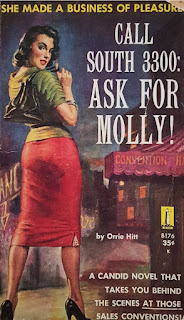
Orrie Hitt's Call South 3300: Ask For Molly!

Call South 3300: Ask For Molly! is a 1958 sleaze novel by Orrie Hitt, one of the most prolific and interesting writers that genre produced.

Slade Martin is the sales manager of the All-Channel TV company. They make TV sets. They were one of the most successful companies in the industry but they’ve been on a downward spiral. The general manager, spends all his time at the golf course. Their sets are outdated and look stodgy. Sales are plummeting. Slade knows that he’s the only man in the company who can turn the business around. The first step is to get a big order from a distributor named Kane. The upcoming sales convention will be the opportunity. Slade has an idea how he can get that order. All he needs is the right girl to butter up Kane.

The obvious choice would be the new girl in Accounting, Ann Frank. Ann is a gorgeous classy blonde. Slade is pretty obsessed by her. He’s an inveterate womaniser but this girl is something special.

Slade is sleeping regularly with his secretary Betty but it doesn’t mean anything to him. She has a nice body, that’s all. He’d much rather have Ann.

There are things he doesn’t know about Ann. The first time Ann slept with a boy it was like a whole new world opening up for her. She really really likes sex. In fact she likes it so much that she does it professionally. Ann is a call girl, working for Molly. She only keeps the job at All-Channel because she’s fallen for Slade.

Slade goes ahed with his plan to get that big order from Kane. He doesn’t actually expect her to sleep with Kane, she’s just supposed to string him along, but Ann takes the assignment more seriously than that. There’s a $500 bonus in it for her if she gets that order out of Kane and to Ann there’s no difference between turning tricks for Molly and turning tricks for the All-Channel TV company.

Things get very complicated. Ann and Slade sleep together but to Ann’s horror she feels nothing. She was thinking in terms of marrying him but to her it seems dishonest to marry a man and then pretend to be experiencing sexual bliss when she feels nothing.

Ann doesn’t feel anything when she sleeps with Slade but she feels a whole lot when she sleeps with bad boy Eric. Eric is a creep and a loser and couldn’t hold down a job under any circumstances and Ann understands that but he drives her wild in bed. She has no illusions about him. She plans to turn Eric into a kept man.

But nothing works out the way they’d expected for Ann or Slade, or for Betty, or for Eric.

This is full-on melodrama. It’s melodrama with sleaze but this was 1958 so while there’s plenty of sex going on we don’t get any graphic descriptions of the sex. We don’t get any descriptions of it at all. There’s an atmosphere of sleaze and lust and thwarted passion and twisted love but when the characters enter the bedroom we have to imagine what they might be getting up to.

None of these characters is especially likeable but they’re not unlikeable either. They’re a mixture of good and bad, strength and weakness, cynicism and romantic ideals. And of course this was the 1950s so it’s taken for granted that prostitution is wicked. Having said that Hitt offers us a surprisingly sympathetic portrayal of a call girl. She’s not a mere bad girl.

The novel certainly takes a jaundiced view of business ethics. And kind of dirty trick is justified if it increases sales. The only strategy that All-Channel TV doesn’t consider is making better TV sets. In fact this book deals with two different businesses, respectable businesses like manufacturing TVs and prostitution. Prostitution comes across as being the more honest business. Ann at least takes pride in her work as a call girl. She makes $100 a trick (which in 1958 would have made her a very expensive high-class call girl) but she gives her customers their money’s worth. The only dishonest acts she performs are on behalf of All-Channel TV. Compared to the people running that company Molly (the madam for whom Ann works) is a model of honesty and integrity. Molly never asks Ann to do anything crooked.

The one puzzle that is never solved in this novel is why Ann can’t get aroused when she has sex with a guy who wants to marry her. We can of course offer our own speculations on that subject but Hitt leaves it an unanswered question.

Call South 3300: Ask For Molly! is fairly typical Orrie Hitt, and that’s no bad thing. Highly recommended.

This novel has been published in a paperback edition from Stark House which includes three Beacon Books sleaze classics (the others being N.R. de Mexico’s Marijuana Girl and Elaine Dorian’s Sex Cure).

Tuesday, March 8, 2022

Diane Cilento’s The Manipulator

The film career of Australian actress Diane Cilento (1932-2011) was at its peak when in 1967 she decided to try her hand at writing a sleazy satirical novel about the film industry. The result was The Manipulator. A second novel followed in 1972. At this time Cilento was married to Sean Connery, to whom The Manipulator is dedicated.

A group of British film people travel to Acapulco for a film festival, accompanied by a British cultural attache. They’re promoting the latest movie by whizz-kid director Nicholas Jeff, a movie that is also intended to launch actress Terry Grant into stardom.

Naturally they spend most of their time bed-hopping, bitching about each other and plotting. The manipulator of the title is Jeff. He loves to manipulate people both emotionally and professionally. He’s planning to stab his producer, an American named Bronson, in the back. He also plans to break up the relationship between his screenwriter Holden and his girlfriend Alfrida and to interfere in the marriage between Scandinavian beauty (and part-time prostitute) Ebba and poor fisherman Juan.

He doesn’t really have much to gain by these manoeuvrings. He just enjoys playing games with other people’s lives. Maybe it gives him as much pleasure as he gets from manipulating the actions of the characters in his movies. Maybe secretly he knows he’s not a very good director. His latest movie is just a concoction of ideas he’s stolen from other people’s movies.

Of course all this manipulating is likely to end disastrously, but disastrously for whom?

You get the feeling that Cilento was pretty cynical about the film industry. Of course she was trying to write an entertaining and amusing satirical novel but you also get the feeling that she’s not exaggerating the foibles of film people all that much. As she portrays it the world of movies is a world of backbiting, intrigue, jealousies, opportunism, sexual adventurism and decadence.

The closest thing to a sympathetic character is Ebba. Being a whore she’s a bit more honest and realistic about sex than movie people. But she does a certain amount of scheming as well.

There’s no graphic sex but there’s certainly an atmosphere of sleaze and decadence. People with too much money and too much ego who are too accustomed to seeing other people in terms of what they can get out of them.

None of these people care very much about movies. They care about making deals and making money, or they care about fame and reputation.

Cilento is quite an amusing writer and while her characters are appalling excuses for human beings they’re very entertaining.

I know nothing about her second novel Hybrid so I can’t tell you if it’s along similar lines or not.

The Manipulator is long out of print but used copies are not too difficult to find, without paying an arm and a leg.

If you’re into stories about sex and sin in the movie world there’s plenty here to enjoy and the fact that it’s the British film industry rather than Hollywood makes it just a bit different. Recommended for those who enjoy this sort of thing.

Sunday, May 4, 2014

The Gauntlet of Alceste

The two 1920s Addison Kent mystery novels of Hopkins Moorhouse have been published in one volume by Coachwhip Press as The Addison Kent Mysteries. The Gauntlet of Alceste was originally published in 1921. The Golden Scarab followed in 1926. I have no idea if these were Moorhouse’s only attempts at detective fiction. The Coachwhip Press edition lacks an introduction, possibly because the author is so obscure that there was insufficient information to provide such an introduction. All that I can tell you is that Hopkins Moorhouse was a pseudonym used by Herbert Joseph Moorhouse (1882-1960).

It is The Gauntlet of Alceste with which we’re concerned at the moment.

This book seems at first to be a typical English country house murder mystery except that the setting in this case, the author being American, is in the United States. Henry C. Radcliffe lives with his daughter Rose in Hillcrest, a large and comfortable mansion in Westchester county in New York State. As is usual in this type of mystery several guests are staying at the house. Mrs St Anton, a handsome lady of mature years, and her nephew Roger Levering seem to be rather unwelcome guests and their presence at Hillcrest is a matter of some perplexity to Rose Radcliffe. The other guest is far more welcome - Tommy Traynor is a personable young man who works for a new York City gem merchant. Traynor is in love with Rose, a matter of which her father is unaware. Traynor has not yet achieved sufficient wealth or social standing to ask for Rose’s hand but he is a young man on the way up and he is confident that this unfortunate circumstance will soon be remedied.

Naturally there is a murder and it occurs quite early in the book. Everyone in the house is a potential suspect. Tommy Traynor feels that it might be advisable at this stage to call in his friend Addison Kent, a popular writer of murder mysteries who has had some success as an amateur detective. Kent is well-known to Detective-Lieutenant Bob Fargey, the investigating officer. Fargey has a reputation as an ambitious publicity-seeker who is nonetheless an honest and efficient police officer. He and Kent get on well and he is quite happy to have Kent’s assistance.

So far it all seems like a by-the-numbers fair-play country house murder mystery but two-thirds of the way through the book that changes dramatically. One of the characters introduces an outlandish and incredibly complex backstory that has no connection with anything that has happened so far and that introduces important new motives and new suspects the existence of which was entirely unknown to the reader up to that point. This in itself is just about enough to disqualify this novel as a fair-play mystery.

Worse is to come. The book proceeds to break most of the rules that would come to govern the golden age detective story. Those rules had not yet been codified of course, and most of the detective story writers of the golden age would at some time bend or break some of those rules. Nevertheless The Gauntlet of Alceste demonstrates the necessity for some sort of rules, and it tellingly demonstrates that while you might get away with breaking one of those rules if you break a whole swag of the rules then the reader is entitled to feel that the author is most definitely not playing fair.

The Gauntlet of Alceste also relies to a perilous extent on coincidence. Not just one coincidence either, but a whole series of very unlikely coincidences.

Despite its 1921 publication date The Gauntlet of Alceste has little in common with the classic puzle-plot mystery of the 1920s and 1930s. It has much more in common with Edwardian crime fiction, and in some ways it has even more in common with the Victorian sensation novel. I am personally quite fond of the sensation novel but it is as well for the reader approaching this book to be prepared for the fact that it does not conform to the pattern of the crime novel of the 20s and 30s.

If you are prepared to make such allowances you might enjoy the sheer outrageousness of the plot, involving as it does secret passage-ways, ghostly apparitions, masked balls, disguises, duels and characters who are not the characters we were led to believe they were.

The key role played by the master jewel-thief Alceste also suggests the influence of the gentleman-thief crime thrillers of the preceding age such as Hornung’s Raffles stories and Leblanc’s adventures of Arsène Lupin.

The characterisation, such as it is, is what you would expect from a Victorian penny dreadful or from melodrama.

Judged by the standards of the contemporary crime novels of Christie, Freeman Wills Crofts, Van Dine and company The Gauntlet of Alceste just won’t do at all and if that’s the sort of thing you’re expecting you may be tempted to throw this one across the room. If you accept it as an outlandish anachronism, a throwback to an earlier age, then you might find some enjoyment here.

Wednesday, February 23, 2011

The Blackcoats: 'Salem Street, by Paul Féval

Paul Féval (1816-1887) was a popular and prolific French novelist who dabbbled in a variety of genres from swashbuckling adventure to gothic horror to crime. His masterwork was the Habits Noirs or Blackcoats cycle, a series of novel dealing with an immense and sinister secret criminal brotherhood. La Rue de Jérusalem (translated by Brian Stableford under the title 'Salem Street) marked the official beginning of this cycle although Féval linked several earlier novels into the series.

Like most of Féval’s works the novel was originally published in serial form, in 1868. As you’d expect from a serial novel it’s a somewhat ramshackle construction with numerous sub-plots and endless complications. Like most authors of these romans-feuilletins Féval wrote quickly, had no interest in revising, and often dictated his books. As a result there are inconsistencies and continuity errors, but they’re part of the charm of this sort of fiction.

To attempt anything approaching a plot synopsis would be a daunting task. There are kidnappings, murders, fortune-hunters, a pretender to the French throne, cases of mistaken identity, old sins that return to haunt both victim and perpetrator, police spies, duels, brawls, betrayals and unrequited romance.

It’s all breathless and melodramatic but with sudden disconcerting switches to broad comedy. In fact the entire book has a certain tongue-in-cheek quality to it. The criminal organisation of the Habits Noirs is a fascinating creation and can be seen as the forerunner of most conspiracy theory fiction.

Féval was pre-eminently a writer of popular entertainment with few pretensions to literary distinction although from time to time he did succumb to the temptation to make a bid for literary respectability, without success. His success as a popular novelist was however undeniable. The Habits Noirs cycle was never completed. After losing his entire considerable fortune in a financial scandal Féval found God and turned to the writing of religious novels.

'Salem Street is a bit rough round the edges but it’s fun. Translator Brian Stableford provides an informative introduction to the Black Coat Press edition of this important pioneering work of crime fiction.

Sunday, November 14, 2010

Grace Metalious’s Peyton Place

If you’re one of those people (like myself) with a deep and abiding love for trash culture than Grace Metalious’s Peyton Place is certainly a book you must read.

Metalious was born in New Hampshire, and that’s where her first and most famous novel is set. But this is not exactly a love letter to the place of her birth. It’s a merciless expose of hypocrisy, narrow-mindedness, viciousness, sexual repression, corruption and general all-round nastiness. Peyton Place is a picturesque little town, but behind the neatly curtained windows you’ll find murder, incest, abortion, rape, bizarre sexual deviance, alcoholism and all the other joys of small-town life.

If there are two things the residents of Peyton Place fear more than anything else those things are scandal and facing the truth. Constance Mackenzie is more afraid than most. She isn’t really a widow raising a daughter on her own. She was never married, and her daughter Allison was the result of a liaison with a married man. Evelyn Page’s fear is sex, especially in regard to her teenage son Norman. She deals with this by giving him constant enemas, this being the only pleasure the two of them get out of life. Yes, this is fairly outrageous stuff for a novel published in 1957.

Leslie Harrington’s fear is that his dictatorial power over the town may one day be loosened. His son Rodney’s fear is that one day people will realise he’s not merely a bully but a coward as well. Selena Cross’s fear is her stepfather, who gets her pregnant at the age of 14. The town’s loveable doctor Matt Swain is afraid of the shack-dwellers. The novel begins in the late 1930s, and the shack-dwellers living in filth and squalor on the outskirts of town are a legacy of the Depression, but they’re also a result of inbreeding, alcoholism and ignorance. Doc Swain regards them with with horror and loathing, apart from Selena Cross. Selena has brains and ambition, she has a chance to escape, but being a teenage mother will destroy that chance forever. Doc Swain performs an illegal abortion on her, which gives him one more thing to torture himself about.

The town is also trying to adapt to the presence of the high school’s new headmaster. He’s an object of suspicion for three reasons - he’s from New York, he has a Greek name, and he’s an intellectual. He’s particularly disturbing to Constance Mackenzie, awakening sexual desires that she’d successfully repressed for almost two decades. She won’t marry him, because that might cause talk, but she’s willing to share her bed with him.On the other hand she’s determined that if she’s going to sleep with him at least she’ll make sure she doesn’t enjoy it.

In 1957 this book had something to offend just about everybody. And it wasn’t just the content. It was the gloriously trashy style of the writing. There was no way of excusing this book as Serious Literature, but there was also no way of keeping it from becoming a massive bestseller. The combination of sex, sin and trash was much too seductive. For better or worse, this book changed the face of American publishing. It sold eight million copies, and it taught American publishers that sex and scandal sells.

It was made into a delightfully campy film in the late 50s, but the movie is a very very sanitised version of the novel. The novel is not just more sleazy, it’s also much more cynical. It’s even cynical about war heroes, which was pretty daring in 1957. Peyton Place’s only actual war hero is a fake, but that’s conveniently covered up. It also tackles the issues of wartime profiteering and and the town elite using their control of the draft board to make sure that their sons don’t have to go off to war.

While it might not have a great deal of literary merit it did have something that American readers at the time were craving. It was honest about sex. Not sex as part of a romantic ideal of married love, but down-and-dirty lust. And it was honest in dealing with female lust, and with the reality that teenagers are interested in sex and no amount of denial is going to change that.

This novel is trash culture at its finest. I Ioved it.