Bruce Elliott’s noir novel One is a Lonely Number was published as a paperback original by Lion in 1952.
Thirty-two-year-old Larry Camonille has just busted out of prison. He had five years still to serve in Joliet but those five years would have been a death sentence for him. He has tuberculosis. In a healthy climate he might live for years. In a prison cell he’d have been dead in a year or so.
Right from the start things go wrong. He had some money stashed on the outside but when he got out he discovered that his girl had taken off with it. He’s just spent his last five bucks on a whore. He needs to get to Mexico. The Mexican climate would be good for him. But he needs money. He has a good plan to get some easy money fast and it works, and then things go wrong again.
He decides to hitch-hike and he’s picked up by a middle-aged woman named Vera. She arranges for him to get a job in Max’s road house. He works in the kitchen. He gets on well with Warren, the chef, and with Benny, the young kitchen hand. The job is fine but it’s women that are the problem. He has bad luck with women. They complicate his life and he can’t afford that. Vera complicates his life. She wants his help. It means easy money. It’s a bad idea but he’s tempted.
He’s also tempted by Benny’s young girlfriend Jan. Larry should see the red flags there but he doesn’t. He sleeps with her. She also wants his help. It also means easy money. It’s also a bad idea but again he’s tempted.
Larry is vaguely aware that he’s not in control and that he’s being manipulated but he can’t quite figure out how and why. If he doesn’t figure it out he’s in big trouble.
Larry isn’t such a bad guy. He’s not violent. He has a gun but he doesn’t really believe he’d ever be able to use it. In general he has no desire to hurt people. He thinks he’s tough but he really isn’t. Ruthlessness just doesn’t come naturally to him.
Larry isn’t stupid but he’s not quite smart enough. He’s smart enough to know not to trust people, but then he trusts them anyway. He thinks he knows what he’s doing but he’s just getting into more and more trouble. He’s becoming entangled in a web but he doesn’t know who is spinning the web.
There are plenty of dangerous women in this novel but they’re all different. They’re not just a succession of femmes fatales. Only one is truly evil. The others are desperate and quite capable of getting a guy in hot water but maybe they’re just as trapped by life as Larry is.
There’s no shortage of noir bleakness. Every time Larry thinks he might be about to get an even break something else goes wrong. Sometimes it’s his own fault, or at least partly his own fault. He seems incapable of making coherent long-range plans, and prison escapees who don’t want to end up back inside need long-range plans. Sometimes it’s someone else’s fault. Sometimes Larry just isn’t quite sharp enough to anticipate the blows of fate.
I like it when I don’t know how a story is going to end but when it does end the ending just feels right. It couldn’t end any other way. That’s the case with this book.
The sense of impending doom is overwhelming. There’s not a great deal of violence. There’s a certain amount of sleaze and you can smell the sweat and desperation.
One is a Lonely Number is top-quality noir fiction and it’s highly recommended.
Stark House have paired this novel with Elliott Chaze’s Black Wings Has My Angel in one of their terrific Noir Classics two-novel paperback editions.
pulp novels, trash fiction, detective stories, adventure tales, spy fiction, etc from the 19th century up to the 1970s
Showing posts with label E. Show all posts
Tuesday, July 9, 2024
Thursday, March 21, 2024
James Eastwood’s Seduce and Destroy
Seduce and Destroy, published in 1968, was the second of James Eastwood’s three Anna Zordan spy thrillers.
I can tell you very little about James Eastwood. I believe he was born in 1918 and I’m reasonably certain he was English. He may or may not have been the same man as a scriptwriter named James Eastwood who wrote some interesting movies.
The Anna Zordan spy novels belong to the glamorous lady spy sub-genre.
Anna Zordan works for a very shadowy British intelligence agency which uses a film studio as a front. The agency is run by Sarratt. Anna is his top agent. Their professional relationship is complicated by a certain mutual sexual attraction.
Events in central Europe have become rather disturbing. It seems that neo-Nazis may be behind the trouble (the obsession with neo-Nazis was one of the more bizarre features of 1960s spy fiction and spy TV series). Sarratt has also received a letter from a journalist who has disappeared. The journalist seems to have become mixed up with a group known as the Family. The Family seems to be involved in all sorts of nefarious activities.
Anna needs to get herself recruited into the Family.
Sarratt meanwhile has decided to take a holiday in central Europe. Perhaps not the ideal travel destination at this point in time, and he may have had second thoughts had he known he was being trailed.
The Family really are preparing something big. The objective seems to be to create chaos. It’s not just the Family involved. And it’s possible that not everyone involved has quite the same agenda.
The two big spy fiction obsessions of the time both figure in this story - neo-Nazis and the Chinese. Strange bedfellows indeed.
Once the plot really kicks in there are enough twists to keep things pretty interesting.
There’s surprisingly little sex in this story although there is one sexual encounter that you wouldn’t get away with these days.
Anna, as in the other two novels in which she features, sees sex as something that nicely combines business and pleasure. Sex really is part of her business as a spy. She is expected to use sex as one of the tools of the trade.
She’s also rather ruthless. She kills a man early on when she only intended to stun him but she feels no remorse. She’s just annoyed at herself for making a mistake. He won’t be the last person Anna kills in this story. She’s very good at killing and she doesn’t believe in nonsense like giving the bad guys a sporting chance.
She’s a very proficient spy but she’s not infallible. And Eastwood doesn’t make the mistake of making her an unstoppable combat machine. She wins fights when the odds are not too heavily stacked against her but when the odds are really unfavourable she loses and ends up in real bother. Eastwood also avoids the error of giving his heroine excessive escapology skills. Anna has to think her way out of the jams she gets into.
The Anna Zordan books are sexy spy novels but not in the same sex-drenched sense as the Lady from L.U.S.T. books (such as Lust, Be a Lady Tonight and Lay Me Odds) or Robert Tralins’ The Chic Chick Spy. Anna is more in the Modesty Blaise mould and she does bear some resemblance to Modesty Blaise - they’re both non-British but they do jobs for British intelligence, both have pragmatic easy-going attitudes towards sex, both are efficient but not invincible.
Seduce and Destroy might not be absolutely top-tier spy fiction but it offers plenty of entertainment. Highly recommended.
I’ve also reviewed the first Anna Zordan thriller, The Chinese Visitor, and the third, the excellent Come Die With Me.
I can tell you very little about James Eastwood. I believe he was born in 1918 and I’m reasonably certain he was English. He may or may not have been the same man as a scriptwriter named James Eastwood who wrote some interesting movies.
The Anna Zordan spy novels belong to the glamorous lady spy sub-genre.
Anna Zordan works for a very shadowy British intelligence agency which uses a film studio as a front. The agency is run by Sarratt. Anna is his top agent. Their professional relationship is complicated by a certain mutual sexual attraction.
Events in central Europe have become rather disturbing. It seems that neo-Nazis may be behind the trouble (the obsession with neo-Nazis was one of the more bizarre features of 1960s spy fiction and spy TV series). Sarratt has also received a letter from a journalist who has disappeared. The journalist seems to have become mixed up with a group known as the Family. The Family seems to be involved in all sorts of nefarious activities.
Anna needs to get herself recruited into the Family.
Sarratt meanwhile has decided to take a holiday in central Europe. Perhaps not the ideal travel destination at this point in time, and he may have had second thoughts had he known he was being trailed.
The Family really are preparing something big. The objective seems to be to create chaos. It’s not just the Family involved. And it’s possible that not everyone involved has quite the same agenda.
The two big spy fiction obsessions of the time both figure in this story - neo-Nazis and the Chinese. Strange bedfellows indeed.
Once the plot really kicks in there are enough twists to keep things pretty interesting.
There’s surprisingly little sex in this story although there is one sexual encounter that you wouldn’t get away with these days.
Anna, as in the other two novels in which she features, sees sex as something that nicely combines business and pleasure. Sex really is part of her business as a spy. She is expected to use sex as one of the tools of the trade.
She’s also rather ruthless. She kills a man early on when she only intended to stun him but she feels no remorse. She’s just annoyed at herself for making a mistake. He won’t be the last person Anna kills in this story. She’s very good at killing and she doesn’t believe in nonsense like giving the bad guys a sporting chance.
She’s a very proficient spy but she’s not infallible. And Eastwood doesn’t make the mistake of making her an unstoppable combat machine. She wins fights when the odds are not too heavily stacked against her but when the odds are really unfavourable she loses and ends up in real bother. Eastwood also avoids the error of giving his heroine excessive escapology skills. Anna has to think her way out of the jams she gets into.
The Anna Zordan books are sexy spy novels but not in the same sex-drenched sense as the Lady from L.U.S.T. books (such as Lust, Be a Lady Tonight and Lay Me Odds) or Robert Tralins’ The Chic Chick Spy. Anna is more in the Modesty Blaise mould and she does bear some resemblance to Modesty Blaise - they’re both non-British but they do jobs for British intelligence, both have pragmatic easy-going attitudes towards sex, both are efficient but not invincible.
Seduce and Destroy might not be absolutely top-tier spy fiction but it offers plenty of entertainment. Highly recommended.
I’ve also reviewed the first Anna Zordan thriller, The Chinese Visitor, and the third, the excellent Come Die With Me.
Tuesday, August 29, 2023
James Eastwood’s The Chinese Visitor
The Chinese Visitor was the first of James Eastwood’s three Anna Zordan spy thrillers. It belongs to the sexy spy thriller sub-category.
It was published in 1965. This was at the height of Bond Fever but it was also a time when lady spies were becoming very much the in-thing. Cathy Gale had become a pop culture icon in The Avengers TV series while another pop icon, comic-strip heroine Modesty Blaise, made her first appearance in print in 1963. So a series of novels about a female spy was almost guaranteed to attract a readership.
I have been able to find out virtually nothing about James Eastwood. He was almost certainly English and appears to have been born in 1918. I suspect he’s the same man as the James Eastwood who wrote some extremely interesting movies such as Devil Girl from Mars, Urge To Kill and The Counterfeit Plan.
The Chinese Visitor provides us with Anna’s backstory.
It opens with the assassination of a top Chinese politician while on a visit to London. In the ensuing confusion the police naturally arrest anyone they don’t like the look of. One of those arrested is young Hungarian-born Anna Zordan. They can’t pin anything on her apart from resisting arrest. She spends a couple of days locked up.
She returns to her flat to find she has a sinister visitor. A visitor who has some disturbing things to tell her about the murder of her parents in Vienna some time earlier, a trauma from which Anna has not fully recovered. The visitor informs her that her father was a spy for the Chinese. She doesn’t believe him but she does believe that he was the one who killed her parents and that she’s about to be killed. Fortunately her would-be killer didn’t expect to encounter any serious resistance from a harmless-looking girl. She does more than resist. She puts a couple of bullets into him.
A dead man in her living room is a bit of an embarrassment. Then she remembers a very nice middle-aged Englishman who was very sympathetic to her in Vienna after her parents were murdered. His name was Sarratt and he worked for the Foreign Office. He told her to contact him if she ever found herself in trouble. She contacts him and that’s how she finds herself recruited to an ultra-top secret British counter-espionage agency.
Her first assignment is to check on a man named Steiner, an American who runs a virulently anti-communist aid organisation for refugees. He seems clean, but Sarratt isn’t convinced. He’d have been less convinced had he known of Steiner’s recent trip to Albania, Albania being China’s loyal ally.
Anna will have to get close to Steiner and there’s a race against time element. Sarratt knows of a Chinese plot to assassinate important western leaders, including the British Foreign Secretary. He has a hunch that Steiner is involved.
Anna is new to the spy game but she’s a natural. Even without training she had been able to dispose of a professional assassin. She’s demonstrated that she’s a girl who keeps her cool in sticky situations. She speaks five languages. She likes playing games, the more dangerous the better. She’s intelligent and she’s an expert seductress.
Anna is a very 60s heroine. She likes sex and she gets plenty of it. She’s not overly fond of rules. She likes her independence.
There’s not as much sex as there is in the later books in the series but there’s some, and as in those books there are hints of perversity. Anna picks up a nice young Italian stud at a party only to find that his favourite hobby is torture.
The violence is low-key. There’s suspense and Anna has a few hair’s-breadth escapes.
The plot is serviceable enough. Atmosphere is more important than plot in spy fiction and this book achieves the right mood of duplicity and ruthlessness.
The Chinese Visitor is a solid competent spy thriller with a likeable heroine. Recommended.
I’ve also reviewed the third Anna Zordan thriller, Come Die With Me, which is very clever and a lot of fun (and in my view superior to The Chinese Visitor), and the second book, Seduce and Destroy.
It was published in 1965. This was at the height of Bond Fever but it was also a time when lady spies were becoming very much the in-thing. Cathy Gale had become a pop culture icon in The Avengers TV series while another pop icon, comic-strip heroine Modesty Blaise, made her first appearance in print in 1963. So a series of novels about a female spy was almost guaranteed to attract a readership.
I have been able to find out virtually nothing about James Eastwood. He was almost certainly English and appears to have been born in 1918. I suspect he’s the same man as the James Eastwood who wrote some extremely interesting movies such as Devil Girl from Mars, Urge To Kill and The Counterfeit Plan.
The Chinese Visitor provides us with Anna’s backstory.
It opens with the assassination of a top Chinese politician while on a visit to London. In the ensuing confusion the police naturally arrest anyone they don’t like the look of. One of those arrested is young Hungarian-born Anna Zordan. They can’t pin anything on her apart from resisting arrest. She spends a couple of days locked up.
She returns to her flat to find she has a sinister visitor. A visitor who has some disturbing things to tell her about the murder of her parents in Vienna some time earlier, a trauma from which Anna has not fully recovered. The visitor informs her that her father was a spy for the Chinese. She doesn’t believe him but she does believe that he was the one who killed her parents and that she’s about to be killed. Fortunately her would-be killer didn’t expect to encounter any serious resistance from a harmless-looking girl. She does more than resist. She puts a couple of bullets into him.
A dead man in her living room is a bit of an embarrassment. Then she remembers a very nice middle-aged Englishman who was very sympathetic to her in Vienna after her parents were murdered. His name was Sarratt and he worked for the Foreign Office. He told her to contact him if she ever found herself in trouble. She contacts him and that’s how she finds herself recruited to an ultra-top secret British counter-espionage agency.
Her first assignment is to check on a man named Steiner, an American who runs a virulently anti-communist aid organisation for refugees. He seems clean, but Sarratt isn’t convinced. He’d have been less convinced had he known of Steiner’s recent trip to Albania, Albania being China’s loyal ally.
Anna will have to get close to Steiner and there’s a race against time element. Sarratt knows of a Chinese plot to assassinate important western leaders, including the British Foreign Secretary. He has a hunch that Steiner is involved.
Anna is new to the spy game but she’s a natural. Even without training she had been able to dispose of a professional assassin. She’s demonstrated that she’s a girl who keeps her cool in sticky situations. She speaks five languages. She likes playing games, the more dangerous the better. She’s intelligent and she’s an expert seductress.
Anna is a very 60s heroine. She likes sex and she gets plenty of it. She’s not overly fond of rules. She likes her independence.
There’s not as much sex as there is in the later books in the series but there’s some, and as in those books there are hints of perversity. Anna picks up a nice young Italian stud at a party only to find that his favourite hobby is torture.
The violence is low-key. There’s suspense and Anna has a few hair’s-breadth escapes.
The plot is serviceable enough. Atmosphere is more important than plot in spy fiction and this book achieves the right mood of duplicity and ruthlessness.
The Chinese Visitor is a solid competent spy thriller with a likeable heroine. Recommended.
I’ve also reviewed the third Anna Zordan thriller, Come Die With Me, which is very clever and a lot of fun (and in my view superior to The Chinese Visitor), and the second book, Seduce and Destroy.
Sunday, July 30, 2023
Lust Victim (AKA No Lust Tonight)
Lust Victim (AKA No Lust Tonight) was written by Robert Silverberg under the name Don Elliott and was published in 1962. It’s one of the countless sleaze novels churned out by Silverberg at a time when the bottom had temporarily fallen out of the science fiction market.
These sleaze novels were interesting in that on the one hand they were written to a rigid formula and on the other hand they offered writers almost complete artistic freedom. The formula was that the novels had to be short and had to contain frequent sexual encounters. Apart from that a writer could do pretty much what he wanted. In this case Silverberg chose to write a marital melodrama but with a crime and a mystery of sorts to add spice. And since he happened to be a very fine writer Silverberg managed to write a reasonably interesting story.
Dave Lamson has everything a man could want. He’s in his mid thirties. He runs a very successful electronics company. He has plenty of money. He lives in a very comfortable house in a very comfortable neighbourhood. His wife Moira is not just a loving faithful wife. She’s also extremely hot and they have a great mutually satisfying sex life.
And then it all comes crashing down. A burglar breaks into the house, ties up Dave and rapes Moira in front of him.
Dave is a decent guy and a good husband but his life has been utterly conventional, and his outlook is utterly conventional. He cannot deal with the fact that everything has now changed. He thinks they should just forget the unpleasant incident and everything will go back to normal. It’s not that he’s insensitive. He knows it will take Moira a while to get over the trauma. He’s prepared to give her all the time she needs. If it takes her a couple of days, maybe even three days, to get over her trauma he’ll be patient.
But when things are not back to normal after a few days Dave gets frustrated. Moira doesn’t want to have sex and more. Dave thinks this is a crazy silly over-reaction to such a minor incident. But after five days he can’t wait any longer. He makes it clear that he expects sex. Moira agrees, but she’s unresponsive. This is just too much for Dave. It’s not enjoyable having sex with her if she just lies there passively.
Dave is pretty disturbed by all this and he he now finds himself pretty disturbed by his tall blonde very pretty secretary Ruthie. He’d never really noticed her breasts before but now he notices them all the time. And he notices the interesting things her posterior does when she walks. Pretty soon they’re having an affair. Dave figures he’s doing Moira a favour. This way he won’t keep pressuring Moira for sex, and that will give Moira some time to get herself back to normal. Dave has quite a way of rationalising things.
Dave persuades Moira to see a psychoanalyst and the analyst has an intriguing theory. It has to do with the fact that the rapist looked a lot like Dave. Maybe it would be helpful to track down this rapist. Dave starts playing amateur detective, and his investigations invariably lead him into bed with various women. It’s one way of following up leads. Eventually, after bedding a lot of women, he finds the lead he’s looking for but whether it will lead to the result he hoped for is another matter.
There’s a lot of sex in this book. By sleaze fiction standards it’s reasonably explicit. It’s all described in terms of euphemisms but you have no doubt who is doing what to whom. The fact that sleaze authors had to avoid the cruder sexual terms makes the sex seem rather sexier.
Dave is an odd character. On the surface he seems to be presented as a pretty good guy but I can’t help feeling that Silverberg is being heavily ironic at times, especially with the amusing rationalisations Dave comes up with for jumping into bed with every female he encounters. The book doesn’t seem quite sure whether it approves of the Sexual Revolution or not. That Sexual Revolution was just starting to take off in 1962. Of course at that time authors (and publishers) had to tread carefully. They couldn’t come out in favour of promiscuity, but Silverberg isn’t anxious to condemn promiscuity either. One of the nicest characters in the book is a whore.
You never know with these sleaze novels whether they’ll turn out to be sleazy noir fiction with downbeat endings, or sleazy romantic fiction with upbeat endings, or turn out to be just unclassifiable so you could get any kind of ending. I’m not going to give you any hints as to which category this one occupies.
Lust Victim is entertaining (Silverberg could never write dull prose even if he tried), it's often amusingly ironic and I rather liked it. Recommended.
These sleaze novels were interesting in that on the one hand they were written to a rigid formula and on the other hand they offered writers almost complete artistic freedom. The formula was that the novels had to be short and had to contain frequent sexual encounters. Apart from that a writer could do pretty much what he wanted. In this case Silverberg chose to write a marital melodrama but with a crime and a mystery of sorts to add spice. And since he happened to be a very fine writer Silverberg managed to write a reasonably interesting story.
Dave Lamson has everything a man could want. He’s in his mid thirties. He runs a very successful electronics company. He has plenty of money. He lives in a very comfortable house in a very comfortable neighbourhood. His wife Moira is not just a loving faithful wife. She’s also extremely hot and they have a great mutually satisfying sex life.
And then it all comes crashing down. A burglar breaks into the house, ties up Dave and rapes Moira in front of him.
Dave is a decent guy and a good husband but his life has been utterly conventional, and his outlook is utterly conventional. He cannot deal with the fact that everything has now changed. He thinks they should just forget the unpleasant incident and everything will go back to normal. It’s not that he’s insensitive. He knows it will take Moira a while to get over the trauma. He’s prepared to give her all the time she needs. If it takes her a couple of days, maybe even three days, to get over her trauma he’ll be patient.
But when things are not back to normal after a few days Dave gets frustrated. Moira doesn’t want to have sex and more. Dave thinks this is a crazy silly over-reaction to such a minor incident. But after five days he can’t wait any longer. He makes it clear that he expects sex. Moira agrees, but she’s unresponsive. This is just too much for Dave. It’s not enjoyable having sex with her if she just lies there passively.
Dave is pretty disturbed by all this and he he now finds himself pretty disturbed by his tall blonde very pretty secretary Ruthie. He’d never really noticed her breasts before but now he notices them all the time. And he notices the interesting things her posterior does when she walks. Pretty soon they’re having an affair. Dave figures he’s doing Moira a favour. This way he won’t keep pressuring Moira for sex, and that will give Moira some time to get herself back to normal. Dave has quite a way of rationalising things.
Dave persuades Moira to see a psychoanalyst and the analyst has an intriguing theory. It has to do with the fact that the rapist looked a lot like Dave. Maybe it would be helpful to track down this rapist. Dave starts playing amateur detective, and his investigations invariably lead him into bed with various women. It’s one way of following up leads. Eventually, after bedding a lot of women, he finds the lead he’s looking for but whether it will lead to the result he hoped for is another matter.
There’s a lot of sex in this book. By sleaze fiction standards it’s reasonably explicit. It’s all described in terms of euphemisms but you have no doubt who is doing what to whom. The fact that sleaze authors had to avoid the cruder sexual terms makes the sex seem rather sexier.
Dave is an odd character. On the surface he seems to be presented as a pretty good guy but I can’t help feeling that Silverberg is being heavily ironic at times, especially with the amusing rationalisations Dave comes up with for jumping into bed with every female he encounters. The book doesn’t seem quite sure whether it approves of the Sexual Revolution or not. That Sexual Revolution was just starting to take off in 1962. Of course at that time authors (and publishers) had to tread carefully. They couldn’t come out in favour of promiscuity, but Silverberg isn’t anxious to condemn promiscuity either. One of the nicest characters in the book is a whore.
You never know with these sleaze novels whether they’ll turn out to be sleazy noir fiction with downbeat endings, or sleazy romantic fiction with upbeat endings, or turn out to be just unclassifiable so you could get any kind of ending. I’m not going to give you any hints as to which category this one occupies.
Lust Victim is entertaining (Silverberg could never write dull prose even if he tried), it's often amusingly ironic and I rather liked it. Recommended.
Stark House have reprinted this title in paperback, paired with another Silverberg sleaze novel, Lust Queen.
Tuesday, June 28, 2022
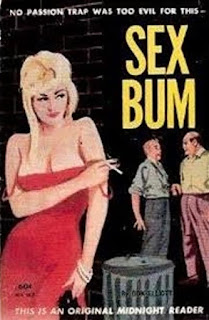
Robert Silverberg's Sex Bum
Robert Silverberg is one of the revered grand masters of American science fiction but his science fiction output is dwarfed by the immense numbers of erotic novels he wrote in the late 50s and early 60s. Sex Bum, published in 1963, is one of the sleaze fiction titles he wrote under the name Don Elliott. This is sleaze, but it's noir fiction as well.
Johnny Price is nineteen and he’s big and muscly although perhaps not too bright. He is however sly and cunning. And he’s ambitious. He makes fifty dollars a week as a delivery boy for a grocery store but he intends to become a big shot. He wants to work for the Syndicate. That way he’ll get to drive around in a Cadillac with tail fins and have lots of sophisticated big city women throwing themselves at him. He figures his chance has come when he manages to help out a couple of mobsters.
They take him on as a chauffeur. He moves out of his aunt’s house and dumps his girlfriend Beth. The job with the mobsters is a live-in job.
They offer him ninety a week plus fringe benefits. He gets a taste of the fringe benefits right away - he gets a free tumble with Marilyn, a gorgeous and very expensive high-class whore.
He manages to impress Marilyn. One thing Johnny is good at is sex.
Johnny is a young man rising fast in the Syndicate, and he intends to rise even faster. He has money in the bank and a fancy car. And he has women. They’re high-class prostitutes, and they’re the types of women Johnny likes. They’re very imaginative in bed. There are two in particular, Ellie and Marie. Marie is Mike Rizzo’s girl. Mike Rizzo is a Syndicate king pin. Sleeping with Mike Rizzo’s girl is a bit foolish but Johnny is supremely confident that he can get away with anything, and Marie assures him there’s no risk.
Johnny works for Lurton and Kloss, who run the Syndicate’s operation in his area. He’s their protégé. To Johnny they’re an obstacle. He figures he can handle their job. He just has to find a way to get them out of the way and he has a plan to do just that.
This is a noir gangster novel but with lots and lots and lots of sex. As a noir novel it works quite well, with a good plot twist at the end and plenty of hardboiled atmosphere. These are ruthless gangsters and the incident with the state senator’s daughter has some real shock value.
But mostly it’s about the sex. Johnny is almost as obsessed by sex as he is with climbing to the top. And the girls, especially Ellie and Marie, provide him with every sexual thrill a nineteen-year-old could imagine and some he hadn’t even thought of. By 1963 standards the sex is described slightly more graphically than you might expect.
Johnny is interesting as a noir protagonist because of his extraordinary self-centredness. He has zero ability to put himself in someone else’s shoes. He gives no thought at all to the effect his actions might have on others. In his line of work this is a dangerous character flaw because it leads him to assume that other people will react the way he wants them to. And he has no capacity for reading other people’s emotions. If you want to survive in his industry you need to be keenly aware of how your actions affect others. You need to be able to anticipate when your actions are going to cause jealousy or bitterness or resentment because in the world of organised crime other people’s jealousy or bitterness or resentment can get you killed. If you want to manipulate people successfully you need to at least have some vague understanding of the concept of loyalty, so that you can at least pretend to be loyal to people. Johnny lacks these abilities.
He also makes assumptions about the women in his life. If Ellie and Marie tell him he’s terrific in bed he assumes that they will therefore do exactly what he wants them to do. The fact that they might have their own agendas or their own ambitions doesn’t occur to him.
This is what makes the book work as a noir thriller. Johnny is such an extreme narcissist and probably a psychopath.
But it’s the sleaze that was always going to be the book’s selling point and it delivers on that count. Silverberg’s sleaze fiction was, for its time, very sleazy. If you want sex and noir Sex Bum is recommended. The effective noirness means you don’t have to be too embarrassed about enjoying it.
Silverberg’s earlier Gang Girl is even better and is highly recommended.
Johnny Price is nineteen and he’s big and muscly although perhaps not too bright. He is however sly and cunning. And he’s ambitious. He makes fifty dollars a week as a delivery boy for a grocery store but he intends to become a big shot. He wants to work for the Syndicate. That way he’ll get to drive around in a Cadillac with tail fins and have lots of sophisticated big city women throwing themselves at him. He figures his chance has come when he manages to help out a couple of mobsters.
They take him on as a chauffeur. He moves out of his aunt’s house and dumps his girlfriend Beth. The job with the mobsters is a live-in job.
They offer him ninety a week plus fringe benefits. He gets a taste of the fringe benefits right away - he gets a free tumble with Marilyn, a gorgeous and very expensive high-class whore.
He manages to impress Marilyn. One thing Johnny is good at is sex.
Johnny is a young man rising fast in the Syndicate, and he intends to rise even faster. He has money in the bank and a fancy car. And he has women. They’re high-class prostitutes, and they’re the types of women Johnny likes. They’re very imaginative in bed. There are two in particular, Ellie and Marie. Marie is Mike Rizzo’s girl. Mike Rizzo is a Syndicate king pin. Sleeping with Mike Rizzo’s girl is a bit foolish but Johnny is supremely confident that he can get away with anything, and Marie assures him there’s no risk.
Johnny works for Lurton and Kloss, who run the Syndicate’s operation in his area. He’s their protégé. To Johnny they’re an obstacle. He figures he can handle their job. He just has to find a way to get them out of the way and he has a plan to do just that.
This is a noir gangster novel but with lots and lots and lots of sex. As a noir novel it works quite well, with a good plot twist at the end and plenty of hardboiled atmosphere. These are ruthless gangsters and the incident with the state senator’s daughter has some real shock value.
But mostly it’s about the sex. Johnny is almost as obsessed by sex as he is with climbing to the top. And the girls, especially Ellie and Marie, provide him with every sexual thrill a nineteen-year-old could imagine and some he hadn’t even thought of. By 1963 standards the sex is described slightly more graphically than you might expect.
Johnny is interesting as a noir protagonist because of his extraordinary self-centredness. He has zero ability to put himself in someone else’s shoes. He gives no thought at all to the effect his actions might have on others. In his line of work this is a dangerous character flaw because it leads him to assume that other people will react the way he wants them to. And he has no capacity for reading other people’s emotions. If you want to survive in his industry you need to be keenly aware of how your actions affect others. You need to be able to anticipate when your actions are going to cause jealousy or bitterness or resentment because in the world of organised crime other people’s jealousy or bitterness or resentment can get you killed. If you want to manipulate people successfully you need to at least have some vague understanding of the concept of loyalty, so that you can at least pretend to be loyal to people. Johnny lacks these abilities.
He also makes assumptions about the women in his life. If Ellie and Marie tell him he’s terrific in bed he assumes that they will therefore do exactly what he wants them to do. The fact that they might have their own agendas or their own ambitions doesn’t occur to him.
This is what makes the book work as a noir thriller. Johnny is such an extreme narcissist and probably a psychopath.
But it’s the sleaze that was always going to be the book’s selling point and it delivers on that count. Silverberg’s sleaze fiction was, for its time, very sleazy. If you want sex and noir Sex Bum is recommended. The effective noirness means you don’t have to be too embarrassed about enjoying it.
Silverberg’s earlier Gang Girl is even better and is highly recommended.
Wednesday, July 1, 2020
Robert Silverberg's Gang Girl
In 1958 there was a major convulsion in the science fiction world and most of the magazines on which writers relied to publish their stories ceased publication. This was a particular problem for younger writers. Writers like Robert Silverberg, who although only in his early twenties was already making a name for himself. Fortunately his pal Harlan Ellison came to the rescue, offering him a contract to write cheap paperback erotic novels for Nightstand Books. He’d have to write a couple of such novels a month which sounds daunting but Silverberg was sure he’d have no problems. And he was correct - in the next five years he churned out 150 sleaze paperbacks under the name Don Elliott.
Gang Girl was one of the earliest, appearing in 1959. It’s a juvenile delinquent potboiler and it’s violent and it’s sleazy. Of course by later standards it is in some ways incredibly tame. There’s a lot sex and it’s graphic enough to ensure the reader knows exactly what is going on, but the language is toned down enough to avoid any inconveniences, like being prosecuted for obscenity. In that respect it’s tame but in other ways it’s still quite startling in its depiction of the mindless brutality, the crazed obsession with sex and the sheer stupidity, boredom, viciousness and futility of New York juvenile gangs in the late ’50s. It’s a lot more open about the sex and violence than any mainstream novels or movies dealing with the subject.
Lora Menotti is sixteen and she’s the deb of the leader of the Scarlet Sinners but now her parents have moved to a new housing estate (all tower blocks) in an effort to get their daughter away from gang life. It doesn’t work. Lora immediately joins the gang in her new neighbourhood, the Cougars. But Lora has no intention of just joining the gang. She intends to run it. That means she’ll have to persuade the gang President, Whitey, to dump his current deb and make her his deb. As Whitey’s deb she’ll be number one girl in the gang, and he has no doubts that she’ll be the one calling the shots.
With her 39-inch bust and her body like a sex goddess she has no trouble getting men to do what she wants them to do. Getting Whitey to dump his current deb, Donna, isn’t going to be a challenge. There is however a minor problem. Whitey always likes to mark his debs to establish his ownership of them, which he does by carving his initials (with a lighted cigarette or a knife) into one of their breasts. Lora has no intention of letting any man carve his initials into one of her spectacular breasts. They’re going to be her meal ticket in the future (she has ambitions to be a call girl). So now her challenge is to maintain her position in the gang without submitting to such treatment.
Lora isn’t too worried. She is utterly ruthless and her mastery of the art of manipulation is something to behold.
Lora’s machinations aren’t just for the purposes of gaining advantages for herself. She is very turned on by violence - nothing gets her more excited than seeing someone being beaten up, except perhaps seeing someone killed. If the victim is subjected to humiliation that’s even better. And it’s best of all if the victim is another woman who might be a rival. Her response to what happens to Mae (one of the debs who happens to be in Lora’s way) is incredibly chilling. Not surprisingly Lora’s arrival among the Cougars triggers a great many outbreaks of violence.
While I said earlier that this book is tame by later standards that’s not really entirely true. You won’t encounter any crude terms for male or female body parts but some of the sexual violence is hair-raising to say the least (such as a truly chilling gang rape). Some of it you just wouldn’t get away with today.
Gang Girl is obviously unashamedly trash fiction. Much of its appeal comes from that. There is however a bit more to it than that. Robert Silverberg was after all a fine writer and even when consciously churning out pulp sleaze he was unable to avoid offering some insights into some of the dark corners of the human psyche, particularly relating to sex and violence. He does try to get inside Lora’s head and what he finds there is deeply unsettling. Lora is not a good girl gone bad, she’s not a victim of circumstances, she’s not a product of a broken home or of childhood trauma. Her evil comes from within. For her the gang life simply has the effect of removing the normal social inhibitions that prevent people from acting on their most primal selfish instincts. It allowed her to shed all her sexual inhibitions very early on and she’s gradually shed all her moral inhibitions.
Perhaps if she had never joined a gang she might have been a nice girl but it seems unlikely. Being selfish and manipulative seems to be an inherent part of her personality. Her prodigious sexual appetites always seem to be inherent. Even without the gangs she would probably have been trouble.
Gang Girl delivers plenty of cheap violent sleazy pulp entertainment but there’s just enough substance there that you don’t have to feel too guilty about enjoying it. OK, you might feel a little bit guilty. There’s also enough dark subject matter to almost qualify it for noir fiction status.
Highly recommended.
Gang Girl was one of the earliest, appearing in 1959. It’s a juvenile delinquent potboiler and it’s violent and it’s sleazy. Of course by later standards it is in some ways incredibly tame. There’s a lot sex and it’s graphic enough to ensure the reader knows exactly what is going on, but the language is toned down enough to avoid any inconveniences, like being prosecuted for obscenity. In that respect it’s tame but in other ways it’s still quite startling in its depiction of the mindless brutality, the crazed obsession with sex and the sheer stupidity, boredom, viciousness and futility of New York juvenile gangs in the late ’50s. It’s a lot more open about the sex and violence than any mainstream novels or movies dealing with the subject.
Lora Menotti is sixteen and she’s the deb of the leader of the Scarlet Sinners but now her parents have moved to a new housing estate (all tower blocks) in an effort to get their daughter away from gang life. It doesn’t work. Lora immediately joins the gang in her new neighbourhood, the Cougars. But Lora has no intention of just joining the gang. She intends to run it. That means she’ll have to persuade the gang President, Whitey, to dump his current deb and make her his deb. As Whitey’s deb she’ll be number one girl in the gang, and he has no doubts that she’ll be the one calling the shots.
With her 39-inch bust and her body like a sex goddess she has no trouble getting men to do what she wants them to do. Getting Whitey to dump his current deb, Donna, isn’t going to be a challenge. There is however a minor problem. Whitey always likes to mark his debs to establish his ownership of them, which he does by carving his initials (with a lighted cigarette or a knife) into one of their breasts. Lora has no intention of letting any man carve his initials into one of her spectacular breasts. They’re going to be her meal ticket in the future (she has ambitions to be a call girl). So now her challenge is to maintain her position in the gang without submitting to such treatment.
Lora isn’t too worried. She is utterly ruthless and her mastery of the art of manipulation is something to behold.
Lora’s machinations aren’t just for the purposes of gaining advantages for herself. She is very turned on by violence - nothing gets her more excited than seeing someone being beaten up, except perhaps seeing someone killed. If the victim is subjected to humiliation that’s even better. And it’s best of all if the victim is another woman who might be a rival. Her response to what happens to Mae (one of the debs who happens to be in Lora’s way) is incredibly chilling. Not surprisingly Lora’s arrival among the Cougars triggers a great many outbreaks of violence.
While I said earlier that this book is tame by later standards that’s not really entirely true. You won’t encounter any crude terms for male or female body parts but some of the sexual violence is hair-raising to say the least (such as a truly chilling gang rape). Some of it you just wouldn’t get away with today.
Gang Girl is obviously unashamedly trash fiction. Much of its appeal comes from that. There is however a bit more to it than that. Robert Silverberg was after all a fine writer and even when consciously churning out pulp sleaze he was unable to avoid offering some insights into some of the dark corners of the human psyche, particularly relating to sex and violence. He does try to get inside Lora’s head and what he finds there is deeply unsettling. Lora is not a good girl gone bad, she’s not a victim of circumstances, she’s not a product of a broken home or of childhood trauma. Her evil comes from within. For her the gang life simply has the effect of removing the normal social inhibitions that prevent people from acting on their most primal selfish instincts. It allowed her to shed all her sexual inhibitions very early on and she’s gradually shed all her moral inhibitions.
Perhaps if she had never joined a gang she might have been a nice girl but it seems unlikely. Being selfish and manipulative seems to be an inherent part of her personality. Her prodigious sexual appetites always seem to be inherent. Even without the gangs she would probably have been trouble.
Gang Girl delivers plenty of cheap violent sleazy pulp entertainment but there’s just enough substance there that you don’t have to feel too guilty about enjoying it. OK, you might feel a little bit guilty. There’s also enough dark subject matter to almost qualify it for noir fiction status.
Highly recommended.
Friday, May 8, 2015
The Golden Age of Murder
Martin Edwards’ study of the golden age of detective fiction, The Golden Age of Murder, has now been published in the UK.
Martin has been an enthusiastic proponent of golden age detective fiction for quite a while now and has contributed introductions to the British Library’s very successful series of classic mystery reprints (the Crime Classics series) which have apparently already sold more than a quarter of a million paperbacks. The Golden Age of Murder should be well worth reading.
Martin’s blog is also very much worth checking out.
Thursday, January 23, 2014
A Master of Mysteries
Elizabeth Thomasina Meade Smith (1844–1914) wrote under the name L. T. Meade, producing countless stories for girls. She also wrote in a variety of other genres, including mysteries and occult detective stories. Most of these were co-authored with Eustace Robert Barton (1854–1943) who wrote under the name Robert Eustace.
A Master of Mysteries, published in 1898, is one of their collections of what could be described as occult detective stories although in fact the hero of these stories, John Bell, is man who specialises in finding rational explanations for apparently occult or inexplicable events such as hauntings. The explanations usually involve a crime, and it is generally a strange and outlandish crime.
This slim volume comprises six stories. The first two stories, The Mystery of the Circular Chamber and The Warder of the Door, are relatively conventional stories of this type dealing with a haunted room in an old house and a family curse involving a door that must always be guarded. The explanations are rational enough although they are also pleasingly bizarre.
In The Mystery of the Felwyn Tunnel Bell must solve a series of unexplained deaths that have occurred near a railway tunnel. Murder is suspected and the police have a suspect but Bell is not so sure that these events are as clear-cut as they seem.
With The Eight-Mile Lock things get a lot stranger. Bell is fairly sure he knows who was responsible for the theft of a very valuable diamond necklace but he needs to discover how the theft was carried out. The methods turns out to be spectacularly bizarre. Like many of the stories of these authors, in this and other collections, the method involves technology that was very high-tech indeed in the 1890s. The authors were clearly fascinated by technology and gadgetry and this fascination is one of the greatest strengths of their stories. At times, as in the story, we are almost approaching what today would be described as steampunk.
The solution to the mystery of How Siva Spoke involves a delightfully outrageous piece of gadgetry, not perhaps high-tech but certainly incredibly ingenious. An eccentric elderly man who has embraced the religion of Brahminism is convinced that he is receiving messages from an idol of the god Siva. As a result of this he is about to be committed to an asylum. Bell has serious doubts as to whether the man is really mad, but at the same time the old gentleman is adamant that the idol really speaks to him. Bell fears that the consequences may be more serious than a committal to an asylum.
To Prove an Alibi also relies on a clever piece of gadgetry, in fact several pieces of gadgetry, and Bell is faced with a thrilling race against time to save the life of an old friend.
The stories are similar in tone to another excellent collection by these two authors, The Brotherhood of the Seven Kings, which recounts the crimes of the evil Madame Koluchy, one of fiction’s finest female diabolical criminal masterminds.
It’s the pseudoscientific gadgetry that is the great appeal of these stories and the authors certainly possessed fertile imaginations in this area. These are not stories to be taken too seriously but they are enormous fun and they do provide some genuine chills and thrills. A Master of Mysteries is delightful offbeat entertainment and is recommended.
A Master of Mysteries, published in 1898, is one of their collections of what could be described as occult detective stories although in fact the hero of these stories, John Bell, is man who specialises in finding rational explanations for apparently occult or inexplicable events such as hauntings. The explanations usually involve a crime, and it is generally a strange and outlandish crime.
This slim volume comprises six stories. The first two stories, The Mystery of the Circular Chamber and The Warder of the Door, are relatively conventional stories of this type dealing with a haunted room in an old house and a family curse involving a door that must always be guarded. The explanations are rational enough although they are also pleasingly bizarre.
In The Mystery of the Felwyn Tunnel Bell must solve a series of unexplained deaths that have occurred near a railway tunnel. Murder is suspected and the police have a suspect but Bell is not so sure that these events are as clear-cut as they seem.
With The Eight-Mile Lock things get a lot stranger. Bell is fairly sure he knows who was responsible for the theft of a very valuable diamond necklace but he needs to discover how the theft was carried out. The methods turns out to be spectacularly bizarre. Like many of the stories of these authors, in this and other collections, the method involves technology that was very high-tech indeed in the 1890s. The authors were clearly fascinated by technology and gadgetry and this fascination is one of the greatest strengths of their stories. At times, as in the story, we are almost approaching what today would be described as steampunk.
The solution to the mystery of How Siva Spoke involves a delightfully outrageous piece of gadgetry, not perhaps high-tech but certainly incredibly ingenious. An eccentric elderly man who has embraced the religion of Brahminism is convinced that he is receiving messages from an idol of the god Siva. As a result of this he is about to be committed to an asylum. Bell has serious doubts as to whether the man is really mad, but at the same time the old gentleman is adamant that the idol really speaks to him. Bell fears that the consequences may be more serious than a committal to an asylum.
To Prove an Alibi also relies on a clever piece of gadgetry, in fact several pieces of gadgetry, and Bell is faced with a thrilling race against time to save the life of an old friend.
The stories are similar in tone to another excellent collection by these two authors, The Brotherhood of the Seven Kings, which recounts the crimes of the evil Madame Koluchy, one of fiction’s finest female diabolical criminal masterminds.
It’s the pseudoscientific gadgetry that is the great appeal of these stories and the authors certainly possessed fertile imaginations in this area. These are not stories to be taken too seriously but they are enormous fun and they do provide some genuine chills and thrills. A Master of Mysteries is delightful offbeat entertainment and is recommended.
Tuesday, September 3, 2013
Paul Ernst’s The Complete Tales of Dr Satan
The eight Dr Satan stories of Paul Ernst appeared in Weird Tales during the course of 1935 and 1936. Dr Satan is a diabolical criminal mastermind and that’s something that always appeals to me. All eight stories are included in The Complete Tales of Dr Satan published by Altus Press.
Paul Ernst was a prolific pulp writer and was best known as the creator of superhero The Avenger in the 1930s, the Avenger being a kind of Doc Savage clone.
Dr Satan is in reality the scion of a very wealthy family although no-one knows his true identity. He has sampled all the thrills and all the ordinary vices that life has to offer, and they are not enough for him. Seeking the ultimate thrill he has turned to crime.
Dr Satan’s plans always involve extortion in one form or another. He has no need of money but making large amounts of money by illegal means is part of the thrill.
Dr Satan employs both scientific and occult knowledge in pursuit of his aims. He has a vast store of both.
Of course any diabolical criminal mastermind has to have henchmen, and Dr Satan’s are particularly creepy. Girse is a tiny man who bears more than a passing resemblance to a monkey. Bostiff is a giant, or rather he would be a giant except that he has no legs. He propels himself by his arms which are possessed of colossal, almost superhuman, strength.
And of course any diabolical criminal mastermind has to have a nemesis, and Dr Satan’s is Ascott Keane. Keane is also wealthy and bored but he has tuned to criminology rather than to crime. Keane’s knowledge of science and the occult equals that of Dr Satan.
Dr Satan comes up with a wide variety of extremely ingenious means of killing or maiming his enemies. The bizarre and hideous means he employs are calculated to exert the maximum amount of terror. He also has hypnotic mind-control powers (as does Ascott Keane).
The biggest weakness of these stories is that they all follow more or less the same formula. Dr Satan demands money from wealthy and powerful men and then two or three such men are found murdered in strange and horrible ways. They will serve as a warming to the others that they would be well advised to pay up. Ascott Keane is either called in or he hears about these weird killings and shows up on his own account. There is then a struggle between Dr Satan’s powers and those of Keane. Keane invariably wins, but Dr Satan always escapes. Hollywood Horror is the best of the tales, largely because Dr Satan’s method of terrorising his victims is both original and strangely fitting.
While it’s true that the stories do stick pretty much to a formula the interesting thing is that they gradually improve with some of the later stories having some quite intriguing twists. Both Horror Insured and Beyond Death’s Gateway introduce more overt occult themes and these two stories could both fairly be described as horror stories, and quite good ones.
John Pelan in his introduction to the Altus Press edition warns the reader not to dissipate the effect of these stories by reading them one after the other, and this is very sound advice.
Despite their formulaic nature these stories are fun and very very pulpy. The means adopted by Dr Satan to carry out his murders are always ingenious and imaginative. The stories were only moderately successful at the time, possibly because Weird Tales was not quite the right venue for them and also because the craze for weird detective stories had not yet arrived.
Paul Ernst was a prolific pulp writer and was best known as the creator of superhero The Avenger in the 1930s, the Avenger being a kind of Doc Savage clone.
Dr Satan is in reality the scion of a very wealthy family although no-one knows his true identity. He has sampled all the thrills and all the ordinary vices that life has to offer, and they are not enough for him. Seeking the ultimate thrill he has turned to crime.
Dr Satan’s plans always involve extortion in one form or another. He has no need of money but making large amounts of money by illegal means is part of the thrill.
Dr Satan employs both scientific and occult knowledge in pursuit of his aims. He has a vast store of both.
Of course any diabolical criminal mastermind has to have henchmen, and Dr Satan’s are particularly creepy. Girse is a tiny man who bears more than a passing resemblance to a monkey. Bostiff is a giant, or rather he would be a giant except that he has no legs. He propels himself by his arms which are possessed of colossal, almost superhuman, strength.
And of course any diabolical criminal mastermind has to have a nemesis, and Dr Satan’s is Ascott Keane. Keane is also wealthy and bored but he has tuned to criminology rather than to crime. Keane’s knowledge of science and the occult equals that of Dr Satan.
Dr Satan comes up with a wide variety of extremely ingenious means of killing or maiming his enemies. The bizarre and hideous means he employs are calculated to exert the maximum amount of terror. He also has hypnotic mind-control powers (as does Ascott Keane).
The biggest weakness of these stories is that they all follow more or less the same formula. Dr Satan demands money from wealthy and powerful men and then two or three such men are found murdered in strange and horrible ways. They will serve as a warming to the others that they would be well advised to pay up. Ascott Keane is either called in or he hears about these weird killings and shows up on his own account. There is then a struggle between Dr Satan’s powers and those of Keane. Keane invariably wins, but Dr Satan always escapes. Hollywood Horror is the best of the tales, largely because Dr Satan’s method of terrorising his victims is both original and strangely fitting.
While it’s true that the stories do stick pretty much to a formula the interesting thing is that they gradually improve with some of the later stories having some quite intriguing twists. Both Horror Insured and Beyond Death’s Gateway introduce more overt occult themes and these two stories could both fairly be described as horror stories, and quite good ones.
John Pelan in his introduction to the Altus Press edition warns the reader not to dissipate the effect of these stories by reading them one after the other, and this is very sound advice.
Despite their formulaic nature these stories are fun and very very pulpy. The means adopted by Dr Satan to carry out his murders are always ingenious and imaginative. The stories were only moderately successful at the time, possibly because Weird Tales was not quite the right venue for them and also because the craze for weird detective stories had not yet arrived.
Thursday, August 22, 2013
Amelia B. Edwards' All Saints’ Eve
Amelia B. Edwards (1831-1892) was a successful writer of both crime stories and ghost stories, although she was to become even better known as a distinguished Egyptologist. She was also an indefatigable traveller, an obsession that furnished her with the backgrounds for so many stories set in various parts of Europe.
Her writing was admired by Charles Dickens who published many of her stories in All the Year Round, especially in the special Christmas numbers of that journal which featured stories of ghosts and other mysteries.
The stories collected in the Wordsworth volume All Saints’ Eve include stories of both the supernatural and stories of murder and mystery. About half of the stories fit into each of these two categories.
Her ghost stories are, sadly, less than impressive. To stand out amid the countless such stories that were published during the 19th century a ghost story needs to have at least one of four things going for it. It has to surprise the reader, it has to have an atmosphere of dread sufficiently strong to produce genuine chills, it has to be terrifying, or it has to create a feeling of the uncanny - of things that are but that should not be. Alas Edwards’ ghost stories fulfill none of these criteria. They are predictable and commonplace and the pay-offs to these stories invariably fall rather flat. She leads us to believe that something truly strange is going to happen and we are inevitably disappointed by the triteness of her endings. These are routine ghost stories, competently written but still no more than routine.
Her mysteries are not sufficiently mysterious to be particularly interesting and they lack sufficient suspense to be exciting.
The Four-Fifteen Express is one of her most celebrated ghost stories and while it is slightly better than the others included in this volume it still lacks any real impact.
Cain is moderately interesting, a story of a painting with an unfortunate history, but again we are left expecting more than the story delivers.
A Night on the Borders of the Black Forest has only a very faint suggestion of the supernatural, or perhaps rather we should say the paranormal, and it is one of the few stories that manages to generate some tension. It is also one of the few stories in this collection which actually makes us fear for the safety of the protagonist, and this is perhaps one of the gravest flaws of the other stories - we never feel any real suspense, any sense of menace. It’s a reasonably successful story.
A Railway Panic and The Guard-Ship at the Aire are all too typical in that they really don’t go anywhere. There’s perhaps some moderate excitement but there’s really nothing there to compel the reader’s interest.
The title story is the most ambitious tale here and it’s possibly the most successful, its advantage being that it has an actual plot that leads somewhere and it has a few twists to keep things interesting.
Whether you’re a fan of ghost stories or of mysteries you’re really quite safe to give this collection a miss. Wordsworth have done a splendid job at making the works of many unfairly forgotten writers available to the modern reading public at ludicrously cheap prices. There are many collections from this publisher in their Tales of Mystery and the Supernatural series that are much more worthy of the reader’s attention than this one.
On the while, disappointing and not really worth seeking out.
Her writing was admired by Charles Dickens who published many of her stories in All the Year Round, especially in the special Christmas numbers of that journal which featured stories of ghosts and other mysteries.
The stories collected in the Wordsworth volume All Saints’ Eve include stories of both the supernatural and stories of murder and mystery. About half of the stories fit into each of these two categories.
Her ghost stories are, sadly, less than impressive. To stand out amid the countless such stories that were published during the 19th century a ghost story needs to have at least one of four things going for it. It has to surprise the reader, it has to have an atmosphere of dread sufficiently strong to produce genuine chills, it has to be terrifying, or it has to create a feeling of the uncanny - of things that are but that should not be. Alas Edwards’ ghost stories fulfill none of these criteria. They are predictable and commonplace and the pay-offs to these stories invariably fall rather flat. She leads us to believe that something truly strange is going to happen and we are inevitably disappointed by the triteness of her endings. These are routine ghost stories, competently written but still no more than routine.
Her mysteries are not sufficiently mysterious to be particularly interesting and they lack sufficient suspense to be exciting.
The Four-Fifteen Express is one of her most celebrated ghost stories and while it is slightly better than the others included in this volume it still lacks any real impact.
Cain is moderately interesting, a story of a painting with an unfortunate history, but again we are left expecting more than the story delivers.
A Night on the Borders of the Black Forest has only a very faint suggestion of the supernatural, or perhaps rather we should say the paranormal, and it is one of the few stories that manages to generate some tension. It is also one of the few stories in this collection which actually makes us fear for the safety of the protagonist, and this is perhaps one of the gravest flaws of the other stories - we never feel any real suspense, any sense of menace. It’s a reasonably successful story.
A Railway Panic and The Guard-Ship at the Aire are all too typical in that they really don’t go anywhere. There’s perhaps some moderate excitement but there’s really nothing there to compel the reader’s interest.
The title story is the most ambitious tale here and it’s possibly the most successful, its advantage being that it has an actual plot that leads somewhere and it has a few twists to keep things interesting.
Whether you’re a fan of ghost stories or of mysteries you’re really quite safe to give this collection a miss. Wordsworth have done a splendid job at making the works of many unfairly forgotten writers available to the modern reading public at ludicrously cheap prices. There are many collections from this publisher in their Tales of Mystery and the Supernatural series that are much more worthy of the reader’s attention than this one.
On the while, disappointing and not really worth seeking out.
Thursday, June 6, 2013
The Mystery of Hunting’s End
Mignon Eberhart (1899-1996) had an extraordinarily long career as a crime writer. Her first mystery was published in 1929; she wrote her 59th and last novel in 1988 at the age of eighty-eight. She was at one time apparently regarded as America’s answer to Agatha Christie. The Mystery of Hunting’s End is one of her early books, dating to 1930.
Unfortunately, it’s not very good.
The plot is your standard “let’s take a group of somewhere between half-a-dozen and a dozen people and strand them somewhere and then have a murder occur” story. This is a very easy and convenient way to limit the number of suspects. If all the suspects are stranded somewhere then the guilty part must be one of their number, and the murderer cannot escape. In the hands of even a moderately skillful writer this device also helps to build tension.
In this case the site chosen is a hunting lodge. Sure enough, as soon as the prospective suspects are assembled the snow sets in, effectively cutting them off entirely from the outside world. Of course the author has to make sure that her detective manages to be included in the group. Eberhart does this by having the owner of the lodge (known as Hunting’s End) invite a detective along to try to solve a five-year-old murder. Matil Kingery’s father was shot to death at Hunting’s End five years earlier. The house has been shut up ever since. Matil has now invited everyone who was present at the time to join her at the lodge and she also invites private detective Lance O’Leary. O’Leary brings along his friend Sarah Keate. She is a nurse and is ostensibly employed to care for Matil’s elderly and querulous Aunt Lucy, but in fact Miss Keate is something of an amateur detective as well.
Within a few hours of the arrival of the various members of the party another murder occurs. Being isolated in a house with a murderer is bad enough but for these unfortunates the situation is even grimmer - they have to share the house with the corpse as well, until the snow stops. As the days tick by tempers start to fray, and to cap things off food starts to run short.
There’s nothing especially wrong with the basic plot. The problem is with the execution. As a writer Eberhart has a number of very irritating habits. The worst of these is foreshadowing. This is a device that I don’t particularly like at the best of times. To me it seems like a cheap way of trying to heighten suspense. The problem here is that Eberhart is totally addicted to this device. Every few pages Sarah Keate (the narrator of the novel) is telling us once again that if only she’d known then what she knows now all this unpleasantness could have been avoided.
Eberhart compounds the felony by other cheap tension-building tricks. She is not content to put her characters in a horrific and frightening situation. She has to tell us that their situation is horrific and frightening. She has to tell us this over and over again. To be honest it wasn’t necessary to tell us even once since the horrific and terrifying predicament of these characters is blindingly obvious.
The writing is also rather long-winded and repetitive. The plot advances at a glacial pace. Too many conversations that don’t advance the plot are recounted in too much detail. The narrator spends too much time telling us how she feels.
By the time the plot was finally resolved I found that I had to a large extent lost interest. I had spent too long with too many uninteresting characters. Even the characters who might conceivably have been colourful (the party includes both a baroness and an opera singer) come across as being rather dreary and petty. We don’t know enough about them to take much interest in them and this being a detective story we don’t really need to know them very well. What we need is for the author to get on with the plot.
Reading a book such as this makes one appreciate the virtues of writers like Christie. Agatha Christie’s writing style isn’t going to dazzle anybody but she gets on with the job and doesn’t bore us. I’m afraid that Eberhart did bore me. I cannot in all conscience recommend The Mystery of Hunting’s End.
Unfortunately, it’s not very good.
The plot is your standard “let’s take a group of somewhere between half-a-dozen and a dozen people and strand them somewhere and then have a murder occur” story. This is a very easy and convenient way to limit the number of suspects. If all the suspects are stranded somewhere then the guilty part must be one of their number, and the murderer cannot escape. In the hands of even a moderately skillful writer this device also helps to build tension.
In this case the site chosen is a hunting lodge. Sure enough, as soon as the prospective suspects are assembled the snow sets in, effectively cutting them off entirely from the outside world. Of course the author has to make sure that her detective manages to be included in the group. Eberhart does this by having the owner of the lodge (known as Hunting’s End) invite a detective along to try to solve a five-year-old murder. Matil Kingery’s father was shot to death at Hunting’s End five years earlier. The house has been shut up ever since. Matil has now invited everyone who was present at the time to join her at the lodge and she also invites private detective Lance O’Leary. O’Leary brings along his friend Sarah Keate. She is a nurse and is ostensibly employed to care for Matil’s elderly and querulous Aunt Lucy, but in fact Miss Keate is something of an amateur detective as well.
Within a few hours of the arrival of the various members of the party another murder occurs. Being isolated in a house with a murderer is bad enough but for these unfortunates the situation is even grimmer - they have to share the house with the corpse as well, until the snow stops. As the days tick by tempers start to fray, and to cap things off food starts to run short.
There’s nothing especially wrong with the basic plot. The problem is with the execution. As a writer Eberhart has a number of very irritating habits. The worst of these is foreshadowing. This is a device that I don’t particularly like at the best of times. To me it seems like a cheap way of trying to heighten suspense. The problem here is that Eberhart is totally addicted to this device. Every few pages Sarah Keate (the narrator of the novel) is telling us once again that if only she’d known then what she knows now all this unpleasantness could have been avoided.
Eberhart compounds the felony by other cheap tension-building tricks. She is not content to put her characters in a horrific and frightening situation. She has to tell us that their situation is horrific and frightening. She has to tell us this over and over again. To be honest it wasn’t necessary to tell us even once since the horrific and terrifying predicament of these characters is blindingly obvious.
The writing is also rather long-winded and repetitive. The plot advances at a glacial pace. Too many conversations that don’t advance the plot are recounted in too much detail. The narrator spends too much time telling us how she feels.
By the time the plot was finally resolved I found that I had to a large extent lost interest. I had spent too long with too many uninteresting characters. Even the characters who might conceivably have been colourful (the party includes both a baroness and an opera singer) come across as being rather dreary and petty. We don’t know enough about them to take much interest in them and this being a detective story we don’t really need to know them very well. What we need is for the author to get on with the plot.
Reading a book such as this makes one appreciate the virtues of writers like Christie. Agatha Christie’s writing style isn’t going to dazzle anybody but she gets on with the job and doesn’t bore us. I’m afraid that Eberhart did bore me. I cannot in all conscience recommend The Mystery of Hunting’s End.
Wednesday, May 30, 2012
George Allan England’s Empire in the Air
George Allan England’s Empire in the Air was serialised in All-Story Cavalier Weekly in 1914. Although he was a successful writer at the time the story has since been all but forgotten, until its publication by Black Dog Books in 2006.
A pioneer aviator named Kramer is attempting to set a new world altitude record when he suddenly disappears. Completely. No wreckage, no explosion, just one minute he’s there and the next he and his plane have vanished. Almost as if they’d been sucked into the Fourth Dimension.
Which is of course exactly what happened!
Scientists at the Observatory in Boston were tracking the flight on an array of high-tech (by 1914 standards) instruments but they are mystified by the vanishing aircraft and aviator.
His girlfriend Ethel immediately swoons and falls into a coma.
Then something even more uncanny happens. A strange greenish transparent globule appears in the Observatory and leaves a mysterious message purporting to be from Kramer. One of the scientists at the Observatory, a man named Keane, also receives a visit from the globule, and another message - in Kramer’s own handwriting!
Further messages are received through the unconscious Ethel who speaks in Kramer’s voice. Kramer’s message is a frightening one. The earth is on the brink of invasion from the Fourth Dimension! But there is hope, if Kramer’s instructions are followed.
The first stage in the invasion comes soon afterwards. Millions of globules spread death and destruction across the entire globe. Boston is devastated, but Keane survives and makes contact with Ethel’s doctor, Dr Rounds. Between them they determine to carry out Kramer’s instructions - it is the only hope for humanity’s survival.
A team of flyers will need to ascend to 20,000 feet where they will be transmuted to the Fourth Dimension. There they will make contact with Kramer and do battle with the invaders. Keane and Dr Rounds find another ally in Hildreth, an Army Aviation lieutenant and a friend of Kramer’s. The future of the world rests on their shoulders, and on the shoulders of the handful of men they manage to collect from the Watertown Arsenal.
While the ideas in this tale are fairly outrageous the energy and urgency of the story-telling are enough to allow for the necessary suspension of disbelief. There’s plenty of excitement and heroism, and Kramer is battling to save not just the world, but the woman he loves.
George Allan England (1877-1936) was a lifelong socialist, something that was apparently very obvious in a none-too-subtle way in some of his other science fiction writings, but curiously enough this book seems to say more about the virtues of good old American rugged individualism than the joys of collectivism although he also manages to suggest a somewhat chilling belief in the necessity of dictatorship in a crisis. This was of course (and still is) a common failing of intellectuals when responding to crises.
Luckily though politics doesn’t intrude very much on what is basically a fun pulpy story. Recommended.
A pioneer aviator named Kramer is attempting to set a new world altitude record when he suddenly disappears. Completely. No wreckage, no explosion, just one minute he’s there and the next he and his plane have vanished. Almost as if they’d been sucked into the Fourth Dimension.
Which is of course exactly what happened!
Scientists at the Observatory in Boston were tracking the flight on an array of high-tech (by 1914 standards) instruments but they are mystified by the vanishing aircraft and aviator.
His girlfriend Ethel immediately swoons and falls into a coma.
Then something even more uncanny happens. A strange greenish transparent globule appears in the Observatory and leaves a mysterious message purporting to be from Kramer. One of the scientists at the Observatory, a man named Keane, also receives a visit from the globule, and another message - in Kramer’s own handwriting!
Further messages are received through the unconscious Ethel who speaks in Kramer’s voice. Kramer’s message is a frightening one. The earth is on the brink of invasion from the Fourth Dimension! But there is hope, if Kramer’s instructions are followed.
The first stage in the invasion comes soon afterwards. Millions of globules spread death and destruction across the entire globe. Boston is devastated, but Keane survives and makes contact with Ethel’s doctor, Dr Rounds. Between them they determine to carry out Kramer’s instructions - it is the only hope for humanity’s survival.
A team of flyers will need to ascend to 20,000 feet where they will be transmuted to the Fourth Dimension. There they will make contact with Kramer and do battle with the invaders. Keane and Dr Rounds find another ally in Hildreth, an Army Aviation lieutenant and a friend of Kramer’s. The future of the world rests on their shoulders, and on the shoulders of the handful of men they manage to collect from the Watertown Arsenal.
While the ideas in this tale are fairly outrageous the energy and urgency of the story-telling are enough to allow for the necessary suspension of disbelief. There’s plenty of excitement and heroism, and Kramer is battling to save not just the world, but the woman he loves.
George Allan England (1877-1936) was a lifelong socialist, something that was apparently very obvious in a none-too-subtle way in some of his other science fiction writings, but curiously enough this book seems to say more about the virtues of good old American rugged individualism than the joys of collectivism although he also manages to suggest a somewhat chilling belief in the necessity of dictatorship in a crisis. This was of course (and still is) a common failing of intellectuals when responding to crises.
Luckily though politics doesn’t intrude very much on what is basically a fun pulpy story. Recommended.
Wednesday, May 23, 2012
The Brotherhood of the Seven Kings
The Brotherhood of the Seven Kings is a series of linked short stories involving what may well be the world’s first female diabolical criminal mastermind, Madame Koluchy.
Written in 1899, it was one of many collaborations in the mystery genre between L. T. Meade and Robert Eustace. L. T. Meade (Elizabeth Thomasina Meade Smith) was a popular writer of stories for girls while Robert Eustace specialised in thrillers with a medical or legal bent.
The narrator, Norman Head, had as a young man met Madame Koluchy in Naples when he became involved in a secret criminal society known as the Brotherhood of the Seven Kings. Madame Koluchy had been the head of this society. When Head discovered the sinister nature of the society he determined to have no more to do with them. He has since been living as a virtual recluse, amusing himself with scientific experiments.
Now their paths have crossed again, and Head realises this will be a duel to the death. She cannot afford to let him live while his honour will not allow him to permit her to ruin any more lives.
Madame Koluchy is also a scientist, and a doctor. In fact she is the most famous doctor in London, her apparently miraculous cures having made her a celebrity while her charm and beauty have made her the darling of English society.
With the aid of his friend Dufrayer, an eminent solicitor, Norman Head is determined to bring this woman to justice. Madame Koluchy uses her medical skills to gain the trust of her victims. They then find themselves the victims of blackmail, robbery, kidnapping or worse crimes.
Norman Head is brave and intelligent, but he is up against a woman of enormous resourcefulness and cunning.
The stories are all entertaining and cleverly constructed. As you would expect, given Robert Eustace’s special interests, many of the stories involve medical conspiracies. There are fiendish plots, ingenious murder attempts, death by X-ray, and infernal machines.
These are crime thrillers that occasionally veer just a little in the direction of what you might call speampunk techno-thrillers.
Highly recommended.
Written in 1899, it was one of many collaborations in the mystery genre between L. T. Meade and Robert Eustace. L. T. Meade (Elizabeth Thomasina Meade Smith) was a popular writer of stories for girls while Robert Eustace specialised in thrillers with a medical or legal bent.
The narrator, Norman Head, had as a young man met Madame Koluchy in Naples when he became involved in a secret criminal society known as the Brotherhood of the Seven Kings. Madame Koluchy had been the head of this society. When Head discovered the sinister nature of the society he determined to have no more to do with them. He has since been living as a virtual recluse, amusing himself with scientific experiments.
Now their paths have crossed again, and Head realises this will be a duel to the death. She cannot afford to let him live while his honour will not allow him to permit her to ruin any more lives.
Madame Koluchy is also a scientist, and a doctor. In fact she is the most famous doctor in London, her apparently miraculous cures having made her a celebrity while her charm and beauty have made her the darling of English society.
With the aid of his friend Dufrayer, an eminent solicitor, Norman Head is determined to bring this woman to justice. Madame Koluchy uses her medical skills to gain the trust of her victims. They then find themselves the victims of blackmail, robbery, kidnapping or worse crimes.
Norman Head is brave and intelligent, but he is up against a woman of enormous resourcefulness and cunning.
The stories are all entertaining and cleverly constructed. As you would expect, given Robert Eustace’s special interests, many of the stories involve medical conspiracies. There are fiendish plots, ingenious murder attempts, death by X-ray, and infernal machines.
These are crime thrillers that occasionally veer just a little in the direction of what you might call speampunk techno-thrillers.
Highly recommended.
Wednesday, March 23, 2011
The Werewolf of Paris, by Guy Endore
Guy Endore’s 1934 novel The Werewolf of Paris is perhaps best known as the basis for the rather delicious 1961 Hammer movie The Curse of the Werewolf. Yes, the one with Oliver Reed as the werewolf!The novel is actually mainly concerned with lycanthropy as a metaphor for human viciousness, and especially for the horrors of war and revolution (much of the action takes place during the Franco-Prussian War of 1870 and the subsequent violence and civil war surrounding the establishment of the Paris Commune).
The book does come up with some intriguing ways of explaining the nature and origin of werewolves – theories involving multiple souls in a single body, and single souls in multiple bodies. There’s also quite a bit that had to be cut from the movie version. There’s incest, and there’s some serious priestly wickedness.
The werewolf of the title is Bertrand, and he’s the unfortunate victim of a kind of family curse going back to a particularly nasty medieval feud and the horrific punishment inflicted on a murderer. Bertrand is basically a nice young man, but he’s subject to overwhelming appetites whenever the change comes upon him. Born in an obscure village, he makes his way to Paris but his destiny is unescapable. He finds love of a kind, with a woman who has almost as many problems as he has. When war comes he discovers ample opportunities for the indulging of his tastes. He’s a monster, but he’s one of those tragic monsters.
Endore wisely avoids excessive sentimentality in the telling of his tale. It’s one of the more interesting werewolf novels that I’ve come across. Definitely worth checking out.
Subscribe to:
Posts (Atom)