Showing posts with label juvenile delinquents. Show all posts

Monday, November 13, 2023

Men’s Adventure Quarterly #7 Gang Girls

Men’s Adventure Quarterly #7 is the Gang Girls issue, devoted to female juvenile delinquents. Which certainly sounds promising.

As usual with Men’s Adventure Quarterly this volume is beautifully presented and copiously illustrated. As a bonus there’s a photo feature on Mamie van Doren.

The Stories

The first two stories are in fact non-fiction exposés. The Vicious Girl Gangs of Boston by Henry S. Galus appeared in Man to Man in August 1954 while Wenzell Brown’s Tomboy Jungle appeared in For Men Only in November 1957. The hysterical tone is mildly amusing but these pieces are not all that interesting.

Zip-Gun Girl by Albert L. Quands was published in Man’s Illustrated in September 1958. It’s a condensed version of a novel which might be why it seems a bit messy and complicated. An ex-con named Lou Jackson and his daughter Pebbles (yes her name is Pebbles) arrive in the city but they get a lot of aggravation from neighbours because of Lou’s prison record. Pretty soon Pebbles is unpopular as well, both her and her father being suspected of snitching to the cops.

Pebbles is desperate to join one of the two local warring gangs, the Tigers and the Buccaneers. It’s not easy for a girl to join a gang while keeping her virtue intact which is what Pebbles hopes to do (this was 1958 so the heroine has to remain virginal). Pebbles has a plan - to form an all-girl gang. Meanwhile an idealistic cop is trying to save her and transform her into a good girl. It’s an OK story.

Jack Smith’s Street Queens Are Taking Over is from the January 1962 issue of Wildcat Adventures. This one is fiction but presented as a true story written by a reporter who has gone undercover to join a teen gang. The leadership of teen gangs in the city is being taken over by girls, and they’re really mean really bad girls. Tougher than any of the boys. In this story the girl leading the gang seeks revenge on a girl who stole her boyfriend. Revenge, with a motorcycle chain used as a weapon.

A pleasingly trashy and quite hard-edged story.

Lust On Our Streets by Allan Hendrix appeared in Wildcat Adventures in September 1963. This one takes its inspiration from what was supposedly a trend at the time - instead of gangs engaging in large-scale rumbles a few gang members would pick a wealthy young couple as victims and lure them into an ambush which would end in robbery and brutal assault.

There’s hardly any actual story at all, with far too much time devoted to pompous pontificating by (almost certainly imaginary) experts. Rather boring.

The ‘Passion Angel’ Cycle Girls by Clinton Kayser appeared in Men for December 1967. This is another faux non-fiction exposé, purportedly made up of interviews with biker chicks and focusing entirely on their sex lives. The reader learns the difference between Old Ladies, Strange Chicks and Mamas. The article makes a vague attempt to analyse the girls’ motives. An amusing piece.

Cycle Queens of Violence by J.R. Wayne was published in Man’s Conquest in June 1970. Yet another non-fiction piece and also pleasingly hysterical.

Final Thoughts

The most fascinating thing about this volume is of course what it has to say about the juvenile delinquent hysteria of the period. This was an age, very much like our own, of rigid social control in which even the slightest deviation from accepted social norms was viewed with suspicion, hostility and paranoia. An age of endless moral panics.

These juvenile delinquent tales reinforce the paranoia whilst gleefully exploiting the shock value.

There’s plenty of amusement and entertainment here. Recommended.

Sunday, May 7, 2023

Edward S. Aarons' Gang Rumble

Gang Rumble is a 1958 juvenile delinquent potboiler written by Edward S. Aarons, using the pseudonym Edward Ronns.

American Edward S. Aarons (1916-1975) is best-remembered for his long-running series of Sam Durell spy thrillers. He wrote around 80 novels in total between 1936 and 1975.

Johnny Broom belongs to a gang, the Lancers. He’s their warlord. He’s ambitious. He has organised a rumble, with the victims being a rival gang. But for Johnny the rumble is just a diversion for a robbery. His accomplices with be a fellow Lancer, Stitch, and a weird kid named Mike. Mike doesn’t quite belong. He’s educated and middle class. Why is he hanging around with punks like Johnny? The answer to that question is the driving force of the plot.

Johnny’s nemesis is a tough crooked drunken cop named Vallera. Vallera hates punks like Johnny. Vallera and his partner have been tipped off about the rumble but Vallera is suspicious. Why would a crook like Comber give him such a tip-off?

Also mixed up in this story is a well-meaning do-gooder who wants to save these juvenile delinquents from themselves.

The robbery naturally doesn’t play out the way Johnny had wanted it to, but it plays out the way Mike had hoped. Johnny has a gun with him, which may have been a bad idea.

There’s plenty of typical 1950s angst about juvenile delinquency and there’s another classic 50s ingredient - an attempt to get inside the head of a dangerous thug.

Johnny is your classic loser, a teenager with ambitions and no brains. Mike is something different. He has some issues. Some of these issues involve women, and involve his relationship with his mother. Yes, this was the 50s so we get hints of pseudo-Freudianism.

It’s a fairly violent story. Out-of-control teenage punks carrying guns will inevitably lead to violence. Both Johnny and Mike are dangerous, but they’re dangerous in different ways. What they have in common is a tendency towards delusions of grandeur. They’re both time bombs waiting to go off.

It’s also a novel that addresses the behaviour of the police. Vallera is in some ways just as dangerous as the teenage punks he hates so much.

This is exciting action-packed pulp fiction but the author also makes a fairly serious attempt to grapple with difficult issues, such as the ways that society tries (and fails) to deal with people who refuse to fit in. Which is an issue that quite a bit of the pulp crime fiction of this era tries to address.

Is it noir fiction? It definitely contains some noir fiction elements. And the ending has a nice noir kind of twist.

The plot works quite effectively, with the tension building as the two young punks get closer and closer to the edge of insanity. Mike and Johnny live in fantasy worlds of their own creation. They’re losers but they think they’re superior.

While Aarons tries to understand the motivations of juvenile delinquents he doesn’t fall for the temptation of sentimentalising them. Maybe it’s a tragedy that kids like this end up the way they do, but they’re still vicious thugs.

This book has been reissued in paperback in Stark House’s Black Gat Books imprint.

I’ve reviewed a couple of the author’s Sam Durell spy novels, Assignment…Suicide and Assignment - Karachi. They’re both worth reading if you’re a spy fiction fan.

Tuesday, July 19, 2022

Marijuana Girl

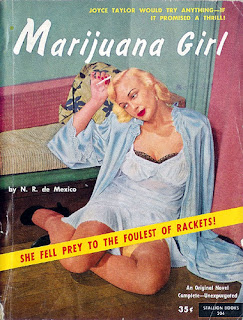
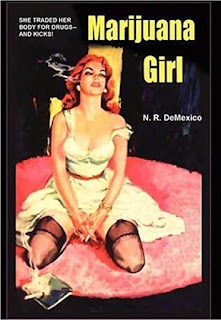
Marijuana Girl by N.R. de Mexico (a pseudonym used by Robert Campbell Bragg) was published by Uni-Books in 1951 and re-issued by Beacon Books in 1960. The book was the centre of some controversy, being singled out for condemnation by a congressional committee on pornography as the kind of book that would encourage innocent American youngsters to rush out and become drug addicts.

What really angered the moral watchdogs was the totally calm and non-hysterical tone of the novel. If you were going to deal with drugs and sex you were supposed to make it clear that drugs and sex led inevitably to misery, ruin and early death. The only acceptable tone was rabid hysteria.

But there’s no hysteria in this novel. Some of the characters use marijuana but they don’t consider it to be a big deal and it doesn’t seem to cause them any real problems. Some of the characters use heroin and that does cause them problems. It is not necessarily the end of the world. The novel doesn’t push the official line that one taste of heroin and you’re a hopeless junkie. There’s even a vague suggestion that for people who have the money for their habit it isn’t a problem.

Even more shocking is that the heroine of the story has sex with more than one man to whom she is not married. She eventually becomes a prostitute but that’s where the book really outrages the moral watchdogs - she’s a prostitute but she’s still a nice girl and she’s still a worthwhile person and she isn’t doomed to a future of misery and degradation. Prostitution is just something you do to make money. It doesn’t have any effect on your moral worth as a person. And it’s like any other job. If you grow tired of it you look for an alternative.

So this is a novel which was certainly promoted as a sensationalist expose of vice and sin but it actually takes a very calm and reasoned and balanced and completely non-judgmental view of certain social problems and it even dares to suggest that some of these social problems aren’t really problems at all.

The fact that the heroine gets introduced to drugs by black jazz musicians in New York undoubtedly contributed even further to the hysterical attacks made on the novel.

While there was plenty of moral hysteria in 1951 the juvenile delinquent hysteria was only just beginning to emerge. Marijuana Girl does have some affinities to the juvenile delinquent scare genre. Joyce, the heroine, has always been rather rebellious and her teachers have always feared that her defiance would lead her into wickedness. Things come to a head when Joyce performs an impromptu strip-tease in the school gymnasium. The school cannot tolerate the presence of such a depraved wicked girl and Joyce is expelled.

Joyce, in typical juvenile delinquent style, doesn’t care about being expelled. She gets herself a job with a local newspaper. The editor, Frank, is almost old enough to be her father but he’s from New York and he has the kind of big-city sophistication and intellectualism that Joyce inevitably finds very attractive. Frank is married and Joyce has a boyfriend (Tony) with whom she is sleeping but they drift into an affair.

The problem for Joyce is that at seventeen she is scarcely capable of dealing with one emotional entanglement let alone two. She can’t choose between the two men in her life. Frank can’t make a decision either - his wife doesn’t mind if he has affairs as long as they don’t get out of hand but she thinks this affair is getting a bit too serious. Tony is almost as young as Joyce and he’s a nice enough guy but not mature enough to deal with the situation. The stresses build up for Joyce and she turns to heroin.

The title of the novel is pretty misleading since marijuana plays a very minor role in the story. It would have been more accurate to call it Heroin Girl.

The author has a few odd stylistic tics but it’s possible that these were part of an attempt to give the book a hip feel. The major subject matter of the book is the emerging jazz-beatnik subculture, which would in the fullness of time become the Counter Culture. It’s a subculture which doesn’t yet see itself as being at war with conventional conservative society but definitely is starting to see itself as standing apart from mainstream society. Jazz, drugs and sex were ways in which to express that sense of apartness.

Marijuana Girl doesn’t fit neatly into the crime, noir or sleaze genres that dominated the paperback originals market in the 50s. It’s more of a melodrama. While the book does take a sceptical look at the conventional social and sexual mores of its era it avoids heavy-handed political messaging. It’s a book worth reading for quite a few different reasons and it’s fairy entertaining. Recommended.

Wednesday, July 1, 2020

Robert Silverberg's Gang Girl

In 1958 there was a major convulsion in the science fiction world and most of the magazines on which writers relied to publish their stories ceased publication. This was a particular problem for younger writers. Writers like Robert Silverberg, who although only in his early twenties was already making a name for himself. Fortunately his pal Harlan Ellison came to the rescue, offering him a contract to write cheap paperback erotic novels for Nightstand Books. He’d have to write a couple of such novels a month which sounds daunting but Silverberg was sure he’d have no problems. And he was correct - in the next five years he churned out 150 sleaze paperbacks under the name Don Elliott.

Gang Girl was one of the earliest, appearing in 1959. It’s a juvenile delinquent potboiler and it’s violent and it’s sleazy. Of course by later standards it is in some ways incredibly tame. There’s a lot sex and it’s graphic enough to ensure the reader knows exactly what is going on, but the language is toned down enough to avoid any inconveniences, like being prosecuted for obscenity. In that respect it’s tame but in other ways it’s still quite startling in its depiction of the mindless brutality, the crazed obsession with sex and the sheer stupidity, boredom, viciousness and futility of New York juvenile gangs in the late ’50s. It’s a lot more open about the sex and violence than any mainstream novels or movies dealing with the subject.

Lora Menotti is sixteen and she’s the deb of the leader of the Scarlet Sinners but now her parents have moved to a new housing estate (all tower blocks) in an effort to get their daughter away from gang life. It doesn’t work. Lora immediately joins the gang in her new neighbourhood, the Cougars. But Lora has no intention of just joining the gang. She intends to run it. That means she’ll have to persuade the gang President, Whitey, to dump his current deb and make her his deb. As Whitey’s deb she’ll be number one girl in the gang, and he has no doubts that she’ll be the one calling the shots.

With her 39-inch bust and her body like a sex goddess she has no trouble getting men to do what she wants them to do. Getting Whitey to dump his current deb, Donna, isn’t going to be a challenge. There is however a minor problem. Whitey always likes to mark his debs to establish his ownership of them, which he does by carving his initials (with a lighted cigarette or a knife) into one of their breasts. Lora has no intention of letting any man carve his initials into one of her spectacular breasts. They’re going to be her meal ticket in the future (she has ambitions to be a call girl). So now her challenge is to maintain her position in the gang without submitting to such treatment.

Lora isn’t too worried. She is utterly ruthless and her mastery of the art of manipulation is something to behold.

Lora’s machinations aren’t just for the purposes of gaining advantages for herself. She is very turned on by violence - nothing gets her more excited than seeing someone being beaten up, except perhaps seeing someone killed. If the victim is subjected to humiliation that’s even better. And it’s best of all if the victim is another woman who might be a rival. Her response to what happens to Mae (one of the debs who happens to be in Lora’s way) is incredibly chilling. Not surprisingly Lora’s arrival among the Cougars triggers a great many outbreaks of violence.

While I said earlier that this book is tame by later standards that’s not really entirely true. You won’t encounter any crude terms for male or female body parts but some of the sexual violence is hair-raising to say the least (such as a truly chilling gang rape). Some of it you just wouldn’t get away with today.

Gang Girl is obviously unashamedly trash fiction. Much of its appeal comes from that. There is however a bit more to it than that. Robert Silverberg was after all a fine writer and even when consciously churning out pulp sleaze he was unable to avoid offering some insights into some of the dark corners of the human psyche, particularly relating to sex and violence. He does try to get inside Lora’s head and what he finds there is deeply unsettling. Lora is not a good girl gone bad, she’s not a victim of circumstances, she’s not a product of a broken home or of childhood trauma. Her evil comes from within. For her the gang life simply has the effect of removing the normal social inhibitions that prevent people from acting on their most primal selfish instincts. It allowed her to shed all her sexual inhibitions very early on and she’s gradually shed all her moral inhibitions.

Perhaps if she had never joined a gang she might have been a nice girl but it seems unlikely. Being selfish and manipulative seems to be an inherent part of her personality. Her prodigious sexual appetites always seem to be inherent. Even without the gangs she would probably have been trouble.

Gang Girl delivers plenty of cheap violent sleazy pulp entertainment but there’s just enough substance there that you don’t have to feel too guilty about enjoying it. OK, you might feel a little bit guilty. There’s also enough dark subject matter to almost qualify it for noir fiction status.

Highly recommended.