Showing posts with label O. Show all posts

Thursday, September 4, 2025

Modesty Blaise: The Iron God and The Wicked Gnomes

Two more Modesty Blaise comic-strip adventures by Peter O’Donnell from 1973 and 1974, The Wicked Gnomes and The Iron God, reprinted by Titan Books in 1989.

By this time Enrique Badía Romero was well established as the Modesty Blaise artist (the original artist Jim Holdaway having passed away in 1970). Apparently O’Donnell would write the comic strips accompanied by crude stick-figure illustrations to give an idea of the action. They would then be sent to Spain where Romero would do the art work. The arrangement worked because right from the start Romero “got” Modesty Blaise. He knew exactly what O’Donnell wanted.

Romero’s style was subtly different from Holdaway’s but Romero maintained the essential feel.

The Wicked Gnomes was published in the Evening Standard from May to September 1973. Maude Tiller is a cute British spy who worked on a previous case with Modesty and Willie. Now she and Willie are having a romantic weekend together, until Maude is kidnapped by Salamander Four. Salamander Four is a freelance International espionage group, very efficient, very ruthless and totally without ethics. Modesty has crossed swords with them before. In this case the Salamander Four operatives are two very creepy killers.

Their plan is to exchange Maude for Pauline Brown, a communist spy currently serving a prison sentence in Britain. Tarrant, the British secret service chief for whom Modesty and Willie often work on a freelance basis, knows that there’s no way to stop Modesty and Willie from being involved. He assumes they’ll do the logical thing and start trying to find Maude to rescue here but Modesty has a much more unconventional plan in mind. Tarrant would not approve, so she doesn’t tell him.

Modesty ends up in a magic grotto dressed as a fairy queen. She’s done crazier things.

A good story with some nice touches and some decent action and Maude Tiller is a fun character. You don’t want to make Maude angry. She’s a sweet girl but she is after all a trained killer.

The Iron God appeared in the Evening Standard between October 1973 and February 1974. Both Modesty and Willie are in Papua where their light plane has to make a forced landing. They encounter a Papuan nurse who is in a lot of trouble. The local tribe isn’t very friendly. They’re head hunters, and they’re being led by a mad bad Irishman, O’Mara.

O’Mara is there because of the Iron God. I won’t spoil things by telling you what the Iron God is but you can see why O’Mara is so interested in it. And he has need of certain skills that Modesty and Willie possess.

Modesty and Willie have to do some quick thinking.

There’s quite a clever little plot here. If Modesty and Willie do what O’Mara wants he will then kill them so they have to play for time and that’s quite a challenge.

A very good story.

In fact they’re both fine stories. The Modesty Blaise formula was well and truly established by this time - exotic locales, colourful villains, outlandish criminal schemes, plenty of action, a hint of romance and a touch of sexiness. And plots that invariably hinge on the extraordinary communication and understanding between Modesty and Willie. Modesty Blaise fans will enjoy these tales. Highly recommended.

I’ve reviewed other early Modesty Blaise comic-strip collections, The Gabriel Set-Up, Warlords of Phoenix and The Black Pearl, as well as the first three novels - Modesty Blaise, Sabre-Tooth and I, Lucifer.

Saturday, June 7, 2025

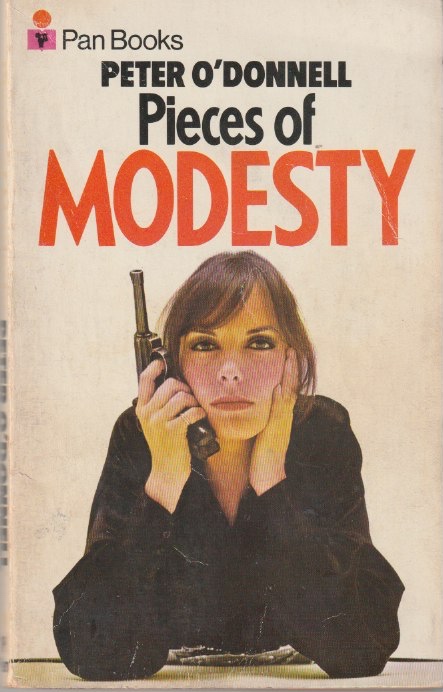
Peter O’Donnell’s Pieces of Modesty

Pieces of Modesty, published in 1972, was Peter O’Donnell’s first Modesty Blaise short story collection. By this time he had already written five extremely popular Modesty Blaise novels.

There are six short stories in this collection and they’re rather varied in tone and approach.

The first story, A Better Day To Die, begins on a bus on a remote road somewhere in Latin America. For the whole trip Modesty has been subjected to a lecture by a clergyman on the evils of violence, and on her own wickedness in resorting so often to violence. The reverend gentleman is escorting a party of schoolgirls.

A shot rings out, the bus driver is dead, and Modesty and her fellow passengers are now prisoners of a rag-tag but trigger-happy party of guerrillas, although really they’re not much more than glorified bandits. Modesty would be a lot happier if the clergyman had not seized her little .25 automatic and tossed it into the bushes. The clergyman assures her that it is always wrong to meet violence with violence.

This story is interesting in showing a very ruthless side to both Modesty and Willie Garvin. They don’t enjoy killing (Modesty does end up respecting the clergyman’s courage in sticking to his non-violent principles). But when it’s clear to them that lethal force is justified they become merciless and efficient killing machines.

Modesty also displays some slightly shocking touches of cynicism. Or perhaps not cynicism - perhaps merely an acceptance of brutal realities. An excellent story.

The Giggle-wrecker is outlandish and even whimsical. It starts in a straightforward manner. A Japanese scientist who defected to the Soviets a decade earlier now wants to defect back to the West. He’s now in hiding in East Berlin. Getting him out is quite possible but would involve a major operation which would put the British espionage network in East Germany at risk. Tarrant, the British spymaster for whom Modesty often does jobs, doesn’t want to take that risk.

The alternative to a major operation would be to get a couple of unconventional talented freelancers to do the job. Freelancers like Modesty and Willie. They encounter unexpected and frustrating problems until Willie has a brainwave. His idea is pure madness but it might work. A light but amusing tale.

I Had a Date with Lady Janet is narrated by Willie Garvin. He has a new girlfriend, a charming girl with one leg. Then a nightmare from the past catches up with him - Rodelle, a very unpleasant man he thought he’d killed, isn’t dead after all. Rodelle wants revenge but he intends to strike at Willie through Modesty whom he has kidnapped.

There’s lot of mayhem in a crumbling old baronial house in Scotland. And it really is literally crumbling. A story very much about the unusual but intense Modesty-Willie friendship and quite exciting as well.

A Perfect Night to Break Your Neck is mostly a story of Willie and Modesty trying to find a way to help their friends John Collier and Dinah without appearing to help them (there’s nothing worse than being put in the position of seeming to be asking for help). There have been a series of spectacular robberies, which may turn out to be the perfect opportunity.

It also offers a reminder that Willie and Modesty are not cops or government agents. Their attitude towards the law is decidedly flexible. A fairly enjoyable story.

In Salamander Four Modesty gets mixed up in industrial espionage after a wounded man shows up on the doorstep of the remote Finnish cabin she is sharing with a renowned sculptor named Hemmer. He’s doing a sculpture of her. She’s giving him lots of encouragement in the bedroom and out of it.

The wounded man, Waldo, is an old rival from her criminal past. A rival but a friendly rival. Waldo’s troubles are none of her business but she doesn’t take kindly to attempt to kill people she knows socially. A pretty decent story.

The Soo Girl Charity is a story in which Modesty’s bottom plays as crucial role. It goes without saying that Modesty has a very nice bottom. She has no great objections to having it admired. Even a gentle friendly pinch is something she can take her in her stride. But this was different. What business Charles Leybourn did to Modesty’s bottom was neither gentle nor friendly.

Modesty and Willie decide that Leybourn needs to be taught a lesson in manners. Their plan involves stealing. They haven’t stolen anything for such a long time so this sounds like fun.

It turns out that there is more than bottom-pinching going on.

This is the best story in the collection. There are several twists, including a very nice one at the end.

Pieces of Modesty is an interestingly varied collection and is highly recommended.

I’ve reviewed three early Modesty Blaise comic-strip collections, The Gabriel Set-Up, Warlords of Phoenix and The Black Pearl, as well as the first five novels - Modesty Blaise, Sabre-Tooth, A Taste for Death, The Impossible Virgin, And I, Lucifer.

Thursday, May 1, 2025

Modesty Blaise: Uncle Happy

Uncle Happy collects two Modesty Blaise comic-strip adventures, Uncle Happy from 1965 and Bad Suki from 1968.

Uncle Happy represented an interesting step for Peter O’Donnell, the creator and writer of the comic strip. His concept for the character was a woman who underwent horrific experiences in childhood but survived and came out much stronger. She put herself back together again. A crucial aspect of the character is that despite those traumatic experiences she is a fully functional woman. She is perfectly capable of having normal emotional relationships with men, and she is perfectly capable of having normal sexual relationships with men.

It was therefore important to make it clear that Modesty has a sex life. In the early strips this was implied. In Uncle Happy it’s made quite explicit. Modesty has found a new man. They have moved in together and they are most definitely sleeping together. This was quite daring in 1965, for a comic strip published in daily newspapers.

Uncle Happy is also interesting for being set partly in Las Vegas, and for the fact that there is clearly a kinky sexual element to the nastiness of the chief villainess. It also demonstrates that Peter O’Donnell was quite comfortable dealing with female evil as well as male evil.

On a skin-diving holiday Modesty meets underwater photographer Steve. Pretty soon they’re shacked up together. Everything is going great until he gets kidnapped. Modesty rescues him but he won’t call the cops. Modesty suspects he’s mixed up in something criminal. They’re both keeping secrets from each other and their love affair fizzles out.

Then Willie Garvin shows up unexpectedly. He’s investigating the possible murder of an old girlfriend but there’s an odd link with Steve - the people who kidnapped him are the very people Willie is investigating. These people are a rich philanthropist and his wife. The philanthropist has earned the nickname Uncle Happy for providing disadvantaged kids with an island playground.

There’s plenty of action in this adventure and a couple of memorable twisted villains including a very nasty lady villain with a taste for sadism. A fine adventure.

Bad Suki is interesting for other reasons. O’Donnell preferred to avoid topical subject matter and in fact he preferred to avoid anything that would make his comic strips date. Modesty’s clothes (when she’s not on a mission) are stylish and elegant but in the 60s you’ll never see her wearing the latest Carnaby Street fashions. Her look is timeless.

Bad Suki was an exception to all of these rules. It deals with a subject very topical at the time - drugs. And it deals with the emerging hippie subculture. It’s an experiment that works reasonably well, but it was an experiment that O’Donnell did not care to repeat.

Willie rescues a hippie girl having a bad acid trip. Willie is no fool. He knows you can’t help people who don’t want to be helped. But he and Modesty feel sorry for the girl. They figure if they can’t help her directly they can deal with the drug pushers.

This is yet another Modesty Blaise adventure featuring underwater action. I’m not complaining. I love underwater action scenes.

It’s also a story that displays a ruthless side to Modesty that you don’t see in most of her adventures. In general Modesty hates killing and does so only when strictly necessary. But this time she intends to kill and she intends to enjoy it. This is another experiment that O’Donnell was reluctant to repeat.

So while Bad Suki can be a bit cringe-inducing at times when dealing with the far-out groovy hippie world it is an intriguingly atypical Modesty Blaise story.

So, two comic-strip adventures, one extremely good and one flawed but interesting. Which makes this volume a worthwhile purchase.

Both adventures feature Jim Holdaway’s art.

I’ve reviewed three other early Modesty Blaise comic-strip collections, The Gabriel Set-Up, Warlords of Phoenix and The Black Pearl, as well as the first three novels - Modesty Blaise, Sabre-Tooth and I, Lucifer.

Tuesday, January 14, 2025

John O’Hara’s BUtterfield 8

BUtterfield 8 was John O’Hara’s second novel, appearing in 1935. It was an immediate bestseller.

John O’Hara (1905-1970) is now almost entirely forgotten but he was quite a big deal on the American literary scene at one time. Even during his heyday he had his detractors as well as his admirers.

BUtterfield 8 was based on the notorious real-life case of a flapper named Starr Faithfull.

This is a Depression novel in the sense that the Great Depression is mentioned constantly but while the characters complain about how hard the Depression has hit them these are people for whom extreme poverty means having to cope with fewer servants. These are very rich people having to deal with the trauma of suddenly finding themselves only moderately rich.

The novel concerns an affair between a young woman named Gloria and a married man named Weston Liggett.

After spending the night having sex with Liggett in his apartment (in the marital bed) Gloria leaves, taking with her Liggett’s wife’s mink coat. That mink coat becomes an obsession with Liggett. Or rather, he becomes obsessed by the difficulty of explaining its absence to his wife.

Gloria is eighteen but she has had a lot of men. She feels plenty of guilt and existential despair. Liggett is torn between guilt, his cowardice about coming clean to his wife and his feelings for Gloria. Eventually the illicit relationship between Gloria and Liggett reaches a crisis.

There are also numerous sub-plots involving other couples but they go nowhere and serve no apparent purpose. Perhaps O’Hara saw this novel as a kind of social document on American middle-class life in the 1930s but the result is a novel that feels badly unfocussed. Or perhaps social documents are just not to my taste.

The book’s success at the time is understandable. It was based on a widely publicised real-life scandal and the plot revolves entirely around sex. In 1935 this novel would have been considered racy.

What’s curious is the total lack of any sense of erotic or emotional heat. When characters in this novel have sex they do so with as much enthusiasm, passion, desperation and madness as they would experience when deciding whether or not to have a second cup of coffee at breakfast. When one of the male characters tells one of the female characters that he has to have her, or when one of the female characters tells one of the male characters that she loves him, we just don’t buy it. We’re just not convinced that these people feel anything.

The characters are totally lifeless and uninteresting. It’s easy to get the various characters confused because they don’t have any real individuality.

The climax comes as more of an anti-climax.

Maybe O’Hara was trying to say something profound about the emptiness of modern life. Or maybe he just couldn’t write interesting prose or create living characters. Maybe he thought he was writing an honest hard-hitting realist novel but the fact that the characters are not believable is still a problem.

The novel gives us exhaustive backstories on even minor characters. It gives us a detailed explanation of how Gloria came to be such a wicked girl. This aspect of the story was handled much more economically, much more effectively and much more convincingly in the 1960 movie.

This is one of the cases of a movie adaptation being vastly superior to the source novel. The screenwriters of the 1960 movie, Charles Schnee and John Michael Hayes, wisely dumped most of O’Hara’s story and replaced it with a much more interesting story. They also retooled the story as melodrama, but very superior and very entertaining melodrama. The movie also has the advantage that Elizabeth Taylor brings Gloria to life on the screen in a way that O’Hara totally failed to do on the printed page.

I’m not sure I’d go so far as to say that BUtterfield 8 is a bad book but it’s most definitely not to my taste and I can’t recommend it.

I can however very strongly recommend the movie which I reviewed here - BUtterfield 8 (1960).

Sunday, November 10, 2024

Modesty Blaise: The Puppet Master

The Puppet Master collects three early 1970s Modesty Blaise comic-strip adventures by Peter O’Donnell. By this time Modesty Blaise was also the heroine of a very successful series of novels, also written by Peter O’Donnell. Modesty was a fairly major pop culture icon.

The Puppet Master

Modesty is kidnapped by an old foe seeking a particularly refined and cruel form of vengeance. He has a plan for revenge that will encompass both Modesty and Willie Garvin.

Brainwashing stories of various kinds were a major cultural obsession in the 1960s.

Not a bad story but the plot twists are just a little predictable. It does touch on Modesty’s psychological quirks and on the particular bond that she has with Willie.

With Love From Rufus

A burglar breaks into Modesty’s flat. He must be a very clever burglar to get past the high-tech security system Willie Garvin had installed. He doesn’t take anything but he leaves something behind. Two things in fact. A bunch of flowers and a note signed “With Love From Rufus” and Modesty has never heard of a Rufus. While some women might be alarmed by this Modesty Blaise, being Modesty Blaise, is intrigued.

It turns out that Modesty doesn’t have a stalker but she does have a fan. Just like a pop star. A fan who worships her. She’s flattered but worried. He wants to emulate her criminal career. He’s also landed himself in a very dangerous situation. He might be an aspiring criminal mastermind but he’s basically a good lad and Modesty doesn’t want to see him end up in the slammer, or worse.

Getting him out of the jam he’s in involves Modesty and Willie in plenty of danger.

This is a solid story but the main interest is provided by the fan-worship aspect. Modesty gets to be both motherly and a bit ruthless.

The Bluebeard Affair

The Bluebeard Affair really does concern a modern Bluebeard, Baron Rath. The Baron (whose noble lineage is non-existent) has married a series of rich but timid women. They seems to have unfortunate, and fatal, accidents. Modesty’s friend Raul (a big wheel in the French Sûreté) is worried that his niece will be the next victim. She has become Baron Rath’s fourth wife.

Modesty decides that she needs to present herself as a candidate to be the Baron’s fifth wife. She’s not used to being meek and submissive but she’s a natural actress and has no trouble getting his attention.

The basic story might not be startlingly original but it’s executed with style. We get diabolical female evilness in the persons of the baron’s frightening daughters. We get Modesty sword-fighting. And we get Chloe the elephant who lends Willie a hand (sometimes owning a circus comes in handy).

We also have Willie dealing with something much more terrifying than super-villains - a girl determined to marry him. And she has three very tough very mean brothers to make sure he does the right thing.

There’s plenty of stylish action. A fine story and the highlight of this particular collection.

Final Thoughts

A good solid collection with at least one major standout. Modesty Blaise is always worth reading, in comic-strip or in novel form. Highly recommended.

I’ve reviewed three other early Modesty Blaise comic-strip collections, The Gabriel Set-Up, Warlords of Phoenix and The Black Pearl, as well as the first three novels - Modesty Blaise, Sabre-Tooth and I, Lucifer.

Wednesday, November 6, 2024

Milton K. Ozaki’s The Scented Flesh

Milton K. Ozaki’s The Scented Flesh was published in 1951.

Milton K. Ozaki (1913-1989) was an American writer born in Wisconsin. His father was Japanese. He wrote a couple of dozen crime novels between 1946 and 1960.

The Scented Flesh opens in classic hardboiled style. Private eye Carl Good wakes up next to a beautiful blonde. This dame has real class, and a look around her apartment indicates she has real money as well. That puzzles Carl. If she has class why would she have gone to bed with him? Dames like her don’t sleep with two-bit private eyes. There’s a used flash bulb on the floor, which worries Carl a little. Another thing that bothers Carl is that the blonde is dead. He doesn’t like the implications of that. He certainly didn’t kill her but it looks like someone is trying to make it look that way.

It would help if he could remember how he ended up in the dame’s apartment but the previous night is a complete blank. Carl is no drunk. He figures someone slipped him a mickey.

Eventually he remembers that he’d been in a dive called The Shamrock. Maybe one of the girls there remembers seeing him. Flo remembers him. She thought he was a pretty nice guy.

Another thing that Carl figures out is that he’s making somebody nervous. Nervous enough to try to blow him up with a hand grenade. There are whispers of a shake-up in the world of organised crime but Carl can’t see how that could connect with a routine missing persons case. Which is all that this started out to be. An old guy from Iowa hired him to find a girl, Sylvia Shepherd. Maybe she’s his daughter. Carl doesn’t care. He was offered two hundred bucks to find her so he took the case.

Now everyone is telling him that the smart thing to do is to drop the case. Carl thinks that would be the smart thing to do as well. He has no personal stake in this and it sounds like some very dangerous people are mixed up in it, the kinds of people a smart private eye steers well clear of. But Carl is stubborn.

The sleaze level gradually increases. It’s a crooked town. But Carl has been around long enough to take that for granted. He’s a big boy.

There are a lot of women in this case. Lots of naked women. Some dead, some alive. Some of them are strippers. Some seem respectable. Carl thinks the strippers are more trustworthy than the respectable dames. Maybe he’s right.

Maybe he should talk to the organised crime boss? A crazy idea but it might give him a clue. And it’s not like Carl has any crusading ideas about clearing up crime and corruption. He just wants to solve the case and collect his two hundred bucks and go back to his normal routine. A routine that doesn’t involve waking up in bed with dead blondes.

It’s a fairly routine plot but it’s serviceable enough. Carl gets himself deeper and deeper into something he still doesn’t understand and that offers plenty of potential for action and narrow escapes from danger.

There’s plenty of hardboiled atmosphere but this is definitely not noir fiction.

The Scented Flesh is a fairly average but very competent hardboiled PI thriller. As long as you don’t approach it with unrealistically high expectations it’s enjoyable. Recommended.

Armchair Fiction have paired this title with Owen Dudley’s rather good Run If You Can in a two-novel edition.

Wednesday, August 14, 2024

Peter O’Donnell’s The Impossible Virgin

The Impossible Virgin was published in 1971. It was the fifth of Peter O’Donnell’s eleven Modesty Blaise novels. The Modesty Blaise comic-strip debuted in the London Evening Standard in 1963. The comic-strip adventures are excellent and I recommend them but the novels have more depth and psychological complexity and were able to deal more openly with adult themes.

People unfamiliar with either the comic strip or the novels sometimes make the mistake of thinking of Modesty Blaise as a female James Bond. Nothing could be further from the truth. She is almost the exact opposite of Bond in every way. Bond is British to his bootstraps and fiercely patriotic. He has a naval background and is accustomed to obeying orders. He has never questioned authority. He is a professional spy working for the British Government. He is a straightforward old-fashioned kind of guy.

Modesty is British only by marriage (a marriage of convenience). She has no idea what her own nationality or ethnicity might be - she’s probably southern European or Slavic. Modesty’s background is entirely criminal - she ran an organised crime gang. She has never obeyed an order in her life. She often does jobs for the British Government but strictly as a freelancer and she feels under no moral obligation to accept such jobs. She also does jobs for the French intelligence services.

Modesty is really a female Simon Templar - a retired criminal who is now a crimefighter and part-time spy. She is a female version of the gentlemen rogues who thrived in British popular fiction in the 1930s. Like the Saint she gets involved in capers for the adventure, or because she thinks a particular villain needs to be destroyed or occasionally for motives of personal revenge.

This caper begins when a low-level Soviet intelligence analyst makes an interesting discovery. It has no military significance but it could make him rich. It doesn’t turn out that way. A few months later he staggers into a bush hospital in Tanzania and promptly dies. He gives the appearance of having been tortured. The hospital’s only doctor is Giles Pennyfeather, a disreputable shabby socially inept eccentric Englishman. To look at him you wouldn’t trust him to operate on a stray dog, but the weird thing is that his patients do surprisingly well.

As it happens Dr Pennyfeather has at this moment acquired a kind of temporary nurse and assistant, a striking young woman who literally fell from the sky when she had to make a forced landing in her aeroplane. She has no medical training but she’s a quick learner. Her name is Modesty Blaise. She is in Tanzania purely by accident.

There is no way such a beautiful young woman would be interested in such a poor specimen of manhood as Giles Pennyfeather but Modesty thinks he’s rather adorable and she is soon sharing his bed.

Then two thugs arrive and starting beating up Dr Pennyfeather. They seem to be convinced he has some information they want. Modesty takes exception to their behaviour and deals with them accordingly but without knowing it she has become involved with some very dangerous very evil people.

There is an impossible virgin in this story, of a sort. There’s also Lisa, who is no virgin but is certainly very dangerous. The gorilla might also be a problem - he’s a real gorilla and he’s bad-tempered and being locked in a cage with him isn’t very reassuring.

Modesty will have to face most of these dangers alone, when the faithful Willie Garvin makes a sudden departure. Modesty will also need a certain special ability that she has - she can shut herself down mentally so that she is unaware of what is being done to her, and some rather nasty things are done to her in this caper.

Finding out why the impossible virgin’s virginity remains inviolate will be crucial.

There’s enough action here to satisfy fans and there’s plenty of suspense as Modesty’s position becomes seemingly hopeless.

The Impossible Virgin is a fine action/adventure novel and is highly recommended.

I’ve reviewed the earlier Modesty Blaise novels, Modesty Blaise, Sabre-Tooth, A Taste for Death and I, Lucifer, which are all excellent. I’ve also reviewed several of the earlier volumes of the collected Modesty Blaise comics, The Gabriel Set-Up, The Black Pearl and The Hell-Makers which I also highly recommend.

Friday, April 19, 2024

Modesty Blaise: Warlords of Phoenix

Warlords of Phoenix collects three Modesty Blaise comic-strip stories from the tail end of the 60s. If you’ve only read the Modesty Blaise novels (which are wonderful) I urge you to check out her comic-strip adventures which are also excellent.

Peter O’Donnell created the character in 1963. He wrote the comic strip until 2001. It became the last of its breed - the ongoing comic-strip story unfolding three panels at a time in a daily newspaper.

Halfway through the second story in this collection, Warlords of Phoenix, the strip’s original artist Jim Holdaway passed away. He was replaced by a Spanish artist, Enrique Badía Romero. The result was a very slight change in style, with Modesty’s appearance subtly changed.

It’s also noticeable that there’s just a bit more nudity compared to the earlier strips.

The 1969 story Takeover was the last to be drawn entirely by Jim Holdaway whose collaboration with O’Donnell went back to the 1950s when O’Donnell was writing the popular Romeo Brown comic strip.

In this adventure the Mafia is trying to take over organised crime in Britain. O’Donnell portrays the Mafiosi as smooth business types (albeit with a brutal and ruthless streak) capable of passing as reasonably respectable citizens. In 1969 this was still a slightly unusual approach in fiction dealing with the Mob.

The Mafia’s methods are sufficiently ruthless to discourage informers who might be tempted to talk to the police. Modesty will have to offer herself up as bait. Willie with then spring the trap closed. Her plan is sound enough, provided the Mafia guys are not suspicious enough to scent a trap. But these Mafiosi are very suspicious indeed and Modesty and Willie could be in trouble.

What’s most interesting about this story is that Modesty’s criminal past is a crucial plot ingredient. Her criminal past is also the key to her whole attitude towards the case but I won’t say any more about that for fear of revealing spoilers.

In Warlords of Phoenix Modesty and Willie are in Japan, visiting a very dear friend (and famed judo master). He’s 70 years old but he’s still a formidable master of the art.

His granddaughter’s boyfriend tries to murder her, apparently because she found out about his involvement with an organisation called Phoenix. Nobody knows anything at all about this organisation.

This organisation does however know quite a bit about Modesty Blaise and Willie Garvin. They have plans to use Modesty and Willie. Modesty and Willie will need all of their combat skills and experience - they are going to come up against some very highly trained killers.

There are plenty of clever action scenes.

Willie the Djinn takes Modesty and Willie into the desert, to a sheikh’s palace. It all started with the sheikh’s obsession with playing games with Modesty. Not sinister games - he genuinely just wants to play backgammon with her.

Modesty and Willie are caught up in palace plots and they have a whole troupe of pretty English dancing girls (the delightfully named Dollyrockers) to protect as well. And Willie is mistaken for a djinn.

There’s plenty of mayhem and the Dollyrockers join in with great enthusiasm. These girls just love having the chance to use submachine guns.

By this time O’Donnell was well and truly in the groove and these are three fine adventures. Highly recommended.

I’ve reviewed two other early Modesty Blaise comic-strip collections, The Gabriel Set-Up and The Black Pearl, as well as the first three novels - Modesty Blaise, Sabre-Tooth and I, Lucifer.

Monday, January 15, 2024

Peter O’Donnell’s Modesty Blaise: A Taste for Death

A Taste for Death, published in 1969, was the fourth of Peter O’Donnell’s eleven Modesty Blaise novels. Modesty Blaise of course made her first appearance in comic-strip form in 1963. O’Donnell’s Modesty Blaise comics are excellent but the novels are even better, having a lot more depth.

Modesty Blaise is one of the great fictional spy/crime thriller characters. Her nightmarish childhood left her psychologically damaged but she learnt to turn her psychological damage into assets that made her more dangerous and more formidable. She acquired the ability to shut down completely psychologically whenever she was in a really unpleasant situation and this now gives her an extraordinary resistance to pain and suffering.

Modesty became a very successfully criminal. She is now not so much reformed as retired. Like that other great fictional rogue, the Saint, she feels no remorse or guilt for her criminal past. She gave up crime because she was smart enough to quit while she was ahead. Like Simon Templar she has an amazing ability to find adventure. In fact adventure finds her. She sometimes does jobs for a British counter-intelligence agency but she is strictly a freelancer. Modesty is her own boss. If the agency wants her to do a job for them she does it in her own way on her own terms. Modesty takes orders from no-one.

She is also rather complex emotionally and sexually. Willie Garvin was her righthand man in her criminal days and he is still her righthand man. The emotional bond between them is intense but unconventional. They know they can never sleep together. Which is not to suggest that Modesty has a problem with sex. She has a healthy enthusiasm for it. She has no difficulty forming emotional attachments with men, but those attachments remain loose and temporary.

A Taste for Death begins when Willie, on holiday on a remote island, witnesses a murder. He witnesses it at long range and cannot prevent it. Two hoods are about to murder two girls but they kill only one of them. For some unknown reason they want the other girl alive and undamaged.

Willie rescues the surviving girl. She is a blind Canadian girl named Dinah. And the reason the hoods wanted her alive cannot be because they hope to hold her for ransom. She has no money and her family has no money. She also possesses no knowledge likely to prove useful to a criminal gang or a spy ring.

Willie sees something else that really interests him. He sees two men on a yacht. They are clearly awaiting the return of those two hoods. Willie recognises both men on the boat, and one of them is Gabriel. If you’re familiar with the previous adventures of Modesty and Willie you know that Gabriel is one of the most formidable villains they have ever encountered. If Gabriel is involved then something big is about to go down.

While this is happening an archaeologist is murdered in London. There is no obvious connection between these two events but of course a connection does eventually emerge. And the reason for Gabriel’s interest in Dinah slowly becomes clear. Dinah has a peculiar talent. A very useful talent.

Gabriel is not the principal villain on this story. That rôle is played by Simon Delicata, a giant of a man and a man far more dangerous and evil than Gabriel. He’s a wonderful creation.

Most of the action takes place in the desert, at the site of an archaeological dig. Modesty and Willie have a plan but it misfires and this time there seems likely to be no way they can escape with their lives. But Modesty and Willie never give up and Dinah’s strange talent comes to their aid.

There is action and excitement, there is a vast criminal conspiracy, there is suspense. The peculiar talents of Modesty and Willie are called for. While they both possess the kinds of abilities you expect, such as formidable combat skills, what really makes Modesty and Willie so dangerous is their extraordinary psychological self-training. Both Modesty and Willie will face fights to the death with the odds stacked against them but it is their mental toughness and flexibility that will give them a chance of survival. Modesty also has a frightening willingness to put herself in extreme danger quite willingly, and to endure tremendous punishment. It’s a price she is prepared to pay if it will give her a psychological edge.

A Taste for Death is top-notch action adventure fiction. Highly recommended.

I’ve reviewed the earlier Modesty Blaise novels, Modesty Blaise, Sabre-Tooth and I, Lucifer, which are all excellent. I’ve also reviewed several of the earlier volumes of the collected Modesty Blaise comics, The Gabriel Set-Up, The Black Pearl and The Hell-Makers which I also highly recommend.

Sunday, October 1, 2023

Modesty Blaise: The Hell-Makers

The Titan Press volume The Hell-Makers contains three of Peter O’Donnell’s fairly early Modesty Blaise comic-strip adventures. At this stage Jim Holdaway was still doing the artwork.

I’ve written at length on the subject of Modesty Blaise as a character in previous reviews. Suffice to say that I’m a major fan. Modesty Blaise was like a breath of fresh air in the world of British comics when the strip made its debut in 1963. Like its heroine it was exciting and sexy and stylish and totally in tune with the mood of Swinging London.

Modesty Blaise is in the great tradition of criminals turned amateur crime-fighters and she bears at least a passing resemblance to the greatest of all such literary characters, The Saint. As well as fighting crime Modesty dabbles in espionage and counter-espionage on a strictly freelance basis. Modesty is always her own boss.

The three adventures in this volume originally appeared in the London Evening Standard in 1968 and 1969.

The Galley Slaves

In The Galley Slaves Modesty and her crimefighting partner (but not lover) Willie Garvin are guests on a yacht in the South Pacific but they’re bored so they get themselves put ashore on a tiny island. The island is not very far from Tahiti. Willie is sure they can easily build a raft to reach Tahiti.

While taking a break from raft-building they notice something unusual heading for their island. It’s a Roman trireme filled with Roman legionaries. Of course it turns out that somebody is making a movie.

Other things are happening in this South Seas paradise. The Americans have misplaced a nuclear ballistic missile submarine. It’s a drone submarine and they think somebody stole it. Modesty and Willie know who stole it - an old friend of theirs from their criminal days. A man named Lim. And Modesty owes Lim a big favour. Modesty never forgets a debt.

The submarine was not the real prize. What Lim was after was the telemetry system which made the drone submarine operable. And that system is a lot easier to hide than a submarine. It could be hidden anywhere. It may be necessary to negotiate with Lim and the possibility of a double-cross is very real.

There’s a fine action climax on board the trireme. A good story.

The Red Gryphon

In The Red Gryphon Modesty is in Venice with her new boyfriend Max, a young Italian architect. Max is restoring a palazzo on an island for a client. The client bought he island from Count Alborini. Modesty’s chance encounter with two cute but larcenous orphan children indirectly leads to a discovery by Alborini. There is something on that island, something worth killing for. There’s a connection with a huge statue of a gryphon.

And murder does indeed soon follow. Modesty and Willie have to foil Alborini’s plans, but Alborini is ruthless and has a team of rather nasty thugs in his employ.

This story has (as usual) some fine action scenes and it makes good use of the Venetian setting. Another solid story.

The Hell-Makers

The Hell-Makers starts with Willie Garvin stopping to help a distressed young woman by the side of a highway in Montana. Willie doesn’t know it yet but he just made a big mistake. Somebody intends to use Willie as the ammunition in an attempt to blackmail Modesty as part of an espionage plot. It’s going to be a nightmare time for Willie.

Modesty makes an unlikely friend, learns a new way of climbing unclimbable cliffs, makes an unexpected visit to a naturist resort and gets some help from a couple of birds, of the feathered variety.

There’s also a great deal of gunplay, with Modesty in a ruthless mood. And Modesty faces a more personal battle as well. A very good story.

Final Thoughts

Three very fine adventures, with The Hell-Makers being particularly interesting in that it tells us a bit more about the strange relationship between Modesty and Willie. A great collection, highly recommended.

I’ve reviewed several of the Modesty Blaise novels - Modesty Blaise, Sabre-Tooth, I, Lucifer and Last Day In Limbo - as well as a couple of the earlier comic-strip collections - The Gabriel Set-Up and The Black Pearl.

Monday, June 19, 2023

Peter O’Donnell’s I, Lucifer (Modesty Blaise #3)

I, Lucifer was the third of Peter O’Donnell’s Modesty Blaise novels. It appeared in 1967.

Modesty Blaise of course started life as a comic strip character, created by O’Donnell in 1963. He was hired to write the screenplay for the Modesty Blaise movie, which ended up not being used for the movie. But even before the movie was released O’Donnell had produced a novelisation of the screenplay which was published in 1965 as Modesty Blaise and was hugely successful (in fact a lot more successful than the movie).

O’Donnell eventually wrote eleven Modesty Blaise novels plus two short story collections, while continuing to write the comic strip.

Modesty Blaise was certainly not the first kickass action heroine. Honey West predates her by several years - the first Honey West novel, This Girl for Hire, appeared in 1956. And by the time the Modesty Blaise comic was launched Cathy Gale had already exploded onto the small screen in The Avengers.

What made Modesty Blaise so intriguing is that she was not just a kickass action heroine. She also belonged to the tradition of the gentleman rogue hero. The most famous such hero is of course Leslie Charteris’s Simon Templar, the Saint. The Saint had several precursors and lots of imitators. What makes Modesty Blaise so very interesting is that she was not just the first lady rogue acton heroine, she is still just about the only representative of that species.

And Modesty has a great deal in common with Simon Templar. Both became exceedingly rich by being very successful criminals. Both more or less retired from crime to become crime-fighters. Both have worked unofficially for the British intelligence services. Both occupy a socially ambiguous position. Simon Templar can pass as a gentleman but he isn’t really one. Modesty can pass as a lady but she isn’t really one. They are able to move in the highest social circles but they remain outsiders. Both are charming, sexy and dangerous. Both tend not to worry too much about conforming to conventional standards of morality. Both have a definite streak of ruthlessness. Both are unapologetic about their criminal pasts. Modesty Blaise is to a large extent a female Simon Templar.

The adventure with which I, Lucifer is concerned isn’t really Modesty’s business, but she makes it her business (which is exactly Simon Templar’s approach to life). Someone tries to kill a friend of hers, a man highly placed in the French intelligence community. Modesty tends to get annoyed by that sort of thing. She has a word to Sir Gerald Tarrant, a man very highly placed in a British counter-espionage agency for whom she often works totally unofficially. And she discovers that something very strange is going on. Someone is running a protection racket, but an unusual one. Those who don’t pay up die, but they die of natural causes.

The reader already knows that Lucifer has something to do with his. No, not that Lucifer, the real one, but a very disturbed young man who is convinced that he is Lucifer. He has a very unusual ability, which eventually explains how that unconventional protection racket is worked. That ability possessed by the young man is being used by a criminal mastermind.

Modesty and her partner-in-crime (now her partner in crimefighting) Willie Garvin finally manage to infiltrate this criminal organisation and a great deal of mayhem ensues. There are quite a few complications. Modesty has been having a rather pleasant love affair with a young fellow named Stephen. Stephen is a bit of an innocent and somehow he has become involved in this criminal conspiracy.

This novel deals with the paranormal, in this case precognition. You do have to remember that this was 1967, a time when the paranormal was still moderately scientifically respectable. The paranormal was not a concept that was confined merely to genres like science fiction and fantasy. It would pop up from time to time in spy fiction. In fact at that time some of the crazier real-life intelligence agencies such as the C.I.A. took things like telepathy quite seriously.

And this paranormal aspect is used quite skilfully. The way the protection racket works is clever. The paranormal powers possessed by Lucifer have serious limits. They do not make him invulnerable nor do they make the criminal gag unbeatable. That’s normally the biggest single disadvantage of magic, super-powers or paranormal powers in fiction - they make either the hero or the villain seem too formidable.

And Lucifer is an intriguing charter. He’s a nice young man who just happens to believe that he is the Prince of Darkness. Modesty rather likes him.

During the course of this case Modesty will have to consider whether she’s prepared to (literally) get into bed with the Devil. She decides that she’s done worse things, and he is very good-looking.

The novel doesn’t stint when it comes to action. If you want unarmed combat, gunplay, knife fights and explosions you’ll be well satisfied. There are sinister insane villains (who are much more sinister and insane than Lucifer).

And then there are Pluto and Belial, and they add another touch of outrageousness to the story.

There’s no graphic sex but there’s a casual acceptance of the idea that people do have sex. Modesty likes sex. She’s by no means obsessed with it, but she does enjoy it.

Like the two earlier novels in the series I, Lucifer is clever, witty and great fun. Highly recommended.

Saturday, May 13, 2023

Modesty Blaise La Machine, The Long Lever, The Gabriel Set-Up

La Machine was the first-ever Modesty Blaise comic strip, and the first-ever Modesty Blaise story. It’s included, along with the next two adventures, in the first of the Titan Books volumes collecting the comic strips in book form.

Modesty Blaise was not the first kickass action heroine in fiction but she was a very early example of the breed. She was not only one of the most successful such heroines, she is also one of the most interesting.

The Modesty Blaise comic strip first appeared in the London Evening Standard on 13 May 1963. The comic strip ran until 2001. She appeared in eleven novels and two short story collections between 1965 and 1996. There were film and TV adaptations.

Peter O’Donnell seems to have known from the start that he was onto something special. He spent a year developing the character before the first comic strip appeared. He wanted to get her just right and he wanted her to be not just a comic-strip heroine but a complex and fascinating woman.

La Machine is very much a setting up the characters story and O’Donnell therefore keeps the narrative fairly straightforward. Modesty, in retirement after her successful criminal career, is persuaded to take on a job for the British security services. As will become usual it is a shadowy figure in the British Secret Service, Sir Gerald, who offers her the assignment. But Modesty is a freelancer. She is never under any obligation to accept an assignment.

The mission in this case is to expose and destroy an international murder racket known as La Machine, a kind of Murder Inc operation. Modesty’s plan is to tempt the racketeers into seeing her as a potential client. She will have to go further than that, and she lands herself in a very tricky situation. Her motives are suspected and La Machine marks her down for execution.

In this story O’Donnell succeeds in telling us a very great deal about Modesty, about how she operates and how she feels.

In the second story, The Long Lever, the KGB snatches a scientist and the Americans want him back. Sir Gerald hopes to pull off a coup - using Modesty and Willie to beat the Americans to the punch. It’s all a matter of British pride.

It’s a story with an unexpected twist, the first sign that O’Donnell was not always going to conform to out expectations. The twist also tells us a bit more about Modesty, and how her past has affected her.

The third story, The Gabriel Set-Up, taps into themes that were very much in tune with the early 60s zeitgeist - brainwashing and mind control. Super-criminal Gabriel (who has clashed with Modesty in the past, is running a clinic for neurotic rich people. It’s part of a racket dealing in blackmail and industrial espionage, but Gabriel’s plans extend much further than that.

Modesty of course turns up at the clinic as a patient. Considering her past the idea of letting people play with her mind is rather frightening but Modesty is always prepared to endure unpleasantness in order to carry out a mission. And controlling Modesty’s mind is quite a challenge.

The first thing to be said is that Modesty is not a Honey West clone or a Cathy Gale clone. She is also not James Bond in a skirt. She is in some ways more like a female Simon Templar. Like the Saint she has made her fortune from crime. Like the Saint she feels no remorse whatsoever. Again like Simon Templar she figures that she has more than paid back society through her crime-fighting and counter-espionage activities so she has no need to feel any guilt. Like Simon Templar, but to a much greater degree, she is a bit of an outsider. But there’s a lot more to Modesty Blaise.

Modesty knows nothing of her origins. At the end of the war she was a kid in a displaced persons camp in the Middle East. Her dossier in the files in the British security service mentions that she is just very slightly Eurasian in appearance. Modesty speaks several languages and probably doesn’t know what her mother tongue is. She is a British citizen by marriage.

One of the things that makes Modesty interesting is that she’s psychologically damaged. She want through Hell when she was young and she still bears the scars. She has been able to put herself back together again but the damage is still there. It has made her both tougher and, oddly, more vulnerable.

Modesty’s missions always seem to put her in situations in which it’s an absolute certainty that she will be captured, physically abused, tortured and humiliated. And she puts herself in these situations deliberately. She’s not a masochist as such, she doesn’t enjoy it, but she does seem to get a certain amount of satisfaction out of proving that she can take it, and proving that no matter what is done to her it won’t really hurt her because she has developed techniques to switch herself off completely. There’s always a sexual element involved in these situations but Modesty has also trained herself to switch off from that, so that these events never warp her thoroughly natural enjoyment of her sex life.

The backstory also makes the Modesty-Willie Garvin relationship makes and explains why, despite their intense emotional bond and despite the fact that they both have normal healthy sex lives, they cannot ever sleep together. They developed a kind of brother-sister relationship which would be shattered if they had sex.

Another cool thing about Modesty is that she doesn’t just have the usual accomplishments (firearms and unarmed combat skills). She has some psychological tricks she developed in order to survive her nightmare childhood and these tricks often give her an edge over an opponent.

Of all the kickass action heroines of the past sixty years I find Modesty Blaise to be the most convincingly female. She’s an intelligent, resourceful, tough and capable woman, but she is always a woman. As I said earlier, you’ll never mistake her for James Bond in a skirt. She’s also by far the most psychologically and emotionally complex of kickass action heroines. She really is a fascinating woman.

Modesty Blaise is a comic strip for grown-ups. There’s plenty of action and excitement but it offers some subtlety and it explores surprisingly complex themes. Of course these themes, and Modesty’s fascinating personality and motivations, are explored in more depth in the novels but the comic strips have just a bit more depth than you might expect. Highly recommended.

I’ve reviewed several of the Modesty Blaise novels, including the first one and the excellent Sabre-Tooth as well as one of the later entries in the series, Last Day In Limbo.

Wednesday, December 28, 2022

William O’Farrell’s Repeat Performance

William O’Farrell’s Repeat Performance was published in 1942.

It is 1942. Barney Page is a successful Broadway actor. At least he was a successful actor. Now he’s a bum. He blames himself for his wife Sheila’s death. And he knows he was responsible for his mistress Fern’s death. He remembers strangling her. He knows the cops will soon be closing in on him. His producer John Friday tells him that maybe he can help him. Barney trusts John Friday. John tells him that what Barney’s life needs is a rewrite job.

Surprisingly Barney gets the chance to do that rewrite job. Because now it’s 1941. None of the things that wrecked his life have happened yet. Barney knows they’re going to happen, but that knowledge might give the chance he needs. Now he’s more like the director of the play that is his life, rather than just an actor in it.

And Barney knows all the mistakes he’s going to make. Every one of them. It should be possible to avoid them. He knows he should not take the movie job he’s been offered because if he goes to Hollywood he’ll meet Fern and he’ll have an affair with her. So he decides that he is definitely not going to Hollywood.

He also knows that it’s important not to sleep with Pete McCord’s wife. That’s a big mistake he made, or rather it’s a big mistake he’s going to make unless he’s careful.

He has to make sure Sheila doesn’t meet Jake. Jake is the writer of the play in which Barney is about to star. If he can prevent them from meeting they won’t sleep together, and Sheila might not die.

Barney knows about other mistakes he’s going to make as well. He has to keep away from the booze.

Of course knowing the dumb things you’re going to do and the disastrous consequences that will follow doesn’t necessarily mean that you’re not going to do those dumb things anyway. Barney however is determined to try, and he does try. He tries really hard.

There is a crime but this isn’t really a crime novel in a conventional sense. It is however very definitely noir fiction. It’s a different kind of noir novel, in which the protagonist knows how his own story is going to end. He knows the ending, but he thinks he can change it. He thinks he can write the script for his life as he lives it.

Barney is a nice enough guy. He has never intended to hurt anyone. He likes people. He has no dislike of women. He just doesn’t quite have the strength of character to avoid temptations, especially temptations of the feminine variety. He ends up in bed with women without really knowing how it happened. Barney isn’t particularly driven by lust. It’s more loneliness. He doesn’t have the emotional closeness with Sheila than a man should have with his wife, and it seems to that need for emotional connection that drives him.

Barney qualifies as a noir protagonist. The three women however don’t really fit into the femme fatale category. Sheila isn’t a bad girl, although she drinks too much. It’s not really anyone’s fault that the marriage didn’t work out.

Fern is not the kind of woman who sets out to steal other women’s men, but with Barney it just kind of happened.

Sis isn’t a classic bad girl. She’s promiscuous and Pete should never have married her but she’s not an evil spider woman.

The whole rewriting his life thing raises obvious questions. Is this a science fiction/crime crossover story? Is something supernatural or paranormal happening? Is it a dream or just a distorted memory? You’ll have to read the book to find out.

Repeat Performance was filmed in 1947, which is intriguing. I could think of so many ways that Hollywood could have made a mess of an adaptation, and in my opinion that's exactly what they did. Here's my review of the movie.

Repeat Performance is a bit of an oddity and it’s worth reading for that reason. It’s also a decent noir-tinged romantic melodrama. Highly recommended.

Sunday, December 18, 2022

Peter O’Donnell’s Sabre-Tooth (Modesty Blaise 2)

Sabre-Tooth, published in 1966, is the second of Peter O’Donnell’s Modesty Blaise novels. Modesty Blaise started out as a comic strip created by O’Donnell in 1963. Its immense popularity led to the making of the Modesty Blaise movie which was released in 1966. O’Donnell was hired to write the screenplay. The producers didn’t like his screenplay and made so many drastic changes that the movie bore little resemblance to O’Donnell’s script and the character in the film bore little resemblance to O’Donnell’s creation. Before the script was totally rewritten O’Donnell had been commissioned to write a novelisation. His novelisation was based on his original script and has little to do with the film.

The film was only moderately successful and was poorly received by critics. O’Donnell’s novelisation on the other hand was a bestseller and everybody loved it. It was so successful that O’Donnell went on to write a total of eleven Modesty Blaise novels plus two short story collections.

Sabre-Tooth gives us a brief recap of Modesty’s backstory. She was a wartime refugee who was looking for an escape from poverty and misery. She chose a life of crime and ended up as head a vast criminal syndicate. Having made her fortune she retired from crime. She is now semi-respectable and is more likely to be fighting crime than committing it, and she helps out the Secret Service from time to time.

Modesty is sometimes described as a female James Bond but that is inaccurate and misleading. Bond is a professional with a background in military intelligence. He is part of the Establishment and his loyalty is to the Establishment. Modesty is a freelancer and an amateur and her background is entirely criminal. She is definitely not part of the Establishment.

In fact it would be more accurate to describe her as a female Simon Templar, the Saint. The Saint has a veneer of sophistication and charm and can just about pass as a gentleman but he is not one. Being a gentleman is a matter of Breeding and the Right Schools. The Saint did not enjoy those advantages. Modesty Blaise has the same surface poise and sophistication and can just about pass as a lady, but she will never truly be a lady. And like Simon Templar she will never truly be accepted as respectable.

Modesty Blaise was not quite the first sexy kickass action heroine (Cathy Gale beat her to the punch) but she remains one of the most memorable. She’s a bit more complicated than Cathy Gale but there are obvious similarities. The 60s was a decade in which sooner or later such female characters were going to emerge. Modesty Blaise, like The Avengers, was very much in tune with the zeitgeist of the 60s.

Modesty has a partner, Willie Garvin. He has a similar criminal background. Willie is the most important man in Modesty’s life and she is the most important woman in his life but they are not lovers. That was quite a good idea on O’Donnell’s part. It leaves him free to allow both Modesty and Willie to have romantic adventures. And indeed they each have plenty of romantic and sexual adventures in this tale.

Sabre-Tooth concerns a mercenary army led by the ruthless Karz. Karz needs leaders for his army. He thinks Willie Garvin and Modesty Blaise might be suitable. Modesty did after all run a vast criminal organisation. She knows how to persuade men to obey her.

Tarrant, who runs a top-secret intelligence department at the Foreign Office, knows something is going on because an enormous number of mercenaries have suddenly dropped out of sight. His instincts tell him they’re being recruited for something big and unpleasant. Modesty and Willie have done jobs for him before and it occurs to him that it would be useful if they could get themselves recruited.

Most of the novel is concerned with the devious manoeuvrings of Karz on the one side and Modesty and Willie on the other, with plenty of action along the way. They do finally get recruited and that’s when the tension starts to build. They have to find a way to foil Karz’s scheme but they’re totally on their own. And Karz has an emotional lever with which to control them.

O’Donnell certainly knew what he was doing when it came to providing thrills, action and suspense and he made sure these ingredients were available in quantity. There are some memorable fights. When it comes to a fight Modesty has a secret weapon which she calls The Nailer. I won’t spoil things by telling you how it works.

There’s also plenty of sex. There’s nothing remotely graphic about the sex but it isn’t there purely for titillation. Modesty’s attitude towards sex tells us quite a bit about a woman with a troubled past. Sex is also used at times in an emotionally shocking way. Modesty ends up working in a brothel, very much against her will. That was a common enough trope in crime/spy thrillers but authors often pulled their punches. O’Donnell doesn’t. Modesty really is forced to have sex with a lot of unsavoury characters and she doesn’t escape entirely unscathed emotionally.

There is in fact a surprising amount of emotional depth. Both Modesty and Willie Garvin have emotional vulnerabilities with they have to deal with. Being an amateur secret agent isn’t a harmless game. You can get hurt and you can get psychologically damaged. Modesty Blaise might be a super-woman when it comes to unarmed combat and gunplay but she is a woman and she has a woman’s emotional responses. She has chosen a life of adventure and danger but it’s a life that comes at an emotional price.

Sabre-Tooth is definitely a superior spy thriller with a bit of depth and plenty of high excitement. I think this novel is even better than the first first Modesty Blaise novel. Very highly recommended.

I’ve reviewed both the first novel, Modesty Blaise, and one of the later books in the series, Last Day In Limbo.

Monday, January 10, 2022

David Wright O’Brien's Once is Enough

Once is Enough is a 1943 crime novella (which could at a stretch almost qualify as a short novel) by David Wright O’Brien, an American pulp author whose obscurity has a lot to do with his very early death - he was killed in action in World War 2 at the age of twenty-six. He seems to have written mostly science fiction.

The protagonist of Once is Enough, Richard Thane, wakes up feeling very sorry for himself. He feels terrible and he has a very nasty wound on his head. He is clutching a gun. A few feet away is a dead body. The corpse is holding a bloodied fire poker. Thane hasn’t got a clue where he is. He’s in an apartment he’s never seen before. He doesn’t know how he got there. He has no idea of the identity of the dead guy.

Thane is a lawyer and there’s one thing he is sure of. There’s enough evidence here for the police to charge him with murder, and they would almost certainly get a conviction.

Thane needs to get out of this apartment and he needs to figure out what has happened. First he needs to telephone his wife. He doesn’t get any answer. Where on earth could Lynn be? It’s the middle of the night.

He finally remembers going into a bar the night before. The barkeep remembers him. What the barkeep tells him makes the whole situation even more incomprehensible. What’s even more puzzling is that he knows he left home the previous day with twenty bucks in his wallet. Now there’s $2,500 in his wallet.

It’s a reasonable supposition that someone in the bar drugged him and then tried to frame him for the murder. Then he gets a telephone call which increases his mystification even further. It doesn’t seem to be a simple frame-up after all. The caller tells him to take a train and head for a small town in Wisconsin.

Thane picks up some clues on the train. He forms some theories but every time he finds a new clue he has to discard one of his theories.

There’s some decent suspense and some reasonably OK plot twists. We’re fairly effectively kept in the dark about what’s really going on until the end. There’s plenty of paranoia. The scene-setting early on is handled very skilfully.

It’s not much more than a novella so there’s not a huge amount of scope for in-depth characterisation. Thane is at least a moderately interesting protagonist. He starts off being scared and defeated but gradually he starts to get angry and that provides him with the motivation to try to turn the tables on the people who have turned his orderly life into a nightmare. The blond heavy Harvard is a nicely creepy character.

The atmosphere definitely has a hardboiled edge to it, with serious noir overtones.

The one weakness is the lack of a femme fatale. A femme fatale always adds some spice to a hardboiled mystery thriller.

Although O’Brien apparently wrote a lot of humorous stories there’s not a lot of humour here.

There’s a change of pace at the end when we finally discover what the bad guys are really up to. It comes as quite a surprise although there are a couple of subtle clues that perhaps should have made it less of a surprise to me.

Once is Enough is entertaining stuff, not quite top-drawer noir but still pretty good. Highly recommended.

Armchair Fiction have paired Once is Enough with John N. Makris’s Nightshade (which is also quite good) in one of their excellent double-novel editions.

Saturday, July 18, 2020

The Copenhagen Affair (The Man from U.N.C.L.E. tie-in novel)

The Copenhagen Affair is an original novel by John Oram published in 1965 and based on the hit television spy series of the 1960s, The Man from U.N.C.L.E.

John Oram Thomas (1906-1992) was a Welsh writer who wrote two Man From U.N.C.L.E. novels as John Oram. He also wrote a non-fiction history of the World War 2 Danish Resistance movement and in fact there are constant references to the war and to the Resistance in The Copenhagen Affair.

On a business trip to Copenhagen Mike Stanning meets a girl named Norah. They get quite friendly. In fact they get very friendly indeed.  And then Norah has an unfortunate accident, But before the accident she gives Mike a package, to be delivered to Alexander Waverley at U.N.C.L.E. headquarters in New York. Mike also encounters Major Garbridge, and a rather unpleasant encounter it is.

The package contains film of flying saucers. But these are not flying saucers piloted by little green men. They are flying saucers piloted by T.H.R.U.S.H. agents. No-one knows why T.H.R.U.S.H. has suddenly become interested in flying saucers but what is certain is that it means trouble.

What Napoleon Solo and Illya Kurykin now have to do is to find out where these flying saucers are being manufactured (it’s pretty obviously in Denmark somewhere), what their purpose is and most importantly they have to destroy the secret factory. So it’s obviously a story of sabotage closely modelled on the exploits of the WW2 Resistance and Mr Solo and Mr Kuryakin get help from a number of ageing Resistance fighters.

The plot is serviceable enough although there are no great surprises. There’s enough action to keep things interesting.

Like the other Man from U.N.C.L.E. and Girl from U.N.C.L.E. tie-in novels that I’ve read recently The Copenhagen Affair is a pleasant surprise. It’s a perfectly competent and quite enjoyable lightweight spy thriller and it captures the tone of the series pretty well. At least it captures the tone of the first season pretty well, when the TV series was still a semi-serious spy series.

The edition I have was published in the U.K. in 1993 by Boxtree Limited. It’s interesting that there was still enough of a market for Man from U.N.C.L.E. tie-in novels to justify republishing them in the 90s.

The Copenhagen Affair is quite enjoyable. If you’re a fan of the TV series it’s definitely worth reading and it’s an enjoyable enough spy potboiler in its own right. Recommended.