Showing posts with label adventure tales. Show all posts

Monday, July 27, 2026

Johnson McCulley's Daughter of the Idol

Daughter of the Idol is a 1909 novel by Johnson McCulley, originally serialised in Railroad Man’s Magazine. Steeger Press have reprinted five Johnston McCulley novels including this one in a mammoth paperback omnibus edition, King of Chaos and Other Adventures.

Johnson McCulley (1883-1958) was a prolific American writer of novels, short stories and screenplays. He is of course most famous as the creator of Zorro.

Daughter of the Idol takes place almost entirely at sea, aboard a tramp steamer. Shipboard thrillers and adventure tales are always a joy to me.

Minding his own business on the docks in San Francisco a young lad named Roland is accidentally shanghaied aboard the tramp steamer Faraway but his uncle, the famed explorer Dick Engle, was deliberately snatched. Initially no-one knows the lad is aboard, until he is discovered by Ruth Holland. Ruth is a beautiful young lady but is very enigmatic about her presence aboard the steamer. She will not explain why things are so tense between her and Dick Engle.

The steamer is bound for a remote Pacific island. The steamer’s crew comprises natives of this island and they seem to be in awe of Ruth, as if they consider her a sacred personage.

A man named Welch, a thorough-going villain, is the prime mover in some mysterious plot. It involves an idol. Welch may be an adherent of a blood-soaked cult centred on the island. Whether he is really sincere about his allegiance to the cult or whether he’s after money or power or a woman remains uncertain.

The steamer’s skipper was in league with Welch but he’s having second thoughts.

Now the action begins and it doesn’t stop. There are gunfights. Some of the good guys get captured by the bad guys. Some of the bad guys get captured by the good guys. There are more gunfights. There are hair’s-breadth escapes. There are fistfights. There are more gunfights. And piracy.

Ruth, Uncle Dick and Roland will need to do something before they reach the island.

That’s where the executions will take place. Perhaps executions, or perhaps human sacrifices.

Dick Engle is a brave hero but he’s not infallible. Ruth is a fine feisty heroine but sometimes she jumps to conclusions. Dick and Ruth are in love but they’re not sure if they trust each other.

Roland is a brave resourceful lad. The captain of the Faraway adds some interesting uncertainty. Maybe our heroes can trust him and maybe they can’t. Welch is a pretty effective villain, ruthless and calculating rather than crazed.

McCulley knows how to handle both action and suspense and create an air of breathless excitement and danger. The nautical setting and the exotic remote island add some splendid atmosphere. There’s a plot with plenty of twists and betrayals. There’s superstition and mystery. And there’s a tangled romance.

McCulley is one of those largely forgotten adventure writers who does not deserve to anguish in obscurity.

Daughter of the Idol is a marvellous adventure yarn and it’s highly recommended.

I’ve also reviewed the title story from this collection, King of Chaos, and the first of McCulley’s terrific Zorro novels, The Curse of Capistrano.

Sunday, July 5, 2026

The Red Skull (Doc Savage)

The Red Skull is a Doc Savage novel published in the Street & Smith Publications pulp magazine Doc Savage Magazine in August 1933.

It was written by Lester Dent, writing as Kenneth Robeson. Kenneth Robeson was a house name at this publisher. Lester Dent wrote most of the Doc Savage Magazine stories.

The Red Skull begins with an entertaining shootout on a golf course involving an aeroplane. A cowboy kind of guy from out West is trying to get a message to Doc Savage. His buddies need some help.

Doc and his assistants - Monk, Ham, Renny, Johnny and Long Tom - are always ready to help anyone in need.

In this case it’s something to do with a radium mine in Canada, but Doc has a feeling that the whole story is phoney. Doc believes that somebody really does need his help but that the message may have been tampered with.

So Doc has to try to figure what’s really going on, but he doesn’t where it’s going on or who it is needing help, or what it’s about or who the bad guys might be.

But there are definitely bad guys.

The trail leads Doc and his crew to Arizona. There’s a dam under construction. Somebody seems to be sabotaging the construction, for no obvious reason.

Of course there is a reason. But in the meantime there’s more than sabotage going on. There are attempted murders. Doc’s assistants are among the intended victims, and the beautiful secretary of one of his lieutenants is kidnapped.

Doc is also puzzled by the plane crash involving one of the owners of the dam construction company. It doesn’t seem to add up.

There’ll be plenty of meyhem before this story is concluded and it builds to a satisfying action climax.

Doc Savage doesn’t like to kill bad guys (although in the early stories many of them do come to a sticky end). Doc prefers to capture them and send them to his private clinic where they get the Clockwork Orange treatment - they get brainwashed and turned into respectable law-abiding citizens. In the early 1960s brainwashing became a major pop culture obsession and figured in countless spy and science fiction stories, and was always seen as something sinister. It’s odd to see it treated in such a positive way in 1933.

He makes use of gadgets, most notably various methods of dispersing knockout gas, and occasionally gas of a more lethal nature.

Doc has an ultra-advanced high-speed aircraft of his own design, and a high-tech autogyro. I’m always delighted by any kind of 1930s high technology.

There was never any doubt that Lester Dent knew how to keep a pulp adventure story powering along.

The Red Skull is fine pulp adventure. Highly recommended.

I’ve reviewed several earlier Doc savage novels - The Man of Bronze, Land of Terror and The Polar Treasure and I recommend all of them.

Thursday, April 30, 2026

Robert E. Howard's The Lost Valley of Iskander

Robert E. Howard created numerous series characters besides Conan. One of the more interesting was a 19th century gunslinger from Texas named Francis Xavier Gordon who becomes a renowned swordsman and adventurer in central Asia. He becomes known as El Borak. Five El Borak stories were published during Howard’s lifetime with several others appearing posthumously. The Ace paperback The Lost Valley of Iskander collects three of the El Borak stories.

These are adventure stories with exotic settings rather than sword-and-sorcery. There are no actual supernatural elements.

The novel The Daughter of Erlik Khan was published in the pulp Top Notch in 1934. El Borak has been hired by two Englishmen, Pembroke and Ormond, to find a friend of theirs who has disappeared. El Borak soon discovers that he has been tricked. He has also been given a reason to seek revenge.

His pursuit of the treacherous Englishmen will take him into the country of fierce Kirghiz tribesmen who tend to kill outsiders on sight. They are devil-worshippers. Along the way El Borak encounters a troop of Turcoman bandits and he soon assumes their leadership. His quest will take him to a mysterious forbidden city where he will, quite unexpectedly, find the beautiful and formidable Jasmeena. They are old friends. She needs his help. She’s in a very awkward situation indeed. Being worshipped as a goddess is not all it’s cracked up to be.

This is a fine adventure story anyway but it’s Jasmeena who makes it really interesting. She’s not a good girl and she’s not a bad girl. She’s ambitious and she’s out for what she can get but she isn’t a scheming spider woman. You wouldn’t want to trust her too far but she’s not malicious or cruel. Perhaps El Borak doesn’t entirely approve of her but he rather Iikes her. She’s feisty and sexy and she’s just what a rollicking tale of adventure needs.

This is an action-packed tale of betrayal and revenge. Fine stuff.

In the short story The Lost Valley of Iskander El Borak has to deliver a package of vital documents that prove that a master criminal named Hunyadi is plotting to embroil the whole of central Asia in a religious war. And El Borak discovers a lost civilisation in a hidden valley - descendants of the soldiers of Alexander the Great.

The lost civilisation angle is cool and Hunyadi is a suitably menacing villain. A fairly good story.

The novella Hawk of the Hills was published in Top Notch in June 1935. An Englishman named Willoughby, a sort of unofficial agent of the British Government, is trying to negotiate an end to a feud between two bandit armies. One of which is led by none other than El Borak.

Willoughby is well-meaning and his theoretical understanding of diplomacy is sound but he just doesn’t understand the psychology of the wild tribesmen of the North-West Frontier. He doesn’t understand the complicated loyalties and he can’t comprehend the intricate webs of treachery, ambition and greed that motivate the bandit chieftains. El Borak thinks Willoughby is a nice guy but a man out of his depth. El Borak knows that the way to end his blood feud with the perfidious Afdal Khan is to kill him. That deeply shocks Willoughby.

There are plenty of battles and sieges and narrow escapes, there’s an impregnable castle and there are running fights in cave systems. This is Robert E. Howard in top form.

The North-West Frontier is an ideal setting for stirring violent tales of adventure. It’s a world apart from the civilised world.

El Borak is a fine hero. He has a code of honour but he’s no Boy Scout. He’s a realist. He is at heart as much of a barbarian as Conan.

The El Borak stories are terrific. Highly recommended.

Tuesday, February 10, 2026

Roy Norton's The Glyphs

The Glyphs is a lost civilisation novel by Roy Norton which was originally published in The Popular Magazine in 1919.

Roy Norton (1869-1942) was an American newspaperman who wrote a lot of westerns and a handful of science-fiction novels.

A moderately honest American big game hunter, explorer and adventurer named Hallewell encounters an eccentric and definitely not very honest Italian archaeologist. Dr Morgano has made a thrilling discovery - it is a key which will allow him to decipher ancient inscriptions in the Mayan tongue. He wants Hallewell to led an expedition to Guatemala so that Dr Morgana can get cracking on reading those inscriptions. Halelwell is not interested until Dr Morgano mentions the possibility of long-lost treasure.

A huge eccentric English explorer and hunter named Wardrop is persuaded to join the expedition, and pay the bills.

Dr Morgano might have flexible ethics in many respects but he really is a great archaeologist.

Accompanied by a guide who is a descendant of the Mayans they set off into the jungle of Guatemala.

They find an ancient road which will take them to a lost city but the road ends at a chasm. The Mayans destroyed the bridge centuries before. Hallewell does find a cave. Perhaps there is another way to reach the city.

This is a jungle adventure in which the most dangerous foe is the jungle itself. It’s a green hell. There is no action. There are no encounters with hostile tribesmen. There are no battles. 

There is however plenty of danger and excitement. An explorer who takes one wrong step could be entombed in a mountain forever. A mistake with a rope could lead to a deadly plunge into an almost bottomless chasm. There are venomous snakes and other nasty crawly things.

This is an epic of survival and endurance.

It’s also a tale that focuses on the motivations of the explorers. Hallewell, Wardrop and Dr Morgano are far from perfect but there’s a certain core decency in all three men. Morgano is genuinely driven by intellectual curiosity. Wardrop is driven by a taste for adventure but he is to some extent at least infected by Morgano’s enthusiasm for knowledge. Hallewell hopes for treasure but he can’t help being excited by the idea of being associated with what might be the scientific discovery of the decade. The Mayan guide hopes to revive his people’s past glory.

Respect and admiration has grown up between all four men. They don’t always agree but treachery is just not in their makeup.

They do reach a lost city and what they find there is not quite what they expected. Perhaps they have discovered as much about themselves as about the ancient Mayans.

This is a well-written novel that offers entertainment and excitement without relying on action clichés. Highly recommended. Norton is an author worthy of rediscovery.

The Glyphs has been reissued by Armchair Fiction in their marvellous Lost Worlds series.

I’ve also reviewed Roy Norton’s 1909 lost civilisation novel The Land of the Lost, and it’s pretty good also. Also reissued by Armchair Fiction.

Tuesday, January 6, 2026

Doc Savage 5 - Pirate of the Pacific

Pirate of the Pacific, published in 1933, is the fifth of the Doc Savage novels. It was written by Lester Dent.

Doc Savage is a superhero of a kind but he has no superhuman powers. He has simply developed his own physical, psychological and intellectual powers to an extraordinary degree. He is a scientist and inventor and is fabulously wealthy. He uses his wealth and his physical and intellectual capabilities to fight crime and injustice everywhere.

The major flaw of the Doc Savage stories is that Doc is much too perfect. He never makes mistakes. He never fails to foresee danger. He does not even have a few minor weaknesses that might make him seem human.

His five assistants are not quite as perfect, but almost.

The previous book in the series, The Polar Treasure, had taken Doc Savage and his friends to the Arctic in a super-advanced submarine. On their arrival home they are bombed from the air. And they discover that they now have pirates to deal with.

Piracy was rife in the South China Sea at that time but Tom Too is more than just an ordinary pirate. He has much grander ambitions. He wants his own country. He is plotting to take over the Luzon Union (we’re clearly talking about the Philippines here). Tom Too controls a huge pirate fleet ad a vast army of cutthroats. He is very much a megalomaniac and an evil genius and a Super Villain.

Juan Mindoro has asked Doc for help. Mindoro runs a secret society in the Luzon Union but his secret society is not sinister. He’s one of the good guys.

Tom Too’s influence even extends to New York where his henchmen murder one of Mindoro’s old friends and associates.

Tom Too’s organisation is gunning for Doc Savage as well.

Doc and his buddies head for the Luzon Union upon aboard the passenger liner Malay Queen. It’s a voyage marked by non-stop mayhem.

Tom Too’s tentacles are everywhere. Almost anyone could be one of Tom Too’s agents.

Doc’s buddies keep getting captured by the bad guy but Doc is never dismayed.

Doc has a number of non-lethal weapons at his disposal. He prefers to capture bad guys alive. They are sent to an institute that Doc funds where they are reprogrammed to be useful law-abiding citizens. Yes, perhaps a bit Clockwork Orange-y. It is an early example of the interest in brainwashing and mind control that became more and more of a feature of pop culture and reached a fairly spectacular lowering in the 60s. It’s intriguing to see these elements, which would increasingly be the province of fictional bad guys, being used here by the good guy.

It should be assumed that Doc’s methods are entirely non-lethal. He isn’t one of those moralistic superheroes who won’t kill. He doesn’t in the least mind killing bad guys if he has to and he and his crew never go anywhere without a supply of machineguns and grenades.

Interestingly I don’t recall a single female character in this book. Not even a very minor female character.

Pirate of the Pacific is breathtakingly politically incorrect and those who enjoy being offended will have a field day.

One thing you have to say about Lester Dent - he understood that pulp action adventure is all about action. And the pacing doesn’t flag for a moment.

Pirate of the Pacific has zero subtlety and complexity but it’s excellent pulp fun and it’s highly recommended.

I’ve reviewed two of the earlier Doc Savage books, The Polar Treasure and Land of Terror.

Saturday, October 18, 2025

Golden Age Sheena: The Best Of The Queen Of The Jungle: 1

Golden Age Sheena: The Best Of The Queen Of The Jungle: volume 1 (published by Devil’s Due Publishing) collects eleven of the very early Sheena comic-strip adventures from Jumbo Comics. These adventures date from 1938 to 1946.

Before Vampirella, even before Wonder Woman, there was Sheena: The Queen Of The Jungle. She was the first-ever comic-book action heroine. She made her first appearance in 1938. She was not quite the first fictional action heroine (C.L. Moore’s Jirel of Joiry beat her to the punch) but Sheena established the glamorous sexy action heroine as a viable commercial proposition.

Sheena later appeared in prose stories, there was a 1950s TV series and a much later TV series as well, and there was the excellent and very very underrated 1984 Sheena movie with Tanya Roberts.

Sheena was created by Will Eisner and Jerry Iger.

The comics in this collection don’t include the backstory but Sheena is of course basically a girl Tarzan. After her father’s death in the African jungle his daughter is raised by a tribal witch-doctor (rather than apes). She was just old enough at the time to have learnt fluent English and now she is steeped in the lore of the jungle. She has her own queendom.

She battles an extraordinary array of bad guys, assisted by great white hunter Bob Reynolds. The nature of their relationship is made fairly obvious - at one stage we see then putting the finishing touches to their new jungle tree-house love nest. Sheena always refers to Bob as her mate. There’s no question that they are living together as man and wife although they are not married. The 1950s TV series by contrast had to go to great lengths to convince the audience that there was no hanky-panky going on.

One thing that is a bit startling about the early Sheena comics is Sheena’s ruthlessness. She is a killer. She’s one of the good guys but if necessary she kills bad guys without a second’s hesitation or remorse. And she kills quite regularly.

It’s customary to preface a review such as this by making a grovelling apology for the material’s lack of political acceptability. I’m obviously not going to do that. Sheena would never have apologised for herself and I’m not going to insult her by doing so on her behalf. If you’re the sort of person who worries about ideological acceptability you’re not going to enjoy this book anyway.

In Slashing Fangs a notorious crook is trying to cheat a tribe out of the profits from their tobacco crop. The crook turns the tribe against Sheena and she discovers that at dinner that night she’s going to be the main item on the menu.

In Meat for the Cat-Pack Sheena and Bob discover a lost world ruled over by a rather nasty queen. Sheena will have to battle not just human enemies but both terrestrial and aquatic monsters. Considerable mayhem and bloodshed ensues.

In the next story Sheena and Bob get mixed up with town folk and circus folk, and indirectly in a murder case. The real trouble is caused by the fact that Sheena has a double. This lands her in difficulties with two of the local tribes.

In the following story Sheena encounters yet another double. This time it’s part of a villainous plan to convince the local tribes that Sheena is dead. This will allow the villains to enrich themselves.

Next up is an adventure which sees Sheena up against slavers, led by the deliciously wicked African queen Hawkina.

In Death Kraal of the Mastodons an ageing chief imparts secret to Sheena - the location of an elephant’s graveyard and immense quantities of ivory. Others, motivated by greed, want that secret. And Bob is plunged into madness by a close brush with death. There’s a wicked Bad Girl to deal with as well.

Sheena battles slavers again in The Slave Brand of Hassan Bey and there are riverboat battles as well.

In Derelict of the Slave Kings Sheena encounters a very nasty sadistic female and a young woman terrorised by her aunt and uncle. There’s a huge shipment of diamonds at stake.

Then we move on to The Beasts That Dawn Begot. It appeared in 1946. Five years later it was reprinted in Sheena, in a heavily censored form. Both versions are printed here. Sheena was a major target of those seeking to force comics to become squeaky clean. It’s amusing to see that the artwork was modified to make Sheena’s costume more modest. Those breasts of hers might have inflamed the passions of innocent young lads. It’s a fun story in its uncensored form, with some very cool monsters and a memorable villainess.

This volume also includes a couple of Sheena prose stories. Sheena and the Flaming Pyre of Doom (by Tom Alexander) is fun, with an island under a death spell ruled by a Diamond Goddess. Sheena and the Howling Horror is a rather dull story which begins with an awful howling noise in the jungle.

The Sheena comics really are so much fun. Highly recommended.

I’ve also reviewed the 1984 Sheena movie (which I adore) and the 1955 Sheena Queen of the Jungle TV series (which is worth seeing just for the amazing Irish McCalla in the title role).

Thursday, October 2, 2025

Ki-Gor, The Complete Series Volume 1

The Ki-Gor stories by John Peter Drummond were published in the pulp magazine Jungle Stories, beginning in 1938. The Complete Series Volume 1 edition contains six early stories.

These are jungle adventure tales very very obviously influenced by the Tarzan stories. In fact the basic premise is pretty much lifted directly from the original 1914 Edgar Rice Burroughs novel Tarzan of the Apes.

A formula soon emerges in these stories. These are not tales of a jungle man battling poachers or diamond smugglers or anything along that line. Ki-Gor is pitted against more outrageous dangers - crazed would-be emperors, armies of man-like apes and lost civilisations.

He acquires several allies including his faithful elephant Marmo. But the most important is American society girl and heiress, and daring aviatrix, Helene Vaughn. Ki-Gor has never seen a cute redhead before and he’s impressed. To Helene Ki-Gor seems to be a tall muscular wild half-savage untamed wild man. That’s how she likes her men.

Pretty soon they are obviously shacked up together in various jungle lairs. He always refers to her as his woman. In the sixth story, completely out of the blue, it is suggested that they actually married during their brief time together in England. Perhaps the author decided it might be wise to throw that in to counter possible accusations of immorality since it’s very plain in the first five stories that Ki-Gor and Helene are sharing a bed.

The first story, Ki-Gor: King of the Jungle, begins with bold but foolhardy young American aviatrix Helene Vaughn crashing her red monoplane in the African jungle. She is rescued from several imminent dangers by a blond-haired blue-eyed jungle man. He speaks English, after a fashion. She soon figures out that he is English, the son of a missionary who perished in this jungle twenty years earlier. His name is actually Robert Kilgour. He calls himself Ki-Gor. He has lived alone in the jungle from the age of six.

Ki-Gor is pretty much a Tarzan clone, although perhaps a bit more bloodthirsty. He is of course totally uneducated but he’s intelligent and quick-witted. Helene makes an ideal mate for him - she’s resourceful and she loves adventure and she soon discovers that she prefers the jungle to civilisation.

Helene wants him to take her to the nearest village but Ki-Gor warns her that the local tribe is extremely hostile. She soon discovers that he’s not kidding about that.

Ki-Gor is very friendly. He ties her up and takes her back to his cave. Then he unties her, they have a meal and survive a ferocious attack by those hostile tribesmen. The shared danger creates a bond between them, but naturally he ties her up again before he goes to sleep. She might run away. You know what girls are like. She does run away but he recaptures her and they have more escapes from danger. This is a pretty entertaining start to the series.

As these stories progress other regular characters star to make their appearance. Like George, chief of a tribe of brave warriors. George is black but he’s an American. He becomes Ki-Gor’s ally when Helene is in danger. George is not going to let an American girl come to harm.

The second story is Ki-Gor and the Stolen Empire. Helene is naturally anxious to make contact with civilisation. Ki-Gor arranges for her to meet a fellow European. He does so in his inimitable fashion. He kidnaps the guy. The guy is Julio and he’s an insane megalomaniac. He will become a recurring villain, constantly cooking up fiendish new plots.

Ki-Gor and Helene are getting along well by now. He doesn’t tie her up any more. Ki-Gor is looking for a place for them to live. He assumes they will set up housekeeping together. He likes her. She is ignorant of the ways of the jungle but he knows a pretty girl when he sees one. Helene was not planning on spending her life in a jungle treehouse. She wants to go back to England (or at least she thinks she does). But she wants Ki-Gor to go with her. She’s grown fond of him and she can certainly appreciate his manly physique.

This is a kind of lost civilisation tale, with a mysterious city hidden in the jungle guarded by an army of chimpanzees. And there are rumours of treasure.

Ki-Gor and the Giant Gorilla-Men pits Ki-Gor against a Hindu with a hidden kingdom of his own. And an army of specially bred super-gorillas. It ends with a full-scale battle.

In Ki-Gor and the Secret Legions of Simba the shadow of war falls over Africa. Not just the Second World War but the prospect of a holy war in Africa. The story begins however with Ki-Gor and Helene in London. Ki-Gor quickly decides that he does not want to live in England among his own people. His home is the African jungle. Returning to Africa means parting from Helene but he knows they will not be parted forever. She is his woman.

Ki-Gor and the Forbidden Mountain involves another lost tribe. Their mountain home is protected by a ring of death - anyone who crosses the surrounding wasteland dies instantly and inexplicably. The tribe is ruled by a mysterious pale-skinned queen and they make their living from slavery. Ki-Gor will have to penetrate that ring of death - the tribe has kidnapped Helene.

This is another story in which the war plays a role in the background. The agent of a foreign power wants something from this hidden kingdom but hat exactly is it that he’s after?

Ki-Gor and the Cannibal Kingdom sees Ki-Gor’s friend George in trouble. Ki-Gor has to deal with cannibals and talking bulls.

These are fine pulp stories and if you love outrageous jungle adventures you won’t be disappointed. Highly recommended.

Saturday, March 22, 2025

Theodore Roscoe’s Tarantula Tower

Tarantula Tower is the fourth collection of Theodore Roscoe’s stories of the adventures of curio hunter Peter Scarlet and his friend the naturalist Bradshaw. It’s been issued by Steeger Books in their Argosy Library series. The stories were originally published in various pulp magazines between 1933 and 1935.

The stories take place in a variety of exotic settings - central Asia, the Red Sea coast of Africa, the Dutch East Indies (as Indonesia then was) and British India. These are tales of adventure with touches of horror and weird fiction, although without any supernatural elements. There are monsters, but they are human monsters.

The stories generally have a nasty but clever sting in the tail and an atmosphere of the weird and the mysterious.

Although referred to as the Scarlet and Bradshaw stories the two men only occasionally appear in the same story.

Tarantula Tower appeared in Argosy in September 1933. Bradshaw explains where his horror of spiders originated. It started in central Asia, with a broken-down Russian officer who claimed to know where the Russian Crown Jewels had been concealed. They were hidden in a tower on a tiny island in the middle of a lake. He will take Bradshaw there. All he wants in return is a modest cash payment. The jewels are of no use to the Russian officer. He is being trailed by Bolshevik spies who would not let him get away with them.

The island is there. So is the tower. So are the jewels. But it’s not that simple as devious plot twists start to kick in. There’s something very strange, in fact quite impossible, about that tower.

Plenty of menace and creepiness in this clever story in which the mystery is never quite resolved.

Octopus appeared in the January-February 1934 issue of Action Stories. Peter Scarlet is in Somaliland. He doesn’t want to be there but he received a letter from an old buddy. Two old buddies were searching for treasure. Peter Scarlet is experienced enough not to get himself involved in such follies but when a friend needs urgent help that’s a different matter.

Scarlet will encounter the Green God of Sheba which is no god but it’s pretty formidable and dangerous just the same. It seems like the little American curio hunter might meet his doom in a sinister pool at the bottom of a ravine, a pool concealing some unknown horror. Plenty of action and excitement in this story.

Blood of the Beast was published in the March-April issue of Action Stories. Peter Scarlet faces a deadly stand-off with a madman bent on revenge. And the madman possesses the ultimate weapon- a bloodthirsty murderous pet orang-utan! A solid tense little story.

The Evil Eye appeared in Action Stories in June 1934. The setting is the Moluccas in the Dutch East Indies. A Prussian officer who is also a racketeer and a killer served a long prison sentence (which he thoroughly deserved) and died soon after his release.

Three years after his death the five men responsible for sending him to prison receive letters from the dead man. They are told that if they go to his castle and look his portrait straight in the eye they will find the key to a vast treasure.

Peter Scarlet tracks down the Dutchman, Schneider, who painted that portrait. By this time Scarlet is the only one of the five left - the others have all mysteriously disappeared. Scarlet and the Dutchman set out to solve the mystery, and a nasty little mystery it it. A fine story.

Port of Missing Heads was published in Argosy in 1935. The setting is Bhutan. It’s the most outrageous story in this collection. Bradshaw was acting as guide to a rich American on a hunting expedition. The American wanders off from the camp and is never seen again - until his head turns up in the river near the local police outpost. It’s the latest in a long series of decapitated heads found in the river. Apart from the obvious mystery surrounding these men’s fates there seems to be no rational way the heads could have ended up in that particular river.

It has something to do with the popular local superstition regarding the Little Dog. The Little Dog is actually a giant dog, with a tongue of diamond. Many have sought to find Little Dog. It has always ended badly for the seekers. Bradshaw has no choice - he must find the golden dog to clear himself of suspicion of murder. A nicely strange and creepy story.

Final Thoughts

Roscoe was one of the greats of pulp fiction, a solid prose stylist with a deliciously twisted imagination. This collection is huge amounts of fun. Highly recommended.

I’ve reviewed several of the Scarlet and Bradshaw collections - The Tower of Death, The Ruby of Suratan Singh and Blood Ritual - as well as the miscellaneous story collection The Emperor of Doom and his excellent mystery/adventure/horror novel Z Is For Zombie.

Thursday, February 27, 2025

H. Bedford-Jones's Buccaneer Blood

Buccaneer Blood from Altus Press collects five rollicking pirate adventure tales by H. Bedford-Jones, all published in the pulp magazine Argosy in the early 1930s.

Canadian-born H. Bedford-Jones (1887-1949) was an incredibly prolific pulp writer, mostly of adventure stories (often in historical settings) although he also wrote science fiction and westerns.

These five loosely linked short stories recount the adventures of Irish soldier of fortune and pirate Denis Burke.

Escape! appeared in Argosy in November 1931. In 1703 Burke is in the French service, until he is rash enough to make a very unflattering remark about Louis XIV. Now he will need to leave France in a hurry, keeping one step ahead of the king’s wrath.

Burke can be hot-headed but he is clever and determined and his boldness counts in his favour. He is a master of the art of bluff. If he can find a ship he has a chance. He will have to steal the ship but that prospect does not daunt him.

Luck of the Sea Burkes was published in Argosy in January 1932. Having assumed the name Captain Mayo Denis Burke has his first success as a pirate, capturing a fine Spanish frigate. He learns of great riches that are his for the taking, if he and his crew are prepared to fight hard enough. His crew will certainly fight for money.

There is a woman involved as well. There usually is where Denis Burke is concerned.

Spanish Gold appeared in Argosy in March 1932. A Spaniard tells Burke of a sunken galleon, lying in shallow water with a fortune aboard. This sets off a series of double-crosses and deceptions. Everyone wants that fortune but it’s not as straightforward as it sounds.

Burke encounters a woman from his past. Maybe she’ll be an ally.

There’s also plenty of action and suspense.

Buccaneer Blood is from a September 1932 issue of Argosy. Denis Burke is never really at his best when he isn’t at sea but he has a plan for the future which cannot be executed at sea.

He is trying to pass himself off as a French nobleman. He has good reasons for not wanting to be recognised as either Denis Burke or Captain Mayo.

His problem is that a French officer has indeed recognised him as the notorious wanted outlaw Denis Burke.

He may also have found love. He is not sure, but maybe he’s ready for marriage, something he had never considered before.

Spanish Blood is Proud Blood appeared in Argosy in March 1933.

Burke has fresh plans. Or rather a variation on earlier plans. If he succeeds he will no longer be a hunted man. His new plan is of course crazy and daring.

The trouble with being a pirate is that you find yourself associating with the wrong sort of people. Treachery is an ever-present danger. You have to be careful whom you trust.

Bedford-Jones did this sort of thing extremely well. He knew how to strike the right balance between action and romance and he knew how to keep a story powering along. He throws in lots of plot twists as well.

If you love pulp fiction and pirate adventures, and I assume that includes everybody, then Buccaneer Blood is highly recommended.

Wednesday, January 8, 2025

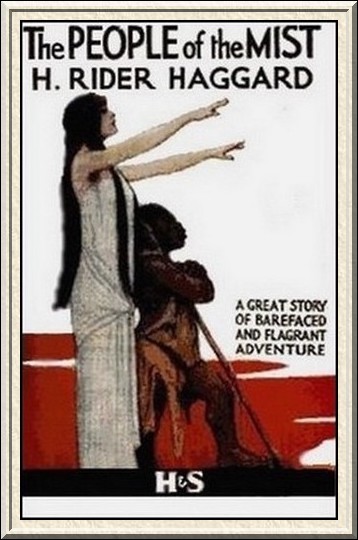
H. Rider Haggard’s The People of the Mist

H. Rider Haggard’s novel The People of the Mist was published in 1894 by which time he was just about the most popular writer in Britain. Haggard largely invented the Lost Civilisation genre and The People of the Mist definitely falls into this category.

Brothers Tom and Leonard Outtram were born into wealth. As sons of a wealthy baronet they had social position, education and all the advantages that any young men could enjoy. Until their father’s shady business dealings bring it all crashing down. The father kills himself, leaving his sons penniless and faced with the loss of the ancestral estate. The brothers make a vow that they will leave England to seek fortune elsewhere. When they have made their fortunes they will return to England to repurchase the estate and restore the family honour.

They end up in Africa, digging unsuccessfully for gold. Tom dies of fever but makes a death-bed prophecy - that Leonard will gain untold riches with the help of a woman.

Then an elderly African woman named Soa turns up with a strange tale. She had been nurse to a young English-Portuguese girl. She and the girl were devoted to each other. Now the girl, Juanna, has been captured by slavers. She wants Leonard’s help in rescuing the girl. And then she really gets Leonard’s attention - if he rescues Juanna then Soa will tell him how to reach the land of the fabled People of the Mist where rubies and sapphires are as common as pebbles. Surely this must be part of Tom’s dying prophecy - Soa is the woman who will lead Leonard to riches.

With his faithful African sidekick Otter (he really is more a sidekick than a servant) Leonard finds himself hurled into a series of extraordinary adventures. They will find the People of the Mist, Juanna and Otter will be worshipped as gods and they will face countless dangers from sacred crocodiles and treacherous priests, they will be imprisoned, they will have narrow escapes from death and will have to face the terror of the ice bridge.

Haggard understood that action and danger are essential ingredients of an adventure tale but it helps to have interesting characters. All of the characters in this story, African and European, are interesting and they’re all varied. There’s not one character who can be dismissed as a stereotype (either a racial stereotype or an adventure fiction stereotype).

Leonard is certainly a brave and determined hero capable of acting nobly but he is not a Boys’ Own Paper perfect specimen of manly heroism. He is not motivated by the desire to perform noble deeds, or even by a thirst for adventure. He is motivated by plain old-fashioned greed. He is a flawed hero.

Juanna is not quite a perfect heroine. She is quick-tempered, jumps to conclusions and misinterprets her own feelings and the feelings of others. She’s a fine young woman, but she has her exasperating quirks.

Otter is a dwarf and extremely ugly. He drinks far too much. He doesn’t know when to keep his mouth shut. He’s also as brave as a lion, almost as strong and in a fight he knows how to use brains as well as brawn.

Soa is very complicated. At times she seems like a villainess, at other times like a wise guide. She does some very bad things but she always has comprehensible motivations. She was dealt a bad hand by fate and her resentments are understandable. There is good and bad in her.

Nam the high priest is a villain, but again he has comprehensible motivations. He’s not just villainous for the sake of being villainous.

The land of the People of the Mist is far from being a utopia. They have some unpleasant customs but their reasons for clinging to their traditions are understandable.

The characters reflect the social and cultural attitudes of the time but it’s important to understand that the actual Victorians were nothing like the caricatured view so many people have of them today. They were intelligent complicated people with all of the normal human contradictions. Their beliefs and values were complex and nuanced.

It’s worth remembering that a lot of the clichés of adventure fiction were invented by Haggard and they weren’t clichés then.

This is a longish book but there’s plenty of plot, plenty of action and peril and an interesting cast of characters. There’s a reason that Haggard’s books remain in print after a century and a half. They remain in print because they’re extremely good. This one is not quite as good as his acknowledged masterpiece She but it’s highly recommended.

I’ve also reviewed Haggard’s King Solomon’s Mines.

Friday, December 27, 2024

John Charles Beecham’s The Argus Pheasant

John Charles Beecham’s novel The Argus Pheasant was serialised in the pulp magazine All-Story Weekly in 1917. I’m afraid I can’t tell you anything abut this author other than the fact that he seems to have been reasonably prolific and that both the male protagonist (the young American sailor Peter Gross) and the female protagonist (the beautiful sexy mysterious Koyala) were popular enough with readers to feature in several stories.

Pulp readers in the first half of the 20th century had an insatiable appetite for stories of Americans caught up in adventures in the tropics and the Far East. To be honest it’s an appetite I share. Some of these American adventurers were good-hearted but none too honest while others fell into the square-jawed clean-limbed virtuous hero category. The hero of this novel, Peter Gross, falls into the latter category.

The setting is the Dutch East Indies. The province of Bulungan in Borneo is in a mess. The Dyak hill tribes and the Dyak coast tribes are at each other’s throats. The Chinese and the Malays are regarded with resentment by both the native tribes. Head-hunting is common. Piracy is rife. Taxes have not been paid. The administration is corrupt and inefficient. In desperation the governor appoints a young American sailor as the new resident. Peter Gross has lived in the Dutch East Indies for years, he speaks Dutch and the tribal languages and he is a land-owner in the colony. And he’s half-Dutch.

Peter Gross is not daunted by the prospects before him but there is one problem that would daunt any man. Her name is Koyala. She is young and very beautiful. She is half-French and half-Dyak. She is acknowledged as unofficial leader by the locals - not quite a queen, not quite a high priestess, not quite a warlord but a combination of all these things. To her enemies she is a witch and a scheming temptress and regarded with superstitious fear. And no man can resist her beauty.

She may or may not be in league with the fabulously ric merchant, the wily and vicious Ah-Sing. Ah-Sing may be in league with the pirates. The local Dutch officials may be in league with Ah-Sing and the pirates. For Peter Gross it’s going to be like walking through a minefield.

Peter wants to avoid bloodshed. He wants all these people to live in peace. He thinks that if he treats them fairly and offers them good honesty government they will bury their differences and learn to get along. His plan might have worked smoothly except that there are powerful greedy corrupt men among both the Dutch and the various tribes and the merchants who have been making a lot of money out of exploiting the people, stealing the taxes and engaging in outright piracy. Those men will resist all of Peter’s efforts and if that doesn’t work they’re quite prepared to have him killed and drown the province in blood. They have killed reforming residents before this. And since Dutch government officials are involved in these crooked dealings it’s not easy for Peter to find people he can trust.

He trusts Koyala. The Dutch had put a price on her head. Peter cancels that. He convinces himself that she is now grateful and therefore trustworthy. Everybody warns him not to trust her but she’s so charming and so cute. How could such a charming pretty girl not be trustworthy?

Peter is a reasonably likeable hero and he’s brave and intelligent and in many ways rather wise but he doesn’t understand women.

Koyala is the character who makes this book interesting. Peter doesn’t know for sure if he can trust her. The reader doesn’t know either. We don’t know which way she will jump because she doesn’t know that herself. She’s a complicated woman with complicated motivations and resentments and jealousies. She has a woman’s hatreds. She’s not a straightforward villainess. She genuinely wants what is best for her people, but what she thinks is best for her people doesn’t necessarily fit in with Peter’s plans. She might decide to coöperate with Peter. On the other hand she might decide to have him tortured to death. She might be attracted to him. That might make her even more inclined to have him tortured to death. She is cynical about love and she is not comfortable with her sexual feelings.

There’s plenty of action along the way, on land and at sea. There are hair’s-breadth escapes from danger. There is treachery and there are strong loyalties.

An entertaining tropical adventure. Highly recommended.

The first two Koyala novels have been paired by Steeger Press in their excellent Argosy Library series.

Wednesday, November 13, 2024

Otis Adelbert Kline's The Secret Kingdom

Otis Adelbert Kline and Allen S. Kline’s lost civilisation novel The Secret Kingdom was serialised in Amazing Stories in late 1929.

Chicago-born Otis Adelbert Kline (1891-1946) is often dismissed as an Edgar Rice Burroughs imitator. Which to some extent is true. He was however a pretty good Edgar Rice Burroughs imitator and his stories are quite entertaining.

The lost world/lost civilisation genre was made enormously popular by H. Rider Haggard in the 1880s (his 1886 novel She is still perhaps the finest example of the genre). These tales remained popular until the 1930s. Sadly, in the post-World War 2 period the idea of undiscovered civilisation in remote parts of the globe could no longer be made to seem plausible. The world no longer contained any unexplored corners and much of the romance and mystery of life vanished.

Bell is a young American scientist trekking through an unexplored region in South America. He’s collecting specimens. He has a rival, a German scientist who is out to get him. 

On a remote plateau Bell saves the life of a man, a very oddly dressed man. He has unwittingly encountered a remnant of Inca civilisation. The man he saved is the Inca himself.

This remnant seems to be thriving and they really are quite civilised. The Inca is a very decent guy and he is anxious to reward Bell. There’s just one problem. Bell now knows of the existence of this Inca civilisation, a closely kept secret. He can never be allowed to leave. He is ennobled, given a fine house, treated with immense respect, given servants. He is even given wives. Six of them. All of them young and pretty and very excited to be married to the handsome foreigner.

Bell has met another outsider. Nona, a half-French half-Spanish girl. She also stumbled upon this lost civilisation by accident, and like Bell she will never be permitted to leave.

Bell and Nona fall hopelessly in love but there’s a problem. Nona is supposed to marry the high priest Tupac. The Inca is a good man and a just man but Nona was promised to Tupac and the Inca never breaks his word. He knows Nona does not want to marry Tupac and he has tried to persuade the high priest to release her from her bond but Tupac is unrelenting. Tupac is treacherous, crafty and cruel.

Naturally Bell encounters many dangers, such as narrowly escaping being served as dinner to an enormous and very hungry boa constrictor. There are various attempts to deprive Bell of his life or his freedom, or both. Tupac hatches sinister conspiracies. Bell’s nemesis, the German scientist von Steinbeig, shows up at an inconvenient moment.

There’s plenty of action.

Bell also has his hands full with his six wives. They’re all madly in love with him. Somehow Bell has to avoid sharing his bed with any of them. Nona is a sweet girl but she is a woman and she has a woman’s natural jealousy. She has no intention of sharing Bell with another woman and she certainly isn’t going to share him with six sex-crazed maidens.

Bell is your basic square-jawed hero but he’s likeable enough. Tupac makes a fine villain. The world-building is not elaborate and certainly doesn’t compare with the kind of world-building you would get in an Edgar Rice Burroughs story.

Kline’s prose style is perfectly serviceable. This is pulp fiction and it’s not trying to be anything more than that.

The Secret Kingdom is not a top-tier lost civilisation novel but if you love this genre it’s quite enjoyable. Recommended.

I’ve reviewed several other Otis Adelbert Kline novels - Jan of the Jungle (a Tarzan imitation combined with lost world stuff), Planet of Peril (a decent sword-and-planet adventure) and Lord of the Lamia (an excellent mix of mystery, action, Egyptology, horror and an offbeat love story).

Wednesday, August 21, 2024

The Saint and Mr Teal (Once more The Saint)

The Saint and Mr Teal is a 1933 collection of three Saint novellas by Leslie Charteris. Two of these stories had had previous magazine publication. It was originally published as Once More The Saint. Charteris wrote great novels and short stories but it always seemed to me that the novella was the format that suited him most.

By this stage in the Saint’s evolution he no longer has his little band of followers but he still has his live-in girlfriend Patrica Holm.

The early Saint stories were not always straightforward crime thrillers. There were often hints of espionage and international intrigue. Some are out-and-out spy thrillers. They are also often quite outrageous. There are even occasional hints of science fiction with high-tech gadgets and new scientific inventions driving some of the plots.

The Man from St Louis deals with a subject of some concern in Britain at the time, the fear that American-style gangsterism might take root in the British underworld.

In this novella an American gangster named Tex Goldman has found his home city of St Louis a bit too hot for him. He thinks London would be safer and would also offer more opportunities. In St Louis he was a fairly big fish in a fairly small pond. In London he’s confident he can become a really big fish in a really big pond.

He has acquired a couple of English stick-up men. Ted Orping likes the idea of becoming a proper Chicago-style hoodlum. He’s naturally vicious. Clem is less vicious but he has aspirations to being a tough guy as well. They’ve carried out a series of daring robberies on Tex’s behalf. The robberies have involved quite a few shootings, some of them fatal.

Chief Inspector Teal is aware of this situation but of course he’s hampered by silly annoyances like the need to find evidence. Simon Templar is also aware of this new criminal trend, he is determined to nip it in the bud and he is not the least bit constrained by the need to follow proper procedures. The Saint has already foiled one of the gang’s robberies. The contest between Simon and Tex has begun and each is determined to destroy the other.

Also involved in some way in Tex’s activities is Ronald Nilder. Nilder is mixed up in white slavery. The Saint has already marked Ronald Nilder for destruction.

Tex has decided that Simon Templar has to be eliminated but Ted proves to be over-confident and Simon too devious.

Typically for a Saint story there is a rather neat and very Saintly ending, and Simon Templar displays his taste for methods that are as ruthless as they are devious.

The Man from St Louis was adapted by Paddy Manning O’Brine (and renamed The Set-Up) as episode fifteen of season three of The Saint TV series which screened in January 1965.

The Gold Standard begins with Simon Templar being a witness to a murder in Paris. A dissolute young man named Brian Quell has been shot and before dying mutters something about gold.

Simon has meanwhile returned to London where he is outraged to discover that a burglar has left the Saint’s stick-figure trademark at the scene of the crime. Simon assures Chief Inspector Teal of his innocence and in fact he has an alibi.

Simon then finds that a Mr Jones is taking an interest in him. Not a very friendly interest. Mr Jones is also taking a distinctly unfriendly interest in Patricia Holm. The Saint is slowly starting to piece a picture together. The murder of Brian Quell, the disappearance of Quell’s eminent scientist brother and the unpleasant Mr Jones all fit into this picture somehow. As does poor Brian Quell’s dying statement.

The Saint will encounter both temptation and a moral dilemma and will need all his cunning and ruthlessness this time. The stakes turn out to be much higher than he’d imagined. He also has reason to think he may have dangerously underestimated Chief Inspector Teal.

The Gold Standard was adapted (with a title change to The Abductors) for the TV series by Brian Degas. It went to air in July 1965.

The Death Penalty is set on the Scilly Isles, off the coast of Cornwall. Simon Templar is drawn into his latest adventure when he saves a pretty girl, Laura Berwick, from drowning. The Saint becomes really interested by the fact that her stepfather, a man named Stride, seems to have an unsavoury history. He is even more interested by the presence of Abdul Osman. He is encountered Osman before. That encounter ended very unpleasantly for Osman. Osman controls a vast criminal empire in the East, based on white slavery and drug trafficking. It appears that Laura’s stepfather is in the same line of work as Osman.

Osman has blackmailed Stride into retiring, thus leaving him in control of an even vaster criminal network. He is prepared to allow Stride to live but only if Stride gives him something he wants. What he wants is Laura. No decent human being would sell his own stepdaughter into white slavery but Stride is happy to do so.

Osman certainly wants Laura but what Osman mostly wants from life is the opportunity to humiliate those against him he has grudges. Men like his secretary Clements. Osman had been unlucky enough to attend one of England’s great public schools. At school Clements taunted him mercilessly for being an Asiatic. Osman has since taken a terrible revenge on Clements.

Templar feels that he ought to do something about this whole situation. Laura is a charming girl who knows nothing of her stepfather’s criminal activities. Simon will have to rescue her, because that’s the sort of thing he does.

The situation comes to a head on board Osman’s yacht. It ends with a man dead from a gunshot wound.

What’s interesting about this novella is that the plot is resolved satisfactorily, and then we discover that what we thought happened was not what happened at all.

The Gold Standard was adapted (with a title change to The Abductors) for the TV series by Brian Degas. It went to air in July 1965.

The Death Penalty was adapted by Ian Stuart Black as the ninth episode in the third season of The Saint TV series. It aired in December 1964.

Al three novellas have the rather devious sting-in-the-tail endings that Charteris did so well. The Saint and Mr Teal is fine entertainment. Highly recommended.

I’ve reviewed the TV adaptations of all three novellas.

Wednesday, August 14, 2024

Peter O’Donnell’s The Impossible Virgin

The Impossible Virgin was published in 1971. It was the fifth of Peter O’Donnell’s eleven Modesty Blaise novels. The Modesty Blaise comic-strip debuted in the London Evening Standard in 1963. The comic-strip adventures are excellent and I recommend them but the novels have more depth and psychological complexity and were able to deal more openly with adult themes.

People unfamiliar with either the comic strip or the novels sometimes make the mistake of thinking of Modesty Blaise as a female James Bond. Nothing could be further from the truth. She is almost the exact opposite of Bond in every way. Bond is British to his bootstraps and fiercely patriotic. He has a naval background and is accustomed to obeying orders. He has never questioned authority. He is a professional spy working for the British Government. He is a straightforward old-fashioned kind of guy.

Modesty is British only by marriage (a marriage of convenience). She has no idea what her own nationality or ethnicity might be - she’s probably southern European or Slavic. Modesty’s background is entirely criminal - she ran an organised crime gang. She has never obeyed an order in her life. She often does jobs for the British Government but strictly as a freelancer and she feels under no moral obligation to accept such jobs. She also does jobs for the French intelligence services.

Modesty is really a female Simon Templar - a retired criminal who is now a crimefighter and part-time spy. She is a female version of the gentlemen rogues who thrived in British popular fiction in the 1930s. Like the Saint she gets involved in capers for the adventure, or because she thinks a particular villain needs to be destroyed or occasionally for motives of personal revenge.

This caper begins when a low-level Soviet intelligence analyst makes an interesting discovery. It has no military significance but it could make him rich. It doesn’t turn out that way. A few months later he staggers into a bush hospital in Tanzania and promptly dies. He gives the appearance of having been tortured. The hospital’s only doctor is Giles Pennyfeather, a disreputable shabby socially inept eccentric Englishman. To look at him you wouldn’t trust him to operate on a stray dog, but the weird thing is that his patients do surprisingly well.

As it happens Dr Pennyfeather has at this moment acquired a kind of temporary nurse and assistant, a striking young woman who literally fell from the sky when she had to make a forced landing in her aeroplane. She has no medical training but she’s a quick learner. Her name is Modesty Blaise. She is in Tanzania purely by accident.

There is no way such a beautiful young woman would be interested in such a poor specimen of manhood as Giles Pennyfeather but Modesty thinks he’s rather adorable and she is soon sharing his bed.

Then two thugs arrive and starting beating up Dr Pennyfeather. They seem to be convinced he has some information they want. Modesty takes exception to their behaviour and deals with them accordingly but without knowing it she has become involved with some very dangerous very evil people.

There is an impossible virgin in this story, of a sort. There’s also Lisa, who is no virgin but is certainly very dangerous. The gorilla might also be a problem - he’s a real gorilla and he’s bad-tempered and being locked in a cage with him isn’t very reassuring.

Modesty will have to face most of these dangers alone, when the faithful Willie Garvin makes a sudden departure. Modesty will also need a certain special ability that she has - she can shut herself down mentally so that she is unaware of what is being done to her, and some rather nasty things are done to her in this caper.

Finding out why the impossible virgin’s virginity remains inviolate will be crucial.

There’s enough action here to satisfy fans and there’s plenty of suspense as Modesty’s position becomes seemingly hopeless.

The Impossible Virgin is a fine action/adventure novel and is highly recommended.

I’ve reviewed the earlier Modesty Blaise novels, Modesty Blaise, Sabre-Tooth, A Taste for Death and I, Lucifer, which are all excellent. I’ve also reviewed several of the earlier volumes of the collected Modesty Blaise comics, The Gabriel Set-Up, The Black Pearl and The Hell-Makers which I also highly recommend.

Saturday, July 13, 2024

Secret Agent X: The Torture Trust

The Secret Agent X novels were published in the pulp magazines of the same name which ran for 41 issues between 1934 and 1939. The stories were published under the house name Brant House but there were in fact several authors. The Torture Trust, written by Paul Chadwick, was the first to be published.

Secret Agent X is a typical pulp hero of the time, an amateur crime-fighter who conceals his real identity. He is in reality a war hero who was grievously wounded in the First World War.

He is a master of disguise. Disguise was an obsession with crime writers in the late 19th and the first half of the 20th century. It was a somewhat over-used trope and almost always stretches credibility to the breaking point. The Secret Agent X stories push the use of this trope about as far as it could be pushed. To be fair the author tries to make the idea slightly more credible by explaining how the hero manages his extraordinary repertoire of disguises and suggests that he has some sort of theatrical background. The degree of suspension of disbelief required of the reader is still immense.

Agent X can assume his disguises in a matter of minutes, which stretches credibility even further.

As is fairly standard in pulp stories of this type Secret Agent X is regarded with suspicion by the police. They see him as either a master criminal or a vigilante and whichever he might be they don’t approve.

The author goes to great lengths to reassure the reader that despite his unconventional methods and the fact that these methods might at times veer dangerously close to being illegal or unethical he is very definitely one of the good guys. He has secret backing from the government, and of course the government would never be involved in anything illegal or unconstitutional.

As is also fairly standard in such pulp stories Secret Agent X tries very hard to avoid killing. After all if he went around killing people, even criminals, he’d be a kind of government sanctioned assassin or vigilante killer and that might get the publisher in trouble.

There is of course a vast criminal conspiracy afoot. A gang has been kidnapping prominent citizens and engaging in extortion and blackmail. They use terror as a weapon. If their victims refuse to play ball they are permanently disfigured with acid. This method is used against anyone who gets in their way. The acid treatment frequently has fatal results.

Agent X uses his mastery of disguise to infiltrate himself into situations in which he can discover the plans of this nefarious criminal organisation. He disguises himself as everything from a cab driver to a police commissioner.

He has a kind of assistant, a young lady named Betty Dale. There doesn’t seem to be any real romantic attachment between them. Betty’s purpose is of course to get herself captured by the bad guys so Secret Agent X can rescue her.

The villains are not ordinary criminals. A couple of them are doctors, including an expert in psychology. He knows all about breaking people’s wills. Sinister psychologists or psychologists are always fun. Naturally he employs hypnotism as a weapon.

The author uses footnotes to give an air of authenticity and in an attempt to make it plausible that Agent X is an expert in so many fields. I like novels with footnotes.

Secret Agent X has no super-powers, he doesn’t have almost superhuman strength and he doesn’t rely on gadgets. His skill at disguise is however so great that it’s as good as a superpower.

This is pure pulp fun, more or less in the mould of The Shadow, Doc Savage and other 30s pulp heroes. Highly recommended.

Thursday, July 11, 2024

Perley Poore Sheehan’s Woman of the Pyramid

Perley Poore Sheehan’s novel Woman of the Pyramid was published in The All-Story pulp magazine in 1914.

Napoleon’s expedition to Egypt in 1798 had first sparked western interest in ancient Egypt and by 1914 Egyptology had become quite a craze. This novel was therefore very topical.

In the days before the First World War a young American named George Carlton is a bit of a scientific dilettante. He’s trained in psychology and psychiatry but his real interest lies in the occult and in what would later come to be known as the paranormal. He’s very interested in ghosts.

As an aside, at that time such interests still had at least a degree of scientific respectability and plausibility.

Carlton is in love with a pretty English girl named Alice Wentworth. Wedding bells would seem to be in the offing. In the meantime Carlton, Alice and her aunt are off to Egypt. Carlton already has a very keen interest in ancient Egypt.

Carlton is a little disturbed by the mysterious woman he keeps seeing. No-one else seems to be able to see her. He suspects that she’s a ghost of some sort. He also suspects that she’s connected to ancient Egypt in some ways. He thinks of her as the Woman of the Pyramid.

He becomes a little obsessed. He enters the famous Red Pyramid (the third largest of the pyramids) and there he encounters the Woman of the Pyramid again. It’s a fateful meeting. Carlton finds himself back in the distant past. The Woman of the Pyramid is the queen, Netokris, recently widowed. And Carton is no longer Carlton. He is now Menni, an important man, governor of the royal palace in fact. It seems that the queen sees him as a potential husband.

Menni isn’t interested. He’s in love with slave girl Berenice, who is in fact Alice Wentworth. Netokris is a woman who doesn’t take no for an answer. She’s ruthless, cruel and inclined to act on whims. She decides that Berenice is a rival whose existence cannot be tolerated.

There are various palace conspiracies afoot and while Carlton/Menni doesn’t want to get mixed up in them it might be the only way to save Berenice/Alice, and his own skin.

A possible ally is the priest and sorcerer Baknik. Baknik has various occult powers including the power to foretell the future. The future he predicts for Carlton/Menni and Berenice/Alice is a case of good news and bad news. His predictions of the queen’s future are not entirely hopeful either. All of the characters feel themselves to be the playthings of Fate.

This might at first seem to be a time travel story but it’s more of a past lives story. The question is the extent to which events in one life will affect their next life.

It’s also very much a love story.

Most of the story takes place in ancient Egypt but the final quarter of the book brings Carlton back to the 20th century, where the same three people seem destined to replay the events of the past. The past lives thing is done quite well here with the past lives and present lives intersecting neatly.

I don’t think Sheehan was overly obsessed with historical accuracy but the background is at least vaguely historical. Netokris probably existed and may possibly have been responsible for building the Red Pyramid. Some plot points are lifted from the account of her reign by Herodotus.

If the past lives thing appeals to you and you have any kind of interest in ancient Egypt and you happen to enjoy pulp adventure/romance then this novel will tick all your boxes. I enjoyed it. Highly recommended.

Woman of the Pyramid has reprinted in a paperback omnibus edition (including three other stories by the same author) by Steeger Books in their excellent Argosy Library series.

I've also reviewed another of Sheehan's novels, The Red Road to Shamballah. It's pretty good also.

Sunday, July 7, 2024

Don Wilcox’s The Ice Queen

Don Wilcox’s short novel The Ice Queen was published in Fantastic Adventures in January 1943. It’s a lost civilisation tale, my absolute favourite genre.

The Ice Queen takes place in the 19th century. Jim McClurg is an artist. He’s been hired to make a visual record of a polar expedition organised by Lady Lucille Lorruth. Five years earlier her husband disappeared in the Arctic while on a fur-trading expedition. Lady Lucille would like people to think that she believes her husband is still alive and that the object of her expedition is to find him. Jim suspects that she’s only interested in those furs. In his final communication Lord Lorruth claimed to have collected a vast number of furs, worth a rather large fortune.

The brig Aurora is commanded by Captain French. He drinks a lot and does not appear to be very honest. It’s not clear whether Lady Lucille is angling to marry the captain for the sake of his fortune (he’s a rich man) or whether the captain is angling to marry Lady Lucille for the sake of that fortune in furs.

Jim is mostly interested in the girl on the tiger. She’s very pretty, she looks like a Viking maiden, she rides a pure white tiger and she’s been shadowing the Aurora. This is impossible of course. The girl cannot exist. And yet she does exist.

There’s a stowaway who knows far too much about this frozen wasteland, and seems to know all about the girl. She is apparently a queen. We later find out that her name is Veeva.

There are unexpected dangers in the Arctic. Huge ice bubbles appear from nowhere. Several members of the party are imprisoned in these bubbles. It is possible to dig one’s way out but they’re very disconcerting, and the worry is that an ice bubble forming over the ship might sink it.

There is also a strange lost world in these frozen wastes. Possibly a very ancient world although its origins are unknown even to the inhabitants. This lost world holds the answer to the disappearance of Lord Lorruth.

A complication is that every male member of the expedition is hopelessly in love wth the beautiful young ice queen while Lady Lucille sees her as a deadly threat.

The trick with lost civilisation stories is not just to make the lost civilisation interesting, but believable as well. There have to be plausible explanations for the strangeness of such a civilisation. Wilcox succeeds rather well on both counts. Veeva’s icy realm is strange but it makes sense. Even the fact that Veeva claims to be 22,000 years old makes sense. And the sleeping king ends up making sense. It all hangs together.

There’s a suggestion of menace about Veeva’s realm, but it’s a subtle menace. Veeva appears to be good-natured and cheerful. There doesn’t seem to be any reason for the expedition members to be afraid, and yet there’s something slightly sinister about it all.

There’s a suggestion that Veeva may have access to certain powers, possibly technological and possibly magical, and that technology or magic may be behind some of the mysteries of her kingdom, but it’s left nicely vague and ambiguous.

This books ticks all my boxes. I love lost world stories and I love adventure, horror or science fiction stories in polar settings. And how could anyone not love a pretty young heroine who rides a huge white tiger whilst wearing furs, a metal breastplate and a Viking helmet?

The Ice Queen is very pulpy but it has plenty of atmosphere, danger and excitement and it’s hugely enjoyable. Highly recommended.

I know almost nothing about Don Wilcox (1905-2000) other than the fact that he was American and his writing career seems to have been confined to the 1940s and 1950s. I have read another of his novels, Slave Raiders from Mercury, and it’s very pulpy but quite enjoyable.

Armchair Fiction have paired this one with Poul Anderson’s The Sargasso of Lost Starships in a two-novel paperback edition.