Showing posts with label poul anderson. Show all posts

Monday, July 15, 2024

Poul Anderson’s Sargasso of Lost Starships

Poul Anderson’s novella Sargasso of Lost Starships appeared in Planet Stories in January 1952.

Anderson wrote a lot of fine sword-and-sorcery and sword-and-planet tales early in his career. The Sargasso of Lost Starships seems at first to be space opera, and in fact it is space opera, but as the story develops it becomes more and more of a sword-and-planet story.

This is a clash of cultures story but it involves three rather than just two very different cultures. It’s also a story of civilisation pitted against barbarism but with ambiguities as to which culture represents the good guys and which represents the bad guys. Maybe all cultures have both good and bad in them. And maybe heroes and villains are not clearcut either. This is an exciting pulp space adventure but with some added subtleties and some complexity. At no stage in his career could Anderson be dismissed as a mere hack.

The hero, Basil Donovan, is a hereditary ruler on the planet Ansa. The people of Ansa are human, descendants of colonists from Earth. For centuries, after Earth’s interstellar empire collapsed, they have been independent. Fiercely independent. Ansa is now a backwater, a kind of feudal agrarian society but with high technology as well. They are still spacefarers in a small way. Basil is a proud stubborn aristocrat but a just and humane leader.

Everything was fine until the Terrans created a new interstellar empire, the Solar Empire. Ansa wanted no part of the Solar Empire but was not given a choice. It is now merely a province of that empire. The Terrans are human and enlightened masters but they are still the masters and the Ansans bitterly resent this. Basil resents it very bitterly indeed. He had participated in the great space battles in which the Ansans fought, unsuccessfully, to maintain their independence.

Basil now lives on booze and dreams of past glories. Until he receives an Imperial summons. The Empire has need of his services. It involves the Black Nebula. Basil is unusual, indeed unique. He has been to the Black Nebula and come back alive and sane. Well, mostly sane.

Basil is to be guide and advisor to Captain Helena Jansky, commander of the Terran starship Ganymede. The Black Nebula has become a problem that needs to be confronted. Captain Jansky needs Basil’s knowledge of the Black Nebula. He is prepared to share that knowledge, but the suspicion remains that he is concealing a great deal of what he knows. Basil and Helena do not trust one another.

When the Ganymede reaches the Black Nebula it becomes obvious that there is a very great deal indeed that Basil has not revealed. He had not mentioned the voices. The voices that are reducing the Ganymede’s crew to madness. The voices seem to come from nowhere. Basil had also failed to mention Valduma. Valduma is a woman but she is definitely not human. Perhaps Basil loves her, perhaps he hates her.

To add to the complications Basil is no longer sure that he hates Helena. Perhaps he loves her. There’s a bizarre romantic triangle here. Basil must choose between these two women and his choice will have momentous consequences.

This is an exciting tale of high adventure and action and it’s a twisted love story. It’s also a story of rising civilisations and dying civilisations. It’s also a story about freedom and servitude both of which turn out to be complex and ambiguous. And it’s a story about a man torn by conflicting loyalties and conflicting loves.

There’s no magic and there are no wizards but there are technologies so advanced and so strange and so incomprehensible that they might as well be magic. They serve the same purpose that magic would serve in a sword-and-sorcery story.

Sargasso of Lost Starships is superior-grade pulp fiction that manages to deal with complex issues whilst still offering plenty of old-fashioned entertainment. Very highly recommended.

Armchair Fiction have paired this one with Don Wilcox’s excellent The Ice Queen in one of their two-novel paperbacks. The combination of two very good titles makes this a very worthwhile purchase.

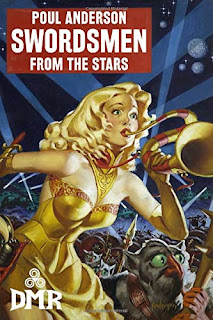
I’ve also reviewed DMR Press’s Swordsmen from the Stars which contains three excellent Poul Anderson sword-and-planet novellas. Anderson’s Virgin Planet also has some slight affinities to the sword-and-planet genre and it’s very much worth reading as well.

Thursday, June 6, 2024

Poul Anderson's The Golden Slave

The Golden Slave is a 1960 historical novel by Poul Anderson.

Anderson had a formidable reputation as a science fiction writer but my own preference is for his work in the fantasy, historical fiction and sword-and-sorcery genres. Anderson knew his history and his mythology and he had a genuine feel for those subjects. This comes through strongly in his Hrolf Kraki's Saga and his fantasy masterpiece The Broken Sword.

The story takes place around the year 100BC. A number of barbarian tribes are attempting to conquer Rome. Among these tribes are the Cimbrians, hailing originally from Denmark. Eodan is the son of the tribal war chief. The Cimbrians have won several battles against the Romans, and as a result Eodan has obtained a Roman slave named Flavius. Flavius was a rich and important man. The destinies of Eodan and Flavius will become inextricably entangled.The Cimbrians are about to face the Roman army of Marius in battle. The result is disaster for the Cimbrians. Now Eodan is Flavius’s slave.

Eodan knows that his little son is dead. He saw his wife Hwicca dash the child’s brains out rather than allow him to fall into the hands of the Romans. He does not blame her for this. He would have done the same. He believes Hwicca was killed in the slaughter after the battle.

Eodan is not quite a broken man but there is now an emptiness within him. When Flavius’s wife Cordelia chooses him as her latest bed partner he does not complain. With Hwicca dead nothing really matters. An uneasy friendship develops between Eodan and Cordelia’s Greek slave-girl Phryne. They do not sleep together but their destinies also become intertwined.

Eodan makes some startling discoveries which give him new hope. But first he must escape. With Phryne’s help he does so, and she accompanies him in his flight. He does not understand why. Women are a bit of a mystery to Eodan.

The escape is the beginning of a series of wild adventures on land and at sea. These include a brief interlude as a pirate. He will end up at the court of King Mithradates the Great of Pontus, a kingdom on the Black Sea that is about to challenge Rome for control of Asia. Flavius will play a somewhat sinister part in these adventures.

In his early 1950s sword-and-sorcery and sword-and-planet tales Anderson had already demonstrated his ability to tell exciting action-packed stories so it’s no surprise that The Golden Slave is a roller-coaster ride of battles, narrow escapes, betrayals and sudden changes in fortune.

There is however a bit more depth to this novel. Eodan, Hwicca and Phryne (and even to a lesser extent Flavius) have complex contradictory motivations and are driven by desires and emotions which they do not always understand and cannot always control. Despite the non-stop action this is a rather character-driven story.

These are also genuinely people from a different culture, very much inclined to see themselves as driven inexorably by a fate they cannot escape. Their attitudes towards honour, duty, pride, sexual propriety and loyalty reflect a totally different cultural mindset.

This is real historical fiction, rather than the fake kind that is so common these days that features 21st century characters with 21st century attitudes being involved in 21st century dramas whilst wearing historical costumes.

It’s only at the end that we find out what Anderson was really up to in this tale, and the revelation links this novel to some of his other historical/fantasy work. This is a fine adventure story but it’s more than just that. Highly recommended.

I’ve reviewed some of Poul Anderson’s excellent sword-and-sorcery/sword-and-planet stories from the collection Swordsmen from the Stars (which I also highly recommend).

Thursday, March 16, 2023

Poul Anderson’s Virgin Planet

Poul Anderson’s science fiction novel Virgin Planet was published in 1959.

Poul Anderson (1926- 2001) was an incredibly prolific writer. He is of course best remembered for his science fiction but he wrote some superb fantasy (such as The Broken Sword) and in the early 50s produced some rather wonderful sword-and-sorcery/sword-and-planet stories.

Virgin Planet is set on a planet inhabited entirely by women. They are obviously human women. It appears that the original colonists were supposed to arrive in two spaceships, one carrying the men and one carrying the women. Only the ship carrying the women arrived. This happened a long time ago and the colonisation has become encrusted with legend. The women still believe that one day the Men will arrive. They look forward to that day is a kind of religious way, but with some uneasiness. They have only the vaguest idea of what a man is.

When a spacecraft is seen to land the women think that it might be the Men at last, but it could be Monsters. They also have fairly vague ideas about the Monsters but they know that the Monsters come from the stars and have dealings, sometimes friendly and sometimes hostile, with Men.

Corporal Maiden Barbara Whitley is the one who finds the spaceship. There’s only one crew member. She figures he’s a Monster, but a friendly one. He can’t be a Man. Everyone knows that Men are wise and noble and dazzlingly beautiful. This creature just seems weird and misshapen.

The women of Freetoon are not quite sure what to do with this creature. His arrival turns out to be a disaster - it sets off a war with a neighbouring town. The creature from space and three of the surviving women from Freetoon make their escape. They’re not sure where to head for. Maybe they should head for the Ship of the Father. The Doctors may have an answer. The Doctors know everything, they even know how to work the parthenogenesis machine which allows the women of Atlantis to have children.

The creature is of course no monster. He’s very much a human and a man. He’s David Bertram and he’s on a kind of freelance survey mission.

Davis slowly pieces together what is going on. He’s on a planet named Atlantis. Technically it’s not a planet. It’s the size of Earth and it’s fairly Earth-like but it’s a satellite of a gas giant called Minos.

By this time humans have colonised countless planets but Atlantis was previously unknown, being inaccessible due to the presence of a vortex in space-time. Human civilisation is highly advanced, with faster-than-light travel and other advanced technologies. The inhabitants of Atlantis are all women, on the way to join their men when their spaceship was swept hundreds of light-years off course by the vortex. There were originally five hundred women. There are now possibly a quarter of a million, but all are clones of those original five hundred colonists. A caste system has developed, with each caste being made up of a single genotype.

Society on Atlantis has regressed quite a bit. That original spacecraft was not carrying the necessary equipment to support an advanced technological society. There’s no nuclear power, no automobiles, no electricity. It’s now a rather primitive agrarian society.

There are in fact a number of subtly different cultures on Atlantis and Anderson has fun speculating on the way in which such societies could evolve. Societies made up of clones, with no men.

Naturally once the women discover that Davis Bertram is a Man they’re fascinated. All the animals on Atlantis are birds. The women of Atlantis are not only unfamiliar with the idea of human sex, they’re unfamiliar with mammalian sex. But they’re eager to learn. The complication for Davis is that some of these women are also starting to discover the concept of love. Both Barbara and her clone sister/twin Valeria have fallen in love with him.

This sounds like a recipe for a sleaze novel but that’s not how Anderson plays it. This is a serious science fiction novel although there’s also some humour and quite a bit of adventure. And there’s no sex at all.

Davis Bertram is an engaging hero because he isn’t a square-jawed action hero. He’s by no means helpless but he’s no warrior. He’s not a coward but he’s only moderately brave. He’s not stupid but he’s not a genius. He’s a spoilt rich man’s son and his solo survey mission is just an adventure to him. He’s always been rather irresponsible. On the other hand he’s good-natured and kind-hearted.

Barbara and Valeria are of course mirror images of each other. They’re warriors who believe in shooting first (with their repeating crossbows) and asking questions afterwards. But they’re gorgeous and they’re smart and underneath a slightly intimidating exterior they’re likeable.

The paperback edition includes an afterword from the author in which he explains that the only respect in which he’s played fast and loose with science is the faster-than-light travel. Other than that everything is based on solid science. This is very much hard science fiction, but it’s hard SF combined with a rollicking adventure plot and some clever speculations about the ways in which societies evolve.

Most of all Virgin Planet is extremely entertaining. Highly recommended.

Saturday, January 29, 2022

Poul Anderson's Swordsmen from the Stars

Poul Anderson (1926-2001) became one of the most celebrated of American science fiction writers. Early in his career he wrote stories for the pulp magazines, including sword-and-sorcery and sword-and-planet tales. Swordsmen from the Stars collects three such novellas, all published in Planet Stories in 1951.

At this stage Anderson was clearly channelling Robert E. Howard and hadn’t quite found his own voice. By 1954, when he published his fantasy masterpiece The Broken Sword, he had most definitely found his own style. But the youthful Anderson was already a talented writer and these early sword-and-sorcery novellas are bursting with energy and imagination. They’re also perhaps just a little sexier than Howard’s stories.

These stories appear to be sword-and-sorcery but on closer examination they are really sword-and-planet stories. There’s magic, but it’s strongly suggested that all the magic has a rational scientific explanation. There are monstrous beasts but the first two stories clearly take place on other planets (a planet with two moons in the second story) so presumably they’re just the strange native fauna of those planets. The third novella takes place on Earth, in a very distant and very strange future, which explains the apparent alienness.

Witch of the Demon Seas

Witch of the Demon Seas is the story of Corun, a pirate whose career seems destined to end with death in the arena of the thalassocracy of Achaera. His one-man war against the Achaerans, against who he has a personal grudge, seems to have ended with his capture. It comes as quite a surprise when the old sorcerer Shorzon offers him a deal in exchange for his freedom. Khroman is king of Achaera but Shorzon is generally assumed to be the real power in the land, along with his granddaughter Chryseis. Shorzon and Chryseis need Corun to guide a ship to the Demon Sea, home of the dreaded amphibious reptile-men the Xanthi. They have some grand scheme in mind. Corun doesn’t trust them.

Chryseis is reputed to be a witch. Her sexual appetites are legendary. The rumour is that her lovers do not live long - she simply wears them out. She is dangerous and probably evil but she is astoundingly beautiful. Corun decides she’s his kind of woman.

Shorzun, Chryseis and Corun embark on a fast galley and head for the Demon Sea. Chryseis and Corun soon become lovers. The captain of the ship warns Corun that she may have bewitched him. Which is true enough, although given her beauty and rampant sexuality she may not have needed any supernatural powers to achieve this.

There are epic sea battles with the aquatic reptile-men, there is captivity in a gloomy castle, there is the revelation of the staggering scale of the plot that Shorzon and Chryseis have cooked up. There is action a plenty, and there is love and suspicion and betrayal.

Corun is your typical barbarian sword-and-sorcery hero, although perhaps more driven by sexual lusts than most. Shorzon is your typical sinister sorcerer although in this case we don’t at first know what he is planning or whether his plans are truly evil or not. It’s Chryseis who provides most of the interest. Women who are dangerous, possibly evil, incredibly beautiful and driven by sexual hunger do tend to provide plenty of interest.

The handling of magic in the story is interesting. Magic can unbalance a story if it’s made too powerful but Anderson solves that problem neatly.

A fast-moving action-filled tale with enough ambiguity in the romantic subplot to make things interesting. A very fine story.

The Virgin of Valkarion

Alfric is a barbarian warrior whose wanderings have brought him to the ancient imperial capital of Valkarion. He may stay for a while, if he can find someone willing to hire his sword. He finds an inn and is pleasantly surprised by the extremely low price he is asked to pay for a room for the night. Especially since the price includes breakfast in the morning and a whore for the night. He’s even more surprised when he sees the whore.

Freha is not just stunningly beautiful. She has class. She has an aristocratic bearing. She could almost be a great lady. But as he finds out that night she knows as much about the art of love as the most experienced whore in the land.

There is trouble brewing in Valkarion. The old emperor is dying. His son has a beautiful wife, Queen Hildaborg, but he has been unable to get her with child. There are rumours that the young queen has been forced to look elsewhere to satisfy her normal womanly physical desires. There has long been a power struggle between the throne and the priests of the temple.

Alfric cares little of all this. What he does care about is that on his way to Valkarion he was set upon by assassins. And now assassins have broken into the room in the inn to make another attempt on his life, just as he was having such a nice time with the very willing and very enthusiastic Freha. These assassins appear to be temple slaves. Alfric and Freha are forced to flee.

They find themselves caught up in a power struggle that could finally destroy the long-decaying empire of Valkarion but there are things that Alfric does not know. He does not know about the prophecy and that he is destined to play a part in it. As will Freha.

As in Witch of the Demon Seas there’s a strong interesting female character who is central to the plot but Freha is a woman very different from Chryseis. Anderson demonstrates his ability to create a variety of fascinating women characters.

Not quite as good as Witch of the Demon Seas but the action is non-stop and it’s still a very good story.

Swordsman of Lost Terra

Swordsman of Lost Terra takes place on Earth (as the title makes clear and as quickly becomes obvious). Things have changed. The Earth no longer rotates. One face is always presented to the sun. Half the world is in permanent night, the other half in permanent day, except for the Twilight Lands which are, obviously, parts of the planet in a perpetual twilight.

Barbarians from the north have been driven south by hunger. They encounter terrifying enemies from the Dark Lands, humans adapted to a world of moonlight and starlight. The barbarians make an uneasy alliance with the city of Ryvan, ruled by the young and beautiful Queen Sathi (another strong female character with whom the hero will of course become romantically involved). The hero is Kery, a young barbarian whose sorcerer father is the keeper of the pipes of the god. These appear to be bagpipes with terrifying magical powers. One day Kery will be keeper of the pipes.

There’s treachery and betrayal in Ryvan, there are epic battles and sieges, Kery and Queen Sathi fall into the hands of their enemies.

It’s an exciting tale but notable mostly for some very clever world-building.

Final Thoughts

The three novellas that comprise Swordsmen from the Stars are all hugely enjoyable tales of adventure and romance, with a bit of subtlety and some economical but interesting world-building. This collection, from DMR Press, is very highly recommended.

Wednesday, March 8, 2017

Poul Anderson’s The High Crusade

Poul Anderson’s delirious science fiction romp The High Crusade was published in 1960. The basic premise struck me as one that could have made an amusing short story but I was rather dubious as to whether it could be sustained over the course of a novel. In fact Anderson manages to do so without any difficulty whatsoever.

The basic idea is that a spacecraft lands in England, near the village of Ansby, in the year 1345. The spacecraft is a scout ship for the Wersgor Empire. The Wersgorix are an aggressive imperialist spacefaring race who have already enslaved the inhabitants of hundreds of planets. To oppose the alien invaders Sir Roger de Tourneville has a small force of mounted knights, some men-at-arms and some longbowmen.

The Wersgorix, who have mastered the technology of faster-than-light travel, are so far in advance of fourteenth century Earth that the outcome of the encounter is beyond any doubt. It’s going to be not so much a battle as a massacre. And that’s exactly how it turns out. The Wersgorix are slaughtered. They discover that their incredibly advanced military technology is no match for our puny Earth weapons.

This is just the start of the tale. Sir Roger and his followers now find themselves in possessions of a spaceship, and they have a captured prisoner who can be persuaded to tell them how to work it. They intend to fly the spaceship to France to join the King in his campaign there although Sir Roger has the notion it might be possible to use the ship to recapture the Holy Land. They do not however end up in France or in the Holy Land but on the planet Tharixan, hundreds of light years from Earth. Tharixan is a Wersgorix slave planet. It is well defended, by all manner of high technology hardware like fighter aircraft, spaceships, force fields, armoured vehicles and even nuclear weapons. None of which is going to deter a couple of hundred stout Englishmen led by a brave knight like Sir Roger.

What follows is an exuberant space opera plot with pitched battles and daring stratagems, all combined with a romantic intrigue and some amusing observations on competing political systems.

There’s nothing terribly outlandish about a low-tech army winning a single battle against a much more technologically sophisticated enemy (Isandlwana and the Little Big Horn are obvious examples) but there are very few examples of a low-tech army winning a protracted war on a vast scale against a technologically vastly superior enemy. The great thing about this novel is that Anderson consistently comes up with scenarios in which the technological sophistication of the Wersgorix is either no help to them, or becomes a positive hindrance.

One particularly nice thing is that Anderson stresses that although the medieval English are scientifically backward compared to their foes they are every bit as intelligent and every bit as resourceful. In fact, as Roger remarks at one point, the conditions of Europe in the fourteenth century provide him with a much better grounding in the art of political intrigue.

This story involves more than a clash between different military systems - it is also a contest between two sharply differing political systems. The Wersgor Empire is a centralised bureaucracy. The feudal system as practised in medieval England proves to be vastly superior. Again Anderson doesn’t just indulge in wish fulfillment - he demonstrates that feudalism is more flexible and much more suited to conditions of crisis. Sir Roger and his followers are bound together by a complex web of loyalties, rights and duties and this web of mutual obligation can withstand a great deal of stress. A centralised bureaucracy on the other hand can collapse very quickly indeed, given that no-one really has any personal stake in the system.

So we have clever ideas, lots of action, battles on land and in space, some cool aliens and a bit of speculation about competing social methods of social organisation. What about characterisation, usually regarded as the main failing of golden age science fiction? There’s fairly good news here as well. Both Sir Roger and his wife Lady Catherine are fairly complex well-rounded personalities. They have their strengths and weaknesses, sometimes they behave nobly and sometimes not so nobly. Even when they do things we do not approve of we can understand the reasons for their actions. Sir Owain Montbelle is the third party in a fatal romantic triangle but even he’s a little bit more than just a cardboard cutout villain. Branithar, the Wersgorix  captive, is also a bit more than a stock alien character.

The High Crusade is also an amazing amount of fun. Very highly recommended.