Showing posts with label alistair maclean. Show all posts

Thursday, November 10, 2022

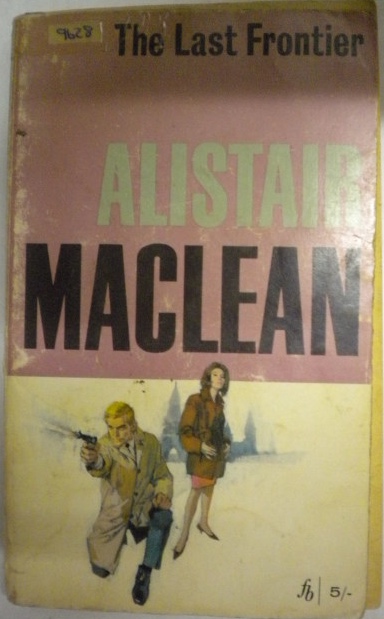
Alistair MacLean’s The Last Frontier

The Last Frontier is an early Alistair MacLean thriller, dating from 1959. It was filmed in 1961 as The Secret Ways and has also been published under that title. In my view MacLean was at his peak in the 60s and early 70s and his best books were those written in the first person. First-person narration suited MacLean’s purposes perfectly and allowed him to indulge in some of his favourite narrative tricks. The Last Frontier is written in the third person and it’s MacLean starting to really find his feet as a thriller writer. He hasn’t yet perfected his technique but he’s getting there.

There are also a couple of interesting aspects to this novel which I’ll get to later.

You know you’re in MacLean country from the first page - the hero is surrounded by a vast expanse of snow and ice and MacLean makes sure the reader feels the cold as well. It’s not the last time in the book that you’ll feel the cold seeping into your bones.

Michael Reynolds is a British spy and he’s behind the Iron Curtain and he’s cold and he’s being hunted. He’s spent months training for a very important mission and this is the first day and it’s all gone badly wrong. He expected the road-block just outside Budapest but he hadn’t expected the second road-block. Pretty soon he’s in the hands of the Hungarian secret police, the dreaded AVO. There’s no escape.

Then the first plot twist kicks in.

Reynolds’ job is to bring a British scientist back from Budapest. The scientist has no desire to return to the West but the British secret service will use whatever means necessary to persuade him to come. They’re hoping that lies, deception and emotional manipulation will work but it’s clear they’re prepared to resort to more drastic measures.

This is one of the interesting aspects I alluded to earlier. In this novel the British are the good guys but they’re as ruthless, dishonest and cynical as the communists. The novel even floats the suggestion that it was the West that was responsible for the Cold War in the first place. These thoughts are expressed by the courageous Hungarian freedom fighter Jansci who is in fact the most noble and sympathetic character in the book. Jansci takes an instant dislike to Michael Reynolds. Reynolds is everything he despises - a man without honour, without scruples, without emotions. A man of blood. And Reynolds is the novel’s hero. We’re getting close to John le Carre-Len Deighton levels of cynicism and darkness here.

There’s also some political messaging but it’s not at all what you expect in a Cold War spy thriller. It’s all about the futility of war and violence and the desirability of peace, non-violence and peaceful co-existence between the West and the communist world. Very unexpected for 1959, and any kind of messaging comes as a surprise in an Alistair MacLean novel. Usually I detest this kind of messaging but I can’t say it bothered me in this book.
Jansci and the Count, both key characters, offer a perspective on the Cold War that is radically at odds with the view that is offered in just about every other spy novel of the late 50s. It’s a perspective with which the novel’s hero, Reynolds, is increasingly in sympathy. And my impression is that MacLean had some sympathy for this radical re-appraisal of Cold War politics as well since it does constitute the major theme of the novel. In many ways The Last Frontier has a much stronger affinity with Graham Greene’s The Quiet American than with mainstream late 50s spy fiction and it can be seen as an anticipation of the moral murkiness of le Carre and Deighton. But the cynicism abut the Cold War in The Last Frontier goes way beyond anything in le Carre.

What we do expect in a MacLean are devious plot twists, relentless action and suspense and this novel delivers on all these counts. The plot is excellent. Reynolds makes mistake, all the heroic characters in the book make mistakes and all the villains make mistakes as well. Every time Reynolds thinks that this time he’s got it figured out and he’s not going to make another error everything goes horribly wrong again. He seems to keep running into brick walls but he’s been trained never to give up so he just picks himself up and has another try.

There’s a fair amount of violence and there are extended torture scenes but again MacLean surprises us. These are non-violent tortures by means of drugs intended not just to break down the victim’s resistance but to leave him nothing more than an empty shell. There’s no need to kill him afterwards because his personality will have been entirely destroyed. It’s much more horrifying than the conventional torture scenes that the average thriller writer would rely on.

Yet another surprise is the real emotional depth of the hero. We’re talking major character development here. By the end of the book the Michael Reynolds to whom we are introduced at the beginning has ceased to exist, not because his personality has been destroyed by torture but because all his prejudices and illusions and cherished beliefs have been exposed as wrong-headed and devoid of meaning. When a man has to abandon all the codes and values by which he has lived he really has to re-assemble his personality from scratch and that’s the challenge that Michael Reynolds faces.

MacLean did at times offer us damaged or flawed heroes (Fear Is the Key being an example) so perhaps we shouldn’t be so surprised by the complexity of the hero of The Last Frontier.

There are still the usual spy fiction themes of loyalty and betrayal, but they’re handled in a complex way.

MacLean’s plots were so good and he was such a master of action and suspense that it’s easy to overlook the fact that he could write some pretty gritty hard-edged prose when he had a mind to.

The Last Frontier is a slightly unconventional but very effective and very entertaining spy thriller. It has a slightly different feel compared to the novels he would write in the 1960s but it’s still highly recommended. In fact it’s thematically interesting enough to qualify for a very highly recommended rating.

I've reviewed the movie version, The Secret Ways (1961), on Classic Movie Ramblings.

Thursday, November 16, 2017

Alistair MacLean's The Golden Rendezvous

Alistair MacLean was well and truly on a roll when he wrote his eighth novel, The Golden Rendezvous, in 1962. It’s fairly typical of his output at this time, with first-person narration, some wry humour and plenty of atmosphere.

In normal circumstances the SS Campari is a fairly happy ship. It’s a kind of tramp steamer, but a very superior type of tramp steamer. It carries both cargo and passengers and the passengers (and the Campari’s passengers are all very rich) enjoy standards of luxury that put the ship in a class of its own. A happy ship normally, but not at this time. The Campari’s latest voyage has been nothing but frustrations and headaches. It all started with a curious event that had nothing whatever to do with the ship. An American scientist suddenly disappeared, taking with him the prototype for a new nuclear weapon. Circumstances suggested that he might have made his escape on board the Campari. A thorough search proved that this was not the case but the search disrupted the ship’s sailing schedule and left the officers and crew decidedly disgruntled.

In fact their troubles have only just begun. A crew member disappears; another is murdered. And worse is to come. Much worse.

The hero, the Campari’s First Officer John Carter, is a typical MacLean hero. He’s tough and determined with a streak of ruthlessness but he’s fallible. He thinks he’s figured out what is going on on board the Campari but while he’s partly correct he’s partly incorrect, and his incorrect inferences prove to be costly.

There’s never any sex in a MacLean thriller and there’s usually not a great deal of romance. MacLean knew his strengths and weaknesses as a writer. He was superb at atmosphere and action but love stories were not his forte. The Golden Rendezvous though has a bit more romance than most of his novels, and (by MacLean standards) a reasonably interesting heroine. Susan Beresford is an unlikely heroine and an unlikely love interest for First Officer Carter. She is rich. Very very rich indeed. And very spoilt. Carter dislikes her on sight but in the course of the adventure they seem to be continually thrown together and she turns out to be a young woman with a bit more substance than initial impressions would have suggested. As Carter grows to like her more he finds her even more disturbing. She is not only rich but also exceptionally beautiful.

The plot is rather far-fetched, but that’s no great fault in a thriller. It’s ingenious, and that’s what matters.

Many of MacLean’s best books have nautical themes. He had a very deep feeling for the sea. This was matched by his ability to convey not so much the romance of the sea as the perils and hardships associated with ships and the sea. He loved the sea but knew what it could do to men.
You can practically smell the sea in his maritime thrillers. In a MacLean sea-borne thriller the sea it as much an enemy, and as much a character, as the villain.

Speaking of villains, this book has a full-blown conspiracy that is (unusually for MacLean) almost reminiscent of Ian Fleming. The chief villain is not the larger-than-life character Fleming would have made him. He’s cold and calculating and grimly efficient.

MacLean was not exactly renowned for his skill in characterisation. This time however he does manage to create a few interesting minor characters who could have been very stereotyped standard types but instead they have a a few interesting quirks to them.

And there is of course plenty of action. It starts with a mystery and a sense of foreboding but by the halfway point it’s full-scale mayhem. There’s an impressive body count - by the time the story is finished, very impressive indeed. There’s not just murder, but piracy and other intended crimes that make mere piracy seem almost trivial.

MacLean often included surprisingly elaborate mystery elements in his thrillers. At the very least he always liked to keep at least one surprise up his sleeve. The Golden Rendezvous is no exception although the mystery angle is considerably weaker than in some of his other books.

I wouldn’t put this novel in quite the same league as Night Without End, Ice Station Zebra or Fear is the Key but The Golden Rendezvous offers plenty of thrills, suspense and excitement. Recommended.

Saturday, September 3, 2016

Alistair MacLean’s Ice Station Zebra

Ice Station Zebra is in my view one of the very best of Alistair MacLean’s thrillers, published at a time (1963) when he was at the peak of his powers. It not only benefits from superb use of classic MacLean settings it’s also one of his most cleverly plotted novels.

A radio message has been picked up from Drift Ice Station Zebra. Drift ice stations, temporary bases located on ice floes or ice islands that slowly drift through the Arctic Ocean, have been used extensively by the Russians and other nations for various kinds of scientific research. During the Cold War both the Soviet Union and the US used them also for intelligence-gathering purposes. The fictional Drift Ice Station Zebra is a British station ostensibly involved in meteorological research.

The radio message is garbled but it is clear that something has gone very wrong and that the nineteen men at Zebra are in desperate trouble. The problem is that drift ice stations do not stay in the one place and nobody knows the current precise location of Ice Station Zebra. British, US and Soviet aircraft have been unable to locate the station. The new US nuclear submarine Dolphin has been despatched from its Scottish base on a rescue mission. The Dolphin’s ability to sail beneath the ice cap gives it a better chance than even the most powerful icebreakers of finding the station.

Just before the Dolphin sails its captain, Commander Swanson, is informed that he will have a passenger. The passenger is a British civilian. This is contrary to all US naval regulations but the passenger, a Dr Carpenter, has authorisation at the very highest levels. Commander Swanson is bewildered and suspicious - why should a civilian doctor be sent when the Dolphin has its own very competent ship’s doctor? Dr Carpenter’s story is that he has particular expertise in treating the effects of extreme cold but Swanson knows quite well that the US Navy has plenty of doctors with that kind of expertise. He is sceptical of Carpenter’s explanation.

And Dr Carpenter, who is both the hero and the narrator of the tale, makes it clear to the reader that Swanson’s scepticism  is more than justified. Dr Carpenter’s story is a complete fabrication. So what exactly is Carpenter doing on board the Dolphin? That is something we will not discover until the end of the book.

The voyage is eventful to say the least. What should have been a relatively straightforward mission of mercy turns out to be frighteningly dangerous. Nothing is quite what it appears to be and a major surprise awaits Commander Swanson and his crew when they reach Ice Station Zebra. And the surprises, and the dangers, are far from over. 

The novel was inspired by a number of real life incidents during the Cold War. MacLean’s spy thrillers were general fairly realistic - he avoided the flights of fancy that writers like Ian Fleming indulged in. 

This is not only a wonderfully entertaining spy story it’s also satisfyingly complex. While MacLean did not attract the kind of critical adulation that was directed towards writers like Len Deighton and John le Carre books like Ice Station Zebra show that at his best he deserved to be taken a good deal more seriously than he was. 

Dr Carpenter is not quite an unreliable narrator but he is certainly economical with the truth. He not only conceals things from Commander Swanson but also from the reader. The narrator does not actively mislead us - he simply chooses not to reveal certain things. He is not being dishonest - he makes it clear to us that he is not telling us the whole truth. This was a technique MacLean used in many of his best novels and he used it with great skill. It’s done particularly well in this book.

One of the things that makes MacLean’s spy fiction unusual is that more often than not the underlying structure of his novels is that of the classic detective novels of the golden age. This is very much the case here. It has in fact a scrupulously fair-play mystery plot. And at the end of the book the hero brings all the suspects together before revealing the identity of the criminal and then explaining how the crime was committed and how he solved the mystery - this is all done exactly the way Hercule Poirot would have done it. In fact, just as in so many of Poirot’s cases, MacLean’s detective knows the identity of the criminal well before the end of the book but he cannot reveal this because he does not yet have proof.

The resemblance to classic detective fiction is even closer - both Drift Ice Station Zebra and the USS Dolphin serve the same purpose as a country house in a detective story - they limit the number of suspects and they prevent any of the suspects from leaving the scene. This is a classic golden age detective story, but with a spy background and some superb and highly suspenseful action set-pieces added. The result is a true (and remarkably successful) hybrid of the mystery and thriller genres.

MacLean also gives us quite a lot of technical details about nuclear submarines, but these are not mere info-dumps - some are actually vital clues.

The 1968 movie Ice Station Zebra is an entertaining but very loose adaptation. It’s worth a look.

Ice Station Zebra is MacLean at the top of his form and it’s a terrific spy mystery thriller. Very highly recommended.

Monday, February 8, 2016

Alistair MacLean's Caravan to Vaccarès

Alistair MacLean wrote Caravan to Vaccarès in 1970 when he was still pretty much at the peak of his powers. It’s a fine example of the work of a master of the thriller genre.

Each year gypsies from all over Europe gather in Provence at the shrine of their patron saint. They even come from behind the Iron Curtain - no-one, not even a devout communist, wants to risk trying to stop them and ending up with a gypsy curse on his head. As the novel opens a young gypsy is being hunted, by other gypsies. He takes refuge in a series of gigantic limestone caverns but he does not expect this to save him. He knows he is under the shadow of death. But why is he being hunted?

At the nearby Hotel Baumanière (which boasts some of the finest food in Europe) an Englishman named Neil Bowman is having lunch with a rather charming blonde young lady. At a table nearby the young lady’s equally charming brunette friend is lunching with the extraordinary Duc de Croyter, an eminent folklorist who always turns up at this time of the year to study the culture of the gypsies. The Duc de Croyter is a huge man with a booming voice and a prodigious appetite (for food and other sensory delights) and he has an aristocratic disdain for convention, a disdain that he takes to extreme lengths.

Neil Bowman is not a folklorist. He has no occupation. He has enough money (from his very wealthy family) to have no need to trouble himself with anything as sordid and tiresome as work. What he does have is an inexplicable degree of curiosity about these gypsies. This curiosity seems like it might cost him his life. It might also cost the life of Cecile Dubois, a young woman whose only crime is that she has been seen in Bowman’s company and is therefore assumed to be involved with him in his excessive curiosity.

Bowman soon finds himself being hunted, in an extended and extremely well executed action sequence, through the grim ruins of a medieval castle high on a cliff-top.

But why is someone so keen to kill this apparently innocuous Englishman? Why were the same people so keen to kill the young gypsy? And where does the Duc de Croyter fit into all this?

In this novel MacLean employs a technique that he also uses in a number of his other books - he plunges us into an exciting and dangerous tale but he is careful to conceal from the reader exactly what the situation really is. In a suspense story the usual method is to give the reader information that the protagonist does not possess, the suspense coming from the reader’s anticipation of dangers the protagonist does not suspect. MacLean’s method was quite different. He structured his thrillers more like classic mystery novels, where the detective generally knows the answer to the puzzle long before the reader does. Oddly enough this technique worked very well for MacLean, since the reader knows the protagonist is in danger but has no way of knowing what will happen next.

Once you’re familiar with his techniques you can certainly make some educated guesses as to what’s really going on but in Caravan to Vaccarès he throws in enough additional twists that it’s exceedingly unlikely the reader will unravel all the mysteries.

MacLean was also very good at action set-pieces and this novel has several that are very good indeed - the pursuits in the limestone caves and through the castle ruins mentioned earlier plus a very clever bull-ring execution scene and a canal chase involving a power boat, a fishing boat and a Rolls-Royce limousine. 

He also had a well-deserved reputation for making exceptionally effective use of harsh and forbidding landscapes. In this novel his use of the ruined castle and the endless plains of the Camargue are fine examples of this talent.

By comparison with many of his contemporaries MacLean avoided sex and graphic violence. There’s always plenty of violence but it’s fairly toned down. The truth is he had no need to resort to resort to graphic depictions of violence - he relies on maintaining a relentless pace and keeping the reader slightly off-guard and these qualities are more than sufficient to generate the necessary excitement.

While there’s no sex at all in this story there is, unusually for a MacLean novel, a very definite romantic sub-plot. Even more surprisingly, it works rather well.

Caravan to Vaccarès has everything an Alistair MacLean fan could ask for - it has the perfect combination of mystery, action, atmosphere and adventure. Superb entertainment, and highly recommended.

Thursday, December 31, 2015

best non-crime books read in 2015

These were my favourite non-crime reads of 2015 (I’ll do a separate post for my favourite crime books of the year).

Stanley J. Weyman, Under the Red Robe (1894) - intelligent swashbuckling.

Leslie Charteris, Enter the Saint (1930) - three very entertaining novellas.

Edgar Rice Burroughs, Jungle Girl (1933), not a lady Tarzan but a fine lost civilisation tale.

Perley Poore Sheehan, The Red Road to Shamballah (1933), a great pulpy adventure story.

Edison Marshall, Dian of the Lost Land (1935), a fine lost world tale.

John P. Marquand, Thank You, Mr Moto (1936), an unusual spy thriller

Berkeley Gray, Miss Dynamite (1939), an outrageous and immensely enjoyable thriller.

Manning Coles, Drink to Yesterday (1940), a thoughtful and rather dark Great War spy tale.

John Wyndham, The Midwich Cuckoos (1957), chiling alien invasion story.

Alistair MacLean, The Dark Crusader (1961), a superbly crafted adrenaline-rush thriller.

And of these ten which would be my pick as the best book I read in 2015? I think I'd have to go for Berkeley Gray's Miss Dynamite - so much fun in one book.

Saturday, October 3, 2015

Alistair MacLean’s The Dark Crusader

Alistair MacLean’s seventh novel, The Dark Crusader (inexplicably and incongruously renamed The Black Shrike in the US) appeared in 1961. MacLean had enjoyed great success with his debut novel HMS Ulysses, a fine naval war story, in 1955 and had followed it up with the equally successful The Guns of Navarone, a wartime action adventure story, in 1957. By the time The Dark Crusader was published he had settled comfortably into the genre that best suited his talents - the contemporary thriller, usually but not always with an espionage slant.

The hero of The Dark Crusader is Johnny Bentall, a scientist who has been recruited by the British Secret Service. A number of top British scientists have recently gone missing. They had been lured to Australia by advertisements offering lucrative jobs but then simply disappeared, along with their wives. Bentall and a female Secret Service agent, Marie Hopeman, have the task of discovering the fate of the missing boffins. Bentall is posing as another scientist who has answered the same advertisement while Marie will pose as his wife. Bentall’s chief is confident that an attempt will be made to shanghai the couple, which will hopefully lead them to the persons responsible. Of course it could also get them killed, but that’s an occupational hazard for a counter-espionage agent.

Sure enough the agents are kidnapped. Their immediate fate, after they are spirited aboard a disreputable schooner captained by an even more disreputable Australian, may strike the reader as being a bit far-fetched. Do not despair. MacLean’s plotting was always sure-footed and as usual even his more outrageous plot elements do end up making perfect sense.

Bentall and Marie find themselves on a Pacific island where they encounter the eccentric English archaeologist Witherspoon. Witherspoon has made discoveries here that will revolutionise the field of archaeology but there are much stranger things on this island than ancient artifacts. Bentall will soon find out exactly why a scientist like himself with expertise in solid fuel rocket technology was chosen for this mission.

You expect a spy story to have plenty of plot twists but MacLean has really outdone himself here. The plot twists just keep on coming.

MacLean’s approach to thriller writing could almost be described as being diametrically opposed to that of his fellow Scotsman and near-contemporary Ian Fleming. In fact one cannot help suspecting that MacLean was deliberately distancing himself from the style of the Bond novels. There is no sex in MacLean’s books. Romance plays a very minor role in his stories, if it appears at all. There’s plenty of violence but MacLean avoids graphic violence. You might think this would make his books rather old-fashioned and even a bit on the cozy side but you’d be dead wrong. MacLean’s novels are actually remarkably gritty and even at times somewhat bleak. His villains are exceptionally ruthless and cold-blooded and his heroes can be pretty cold-blooded as well. 

MacLean’s heroes are not, however, cynical. They may be disillusioned but that’s quite a different thing. MacLean avoids the fashionable nihilism and cheap cynicism that infected so much popular fiction from the 1950s onwards. There is no real moral ambiguity. His stories have definite good guys and definite bad guys. The problem for his heroes is that the bad guys often look just like the good guys. MacLean’s villains are never obvious super-villains like Ernst Stavro Blofeld or Auric Goldfinger.

MacLean, like Fleming, sent his heroes to far-flung places. The key difference is that his heroes were more likely to find themselves in harsh, hostile, unforgiving settings. A MacLean hero is unlikely to be spending much time in casinos or lazing on a beach on the Côte d'Azur and is very unlikely to find opportunities to show off his knowledge of fine wines. He’ll be more likely to be battling frostbite. Much of The Dark Crusader takes place on a Pacific Island but this is not the kind of tropical paradise familiar to James Bond and his ilk. The island had been a giant phosphate mine. It is barren, bleak, ugly and cheerless. Just the kind of setting he loves to put his heroes in, and just the kind of setting that gives MacLean the chance to display his considerable gifts for creating menacing atmosphere. 

MacLean was unbelievably popular during his lifetime but he was always underrated. He was too often dismissed merely as a fine storyteller. In fact as a thriller writer he was quite bold. You can never be sure that you’re going to get a happy ending. The hero might triumph, but he might also pay a high price for his triumph. You can also never be sure that MacLean’s first-person narrators are being entirely candid with his readers - they often know rather more about what is really going on than than they appear to. There is an odd similarity to the detective fiction of the golden age, with the hero sometimes knowing more about the solution to the mystery than he is willing to reveal. And in The Dark Crusader MacLean gives the reader the same clues that his protagonist will use to unravel the puzzle. 

MacLean’s heroes are also very human. They make mistakes, often tragic mistakes, and the mistakes cannot always be put right.

The Dark Crusader, like MacLean’s other great novels, is an intelligent grownup thriller. It’s also action-packed and thoroughly entertaining. Very highly recommended.

Sunday, December 21, 2014

Alistair MacLean's Bear Island

Bear Island was the sixteenth novel by Alistair MacLean (1922-1987) and generally seems to be regarded as the last of his really top-notch thrillers. Published in 1971, it also includes most of the characteristic MacLean signatures.

In Bear Island MacLean returns to two subjects that obsessed him, the sea and the Arctic. That these subjects interested him is not surprising - his wartime naval experiences  included service on two of the horrifically grueling Arctic convoys to Russia.

Most of the novel takes place on board the converted trawler Morning Rose which has been chartered by a film production company, Olympus Productions. The company intends to use Bear Island to shoot location footage for its next feature film. The bleak island, located well to the north of the Arctic Circle, might seem to be an odd choice for a film company but that’s one of the mysteries that will be explained in the course of the novel. And the setting certainly suits MacLean’s purposes.

The first-person narrator of the novel is Dr Christopher Marlowe (his parents had rather literary tastes), employed by Olympus Productions as their unit doctor. You might think that  his duties would not be particularly onerous but in fact he will be kept very busy indeed as members of the film company and the ship’s crew start dropping like flies. Dr Marlowe puts this down to an outbreak of food poisoning but after three deaths the mood on board the Morning Rose is anything but cheerful. And these will not be the last deaths. By the time they reach Bear Island it’s fairly obvious that something distinctly sinister is going on. It’s also starting to become apparent that Bear Island was not chosen as their destination because of its suitability for film-making purposes.

MacLean had two great strengths as a thriller writer - his ability to tell a suspenseful story and his ability to enhance the suspense by the effective building of atmosphere. He was a powerful descriptive writer and the sea and the Arctic inspired his descriptive abilities to a very high degree. As in his earlier (and absolutely superb) thriller Night Without End the Arctic itself becomes in effect a major character, in fact in some ways it becomes more menacing than the actual villains. 

While MacLean is usually thought of as a slightly old-fashioned and fairly straightforward spinner of stories he was prepared to experiment a little. Bear Island features a first-person narrator who is perhaps not an unreliable narrator, but certainly a narrator who is less than candid with the reader. We might not suspect Dr Marlowe of actively misleading us but we certainly get the feeling that he is concealing some fairly important facts from us. It’s a rather bold narrative strategy for a thriller writer but MacLean carries it off quite successfully. Structurally the novel can be considered to be as much a mystery as a thriller, with much in common with golden age detective fiction which delighted in isolating a group of people with a murderer running amok amongst them.

MacLean was somewhat notorious for being weak at creating female characters, and for almost invariably calling his main female character Mary. Bear Island features not just one Mary, but two! The accusation is accurate enough but it’s rather irrelevant. MacLean knew his strengths and his weaknesses as a writer and quite sensibly he played to his strengths while avoiding his weaknesses. 

While the plot of Bear Island has nothing in common with Night Without End the formula is quite similar - take a group of people, isolate them in a hostile environment, throw in one or more murderous villains and then ratchet up the tension as the situation becomes a battle for survival against both Nature and human villainy. Bear Island doesn’t work quite as well as Night Without End but it’s still a gripping and well-crafted thriller and it still delivers plenty of entertainment.

The plot of the 1979 movie adaptation has almost nothing in common with the plot of the novel. Not that it’s such a bad movie; it simply has little connection with MacLean’s book.

MacLean was one of those writers who enjoyed immense success in his lifetime, followed by rapid eclipse. During the 1960s he was arguably the most successful living writer of thrillers, outselling Ian Fleming by a comfortable margin (no mean achievement given that Fleming is one of the bestselling novelists of all time). 

It’s rather interesting to compare MacLean’s career, and his style, with Fleming’s. They had a lot in common, while there were also very important differences between them. Both were Scottish and they were more or less contemporaries (Fleming was born in 1908 and MacLean was born in 1922). Both served in the Royal Navy during the Second World War (Fleming was an officer in naval intelligence while MacLean was an enlisted man and saw considerable active service). Both achieved success quickly and at about the same time. Fleming’s debut novel, Casino Royale, came out in 1953. MacLean’s first novel, H.M.S. Ulysses, appeared in 1955. Both men had a reputation for hard living and both died prematurely as a result. Both were subjected to a considerable amount of critical derision. Both gained a reputation for writing the sorts of novels that men enjoy very much but that women don’t. Both confined their attentions mostly to the thriller genre and both tried their hands at writing screenplays. Virtually everything Fleming wrote has been adapted for film while no less than eighteen of MacLean’s novels and stories have been made into movies.

The difference between them were however quite important. The Fleming formula was to take the pre-war British thriller and add more glamour, a lot more sex, a lot more graphic violence and just a dash of sadism. MacLean generally avoided not only sex but also romantic subplots. There’s plenty of violent mayhem in MacLean’s novels but it’s not overly graphic and the hint of sadism is noticeable lacking.

 MacLean’s reputation has not lasted anywhere near as well as Fleming’s and there are several reasons for this. MacLean did not create an iconic hero in the mould of James Bond. MacLean did not create any series characters at all. He also did not create the kinds of memorable villains that Fleming created. The popular writers who achieve lasting popularity and who develop cult followings are generally those who do succeed in creating truly iconic heroes and/or villains. And those writers have a chance of eventually attracting the notice of academics who are interested in them as pop culture phenomena. As a result MacLean, despite his immense success during his lifetime, has been largely ignored even by those who take an interest in popular literature. Also counting against him is the fact that even his most ardent supporters admit that the quality of his writing declined dramatically during the 1970s.

This is somewhat unfair. MacLean had some very real virtues as a writer and at his best he could produce some of the most effective works in the genre. He is overdue for rediscovery. Bear Island is thoroughly enjoyable. Recommended. 

Tuesday, October 28, 2014

Alistair MacLean's Night Without End

In the late 1950s Alistair MacLean (1922-1987) established himself as one of the premier British thriller writers and by the 1960s he was one of the world’s bestselling novelists. MacLean’s popularity was starting to falter by the 80s and continued to decline thereafter although his books remain in print in the UK. Night Without End was his fifth book, appearing in 1959.

No less than fifteen of his books were made into movies, including major box-office hits such as The Guns of Navarone and Where Eagles Dare.

MacLean’s first novel, H.M.S. Ulysses, was a war novel based on the author’s own experiences in the Royal Navy during World War 2, experiences that had included service on two of the Arctic convoys to Russia. H.M.S. Ulysses was notable for its graphic depictions of the harsh Arctic conditions and after he switched to writing thrillers he would return to such settings again and again. Such conditions were of course ideal for thrillers. They provided opportunities for MacLean to place his characters in extreme danger in isolated locations and they also meant that his heroes would be fighting as much against the harsh and potentially deadly weather as against the bad guys.

The hero of Night Without End is Dr Peter Mason. He’s both a medical doctor and a geologist and he’s part of a scientific team based in Greenland, right in the middle of the ice sheet and many hundreds of miles from any habitation. With him are Jackstraw, a half-Danish half-Eskimo scientist, and radio operator Joss London. The other members of the scientific team are currently engaged on a field trip hundreds of miles away. Conditions at the base camp are rather primitive but the three men are accustomed to the Arctic.

Being about as far away from civilisation as you can get while still remaining on planet Earth the three are naturally somewhat surprised to hear an aircraft approaching. The only aircraft likely to be anywhere in the vicinity would be US bombers from the Strategic Air Command on exercises or meteorological aircraft from the air base at Thule in the northwest corner of the island. But such aircraft would not be flying at low altitude and this aircraft is flying at very low altitude indeed. So low that it can only be in trouble. 

The aircraft is in very big trouble and makes a crash landing nearby. To the amazement of Mason and Jackstraw it is a British BOAC airliner, a very very long way from where it should be. There are only a few passengers on board of whom nine plus the stewardess survive the crash. The base camp is certainly not equipped to feed and house ten additional people including several who are injured. Obviously the best thing to do is to radio the field team or the expedition’s base camp at Uplavnik. That’s exactly what Mason intends to do but that idea goes out the window when the camp’s powerful radio transmitter gets smashed. That’s a worrying enough incident but Mason has a great deal more to worry about when he discovers that the airliner’s pilot and one of the passengers did not die in the crash - they were shot dead at close range. The terrifying conclusion cannot be escaped that one of the surviving passengers is a murderer. Actually it’s worse than that, since the pilot and the dead passenger were shot simultaneously in different sections of the aeroplane with guns of different calibre. That means there are two murderers.

Having now no way of making contact with the outside world Mason has no means of finding out what might be behind the murders. And there is not enough food for thirteen people. The only option is to set out for the coast but with the field team having taken the only modern Sno-Cat with them they will have to make the journey in the backup snow tractor, an ancient pre-war Citroën of extremely dubious reliability. They are faced with a very long journey in an antique snow tractor with two seriously ill people and virtually no food, and with the knowledge that two members of the party are ruthless murderers.

Of course it goes without saying that there is more than murder involved. MacLean liked elaborate conspiracies, especially if they involved espionage, and even more especially if the stakes were high. The stakes here are very high indeed. 

It’s a classic setup for an exciting thriller and MacLean exploits it skillfully. He’s sparing with the action scenes, preferring to rely on suspense and atmosphere. And he provides plenty of both.

It’s easy to point to flaws in MacLean’s writing. His ear for dialogue fails him at times. He makes excessive use of foreshadowing. His characterisation is basic at best. And the romantic sub-plot falls hopelessly flat (MacLean’s romantic sub-plots were always very weak). None of this really matters. The characters have enough distinctiveness for his purposes and the book demonstrates his very real skills which prove to be more than adequate compensations for his weaknesses.

The Arctic always inspired MacLean’s considerable descriptive abilities and those abilities are displayed here to their best possible advantage. You’ll find yourself checking your own fingers and toes for frostbite, and trying to take shelter from the blizzards. He certainly knew how to build and maintain suspense. And he knew how to construct intricate plots and how to make them work. He had in fact all the strengths that a thriller writer requires while the weaknesses of his writing were in areas that were more or less irrelevant for his purposes.

In 1959 MacLean was just starting to reach his peak as a thrillerr writer and Night Without End ticks all the right boxes. An author who does not deserve the relative oblivion into which he has fallen. Very highly recommended.