Whitley Strieber’s novel The Hunger was published in 1981. In 1983 there was a celebrated movie adaptation which is one of those love it or hate it movies (I love it).
John Blaylock and Miriam are hunting. John’s target is Faye, a teenaged girl. Miriam’s target is Faye’s boyfriend. If one of these teenagers suddenly disappeared questions might get asked. If they both disappear at the same time it will be assumed that they ran off together. It is important that no questions should get asked. Good clean kills with no traces left, that’s the objective.
John and Miriam are very much in love. They’re a typical couple except that Miriam is a bit older than John. Several thousand years older. John isn’t even 200 years old. John and Miriam are vampires.
John has noticed something recently, something slightly disturbing. He doesn’t know what it means. Miriam knows exactly what it means. She has been dreading this. She loves John. She has loved all of them, and has lost all of them. Like the others John is not a true vampire. Miriam is sure there must be a way to make her lovers immortal like herself. She can’t go on losing those she loves after only a few centuries.
She suspects that Dr Sarah Roberts might have accidentally stumbled upon the key. Sarah is a sleep researcher and has discovered something extraordinary about the links between sleep and ageing. Persuading Sarah to help her will be tricky, but it could be done.
The clever thing here is that even when Sarah becomes totally enmeshed in Miriam’s scheme she has no idea that she is dealing with a vampire. Miriam does something very unexpected. Something that you do not expect a vampire to do. She deliberately puts herself in the hands of scientists (Sarah and her team). She allows them to study her, knowing that they are very quickly going to realise that there are things about her that are wildly outside the normal human parameters. Her blood composition is bizarre. Her sleep patterns are bizarre.
But what’s really clever about Miriam’s scheme is that the scientists are not going to realise that she’s a vampire. That possibility will never occur to them, it could never occur to them, because vampires do not exist. And she has been very careful to ensure that they do not have possession of a single item of knowledge about her that might suggest the possibility that she is non-human. She appears to be a 30-year-old woman so that’s what they assume she is. They do not suspect that she is thousands of years old. They know nothing of her blood-drinking. They have no way of knowing that she has killed thousands of times. And they do not for a second suspect that she might be dangerous.
It’s all part of Miriam’s plan to draw Sarah in.
There are three separate species in this book. There are the humans of course. There’s Miriam. She is a true vampire. She is not human. She belongs to a closely related but distinct species. And there are the transformed vampires, such as John Blaylock. They are hybrids. The transformation has made them vampires of a sort. They have many of the characteristics of vampires. But they are not true vampires. They are both vampire and human.
Strieber uses this fact to explore the moral issues connected to vampirism in interesting ways. Miriam fees no remorse whatsoever about killing humans in order to feed. She likes humans. She is genuinely fond of them and in some ways she admires them. But she regards them the way a farmer regards his livestock. He may be quite fond of his cows but he accepts that the time will come when they have to be eaten. Miriam does not consider herself to be a murderess. To some extent she regards transformed humans such as John Blaylock as much-loved pets. We might love a dog very much but the dog is a pet, not a human lover.
John has never quite come to terms with the need to kill because he is aware that he is still partly human. It feels like cannibalism. It feels like murder. He has become accustomed to it, reconciled to it, he has even come to enjoy the hunt, but he is still not entirely comfortable with it.
The human scientists and doctors have no more respect for Miriam’s rights than she has for her victims. They think of her the way they think of their lab animals. As far as they’re concerned she has no more rights than one of the rhesus monkeys on which they experiment. And they treat her this way even though they have no knowledge of her true nature. They think she’s human. They just think that she is so unusual that they are justified in treating her like a lab rat. The humans in this story are morally no better than the vampires.
The book is very concerned with morality but treats the subject in a very complex and provocative way.
This is also a story about love and loss, but love of an unusual kind.
Strieber creates a very complicated and elaborate and original vampire mythology, but it’s not a mythology as such. This is a science fiction novel. He also gives Miriam and John very detailed backstories. None of these things would have worked in a movie so the 1983 movie very wisely focuses on the emotional implications of the story. The novel and the movie are therefore very very different but I love them both equally.
The Hunger is a fascinating science fiction vampire tale. Highly recommended.
I’ve also reviewed his brilliant 1978 werewolf novel Wolfen and I've reviewed the movie, The Hunger (1983).
pulp novels, trash fiction, detective stories, adventure tales, spy fiction, etc from the 19th century up to the 1970s
Showing posts with label vampires. Show all posts
Monday, November 3, 2025
Sunday, January 26, 2025
Vampirella Archives, volume 4
Vampirella Archives volume 4 collects issues 22 to 28 of the Vampirella magazine. These issues were published in 1973. As usual each issue contains a Vampirella story and usually four other stories.
Esteban Maroto’s Tomb of the Gods: Orpheus is a retelling of Orpheus’s descent into the Underworld in search of Eurydice. In The Sentence we find that even the cleverest burglars do not escape justice. Cry of the Dhampir is a reasonably good tale of vampires and those who hunt them. Minra is silly hippie-dippie nonsense about the nature of evil.
Cobra Queen is an OK jungle adventure tale which needed to be developed a bit more. Call It Companionship is about a woman whose boyfriend problems are solved by her cat. You can’t trust men but you can trust your cat. The Accursed concerns a man who seeks revenge on an already dead sorcerer. In Witch’s Promise the daughter of a woman hanged for witchcraft is seduced by a handsome rake, an army officer who uses women for his pleasure. She vows to have her revenge. In Won’t Eddie Ever Learn? a drifter thinks that robbing an old farmer and his blind daughter will be easy.
Middle Am is silly moralising nonsense. Homo Superior is science fiction. A member of a top-secret research assistant has discovered something disturbing - a member of the team is not human at all but could perhaps intend to replace humans. A reasonably good story. The Choice offers an encounter between a werewolf and a vampire, with some twists. Not a bad story. Changes follows an ordinary morning in the life of an ordinary man. The only interesting thing that happens on this morning is that his wife is murdered. It’s at most mildly disturbing, a minor disruption. We soon discover that this is a world in which people are murdered regularly and it’s no big deal. It’s not as if he is actually losing his wife. An odd, unsettling and very good story.
The Haunted Child is the tale of a husband-and-wife team of psychic researchers and a house haunted by the ghost of a child. An OK story. Cold Calculations takes lace in the frozen wastes of Alaska. Could there really be a yeti in Alaska? Another OK story. Nimrod is about poachers in Africa who stumble upon a strange creature who rescues freaks. A disappointing story ruined even further by a clumsy moral message. Dead Howl at Midnight borrows elements from both The Body Snatchers and Frankenstein. A passable story.
Moonspawn is an intriguing attempt at a science fiction explanation for werewolves. Not a bad story. In Fringe Benefits a murderer thinks that a lucky accident has allowed him to escape justice. An OK story. Demon Child tells of an ageing occult investigator who has dark suspicions about his granddaughter. Another moderately entertaining story. Blood Brothers is the tale of two revolutionaries, a secret hoard of gold and a strange cult. This one is pretty good.
Clash of the Leviathans is a tale of dinosaurs, of one dinosaur in particular whose battle with a strange enemy will have momentous consequences. A clever story. Blind Man’s Guide tells of a boy who was once a guide for an old man. Now the boy is blind and has a dog to guide him. For the boy history will repeat itself. Not too bad a story. The Power and the Glory is the story of a wicked Englishman in colonial times. His rich father protects him from the consequences of his crimes. Nothing can touch the young man. A fairly decent story.
Eye Don’t Want To Die tells of an old tailor with a glass eye. He is reputed to be a rich old miser. There are those who covet his supposed riches. A pretty good story. The Other Side of Heaven is about a fisherman who meets God. Well, maybe not the God but certainly a god. A rather Cthulhu-like god. An interesting story. Old Texas Road shows what can happen when you run out of petrol on a deserted road. A nasty but effective little chiller.
The Vampirella stories
Hell From on High takes Vampirella and the Van Helsings to the Rocky Mountains where they encounter a kindly priest. They also discover that they now face a formidable new threat, the Darkling Disciples.
The Blood Queen of Bayou Parish takes Vampirella and her friends into swamp country, a setting I always love. And the men discover that finding the woman of your dreams is not necessarily a good thing.
In Into the Inferno and What Price Love Vampirella’s friend Pendragon, a broken-down stage magician, has to confront his past and there are gangsters to deal with as well. Vampirella learns to kill, under the influence of drugs. This is a horrifying experience for her. No matter how strong her craving for blood she has always in the past avoided killing.
In Demons in the Fog Vampirella needs blood. Not for herself. For another reason entirely. Pendragon’s efforts to help backfire, as they so often do, and Vampirella has to battle old enemies, but very deadly enemies.
In Return Trip Vampirella faces a new menace - a man who can control her dreams. He can give dreams of happiness, and force her to do evil.
The Curse of the MacDaemons begins with Vampirella and Pengragon holidaying in Scotland. Vampirella meets a handsome young Scottish laird but Vampirella is not going to get to enjoy the joys of love. There’s an interesting twist to a popular legend and a decidedly perverse atmosphere to this excellent story.
Final Thoughts
These Vampirella Archive reprints really are a must for comic-book enthusiasts. Vampirella is one of the great comic-book heroines and while the non-Vampirella stories are a mixed bag some are very interesting indeed. Highly recommended.
Esteban Maroto’s Tomb of the Gods: Orpheus is a retelling of Orpheus’s descent into the Underworld in search of Eurydice. In The Sentence we find that even the cleverest burglars do not escape justice. Cry of the Dhampir is a reasonably good tale of vampires and those who hunt them. Minra is silly hippie-dippie nonsense about the nature of evil.
Cobra Queen is an OK jungle adventure tale which needed to be developed a bit more. Call It Companionship is about a woman whose boyfriend problems are solved by her cat. You can’t trust men but you can trust your cat. The Accursed concerns a man who seeks revenge on an already dead sorcerer. In Witch’s Promise the daughter of a woman hanged for witchcraft is seduced by a handsome rake, an army officer who uses women for his pleasure. She vows to have her revenge. In Won’t Eddie Ever Learn? a drifter thinks that robbing an old farmer and his blind daughter will be easy.
Middle Am is silly moralising nonsense. Homo Superior is science fiction. A member of a top-secret research assistant has discovered something disturbing - a member of the team is not human at all but could perhaps intend to replace humans. A reasonably good story. The Choice offers an encounter between a werewolf and a vampire, with some twists. Not a bad story. Changes follows an ordinary morning in the life of an ordinary man. The only interesting thing that happens on this morning is that his wife is murdered. It’s at most mildly disturbing, a minor disruption. We soon discover that this is a world in which people are murdered regularly and it’s no big deal. It’s not as if he is actually losing his wife. An odd, unsettling and very good story.
The Haunted Child is the tale of a husband-and-wife team of psychic researchers and a house haunted by the ghost of a child. An OK story. Cold Calculations takes lace in the frozen wastes of Alaska. Could there really be a yeti in Alaska? Another OK story. Nimrod is about poachers in Africa who stumble upon a strange creature who rescues freaks. A disappointing story ruined even further by a clumsy moral message. Dead Howl at Midnight borrows elements from both The Body Snatchers and Frankenstein. A passable story.
Moonspawn is an intriguing attempt at a science fiction explanation for werewolves. Not a bad story. In Fringe Benefits a murderer thinks that a lucky accident has allowed him to escape justice. An OK story. Demon Child tells of an ageing occult investigator who has dark suspicions about his granddaughter. Another moderately entertaining story. Blood Brothers is the tale of two revolutionaries, a secret hoard of gold and a strange cult. This one is pretty good.
Clash of the Leviathans is a tale of dinosaurs, of one dinosaur in particular whose battle with a strange enemy will have momentous consequences. A clever story. Blind Man’s Guide tells of a boy who was once a guide for an old man. Now the boy is blind and has a dog to guide him. For the boy history will repeat itself. Not too bad a story. The Power and the Glory is the story of a wicked Englishman in colonial times. His rich father protects him from the consequences of his crimes. Nothing can touch the young man. A fairly decent story.
Eye Don’t Want To Die tells of an old tailor with a glass eye. He is reputed to be a rich old miser. There are those who covet his supposed riches. A pretty good story. The Other Side of Heaven is about a fisherman who meets God. Well, maybe not the God but certainly a god. A rather Cthulhu-like god. An interesting story. Old Texas Road shows what can happen when you run out of petrol on a deserted road. A nasty but effective little chiller.
The Vampirella stories
Hell From on High takes Vampirella and the Van Helsings to the Rocky Mountains where they encounter a kindly priest. They also discover that they now face a formidable new threat, the Darkling Disciples.
The Blood Queen of Bayou Parish takes Vampirella and her friends into swamp country, a setting I always love. And the men discover that finding the woman of your dreams is not necessarily a good thing.
In Into the Inferno and What Price Love Vampirella’s friend Pendragon, a broken-down stage magician, has to confront his past and there are gangsters to deal with as well. Vampirella learns to kill, under the influence of drugs. This is a horrifying experience for her. No matter how strong her craving for blood she has always in the past avoided killing.
In Demons in the Fog Vampirella needs blood. Not for herself. For another reason entirely. Pendragon’s efforts to help backfire, as they so often do, and Vampirella has to battle old enemies, but very deadly enemies.
In Return Trip Vampirella faces a new menace - a man who can control her dreams. He can give dreams of happiness, and force her to do evil.
The Curse of the MacDaemons begins with Vampirella and Pengragon holidaying in Scotland. Vampirella meets a handsome young Scottish laird but Vampirella is not going to get to enjoy the joys of love. There’s an interesting twist to a popular legend and a decidedly perverse atmosphere to this excellent story.
Final Thoughts
These Vampirella Archive reprints really are a must for comic-book enthusiasts. Vampirella is one of the great comic-book heroines and while the non-Vampirella stories are a mixed bag some are very interesting indeed. Highly recommended.
Tuesday, November 19, 2024
Vampirella Archives vol 3
Vampirella Archives vol 3 collects issues 15 to 21 of the original Vampirella comic book when it was still published by Warren Publications. These issues are from the early 70s. Each issue contains a reasonably lengthy Vampirella adventure plus four much shorter unrelated comic-strip stories. As always the Vampirella stories are pretty cool while the non-Vampirella stories range from awful to excellent.
Each Vampirella adventure more or less stands on its own but there are continuing story arcs so they really do need to be read in sequence. Vampirella of course is not a conventional vampire - she’s an alien from the planet Drakulon. The inhabitants of Drakulon must drink blood to survive but they don’t kill. On Earth however Vampirella would have no choice but to kill had a scientist not developed a blood-substitute serum for her. Vampirella is a heroine with a dark side.
This is a totally original and intriguing vampire mythos and then things interesting as Dracula starts to figure more often in the stories. Dracula should be totally out of place in the Vampirella Mythos but instead we get a whole new Dracula Mythos which is compatible. And it works better than you might expect.
By this time she has acquired a sidekick, a broken-down but good-natured stage illusionist named Pendragon. And she has an uneasy relationship with the van Helsing family. Conrad van Helsing believes she is an evil vampiress who must be destroyed. His son Adam’s attitude towards her is much more complicated, given that he’s in love with her. And she’s in love with him.
The Vampirella Stories
In the Resurrection of Papa Voudoo, the dictator of a Caribbean island nation (obviously a thinly disguised version of Haiti), has been assassinated. His mistress and his chief advisor are alarmed but they have a plan to revive him. It involves voodoo. Papa Voudoo’s mistress is a powerful sorceress but she will face a formidable opponent in Vampirella.
In And Be a Bride of Dracula Vampirella almost gets married, to a certain Transylvanian Count. And we find out something about Dracula’s past. It all starts when Pendragon finds himself a job, as a stage magician with Vampirella as his beautiful female assistant.
Beware, Dreamers takes place entirely in the world of dream, but it’s a dream that can kill. And Vampirella has run out of her serum. She needs blood. When that happens she becomes a ruthless huntress.
Dracula Still Lives! sees Conrad van Helsing once again deciding that Vampirella must be destroyed. Dracula is now becoming the key character in the story and the Dracula Mythos takes strange new turns involving a mysterious goddess, the Conjuress.
And in Shadow of Dracula we discover that the Conjuress has plans for Dracula. The key lies in the past, in the 19th century.
In When Wakes the Dead both Dracula and Vampirella are transported back to the year 1897 where an earlier generation of Van Helsings are seeking a cure for vampirism. Dracula wants to be cured but he makes the mistake of thinking that simply overcoming the bloodlust will solve his problem when in fact he must confront his darker desires. Vampirella has another problem - she thought she loved Adam but now she thinks she loves someone else, someone she shouldn’t love.
In Slitherers of the Sand the Conjuress sends Vampirella and Dracula to a desert planet where there is nothing but sand. And monsters who feed on sand. By accident Conrad Van Helsing and his son Adam as well as Pendragon end up there as well. The big problem is that Vampirella has no blood serum with her. She’s likely to get thirsty, for blood. Dracula faces the same problem.
The non-Vampirella Stories
Issue 15: In Quavering Shadows a man is worried about his friend Jason who lives in a castle and really seems to think he’s living in the 16th century. Very strange things seem to be going on in this castle and Jason seems to appear and disappear in impossible ways. A reasonably good creepy story. A House Is Not a Home is a nothing story about a girl whose father dabbles in black magic. In Welcome to the Witches’ Coven a young wife joins a Women’s Lib group but it’s not what she’d hoped for.
Issue 16: Purification is a brief lame attempt at out-and-out comedy. In Gorilla My Dreams an explorer in Africa rescues a girl but then has disturbing dreams. Another story that needed to be fleshed out a little. Girl on the Red Asteroid concerns an astronaut marooned on an asteroid. He thinks his luck has changed when he finds a giant egg. Lover! is an OK tale of terror and sadism from the French Revolution. Cilia is the best story so far. In the late 19th century two men survive a shipwreck. They are rescued and one of them arrives in England with a new wife of mysterious origins; the other knows nothing of how he survived. It’s a dark fantasy tale with a tragic edge and it’s very good.
Issue 17: Horus, written and drawn by Esteban Maroto, has a setting in Ancient Egypt. A young woman feigns death to be with her beloved, entombed in one of the pyramids. A rather good tale of love and death. Death in the Shadows is about a girl who is confined to a mental hospital after being found behaving very strangely in a graveyard. She is convinced that there is something she simply must do but she’s not sure what it is. A reasonably effective macabre tale.
A Man’s World takes a reporter to a women’s commune. A series of grisly murders has taken place in the area. The women are self-sufficient although how they manage that in such a desolate spot is a mystery. The reporter will find the answer to several mysteries. A grim but mediocre story. Lover of the Bayou takes place in the swamps. There’s a kind of monster reputed to live in the swamp but no-one really knows anything about it. Quite a good story. The Wedding Ring is about a man who accepts an invitation from an old flame. He hopes for a chance to rekindle that old romance, especially since her new husband isn’t around. An OK story.
Issue 18: Kali Tomb of the Gods tells how the maiden Kali became a goddess. It’s another Esteban Maroto story. I’m starting to really like his work - lush and erotic and psychedelic. Song of a Sad-Eyed Sorceress tells of a sleazy guy who meets a woman with unexpected results for both of them. It’s not bad. Won’t Get Fooled Again concerns a couple driving in the country. They run out of petrol and take refuge in a decaying mansion. There is evil afoot, but what can kind of evil? Fairly entertaining. In The Dorian Gray Syndrome a girl reporter thinks she’s found a real-life Dorian Gray but there’s a twist. A decent story.
Issue 20: Gender Bender by Esteban Maroto is an intriguing wild crazy freaked-out psychedelic trip into the unconscious. Love Is No Game is a nothing story that goes nowhere, about a young woman trying to attract a man’s attention. Eye Opener is yet another story of a sleazy guy pursuing a girl, in a creepy old house. But the old blind woman sees all. Not a bad story. Vengeance, Brother, Vengeance is a sword-and-sorcery tale of two brothers whose fates intersect in unexpected ways. It has a very clever sting in the tail. Good story.
Issue 21: Tomb of the Gods: Legend is an Esteban Maroto tale of a Norse hero who is perhaps not so heroic. An interestingly cynical take on heroes. Good stuff. Paranoia is a dream story, or rather the sort of dream that you hope is just a dream. Not a bad idea but it needed to be fleshed out a little. The twist in The Vampiress Stalks the Castle This Night is that the castle is a castle but it’s in New York.
Final Thoughts
The Vampirella comics are fun and while it’s an uneven collection Vampirella Archives vol 3 is very much worth checking out if you’re a fan of comics that are a bit more outré than superhero fare. Highly recommended.
Each Vampirella adventure more or less stands on its own but there are continuing story arcs so they really do need to be read in sequence. Vampirella of course is not a conventional vampire - she’s an alien from the planet Drakulon. The inhabitants of Drakulon must drink blood to survive but they don’t kill. On Earth however Vampirella would have no choice but to kill had a scientist not developed a blood-substitute serum for her. Vampirella is a heroine with a dark side.
This is a totally original and intriguing vampire mythos and then things interesting as Dracula starts to figure more often in the stories. Dracula should be totally out of place in the Vampirella Mythos but instead we get a whole new Dracula Mythos which is compatible. And it works better than you might expect.
By this time she has acquired a sidekick, a broken-down but good-natured stage illusionist named Pendragon. And she has an uneasy relationship with the van Helsing family. Conrad van Helsing believes she is an evil vampiress who must be destroyed. His son Adam’s attitude towards her is much more complicated, given that he’s in love with her. And she’s in love with him.
The Vampirella Stories
In the Resurrection of Papa Voudoo, the dictator of a Caribbean island nation (obviously a thinly disguised version of Haiti), has been assassinated. His mistress and his chief advisor are alarmed but they have a plan to revive him. It involves voodoo. Papa Voudoo’s mistress is a powerful sorceress but she will face a formidable opponent in Vampirella.
In And Be a Bride of Dracula Vampirella almost gets married, to a certain Transylvanian Count. And we find out something about Dracula’s past. It all starts when Pendragon finds himself a job, as a stage magician with Vampirella as his beautiful female assistant.
Beware, Dreamers takes place entirely in the world of dream, but it’s a dream that can kill. And Vampirella has run out of her serum. She needs blood. When that happens she becomes a ruthless huntress.
Dracula Still Lives! sees Conrad van Helsing once again deciding that Vampirella must be destroyed. Dracula is now becoming the key character in the story and the Dracula Mythos takes strange new turns involving a mysterious goddess, the Conjuress.
And in Shadow of Dracula we discover that the Conjuress has plans for Dracula. The key lies in the past, in the 19th century.
In When Wakes the Dead both Dracula and Vampirella are transported back to the year 1897 where an earlier generation of Van Helsings are seeking a cure for vampirism. Dracula wants to be cured but he makes the mistake of thinking that simply overcoming the bloodlust will solve his problem when in fact he must confront his darker desires. Vampirella has another problem - she thought she loved Adam but now she thinks she loves someone else, someone she shouldn’t love.
In Slitherers of the Sand the Conjuress sends Vampirella and Dracula to a desert planet where there is nothing but sand. And monsters who feed on sand. By accident Conrad Van Helsing and his son Adam as well as Pendragon end up there as well. The big problem is that Vampirella has no blood serum with her. She’s likely to get thirsty, for blood. Dracula faces the same problem.
The non-Vampirella Stories
Issue 15: In Quavering Shadows a man is worried about his friend Jason who lives in a castle and really seems to think he’s living in the 16th century. Very strange things seem to be going on in this castle and Jason seems to appear and disappear in impossible ways. A reasonably good creepy story. A House Is Not a Home is a nothing story about a girl whose father dabbles in black magic. In Welcome to the Witches’ Coven a young wife joins a Women’s Lib group but it’s not what she’d hoped for.
Issue 16: Purification is a brief lame attempt at out-and-out comedy. In Gorilla My Dreams an explorer in Africa rescues a girl but then has disturbing dreams. Another story that needed to be fleshed out a little. Girl on the Red Asteroid concerns an astronaut marooned on an asteroid. He thinks his luck has changed when he finds a giant egg. Lover! is an OK tale of terror and sadism from the French Revolution. Cilia is the best story so far. In the late 19th century two men survive a shipwreck. They are rescued and one of them arrives in England with a new wife of mysterious origins; the other knows nothing of how he survived. It’s a dark fantasy tale with a tragic edge and it’s very good.
Issue 17: Horus, written and drawn by Esteban Maroto, has a setting in Ancient Egypt. A young woman feigns death to be with her beloved, entombed in one of the pyramids. A rather good tale of love and death. Death in the Shadows is about a girl who is confined to a mental hospital after being found behaving very strangely in a graveyard. She is convinced that there is something she simply must do but she’s not sure what it is. A reasonably effective macabre tale.
A Man’s World takes a reporter to a women’s commune. A series of grisly murders has taken place in the area. The women are self-sufficient although how they manage that in such a desolate spot is a mystery. The reporter will find the answer to several mysteries. A grim but mediocre story. Lover of the Bayou takes place in the swamps. There’s a kind of monster reputed to live in the swamp but no-one really knows anything about it. Quite a good story. The Wedding Ring is about a man who accepts an invitation from an old flame. He hopes for a chance to rekindle that old romance, especially since her new husband isn’t around. An OK story.
Issue 18: Kali Tomb of the Gods tells how the maiden Kali became a goddess. It’s another Esteban Maroto story. I’m starting to really like his work - lush and erotic and psychedelic. Song of a Sad-Eyed Sorceress tells of a sleazy guy who meets a woman with unexpected results for both of them. It’s not bad. Won’t Get Fooled Again concerns a couple driving in the country. They run out of petrol and take refuge in a decaying mansion. There is evil afoot, but what can kind of evil? Fairly entertaining. In The Dorian Gray Syndrome a girl reporter thinks she’s found a real-life Dorian Gray but there’s a twist. A decent story.
Issue 20: Gender Bender by Esteban Maroto is an intriguing wild crazy freaked-out psychedelic trip into the unconscious. Love Is No Game is a nothing story that goes nowhere, about a young woman trying to attract a man’s attention. Eye Opener is yet another story of a sleazy guy pursuing a girl, in a creepy old house. But the old blind woman sees all. Not a bad story. Vengeance, Brother, Vengeance is a sword-and-sorcery tale of two brothers whose fates intersect in unexpected ways. It has a very clever sting in the tail. Good story.
Issue 21: Tomb of the Gods: Legend is an Esteban Maroto tale of a Norse hero who is perhaps not so heroic. An interestingly cynical take on heroes. Good stuff. Paranoia is a dream story, or rather the sort of dream that you hope is just a dream. Not a bad idea but it needed to be fleshed out a little. The twist in The Vampiress Stalks the Castle This Night is that the castle is a castle but it’s in New York.
Final Thoughts
The Vampirella comics are fun and while it’s an uneven collection Vampirella Archives vol 3 is very much worth checking out if you’re a fan of comics that are a bit more outré than superhero fare. Highly recommended.
Tuesday, April 16, 2024
Thorp McClusky’s Loot of the Vampire
Thorp McClusky’s short novel Loot of the Vampire was published in two parts in Weird Tales in 1936. It’s a vampire story in a contemporary big-city American setting.
Thorp McClusky (1906-1975) is a rather obscure American writer whose works appeared in pulp magazines in the 1930s.
It begins with a jewel robbery. The jeweller has been discussing the sale of a very valuable string of pearls to a European nobleman. The jeweller is found dead and the pearls are gone. The strange thing is that there’s no obvious way the killer could have made his escape.
Even more curious is the fact that the jeweller seemed to be suffering from a very serious case of anaemia. It’s almost as if there’s no blood at all in the body.
Then on the following day the dead jeweller turns up at the jewellery story, very much alive. The police commissioner and Detective-Lieutenant Peters are both puzzled and alarmed.
They do have a suspect, a Count Woertz. The count is about to hold a mind-reading session at a swank charity party. Lieutenant Peters poses as a guy wanting to have his mind read and discovers, to his consternation, that the count really can read minds.
Peters has an interest in the occult and he wonders if possibly they’re dealing with a vampire.
There’s no solid evidence against the count and the police commissioner has another problem. He’s in love with a sweet girl named Mary. They’re going to be married. The count has threatened to steal Mary away from the commissioner and the big worry is that he may be able to do just that by using some form of mind control.
There’s not much more than this to the plot. There are a couple of slightly creepy moments. There’s no action to speak of. There’s no reign of terror carried out by the vampire.
And to be honest there’s not much suspense. We don’t get enough of a sense that Mary is in real danger, and we don’t get enough of the feeling that the natural order is being threatened and that’s something I consider to be an essential element in supernatural horror.
The sea chase is the highlight and it’s not too badly done.
The vampire in this tale conforms to some of the rules of established vampire lore as it stood at the time, but not all. This vampire cannot tolerate sunlight but on the other hand he’s totally indifferent to garlic. The mirror stuff is an interesting variation on the usual idea. I like vampire stories that vary the rules a bit.
Loot of the Vampire is OK but it doesn’t quite deliver the goods. It’s recommended purely for its historical interest and its curiosity value.
Armchair Fiction have paired this novel with The Man Who Made Maniacs in one of their excellent two-novel paperback editions.
This story seems to belong to a very short-lived 1930s genre, the weird detective story. These were basically hardboiled detective stories with some supernatural and horror elements added for extra spice. That’s actually a promising combination.
If the weird detective story genre attracts you then you should check out Off-Trail Publications’ volume Cult of the Corpses which includes two novellas of this type by Maxwell Hawkins and they’re both far superior to Loot of the Vampire.
Thorp McClusky (1906-1975) is a rather obscure American writer whose works appeared in pulp magazines in the 1930s.
It begins with a jewel robbery. The jeweller has been discussing the sale of a very valuable string of pearls to a European nobleman. The jeweller is found dead and the pearls are gone. The strange thing is that there’s no obvious way the killer could have made his escape.
Even more curious is the fact that the jeweller seemed to be suffering from a very serious case of anaemia. It’s almost as if there’s no blood at all in the body.
Then on the following day the dead jeweller turns up at the jewellery story, very much alive. The police commissioner and Detective-Lieutenant Peters are both puzzled and alarmed.
They do have a suspect, a Count Woertz. The count is about to hold a mind-reading session at a swank charity party. Lieutenant Peters poses as a guy wanting to have his mind read and discovers, to his consternation, that the count really can read minds.
Peters has an interest in the occult and he wonders if possibly they’re dealing with a vampire.
There’s no solid evidence against the count and the police commissioner has another problem. He’s in love with a sweet girl named Mary. They’re going to be married. The count has threatened to steal Mary away from the commissioner and the big worry is that he may be able to do just that by using some form of mind control.
There’s not much more than this to the plot. There are a couple of slightly creepy moments. There’s no action to speak of. There’s no reign of terror carried out by the vampire.
And to be honest there’s not much suspense. We don’t get enough of a sense that Mary is in real danger, and we don’t get enough of the feeling that the natural order is being threatened and that’s something I consider to be an essential element in supernatural horror.
The sea chase is the highlight and it’s not too badly done.
The vampire in this tale conforms to some of the rules of established vampire lore as it stood at the time, but not all. This vampire cannot tolerate sunlight but on the other hand he’s totally indifferent to garlic. The mirror stuff is an interesting variation on the usual idea. I like vampire stories that vary the rules a bit.
Loot of the Vampire is OK but it doesn’t quite deliver the goods. It’s recommended purely for its historical interest and its curiosity value.
Armchair Fiction have paired this novel with The Man Who Made Maniacs in one of their excellent two-novel paperback editions.
This story seems to belong to a very short-lived 1930s genre, the weird detective story. These were basically hardboiled detective stories with some supernatural and horror elements added for extra spice. That’s actually a promising combination.
If the weird detective story genre attracts you then you should check out Off-Trail Publications’ volume Cult of the Corpses which includes two novellas of this type by Maxwell Hawkins and they’re both far superior to Loot of the Vampire.
Wednesday, April 3, 2024
Vampirella Archive volume 2
I of course knew of the iconic comic-strip character Vampirella but until now I had never seen an actual Vampirella comic. I’ve never been much of a comics fan. I have recently developed a taste for European comics such as Jean-Claude Forest's Barbarella and Guido Crepax’s surreal erotically charged comics (in collections such as Evil Spells) and even more recently I’ve become a major fan of the British Modesty Blaise comics. But my exposure to American comics has been limited to a couple of 90s graphic novels and my exposure to American comics of earlier periods has been totally non-existent.
So on a whim I bought one of the hardcover Vampirella Archive collections (volume 2 in fact) which includes half a dozen of the original Vampirella comic books which first appeared around 1969.
Vampirella the character was at least partly the creation of science fiction super-fan Forrest J. Ackerman. Each issue of the comic included half a dozen or so comic-strip adventures plus various other features. Disappointingly Vampirella herself only features in one story per issue. This volume begins with issue 8 of the comic. Lots of different writers and artists contributed.
There are also fairly regular sword-and-sorcery stories and they’re pretty good as well. The other stories in each comic are the problem. The stories are often just too short so although the ideas are often very good there’s no time to develop them. By the time you start getting interested they’re over. Some of the non-Vampirella stories work; some don’t.
The comic was definitely aiming to be sexy. There’s quite a bit of nudity. There seemed to be a gradual increase in the level of nudity. In the first few issues in this volume there’s nudity but with the woman’s hair always artfully concealing her nipples. The later issues are not quite so coy. The publishers had evidently figured out that by 1971 they could get away with quite a lot and so they decided to ramp up the nudity quotient. Which I think was a good move. If you’re going to do a sexy comic you might as well make it genuinely sexy.
The Vampirella stories are very good and they’re linked which makes them more interesting. Vampirella is up against a deadly cult. She does have one advantage. She has found out how to survive without having to kill humans for their blood. Vampirella has no desire to hurt humans, unless she is forced to. She is an alien rather than a straightforward vampire and she is cast as heroine rathe than villainess.
In the lead story of issue 8 Vampirella is finding life on Earth to be rather difficult. On her home planet Drakulon blood is easy to obtain but on Earth the only way to get blood is by attacking humans. And Vampirella must have blood to survive. She ends up in a clinic where a kindly doctor tells her that he can solve this problem for her. Vampirella is not quite sure about this clinic - she’s rather suspicious of the doctor’s nurse. With good reason. Vampirella finds herself in a bizarre and terrifying nightmare world of demons. A good action-packed fun story.
In issue 9 Vampirella continues to hunt for the evil cultists but she is in turn being hunted by the Van Helsings (yes, descendants of that Van Helsing). They naturally assume that she is an ordinary vampire and therefore evil.
Vampirella is drawn to a decaying carnival in Carnival of the Damned. It’s not just decaying. There is an atmosphere of misery. And there is magic afoot, and the cult of chaos against which Vampirella has been battling may be involved. Meanwhile the Van Helsings are closing in on Vampirella. Vampirella acquires an ally, a broken-down stage magician named Pendragon who becomes a recurring character. A great story.
In Isle of the Huntress Vampirella and Pendragon are marooned on an island which is inhabited by a werewolf. Or perhaps not a werewolf. Just as Vampirella is not a conventional vampire so this werewolf is not a conventional werewolf. Vampirella could end up as either the hunted or the huntress. A good story.
Lurker in the Deep pits Vampirella and Pendragon against a very nasty aquatic demon. Fun.
As for the non-Vampirella stories, the sword-and-sorcery stories are pretty good. Gardner Fox wrote many such tales and his first story featuring the word-wielding queen Amazonia is excellent. A demon wants to claim Amazonia’s throne. He also wants to kill her but he makes a mistake that makes that impossible. He is however confident that he has neutralised her. This warrior babe is however not all that easy to neutralise. A short but entertaining tale.
War of Wizards is fairly good - a barbarian warrior is caught in a conflict between rival wizards. The barbarian wants to save himself, save his lady love and destroy the empire.
Amazonia and the Eye of Ozirios is a pretty decent sword-and-sorcery tale.
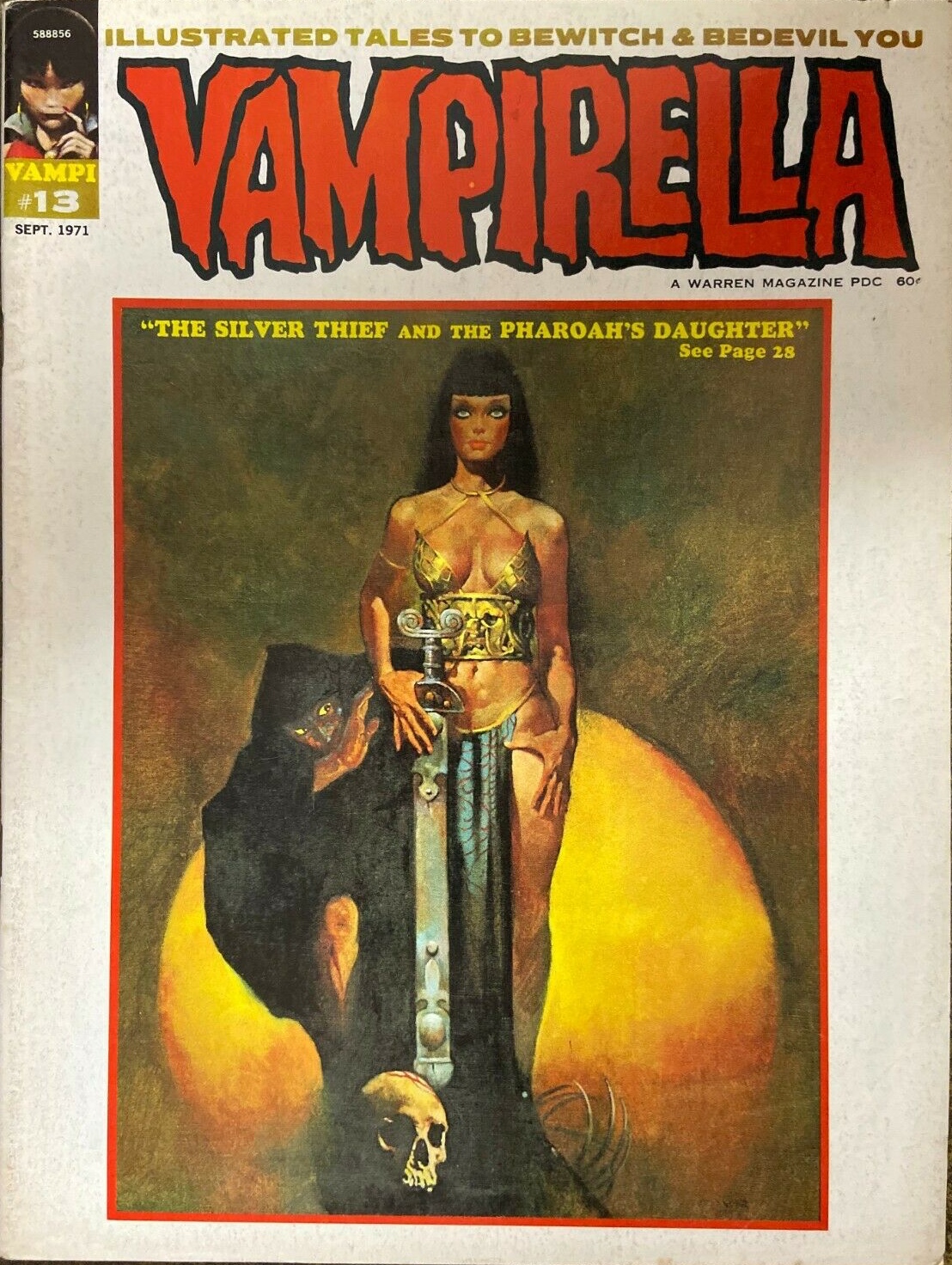
The Silver Thief and the Pharaoh’s Daughter benefits from a properly developed plot with some decent twists. The ancient Egypt setting works extremely well. A very good story.
Eye of the Beholder is the grisly tale of a medieval countess who will take any steps necessary to make herself attractive to men. Possibly inspired very vaguely by the legends surrounding Elizabeth Bathory? It’s a good story anyway.
To Kill a God takes place in Egypt. A Roman officer seeks to save a beautiful princess. She is threatened by a high priest, or perhaps the threat comes from a god. This tale plays fast and loose with both history and Egyptian mythology but it does so in a very enjoyable way.
Prisoner in the Pool is set 3,000 years in the past. A greek hero has to free a maiden confined to a pool by a magic spell. A story that just needed a bit more plot.
In The Sword of Light a beautiful young queen must defend her realm against an evil magic warrior. One man could aid her, except that he’s a coward. A good fun story with mayhem, magic and a feisty heroine.
The stories with contemporary settings and the science fiction stories are more of a mixed bag. The Curse is promising - a man without a memory meets a half-naked girl who tells him they’ve both been cursed by a witch. It’s rather good.
Snake Eyes is a decent story of a girl named Sara who looks like a reptile girl, despite which she has managed to find a boyfriend. He has plans to launch her career as a side-show attraction but he needs money for publicity. If only he could persuade her to sell that strange pendant. It turns out that there is more to Sara than meets the eye, and there’s another twist as well.
Regeneration Gap is a successful sci-fi story in which an astronaut returns to Earth to find that 128 years have passed. Whether life still survives on Earth depends on how you define life.
The Escape concerns a glamorous female jewel thief in the 26th century. Her costume is even more revealing than Vampirella’s. She’s on the run and takes a desperate chance. Not a bad idea but with an overly obvious ending.
Quest is a very short but very good story. It’s very minimalist. There’s no dialogue and we don’t know where or when it takes place. It has a nicely nasty little twist at the end.
Final Thoughts
Given that so many different writers and artists were involved it’s inevitable that this collection is very uneven. Each issue did however contain a good Vampirella and usually a couple of other very good stories. And each issue contained two or three stories that were either disappointing because they were not fully developed or complete misfires.
That’s not such a terrible success/failure ratio. On the whole I thoroughly enjoyed this collection. Recommended, and Vampirella is such an icon that you really do need to sample some of her early adventures and that’s probably enough to bump this volume up to highly recommended status.
So on a whim I bought one of the hardcover Vampirella Archive collections (volume 2 in fact) which includes half a dozen of the original Vampirella comic books which first appeared around 1969.
Vampirella the character was at least partly the creation of science fiction super-fan Forrest J. Ackerman. Each issue of the comic included half a dozen or so comic-strip adventures plus various other features. Disappointingly Vampirella herself only features in one story per issue. This volume begins with issue 8 of the comic. Lots of different writers and artists contributed.
There are also fairly regular sword-and-sorcery stories and they’re pretty good as well. The other stories in each comic are the problem. The stories are often just too short so although the ideas are often very good there’s no time to develop them. By the time you start getting interested they’re over. Some of the non-Vampirella stories work; some don’t.
The comic was definitely aiming to be sexy. There’s quite a bit of nudity. There seemed to be a gradual increase in the level of nudity. In the first few issues in this volume there’s nudity but with the woman’s hair always artfully concealing her nipples. The later issues are not quite so coy. The publishers had evidently figured out that by 1971 they could get away with quite a lot and so they decided to ramp up the nudity quotient. Which I think was a good move. If you’re going to do a sexy comic you might as well make it genuinely sexy.
The Vampirella stories are very good and they’re linked which makes them more interesting. Vampirella is up against a deadly cult. She does have one advantage. She has found out how to survive without having to kill humans for their blood. Vampirella has no desire to hurt humans, unless she is forced to. She is an alien rather than a straightforward vampire and she is cast as heroine rathe than villainess.
In the lead story of issue 8 Vampirella is finding life on Earth to be rather difficult. On her home planet Drakulon blood is easy to obtain but on Earth the only way to get blood is by attacking humans. And Vampirella must have blood to survive. She ends up in a clinic where a kindly doctor tells her that he can solve this problem for her. Vampirella is not quite sure about this clinic - she’s rather suspicious of the doctor’s nurse. With good reason. Vampirella finds herself in a bizarre and terrifying nightmare world of demons. A good action-packed fun story.
In issue 9 Vampirella continues to hunt for the evil cultists but she is in turn being hunted by the Van Helsings (yes, descendants of that Van Helsing). They naturally assume that she is an ordinary vampire and therefore evil.
Vampirella is drawn to a decaying carnival in Carnival of the Damned. It’s not just decaying. There is an atmosphere of misery. And there is magic afoot, and the cult of chaos against which Vampirella has been battling may be involved. Meanwhile the Van Helsings are closing in on Vampirella. Vampirella acquires an ally, a broken-down stage magician named Pendragon who becomes a recurring character. A great story.
In Isle of the Huntress Vampirella and Pendragon are marooned on an island which is inhabited by a werewolf. Or perhaps not a werewolf. Just as Vampirella is not a conventional vampire so this werewolf is not a conventional werewolf. Vampirella could end up as either the hunted or the huntress. A good story.
Lurker in the Deep pits Vampirella and Pendragon against a very nasty aquatic demon. Fun.
As for the non-Vampirella stories, the sword-and-sorcery stories are pretty good. Gardner Fox wrote many such tales and his first story featuring the word-wielding queen Amazonia is excellent. A demon wants to claim Amazonia’s throne. He also wants to kill her but he makes a mistake that makes that impossible. He is however confident that he has neutralised her. This warrior babe is however not all that easy to neutralise. A short but entertaining tale.
War of Wizards is fairly good - a barbarian warrior is caught in a conflict between rival wizards. The barbarian wants to save himself, save his lady love and destroy the empire.
Amazonia and the Eye of Ozirios is a pretty decent sword-and-sorcery tale.
The Silver Thief and the Pharaoh’s Daughter benefits from a properly developed plot with some decent twists. The ancient Egypt setting works extremely well. A very good story.
Eye of the Beholder is the grisly tale of a medieval countess who will take any steps necessary to make herself attractive to men. Possibly inspired very vaguely by the legends surrounding Elizabeth Bathory? It’s a good story anyway.
To Kill a God takes place in Egypt. A Roman officer seeks to save a beautiful princess. She is threatened by a high priest, or perhaps the threat comes from a god. This tale plays fast and loose with both history and Egyptian mythology but it does so in a very enjoyable way.
Prisoner in the Pool is set 3,000 years in the past. A greek hero has to free a maiden confined to a pool by a magic spell. A story that just needed a bit more plot.
In The Sword of Light a beautiful young queen must defend her realm against an evil magic warrior. One man could aid her, except that he’s a coward. A good fun story with mayhem, magic and a feisty heroine.
The stories with contemporary settings and the science fiction stories are more of a mixed bag. The Curse is promising - a man without a memory meets a half-naked girl who tells him they’ve both been cursed by a witch. It’s rather good.
Snake Eyes is a decent story of a girl named Sara who looks like a reptile girl, despite which she has managed to find a boyfriend. He has plans to launch her career as a side-show attraction but he needs money for publicity. If only he could persuade her to sell that strange pendant. It turns out that there is more to Sara than meets the eye, and there’s another twist as well.
Regeneration Gap is a successful sci-fi story in which an astronaut returns to Earth to find that 128 years have passed. Whether life still survives on Earth depends on how you define life.
The Escape concerns a glamorous female jewel thief in the 26th century. Her costume is even more revealing than Vampirella’s. She’s on the run and takes a desperate chance. Not a bad idea but with an overly obvious ending.
Quest is a very short but very good story. It’s very minimalist. There’s no dialogue and we don’t know where or when it takes place. It has a nicely nasty little twist at the end.
Final Thoughts
Given that so many different writers and artists were involved it’s inevitable that this collection is very uneven. Each issue did however contain a good Vampirella and usually a couple of other very good stories. And each issue contained two or three stories that were either disappointing because they were not fully developed or complete misfires.
That’s not such a terrible success/failure ratio. On the whole I thoroughly enjoyed this collection. Recommended, and Vampirella is such an icon that you really do need to sample some of her early adventures and that’s probably enough to bump this volume up to highly recommended status.
Wednesday, March 13, 2024
Jim Harmon’s The Man Who Made Maniacs!
Armchair Fiction have re-issued a lot of obscure but extremely interesting science fiction and other mid-20th century genre novels. Their two-novel paperback editions are usually very much worth buying. In these editions you might get one excellent novel and one that’s not so good but it’s surprising how often both novels turn out to be highly entertaining. Science fiction and horror are their specialities but occasionally they come up with something so weird as to be almost unclassifiable.
That’s definitely the case with their double-header that includes Thorp McClusky’s Loot of the Vampire and Jim Harmon’s The Man Who Made Maniacs! I see Loot of the Vampire as fitting vaguely into the short-lived 1930s weird detective story genre. The Man Who Made Maniacs! was published in 1961 and I have no idea to what genre it belongs. All I know is that it’s deeply weird. It’s The Man Who Made Maniacs! that concerns us in this review.
Jace Reid is a Hollywood screenwriter. A couple of years earlier he had a big success with a book and a movie called Maniac. It was about murderous sex fiends. Naturally a lot of people assumed that a man who wrote about such subjects was most likely a sex fiend himself. One guy saw the movie and then committed a murder, claiming to be inspired by the movie. That was pretty upsetting to Jace.
Now something even worse has happened. Someone has accused him of running a sadistic satanic Hollywood sex cult. And the cops seem to be taking the accusation seriously. The cops come knocking on his door just as he’s about to engage in some serious bedroom fun with his agent Lisa, which is more than a little annoying.
Jace has worked in Hollywood so he, like everybody else, knows that most people in Hollywood really are involved in bizarre sex orgies. But mostly they’re harmless bizarre sex orgies. And Jace is not personally involved in any such goings-on.
Soon things become a lot more disturbing for Jace. He finds himself in a sanatorium where the staff are crazier than the patients. He is drugged, or at least he thinks he was drugged. There’s a girl named Doris MacNiter who accuses him of encouraging her sister Clara’s sadomasochistic tendencies. He has never met Clara. Now he gets to meet both sisters and they’re both rather worrying.
Then the dead body shows up.
The books gets much stranger. There’s a dead guy who may or may not really be dead. There’s a vampire, or at least there might be. There’s lots of sexual kinkiness. People are not who they seem to be, but then maybe they are. Disturbing things happen to Jace, or at least they might have happened. There are beatniks.
This is actually a book that would fit in well with the late 60s vogue for psychedelic freak-out movies and books, but you don’t expect that so much in 1961.
This might be a crime story of sorts. It might have been intended as horror. It may have been aimed at the sleaze fiction market. In fact I’d be fairly certain that was the primary target market but the author seems to have had other agendas going.
There are some amusing moments but it’s not quite certain that this is intended as a spoof, but it might be a spoof.
All of the women have very large breasts. That point is strongly emphasised. Not just large breasts but large thrusting breasts. There are lots of catfights. Those large thrusting breasts always seem to play a key role in the catfights.
It’s hard to say whether the book is well-written or badly written. A decision on that point depends on just how seriously you think the author was taking his story, and whether you think it’s all done with tongue firmly planted in cheek.
Either way it’s a wild crazy oddball book and for me that’s enough to earn it a highly recommended rating, as long as you realise that I’m recommending it for its very high weirdness quotient.
That’s definitely the case with their double-header that includes Thorp McClusky’s Loot of the Vampire and Jim Harmon’s The Man Who Made Maniacs! I see Loot of the Vampire as fitting vaguely into the short-lived 1930s weird detective story genre. The Man Who Made Maniacs! was published in 1961 and I have no idea to what genre it belongs. All I know is that it’s deeply weird. It’s The Man Who Made Maniacs! that concerns us in this review.
Jace Reid is a Hollywood screenwriter. A couple of years earlier he had a big success with a book and a movie called Maniac. It was about murderous sex fiends. Naturally a lot of people assumed that a man who wrote about such subjects was most likely a sex fiend himself. One guy saw the movie and then committed a murder, claiming to be inspired by the movie. That was pretty upsetting to Jace.
Now something even worse has happened. Someone has accused him of running a sadistic satanic Hollywood sex cult. And the cops seem to be taking the accusation seriously. The cops come knocking on his door just as he’s about to engage in some serious bedroom fun with his agent Lisa, which is more than a little annoying.
Jace has worked in Hollywood so he, like everybody else, knows that most people in Hollywood really are involved in bizarre sex orgies. But mostly they’re harmless bizarre sex orgies. And Jace is not personally involved in any such goings-on.
Soon things become a lot more disturbing for Jace. He finds himself in a sanatorium where the staff are crazier than the patients. He is drugged, or at least he thinks he was drugged. There’s a girl named Doris MacNiter who accuses him of encouraging her sister Clara’s sadomasochistic tendencies. He has never met Clara. Now he gets to meet both sisters and they’re both rather worrying.
Then the dead body shows up.
The books gets much stranger. There’s a dead guy who may or may not really be dead. There’s a vampire, or at least there might be. There’s lots of sexual kinkiness. People are not who they seem to be, but then maybe they are. Disturbing things happen to Jace, or at least they might have happened. There are beatniks.
This is actually a book that would fit in well with the late 60s vogue for psychedelic freak-out movies and books, but you don’t expect that so much in 1961.
This might be a crime story of sorts. It might have been intended as horror. It may have been aimed at the sleaze fiction market. In fact I’d be fairly certain that was the primary target market but the author seems to have had other agendas going.
There are some amusing moments but it’s not quite certain that this is intended as a spoof, but it might be a spoof.
All of the women have very large breasts. That point is strongly emphasised. Not just large breasts but large thrusting breasts. There are lots of catfights. Those large thrusting breasts always seem to play a key role in the catfights.
It’s hard to say whether the book is well-written or badly written. A decision on that point depends on just how seriously you think the author was taking his story, and whether you think it’s all done with tongue firmly planted in cheek.
Either way it’s a wild crazy oddball book and for me that’s enough to earn it a highly recommended rating, as long as you realise that I’m recommending it for its very high weirdness quotient.
Tuesday, December 12, 2023
Henry Carew’s Vampires of the Andes
Henry Carew’s Vampires of the Andes is a lost world novel published in 1925.
Henry Carew is a very obscure author indeed. He wrote another novel called The Secret of the Sphinx, published in 1923. He was probably English. Beyond that I can tell you nothing about him.
The plot is rather convoluted and there are a lot of characters to keep track of but the ideas are undeniably interesting, if exceedingly weird and mystical.
An English archaeologist-explorer named Wootton discovers a strange apparently sacred block covered with inscriptions on an expedition to the Andes. He ships it back to England where he hopes his former teacher Professor Stevenson will be able to decipher the inscriptions. That proves to be quite difficult. They’re in a variety of ancient languages some of which defy translation. Making sense of what can be read is an even bigger challenge.
There are those in Peru who feel that the block belongs to them and that the inscriptions must not be deciphered. They are the key to an ancient mystery. It’s a mystery concerning people who trace their descent back to unimaginably old civilisations, perhaps more than ten thousand years old. The mystery involves an event that occurs once every thousand years. It has some connection to a legend concerning the sacrifice of seven maidens, a sacrifice that may also occur once every thousand years. The maidens end up drained of blood.
There seem to be several groups seeking possession of that sacred block, and those groups may possibly have quite different agendas.
Wootton is engaged to be married to a charming Peruvian girl named Quitu. There is some doubt about the girl’s parentage. She was found abandoned in odd circumstances. She was adopted by a respected and prosperous family, friends of both Professor Stevenson and Wootton. At that time the girl’s adoptive mother received an enigmatic warning concerning a great danger the girl would face at some time in the future.
There’s also a wicked priest who is involved in one of the conspiracies centred around that sacred block.
Those who want to gain possession of the sacred block also seem to be interested in gaining possession of Quitu.
There are also rumours that the vampires have returned. The nature of these vampires is mysterious unknown. There was a fabulous bird known as the Ara that was worshipped by those long-vanished civilisations mentioned earlier. The Ara might be connected with the vampires, or might even be the vampires.
There are a lot of puzzles that Wootton and Professor Stevenson will need to solve and while they know that the stakes are high they don’t know exactly what those stakes are. They really don’t know what they are dealing with. They’re not even sure that they’re dealing with something real. It might be mere legends. Wootton is driven on by his concern for Quitu’s safety. That’s a concern for the Professor as well but he is also driven by an insatiable desire to discover long-hidden secrets.
There’s likely to be plenty of danger and adventure in store for the protagonists. They’re up against formidable enemies. Those enemies might be evil, but that is by no means certain.
It seems that this is to be a story of thrilling adventure, but appearances can be deceptive. As the book progresses it becomes more and more concerned with metaphysical, quasi-religious, mystical and esoteric themes. The author throws just about every ancient legend and elements of just about every mythology into the mix. It’s all about secret knowledge and cosmic wisdom. It’s surprising that this book was not rediscovered back in the 70s. At a time when ancient astronauts, the Bermuda Triangle and psychic phenomena were all the rage it should have been a sensation.
If you enjoy that sort of thing then you’ll be in Seventh Heaven. If you don’t enjoy that sort of thing you’ll be bored out of your mind. You’ll just have to decide for yourselves if Vampires of the Andes is likely to be your cup of tea. It certainly wasn’t mine.
Armchair Fiction have reprinted this book, in paperback, in their excellent Lost World-Lost Race Classics series.
Henry Carew is a very obscure author indeed. He wrote another novel called The Secret of the Sphinx, published in 1923. He was probably English. Beyond that I can tell you nothing about him.
The plot is rather convoluted and there are a lot of characters to keep track of but the ideas are undeniably interesting, if exceedingly weird and mystical.
An English archaeologist-explorer named Wootton discovers a strange apparently sacred block covered with inscriptions on an expedition to the Andes. He ships it back to England where he hopes his former teacher Professor Stevenson will be able to decipher the inscriptions. That proves to be quite difficult. They’re in a variety of ancient languages some of which defy translation. Making sense of what can be read is an even bigger challenge.
There are those in Peru who feel that the block belongs to them and that the inscriptions must not be deciphered. They are the key to an ancient mystery. It’s a mystery concerning people who trace their descent back to unimaginably old civilisations, perhaps more than ten thousand years old. The mystery involves an event that occurs once every thousand years. It has some connection to a legend concerning the sacrifice of seven maidens, a sacrifice that may also occur once every thousand years. The maidens end up drained of blood.
There seem to be several groups seeking possession of that sacred block, and those groups may possibly have quite different agendas.
Wootton is engaged to be married to a charming Peruvian girl named Quitu. There is some doubt about the girl’s parentage. She was found abandoned in odd circumstances. She was adopted by a respected and prosperous family, friends of both Professor Stevenson and Wootton. At that time the girl’s adoptive mother received an enigmatic warning concerning a great danger the girl would face at some time in the future.
There’s also a wicked priest who is involved in one of the conspiracies centred around that sacred block.
Those who want to gain possession of the sacred block also seem to be interested in gaining possession of Quitu.
There are also rumours that the vampires have returned. The nature of these vampires is mysterious unknown. There was a fabulous bird known as the Ara that was worshipped by those long-vanished civilisations mentioned earlier. The Ara might be connected with the vampires, or might even be the vampires.
There are a lot of puzzles that Wootton and Professor Stevenson will need to solve and while they know that the stakes are high they don’t know exactly what those stakes are. They really don’t know what they are dealing with. They’re not even sure that they’re dealing with something real. It might be mere legends. Wootton is driven on by his concern for Quitu’s safety. That’s a concern for the Professor as well but he is also driven by an insatiable desire to discover long-hidden secrets.
There’s likely to be plenty of danger and adventure in store for the protagonists. They’re up against formidable enemies. Those enemies might be evil, but that is by no means certain.
It seems that this is to be a story of thrilling adventure, but appearances can be deceptive. As the book progresses it becomes more and more concerned with metaphysical, quasi-religious, mystical and esoteric themes. The author throws just about every ancient legend and elements of just about every mythology into the mix. It’s all about secret knowledge and cosmic wisdom. It’s surprising that this book was not rediscovered back in the 70s. At a time when ancient astronauts, the Bermuda Triangle and psychic phenomena were all the rage it should have been a sensation.
If you enjoy that sort of thing then you’ll be in Seventh Heaven. If you don’t enjoy that sort of thing you’ll be bored out of your mind. You’ll just have to decide for yourselves if Vampires of the Andes is likely to be your cup of tea. It certainly wasn’t mine.
Armchair Fiction have reprinted this book, in paperback, in their excellent Lost World-Lost Race Classics series.
Friday, March 11, 2022
Sheridan Le Fanu’s Carmilla
Joseph Sheridan Le Fanu’s vampire novella Carmilla was serialised in the magazine The Dark Blue in late 1871 and early 1872. Later in 1872 it was included in the short story collection In a Glass Darkly, which featured various cases investigated by Dr Hesselius. Carmilla is historically important for a number of reasons. It was an early example of a vampire tale involving a female vampire, it was a very early example of a lesbian vampire story (although Coleridge’s 1797 poem Christabel has been claimed by some as an earlier example) and Dr Hesselius is the prototype of the occult detective. But in fact Dr Hesselius plays no actual part in Carmilla.
Irishman Joseph Sheridan Le Fanu (1814-1873) wrote many excellent gothic horror and ghost stories as well as some of the finest examples of the Victorian sensation novel (such as Wylder’s Hand), one of the ancestors of the detective story.
Laura is an English girl in her late teens who lives with her father and her governess in an isolated castle in Austria. Laura is happy enough but a girl her age naturally gets rather lonely in such a situation. She is naturally overjoyed when a happy accident brings her a young female companion, Carmilla. The carriage in which Carmilla and her mother were travelling overturned. Luckily nobody was hurt but Carmilla was badly shaken. Her mother is distressed. She cannot break her journey for a moment but Carmilla is in no state to travel. Laura’s father very gallantly offers to allow Carmilla to stay in the castle for three months, until her mother returns.
There is one thing that disturbs Laura. As a little girl she had been frightened by a vivid dream in which a female figure had climbed onto her bed. And Carmilla looks exactly like the female in that dream. Oddly enough Carmilla tells Laura that she had a similar dream at the same time.
The mood in the nearby countryside is sombre. A number of young women have died rather suddenly, after claiming to be attacked in some mysterious way. As Laura and Carmilla pass the funeral of one of these women Carmilla’s behaviour becomes rather odd.
There was also the incident with the old travelling entertainer/huckster, who claimed that Carmilla’s teeth needed to be filed down. And his dog seemed terribly afraid to approach Carmilla.
Laura is also a little taken aback by Carmilla’s tendency to be physically over-affectionate, showering her with kisses.
Odd things continue to happen. Carmilla disappears for a day but offers only a confused explanation. Laura suffers from an increasing weakness.
Then there’s the encounter with the neighbour, a retired general. He has a strange story to tell. Not long before Carmilla’s arrival it had been intended that the General’s beloved niece would pay an extended visit to the castle but the niece suddenly took ill and died. The General was convinced that her death did not come about by natural means and he now believes he has proof. His tale is of vampires, and the long-dead Countess Karnstein who may not be as dead as everyone supposes. The General is determined to wreak vengeance on the vampire.
This is only a novella so the plot really consists of two fairly brief episodes, the one involving Laura and the one involving the General’s niece which is told in an extended flashback. These two episodes will come together at the end.
This novella is interesting for many reasons. It added quite a lot of what would later become part of accepted vampire lore, but it differs from later vampire tales in some respects. These are vampires that feed on blood, they are governed by rules as to where they can sleep undisturbed (they must have the shroud in which they were buried), they may either have some shape-shifting ability or more likely an ability to appear to take on other forms. They seems able to pass through locked doors. On the other hand they are perfectly capable of being active during daylight hours and are more or less indistinguishable from normal living persons.
Is this really a lesbian vampire story? I would say, yes and no. These are vampires who appear, on occasion, to develop a strong bond with their victims. It’s a kind of erotic romantic bond but there is no indication in the text as to whether this bond usually develops exclusively between female vampires and female victims but it’s implied that this is not so. I think there’s no doubt that Le Fanu intends to suggest that vampirism can be linked to sexual attraction and I would guess that he was aware that Carmilla’s obsessions with her female victims were somewhat erotic in nature. I’m not sure that he actually intended to sit down and write a lesbian vampire story. The idea of vampirism as something linked eroticism was however already well established, and would be further elaborated a few years later in Bram Stoker’s Dracula.
Carmilla has been filmed several times, with Roger Vadim’s Blood and Roses (1960), Vicente Aranda’s The Blood Spattered Bride (1972) and Hammer’s The Vampire Lovers (1970) being notable examples. And Carmilla has been an indirect inspiration for countless vampire movies.
Irishman Joseph Sheridan Le Fanu (1814-1873) wrote many excellent gothic horror and ghost stories as well as some of the finest examples of the Victorian sensation novel (such as Wylder’s Hand), one of the ancestors of the detective story.
Laura is an English girl in her late teens who lives with her father and her governess in an isolated castle in Austria. Laura is happy enough but a girl her age naturally gets rather lonely in such a situation. She is naturally overjoyed when a happy accident brings her a young female companion, Carmilla. The carriage in which Carmilla and her mother were travelling overturned. Luckily nobody was hurt but Carmilla was badly shaken. Her mother is distressed. She cannot break her journey for a moment but Carmilla is in no state to travel. Laura’s father very gallantly offers to allow Carmilla to stay in the castle for three months, until her mother returns.
There is one thing that disturbs Laura. As a little girl she had been frightened by a vivid dream in which a female figure had climbed onto her bed. And Carmilla looks exactly like the female in that dream. Oddly enough Carmilla tells Laura that she had a similar dream at the same time.
The mood in the nearby countryside is sombre. A number of young women have died rather suddenly, after claiming to be attacked in some mysterious way. As Laura and Carmilla pass the funeral of one of these women Carmilla’s behaviour becomes rather odd.
There was also the incident with the old travelling entertainer/huckster, who claimed that Carmilla’s teeth needed to be filed down. And his dog seemed terribly afraid to approach Carmilla.
Laura is also a little taken aback by Carmilla’s tendency to be physically over-affectionate, showering her with kisses.
Odd things continue to happen. Carmilla disappears for a day but offers only a confused explanation. Laura suffers from an increasing weakness.
Then there’s the encounter with the neighbour, a retired general. He has a strange story to tell. Not long before Carmilla’s arrival it had been intended that the General’s beloved niece would pay an extended visit to the castle but the niece suddenly took ill and died. The General was convinced that her death did not come about by natural means and he now believes he has proof. His tale is of vampires, and the long-dead Countess Karnstein who may not be as dead as everyone supposes. The General is determined to wreak vengeance on the vampire.
This is only a novella so the plot really consists of two fairly brief episodes, the one involving Laura and the one involving the General’s niece which is told in an extended flashback. These two episodes will come together at the end.
This novella is interesting for many reasons. It added quite a lot of what would later become part of accepted vampire lore, but it differs from later vampire tales in some respects. These are vampires that feed on blood, they are governed by rules as to where they can sleep undisturbed (they must have the shroud in which they were buried), they may either have some shape-shifting ability or more likely an ability to appear to take on other forms. They seems able to pass through locked doors. On the other hand they are perfectly capable of being active during daylight hours and are more or less indistinguishable from normal living persons.
Is this really a lesbian vampire story? I would say, yes and no. These are vampires who appear, on occasion, to develop a strong bond with their victims. It’s a kind of erotic romantic bond but there is no indication in the text as to whether this bond usually develops exclusively between female vampires and female victims but it’s implied that this is not so. I think there’s no doubt that Le Fanu intends to suggest that vampirism can be linked to sexual attraction and I would guess that he was aware that Carmilla’s obsessions with her female victims were somewhat erotic in nature. I’m not sure that he actually intended to sit down and write a lesbian vampire story. The idea of vampirism as something linked eroticism was however already well established, and would be further elaborated a few years later in Bram Stoker’s Dracula.
Carmilla has been filmed several times, with Roger Vadim’s Blood and Roses (1960), Vicente Aranda’s The Blood Spattered Bride (1972) and Hammer’s The Vampire Lovers (1970) being notable examples. And Carmilla has been an indirect inspiration for countless vampire movies.
Friday, November 12, 2021
Little Orphan Vampires
Little Orphan Vampires is perhaps not the sort of book I'd usually talk about here, being a novel from 1993.
It's a short novel by Jean Rollin (1938-2010). Rollin is better known in the English-speaking world as the director of strange surreal erotic horror movies with the emphasis on the surrealism and with a twisted fairy tale feel to them. In his native France he enjoyed more success as a novelist, working in the fantasy and horror genres.
Little Orphan Vampires is the tale of two young blind orphan girls who may or may not be vampires but they are certainly killers. Whether or not they are evil is also open to debate.
My full review can be found at my Cult Movie Reviews blog. Here's the link.
Saturday, June 20, 2015
J.-H. Rosny Aîné's The Young Vampire
Belgian-born Joseph Henri Honoré Boex (1856-1940) was a science fiction author who wrote in collaboration with his brother Séraphin Justin François Boex under the name J.-H. Rosny. When their writing partnership broke up Joseph continued to write under the name J.-H. Rosny Aîné (J.-H. Rosny the elder) while his brother wrote as J.-H. Rosny jeune (J.-H. Rosny the younger). J.-H. Rosny Aîné is regarded as a very important figure in the history of French science fiction, his best-known books being Quest for Fire (1909) and Quest of the Dawn Man (1918). The Young Vampire, published by Black Coat Press in 2010, includes three of J.-H. Rosny Aîné’s short stories and a short novel.
It’s certainly a varied and odd collection. The Witch is a very early story and it’s mind-numbingly dreadful. In fact it’s one of the worst stories I’ve ever read, in any genre. It’s an ugly ham-fisted embarrassingly obvious tale about the persecution of a woman accused by peasants of witchcraft. The story positively drips with the author’s loathing for his characters and for the peasantry in general, and with his narrow-minded anti-religious bigotry. All that would be bad enough but it’s also one of the most abysmally poorly written stories you’re ever likely to encounter. Whether that is entirely Rosny’s fault or whether Brian Stableford, who translated the stories in this collection, must also accept part of the blame is difficult to determine. Stableford’s translations are not usually this bad so he may well have been deliberately trying to capture the flavour of Rosny’s prose, a flavour that is an unholy blending of clumsiness and pomposity.
The Young Vampire is somewhat more interesting. It’s just as badly written but at least it has some clever ideas. It concerns a young woman named Evelyn noted for her oddness and extreme pallor. Her mother explains that the pallor is caused by the fact that Evelyn died some months earlier. She died, but three days later she revived. Since then she has been abnormally pale and strangely disconnected. And, although her family is not yet aware of the fact, she has become a vampire. This fact is discovered by her husband shortly after their marriage. As you might expect this puts a certain amount of strain on the marriage although the husband tries to accommodate himself to this distressing situation.
This story, published in 1920, is a very early fictional example of vampirism as a kind of medical condition. It’s a bit more than that though - it also involves transference of personality and the implication of some kind of alternative existence although whether we’re intended to see this as having supernatural or scientific causes is open to debate. It seems most likely that the author intends it to be seen as a scientific phenomenon although he declines to give us any kind of explanation.
These are good ideas but they’re weakened by the awkward writing and the overall tone. Rosny seems to be aiming at satire although I have to confess I’m not sure what it is he’s trying to satirise. Possibly the English, since he seems to convey a considerable dislike for them in the story.
The Supernatural Assassin, dating from 1923, is a considerable improvement on the first two stories. It’s a reworking of one of the favourite themes of gothic fiction but it attempts to give it a vaguely scientific, or perhaps psychological, basis. It does have the authentic gothic atmosphere of the uncanny.
Companions of the Universe, published in 1934, is a mess. I have no idea what the author was aiming for. Brian Stableford, who translated these stories, admits in his afterword that he has no idea what Rosny was trying to do in this story either. There is a minor science fictional sub-plot that goes nowhere and we never find out what it’s about apart from some vague references to a fourth universe. However almost the entire novella-length story is taken up by the romantic adventures of the hero with a startling number of women with tedious musings on the nature of love and sexual attraction, plus some odd nonsense about the hero’s three natures although what these three natures might be remains (perhaps mercifully) obscure. At times it becomes almost Proustian in its meanderings. The main story is uninteresting and the science fiction element is at best a very minor afterthought that has nothing to do with the rest of the story. This is the kind of stuff that gives French intellectuals a bad name.
The Navigators of Space is a very uneven but far better collection of Rosny's work, often dealing (in a much more interesting way) with similar themes
Overall The Young Vampire is a truly abysmal collection. Two stories that have some minor interest and two absolutely atrocious stories. Just remember I wasted precious hours of my life reading this rubbish so you won’t have to! Avoid at all costs.
Wednesday, June 11, 2014
Colin Wilson's The Space Vampires
Colin Wilson’s 1976 novel The Space Vampires is a bizarre oddity that defies easy categorisation into any particular genre.
At first it seems like science fiction, but it soon shows signs of becoming a horror novel, and then it starts to move into the areas that have always fascinated Wilson - the world of the occult, and of violent psycho-sexual crime.
In the late 21st century an enormous space craft is located, a spacecraft so big that it is difficult to understand how it could possibly have found its way into Earth’s solar system without being detected earlier.
Commander Olof Carlsen and the crew of the Earth spaceship Hermes investigate. The interior of the alien craft is strange and disturbing, but even more unsettling is the discovery of a large number of apparently dead humanoid creatures. They look very human indeed. Carlsen is instructed to bring three of the corpses back to Earth. But these creatures are not dead after all. And they’re vampires. Not blood-sucking vampires, but energy vampires. They drain the life-force from other creatures.
Carlsen makes contact with a number of researchers on the fringe of respectable science, researchers with an interest in vampirism. He learns that vampirism of a sort is common in the animal world, and among humans. But these space vampires are much more dangerous than any Earth-bound vampires, and are able to shift from one body to another.
The book attempts to explain vampirism as a natural rather than supernatural phenomenon, something that can be investigated scientifically. But Colin Wilson’s idea of science isn’t exactly conventional. It’s the sort of science that Mulder from The X-Files would dismiss as being way too flakey. It’s occultism with a scientific veneer.
Wilson also uses vampirism as a kind of explanation for violent psycho-sexual crime, perhaps not surprising given that one of his early bestsellers (Ritual in the Dark) was a novel based on Jack the Ripper and given his keen interest in the occult.
The result is an odd blend of interesting ideas that never quite comes together in a wholly convincing way. But it’s strange enough to be worth a look if you have a taste for the offbeat.
The energy vampire idea has subsequently been dealt with in quite a few novel, notably in Simmons’ unbelievably tedious Carrion Comfort. While The Space Vampires is not exactly a conventionally well-written novel it’s a literary masterpiece in comparison with Simmons’ effort.
Wednesday, November 9, 2011
Etienne-Leon de Lamothe-Langon's The Virgin Vampire
The Virgin Vampire (La Vampire, ou la vierge de Hongrie) was one of several gothic novels written by Etienne-Leon de Lamothe-Langon, an author who went on to have enormous success with lurid faked memoirs of famous people.The Virgin Vampire appeared in 1825. John Polidori’s The Vampyre had enjoyed a major success in 1819 and had triggered off the first vampire fiction boom.
What makes The Virgin Vampire slightly different from most vampire tales, both before and since, is that it depicts vampires as having a purpose. A religious purpose. Their function is to punish those who break a sacred vow. In this case the vow was made by a handsome young French officer named Delmont to an innocent young Hungarian woman. The officer returned to France, married and had two children, and thought no more about his brief liaison in Hungary with a girl named Alinska.
And then Alinska reappears in his life. She has not forgiven him, she has not forgotten, she still considers the promises he made to her to be binding. The officer, now Colonel Delmont, is worried by Alinska’s presence but assumes that she is merely obsessed. The thought that she might present any real danger does not occur to him. He certainly does not imagine that there could be any supernatural threat to his family or to to himself. He is a man of the Enlightenment and has no belief in such superstitions. It’s not that he dismisses the idea of such a threat - it’s something so remote from his intellectual makeup that it never even enters his head.
Delmont still refuses to consider the possibility that something uncanny, something unnatural, might be taking place. Reports of odd deaths, apparently caused by massive blood loss, do not concern him.
Alinska has taken a house near the Delmont estate. When Alinska’s house mysteriously burns to the ground Madame Delmont (who knows nothing of her husband’s previous involvement with this woman) insists that the now homeless girl should move into the Delmont household.
Colonel Delmont is not the only one who is unable to perceive the existence of a real and immediate supernatural threat. While rumours of a vampire are abroad in the neighbouring countryside these rumours are ignored by the more educated people. Unfortunately this includes the Delmont’s doctor, called in when an inexplicable illness strikes down a member of the colonel’s family.
Only the victims of the vampire are aware of what is happening and even they seem uncertain as to whether they are merely dreaming of nocturnal assaults by vampires.
This is an unconventional type of vampire, in some ways closer to the kinds of psychic vampires that would become popular in vampire fiction in the late 20th century. It’s not clear whether this vampire actually physically drains its victim’s blood but nonetheless this is a very real vampire and the scepticism of Colonel Delmont and his acquaintances will not protect them.
There’s also an intriguing moral ambiguity to de Lamothe-Langon’s concept of the vampire. Is this vampire a servant of Satan or of God? Is the vampire even aware of its own nature or of its own place in the universe?
All this probably makes the book sound rather more esoteric and serious-minded than it is. It is essentially a rather sensational and pulpy gothic tale (and it’s reasonably successful on this level) but with an admixture of curious and original ideas. While it’s perhaps not entirely successful it’s one of the more interesting examples of 19th century vampire fiction and is well worth seeking out. It’s available from Black Coat Press, translated by Brian Stableford and with the usual excellent and stimulating introduction and afterword that he customarily provides with his translations. Recommended.
Wednesday, October 19, 2011
Brood of the Witch-Queen
Sax Rohmer gained his greatest fame as the author of the Fu Manchu books but he wrote countless other pulp novels. All of which are great fun, although all are politically incorrect in one way or another. Brood of the Witch-Queen combines the breathless overheated excitement and adventure and the diabolical criminal masterminds of the Fu Manchu and Sumuru novels with all manner of fiendish occult wickedness.Robert Cairn is a terribly brave and very noble young man, the kind of Englishman who built the Empire. Or at least he’s the kind of Englishman Sax Rohmer liked to imagine as an Empire-builder, Rohmer being very much in favour of the Empire. He finds himself involved in an epic life or death struggle with a sinister young man, a fellow medical student named Antony Ferrara. Ferrara is the adopted son of Sir Michael Ferrara, an eminent Egyptologist and a close friend and colleague of Robert Cairns’ father (a celebrated doctor who dabbles in Egyptology). Antony Ferrara doesn’t share Robert’s manly interests, and he’s very popular with women, so he’s already regarded with deep suspicion.
But he isn’t just unmanly, he’s an unnatural fiend who pursues forbidden knowledge. And he has designs on his father’s daughter, the pretty heiress Myra. Robert Cairns is also in love with Myra, although of course in his case it’s a healthy and manly sort of love. Slowly but surely Robert and his father realise they’re dealing with unimaginable evil, with vampires, black magic and occult powers that have lain dormant since the days of Ancient Egypt.
Originally published in 1918, it’s all very silly and outrageous, and yet it’s also wonderfully entertaining. It’s very very pulpy, it’s campy and it’s trashy, but it’s also fast-paced, clever, ingeniously contrived and thoroughly enjoyable (assuming of course that you like pulpy trashy fun yarns of adventure and supernatural horror). The idea of using photography for occult purposes is rather cute as well.
Monday, October 3, 2011
Dracula’s Brood
Dracula’s Brood, edited by Richard Dalby, is an anthology of vampire tales, and is in fact one of the best of its kind. The stories range in date from 1867 to 1940, and thus include several pre-Stoker vampire stories.Phil Robinson’s The Man-Eating Tree is one of the strangest. As the title suggests, it’s about a vampiric tree! Anne Crawford (sister of the better-known F. Marion Crawford) contributes A Mystery of the Campagna, a nicely atmospheric tale of artists and vampiric obsessions. Julian Hawthorne’s Ken’s Mystery is a moody tale of vampires in Ireland, and the fatal lure of the past.
Some of the more interesting stories deal with what are really psychic vampires rather than conventional bloodsuckers. Vincent O’Sullivan’s Will is probably the strongest story in the anthology, and Conan Doyle’s The Parasite is almost as good. Mary E. Braddon’s Good Lady Ducayne is also an unconventional vampire story, again dealing with vampirism as parasitism, but this time with the elderly preying on the young. Vernon Lee’s Marysas in Flanders isn’t really about vampires at all, but rather about pagan gods, but it’s very effective nonetheless.
The 20h century stories aren’t quite as strong, although Ulric Daubeny’s The Sumach is another creepy story of plant vampires. I particularly liked E. R. Punshon’s The Living Stone, combining as it did vampirism, human sacrifice and forgotten gods.
There are surprisingly few really poor stories in this anthology, Hume Nisbet’s The Vampire Maid being the only real failure.
The best thing about this volume is that most of these stories aren’t found in the other major vampire anthologies - Dalby has done a terrific job in unearthing some very obscure but very very fine stories. This book is a must for any serious vampire enthusiast.
Saturday, August 27, 2011
Captain Vampire by Marie Nizet
Marie Nizet was 19 years old when she wrote Captain Vampire. Published in 1879, it’s been claimed as an influence on Bram Stoker’s Dracula, published fifteen years later. In fact Captain Vampire is a remarkable work in its own right and the comparison to Dracula is both misguided and unnecessary.
Nizet’s novel was one of the many 19th century vampire tales that pre-dated Dracula. It owes a certain debt to John Polidori’s 1816 The Vampyre but Nizet was primarily interested in the symbolic significance of the vampire myth.
Nizet was born in Brussels and never visited Romania but her novel is heavily influenced by both Romanian folklore and ever more especially by Romanian politics. She had two very close female friends who were Romanian and they had an immense influence on her.
In his introduction to the novel translator Brian Stableford claims this as one of the first important anti-war novels and a significant example of vampirism as a metaphor for the horrors of war. Actually it seems to me to be much more concerned with Romanian nationalism and with an anti-Russian message rather than being concerned with the evils of war.
The background to the novel is the Russo-Turkish War of 1877-78 which resulted in Romanian independence from the Ottoman Empire, but at the cost of political subservience to Russia. Many in Romania felt that Romanian troops had been cynically used as cannon fodder by the Russians and the arrogant Russian attitude towards Romania caused bitter resentment.
The vampire of the title is Boris Liakoutine, a Russian officer with a mysterious and sinister reputation. It is said he has cheated death several times, in impossible circumstances. It is also said that several young women unlucky enough to become involved with him have met strange deaths. Liakoutine earned the sobriquet Captain Vampire although he is now in fact a colonel.
Ioan Isacescu is the son of a moderately prosperous peasant in a small village near Bucharest. He serves in a Romanian army regiment and is engaged to be married to the beautiful Mariora. The impending war is regarded with foreboding by the villagers who have no love and no trust for their Russian allies. Ioan, his friend Mitica and their friend Relia Comanescu (a young member of the local gentry) will all find themselves embroiled in the war, and in the disastrous assault on the infamous Gravitza Redoubt in which the Romanians believed their troops were cynically exposed to needless slaughter by their supposed allies.
Both Ioan and Mariora will have fateful encounters with the notorious Captain Vampire.
The supernatural elements in this story are very ambiguous indeed. They are not explained away as having a natural explanation but at the same time such an explanation does seem possible. The author is in fact much more interested in the figure of the vampire as a metaphor. While Stableford believes that in this case the vampire represents war it’s just as likely that in fact the vampire represents the Great Powers, and especially Russia, and their treatment of the smaller nations of Europe.
Nizet’s book enjoyed no success in its own time and was forgotten for many years. Its less than flattering attitude towards military glory and power politics would have guaranteed its success half a century later but in 1879 the message fell on stony ground. The Black Coat Press edition seems to be the book’s first appearance in the English language.
Nizet was quite a skillful writer and when you consider this was a first novel by a 19-year-old it’s an impressive achievement. Definitely worth seeking out if you enjoy slightly unusual approaches to the vampire mythos or if you have an interest in the evolution of the vampire sub-genre.
Saturday, February 12, 2011
Vampires of Mars, by Gustave Le Rouge
The scientific romance was a genre that thrived in both Britain in France from the time of Jules Verne up until roughly the 1920s. It produced some wonderfully strange books, and Gustave Le Rouge’s Vampires of Mars might well be the strangest of them all. It’s also possibly the only decadent scientific romance.The scientific romance was essentially science fiction but the science was often rather fanciful (sometimes extremely fanciful) and the emphasis was more on adventure and on speculation about the future of society and of our species rather than on the science.
The writers of these tales came up with some delightfully outlandish methods of interplanetary travel everything from giant cannons to balloons, but Vampires of Mars really excels itself in this respect. Our interplanetary voyager reaches Mars through the power of the will. Or through the power of many wills. The minds of thousands of Hindu fakirs are harnessed by a device invented by a charismatic brahmin and a French engineer named Robert Darvell. The device temporarily stores the volitional fluid thus generated and this volitional fluid produces enough power to send a metal capsule to Mars at the speed of thought (which as everyone knows is approximately half the speed of light).
Upon reaching Mars Darvell encounters several intelligent species, each new species that he encounters proving to be even more bizarre than the previous one. The inhabitants of Mars include gigantic vampire bats with near-human intelligence and even more intelligent invisible vampires.
Darvell’s biggest problem though is how to get back to his home planet. Fortunately his friends on Earth are working on finding other means of inter-planetary travel. These friends include a British officer in the Indian army, a Polish scientist, an English naturalist and a fabulously wealthy heiress (who happens to be also young and beautiful and in love with Darvell). The narrative jumps back and forth between their feverish efforts to organise a rescue mission and Darvell’s adventures on Mars (where he becomes a virtual king).
Le Rouge was certainly inventive and he keeps the action moving along as well. In keeping with the standard practice of authors of the French pulp fictions or romans feuilletons of that era he composed his works extremely rapidly and probably much of it was dictated, and to revise anything or to worry about consistency or continuity would have been a gesture of defeat. As a result the plot is often confusing and contradictory but it doesn’t really matter.
What made Le Rouge unusual among authors of this genre was that he was closely involved with the literary Decadence of the late 19th century. Translator Brian Stableford provides his usual informative and thought-provoking afterword and suggests an interesting reading of the book as a kind of satire on its own genre and on colonialism.
Vampires of Mars was originally published as two books, Le prisonnier de la planète Mars (1908) and La guerre des vampires (1909). If you have a taste for literary oddities and you enjoy the idea of a romance that combines science, mysticism and the occult then it’s certainly worth picking up a copy of the Black Coat Press edition.
Tuesday, February 1, 2011
The Vampire and the Devil’s Son, by Ponson du Terrail
Pierre-Alexis Ponson du Terrail enjoyed immense popularity in mid-19th century France. This was the great age of the romans feuilletons, potboilers published in serial form. Rocambole was his best-known work. The Vampire and the Devil’s Son (La Baronne trépassée) which appeared in book form in 1852 is of exceptional interest.The romans feuilletons followed a definite formula, combining melodrama, sensation and romance. Plot coherence or realism were not essential and these were qualities that Ponson largely ignored. As long as they provided thrills and entertainment no-one was going to complain that the stories made little sense.
The Vampire and the Devil’s Son follows the misadventures of the Baron de Nossac. He is a typical nobleman of his time - brave, dissolute, feckless and charming. And in 1723, as this tale commences, more than a little financially embarrassed. He is awaiting confirmation of his appointment as governor of Brittany, but as that seems likely to fall though he decides it might be wise to find himself a rich wife. The daughter of a wealthy tax-farmer seems a suitable choice. To his surprise he finds that she’s not only rich but also rather charming, the sort of woman with whom he could easily fall in love. As we soon discover, de Nossac has a remarkable propensity for falling in love
There is however a complication. The Baron’s mistress has extracted from an unusual promise, and being a gentleman he must keep this promise. He must agree to be her slave for a period of 24 hours, at any time of her choosing. It is particularly unfortunate that the time she does choose is his wedding night. Very unfortunate indeed - his bride is so upset she leaves his chateau in the middle of the night, catches a chill and dies.
The Baron’s adventures now take a very strange turn indeed. He encounters the mysterious Black Huntsman, who claims to be nothing less than the son of the Devil himself. And he encounters Gretchen, a woman who resembles his dead wife to an uncanny degree, and who proves to be a vampire. But there are many many plot twists still to come, his late wife proves to have more than one double, many of the characters he encounters are not at all who they appear to be, and de Nossac begins to seriously doubt his own sanity.
The reader is also left wondering about the reality of the events described, or at least wondering about their true nature.
Ponson du Terrail was very much influenced by the gothic fictions of Ann Radcliffe but this is gothic with added weird hallucinatory qualities.
Translator Brian Stableford proves both an introduction and an afterword to the Black Coat Press edition and makes some extremely interesting observations in this odd novel. He points out that the author was to some degree constrained by the conventions of the gothic as well as the more general literary convention of his day, and suggests that a modern reader might well interpret the story quite differently as compared to a reader in 1852. Stableford sees the author as being on the verge of several innovative breakthroughs, but being unable to carry them through in a complete manner.
A strange but highly diverting little tale, with some genuinely macabre moments. One of the many forgotten treasures of 19th century French gothic. Highly recommended.
Subscribe to:
Posts (Atom)