Michael Crichton’s novel Sphere was published in 1987. The novel was successful and was well received by critics. The 1988 film adaptation made some significant changes and was very poorly received and was a box-office flop. The fact that Crichton himself was not involved with the film in any way may account for its failure.
The novel begins with a team of four scientists assembled by the U.S. Navy to investigate what the Navy describes as an anomaly a thousand feet below the surface of the South Pacific Ocean. The Navy’s cover story is that it is an air crash scene.
The team comprises astrophysicist Ted Fielding, mathematician Harry Adams, zoologist Beth Halpern and psychologist Norman Johnson. Their investigation will entail spending a week in a deep-sea habitat. Norman is not happy about this but it’s his own fault. He’s the one who, eight years earlier, wrote the protocol for dealing with such a situation and who recommended the inclusion of a psychologist on the grounds that the situation would put the members of such a team under extreme stress.
This is not an air crash. It is a spacecraft crash, and there is clear evidence that the crashed spaceship has been on the ocean floor for at least three hundred years. Which obviously means that it’s an alien spacecraft.
The scientific team will be dealing with the first contact with an alien civilisation.
Norman Johnson’s specialities are the effects of stress and more specifically the effects of stress on human group dynamics. In this case there will be plenty of stress and the group dynamics will be complex and potentially explosive. There are tensions right from the start. This novel is, among many other things, a psychological thriller. And Crichton integrates the psychological thriller and science fiction elements seamlessly.
Right from the start the attitude of Harry Adams is puzzling. This is because he has figured something out. It is not only clear to him that the Navy has withheld important information he has also figured out exactly what it is that they haven’t been told. He is both worried and amused.
The fact that the team members are unaware that the situation is not what it seems to be is important and it’s also important that the reader is unaware of this. For this reason I’m going to be even more careful than usual about hinting at anything that might be a spoiler. Crichton has gone to a lot of trouble to reveal a whole series of secrets to us in a gradual way. Just as we think we know what’s going on he springs another surprise on us.
There’s not just the spacecraft. Aboard the spacecraft is the sphere. What is the sphere and how is it connected with the spacecraft?
Crichton started his literary career as a writer of thrillers and he never forgot the basic techniques of that genre. His skills at building suspense and establishing an atmosphere of menace and paranoia and very evident in Sphere.
This is a classic “put a bunch of people is an isolated confined space and watch them become more and more paranoid” story.
This is also Big Ideas science fiction and in this book he combines a number of big ideas in extremely interesting ways.
This is a novel that came out just before the wave of undersea science fiction adventure films such as The Abyss and it may well have helped to kick off that boom. Sphere is certainly a vastly better story than The Abyss.
Sphere is ambitious and it’s an impressive achievement. Highly recommended.
I’ve reviewed many of Crichton’s books including Scratch One, The Terminal Man, The Andromeda Strain, Binary and Congo. And I’ve reviewed his movies Coma (1978), Looker (1981) and Westworld (1973).
pulp novels, trash fiction, detective stories, adventure tales, spy fiction, etc from the 19th century up to the 1970s
Showing posts with label 1980s. Show all posts
Thursday, June 25, 2026
Monday, November 3, 2025
Whitley Strieber’s The Hunger
Whitley Strieber’s novel The Hunger was published in 1981. In 1983 there was a celebrated movie adaptation which is one of those love it or hate it movies (I love it).
John Blaylock and Miriam are hunting. John’s target is Faye, a teenaged girl. Miriam’s target is Faye’s boyfriend. If one of these teenagers suddenly disappeared questions might get asked. If they both disappear at the same time it will be assumed that they ran off together. It is important that no questions should get asked. Good clean kills with no traces left, that’s the objective.
John and Miriam are very much in love. They’re a typical couple except that Miriam is a bit older than John. Several thousand years older. John isn’t even 200 years old. John and Miriam are vampires.
John has noticed something recently, something slightly disturbing. He doesn’t know what it means. Miriam knows exactly what it means. She has been dreading this. She loves John. She has loved all of them, and has lost all of them. Like the others John is not a true vampire. Miriam is sure there must be a way to make her lovers immortal like herself. She can’t go on losing those she loves after only a few centuries.
She suspects that Dr Sarah Roberts might have accidentally stumbled upon the key. Sarah is a sleep researcher and has discovered something extraordinary about the links between sleep and ageing. Persuading Sarah to help her will be tricky, but it could be done.
The clever thing here is that even when Sarah becomes totally enmeshed in Miriam’s scheme she has no idea that she is dealing with a vampire. Miriam does something very unexpected. Something that you do not expect a vampire to do. She deliberately puts herself in the hands of scientists (Sarah and her team). She allows them to study her, knowing that they are very quickly going to realise that there are things about her that are wildly outside the normal human parameters. Her blood composition is bizarre. Her sleep patterns are bizarre.
But what’s really clever about Miriam’s scheme is that the scientists are not going to realise that she’s a vampire. That possibility will never occur to them, it could never occur to them, because vampires do not exist. And she has been very careful to ensure that they do not have possession of a single item of knowledge about her that might suggest the possibility that she is non-human. She appears to be a 30-year-old woman so that’s what they assume she is. They do not suspect that she is thousands of years old. They know nothing of her blood-drinking. They have no way of knowing that she has killed thousands of times. And they do not for a second suspect that she might be dangerous.
It’s all part of Miriam’s plan to draw Sarah in.
There are three separate species in this book. There are the humans of course. There’s Miriam. She is a true vampire. She is not human. She belongs to a closely related but distinct species. And there are the transformed vampires, such as John Blaylock. They are hybrids. The transformation has made them vampires of a sort. They have many of the characteristics of vampires. But they are not true vampires. They are both vampire and human.
Strieber uses this fact to explore the moral issues connected to vampirism in interesting ways. Miriam fees no remorse whatsoever about killing humans in order to feed. She likes humans. She is genuinely fond of them and in some ways she admires them. But she regards them the way a farmer regards his livestock. He may be quite fond of his cows but he accepts that the time will come when they have to be eaten. Miriam does not consider herself to be a murderess. To some extent she regards transformed humans such as John Blaylock as much-loved pets. We might love a dog very much but the dog is a pet, not a human lover.
John has never quite come to terms with the need to kill because he is aware that he is still partly human. It feels like cannibalism. It feels like murder. He has become accustomed to it, reconciled to it, he has even come to enjoy the hunt, but he is still not entirely comfortable with it.
The human scientists and doctors have no more respect for Miriam’s rights than she has for her victims. They think of her the way they think of their lab animals. As far as they’re concerned she has no more rights than one of the rhesus monkeys on which they experiment. And they treat her this way even though they have no knowledge of her true nature. They think she’s human. They just think that she is so unusual that they are justified in treating her like a lab rat. The humans in this story are morally no better than the vampires.
The book is very concerned with morality but treats the subject in a very complex and provocative way.
This is also a story about love and loss, but love of an unusual kind.
Strieber creates a very complicated and elaborate and original vampire mythology, but it’s not a mythology as such. This is a science fiction novel. He also gives Miriam and John very detailed backstories. None of these things would have worked in a movie so the 1983 movie very wisely focuses on the emotional implications of the story. The novel and the movie are therefore very very different but I love them both equally.
The Hunger is a fascinating science fiction vampire tale. Highly recommended.
I’ve also reviewed his brilliant 1978 werewolf novel Wolfen and I've reviewed the movie, The Hunger (1983).
John Blaylock and Miriam are hunting. John’s target is Faye, a teenaged girl. Miriam’s target is Faye’s boyfriend. If one of these teenagers suddenly disappeared questions might get asked. If they both disappear at the same time it will be assumed that they ran off together. It is important that no questions should get asked. Good clean kills with no traces left, that’s the objective.
John and Miriam are very much in love. They’re a typical couple except that Miriam is a bit older than John. Several thousand years older. John isn’t even 200 years old. John and Miriam are vampires.
John has noticed something recently, something slightly disturbing. He doesn’t know what it means. Miriam knows exactly what it means. She has been dreading this. She loves John. She has loved all of them, and has lost all of them. Like the others John is not a true vampire. Miriam is sure there must be a way to make her lovers immortal like herself. She can’t go on losing those she loves after only a few centuries.
She suspects that Dr Sarah Roberts might have accidentally stumbled upon the key. Sarah is a sleep researcher and has discovered something extraordinary about the links between sleep and ageing. Persuading Sarah to help her will be tricky, but it could be done.
The clever thing here is that even when Sarah becomes totally enmeshed in Miriam’s scheme she has no idea that she is dealing with a vampire. Miriam does something very unexpected. Something that you do not expect a vampire to do. She deliberately puts herself in the hands of scientists (Sarah and her team). She allows them to study her, knowing that they are very quickly going to realise that there are things about her that are wildly outside the normal human parameters. Her blood composition is bizarre. Her sleep patterns are bizarre.
But what’s really clever about Miriam’s scheme is that the scientists are not going to realise that she’s a vampire. That possibility will never occur to them, it could never occur to them, because vampires do not exist. And she has been very careful to ensure that they do not have possession of a single item of knowledge about her that might suggest the possibility that she is non-human. She appears to be a 30-year-old woman so that’s what they assume she is. They do not suspect that she is thousands of years old. They know nothing of her blood-drinking. They have no way of knowing that she has killed thousands of times. And they do not for a second suspect that she might be dangerous.
It’s all part of Miriam’s plan to draw Sarah in.
There are three separate species in this book. There are the humans of course. There’s Miriam. She is a true vampire. She is not human. She belongs to a closely related but distinct species. And there are the transformed vampires, such as John Blaylock. They are hybrids. The transformation has made them vampires of a sort. They have many of the characteristics of vampires. But they are not true vampires. They are both vampire and human.
Strieber uses this fact to explore the moral issues connected to vampirism in interesting ways. Miriam fees no remorse whatsoever about killing humans in order to feed. She likes humans. She is genuinely fond of them and in some ways she admires them. But she regards them the way a farmer regards his livestock. He may be quite fond of his cows but he accepts that the time will come when they have to be eaten. Miriam does not consider herself to be a murderess. To some extent she regards transformed humans such as John Blaylock as much-loved pets. We might love a dog very much but the dog is a pet, not a human lover.
John has never quite come to terms with the need to kill because he is aware that he is still partly human. It feels like cannibalism. It feels like murder. He has become accustomed to it, reconciled to it, he has even come to enjoy the hunt, but he is still not entirely comfortable with it.
The human scientists and doctors have no more respect for Miriam’s rights than she has for her victims. They think of her the way they think of their lab animals. As far as they’re concerned she has no more rights than one of the rhesus monkeys on which they experiment. And they treat her this way even though they have no knowledge of her true nature. They think she’s human. They just think that she is so unusual that they are justified in treating her like a lab rat. The humans in this story are morally no better than the vampires.
The book is very concerned with morality but treats the subject in a very complex and provocative way.
This is also a story about love and loss, but love of an unusual kind.
Strieber creates a very complicated and elaborate and original vampire mythology, but it’s not a mythology as such. This is a science fiction novel. He also gives Miriam and John very detailed backstories. None of these things would have worked in a movie so the 1983 movie very wisely focuses on the emotional implications of the story. The novel and the movie are therefore very very different but I love them both equally.
The Hunger is a fascinating science fiction vampire tale. Highly recommended.
I’ve also reviewed his brilliant 1978 werewolf novel Wolfen and I've reviewed the movie, The Hunger (1983).
Friday, August 16, 2024
Masamune Shirow's Ghost in the Shell
Ghost in the Shell is a 1989-90 cyberpunk manga (Japanese comic-book) by Masamune Shirow. This is very much a manga for grown-ups.
Cyberpunk emerged as a science fiction sub-genre in the 80s, with the movie Blade Runner in 1982 establishing the aesthetic and William Gibson’s 1984 novel Neuromancer and the Bruce Sterling-edited anthology Mirrorshades establishing the thematic framework. Cyberpunk was science fiction focused on the effects of computer technology on human society on Earth rather than on spaceships, photon cannons and aliens.
By the end of the 80s the Japanese were embracing this new sub-genre. In Japan cyberpunk made its appearance in manga and anime rather than in novels and live-action films. This made sense. The Japanese did not have the western prejudice against comic-book and animated movies aimed at adult. And manga and anime were the ideal formats for cyberpunk. There were not particularly restricted by technological or budgetary concerns. The only limitation was the creator’s imagination and the creators of manga and anime had plenty of that.
The anima OVA Cyber City Oedo 808 in 1991 was fully-fledged cyberpunk. The Ghost in the Shell manga was most definitely fully-fledged cyberpunk and would spawn further mangas, several anime feature films (including Mamoru Oshii’s superb 1995 Ghost in the Shell) and an excellent anime TV series.
Major Motoko Kusanagi works for Public Security, Section 9. She leads a top-secret elite squad. Their main brief is counter-terrorist work but in this future world terrorism has become very high-tech and tends to involve hackers, cyborgs, robots and AIs.
The Major herself is a cyborg. She has a human brain and spinal column but everything else is prosthetic. She looks like a normal woman. In this cyberpunk world humans, cyborgs and robots all look human.
Are cyborgs still human? Do robots have rights? Can an AI be alive? These are themes that run right through this manga. These questions are of some personal concern to the Major. Is she a woman or a machine? She feels that she is a woman. She has a woman’s emotions and a woman’s sexual urges. Her body is entirely prosthetic (although it’s fully functional sexually). What matters is the ghost. The body (human or prosthetic) is the shell. The ghost is what makes us alive and makes human.
One of my favourite things about this manga is that Masamune Shirow has provided copious footnotes. Some give fascinating background technical details of this future world. Some provide philosophical musings (this is a manga with a heavy philosophical content). The most interesting offer insight what how the author sees the ghost. The ghost is not quite the soul, at least not in the way we conceive of the soul in countries with a tradition of Christianity. But it’s somewhat akin to a soul. Major Kusanagi is human because she has a ghost. But can an AI have a ghost?
That’s a question that becomes important when she encounters the Puppeteer. It’s not clear what the Puppeteer is but it seems to be a rogue AI. It may have a ghost. This becomes important for Section 9 when it claims political asylum.
The Puppeteer is not confined to a particular body (or shell). But then nor is the Major. She has several spare bodies. Her closest friend and professional colleague Batou has spare bodies as well.
AIs of course are confined to a particular location or body. The Tachikomas, the combat robots used in large numbers by Section 9, are a single AI. Which does not have a ghost. Or at least that’s been the assumption.
Shirow has little or no interest in politics as such but he is interested in power relationships, and politics in this future world is all about power. Mostly however he is interested in philosophical questions (this is a very cerebral manga) which can have a spiritual dimension. In particular he’s fascinated by the philosophical dilemmas that will inevitably arise if and when AIs become self-aware.
The cases Section 9 deals with (the structure of the manga is episodic) mostly hinge on the need to resolve such dilemmas.
It might be cerebral but there’s plenty of action and excitement as well. The Japanese have no problems with the idea of combining big ideas with enjoyable mayhem.
The Major is also interesting because unlike most kickass action heroines she is in a command position. If she makes an incorrect decision people die. Being an action heroine is not a game for her.
Ghost in the Shell really is great stuff - intelligent, provocative, mind-bending, sexy and fun. Very highly recommended.
Cyberpunk emerged as a science fiction sub-genre in the 80s, with the movie Blade Runner in 1982 establishing the aesthetic and William Gibson’s 1984 novel Neuromancer and the Bruce Sterling-edited anthology Mirrorshades establishing the thematic framework. Cyberpunk was science fiction focused on the effects of computer technology on human society on Earth rather than on spaceships, photon cannons and aliens.
By the end of the 80s the Japanese were embracing this new sub-genre. In Japan cyberpunk made its appearance in manga and anime rather than in novels and live-action films. This made sense. The Japanese did not have the western prejudice against comic-book and animated movies aimed at adult. And manga and anime were the ideal formats for cyberpunk. There were not particularly restricted by technological or budgetary concerns. The only limitation was the creator’s imagination and the creators of manga and anime had plenty of that.
The anima OVA Cyber City Oedo 808 in 1991 was fully-fledged cyberpunk. The Ghost in the Shell manga was most definitely fully-fledged cyberpunk and would spawn further mangas, several anime feature films (including Mamoru Oshii’s superb 1995 Ghost in the Shell) and an excellent anime TV series.
Major Motoko Kusanagi works for Public Security, Section 9. She leads a top-secret elite squad. Their main brief is counter-terrorist work but in this future world terrorism has become very high-tech and tends to involve hackers, cyborgs, robots and AIs.
The Major herself is a cyborg. She has a human brain and spinal column but everything else is prosthetic. She looks like a normal woman. In this cyberpunk world humans, cyborgs and robots all look human.
Are cyborgs still human? Do robots have rights? Can an AI be alive? These are themes that run right through this manga. These questions are of some personal concern to the Major. Is she a woman or a machine? She feels that she is a woman. She has a woman’s emotions and a woman’s sexual urges. Her body is entirely prosthetic (although it’s fully functional sexually). What matters is the ghost. The body (human or prosthetic) is the shell. The ghost is what makes us alive and makes human.
One of my favourite things about this manga is that Masamune Shirow has provided copious footnotes. Some give fascinating background technical details of this future world. Some provide philosophical musings (this is a manga with a heavy philosophical content). The most interesting offer insight what how the author sees the ghost. The ghost is not quite the soul, at least not in the way we conceive of the soul in countries with a tradition of Christianity. But it’s somewhat akin to a soul. Major Kusanagi is human because she has a ghost. But can an AI have a ghost?
That’s a question that becomes important when she encounters the Puppeteer. It’s not clear what the Puppeteer is but it seems to be a rogue AI. It may have a ghost. This becomes important for Section 9 when it claims political asylum.
The Puppeteer is not confined to a particular body (or shell). But then nor is the Major. She has several spare bodies. Her closest friend and professional colleague Batou has spare bodies as well.
AIs of course are confined to a particular location or body. The Tachikomas, the combat robots used in large numbers by Section 9, are a single AI. Which does not have a ghost. Or at least that’s been the assumption.
Shirow has little or no interest in politics as such but he is interested in power relationships, and politics in this future world is all about power. Mostly however he is interested in philosophical questions (this is a very cerebral manga) which can have a spiritual dimension. In particular he’s fascinated by the philosophical dilemmas that will inevitably arise if and when AIs become self-aware.
The cases Section 9 deals with (the structure of the manga is episodic) mostly hinge on the need to resolve such dilemmas.
It might be cerebral but there’s plenty of action and excitement as well. The Japanese have no problems with the idea of combining big ideas with enjoyable mayhem.
The Major is also interesting because unlike most kickass action heroines she is in a command position. If she makes an incorrect decision people die. Being an action heroine is not a game for her.
Ghost in the Shell really is great stuff - intelligent, provocative, mind-bending, sexy and fun. Very highly recommended.
I’ve reviewed Mamoru Oshii’s Ghost in the Shell movie elsewhere, as well as the first season of the Ghost in the Shell Stand Alone Complex TV series.
Saturday, June 29, 2024
J.D. Masters' Cold Steele
Cold Steele, published in 1989, is the second of the Steele books by J.D. Masters.
I went into Cold Steele expecting a violent but fun pulp action thriller in the men’s adventure mode. It is in fact a very successful adrenalin-rush pulp action thriller but it’s also a surprisingly smart and interesting and somewhat complex cyberpunk science fiction novel.
The hero is a cyborg, but he’s not a robot with a human brain. He’s a partially robotically enhanced flesh-and-blood man but the twist is that he doesn’t have a human brain. He has a computer brain. Well, it’s sort of a computer brain and sort of a human brain.
Donovan Steele was (and maybe is) a cop who got badly shot up. His body survived. It was badly mangled but with bionic enhancements it was made fully functional. His brain however did not survive. Not on organic form. His personality was however uploaded and used as the basis for the software that drives his electronic brain.
This personality uploading idea was very fashionable in the cyberpunk sci-fi of the 80s. It’s an idea that always struck me as very unconvincing. Masters however handles it rather deftly and in a genuinely provocative and interesting way. Donovan Steele doesn’t know if he’s human or not. He has his human memories. He experiences human emotions. Or at least he thinks he does. But he knows he’s not human in the way other people are human.
And he has some problems, which psychiatrist Dev Cooper is supposed to be helping him work through. Steele has nightmares. These seem to be memories. Very vivid memories. He is convinced that they are real memories. The trouble is that they’re not his memories.
Dev Cooper has problems as well. Ethical problems. He’s been working with a digital copy of Donovan Steele’s personality. This is a Donovan Steele who exists only in digital form, with no physical existence. Dev’s problem is that he has to decide if this digital copy is alive. Does it have rights?
This is also a post-apocalyptic science fiction novel. The world has been devastated by viruses and nuclear war. Large parts of the United States are nothing but radioactive wastelands. Significant parts of the country are controlled by crime gangs who are essentially warlords. Texas has declared its independence. Nobody knows if anybody is still alive in California because nobody has dared to investigate. The federal government wants to reassert its authority and sees cyborgs like Donovan Steele as a way to do this. One cyborg is as effective as a whole squad of cops, and much cheaper. The government doesn’t care about the ethical issues. It just wants power and control.
Donovan Steele’s assignment in this novel is to take down the Borodini crime family which controls much of New York. It would take a small army to deal with the Borodini family. They live in a fortress. Steele figures he can do the job himself.
He has some help. Ice is a black former gang leader who has agreed to help in return for immunity from prosecution. Steele and Ice don’t trust each other but they both have something to gain from working together, and Ice can certainly handle himself in a tough spot. Steele’s other ally is Raven, a young hooker whom he rescued. She can be trusted insofar as she has a personal grudge against the Borodinis.
A weird emotional bond develops between Steele and Raven. Steele doesn’t care that she’s a hooker. Raven doesn’t care that he’s a robot. They’re both broken inside but they find, to their own mutual surprise, that they’ve started to care for each other.
Of course this book is part of a series so some issues are left only partially resolved, presumably to be dealt with further in later books.
There’s as much action and mayhem as you could possibly desire, combined with a strange love story and some surprisingly deep emotional, moral and intellectual speculation. Some of these issues would also be dealt with a few years later in the excellent Japanese sci-fi anime movie Ghost in the Shell.
I enjoyed this novel enough to leave me quite open to the idea of buying the next book in the series.
Cold Steele is highly recommended.
I went into Cold Steele expecting a violent but fun pulp action thriller in the men’s adventure mode. It is in fact a very successful adrenalin-rush pulp action thriller but it’s also a surprisingly smart and interesting and somewhat complex cyberpunk science fiction novel.
The hero is a cyborg, but he’s not a robot with a human brain. He’s a partially robotically enhanced flesh-and-blood man but the twist is that he doesn’t have a human brain. He has a computer brain. Well, it’s sort of a computer brain and sort of a human brain.
Donovan Steele was (and maybe is) a cop who got badly shot up. His body survived. It was badly mangled but with bionic enhancements it was made fully functional. His brain however did not survive. Not on organic form. His personality was however uploaded and used as the basis for the software that drives his electronic brain.
This personality uploading idea was very fashionable in the cyberpunk sci-fi of the 80s. It’s an idea that always struck me as very unconvincing. Masters however handles it rather deftly and in a genuinely provocative and interesting way. Donovan Steele doesn’t know if he’s human or not. He has his human memories. He experiences human emotions. Or at least he thinks he does. But he knows he’s not human in the way other people are human.
And he has some problems, which psychiatrist Dev Cooper is supposed to be helping him work through. Steele has nightmares. These seem to be memories. Very vivid memories. He is convinced that they are real memories. The trouble is that they’re not his memories.
Dev Cooper has problems as well. Ethical problems. He’s been working with a digital copy of Donovan Steele’s personality. This is a Donovan Steele who exists only in digital form, with no physical existence. Dev’s problem is that he has to decide if this digital copy is alive. Does it have rights?
This is also a post-apocalyptic science fiction novel. The world has been devastated by viruses and nuclear war. Large parts of the United States are nothing but radioactive wastelands. Significant parts of the country are controlled by crime gangs who are essentially warlords. Texas has declared its independence. Nobody knows if anybody is still alive in California because nobody has dared to investigate. The federal government wants to reassert its authority and sees cyborgs like Donovan Steele as a way to do this. One cyborg is as effective as a whole squad of cops, and much cheaper. The government doesn’t care about the ethical issues. It just wants power and control.
Donovan Steele’s assignment in this novel is to take down the Borodini crime family which controls much of New York. It would take a small army to deal with the Borodini family. They live in a fortress. Steele figures he can do the job himself.
He has some help. Ice is a black former gang leader who has agreed to help in return for immunity from prosecution. Steele and Ice don’t trust each other but they both have something to gain from working together, and Ice can certainly handle himself in a tough spot. Steele’s other ally is Raven, a young hooker whom he rescued. She can be trusted insofar as she has a personal grudge against the Borodinis.
A weird emotional bond develops between Steele and Raven. Steele doesn’t care that she’s a hooker. Raven doesn’t care that he’s a robot. They’re both broken inside but they find, to their own mutual surprise, that they’ve started to care for each other.
Of course this book is part of a series so some issues are left only partially resolved, presumably to be dealt with further in later books.
There’s as much action and mayhem as you could possibly desire, combined with a strange love story and some surprisingly deep emotional, moral and intellectual speculation. Some of these issues would also be dealt with a few years later in the excellent Japanese sci-fi anime movie Ghost in the Shell.
I enjoyed this novel enough to leave me quite open to the idea of buying the next book in the series.
Cold Steele is highly recommended.
Friday, June 23, 2023
Guido Crepax's Private Life
Private Life is the fourth volume in the superb Complete Crepax series from Fantagraphics. The series aims to collect all of Guido Crepax’s comics. The comics in this volume were written between the mid-60s and the mid-80s.
Guido Crepax was the name used by Milan-Born Guido Crepas (1933-2003). Exciting things were happening in the world of European comics by the 1960s, beginning with the first appearance of Jean-Claude Forest’s Barbarella in the French V Magazine in 1962. European comics of the 60s bore no resemblance to American comics. European comics were aimed at grown-ups. They were sexy and sophisticated, they were witty and wildly imaginative and they were stylistically adventurous.
Crepax would push all of these elements very far indeed. He would attract immediate attention when his first comic adventure, The Lesmo Curve, appeared in Linus magazine in 1965. This was also the first appearance of his most famous creation, the fashion photographer Valentina. Valentina would appear in countless Crepax comics. Her adventures often involved elements of science fiction and fantasy, plentiful hallucinogenic dream sequences, espionage, crime and general weirdness. Plus a great deal of eroticism.
Private Life focuses, as the title suggests, on comics that tell us about Valentina’s emotional life and her relationship with her lover, art critic Phil Rembrandt. As a result there’s not quite as much of the outrageousness, bizarre inventiveness and stylistic flamboyance that you’ll find in Valentina’s other adventures. Crepax however still manages to give us some trippy dream sequences and these comics are by no means totally lacking in delirious weirdness.
Unlike almost every other comic book heroine Valentina ages over the course of her many adventures. At the beginning she is a carefree 22-year-old. She will find a stable emotional relationship with Phil Rembrandt and they will have a child. By the time you get to her final adventures she’s rapidly closing in on middle age.
Another unusual feature is that, in between their extraordinary surreal adventures, she and Phil have a normal family life. The baby has to have his bath. The dishes have to be washed. The laundry has to be done. And while Valentina and Phil both have glamorous jobs they do have to work for a living. This contrast between perfectly normal domesticity and bizarre adventures gives these comics a distinctive flavour.
Crepax’s original intention was to write a comic about an art critic named Phil Rembrandt who has a double life. He is also a superhero named Neutron. He has only one superpower but it’s pretty impressive. He can temporarily paralyse people with his eyes. Crepax soon realised that he wasn’t all that interested in doing a conventional superhero comic and that aspect started to fade into the background. At the same time Crepax’s focus shifted more towards Phil’s fashion photographer girlfriend Valentina.
Crepax’s comics became gradually more surreal and experimental. Reality and dream become hopelessly intertwined. It is never possible to be sure how many of Valentina’s adventures are real, and it could be argued that Valentina’s real life takes place in her dreams.
The Comics
The Lesmo Curve introduces us to Valentina. And it introduces Valentina to Phil Rembrandt, who will become her husband and the great love of her life. Phil is also the superhero Neutron. Valentina and Phil will go on to share all kinds of bizarre adventures.
In The Lesmo Curve beautiful girls are marrying rich men, and the rich men keep meeting with fatal accidents. The latest intended victim is a racing car driver. At this stage Crepax was still finding his feet and this story isn’t as outrageous or bizarre as many of the subsequent stories. But it’s an entertaining story.
Ciao, Valentina involves a photograph taken by Valentina. People are prepared to go to drastic lengths to get their hands on it even though it seems like a remarkably innocent photo. There has to be some key in that photograph, and of course there is.
This is obviously another early story and it still has an at least vaguely conventional thriller plot. The plot is an intriguing anticipation of Antonioni’s Blow-Up. It's fun.
That all changes and things take a turn for the weird with the next stories in this collection. Funny Valentine, Filippo and Valentina, Fearless Paper Doll Valentina and Valentina the Fearless are odd little snippets and also offer glimpses of Valentina’s childhood.
Valentina’s Baby is a series of strange dreams that Valentina has while in labour with her son Mattia. And Valentina’s dreams are very strange indeed.
Manuscript Found in a Stroller is a whimsical little throwaway story about a very strange discovery our heroine makes when she checks her washing machine.
In Fallen Angels Valentina seems to be contemplating having an affair, with a man named Arno. There’s definitely something between these two but Valentina is hanging back. There’s also some cool falling statuary.
In The Empress’s New Clothes Valentina finds herself all alone on a blank page, patiently waiting for Crepax to turn up to create a story for her. Not wildly original (Chuck Jones had been playing with such ideas in Daffy Duck cartoons for years) but it’s a whimsical little throwaway story. It’s also a bit disturbing since, no matter how bizarre and unlikely her adventures, we’ve never before been confronted so starkly with the idea that Valentina is just a comic-book character. It’s Crepax being playful, but it is disturbing.
Le Zattere, Venice is just Crepax reminiscing about his own childhood and it’s a bit dull.
Peitro Giacomo Rogeri is much more interesting. A girl leaves a ’cello in Valentina’s studio and then disappears. She claims the instrument is 250 years old. In fact it was owned at one time by Paganini. Several groups and individuals want to get their hands on that ’cello. There are apparently secret documents concealed in the instrument.
With Anthropology we move into authentically weird Crepax territory. How much of the story is a dream is uncertain. Valentina encounters the Subterraneans, strange human-like but non-human creatures which figure in many of Valentina’s adventures. And Louise Brooks makes an appearance, although maybe it’s not Louise Brooks or maybe it’s Louise Brooks getting mixed up with other women in Valentina’s dream.
Private Life is a slightly older Valentina reminiscing about her past adventures (and wondering how many of them were real). It’s Crepax saying farewell to Valentina, and perhaps Valentina saying farewell to herself. Although the ending didn’t necessarily entirely close off the possibility of further Valentina adventures it’s obvious that Crepax felt that he’d gone as far with the character as he could.
Final Thoughts
Although this volume includes the earliest Valentina comics my personal view is that if you have never encountered Valentina before you’re better off starting with the third of the Fantagraphics Complete Crepax volumes, Evil Spells. I think it’s a better introduction to Valentina’s world and a better illustration of the reasons she became such an important pop culture icon. And on the whole Evil Spells is a stronger collection.
Once you become obsessed with Valentina then you’ll certainly want to pick up Private Life to find out more about what makes her tick. So Private Life is highly recommended, but grab Evil Spells first.
Guido Crepax was the name used by Milan-Born Guido Crepas (1933-2003). Exciting things were happening in the world of European comics by the 1960s, beginning with the first appearance of Jean-Claude Forest’s Barbarella in the French V Magazine in 1962. European comics of the 60s bore no resemblance to American comics. European comics were aimed at grown-ups. They were sexy and sophisticated, they were witty and wildly imaginative and they were stylistically adventurous.
Crepax would push all of these elements very far indeed. He would attract immediate attention when his first comic adventure, The Lesmo Curve, appeared in Linus magazine in 1965. This was also the first appearance of his most famous creation, the fashion photographer Valentina. Valentina would appear in countless Crepax comics. Her adventures often involved elements of science fiction and fantasy, plentiful hallucinogenic dream sequences, espionage, crime and general weirdness. Plus a great deal of eroticism.
Private Life focuses, as the title suggests, on comics that tell us about Valentina’s emotional life and her relationship with her lover, art critic Phil Rembrandt. As a result there’s not quite as much of the outrageousness, bizarre inventiveness and stylistic flamboyance that you’ll find in Valentina’s other adventures. Crepax however still manages to give us some trippy dream sequences and these comics are by no means totally lacking in delirious weirdness.
Unlike almost every other comic book heroine Valentina ages over the course of her many adventures. At the beginning she is a carefree 22-year-old. She will find a stable emotional relationship with Phil Rembrandt and they will have a child. By the time you get to her final adventures she’s rapidly closing in on middle age.
Another unusual feature is that, in between their extraordinary surreal adventures, she and Phil have a normal family life. The baby has to have his bath. The dishes have to be washed. The laundry has to be done. And while Valentina and Phil both have glamorous jobs they do have to work for a living. This contrast between perfectly normal domesticity and bizarre adventures gives these comics a distinctive flavour.
Crepax’s original intention was to write a comic about an art critic named Phil Rembrandt who has a double life. He is also a superhero named Neutron. He has only one superpower but it’s pretty impressive. He can temporarily paralyse people with his eyes. Crepax soon realised that he wasn’t all that interested in doing a conventional superhero comic and that aspect started to fade into the background. At the same time Crepax’s focus shifted more towards Phil’s fashion photographer girlfriend Valentina.
Crepax’s comics became gradually more surreal and experimental. Reality and dream become hopelessly intertwined. It is never possible to be sure how many of Valentina’s adventures are real, and it could be argued that Valentina’s real life takes place in her dreams.
The Comics
The Lesmo Curve introduces us to Valentina. And it introduces Valentina to Phil Rembrandt, who will become her husband and the great love of her life. Phil is also the superhero Neutron. Valentina and Phil will go on to share all kinds of bizarre adventures.
In The Lesmo Curve beautiful girls are marrying rich men, and the rich men keep meeting with fatal accidents. The latest intended victim is a racing car driver. At this stage Crepax was still finding his feet and this story isn’t as outrageous or bizarre as many of the subsequent stories. But it’s an entertaining story.
Ciao, Valentina involves a photograph taken by Valentina. People are prepared to go to drastic lengths to get their hands on it even though it seems like a remarkably innocent photo. There has to be some key in that photograph, and of course there is.
This is obviously another early story and it still has an at least vaguely conventional thriller plot. The plot is an intriguing anticipation of Antonioni’s Blow-Up. It's fun.
That all changes and things take a turn for the weird with the next stories in this collection. Funny Valentine, Filippo and Valentina, Fearless Paper Doll Valentina and Valentina the Fearless are odd little snippets and also offer glimpses of Valentina’s childhood.
Valentina’s Baby is a series of strange dreams that Valentina has while in labour with her son Mattia. And Valentina’s dreams are very strange indeed.
Manuscript Found in a Stroller is a whimsical little throwaway story about a very strange discovery our heroine makes when she checks her washing machine.
In Fallen Angels Valentina seems to be contemplating having an affair, with a man named Arno. There’s definitely something between these two but Valentina is hanging back. There’s also some cool falling statuary.
In The Empress’s New Clothes Valentina finds herself all alone on a blank page, patiently waiting for Crepax to turn up to create a story for her. Not wildly original (Chuck Jones had been playing with such ideas in Daffy Duck cartoons for years) but it’s a whimsical little throwaway story. It’s also a bit disturbing since, no matter how bizarre and unlikely her adventures, we’ve never before been confronted so starkly with the idea that Valentina is just a comic-book character. It’s Crepax being playful, but it is disturbing.
Le Zattere, Venice is just Crepax reminiscing about his own childhood and it’s a bit dull.
Peitro Giacomo Rogeri is much more interesting. A girl leaves a ’cello in Valentina’s studio and then disappears. She claims the instrument is 250 years old. In fact it was owned at one time by Paganini. Several groups and individuals want to get their hands on that ’cello. There are apparently secret documents concealed in the instrument.
With Anthropology we move into authentically weird Crepax territory. How much of the story is a dream is uncertain. Valentina encounters the Subterraneans, strange human-like but non-human creatures which figure in many of Valentina’s adventures. And Louise Brooks makes an appearance, although maybe it’s not Louise Brooks or maybe it’s Louise Brooks getting mixed up with other women in Valentina’s dream.
Private Life is a slightly older Valentina reminiscing about her past adventures (and wondering how many of them were real). It’s Crepax saying farewell to Valentina, and perhaps Valentina saying farewell to herself. Although the ending didn’t necessarily entirely close off the possibility of further Valentina adventures it’s obvious that Crepax felt that he’d gone as far with the character as he could.
Final Thoughts
Although this volume includes the earliest Valentina comics my personal view is that if you have never encountered Valentina before you’re better off starting with the third of the Fantagraphics Complete Crepax volumes, Evil Spells. I think it’s a better introduction to Valentina’s world and a better illustration of the reasons she became such an important pop culture icon. And on the whole Evil Spells is a stronger collection.
Once you become obsessed with Valentina then you’ll certainly want to pick up Private Life to find out more about what makes her tick. So Private Life is highly recommended, but grab Evil Spells first.
Labels:
1960s,
1970s,
1980s,
comics,
erotica,
science fiction,
spy fiction
Monday, March 6, 2023
Renegade Swords
Renegade Swords is a sword-and-sorcery anthology from DMR Press and as usual they’ve come up with an interesting mix of stories.
The House of Arabu is a fairly early Robert E. Howard story. It was apparently written in 1929 but was unpublished during his lifetime, eventually seeing the light of day (under the title Witch from Hell's Kitchen) in the Avon Fantasy Reader in 1952. At this stage Howard was still experimenting with the new sword-and-sorcery genre (which he had more or less invented).
The House of Arabu takes place in a quasi-historical rather than a fantasy setting, Mesopotamia during the Bronze Age. This is the only story Howard wrote featuring Pyrrhas the Argive. This was almost certainly not because there was anything wrong with the character (he’s a colourful proto-Conan) but because Howard realised that sword-and-sorcery tales were going to work better in a more overtly fantasy setting rather than an historical setting.
And this is definitely a sword-and-sorcery tale. There’s the loner barbarian hero, there’s an atmosphere of supernatural menace.
Other sword-and-sorcery writers have equalled or even surpassed Robert E. Howard in some areas but nobody has ever matched the raw vitality of Howard’s writing, and no-one has ever created barbarian heroes as convincingly barbarian as Howard’s. Pyrrhas is not a civilised man. He has the mercurial nature, the superstitious outlook and the casual almost innocent cruelty that typifies a Howard barbarian hero.
Necromancy in Naat is one of Clark Ashton Smith’s best-known stories. Nobody could match Smith when it came to creating an atmosphere of decadence, decay, degeneracy and doom. A prince’s search for his beloved, kidnapped by slavers, takes him to Naat, the dread island of the necromancers from which no man has ever escaped alive. He finds his beloved but it’s not the joyous reunion for which he had hoped. And he faces an almost unimaginably horrible fate. Nobody’s sorcerers were as evil and depraved as Smith’s. A superb story. This is claimed to be the complete text of the story, unpublished until recently. The original published version appeared in Weird Tales in 1936.
The Woman of the Wood by A. Merritt (published in Weird Tales in 1926) is about a scientist named McKay who talks to trees. And they talk back to him. He is drawn into their world, a world of strange tree-women. The trees are at war with three men. The men want to destroy the trees. The trees want to destroy the men. McKay wants to help the tree-women. He’ll do anything for them. Maybe even kill.
Merritt was one of the greatest and most imaginative of the pulp writers. This is a very strange story and maybe nobody else could have pulled it off.
Slaughter of the Gods, dating from the late 80s, was the final story written by Manly Wade Wellman featuring his hero Kardios, the last survivor of Atlantis. The other five Kardios tales are included in the excellent DMR Press volume Heroes of Atlantis & Lemuria. The Kardios stories are fine examples of sword-and-sorcery and Slaughter of the Gods is excellent. Kardios arrives in a city that has no kings, only gods. The real ruler seems to be a goddess. Kardios has his suspicions about the nature of these gods and his suspicions are well-founded. The goddess worries him a little as well. He has sex with her and it’s very nice but then she gets the idea that she now owns him. A neat little story.
Lin Carter’s People of the Dragon (1976) is a prehistoric tale of a tribe migrating southwards to escape from a land that is increasingly a nightmare of snow and ice. A young hunter named Junga sets out to find his father and brothers who failed to return from a hunt. Junga encounters an unimaginable horror but it teaches him a number of things that are essential to the tribe’s survival. A fairly decent story.
Lin Carter’s The Pillars of Hell (1977) is a kind of sequel to People of the Dragon. Carter intended to write a series of stories about the prehistoric tribe who called themselves the People of the Dragon, with each story taking place one generation later. Characters who were young men in one story would appear as old men in the following story. It was an idea with potential and it’s perhaps a pity that he ended up writing just these two stories. The hero of The Pillars of Hell is the son of Junga, the protagonist of People of the Dragon.
The tribe’s southward trek has taken them into barren desert country where fresh horrors await them. Members of the tribe start wandering off into the desert and are never seen again. The hero discovers that they face an appalling unseen enemy. An excellent story.
The Rune-Sword of Jutenheim by Glenn Rahman and Richard L. Tierney dates from 1985 and includes everything you’d want in a sword-and-sorcery tale - a doom-laden atmosphere, a brave Viking warrior, a sexy giantess, an evil sorcerer, magic swords, an epic struggle between the gods. It’s all pretty conventional but it’s done with style and energy and it’s fun.
Princess of Chaos by Bryce Walton appeared in Planet Stories in 1947. It takes place on Venus. Moljar is half-Terran half-Martian gladiator. He belongs to the Princess Alhone. Alhone is not entirely human. She’s covered in fur. She’s a kind of catwoman. Moljar lives for one thing only. One day he intends to kill Princess Alhone, skin her and present her pelt to his tribe as a trophy.
In the arena Moljar meets Mahra. She’s a gladiator (should that be gladiatrix?) She’s a Terran but she’s also a mutant. Nobody likes half-breeds like Moljar and nobody likes mutants so they should get along, but they don’t. Then the Mistmen attack and Alhone offers Muljar a mission. Mahra accompanies him because she figures they have a better chance of survival together.
There’s a lot Muljar doesn’t know about Venus and there’s a great deal he doesn’t know about Princess Alhone. Almost everything he thought he did know turns out to be wrong.
There’s action in generous quantities and a few cool science fictional ideas. This is obviously a sword-and-planet rather than a sword-and-sorcery tale, and it’s a very good one.
Final Thoughts
This is a fairly strong collection embracing both conventional sword-and-sorcery stories and stories that either fit into related genres or don’t fit neatly into any genre. Either way it’s highly recommended.
The House of Arabu is a fairly early Robert E. Howard story. It was apparently written in 1929 but was unpublished during his lifetime, eventually seeing the light of day (under the title Witch from Hell's Kitchen) in the Avon Fantasy Reader in 1952. At this stage Howard was still experimenting with the new sword-and-sorcery genre (which he had more or less invented).
The House of Arabu takes place in a quasi-historical rather than a fantasy setting, Mesopotamia during the Bronze Age. This is the only story Howard wrote featuring Pyrrhas the Argive. This was almost certainly not because there was anything wrong with the character (he’s a colourful proto-Conan) but because Howard realised that sword-and-sorcery tales were going to work better in a more overtly fantasy setting rather than an historical setting.
And this is definitely a sword-and-sorcery tale. There’s the loner barbarian hero, there’s an atmosphere of supernatural menace.
Other sword-and-sorcery writers have equalled or even surpassed Robert E. Howard in some areas but nobody has ever matched the raw vitality of Howard’s writing, and no-one has ever created barbarian heroes as convincingly barbarian as Howard’s. Pyrrhas is not a civilised man. He has the mercurial nature, the superstitious outlook and the casual almost innocent cruelty that typifies a Howard barbarian hero.
Necromancy in Naat is one of Clark Ashton Smith’s best-known stories. Nobody could match Smith when it came to creating an atmosphere of decadence, decay, degeneracy and doom. A prince’s search for his beloved, kidnapped by slavers, takes him to Naat, the dread island of the necromancers from which no man has ever escaped alive. He finds his beloved but it’s not the joyous reunion for which he had hoped. And he faces an almost unimaginably horrible fate. Nobody’s sorcerers were as evil and depraved as Smith’s. A superb story. This is claimed to be the complete text of the story, unpublished until recently. The original published version appeared in Weird Tales in 1936.
The Woman of the Wood by A. Merritt (published in Weird Tales in 1926) is about a scientist named McKay who talks to trees. And they talk back to him. He is drawn into their world, a world of strange tree-women. The trees are at war with three men. The men want to destroy the trees. The trees want to destroy the men. McKay wants to help the tree-women. He’ll do anything for them. Maybe even kill.
Merritt was one of the greatest and most imaginative of the pulp writers. This is a very strange story and maybe nobody else could have pulled it off.
Slaughter of the Gods, dating from the late 80s, was the final story written by Manly Wade Wellman featuring his hero Kardios, the last survivor of Atlantis. The other five Kardios tales are included in the excellent DMR Press volume Heroes of Atlantis & Lemuria. The Kardios stories are fine examples of sword-and-sorcery and Slaughter of the Gods is excellent. Kardios arrives in a city that has no kings, only gods. The real ruler seems to be a goddess. Kardios has his suspicions about the nature of these gods and his suspicions are well-founded. The goddess worries him a little as well. He has sex with her and it’s very nice but then she gets the idea that she now owns him. A neat little story.
Lin Carter’s People of the Dragon (1976) is a prehistoric tale of a tribe migrating southwards to escape from a land that is increasingly a nightmare of snow and ice. A young hunter named Junga sets out to find his father and brothers who failed to return from a hunt. Junga encounters an unimaginable horror but it teaches him a number of things that are essential to the tribe’s survival. A fairly decent story.
Lin Carter’s The Pillars of Hell (1977) is a kind of sequel to People of the Dragon. Carter intended to write a series of stories about the prehistoric tribe who called themselves the People of the Dragon, with each story taking place one generation later. Characters who were young men in one story would appear as old men in the following story. It was an idea with potential and it’s perhaps a pity that he ended up writing just these two stories. The hero of The Pillars of Hell is the son of Junga, the protagonist of People of the Dragon.
The tribe’s southward trek has taken them into barren desert country where fresh horrors await them. Members of the tribe start wandering off into the desert and are never seen again. The hero discovers that they face an appalling unseen enemy. An excellent story.
The Rune-Sword of Jutenheim by Glenn Rahman and Richard L. Tierney dates from 1985 and includes everything you’d want in a sword-and-sorcery tale - a doom-laden atmosphere, a brave Viking warrior, a sexy giantess, an evil sorcerer, magic swords, an epic struggle between the gods. It’s all pretty conventional but it’s done with style and energy and it’s fun.
Princess of Chaos by Bryce Walton appeared in Planet Stories in 1947. It takes place on Venus. Moljar is half-Terran half-Martian gladiator. He belongs to the Princess Alhone. Alhone is not entirely human. She’s covered in fur. She’s a kind of catwoman. Moljar lives for one thing only. One day he intends to kill Princess Alhone, skin her and present her pelt to his tribe as a trophy.
In the arena Moljar meets Mahra. She’s a gladiator (should that be gladiatrix?) She’s a Terran but she’s also a mutant. Nobody likes half-breeds like Moljar and nobody likes mutants so they should get along, but they don’t. Then the Mistmen attack and Alhone offers Muljar a mission. Mahra accompanies him because she figures they have a better chance of survival together.
There’s a lot Muljar doesn’t know about Venus and there’s a great deal he doesn’t know about Princess Alhone. Almost everything he thought he did know turns out to be wrong.
There’s action in generous quantities and a few cool science fictional ideas. This is obviously a sword-and-planet rather than a sword-and-sorcery tale, and it’s a very good one.
Final Thoughts
This is a fairly strong collection embracing both conventional sword-and-sorcery stories and stories that either fit into related genres or don’t fit neatly into any genre. Either way it’s highly recommended.
Sunday, November 13, 2022
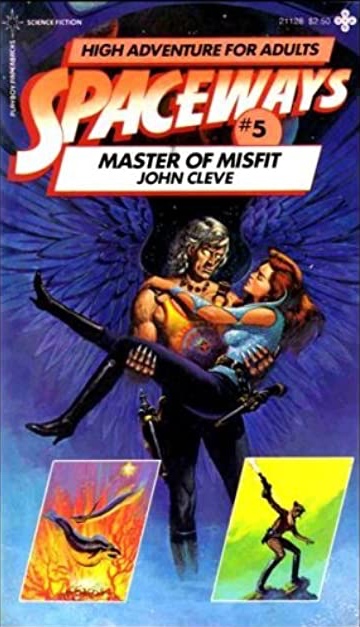
John Cleve's Master of Misfit (Spaceways #5)
Between 1982 and 1985 Playboy Press published the nineteen books in the Spaceways series of science fiction sleaze paperbacks. Master of Misfit was the fifth book in the series. It was published in 1982.
These books were credited to John Cleve, a pseudonym used by American science fiction writer Andrew J. Offutt (1934-2013). He wrote under a dozen or so different pseudonyms. To confuse things somewhat the name John Cleve was used by other writers. It’s possible that some of the Spaceways books may have been collaborations.
Like most sleaze fiction these books have either been ignored or regarded with a sneer. And science fiction fans are often quite disapproving of the idea of injecting sex into their favourite genre. But like so much American sleaze fiction of the period from the 50s to the 80s they were written by a guy who wrote “legitimate” science fiction as well as sleaze. And the other book in this series that I’ve read, Purrfect Plunder, was a rather pleasant surprise.
Master of Misfit opens with a bit of a cyberpunk vibe. Cyberpunk was just starting to make waves in the science fiction genre in 1982. The movie Blade Runner came out that year, William Gibson had had his first cyberpunk story published, Bruce Sterling’s first stories set in his Shaper/Mechanist universe had appeared. The cyberpunk ethos was already in the air.
Dorjan is a thief. Dorjan is one of his names. He has many others. He’s a very successful thief and pirate. He’s not quite human. He spent some time as the slave/pet/personal stud of the very wealthy and very powerful Murrah an Rahmyne. It amused her to have certain modifications made to her slave’s body. Some were intended to enhance his performance as her personal stud but others were intended simply to amuse her. Dorjan has retractable razor-sharp claws, he has 360 degree vision and he has lightweight but extremely powerful wings which can be neatly and unobtrusively folded when not in use. Dorjan is the captain of the pirate spacecraft Misfit and other members of his crew have also been enhanced by genetic and biomechanical means.
All of which, when combined with a universe in which high-tech crime and space piracy both thrive, certainly qualify this novel as proto-cyberpunk if not an early example of full-fledged cyberpunk.
Dorjan is out to steal the Heart of the Universe. This is a fabulously valuable necklace of gold inlaid with firegems, firegems being (literally) living gems. Stealing this jewel is impossible, or would be impossible for an ordinary Galactic (as the descendants of the humans from Earth who colonised this corner of the galaxy are known). But Dorjan is much more than human.
It’s not just a matter of stealing the necklace. Dorjan and his crew have to make a safe getaway from the planet Panish.
We’re also introduced very early on to Coppertop. She has had many names also, and an adventurous life. She has been a slave and a whore but now she’s the very rich widow of a very rich man. She is now known as Lizina Harish. She loved her husband very much and she mourned his passing sincerely but now two months have elapsed and for those two months Lizina has not had a man. She’s practically crawling the walls as a result. Tonight she is most definitely going to have a man. She has one picked out. He seems to be rich and very good-looking. She’s more than willing to accept his invitation to spend the night at his penthouse. Instead of getting a night of passion she gets kidnapped by slavers, and subjected to exquisite tortures (after she’s been raped).
The two plot strands intersect when Dorjan realises that the gorgeous woman he couldn’t help noticing is a slave. He knows she’s a slave because his First Mate has an unusual talent. He has a kind of limited psychic ability. He just knows when someone is a slave, even when they don’t appear to be.
Dorjan and his crew are thieves and pirates but they draw the line at slavery. Most of them, including Dorjan, have been slaves themselves. They have an intense dislike of slavers, and they are always willing to take a break from thieving to rescue a slave.
Dorjan and his crew have another agenda. At one point in their wanderings through the galaxy they discovered an asteroid that had been turned into a spacious habitat capable of housing several thousand people. Since the asteroid had been abandoned they claimed it. They intend to establish their own tiny independent community there, a haven for escaped slaves.
There are going to be complications. Coppertop belongs to Ganessa. Ganessa operates the finest mobile whorehouse in the galaxy. Coppertop was to be a star attraction. Ganessa is not a woman who takes kindly to having her possessions stolen from her, and she paid good money for Coppertop.
There are plenty of adventures to come, plenty of action, more thieving and lots of sex. Including sex with aliens. Dorjan has discovered a new species of intelligent alien. She’s incredibly cute, incredibly female and there’s nothing in the universe she likes more than having sex. And she’s totally sexually compatible with humans. There’s also some much weirder alien sex but there’s lots of god old-fashioned regular sex as well.
The secret of combining sleaze fiction with other genres such as science fiction is to integrate the sex fully into the plot. In this case the author does that very successfully, since the plot mostly revolves around prostitution and sex slavery, but with a definite science fictional flavour.
The sex is reasonably graphic.
Master of Misfit is fast-paced, action-packed and very sleazy. The cyberpunk feel is very marked (and handled in a fairly effective way). I suppose you could call this book sleazepunk. Whatever you decide to call it it’s entertaining and it’s highly recommended.
I also recommend the next book in the series, Purrfect Plunder (which features a particularly interesting alien species).
These books were credited to John Cleve, a pseudonym used by American science fiction writer Andrew J. Offutt (1934-2013). He wrote under a dozen or so different pseudonyms. To confuse things somewhat the name John Cleve was used by other writers. It’s possible that some of the Spaceways books may have been collaborations.
Like most sleaze fiction these books have either been ignored or regarded with a sneer. And science fiction fans are often quite disapproving of the idea of injecting sex into their favourite genre. But like so much American sleaze fiction of the period from the 50s to the 80s they were written by a guy who wrote “legitimate” science fiction as well as sleaze. And the other book in this series that I’ve read, Purrfect Plunder, was a rather pleasant surprise.
Master of Misfit opens with a bit of a cyberpunk vibe. Cyberpunk was just starting to make waves in the science fiction genre in 1982. The movie Blade Runner came out that year, William Gibson had had his first cyberpunk story published, Bruce Sterling’s first stories set in his Shaper/Mechanist universe had appeared. The cyberpunk ethos was already in the air.
Dorjan is a thief. Dorjan is one of his names. He has many others. He’s a very successful thief and pirate. He’s not quite human. He spent some time as the slave/pet/personal stud of the very wealthy and very powerful Murrah an Rahmyne. It amused her to have certain modifications made to her slave’s body. Some were intended to enhance his performance as her personal stud but others were intended simply to amuse her. Dorjan has retractable razor-sharp claws, he has 360 degree vision and he has lightweight but extremely powerful wings which can be neatly and unobtrusively folded when not in use. Dorjan is the captain of the pirate spacecraft Misfit and other members of his crew have also been enhanced by genetic and biomechanical means.
All of which, when combined with a universe in which high-tech crime and space piracy both thrive, certainly qualify this novel as proto-cyberpunk if not an early example of full-fledged cyberpunk.
Dorjan is out to steal the Heart of the Universe. This is a fabulously valuable necklace of gold inlaid with firegems, firegems being (literally) living gems. Stealing this jewel is impossible, or would be impossible for an ordinary Galactic (as the descendants of the humans from Earth who colonised this corner of the galaxy are known). But Dorjan is much more than human.
It’s not just a matter of stealing the necklace. Dorjan and his crew have to make a safe getaway from the planet Panish.
We’re also introduced very early on to Coppertop. She has had many names also, and an adventurous life. She has been a slave and a whore but now she’s the very rich widow of a very rich man. She is now known as Lizina Harish. She loved her husband very much and she mourned his passing sincerely but now two months have elapsed and for those two months Lizina has not had a man. She’s practically crawling the walls as a result. Tonight she is most definitely going to have a man. She has one picked out. He seems to be rich and very good-looking. She’s more than willing to accept his invitation to spend the night at his penthouse. Instead of getting a night of passion she gets kidnapped by slavers, and subjected to exquisite tortures (after she’s been raped).
The two plot strands intersect when Dorjan realises that the gorgeous woman he couldn’t help noticing is a slave. He knows she’s a slave because his First Mate has an unusual talent. He has a kind of limited psychic ability. He just knows when someone is a slave, even when they don’t appear to be.
Dorjan and his crew are thieves and pirates but they draw the line at slavery. Most of them, including Dorjan, have been slaves themselves. They have an intense dislike of slavers, and they are always willing to take a break from thieving to rescue a slave.
Dorjan and his crew have another agenda. At one point in their wanderings through the galaxy they discovered an asteroid that had been turned into a spacious habitat capable of housing several thousand people. Since the asteroid had been abandoned they claimed it. They intend to establish their own tiny independent community there, a haven for escaped slaves.
There are going to be complications. Coppertop belongs to Ganessa. Ganessa operates the finest mobile whorehouse in the galaxy. Coppertop was to be a star attraction. Ganessa is not a woman who takes kindly to having her possessions stolen from her, and she paid good money for Coppertop.
There are plenty of adventures to come, plenty of action, more thieving and lots of sex. Including sex with aliens. Dorjan has discovered a new species of intelligent alien. She’s incredibly cute, incredibly female and there’s nothing in the universe she likes more than having sex. And she’s totally sexually compatible with humans. There’s also some much weirder alien sex but there’s lots of god old-fashioned regular sex as well.
The secret of combining sleaze fiction with other genres such as science fiction is to integrate the sex fully into the plot. In this case the author does that very successfully, since the plot mostly revolves around prostitution and sex slavery, but with a definite science fictional flavour.
The sex is reasonably graphic.
Master of Misfit is fast-paced, action-packed and very sleazy. The cyberpunk feel is very marked (and handled in a fairly effective way). I suppose you could call this book sleazepunk. Whatever you decide to call it it’s entertaining and it’s highly recommended.
I also recommend the next book in the series, Purrfect Plunder (which features a particularly interesting alien species).
Saturday, September 3, 2022
John Cleve’s Purrfect Plunder
John Cleve’s Purrfect Plunder, published in 1982, was the sixth of the nineteen science fiction sleaze paperbacks published by Playboy Press between 1982 and 1985.
Andrew J. Offutt (1934-2013) was an American writer of science fiction and fantasy. He wrote sleaze fiction under a dozen or so different pseudonyms, including John Cleve. To make things a little bit more confusing the name John Cleve was used by other writers and to make things really murky some of the Spaceways books may have been collaborations.
Purrfect Plunder starts with an epic space battle.
Kenowa is one of the officers of the Dauntless. It’s not quite clear what her position is but we know that she’s sleeping with the ship’s commander, Captain Sword. After the battle the spaceship Dauntless is left a drifting wreck. Kenowa finds herself stripped naked and carried off by some kind of tentacled robot. She is placed in a tiny cubicle, in a hold that contains countless other naked females.
It’s a grim situation but things are not as they seem to be.
Then an interstellar cargo ship, the India Spring, sends a distress message. It’s been attacked by pirates. Captain Jonuta picks up the signal in his ship the Coronet and decides to answer the distress call and rescue the merchantman. Which is a little surprising. Captain Jonuta is after all a slaver. That possibly makes him marginally less lawless and disreputable than a pirate, but not much. Jonuta has never been known to do anything unless there’s a healthy profit in it for him.
The India Spring is carrying a couple of passengers. One of them is a female HRal. Her name is HReenee. This is a newly discovered species. They’re felinoprimates. They’re humanoid, but part cat. They’re an intelligent advanced species but they have some very definite feline tendencies. The capture of the India Spring by the pirates was actually fortunate for HReenee since at the time one of the India Spring’s crew members was raping her. Or rather trying to rape her, and in the process discovering that HRal have razor-sharp slashing claws.
What follows are the usual adventures you’d expect in a story about space pirates. Prisoners escape, there are lots of fights and there’s a tense climactic space battle as Jonuta faces off against a hated rival, Captain Corundum. There’s also a complicated four-way romantic/sexual tangle involving HReenee, her stepbrother HRadem, Captain Jonuta and his first officer Kenowa.
There are three lengthy explicit sexual scenes but I figure that if you’re going to be reading a science fiction sleaze novel (or if you’re going to read a review of a sci-fi sleaze novel) you’re probably going to be able to deal with that. And given the setup outlined earlier you’re probably going to be prepared for some inter-species sexual encounters.
Mostly though this is space opera. And it’s pretty good space opera. The author was an actual science fiction writer and he knows how to write space opera. He’s also familiar with at least some of the realities of space travel, things like zero gravity and creating an artificial gravity effect by having a spacecraft rotating. Most of the science and technology stuff is not outlandishly implausible by space opera standards.
And he knows how to handle action. There are some fine zero-gravity fights and the space battles are quite exciting.
There are several things that make this book a bit more interesting than you might expect. The human characters are just a little bit more than cardboard cut-outs. Jonuta is a slaver so he’s a criminal and his ethical standards are very flexible. But he does have ethical standards. He doesn’t like killing. Sometimes it’s an unfortunate necessity and he’s not going to wallow in guilt about it but it’s something he prefers to avoid. He’s had countless lovers but he’s not entirely predatory towards women (just slightly predatory). Jonuta is no Boy Scout. He is not a conventional hero nor is he a conventional villain. He’s a kind of anti-hero, albeit a reasonably likeable anti-hero.
Kenowa is sex-obsessed but not entirely without at least some romantic feelings. Jonuta and Kenowa are not madly in love but they suit each other and their relationship is not entirely based on sex.
The best thing about this novel however is that it features some of the best aliens in science fiction. Catwomen (or catpeople) were by no means an original idea in 1982. They’d been featured in various movies and the best known fictional examples were the kzinti in Larry Niven’s Known Space stories. But the HRal are a lot more interesting and a lot more convincing than the kzinti. The HRal really are both humanoid and feline. They have an advanced technological society and they’re as intelligent as humans but culturally, socially, emotionally and sexually they’re totally cat-like. And the author gives us both a female HRal (HReenee) and a make HRal (HReenee’s step-brother HRadem). HReenee is cat-like in a very female way and HRadem is cat-like in a very male way. HReenee really is a wonderful character - she is totally alien and yet believable. The behaviour of the HRal throughout the book is completely consistent with nature as feline humanoids.
Unlike many science fiction writers Cleve doesn’t seem to have any ideological axe to grind. There is a galactic empire of sorts but in practice it exercises limited control over the various member planets. There’s a galactic police force but it’s overworked ad undermanned and doesn’t achieve very much. Cleve is one of the few science fiction authors to realise that no central government could possibly exercise any real control over an interstellar empire - the distances are too great and it takes too long to cross those distances. It makes no difference what kind of central government you have, they will still be very very limited in what they can do.
The author has obviously given Playboy Press what they wanted - a science fiction adventure spiced up with lots of sex. But he’s also managed to produce a very entertaining space opera with very cool aliens. This book is much much better than you might expect. It's still trashy, but it's quality trash. And sexy space opera turns out to be a rather attractive concept. Purrfect Plunder is highly recommended.
Andrew J. Offutt (1934-2013) was an American writer of science fiction and fantasy. He wrote sleaze fiction under a dozen or so different pseudonyms, including John Cleve. To make things a little bit more confusing the name John Cleve was used by other writers and to make things really murky some of the Spaceways books may have been collaborations.
Purrfect Plunder starts with an epic space battle.
Kenowa is one of the officers of the Dauntless. It’s not quite clear what her position is but we know that she’s sleeping with the ship’s commander, Captain Sword. After the battle the spaceship Dauntless is left a drifting wreck. Kenowa finds herself stripped naked and carried off by some kind of tentacled robot. She is placed in a tiny cubicle, in a hold that contains countless other naked females.
It’s a grim situation but things are not as they seem to be.
Then an interstellar cargo ship, the India Spring, sends a distress message. It’s been attacked by pirates. Captain Jonuta picks up the signal in his ship the Coronet and decides to answer the distress call and rescue the merchantman. Which is a little surprising. Captain Jonuta is after all a slaver. That possibly makes him marginally less lawless and disreputable than a pirate, but not much. Jonuta has never been known to do anything unless there’s a healthy profit in it for him.
The India Spring is carrying a couple of passengers. One of them is a female HRal. Her name is HReenee. This is a newly discovered species. They’re felinoprimates. They’re humanoid, but part cat. They’re an intelligent advanced species but they have some very definite feline tendencies. The capture of the India Spring by the pirates was actually fortunate for HReenee since at the time one of the India Spring’s crew members was raping her. Or rather trying to rape her, and in the process discovering that HRal have razor-sharp slashing claws.
What follows are the usual adventures you’d expect in a story about space pirates. Prisoners escape, there are lots of fights and there’s a tense climactic space battle as Jonuta faces off against a hated rival, Captain Corundum. There’s also a complicated four-way romantic/sexual tangle involving HReenee, her stepbrother HRadem, Captain Jonuta and his first officer Kenowa.
There are three lengthy explicit sexual scenes but I figure that if you’re going to be reading a science fiction sleaze novel (or if you’re going to read a review of a sci-fi sleaze novel) you’re probably going to be able to deal with that. And given the setup outlined earlier you’re probably going to be prepared for some inter-species sexual encounters.
Mostly though this is space opera. And it’s pretty good space opera. The author was an actual science fiction writer and he knows how to write space opera. He’s also familiar with at least some of the realities of space travel, things like zero gravity and creating an artificial gravity effect by having a spacecraft rotating. Most of the science and technology stuff is not outlandishly implausible by space opera standards.
And he knows how to handle action. There are some fine zero-gravity fights and the space battles are quite exciting.
There are several things that make this book a bit more interesting than you might expect. The human characters are just a little bit more than cardboard cut-outs. Jonuta is a slaver so he’s a criminal and his ethical standards are very flexible. But he does have ethical standards. He doesn’t like killing. Sometimes it’s an unfortunate necessity and he’s not going to wallow in guilt about it but it’s something he prefers to avoid. He’s had countless lovers but he’s not entirely predatory towards women (just slightly predatory). Jonuta is no Boy Scout. He is not a conventional hero nor is he a conventional villain. He’s a kind of anti-hero, albeit a reasonably likeable anti-hero.
Kenowa is sex-obsessed but not entirely without at least some romantic feelings. Jonuta and Kenowa are not madly in love but they suit each other and their relationship is not entirely based on sex.
The best thing about this novel however is that it features some of the best aliens in science fiction. Catwomen (or catpeople) were by no means an original idea in 1982. They’d been featured in various movies and the best known fictional examples were the kzinti in Larry Niven’s Known Space stories. But the HRal are a lot more interesting and a lot more convincing than the kzinti. The HRal really are both humanoid and feline. They have an advanced technological society and they’re as intelligent as humans but culturally, socially, emotionally and sexually they’re totally cat-like. And the author gives us both a female HRal (HReenee) and a make HRal (HReenee’s step-brother HRadem). HReenee is cat-like in a very female way and HRadem is cat-like in a very male way. HReenee really is a wonderful character - she is totally alien and yet believable. The behaviour of the HRal throughout the book is completely consistent with nature as feline humanoids.
Unlike many science fiction writers Cleve doesn’t seem to have any ideological axe to grind. There is a galactic empire of sorts but in practice it exercises limited control over the various member planets. There’s a galactic police force but it’s overworked ad undermanned and doesn’t achieve very much. Cleve is one of the few science fiction authors to realise that no central government could possibly exercise any real control over an interstellar empire - the distances are too great and it takes too long to cross those distances. It makes no difference what kind of central government you have, they will still be very very limited in what they can do.
The author has obviously given Playboy Press what they wanted - a science fiction adventure spiced up with lots of sex. But he’s also managed to produce a very entertaining space opera with very cool aliens. This book is much much better than you might expect. It's still trashy, but it's quality trash. And sexy space opera turns out to be a rather attractive concept. Purrfect Plunder is highly recommended.
Subscribe to:
Posts (Atom)