Monday, November 7, 2022

W. Wirt’s When Tigers Are Hunting

When Tigers Are Hunting is a collection of W. Wirt’s Jimmie Cordie adventure stories originally published in various pulp magazine in the late 1920s and early 1930s.

W. Wirt was American and born in 1876 but apart from that not much is known about him. He claimed to have been a Federal agent and to have had various adventures in far-flung places but that was in a bio he provided for a pulp magazine so there’s no way of knowing how much of it was true.

These stories are at the very very pulpy end of the pulp fiction spectrum.

These are pure action stories with very little plot. Each story begins with the heroes in the midst of an epic fight and the fighting rages on until the story ends. The heroes always run short of ammunition and have to resort to hand-to-hand combat. They always kill hundreds if not thousands of bad guys.

Whether you’ll enjoy these stories or not depends on what you want from your pulp fiction. If you just want non-stop action without any real rhyme or reason you’ll be content. If you want interesting stories, genuine thrills and suspense, real atmosphere and the occasional surprise you’ll be disappointed. These stories are about as basic as pulp fiction gets.

You definitely don’t want to read several of thee stories in one sitting because they’ll start to blend into one another. It’s essentially the same story every time.

He’s a Good Little Guy at That appeared in Frontier Stories in May 1928. Jimmie Cordie is one of four soldiers of fortune seeking treasure in Malaya. Actually to call them soldiers of fortune or adventurers would be rather generous. They’re murderous thieves. They’re after the treasure of a local snake god and if they have to machine gun a few hundred Malays to get it that doesn’t bother them one bit. They seem to enjoy killing.

Although these are described as the Jimmie Cordie stories he doesn’t seem to be the the leader of this band of thieves. Red Dolan seems to be the leader, although at times Grigsby seems to give orders. Putney just obeys orders.

They’ve come well equipped for treasure hunting - they have a machine gun, lots of rifles and automatics and a large supply of hand grenades.

Amidst all the carnage they create they come across a twelve-year-old English girl held captive by the tribesmen. And suddenly these cut-throats (Red Dolan in particular) turn into a bunch of sentimental softies. Now nothing matters except to save the little girl. It’s a weird little story, mixing extraordinary amounts of violence and brutality with amazingly soppy sentimentality.

The Major Wanted Him Alive appeared in Frontier Stories in June 1928. Cordie and pals are now, temporarily, Federal agents. Their job is to clean up a smuggling ring. Cordie goes undercover a stir-crazy cook. There’s lots of mayhem.

According to My Size and Disposition appeared in the October 1928 issue of Frontier Stories. This time Cordie and his friends are in China, caught in a struggle between rival warlords. And there’s something about a mining concession. There’s a lot of shooting but no actual plot.

Private Property was published in Short Stories in October 1928. Again there’s action aplenty and there’s a girl who needs rescuing although perhaps rescuing her isn’t such a good idea.

In The Jewel in the Lotus (from Short Stories, November 1928) Cordie and his pals are after a fabulous ruby when they get caught in a vicious struggle between rival Chinese factions. The priests always seem to be the bad guys in these stories and Cordie and his friends are once again fighting to save a brave young girl. They find that the jewel isn’t what they thought it was. A better story.

In When Tigers Are Hunting (from Frontier Stories, November 1928) the boys meet up again with the little English girl they rescued in He’s a Good Little Guy at That. She’s now eighteen and her father has been kidnapped. Jimmie has by now established a connection with a tong - he saved the life of the tong leader’s son. This provides him with very useful sources of intelligence.

As usual the bad guys fire thousands of rounds at our heroes and miss evert time, while the good guys never miss. They kill a few thousand Chinese and rescue the girl’s father.

That Fish Thing was published in Frontier Stories in January 1929. The fish thing is an amulet, Red Dolan has it and a tong will stop at nothing to get it back. Lots of mayhem again.

Right Smack at You! Is from Frontier Stories, April 1929. It’s a longer more ambitious story (more of a novelette) about the search for the treasure in the tomb of Genghis Khan’s son. It’s still basically non-stop action scenes but with a bit more of a plot.

Final Thoughts

These stories are not quite what I look for in pulp adventure fiction set in exotic locales. I prefer a bit more weirdness, a bit more intrigue, more romance, more of the mystery and strangeness of the exotic. If you share my tastes you probably won’t go for this collection.

But if you like relentless action with millions of rounds of small arms ammunition being expended and a few explosions as well you might find these tales to be just what you’re looking for. We all have our own tastes in pulp fiction and I’m not going to try to persuade you that my tastes in pulp are the only valid tastes.

With these thoughts in mind you’ll have to decide for yourself if you want to try When Tigers Are Hunting.

Friday, November 4, 2022

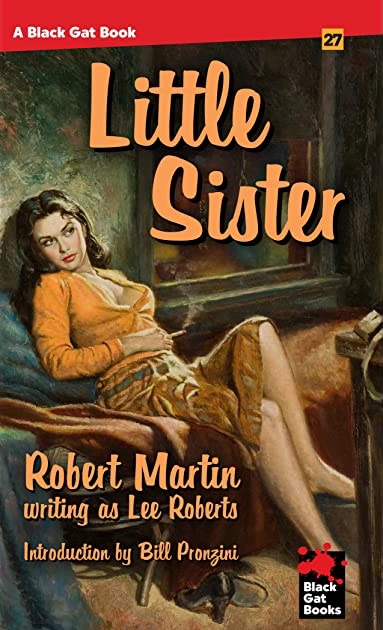
Robert Martin's Little Sister

Robert Martin had a moderately successful career as a pulp writer in the 40s and writing paperback originals in the 50. His career unfortunately hit the skids in the early 60s. He wrote crime novels under his own name and using the pseudonym Lee Roberts. Little Sister was published in 1952, under the Lee Roberts name.

It opens in classic private eye novel style. A PI named Brice (who narrates the tale) arrives at Vivian Prosper’s house. She wants to hire him. Two things are immediately obvious. Firstly, these people are seriously rich. Secondly, Vivian Prosper is the most gorgeous hunk of woman Brice has ever laid eyes on. Vivian is worried about her seventeen-year-old sister Linda. Vivian wants to stop Linda from marrying. Or rather, she wants to hire Brice to find a way to prevent the marriage. It’s a dirty job but Brice is happy to do it.

There are however complications. Such as the dead guy in the trunk of Linda’s car. He’s not just dead, he’s been murdered. Linda arrived home very drunk, which was not unusual, but Brice could see that she wasn’t just drunk. She had been drugged.

Vivian had hoped to get rid of the body to avoid any unpleasantness with the police but the police become involved when a doctor has to be called. The doctor has to be called because Linda’s drug overdose almost proves fatal. Vivian still wants to hire Brice, but now she wants to hire him to prove that Linda had no connection with the murder.

And then somebody drugs Brice.

Brice has a few leads, but one of them leads to another corpse.

There are a number of possible motives. The Prospers’ financial situation is complex and there’s a lot of money involved and murder would be a convenient way for some family members to get their hands on that money. Non-family members might also benefit financially from a well-timed murder.

Then there’s jealousy. Vivian is jealous of Linda, and Linda is jealous of Vivian but for different reasons. And men are a major problem for both Prosper women.

Brice isn’t quite a conventional fictional PI. He’s not that much of a tough guy but you wouldn’t want to underestimate him. He takes being a private detective slightly more seriously than he’s prepared to admit. He’s no genius detective but he knows his job. He gets on very well with the police and he never withholds information from them. The PI with an uneasy or hostile relationship with the cops is such a cliché that it’s quite refreshing to come across one who goes out of his way to help them.

There’s a moderately hardboiled ambience to the story. There’s also some humour. There is a very funny scene in which a woman from whom Brice is trying to get information gets very very excited by the fact that she’s talking to a real private eye, just like in the movies. She practically begs him to seduce her.

There’s also some startling and unexpected cynicism. Brice is a fictional PI who is basically a decent regular guy and basically law-abiding, he’s no thug, but he’s also rather lacking in a sensitive side. He’s not quite your stereotypical tough guy with a warm sensitive caring side.

As for sex, he’s not an outrageous womaniser but if sex is on offer he’ll take it.

The plot is pretty sound, with lots of suspects all of whom seem quite capable of being the killer. The climax, with the killer giving a long confession which fills in all the blank spots in the plot, is maybe a bit contrived but this was a technique that was quite common in traditional puzzle-plot mysteries and this book is structurally closer to the puzzle-plot mystery genre than to the typical American private eye thriller.

There’s certainly plenty of tension in the closing pages. It really does seem like the killer holds all the cards and must triumph. And of course in the noir private eye genre you can never be sure if you’re going to get a downbeat ending or a happy ending. This is a story which could end either way.

It might be a bit of a stretch to describe this book as noir fiction but it does have two femmes fatales. They’re both very sexy and very dangerous and either might well be capable of killing. And they’re both ambiguous enough that they could equally plausibly turn out to be guilty or innocent.

There’s nothing especially to mark this out as a great private eye thriller but it’s very competently executed and it’s a very entertaining read. Recommended.

Little Sister has been reprinted by Stark House under their Black Gat Books imprint.

Tuesday, November 1, 2022

Robert Tralins The Cosmozoids

The Cosmozoids is a 1966 science fiction pulp paperback written by Robert Tralins and published by Belmont Books.

Sandor Robert Tralins (1926-2010) was an American writer of over 250 pulp fiction and science fiction books, published under a number of pseudonyms.

Major James W. Keith is an American astronaut and a national hero but he’s now been forced take an extended leave. The Space Agency is worried about him. He’s been a bit strange since his last trip into space. He’s been having strange dreams and he claims to be able to predict the future. What worries them is that it appears that he can really can predict the future. If they knew he could read minds as well they’d be even more worried.

The Agency wants noted parapsychologist Dr Burr to figure out exactly what is going on with Major Keith, and if possible to find out why.

Remember that this was 1966. Extrasensory perception and similar paranormal topics were all the rage. And the study of paranormal phenomena was still considered to be marginally scientifically respectable. The C.I.A. believed in this sort of stuff. In 1966 The Cosmozoids was very topical and would not have seemed anywhere near as far-fetched as it seems today.

Major Keith and his fiancée Dottie have been settled into a rooming house not far from Dr Burr’s clinic. His fiancée has already figured out that Keith’s claims are not crazy. She has reason to know that he can predict the future.

Keith notices a few odd things going on and people around him behave strangely, as if in a trance. Even Dottie starts to seem a bit odd.

Slowly Keith figures out that he’s dealing with something not of this Earth, and that his paranormal powers are not of this Earth either. He’s dealing with cosmopaths, and (even more terrifyingly) cosmozoids. He is forced to coöperate with the cosmopaths. They need his creativity. They need him to show them how to promote hair growth treatments, but the treatments are not what appear to be. Their real plan is much more horrifying.

He really has no choice at all. Dottie’s life depends on his coöperation. If only he could find a weakness in the cosmozoids. He does find such a weakness, quite by accident, but the odds are still stacks against him.

There’s some silliness here, some delightfully goofy technobabble, plenty of action and some paranoia. This is not exactly serious science fiction.

It’s one of those alien invasion stories in which the aliens are amongst us and nobody knows they’re here. An idea that’s been done many times but it works if it’s done right. It’s done reasonably well here.

The early part of the book has a nicely spooky vibe to it, as Keith tries to work out exactly what is happening to his mind.

Tralins has a very pulpy style, but this is hardly a book with aspirations towards literature. What matters is keeping the story fast and exciting and Tralins does that.

Major Keith is a standard square-jawed hero which is fine in what is after all pulp fiction.

Tralins also wrote the Miss From S.I.S. sexy spy thrillers. I’ve reviewed the second book in that series, The Chic Chick Spy (which is a lot of fun).

The Cosmozoids is long out of print but used copies are not outrageously expensive.

The Cosmozoids isn’t great but it’s harmless fun. Worth a look if you can find a copy.

Thursday, October 27, 2022

The Lady from L.U.S.T. #2 Lay Me Odds

Lay Me Odds is the second of Gardner Francis Fox’s Lady from L.U.S.T. sexy spy thrillers, written under the pseudonym Rod Gray. It was published in 1968.

Eve Drum, ace secret agent for L.U.S.T. (League of Underground Spies and Terrorists), has a problem. She’s on a mission in England and she was supposed to pick up a microfilm but she finds her contact man dead. There’s a possibility that he hadn’t picked up the microfilm before he was killed. It might still be in the hands of his own contact man, a man known as the Satyr. Or the Satyr might know the name of the person currently in possession of that microfilm. Finding the Satyr should be easy. He hangs around the strip clubs in Soho.

The best way to find him would obviously be for Eve to get a job as a stripper. That’s no problem. Eve has no inhibitions whatsoever about taking all her clothes off in front of an audience. Her strip act (as a bashful bride) proves to be a hit and she does find the Satyr. He’s prepared to give her the name she needs as long as she agrees to have sex with him. Eve also has no inhibitions whatsoever about having sex in the line of duty. Eve enjoys sex a great deal. And when she sees the Satyr naked she figures that this will be a very pleasant duty indeed.

She gets the name and the trail takes her to Hamburg. Naturally it takes her to Hamburg’s red light district. The trail will later take her to Innsbruck. This is 1960s spy fiction so some exotic locations are a must and Fox makes good use of them.

Eve has no doubt that the microfilm has fallen into the hands of L.U.S.T.’s deadly enemies, H.A.T.E. (Humanitarian Alliance for Total Espionage). It turns out to be more complicated than that. There’s an internal power struggle within H.A.T.E. and Eve is caught between two deadly factions.

Along the way she acquires a slave. He’s a handsome young German but he just wants to be Eve’s devoted slave. In fact she will discover that he has other more exotic sexual fetishes.

The plot includes enough twists and double-crosses to keep things interesting.

This is refreshingly non-ideological spy fiction. H.A.T.E. is like SPECTRE, it’s just a vast criminal organisation that sees espionage and terrorism as purely business propositions. Fox doesn’t indulge in any political messaging. I’ve now read four of his books and I haven’t got a clue what his political beliefs were. I like that. He just wants to entertain us.

The secret to making a sexy spy thriller work is to strike the right balance between the sleaze and the secret agent action. And Fox, in both his Lady from L.U.S.T. and Cherry Delight thrillers, got that balance right. There’s an enormous amount of sleaze in this book but there’s also non-stop action and mayhem. With an impressively high body count. At one point Eve kills four men within the space of about fifteen seconds. The action scenes are executed with energy and a certain amount of style.

Even is well equipped for her mission. She never goes on an assignment without her explosive panties. Yes, her panties are a deadly weapon.

Eve is highly trained in the normal secret agent skills such as unarmed combat and firearms but she’s equally highly trained in the art of love-making. There’s no sexual activity between a man and a woman that Eve hasn’t tried and in which she isn’t highly proficient. Her controller, David, approves of this. He knows that a lady spy has to have advanced sexual skills. He’s even prepared to assist her in her training in this area.

In 1968 the Sexual Revolution was in full swing and that’s reflected in the book. Eve takes a normal healthy interest in sex. She likes sex and she feels no shame or guilt about it and it’s assumed that the reader will feel the same way.

The sex is moderately graphic with some detailed descriptions of the more interesting parts of both the male and female anatomy (Eve is an expert in both subjects) and the fun you can have when those parts of the respective anatomies come together so to speak. The sex gets decidedly kinky at times. Eve’s slave is a good boy but he craves discipline and Eve is happy to oblige. She’s not really into that sort of thing but it’s the only way to get him excited enough to satisfy her so she’s willing to put some effort into it.

Eve also has no interest in sex with girls but in the line of duty she’s willing to give it a go. Lady spies have to be flexible.

Lay Me Odds works extremely well as sleaze fiction and it works pretty well as a fast-paced action-packed spy thriller as well. Despite the high body count it’s a fun lighthearted romp. Highly recommended.

I’ve also reviewed the first of the Lady from L.U.S.T. books, Lust, Be a Lady Tonight, and the first of Fox’s fairy similar Cherry Delight thrillers, The Italian Connection. Both are also great fun.

Sunday, October 23, 2022

Desmond Bagley’s The Freedom Trap

The Freedom Trap was Desmond Bagley’s eighth thriller, published in 1971. It was filmed two years later as The Mackintosh Man.

At first it seems like it’s going to be a gritty hard-edged crime thriller, but of course that’s not really what it’s all about.

Rearden is a South African thief who has arrived in London to do what should be a very simple job. It’s a diamond robbery but it’s so well-planned that it’s fool-proof. His reputation suggests that he’s a very clever very cautious thief and on this job he leaves nothing to chance. But even the most clever cautious thieves sometimes get caught. In this case it’s obvious to him that there are only two people who could have betrayed him - either Mackintosh (the mastermind behind the robbery) or Mrs Smith (Mackintosh’s young very attractive and ultra-efficient secretary who carried out the detailed planning). Either way he is now facing a very long prison term.

Rearden doesn’t like the idea of spending twenty years in one of Her Majesty’s prisons. If an opportunity for escape is offered he intends to take it. Such an opportunity is offered. There’s an organisation which specialises in breaking out of gaol, if they have the money to pay the very high fees involved. And Rearden has no idea if he’s being set up. He just has to trust these people. The fly in the ointment is that Slade will be breaking out as well. Slade is serving forty-two years for espionage. Rearden isn’t bothered by the fact that Slade is a Soviet spy. Rearden isn’t British, it wasn’t Rearden’s country that Slade betrayed and in any case Rearden has no love at all for the British. The problem is that Slade can’t walk properly so he’s likely to be an encumbrance. However there’s no choice. He either escapes with Slade or he doesn’t escape at all.

It’s not too long before Rearden starts to wonder if he should have trusted these people.

To say any more about the plot would be to risk spoilers.

In the 1960s Alistair McLean was one of the world’s bestselling writers and was regarded (quite rightly) as being at the very top as far as thriller writers were concerned. It’s hardly surprising that he had quite a few imitators. The best of these imitators were Desmond Bagley and Gavin Lyall. Bagley and Lyall were so good that it’s really unfair to dismiss them as imitators. It might be better to say that they belonged to the Alistair McLean School of thriller writing.

The Freedom Trap is very much in the classic MacLean mould. It uses the first-person narration that MacLean used in his best books and it uses certain narrative techniques that MacLean had perfected. MacLean loved exotic settings but he liked exotic settings that were off the beaten track rather than the obviously glamorous settings that Ian Fleming favoured. The Freedom Trap takes place in England, Ireland, Gibraltar and Malta.

My feeling about Bagley is that he was very good but not quite in the same league when it came to plotting as MacLean or Lyall. Bagley’s plots are skilfully handled but they don’t pack the same surprise punches that MacLean and Lyall always delivered. The Freedom Trap has a good plot but once you start to put the pieces together it’s just a little predictable in the way it plays out.

This book is also in the MacLean style in the sense that there’s virtually no sex at all (although there’s a kind of romance between the hero and Alison and I’m not going to tell you who Alison is because that might be a mild spoiler). The emphasis is entirely on action and excitement. In those departments Bagley delivers the goods. The action finale is excellent.

The hero doesn’t have a huge amount of personality. Alison is more interesting. The villains are suitably devious, especially the primary villain.

Bagley always wrote well. In this novel there isn’t really any major use of an exotic setting although he certainly creates a memorable prison atmosphere.

The Freedom Trap is a good solid thriller and it’s definitely worth a look.

On the subject of the Alistair McLean School of thriller writing, I highly recommend Gavin Lyall’s Midnight Plus One and Shooting Script. Bagley’s The Vivero Letter is also well worth checking out and his Running Blind is an object lesson in the effective use of an unusual setting (Iceland).

Thursday, October 20, 2022

Hell Ship to Kuma by Calvin Clements Sr

Hell Ship to Kuma is one of four nautical adventure novels written by Calvin Clements Sr. It was published in 1954 and it also belongs to the adventures in the Far East genre.

John Roper had been the master of a rather fine ship until his career was ended as the result of the blunderings and lies of a drunken mate. Roper has little chance of getting another command. He’s eating himself up with bitterness in Saigon. In desperation he accepts a post as mate on the Wanderer. Roper is starting to lose his moral compass. He wants to make a lot of money so he can buy his own ship and he no longer cares what he has to do to earn the money.

The Wanderer is an ageing rust-bucket commanded by Captain Murdock. Murdock reads the Bible a lot. He is also a bully and a sadist. He has an interesting method of choosing his officers - he picks men with weaknesses he can exploit. He derives extreme pleasure from making them squirm.

The Wanderer is bound for a small island near Indonesia, Kuma. The cargo is not strictly legal.

There are three women aboard the Wanderer and that will trigger all sorts of dramas.

One of the women is Murdock’s wife Kim. Kim refuses to allow Murdock to share her bed. It’s not that she objects to men (we will soon find out that there is a man aboard with whom she will happily share her bed) but she does object to Murdock.

The second woman is the Wanderer’s only paying passenger, Karen Gorman. Karen is on her way to Kuma to become the plaything of the man who runs the island, Da-chong. Karen is adamant that she’s only going there to be an entertainer but no-one could be innocent enough to believe that she will only be required to dance.

The third woman is a stowaway.

All three women will trigger rage in Murdock. Murdock hates women. He’s not actually a misogynist. He’s a misanthrope. He enjoys inflicting physical and psychological torture on both men and women.

Roper just wants to keep out of trouble and collect his share of the profits from the voyage. He’s not going to be able to do that because he’s not a man who will long endure Captain Murdock’s baiting or the captain’s horrifying mistreatment of others. And of course Roper is going to get drawn into dramas with those women.

Things will get more tense when they reach Kuma. Roper and Karen Gorman have of course fallen in love but they both think that there’s something more important than love - money. It’s not that they don’t have moral scruples, it’s just that they’ve convinced themselves that moral scruples are a luxury you can only afford when you have money. Roper thinks he can make enough money from the dishonest trading activities of the Wanderer to buy his own ship and then he can start worrying about thinks like honesty and decency again. Karen thinks she can make a lot of money in Kuma without becoming Da-chong’s whore and then go back to being virtuous again. They both really believe these things. Karen really doesn’t think that she’ll have to play the whore in Kuma, because she doesn’t want to think that.

Of course things will happen in Kuma that will cause them both to think again.

And there’s still the matter of Captain Murdock’s wife. There are rumours, but Roper doesn’t believe those rumours. He can’t afford to believe them.

Roper is a flawed hero. He’s basically a decent guy but he’s compromised himself badly and he’s not very proud of himself. Karen is a flawed heroine. She refuses to face the consequences of her actions. Having both a flawed hero and a flawed heroine is quite interesting.

Murdock is an out-and-out villain but he’s a colourful villain. He’s the sort of villain you love to hate. The other characters mostly have some complexity. The other offices on the Wanderer - Djeff, Appley and Fisher - have advanced quite a long way on the path to self-destruction but they each have a tragic awareness of that fact, and perhaps they can still draw back from the brink.

The climax comes with a storm at sea. The storm could have the effect of revealing an important secret on board the Wanderer, and various characters will have choices to make and there’s potential for lots of double-crosses and triple-crosses.

The plot is not dazzlingly original but with characters who are slightly more than just cardboard cutouts, and with the energy and zest that Clements puts into the storytelling, the result is more interesting than you might expect. And there’s some action and plenty of suspense. This is above-average pulp adventure fiction. Highly recommended.

Sunday, October 16, 2022

Day Keene's Wake Up to Murder

Gunard Hjertstedt (1904-1969) was a fairly prolific American novelist and scriptwriter who wrote under the name Day Keene. Wake Up to Murder, published in 1952, was one of his early novels.

Jim Charters works in a lawyer’s office. He doesn’t get paid much. It’s a menial position. He tends to get the given the dirty jobs. Like telling Pearl Mantinover that her appeal has been rejected and that she’s going to be executed for murder. Pearl is a nice girl and Jim figures she’s probably innocent and this his boss, Kendall, badly mishandled her defence.

Jim tries not to think about it. His life is not that bad. His marriage to May is a good marriage. They’re getting by. And it’s his birthday. It turns out to be a disastrous birthday. Jim gets fired, he thinks May has forgotten his birthday, he takes a few drinks, he takes a few more drinks, he ends up in every bar and dive in Sun City. He wakes up in a hotel room with no idea how he got there. What he does know is that he spent the night with Lou, a cute girl from the office. He feels bad about that. He finds that despite his night on the town he has more money in his wallet than he had at the beginning of the night. That confuses him. Then a guy called Mantin shows up, tells Jim how pleased he is that Jim is going to do that job for him and leaves Jim with an envelope. It’s payment for the job.

The envelope contains ten thousand dollars (a huge fortune in 1952). Jim’s problem is that he doesn’t remember ever meeting Mantin and he doesn’t remember what it was that he agreed to do for him. It has to be something pretty big. Ten grand is a lot of money.

Now Jim isn’t just confused, he’s frightened.

He decides to tell May everything. It’s obvious that he has to find this Mantin guy. And get out of the mess he’s in. He remembers very little of the previous night but he figures he was shooting his mouth off, trying to make himself seem more important. Presumably he claimed to be able to do something that in reality he couldn’t do, and Mantin took him at his word and offered him the ten grand to do it.

Slowly the pieces come together but Jim just seems to be getting into deeper and deeper trouble. Pretty soon there’s a murder for which he is the prime suspect. There are various shady characters who come into the story, some of them very dangerous indeed. In classic noir style Jim Charters has been plunged into a nightmare world and he has no idea how to get out of it because first he has to figure out how the nightmare started.

And he has two women to deal with and he’s not sure if he can trust either of them.

The cops are also likely to be troublesome. Even Jim would have to admit that the story he has to tell them doesn’t sound the slightest bit believable.

This book boasts a nicely devious plot, with both the reader and Jim Charters encountering plenty of unexpected twists.

Keene has a solid prose style. It’s only moderately hardboiled and there isn’t the snappy dialogue one associates with the hardboiled style. There is however plenty of paranoia. Jim Charters has no shortage of things about which to be paranoid.

There’s not a huge amount of action. It’s a plot-driven tale rather than an action-driven tale. Don’t expect shoot-outs and high body counts. Jim Charters is no tough guy. He’s just an ordinary joe and he’s out of place in a world of gangsters and murder.

The sleaze level is quite moderate, in fact very moderate.

This is an unassuming little novel but it’s a well-told well-plotted story and it’s thoroughly enjoyable. Recommended.

Sleep with the Devil, published two years later, is a much more noirish, much more cynical and much sleazier Day Keene novel and it is on the whole a much better book (and a better place to start if you’re new to this author).

Stark House Noir has issued three Day Keene novels (this one, Sleep with the Devil and Joy House) in a single paperback volume.