Monday, January 20, 2025

Blood and Honey - Honey West

Blood and Honey was the eighth of the Honey West mystery novels. The husband and wife writing team of Gloria and Forest Fickling, writing as G.G. Fickling, wrote eleven Honey West novels between 1957 and 1971. They more or less invented the sexy girl private eye genre and Honey West also has claims to being fiction’s first kickass action heroine.

Honey West’s father was a private eye, until he got murdered on a case. Honey now runs the West Detective Agency. In fact she is the Honey West Detective Agency. She handles all the cases herself. Her father taught her the job. She has a PI’s licence. She has a gun and she knows how to use it (for emergencies she carries a .22 in a garter holster). She can handle herself in unarmed combat. Honey is tough, resourceful and very stubborn. She’s a good PI. Honey’s measurements are 38-22-36. In other words she has everything a woman should have, in all the right places. She is young, blonde, cute and very female.

Blood and Honey starts with Honey running down a dark alley in New York wearing a negligee and high heels. She’s running from a man with a gun. When she made her exit through her bedroom window she was only wearing the high heels. She grabbed the negligee on the way out. So we knows she sleeps nude. We also know immediately that this is a real Honey West novel. Poor Honey is a nice girl but she has an amazing knack for being caught without her clothes on.

Honey is in New York at the request of an old friend, Broadway producer Vic Kendall. His latest production has run into troubles. Several attempted murders certainly counts as trouble. Honey has just arrived in the Big Apple and already somebody has tried to kill her. It seems that somebody doesn’t like Vic’s new show. New York critics can be tough but they don’t usually try to literally kill you.

There are all sorts of emotional, romantic and sexual dramas associated with this show. There are other dramas as well, such as questionable business dealings. There are people with scores to settle.

I love showbiz mysteries and thrillers. There’s always a touch of decadence and sin. There’s plenty of both here. And sexual jealousies get even more overheated than usual in this world.

There are some dangerous women. Vic’s ex-showgirl wife Tina. Tina wants love. Lots of it. There’s the star of the show, Pepper Parker. She’s blonde and she’s built and she and Tina hate each other. There’s Pepper’s friend Evy. There are rumours that Evy and Pepper like to play games together, games that involve dressing in cowboy boots and paper doilies and nothing else. Yes, I know, paper doilies are a kink I’d never heard of either.

The movie world is involved as well. Movie producer Anthony Troy has bought an ocean liner. He intends to sink it. For his new movie. He’s mixed up with some of the people in Vic’s new show. There are gangsters as well. And Pepper has a story about being tied to a bed, a special bed with leather straps. She doesn’t like to think about what happened to her next.

Yes, there’s plenty of sleaze here. What I love about the Honey West books is that they’re sleazy but in a kind of playful way. Honey isn’t shocked by any of this. All her cases seem to involve such things. When a girl is a PI she sees all sorts of things. She’s used to it.

This is moderately hardboiled fiction, but again with a playful touch. The authors are aiming for slightly naughty entertainment rather than wallowing in misery. This is hardboiled but it’s not noir fiction.

There’s plenty of action as well.

Honey is a wonderful heroine, with or without her clothes. Once she’s on a case she doesn’t give up.

Blood and Honey
is a typical Honey West novel which means it’s loads of fun. Highly recommended.

I’ve reviewed other Honey West books - This Girl For Hire, Girl on the Loose, A Gun for Honey, Honey in the Flesh and Kiss for a Killer. And I’ve also reviewed the excellent 1965-66 Honey West TV series that starred Anne Francis in the title role.

Saturday, January 18, 2025

Bernard C. Gilford’s The Liquid Man

Bernard C. Gilford’s novel The Liquid Man appeared in Fantastic Adventures in September 1941.

Bernard C. Gilford (1920-2010) was an American writer, mostly in the suspense genre. The Liquid Man seems to have been his only novel (and it’s really not much more than a novella).

The Liquid Man begins with a murder. There’s a witness. It’s a dark night and it’s raining but somehow the killer doesn’t look quite human - more of a vague human-like shape with a disturbing liquid quality.

There’s another murder soon afterwards.

To the police it seems straightforward. A man named Ferdinand Silva thought his girl was two-timing him. He killed the faithless girl and the other man. A very ordinary murder, apart from the odd description of the suspect.

Juan worked in a laboratory, doing routine research on cleaning wax. It appears he was also working on some mysterious project of his own.

There are other murders, and all the witnesses insist that the killer seemed more like a man made out of liquid than an ordinary man. It’s ridiculous of course, but Lieutenant Quante starts to think that there really is something strange about these murders.

Of course tracking down and capturing a man in liquid form would present certain challenges. There’s also the possibility that such a man would be rather difficult to kill.

Even worse, such a man could find unexpected places to hide.

This liquid man seems intent on continuing his murderous rampage, so Lieutenant Quante is under plenty of pressure.

There’s also Priscilla. She is the only one of the liquid man’s victims who escaped, and Lieutenant Quante has fallen for her. There’s a possibility the monster may strike at her again.

The liquid man is a monster, but monsters have feelings too. They need love just like everybody else.

This is a straightforward monster terror tale with a science fictional gloss to it. The difficulties presented by such an unconventional manhunt are handled reasonably well by the author, with the police displaying considerable ingenuity and facing continual frustration.

The story does at least have the virtue of originality.

It’s a very pulpy tale, but that’s all it was ever intended to be. It’s a bit like a 1950s monster movie, but written more than a decade before such movies became popular.

Armchair Fiction have paired this title with Fritz Leiber’s short novel You're All Alone in of their terrific two-novel paperback editions.

This is not a neglected gem. It’s really not very good, but if you’re going to buy the book for the Fritz Leiber novel (and you should) then The Liquid Man might provide some mild entertainment if you’re in the right mood.

Tuesday, January 14, 2025

John O’Hara’s BUtterfield 8

BUtterfield 8 was John O’Hara’s second novel, appearing in 1935. It was an immediate bestseller.

John O’Hara (1905-1970) is now almost entirely forgotten but he was quite a big deal on the American literary scene at one time. Even during his heyday he had his detractors as well as his admirers.

BUtterfield 8 was based on the notorious real-life case of a flapper named Starr Faithfull.

This is a Depression novel in the sense that the Great Depression is mentioned constantly but while the characters complain about how hard the Depression has hit them these are people for whom extreme poverty means having to cope with fewer servants. These are very rich people having to deal with the trauma of suddenly finding themselves only moderately rich.

The novel concerns an affair between a young woman named Gloria and a married man named Weston Liggett.

After spending the night having sex with Liggett in his apartment (in the marital bed) Gloria leaves, taking with her Liggett’s wife’s mink coat. That mink coat becomes an obsession with Liggett. Or rather, he becomes obsessed by the difficulty of explaining its absence to his wife.

Gloria is eighteen but she has had a lot of men. She feels plenty of guilt and existential despair. Liggett is torn between guilt, his cowardice about coming clean to his wife and his feelings for Gloria. Eventually the illicit relationship between Gloria and Liggett reaches a crisis.

There are also numerous sub-plots involving other couples but they go nowhere and serve no apparent purpose. Perhaps O’Hara saw this novel as a kind of social document on American middle-class life in the 1930s but the result is a novel that feels badly unfocussed. Or perhaps social documents are just not to my taste.

The book’s success at the time is understandable. It was based on a widely publicised real-life scandal and the plot revolves entirely around sex. In 1935 this novel would have been considered racy.

What’s curious is the total lack of any sense of erotic or emotional heat. When characters in this novel have sex they do so with as much enthusiasm, passion, desperation and madness as they would experience when deciding whether or not to have a second cup of coffee at breakfast. When one of the male characters tells one of the female characters that he has to have her, or when one of the female characters tells one of the male characters that she loves him, we just don’t buy it. We’re just not convinced that these people feel anything.

The characters are totally lifeless and uninteresting. It’s easy to get the various characters confused because they don’t have any real individuality.

The climax comes as more of an anti-climax.

Maybe O’Hara was trying to say something profound about the emptiness of modern life. Or maybe he just couldn’t write interesting prose or create living characters. Maybe he thought he was writing an honest hard-hitting realist novel but the fact that the characters are not believable is still a problem.

The novel gives us exhaustive backstories on even minor characters. It gives us a detailed explanation of how Gloria came to be such a wicked girl. This aspect of the story was handled much more economically, much more effectively and much more convincingly in the 1960 movie.

This is one of the cases of a movie adaptation being vastly superior to the source novel. The screenwriters of the 1960 movie, Charles Schnee and John Michael Hayes, wisely dumped most of O’Hara’s story and replaced it with a much more interesting story. They also retooled the story as melodrama, but very superior and very entertaining melodrama. The movie also has the advantage that Elizabeth Taylor brings Gloria to life on the screen in a way that O’Hara totally failed to do on the printed page.

I’m not sure I’d go so far as to say that BUtterfield 8 is a bad book but it’s most definitely not to my taste and I can’t recommend it.

I can however very strongly recommend the movie which I reviewed here - BUtterfield 8 (1960).

Saturday, January 11, 2025

Donald Hamilton's Night Walker

Night Walker is an early (1954) spy thriller by Donald Hamilton. At this time he was a moderately successful writer of paperback originals in the crime, spy thriller and western genres. Then in 1960 (with the excellent Death of a Citizen) he created Matt Helm, the toughest most ruthless of all fictional spies, and from that point on he concentrated on writing Matt Helm thrillers.

Night Walker has some of the grittiness of the Helm novels, and it has an intriguingly not-totally-heroic hero.

David Young is a youthful Navy lieutenant on his way to report back to active duty. We will soon find out that he has very mixed feelings about this.

He hitches a ride and gets knocked on the head with a wrench. He wakes up in a hospital bed with his head entirely covered in bandages and discovers that everybody thinks he is Larry Wilson. Larry Wilson was the guy who hit him with a wrench.

In hospital he is visited by his wife Elizabeth, or rather Larry Wilson’s wife Elizabeth. For some reason she is anxious to believe that he is her husband. Or to have him believe that she believes he is her husband.

He also meets Wilson’s cute young girlfriend Bunny. For some reason David feels he should go along with the deception although he’s not sure why he agrees to do this. He can’t explain to himself why he doesn’t just reveal his true identity to the doctors.

This is one of the interesting things about the novel. David has some personal demons to wrestle with and he doesn’t always understand his own motivations. Or rather, he isn’t always honest with himself about his own motivations.

He and Elizabeth settle into a bizarre and uneasy married life. They sleep together. David doesn’t think he’s in love with her.

Elizabeth knows that this is not her husband. She offers David a detailed explanation of what happened to both David and her husband and why these things happened, and of her own part in it. David doesn’t believe a word of it, but he continues to go along with the charade.

There are definitely some hints of noir fiction already becoming apparent. A flawed hero allowing himself to be manipulated by a woman even though he knows he shouldn’t trust her. An atmosphere of deception and paranoia. Elizabeth will certainly strike the reader as a potential femme fatale. And there are hints of slightly odd sexual obsessions.

And then there’s Bunny. Everybody treats Bunny as if she’s a young girl but she’s a young woman. Her relationship with Larry Wilson is a bit mysterious. They were obviously lovers, but there’s something not quite right about the picture.

Another complication is that Elizabeth has a lover, a middle-aged doctor.

There’s a spy fiction plot developing as well. That list of boats that David found is the sort of list a spy might make. It could be a list of rendezvous points. And before bludgeoning him with the wrench Larry Wilson had admitted to being under suspicion as a communist spy.

You can see some of the early plot twists coming but I think that’s intentional on Hamilton’s part. He wants us to think that we’re starting to figure things out. Then he hits us with a series of plot twists. And then some more plot twists.

Things are getting out of control for David. He’s a fairly sympathetic hero. He does some dumb things. His judgment isn’t great when it comes to women. He is haunted by the past. Overall he’s not such a bad guy and we’re inclined to give him some slack. He’s a very imperfect hero but he’s believable enough. His mistakes make sense in view of what we know about his past. He’s a protagonist who could go either way - he could spiral down to destruction into a noirish nightmare world or he could pull himself out of the hole he’s in. We can’t predict which way things will go.

This is a grown-up spy thriller, with people who do foolish or wrong things for entirely understandable reasons. They’re real people.

Night Walker is a fine spy thriller. Highly recommended.

Night Walker is available in paperback from Hard Case Crime.

Wednesday, January 8, 2025

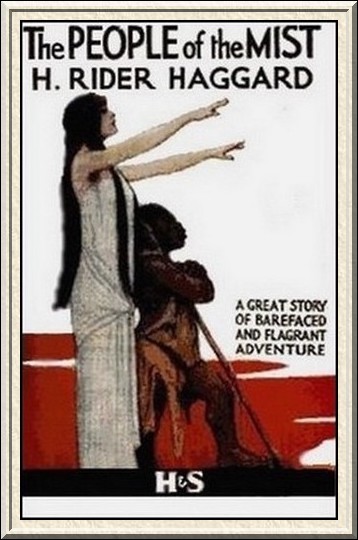
H. Rider Haggard’s The People of the Mist

H. Rider Haggard’s novel The People of the Mist was published in 1894 by which time he was just about the most popular writer in Britain. Haggard largely invented the Lost Civilisation genre and The People of the Mist definitely falls into this category.

Brothers Tom and Leonard Outtram were born into wealth. As sons of a wealthy baronet they had social position, education and all the advantages that any young men could enjoy. Until their father’s shady business dealings bring it all crashing down. The father kills himself, leaving his sons penniless and faced with the loss of the ancestral estate. The brothers make a vow that they will leave England to seek fortune elsewhere. When they have made their fortunes they will return to England to repurchase the estate and restore the family honour.

They end up in Africa, digging unsuccessfully for gold. Tom dies of fever but makes a death-bed prophecy - that Leonard will gain untold riches with the help of a woman.

Then an elderly African woman named Soa turns up with a strange tale. She had been nurse to a young English-Portuguese girl. She and the girl were devoted to each other. Now the girl, Juanna, has been captured by slavers. She wants Leonard’s help in rescuing the girl. And then she really gets Leonard’s attention - if he rescues Juanna then Soa will tell him how to reach the land of the fabled People of the Mist where rubies and sapphires are as common as pebbles. Surely this must be part of Tom’s dying prophecy - Soa is the woman who will lead Leonard to riches.

With his faithful African sidekick Otter (he really is more a sidekick than a servant) Leonard finds himself hurled into a series of extraordinary adventures. They will find the People of the Mist, Juanna and Otter will be worshipped as gods and they will face countless dangers from sacred crocodiles and treacherous priests, they will be imprisoned, they will have narrow escapes from death and will have to face the terror of the ice bridge.

Haggard understood that action and danger are essential ingredients of an adventure tale but it helps to have interesting characters. All of the characters in this story, African and European, are interesting and they’re all varied. There’s not one character who can be dismissed as a stereotype (either a racial stereotype or an adventure fiction stereotype).

Leonard is certainly a brave and determined hero capable of acting nobly but he is not a Boys’ Own Paper perfect specimen of manly heroism. He is not motivated by the desire to perform noble deeds, or even by a thirst for adventure. He is motivated by plain old-fashioned greed. He is a flawed hero.

Juanna is not quite a perfect heroine. She is quick-tempered, jumps to conclusions and misinterprets her own feelings and the feelings of others. She’s a fine young woman, but she has her exasperating quirks.

Otter is a dwarf and extremely ugly. He drinks far too much. He doesn’t know when to keep his mouth shut. He’s also as brave as a lion, almost as strong and in a fight he knows how to use brains as well as brawn.

Soa is very complicated. At times she seems like a villainess, at other times like a wise guide. She does some very bad things but she always has comprehensible motivations. She was dealt a bad hand by fate and her resentments are understandable. There is good and bad in her.

Nam the high priest is a villain, but again he has comprehensible motivations. He’s not just villainous for the sake of being villainous.

The land of the People of the Mist is far from being a utopia. They have some unpleasant customs but their reasons for clinging to their traditions are understandable.

The characters reflect the social and cultural attitudes of the time but it’s important to understand that the actual Victorians were nothing like the caricatured view so many people have of them today. They were intelligent complicated people with all of the normal human contradictions. Their beliefs and values were complex and nuanced.

It’s worth remembering that a lot of the clichés of adventure fiction were invented by Haggard and they weren’t clichés then.

This is a longish book but there’s plenty of plot, plenty of action and peril and an interesting cast of characters. There’s a reason that Haggard’s books remain in print after a century and a half. They remain in print because they’re extremely good. This one is not quite as good as his acknowledged masterpiece She but it’s highly recommended.

I’ve also reviewed Haggard’s King Solomon’s Mines.

Sunday, January 5, 2025

Donald E. Westlake’s The Outfit

The Outfit, published in 1963, is the third of Donald E. Westlake’s Parker novels written under the pseudonym Richard Stark.

I’m not going to give away spoilers for the first two novels (although in fact Westlake does so in this novel) but this third book continues Parker’s feud with the organised crime syndicate known as the Outfit.

Parker is not a member of the Outfit (although he did a job for them once). He’s an independent professional thief. That doesn’t mean he’s small-time. His jobs are always major robberies. He’s very successful. He pulls very few jobs because the ones he pulls are very lucrative. In between jobs he lives a life of leisure in Florida.

Now he has a problem. The Outfit seems to have taken out a contract on him. He thought he had resolved his issues with them. Parker is annoyed but far from disconsolate. He has already established his ability to hurt the syndicate badly. Now he will have to hurt them again, to make them see reason.

The Outfit has a weakness. Their security at their various illegal operations is lax. It has never occurred to them that anybody would be crazy enough to try to rob them. That was before they encountered Parker. Parker is crazy enough to do it. Except he isn’t crazy, just stubborn. If Parker has to hurt the Outfit his campaign against them will be meticulously planned and well thought out. He’s a cold calculating professional.

I love the opening of this novel. Parker is in bed with his current woman, Bett. She is not a criminal. He isn’t the slightest bit in love with her but she suits him and she’s good in bed. A gunman breaks into the hotel room and starts shooting. Any normal woman would be terrified. Bett is excited. Parker realises he will have to torture the gunman for information. He finds such things distasteful but he thinks Bett might enjoy it. When he asks her if she would enjoy torturing the gunman she gets very excited. Parker knew there was something about this girl that he liked. We are definitely in Parker’s world.

There’s another early scene, involving two brothers and a woman, which is just so incredibly Parker-ish.

This is not a straightforward heist story. Rather it is a whole series of heists. Parker’s campaign against the Outfit is based on persuading other independent professional criminals to start raiding Outfit operations. Each of these robberies is a perfect heist story in miniature.

Parker comes up against some old foes in the Outfit, foes who might be thinking they have a score to settle with him. They still haven’t quite realised that they’re up against a very smart guy who thinks out his moves well in advance. Parker has survived a long time as a professional criminal. He knows that if you rely solely on being fast with a gun or your fists you won’t last long. You have to play it smart, and not react emotionally. Parker approaches his conflict with the Outfit more like a game of poker than a bar-room brawl. He’s a tough guy but that’s not what makes him such a fascinating character.

Parker is a full-blown anti-hero. He is ruthless and amoral and apparently emotionless. He has been misunderstood as having no redeeming qualities. That’s not quite true. If necessary he will kill without hesitation and without remorse. On the other hand he never kills without a reason and he never kills for pleasure. He is very careful not to kill innocent bystanders.

In this story he has a woman. He knows that eventually he will have to get rid of her, but getting rid of her does not mean killing her. It just means giving her the brush-off as cleanly and painlessly as possible. He has no intention of killing her. That would be cruel. Parker, despite his serious character flaws, is not a cruel man.

And despite those flaws the reader is going to be on Parker’s side. He’s just so super-cool.

It’s a tough cynical book. Very entertaining. Highly recommended.

I’ve also reviewed the excellent first Parker novel, The Hunter (AKA Point Blank) and the second, The Man with the Getaway Face. You do have to read this series in order. You also need to see the 1967 movie Point Blank, based on the first novel.

Thursday, January 2, 2025

Fritz Leiber’s You're All Alone

Fritz Leiber’s You're All Alone has a fascinating history. It was written between 1943 and 1947 as a 75,000 word novel which was never published and the manuscript was lost. He then rewrote it from scratch as a 40,000 word novella in which form it appeared in Fantastic Adventures in July 1950. In 1953 it was published as The Sinful Ones, with quite a few changes that were made without the author’s consent. The story was sexed-up quite a bit. In 1962 Galaxy published a short story by Leiber, The Big Engine, which is in fact a chapter from another version of the novel. In 1980 Leiber partially rewrote the unauthorised 1953 novel which was then published in an authorised version, again with the title The Sinful Ones.

Oddly enough most of these many versions of the story are fairly easily obtainable.

Armchair Fiction have published the 1950 novella version of You're All Alone in one of their terrific two-novel paperback editions (paired with Bernard C. Gilford’s novella The Liquid Man). This is the version I’m reviewing here.

Fritz Leiber (1910-1992) is one of the greatest of American science fiction and fantasy writers and arguably has never really gained the attention he deserves.

You're All Alone is disorienting brain-twisting stuff right from the start. Carr Mackay is a perfectly ordinary guy working in an employment agency. One day a very frightened young woman comes into the office. He has no idea why she’s frightened although it seems to have something to do with a tall blonde.

Then one of his workmates, Tom, introduces him to a girl, only there isn’t any girl. The guy is talking to the empty air. Carr tries to explain things to his boss but his boss doesn’t seem to notice that Carr is there. People talking to other people who don’t exist is bad enough, but Carr starts to wonder if he himself exists.

Things get stranger. His girlfriend Marcia rings to thank him for a lovely evening, but he never kept that particular date. Tom talks about the great time that Carr had with the girl on the double date the previous night, but Carr wasn’t there.

Pianos play, but no-one is playing them.

And there was that store mannequin. Can a shop-window mannequin look terrified?

He meets the frightened girl. She explains a few things to him, and now he’s more mystified than ever.

Has he gone crazy? Is the whole world crazy? Is the world real? Is he real?

And there are plenty of twists still to come.

It’s easy to see why Leiber was unwilling to abandon this story even when early on it seemed destined to remain unpublished. It’s a great story idea and it was worth reworking it. This is the only one of the several versions of the story that I’ve read and it works very neatly indeed. I am somewhat tempted to track down one of the two versions of The Sinful Ones.

Apart from the brain-twisting science fictional elements there’s a kind of very offbeat love story here as well, and the question of what constitutes reality plays a part in that as well.

It’s not necessary to worry overmuch about plausible science in this tale. This is more a philosophical (perhaps even slightly existentialist) story than a straight science fiction story. It’s the sort of thing Leiber did extremely well.

You're All Alone is excellent stuff. Highly recommended.