Daughter of the Idol is a 1909 novel by Johnson McCulley, originally serialised in Railroad Man’s Magazine. Steeger Press have reprinted five Johnston McCulley novels including this one in a mammoth paperback omnibus edition, King of Chaos and Other Adventures.
Johnson McCulley (1883-1958) was a prolific American writer of novels, short stories and screenplays. He is of course most famous as the creator of Zorro.
Daughter of the Idol takes place almost entirely at sea, aboard a tramp steamer. Shipboard thrillers and adventure tales are always a joy to me.
Minding his own business on the docks in San Francisco a young lad named Roland is accidentally shanghaied aboard the tramp steamer Faraway but his uncle, the famed explorer Dick Engle, was deliberately snatched. Initially no-one knows the lad is aboard, until he is discovered by Ruth Holland. Ruth is a beautiful young lady but is very enigmatic about her presence aboard the steamer. She will not explain why things are so tense between her and Dick Engle.
The steamer is bound for a remote Pacific island. The steamer’s crew comprises natives of this island and they seem to be in awe of Ruth, as if they consider her a sacred personage.
A man named Welch, a thorough-going villain, is the prime mover in some mysterious plot. It involves an idol. Welch may be an adherent of a blood-soaked cult centred on the island. Whether he is really sincere about his allegiance to the cult or whether he’s after money or power or a woman remains uncertain.
The steamer’s skipper was in league with Welch but he’s having second thoughts.
Now the action begins and it doesn’t stop. There are gunfights. Some of the good guys get captured by the bad guys. Some of the bad guys get captured by the good guys. There are more gunfights. There are hair’s-breadth escapes. There are fistfights. There are more gunfights. And piracy.
Ruth, Uncle Dick and Roland will need to do something before they reach the island.
That’s where the executions will take place. Perhaps executions, or perhaps human sacrifices.
Dick Engle is a brave hero but he’s not infallible. Ruth is a fine feisty heroine but sometimes she jumps to conclusions. Dick and Ruth are in love but they’re not sure if they trust each other.
Roland is a brave resourceful lad. The captain of the Faraway adds some interesting uncertainty. Maybe our heroes can trust him and maybe they can’t. Welch is a pretty effective villain, ruthless and calculating rather than crazed.
McCulley knows how to handle both action and suspense and create an air of breathless excitement and danger. The nautical setting and the exotic remote island add some splendid atmosphere. There’s a plot with plenty of twists and betrayals. There’s superstition and mystery. And there’s a tangled romance.
McCulley is one of those largely forgotten adventure writers who does not deserve to anguish in obscurity.
Daughter of the Idol is a marvellous adventure yarn and it’s highly recommended.
I’ve also reviewed the title story from this collection, King of Chaos, and the first of McCulley’s terrific Zorro novels, The Curse of Capistrano.
pulp novels, trash fiction, detective stories, adventure tales, spy fiction, etc from the 19th century up to the 1970s
Showing posts with label edwardian and early 20th century. Show all posts
Monday, July 27, 2026
Tuesday, February 10, 2026
Roy Norton's The Glyphs
The Glyphs is a lost civilisation novel by Roy Norton which was originally published in The Popular Magazine in 1919.
Roy Norton (1869-1942) was an American newspaperman who wrote a lot of westerns and a handful of science-fiction novels.
A moderately honest American big game hunter, explorer and adventurer named Hallewell encounters an eccentric and definitely not very honest Italian archaeologist. Dr Morgano has made a thrilling discovery - it is a key which will allow him to decipher ancient inscriptions in the Mayan tongue. He wants Hallewell to led an expedition to Guatemala so that Dr Morgana can get cracking on reading those inscriptions. Halelwell is not interested until Dr Morgano mentions the possibility of long-lost treasure.
A huge eccentric English explorer and hunter named Wardrop is persuaded to join the expedition, and pay the bills.
Dr Morgano might have flexible ethics in many respects but he really is a great archaeologist.
Accompanied by a guide who is a descendant of the Mayans they set off into the jungle of Guatemala.
They find an ancient road which will take them to a lost city but the road ends at a chasm. The Mayans destroyed the bridge centuries before. Hallewell does find a cave. Perhaps there is another way to reach the city.
This is a jungle adventure in which the most dangerous foe is the jungle itself. It’s a green hell. There is no action. There are no encounters with hostile tribesmen. There are no battles.
There is however plenty of danger and excitement. An explorer who takes one wrong step could be entombed in a mountain forever. A mistake with a rope could lead to a deadly plunge into an almost bottomless chasm. There are venomous snakes and other nasty crawly things.
This is an epic of survival and endurance.
It’s also a tale that focuses on the motivations of the explorers. Hallewell, Wardrop and Dr Morgano are far from perfect but there’s a certain core decency in all three men. Morgano is genuinely driven by intellectual curiosity. Wardrop is driven by a taste for adventure but he is to some extent at least infected by Morgano’s enthusiasm for knowledge. Hallewell hopes for treasure but he can’t help being excited by the idea of being associated with what might be the scientific discovery of the decade. The Mayan guide hopes to revive his people’s past glory.
Respect and admiration has grown up between all four men. They don’t always agree but treachery is just not in their makeup.
They do reach a lost city and what they find there is not quite what they expected. Perhaps they have discovered as much about themselves as about the ancient Mayans.
This is a well-written novel that offers entertainment and excitement without relying on action clichés. Highly recommended. Norton is an author worthy of rediscovery.
The Glyphs has been reissued by Armchair Fiction in their marvellous Lost Worlds series.
I’ve also reviewed Roy Norton’s 1909 lost civilisation novel The Land of the Lost, and it’s pretty good also. Also reissued by Armchair Fiction.
Friday, September 19, 2025
Sax Rohmer's The Green Spider
There was a lot more to Sax Rohmer than the Fu Manchu books. He wrote detective stories many of which had supernatural elements, or at least suggestions of the supernatural. And he wrote some fine gothic horror. Black Dog Books have collected a varied assortment of his early stories in The Green Spider: and Other Forgotten Tales of Mystery and Suspense.
The Green Spider (written in 1904) begins with a college servant named Jamieson discovering what appears to be a horrific murder. Someone has broken into the laboratory of Professor Brayme-Skepley, wrecked everything and murdered the professor. The body however is not there. There is evidence that suggests that the professor was forcibly removed from the premises (either dead or alive) but there is other evidence that suggests that such a thing could not have happened. And there’s the matter of the giant green spider seen by the servant.
The Death of Cyrus Pettigrew involves the sudden death of a man on a train. The only other person in the compartment was Miss Pettigrew, his niece and ward. The doctor who examines the body has no doubt that Cyrus Pettigrew was poisoned but the means by which the poison was administered remains mysterious. This is an impossible crime story, and a pretty good one.
The Mystery of the Marsh Hole dates from 1905 and is a disappointing and contrived story of a disappearance in the marshes.
The Sedgley Abbey Tragedies from 1909 begins with an escape from a lunatic asylum. Soon afterwards a body is found in an abbey moat. The explanation is clear-cut and the case is closed and the drama is over. Except that more bodies turn up in the moat. A good story with some fine twists.
The Mysterious Mummy is an OK very early story (from 1903) about odd happenings in a museum. A mummy is there, and then it isn’t there.
The McVillin (from 1905) concerns a well-born but impoverished Irish officer, Colonel McVillin. In fact he’s now a penniless rogue and adventurer. He finds himself involved in an affair of honour although he has no idea what it is all about. Something about a young lady being forced into a marriage against her will. McVillin will have to fight the duel anyway. A delightfully quirky mix of cynicism, romanticism and mystery. Splendid stuff.
Who Was the Rajah? dates from 1906. A masked ball onboard a steamer ends in piracy on the high seas. A very clever and witty caper story.
The Secret of Holm Peel, published in 1912, takes place on the Isle of Man. There’s a castle that once belonged to the king and a family secret that must be kept. There are secret passageways and phantom dogs. Good fun.
The Dyke Grange Mystery, from 1922, is a puzzle-plot mystery with some exotic touches. Private detective Paul Harley and Inspector Wessex are investigating the murder of a dissipated nobleman. An unusual dagger of Egyptian origin sees to be an important clue. Along with an assortment of cigarette stubs. An entertaining tale.
The Haunting of Low Fennel dates from 1920 and is an unusual and excellent haunted house tale. Major Dale would like to sell Low Fennel, an old house that has been in the family for centuries and has always had an evil reputation. He turns to ghost-hunter Addison for help. I’m not going to risk even the mildest spoiler but this is definitely not a run-of-the-mill haunted house story.
The Blue Monkey was published in 1920. A man is on his way home, on a lonely path through the moors. He is carrying a parcel - a blue porcelain monkey he has just purchased. The man is found dead. He has been strangled. No mystery there, but the only tracks leading from the crime scene seem to belong to a small child. A good solid mystery.
The Zayat Kiss was written in 1912. It’s extremely important since it arks the first appearance of Nayland Smith and Fu Manchu.
The Six Gates of Joyful Wisdom dates from 1915 and is an excerpt from The Return of Fu Manchu.
The Green Spider is a fine collection and is highly recommended.
More of Rohmer’s early short stories can be found in another Black Dog Books volume, The Leopard Couch and Other Stories of the Fantastic and Supernatural, which is also recommended. Also very worth getting hold of is The Dream Detective, a very fine collection of occult detective tales. And there’s some great fiendish occult wickedness in Brood of the Witch-Queen.
Saturday, August 30, 2025
Fantômas: A Royal Prisoner
Published in 1911, A Royal Prisoner (Un Roi Prisonnier) was the fifth of the Fantômas novels.
The brilliant arch-criminal Fantômas is one of the most iconic figures in the history of French pop culture. Marcel Allain (1885–1969) and Pierre Souvestre (1874–1914) wrote thirty-two Fantômas novels between 1911 and 1913. Allain wrote further Fantômas novels about his collaborator’s death. Fantômas later featured in TV shows, silent movie serials, movies and comics.
A Royal Prisoner begins with King Frederick-Christian of Hesse-Weimar (a tiny mythical kingdom) visiting Paris. It’s not an official visit. He’s in Paris to see his mistress, the glamorous courtesan Susy d’Orsel.
Reporter Jerome Fandor (one of the three recurring central characters in the novels) meets the king and they get drunk together. Then there’s an unfortunate incident, with a woman apparently committing suicide by throwing herself out of a window. The French authorities want it to be a suicide. Anything else would cause diplomatic nightmares. The problem is that a witness saw enough to make it certain that this was murder. And the only person with the woman at the time was the king. The king is now very much the prime suspect for murder.
Detective Juve (another of the recurring central characters) is instructed to investigate and to come to the politically acceptable conclusion that this was suicide. But Juve doesn’t operate that way. He intends to find and arrest the murderer, even if it is the king.
There is a great deal of confusion about the murder. A third person may have been present.
Meanwhile Jerome Fandor has been mistaken for the king. And he’s meet a pretty lacemaker who has fallen in love, thinking that she has fallen in love with the king.
Mistaken identities, false identities and disguises will play key roles in this story, as in many of the Fantômas stories. Both the police and the criminals are often operating on false assumptions.
There is also a threatened revolution in Hesse-Weimar. And a stolen diamond. One of the most valuable diamonds in the world.
These are all classic ingredients in Edwardian thrillers and mysteries. The Fantômas novels have a very pulpy feel. There are kidnappings and narrow escapes and secret passageways. In this case there’s a mysterious singing fountain, and the reason it sings will become important. There’s a wildly convoluted plot. There’s breathless excitement. There’s romance. There’s everything needed for a fun crime/espionage/adventure romp. Plus there’s the sinister figure of the ruthless criminal mastermind Fantômas. The ingredients are there and the authors know how to combine them to perfection.
One interesting element is the air of sexual sophistication. Susy d’Orsel is a courtesan. She is technically a prostitute. But she’s a nice girl and not one of the characters expresses the slightest disapproval of her. The king is having an open affair with such a woman but no-one expresses any disapproval. This truly was La Belle Époque. Paris was the city of love, which meant it was the city of sex.
Fantômas’s mistress, the wicked sexy Lady Beltham, naturally puts in an appearance.
Fantômas himself is a figure of mystery. We see the story from the points of view of Juve and Jerome Fandor. They suspect Fantômas’s involvement early on but they can’t prove it. Fantômas is ever elusive. Sometimes he succeeds, sometimes he fails, but bringing him to justice seems impossible. He is sinister and ruthless. One of the great fictional super-villains.
A Royal Prisoner is fast-paced crazy pulp fun. Highly recommended.
I’ve reviewed other Fantômas novels - Fantômas, A Nest of Spies (L'Agent Secret) and The Daughter of Fantômas - as well as the insanely entertaining 60s movie Fantomas (1964).
Tuesday, June 3, 2025
W. Somerset Maugham’s The Magician
The villain of W. Somerset Maugham’s 1908 novel The Magician was inspired by Aleister Crowley although the story itself is pure fiction.
Maugham had met Crowley and while he disapproved of him and considered him to be a charlatan he was strangely fascinated by the notorious occultist. And while many of the extraordinary tales Crowley told about himself were untrue Maugham had to admit that they were not all untrue. Crowley was a remarkable man. It was obvious to Maugham that he was a perfect subject for a novel.
Maugham’s novel begins with a brilliant young surgeon who is engaged to be married to the beautiful Margaret, who had been his ward. In Paris they encounter the notorious occultist and magician Oliver Haddo. Haddo is wildly eccentric and slightly sinister but he is charismatic and fascinating.
Haddo seems to be intent on seducing Margaret. Is he simply making use of standard techniques of hypnotism (aided by his charismatic personality) or does he possess actual occult powers?
And is he intent on mere seduction? There is a possibility that he has something much stranger and much more shocking in mind.
Maugham did not believe that Crowley possessed any real magical powers but had to admit that he certainly had the ability to convince people that he did. Oliver Haddo might well have obtained such powers.
The story of Maugham’s novel of course has no connection whatsoever to any events in the life of Aleister Crowley. Crowley simply served as a jumping-off point. And of course in the late 19th and early 20th centuries there were many occult practitioners so Haddo is perhaps more representative of a breed than of an individual.
Either way Oliver Haddo is a wonderful and memorable larger-than-life character. He entirely dominates the story.
This was a period of intense interest in the occult so in commercial terms the idea was a winner. It was very much in tune with the cultural obsessions of the day. The reading public had an inexhaustible appetite for thrillers with an occult flavouring.
The novel is an unashamed potboiler (and I have no problems with that). It can be regarded as an occult thriller, a melodrama, a romance and even as gothic horror. It’s not what you expect from Maugham, excepting that being a Maugham novel it’s extremely well-written. He has some fine suspense, some genuine chills and thrills and a perverse love story. And the love story is quite powerful.
This is a very early example of the occult thriller genre which would reach its full flowering in the works of Dennis Wheatley.
I thoroughly enjoyed The Magician. Highly recommended.
Rex Ingram’s The Magician (1926) is a superb movie adaptation of the novel.
Crowley was himself a talented writer. His Simon Iff Stories are splendid occult detective stories, Crowley’s most famous novel, Moonchild, does touch on some of the occult practices described in Maugham’s novel. So it is possible to get both sides of the story.
Friday, December 27, 2024
John Charles Beecham’s The Argus Pheasant
John Charles Beecham’s novel The Argus Pheasant was serialised in the pulp magazine All-Story Weekly in 1917. I’m afraid I can’t tell you anything abut this author other than the fact that he seems to have been reasonably prolific and that both the male protagonist (the young American sailor Peter Gross) and the female protagonist (the beautiful sexy mysterious Koyala) were popular enough with readers to feature in several stories.
Pulp readers in the first half of the 20th century had an insatiable appetite for stories of Americans caught up in adventures in the tropics and the Far East. To be honest it’s an appetite I share. Some of these American adventurers were good-hearted but none too honest while others fell into the square-jawed clean-limbed virtuous hero category. The hero of this novel, Peter Gross, falls into the latter category.
The setting is the Dutch East Indies. The province of Bulungan in Borneo is in a mess. The Dyak hill tribes and the Dyak coast tribes are at each other’s throats. The Chinese and the Malays are regarded with resentment by both the native tribes. Head-hunting is common. Piracy is rife. Taxes have not been paid. The administration is corrupt and inefficient. In desperation the governor appoints a young American sailor as the new resident. Peter Gross has lived in the Dutch East Indies for years, he speaks Dutch and the tribal languages and he is a land-owner in the colony. And he’s half-Dutch.
Peter Gross is not daunted by the prospects before him but there is one problem that would daunt any man. Her name is Koyala. She is young and very beautiful. She is half-French and half-Dyak. She is acknowledged as unofficial leader by the locals - not quite a queen, not quite a high priestess, not quite a warlord but a combination of all these things. To her enemies she is a witch and a scheming temptress and regarded with superstitious fear. And no man can resist her beauty.
She may or may not be in league with the fabulously ric merchant, the wily and vicious Ah-Sing. Ah-Sing may be in league with the pirates. The local Dutch officials may be in league with Ah-Sing and the pirates. For Peter Gross it’s going to be like walking through a minefield.
Peter wants to avoid bloodshed. He wants all these people to live in peace. He thinks that if he treats them fairly and offers them good honesty government they will bury their differences and learn to get along. His plan might have worked smoothly except that there are powerful greedy corrupt men among both the Dutch and the various tribes and the merchants who have been making a lot of money out of exploiting the people, stealing the taxes and engaging in outright piracy. Those men will resist all of Peter’s efforts and if that doesn’t work they’re quite prepared to have him killed and drown the province in blood. They have killed reforming residents before this. And since Dutch government officials are involved in these crooked dealings it’s not easy for Peter to find people he can trust.
He trusts Koyala. The Dutch had put a price on her head. Peter cancels that. He convinces himself that she is now grateful and therefore trustworthy. Everybody warns him not to trust her but she’s so charming and so cute. How could such a charming pretty girl not be trustworthy?
Peter is a reasonably likeable hero and he’s brave and intelligent and in many ways rather wise but he doesn’t understand women.
Koyala is the character who makes this book interesting. Peter doesn’t know for sure if he can trust her. The reader doesn’t know either. We don’t know which way she will jump because she doesn’t know that herself. She’s a complicated woman with complicated motivations and resentments and jealousies. She has a woman’s hatreds. She’s not a straightforward villainess. She genuinely wants what is best for her people, but what she thinks is best for her people doesn’t necessarily fit in with Peter’s plans. She might decide to coöperate with Peter. On the other hand she might decide to have him tortured to death. She might be attracted to him. That might make her even more inclined to have him tortured to death. She is cynical about love and she is not comfortable with her sexual feelings.
There’s plenty of action along the way, on land and at sea. There are hair’s-breadth escapes from danger. There is treachery and there are strong loyalties.
An entertaining tropical adventure. Highly recommended.
The first two Koyala novels have been paired by Steeger Press in their excellent Argosy Library series.
Friday, September 27, 2024
Gaston Danville’s The Perfume of Lust (Le Parfum de volupté)
Gaston Danville’s The Perfume of Lust (Le Parfum de volupté), published in 1905, is a kind of lost civilisation tale (involving Atlantis) but not at all typical of that genre. This is definitely not pulp fiction or straightforward adventure fiction. This is much more arty and more literary. Danville had an intense interest in the latest psychological theories of his day and that interest is reflected in this novel.
Gaston Danville was the pseudonym used by French author Armand Blocq (1870-1933). He’s hard to classify. He had links to both the Naturalist and Symbolist movements, two literary movements that were bitterly opposed. There’s also some very obvious influence of the literary Decadence of the fin de siècle.
The Perfume of Lust has a setup that could easily have been used as the basis for a rollicking adventure tale but Danville had other fish to fry.
This is a story related at third hand. This is a story related by a man named Robert Toby to his friend Vincent Tricard who then related it to the narrator of the novel. The narrator is of course then passing it on to the reader so maybe it’s a tale told at fourth hand. Neither the narrator not Vincent Tricard are convinced that the story is true but at the same time they don’t dismiss the possibility. We have to consider the possibility that it’s a tall tale, or a dream, or an hallucination or that it’s all quite true. This ambiguity is never resolved. Perhaps we never can tell dreams from reality anyway.
Robert Toby is a passenger on the steamship Dauphiné. The ship is hit by a gigantic wave. It survives but it is left rudderless and drifting. Repairs are eventually effected and then things start to get strange. The ship encounters an island where no island has ever been before. The Dauphiné finds itself stranded in a large bay surrounded by reefs, unable to regain the open sea.
It appears that some undersea earthquake or volcanic eruption has brought the seabed to the surface and created a new island. The strangest thing is the city. It appears to be an ancient city that sank beneath the waves sometime in the distant past. It might even be Atlantis.
Danville’s interest does not lie in the story itself but in the effects the island has on the passengers and crew of the Dauphiné. Psychological, emotional, sensory, sensual and erotic effects. Danville emphasises the influences of scents and textures and sounds which provide a kind of sensory intoxication.
The passengers certainly have their erotic instincts aroused. Danville mostly describes their erotic experiments obliquely. This was probably not for censorship reasons (writers such as Pierre Louÿs were going much much further at around the same time). It’s more likely that Danville was fascinated by the erotic but not entirely comfortable with such things. There’s a very strange orgy scene in which the participants get very excited but they don’t seem to actually do anything.
In some ways this works in the book’s favour. It’s not simply about sex, it’s about eroticism and sensuality in a much broader sense.
There’s also a sense in which the Dauphiné’s passengers have found a king of paradise but it’s a paradise that might not be good for them and which might be taken away from them. There’s a brooding sense of doom and melancholy. The undersea seismic activity has not ceased. This island and its mysterious exotic lost city suddenly emerged from the waves but there’s no way to know if it will remain in existence for a week or a year or a century. There’s no way to know if escape from the island is possible. These uncertainties add a certain spice to the island’s pleasures.
This is technically science fiction, of a sort, but it’s a novel that might well mystify most science fiction fans. It found it oddly mesmerising. Recommended, but maybe not to everyone.
This is one of the many French science fiction, fantasy and decadent works that have been translated (or to use his preferred terminology adapted) by Brian Stableford.
Saturday, September 21, 2024
Victor Rousseau's Eric of the Strong Heart
Victor Rousseau (1879-1960) was an English British writer who wrote science fiction and other assorted pulp fiction works.
His lost world novel Eric of the Strong Heart was serialised in four parts in Railroad Man's Magazine in November and December 1918.
Eric Silverstein is what would later be called a geek. He lives in New York, he’s wealthy and he’s a history buff. Everything changes for him when he cores across a sideshow attraction featuring a mysterious princess from an exotic land. Much to the amusement of the crowd she speaks in gibberish. Eric notices two things. Firstly her costume is Saxon from around a thousand years earlier and it’s totally authentic. Secondly she isn’t speaking gibberish - she is speaking Old English. Being a history fanatic Eric understands the language. The princess (whose name is Editha) is very indignant. She was expecting an audience with the king of this land.
There is a disturbance and the princess, aided by Eric, makes her escape. She just wants to return to her longship. It turns out she really does have a longship. Then something very odd happens - the princess suddenly becomes a knife-wielding maniac. Her two attendants make apologies for her and it is suggested that it would be safer for Eric to forget all about her. Editha sails off, to return to her own land.
Eric cannot forget her. Oddly enough, even though she is very beautiful, he does not have fantasies of marrying her. He thinks his friend Ralph would be a perfect husband for her.
Eric is intelligent but he has a few huge blind spots. He also underestimates himself. He has never been handsome or athletic. He does not see himself as the stuff that heroes are made of, while he thinks of Ralph as being very much hero material.
Eric knows his history and his geography. He thinks he knows where Editha’s land is. It is in the frozen Arctic, north of Spitzbergen. He buys himself a yacht and with two companions sets off to find Editha’s homeland. His two companions are Ralph and a fisherman named Bjorn.
This is a classic lost world story. Editha’s land has been cut off from the rest of humanity for a millennium. People there live as they did a thousand years ago. There are in fact two peoples there, one (the rulers) descended from the Dames and one (the slaves) descended from the Angles. There are two kings, but the Danish king rules. Editha is the daughter of the Anglian king.
In fact there are three people on this remote island, the third being a race of Trolls.
There are of course power struggles. The Angles have never been entirely reconciled to their subordinate status. The Danes are determined to maintain their superior position. Having two kings complicates things. There has been intermarriage. There are conspiracies aplenty. The arrival of outsiders increases the tension levels, especially when one of the outsiders puts himself forward as a candidate for the kingship.
There is also a sword with a legend attached to it. The man who draws the sword out of its rocky scabbard will be king.
There are conflicted loyalties and betrayals, not just among the islanders but among the three outsiders as well. Bjorn seem to have his own agenda.
There are people who feel they are chosen by destiny, and they can be thereby tempted to do desperate things.
This is a complex lost world. The story offers a lot of action and adventure but with some psychological twists. Eric is a man who is intelligent and resourceful but he has made a very serious error of judgment which could have momentous consequences. There is magic, although the exact nature of the magic is ambiguous.
The ending holds a few surprises.
This is an above-average lost world tale and it’s highly recommended.
Thursday, July 11, 2024
Perley Poore Sheehan’s Woman of the Pyramid
Perley Poore Sheehan’s novel Woman of the Pyramid was published in The All-Story pulp magazine in 1914.
Napoleon’s expedition to Egypt in 1798 had first sparked western interest in ancient Egypt and by 1914 Egyptology had become quite a craze. This novel was therefore very topical.
In the days before the First World War a young American named George Carlton is a bit of a scientific dilettante. He’s trained in psychology and psychiatry but his real interest lies in the occult and in what would later come to be known as the paranormal. He’s very interested in ghosts.
As an aside, at that time such interests still had at least a degree of scientific respectability and plausibility.
Carlton is in love with a pretty English girl named Alice Wentworth. Wedding bells would seem to be in the offing. In the meantime Carlton, Alice and her aunt are off to Egypt. Carlton already has a very keen interest in ancient Egypt.
Carlton is a little disturbed by the mysterious woman he keeps seeing. No-one else seems to be able to see her. He suspects that she’s a ghost of some sort. He also suspects that she’s connected to ancient Egypt in some ways. He thinks of her as the Woman of the Pyramid.
He becomes a little obsessed. He enters the famous Red Pyramid (the third largest of the pyramids) and there he encounters the Woman of the Pyramid again. It’s a fateful meeting. Carlton finds himself back in the distant past. The Woman of the Pyramid is the queen, Netokris, recently widowed. And Carton is no longer Carlton. He is now Menni, an important man, governor of the royal palace in fact. It seems that the queen sees him as a potential husband.
Menni isn’t interested. He’s in love with slave girl Berenice, who is in fact Alice Wentworth. Netokris is a woman who doesn’t take no for an answer. She’s ruthless, cruel and inclined to act on whims. She decides that Berenice is a rival whose existence cannot be tolerated.
There are various palace conspiracies afoot and while Carlton/Menni doesn’t want to get mixed up in them it might be the only way to save Berenice/Alice, and his own skin.
A possible ally is the priest and sorcerer Baknik. Baknik has various occult powers including the power to foretell the future. The future he predicts for Carlton/Menni and Berenice/Alice is a case of good news and bad news. His predictions of the queen’s future are not entirely hopeful either. All of the characters feel themselves to be the playthings of Fate.
This might at first seem to be a time travel story but it’s more of a past lives story. The question is the extent to which events in one life will affect their next life.
It’s also very much a love story.
Most of the story takes place in ancient Egypt but the final quarter of the book brings Carlton back to the 20th century, where the same three people seem destined to replay the events of the past. The past lives thing is done quite well here with the past lives and present lives intersecting neatly.
I don’t think Sheehan was overly obsessed with historical accuracy but the background is at least vaguely historical. Netokris probably existed and may possibly have been responsible for building the Red Pyramid. Some plot points are lifted from the account of her reign by Herodotus.
If the past lives thing appeals to you and you have any kind of interest in ancient Egypt and you happen to enjoy pulp adventure/romance then this novel will tick all your boxes. I enjoyed it. Highly recommended.
Woman of the Pyramid has reprinted in a paperback omnibus edition (including three other stories by the same author) by Steeger Books in their excellent Argosy Library series.
I've also reviewed another of Sheehan's novels, The Red Road to Shamballah. It's pretty good also.
Wednesday, March 27, 2024
Roy Norton’s The Land of the Lost
Roy Norton’s The Land of the Lost is a lost civilisation novel originally published in 1909.
The two main characters are a US Navy captain named Jimmy Tipton and his adoptive brother Billy Pape. They’re both around 40 and although they do not appear to have much in common there’s a fierce bond of friendship between them. Jimmy is well-educated and successful. Billy is a broken-down cowpuncher and failed prospector.
The novel starts off seeming like more of an “end of the world” story than a lost world tale. A brilliant scientist named Martinez has predicted catastrophe. There will be earthquakes on an unprecedented scale. They will happen in mid-ocean, triggering massive tidal waves. All coastal cities will be destroyed. Massive loss of life can only be avoided if governments undertake mass evacuations. Martinez is dismissed as a crank, until it becomes apparent that his predictions are about to come true.
This all happens early in the story and does not play out as you might expect. It is not the end of civilisation. Not by a long way. The cataclysm does however alter the planet’s geography significantly. This will become important.
And Dr Martinez mysteriously vanishes.
Some time later, as the nations of the world adjust to a somewhat altered world geography, ships start to disappear. Jimmy Tipton, in command of the cruiser USS Seattle, is despatched to search for the missing ships. It should be noted that this is 1909 when radio was in its infancy. The difficulty of long-range communication with ships at sea will play a vital role in the story.
The Seattle discovers a huge island, almost a mini-continent, where no island was known to exist. It was presumably created by the massive underwater earthquakes. And very strange things start happening to the American cruiser and its crew.
It’s impossible that this island could be inhabited but it is. The inhabitants are human but they represent a culture like no other on the planet. They have access to strange advanced technologies. Their outlook is very different.
The Seattle’s crew members find themselves either prisoners or guests. They’re not sure which. They are not mistreated in any way. The inhabitants of the island seem friendly but suspicious. A man named Manco, clearly a very important man in this lost civilisation, acts as either their gaoler or their host depending on how you want to look at it. It’s obvious to Jimmy and Billy that there are things that Manco is not telling them. They want to trust him but they’re uneasy. They get the impression that Manco feels the same way.
Of course there really are things happening on the island that they should be worried about but this is a story with quite a bit of moral ambiguity. There are no villains in the usual sense but misunderstandings can lead to violence and even war.
In some ways it’s a standard lost world tale but the moral ambiguity makes it a bit more interesting.
And the islanders’ high technology is interesting. They have unlocked the power of light, and of the atom. They have nuclear power of a sort although it’s based on the state of scientific knowledge of the world of 1909. This was an era in which electricity, magnetism and radio were ultra high technology. Overall the technobabble is very enjoyable. You could even see it is as having just a slight steampunk flavour.
There is some action. There are divided loyalties and friendships are put to the test. And there is a lot at stake. Jimmy is uncomfortably aware that a mistake on his part could have dire consequences not just for this lost civilisation but for his own.
A rather entertaining tale. Recommended, and if you’re a lost world fan I’d bump that up to highly recommended.
The Land of the Lost has been reissued by Armchair Fiction in their wonderful lost World/Lost Race paperback series.
Monday, March 11, 2024
Joseph Conrad’s The Secret Agent
The publication of Joseph Conrad’s The Secret Agent in 1907 is an important milestone in the development of the spy novel. Spy fiction already existed but it was very much of the heroic sort. The Secret Agent is the beginning of a tradition in spy fiction that would reach its full flowering in the works of Eric Ambler, Somerset Maugham, Graham Greene, John le Carre and Len Deighton - the pessimistic, sordid, cynical school of spy fiction.
The inspiration for Conrad’s novel was an anarchist bomb outrage in London in the 1880s. Even by the standards of anarchist terrorism this was a remarkably senseless and useless act - an attempt to blow up the Greenwich Observatory, of all things. It also seems highly likely that it was influenced by Dostoevsky’s The Devils (also known as Demons or The Possessed) although the rabidly Russophobic Conrad was unlikely to have admitted to the influence.
Mr Verloc runs a sleazy little shop in London, specialising in dirty books. He makes very little money from this trade but he has another source of income - he is a secret agent working for an unnamed European great power. He is in fact an agent provocateur. His problem is that so far he has provided some useful intelligence on the anarchist organisations he has infiltrated he has not actually managed to provoke anything. And now his employers want him to do just that. They want a terrorist outrage in Britain. They believe this will encourage the British Government to join them in a continent-wide crackdown on anarchists, socialists and other trouble-makers.
While the foreign power for which Mr Verloc works is not named it does has an emperor so it has to be the Austrians, the Germans or the Russians. Given that the Polish-born Conrad was not only motivated by his inherent Polish Russophobia but had presumably picked up on the hysterical Russophobia of 19th century England it seems reasonable to assume that the power in question is Tsarist Russia. And it’s made clear that this power is extremely reactionary which tends to confirm the view that it’s Russia.
Mr Verloc has close connections to a committee of anarchist activists. They are in fact a motley collection of dreamers, ineffectual agitators, incompetent propagandists, lunatics, losers and would-be terrorists who would be unlikely to terrify even a sensitive five-year-old child. Somehow Mr Verloc will have to find a way to produce the required terrorist outrage or risk losing his lucrative post as a secret agent. That would mean that he might actually have to work for a living, a prospect that horrifies him. Mr Verloc has a wife to support, as well as Stevie. Stevie is his wife’s brother, a young man who is somewhat child-like, over-sensitive and over-excitable.
Most of Mr Verloc’s anarchist contacts are unlikely to be of much help to him but the Professor is another story. The Professor makes bombs. He also carries a bomb with him permanently concealed in his person, a bomb which he intends to detonate if a policeman ever tries to arrest him.
Preventing such acts of terrorism is the task of the Special Crimes division at Scotland Yard. Chief Inspector Heat is an old hand at the job and he is very competent. His superior, the Assistant Commissioner in charge of the Special Crimes division, is perhaps not so competent. He’s an ex-colonial policeman but he is more adept at playing politics than at catching anarchists. The sensible course of action would clearly be to leave the matter to Chief Inspector Heat but the Assistant Commissioner, for reasons which an ungenerous observer might describe as self-interest, decides to meddle.
Conrad clearly has little sympathy for these anarchist misfits and even less sympathy for secret agents. He doesn’t have a huge amount of sympathy for the police either, or for the governments that employ them. And for all his contempt for the anarchists he has to admit that the society they wish to overthrow is corrupt and unjust. He just doesn’t think that throwing bombs will lead to a better society.
Conrad was a deeply pessimistic writer but his tone in this novel is ironic and mocking. It’s often rather amusing. This is not quite the black comedy of Greene’s spy thrillers but at times it does approach black comedy. The world of Conrad’s novel is sordid and cynical. This is not quite Greeneland but one could say that Conrad was mapping out the territory that would later become Greeneland.
This is of course a lot more than a spy novel but it’s The Secret Agent’s place in the history of spy novels with which this review is concerned. Don’t expect a great deal of action and excitement or even suspense (although there is some suspense at the end). The Secret Agent is a study in the psychology of espionage, and the psychology of betrayal, and its influence on writers like Greene and le Carre make it a crucial step in the evolution of the genre. And they make it essential reading for serious students of espionage fiction. Recommended.
Tuesday, January 9, 2024
Gaston Leroux’s The Perfume of the Lady in Black
Gaston Leroux’s impossible crime novel The Perfume of the Lady in Black (the original French title is Le parfum de la dame en noir) was published in 1908.
Gaston Leroux (1868-1927) is best known in the English-speaking world as the author of The Phantom of the Opera. Keen detective fiction fans are also aware of his 1907 locked-room mystery The Mystery of the Yellow Room but Leroux is not regarded as a big deal in the Anglophone world. Leroux was however a prolific and extremely successful author and in France he is definitely a big deal, being considered one of the greats of genre fiction.
The Perfume of the Lady in Black is a kind of sequel to The Mystery of the Yellow Room. Once again the hero is Joseph Rouletabille, newspaper reporter and amateur detective. Joseph Rouletabille was a mere teenager when the events recounted in The Mystery of the Yellow Room took place. Since this book constantly refers to the events of The Mystery of the Yellow Room you probably should read that one first. To avoid spoilers I’ll be very vague about plot details.
There’s a man who should be dead but may not be. He was (or is) a nefarious villain, cunning and ruthless.
Rouletabille has become obsessed with the perfume of the Lady in Black. It’s a childhood memory with immense significance for him.
Most of the story takes place in a castle on the border between France and Italy. The castle was built in the 12th century, extended in the 15th century and again in the 17th century. It’s a maze of intact and partially ruined towers on a peninsula which is almost an island. It’s a great setting for a story of mystery and terror and Leroux makes extensive and skilful use of it. The castle has withstood attack many times and now Rouletabille is hoping it can withstand a more modern type of attack - by a master criminal.
Leroux goes to extraordinary lengths to convince us that the impossible crime which occurs really is impossible. He provides us with floor plans. The big problem is that there is one body too many.
There are several murders and several disappearances. Rouletabille is sure that Larsan is not far away.
The plot hinges on a device that was immensely popular in the mystery and thriller fiction of the late 19th and early 20th century. It’s device which most modern readers will find much too far-fetched. The plot is ingenious but contains a number of elements of doubtful plausibility. Very few readers today will be satisfied with the solution to the impossible crime angle.
Modern readers will also have problems with the pacing.
There are two major plot strands. One concerns events in the here and now and one concerns events in the past, events which concern Rouletabille. The perfume of the Lady in Black continues to haunt him. He feels it is the key not just to his past but to his future happiness and sanity.
Rouletabille is a boy genius detective who enjoys keeping his secrets. He knows certain things which he has reasons not to reveal to anyone else. His plan to apprehend a dangerous criminal depends on secrecy.
I like the breathless sensational tone and the general atmosphere of overheated emotional hysteria.
The concept of fair play had not yet become an accepted part of the detective fiction genre but if you’re familiar with the conventions of the crime fiction of that era you will have your suspicions as to at least a part of what is going on.
There are also several interlocking romance subplots.
The Perfume of the Lady in Black is, to be honest, mainly of historical interest. It has some slight affinities to the 19th century English sensation novel. I enjoyed it well enough but you do have to be a fan of the crime fiction of that era. If you fall into the category you’ll find it worth a look.
There have been several film adaptations of this novel, including Francesco Barilli’s giallo Perfume of the Lady in Black (1974).
Thursday, November 2, 2023
Norman Lindsay's A Curate in Bohemia
Norman Lindsay is (in my opinion) the only truly great painter Australia has ever produced. Lindsay was also a very successful writer. A Curate in Bohemia, published in 1913, was his first novel.
The Rev. James Bowles is about to depart for Murumberee to take up his first curacy but before doing so he makes the fateful decision to look up his old school chum Cripps. The young curate finds himself in the world of pre-WW1 Melbourne arty Bohemia.
Cripps and his friends are art students. Their idea of the pursuit of art is centred around talking about painting rather than actually painting, but mostly it’s centred around beer, tobacco and girls. The curate does not drink nor does he smoke. He is however a young man who always takes the path of least resistance and he is easily persuaded that one drink would do no harm. One drink having produced no great ill-effects he decides to have another. And another.
He wakes up the next morning with his finances sadly depleted but with happy memories of conviviality and even happy memories of long conversations with Florrie, Florrie being an artist’s model who poses for Cripps.
The curate has more convivial evenings. His finances are even more sadly depleted. And somehow he has still not managed to get himself to the railway station to take that train to Murumberee.
Bowles soon discovers that he rather likes beer and he rather likes girls as well. And the reader discovers that the curate doesn’t exactly have a strong vocation as a clergyman. He just drifted into it as a result of his usual practice of taking the line of least resistance.
Matters will come to a head when Cripps decides that his old school chum simply must have a grand send-off party before entraining for Murumberee. Paying for the party will be the challenge. The art students are all broke. They are always broke. Cripps somehow manages to scrape up enough money for the alcohol for the party but he has to adopt desperate and unorthodox measures to provide the food. As a result of those desperate measures he has the law after him.
An ingenious expedient is adopted to keep Cripps out of gaol and that expedient will have consequences for the hapless would-be curate of Murumberee. And things become steadily more farcical and more delightfully absurd.
The book is to some extent autobiographical, with Lindsay admitting that one of the art students, Partridge, is a thinly veiled version of himself.
A Curate in Bohemia is totally outrageous and filled with the vitality and joie de vivre that also infused his paintings. It expresses Lindsay’s love of the sensual pleasures life has to offer. It’s an extremely funny novel. Lindsay might be poking fun at the clergy but he’s deriving just as much enjoyment poking fun at himself and at the world of artistic Bohemia. He also has some fun with the terribly serious debates among the art students about the latest artistic theories.
Lindsay spent his whole life battling those who would censor art and literature. He was always controversial and he relished controversy.
I’ve also reviewed Lindsay’s wonderful 1938 novel Age of Consent which, along with several of his other novels, was banned in Australia.
A Curate in Bohemia was one of five Lindsay novels adapted by ABC Television in the early 1970s but tragically not one of those TV adaptations survives.
A Curate in Bohemia is a delight from start to finish. Highly recommended.
Wednesday, April 5, 2023
Loring Brent's The City of Stolen Lives
The City of Stolen Lives is Altus Press’s first collection of Peter the Brazen stories by Loring Brent. Brent was actually George F. Worts (1892-1967) who wrote pulp fiction under several pen-names and later wrote for slick magazines as well. This collection includes three Peter the Brazen stories originally published in the pulp magazine Argosy late in 1918.
Peter Moore, who becomes known as Peter the Brazen, is a wireless operator on a ship. Worts himself had worked in such a capacity and it seemed like an interesting and promising occupation for the hero of a series of adventure tales set in the East. In 1918 radio was still a new and exciting technology.
Princess of Static, published in Argosy in October 1918, is the first of the Peter the Brazen stories.
Peter Moore has decided to give up his position as a ship’s radio operator. He changes his mind after a strange encounter in Chinatown. A woman’s face glimpsed in a window and a scrawled message lead him to think that something odd is going on and that a woman may be in danger.
He sets sail on the Vandalia, bound for Shanghai. Two women come aboard at the last moment. Moore picks up some odd wireless signals and some unexpected static. Static is never unexpected, but this seems different somehow. And then there’s the matter of stateroom 44. It’s empty, but he knows it can’t be.
The plot, as it is gradually revealed, is very simple and straightforward but it’s enough for an adventure short story. There’s a reasonably effective atmosphere of menace and mystery. And radio does play a key part in the story.
The novella The City of Stolen Lives, dating from late 1918, is a follow-up to Princess of Static. As a result of the events in that story Peter Moore has acquired a mission in life, and a deadly enemy. The enemy is a man known as the Grey Dragon.
After meeting, quite by accident, a young American woman named Amy Vost, Peter takes a job as radio operator on a river steamer. The skipper is an old friend, Bobbie MacLaurin. Bobbie is hopelessly in love with Amy Vost. Peter is enchanted by Amy but his heart belongs to another.
Amy is one of two passengers on the river steamer Hankow.
Once again radio plays a key rôle. Peter picks up a message on a wavelength that nobody ever uses, if fact in normal circumstances nobody can use it. But for some odd reason the Hankow has the equipment to receive such a signal. The messages are cryptic, to say the least. They do however seem to be decidedly sinister.
Again the author doesn’t go in for excessively complicated plotting. He keeps the action moving along and ensures that Peter Moore will have countless dangers to face in the fulfilment of his quest.
The novella Bitter Fountain seems a bit more ambitious. Peter gets involved with two more women and they might perhaps be of the femme fatale type. Romola Borria claims to be in need of help, which may be true. Or there might be more to it. She might be an unwitting pawn of the Grey Dragon. She might be an all-too-willing servant of that mysterious sinister figure. She might be a clever schemer with her own agenda. Or she might really be an innocent damsel in distress. Peter is fairly hopeless when it comes to pretty women. He’s always wanting to rescue them.
Having mysterious possibly dangerous female characters makes this a much stronger story. There’s also more of a sense in this story that Peter really could have embroiled himself in something truly nasty that he doesn’t fully understand.
Once again much of the action takes place at sea and having the protagonist a radio expert is still important.
These stories are not quite in the same league as Theodore Roscoe’s Far East adventure tales but they move along at a brisk clip, there’s plenty of action and there’s a suitably sinister villain. I believe that Peter Moore’s battles with the Grey Dragon continued in several further stories. The three stories in this collection are so closely linked that they can be regarded more as a long episodic novel.
Peter is a likeable enough hero and he’s no superhero. He makes a few mistakes. He’s impetuous. His judgment is terrible when it comes to women. He’s brave and determined but we worry about his fate because we know he’s far from invulnerable. Romola Borria is glamorous and nicely ambiguous.
There’s some fine use of the shipboard settings. On the whole this is a collection that should please fans of pulp adventure fiction. There are better such stories but these offer a good deal of enjoyment. Recommended.
Sunday, February 5, 2023
Johnston McCulley’s King of Chaos
Steeger Press have reprinted five Johnston McCulley novels in a mammoth omnibus edition, King of Chaos. It’s a great chance to discover just how interesting a writer McCulley was.
American writer Johnston McCulley (1883-1958) is an important figure in the history of adventure fiction and pulp fiction who is now sadly neglected. He is remembered mainly as the creator of Zorro but while the various Zorro movies and the 1960s TV series have kept Zorro alive as a pop culture icon McCulley’s original Zorro novels and stories are all but forgotten.
McCulley wrote several Zorro novels and numerous short stories but they were only a part of his vast output. He created a number of memorable pulp heroes, most notably The Black Star, The Spider and The Crimson Clown.
The title story, King of Chaos, was originally published in Argosy in 1912. This novel belongs more to the tradition of late Victorian and Edwardian adventure fiction than to what we would normally think of as the pulp tradition. It has a definite Ruritanian flavour. In fact the theme of a man playing a royal role to which he may or may not be entitled is fairly obviously going to remind readers of Anthony Hope’s 1894 adventure classic The Prisoner of Zenda. And the tone is also not dissimilar.
Carl Henderson is twenty-one years old and he’s an obscure clerk in a brokerage office in Seattle. He’s rather surprised to find himself kidnapped. He awakes on board a steam yacht heading out to sea. He does not awaken in a filthy hold or a cell. He awakens in a luxuriously appointed stateroom. And everyone keeps referring to him as Your Majesty.
A certain Lord Bellan claims to be Carl’s prime minister. He assures Carl that the young man is in fact a king, but he cannot tell him where his realm is. The yacht’s secret destination is Carl’s kingdom.
Being a king turns out to be a rather difficult and wearisome task. There are two factions on board the yacht. One faction follows Lord Bellan. The other follows the yacht’s master, Captain Barrington. There is bad blood between Bellan and Barrington. The reason for this is Lady Elizabeth Bellan, Lord Bellan’s sister. There’s a romantic triangle in which Carl has become unwittingly involved but Lord Bellan’s ambitions play a part as well. An experienced king would have trouble keeping the peace between these two factions. Carl does his best, with some assistance from the ship’s doctor (who is also the court physician), an Irishman named Michael Murphy. Carl also gets some unexpected aid from Lady Elizabeth Bellan’s charming younger sister Grace.
While the two factions are constantly at each other’s throats Lord Bellan still refuses to tell anyone what is actually going on, where the yacht is headed and how a humble clerk like Carl Henderson could possibly be a king.
Bellan eventually does have to reveal the truth, and it’s the kind of outrageous story you expect in a late Victorian/Edwardian adventure tale. Carl had a suspicion there might be pirates involved (there was a rumour in his family that his great grandfather had been a pirate), and that turns out to be correct.
When the royal yacht arrives at Carl’s kingdom there is more trouble for the young king to sort out.
His kingdom is perhaps not quite the kingdom he might have hoped for.
And being a king is not all fun and games. In fact Carl finds it to be a nightmare. He makes mistakes but the subsequent disasters are by no means all his fault. He learns about betrayal, and he learns to be a bit more wary about trusting people. He does learn about kingship along the way.
Anyone who has read McCulley’s original novel of Zorro is aware that McCulley disliked injustice and he particularly disliked abuse of power. These themes surface in King of Chaos as well.
The obvious influences on this tale would be Anthony Hope’s great Ruritanian adventure romances The Prisoner of Zenda (1894) and Rupert of Hentzau (1898), both of which I’ve reviewed here. There’s also a certain kinship with Rudyard Kipling’s magnificent 1888 short story The Man Who Would Be King.
I’ve also reviewed McCulley’s most famous book, The Mark of Zorro (1924, originally serialised as The Curse of Capistrano in 1919).
It’s a rather outlandish tale and it’s best not to think about the plausibility of the plot. King of Chaos is however quite entertaining and it’s recommended.
Saturday, July 16, 2022
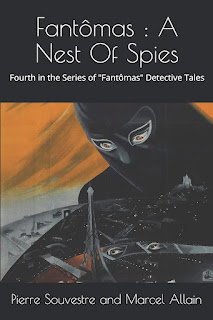
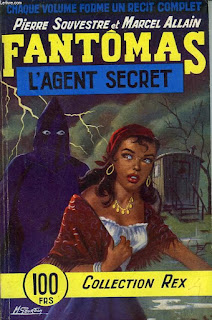
Fantômas: A Nest of Spies (L'Agent Secret)
Fantômas: A Nest of Spies (originally published in 1911 as L'Agent Secret) is the fourth of the original series of Fantômas novels.
Fantômas is a diabolical criminal mastermind created by French writers Marcel Allain (1885–1969) and Pierre Souvestre (1874–1914). They wrote thirty-two Fantômas novels between 1911 and 1913. Allain wrote several more Fantômas novels in the 1920s. There have been Fantômas movies and Fantômas comics.
Fantômas is to French popular culture what Dr Mabuse is to German pop culture, or what Professor Moriarty is to British pop culture.
Fantômas has two deadly enemies - Inspector Juve and crusading journalist Jérôme Fandor. Juve and Fandor have devoted years of their lives to the project of bringing Fantômas to justice. But Fantômas is like Dr Fu Manchu. Nayland Smith can foil Fu Manchu’s plans and destroy his criminal operations but we know that he will never succeed in destroying Fu Manchu or bringing him to justice. Fu Manchu will always slip away, and he will always rebuild his organisation. And, in the same way, Fantômas will always manage to escape Juve’s clutches.
When this fourth novel opens Fantômas has been quiet for a while. Perhaps he has left France. Perhaps he is dead. Perhaps, after suffering defeat at the hands of Juve and Fandor, he has decided to retire from crime.
This fourth novel begins with a French artillery captain who has fallen hard for a very pretty girl, known to her friends as Bobinette. Captain Brocq has in his keeping certain top secret documents, vital to national security and all that stuff, and he finds to his dismay that one of the documents seems to have vanished. It was there a moment ago, just before Bobinette gathered up some letters of hers that Brocq had been, indiscreetly, keeping. Could Bobinette have gathered up the secret document by mistake along with the letters? That must be the explanation. The other explanation, that Bobinette stole the document, is unthinkable. A sweet young girl like Bobinette could not possibly be a spy. Either way Captain Brocq has to get that document back so he sets off in pursuit of his pretty mistress. And the hapless captain then loses his life in bizarre circumstances.
Inspector Juve is called in to investigate.
Journalist Jérôme Fandor is also taking an interesting in the case. He and Juve are old friends, their friendship being strengthened by their past shared struggles against the arch-criminal Fantômas. Juve sees the hand of Fantômas in the murder of Captain Brocq and it’s true that the bizarre murder method is the sort of thing that would appeal to Fantômas. Fandor however believes it’s just a simple case of espionage, although of course espionage is rarely simple.
There certainly is a vast espionage plot at the back of Captain Brocq’s murder. A number of young French officers have been ensnared by pretty but unscrupulous women. They are drawn into the web of espionage gradually. At first the information they’re selling seems so trivial as to be completely harmless. But soon they are being called upon to sell vital secrets.
Juve and Fandor conduct parallel investigations and at times it has to be said that they find themselves at cross purposes. In addition to the police involvement the military intelligence services (the Second Bureau) are investigating the case. The police and the military intelligence people dislike and distrust one another and are constantly getting in each other’s way. Juve doesn’t like the Second Bureau anyway but in this case he suspects that they’ve been infiltrated by foreign spies or possibly even infiltrated by Fantômas’s organisation.
One of the conventions of pre-First World War crime and spy fiction is that you can’t be a proper great detective or a proper great villain unless you are a master of disguise. The detectives and the villains assume a bewildering range of disguises and nobody ever manages to penetrate those disguises. It’s a convention that some modern readers find off-putting, while others find that it adds a certain period charm. In this novel Allain and Souvestre have their characters assuming so many disguises that one can’t help suspecting that at times they’re being a bit tongue-in-cheek.
The disguises are however vital to the story. It is essential that the relevant authorities should be totally bewildered and it’s essential that even Juve and Fandor should become hopelessly confused. And even Fantômas occasionally gets taken in by disguises assumed by the good guys.
And Fantômas doesn’t just adopt disguises - at times he wears a sinister mask and cloak.
The tone of the novel is one of breathless excitement with an endless succession of unlikely and bizarre events, impossibly narrow escapes and hopeless misunderstandings. Juve and Fandor both manage to get themselves arrested.
There are romantic complications as well. There are several romance sub-plots and naturally the course of true love is beset by endless misunderstandings and deceptions.
The plots of the Fantômas novels are ludicrously contrived. They’re incredibly pulpy. They’re much less sophisticated in a literary sense than Sax Rohmer’s Fu Manchu novels. The Fantômas novels probably had more influence on the world of comics than on the world of pulp fiction. They were a definite influence on the adult-oriented comics that became popular in Europe in the early 1960s (such as the Italian fumetti Neri comics) and a definite indirect influence on 60s movies such as Barbarella and Danger: Diabolik. You could possibly even argue that they had an indirect influence on the Bond movies, especially as the Bond films moved further and further away from realism.
The Fantômas stories are among the foundational texts of modern pop culture. For that reason it is essential to read at lest a couple of them. And once you get into the swing of them they’re great fun.
I also very highly recommend the 1964 Fantômas movie.
Friday, May 27, 2022
Nick Carter, The Cypher Letter
The Cypher Letter is a Nick Carter mystery.
Nick Carter is a fictional character with an intriguing history. He began life as a Sherlock Holmes-style detective in dime novels between 1886 and 1915. The character was revived in pulp magazines in the 1920s and again in the 1930s (this time as a hardboiled detective). In the 1960s he was revived yet again as a James Bond-style secret agent in the long-running Killmaster series of novels which were still being published as late as 1990. There have been various Nick Carter movies and radio serials.
The Nick Carter stories have always been credited to Nick Carter as author but in fact many different writers wrote Nick Carter adventures over the years.
I have no idea when The Cypher Letter was written but the fact that it takes place in New York but there’s not a single mention of cars or telephones leads me to suspect that it’s a pretty early story, possibly from the 1890s.
Nick Carter’s wife has come across a cypher letter the significance of which is unknown. At the same time Nick’s pal, Inspector Byrnes, has received an anonymous letter which claims that a serious crime has been committed in the Kempton mansion. These two letters do not appear to be connected but of course they are.
Old Archibald Kempton is blind but he’s extremely rich. He lives with this two daughters (who bear no resemblance to one another in looks or personality).
A child has been kidnapped but it’s not obvious how that ties in. Nick spots a smooth-talking gent leaving the Kempton mansion and suspects he could be worth following. The gent is Mortimer Guernsey and Nick’s suspicion that he is mixed up in this case proves to be well-founded.
Nick does some shadowing of suspects and he gets shadowed in turn, and that nearly costs him his life.
This early version of Nick Carter is very much an American Sherlock Holmes. Holmes was a master of disguise, so Nick Carter is a master of disguise. There’s a Sherlock Holmes stories about cyphers so here we get a Nick Carter story about cyphers. The disguise stuff is really overdone, to the point where at times it seems that disguise is the only detective technique of which Nick is aware.
The plot is outrageously melodramatic with some very far-fetched elements and lots of unlikely coincidences. And of course hair’s-breadth escapes from certain death.
This incarnation of Nick Carter is definitely not hardboiled nor is he a tough guy but he is just a bit more of an action hero than Holmes. He definitely has an American flavour.
This very short novel is interesting mostly for historical reasons. It’s a glimpse into the world of the American dime novel. And of course it gives us a sampling of the first version of a character who just kept bouncing back in different forms, and a character who was one of the first popular American fictional detectives. If you’re a serious student of the history of crime fiction you need to sample at least one Nick Carter story. Apart from that historical interest it doesn’t have all that much to recommend it although you might get some amusement from the outlandishly melodramatic plot. So maybe worth a look but with quite a few reservations.
This book seems to be obtainable only in a print-on-demand form which is riddled with distracting typographical errors.
Wednesday, December 2, 2020
The Citadel of Fear
Gertrude Barrows Bennett (1884-1948) had a very brief career writing for the pulps from around 1917 to around 1919. At the time her work was widely praised by luminaries such as A. Merritt. Most of her fantasy/science fiction/weird fiction was published under the pseudonym Francis Stevens. She seems for some reason to have stopped writing in 1919. After that she disappears into complete obscurity. Until recently even the date of her death was unknown.
Her best-known novel, The Citadel of Fear, was reprinted in 1952 and her reputation slowly revived. She is now considered to be one of the most important female writers of fantasy of her era. The Citadel of Fear is a lost world story and that happens to be one of my favourite genres. The Citadel of Fear was originally serialised in the pulp magazine The Argosy in late 1918.
Two prospectors, a tall Irishman named Colin O’Hara (usually known as Boots) and a man named Kennedy, are lost in the desert somewhere in Mexico. Just when it looks hopeless for them they stumble upon a hidden valley. There’s not supposed to be any trace of civilisation anywhere in the vicinity but here is a fertile valley full of cultivated crops and a large hacienda.
There is something slightly odd about all this. The owner of the hacienda is not Mexican but a Norwegian-American and he gives the impression of being just a trifle secretive.
In fact the two prospectors haven’t just stumbled into a hidden valley, they have discovered a whole lost civilisation. A Pre-Columbian Mesoamerican culture, with vast temples and cities. And (of most interest to Kennedy) gold. This is the legendary land of Tlapallan. And they’ve also blundered into a power struggle between the priests of Quetzalcoatl and the priests of Nacoc-Yaotl.
While Kennedy is interested in the gold O’Hara is more interested in the moth girl. What gets Kennedy into trouble is not the gold but witnessing a religious ritual, something forbidden to outsiders. What gets O’Hara into trouble is a combination of his fascination for the moth girl, his natural chivalry and his impetuosity. These two outsiders could unwittingly start a civil war. A civil war that could involve gods taking sides.
There are some nice touches to this lost world, such as the lake. I won’t spoil things by telling you what’s strange about the lake. And the light is strange too. As in the best examples of this genre the author creates a lost world that really does feel odd and alien.
It’s only the first half of the story that takes place in Mexico. Then the scene switches to the United States, many years later, but the story is far from finished. There are monsters loose. Are they human or animal or maybe even supernatural? And there’s another strange other-worldly girl. Not the moth girl, but with the same ethereal beauty and the same oddness. She’s quite mad. At least that’s what O’Hara is told. He doesn’t seem to care, although he doesn’t really know why he’s drawn to her. Is there some memory at the back of his mind?
The latter part of the story, even without the exotic setting of the first half, has plenty of strangeness and it gets stranger. O’Hara has no idea why he has suddenly become caught up in such inexplicable and disturbing events. Again there’s an ambiguity - is this story science fiction or fantasy? Is O’Hara dealing with gods or men, with monsters or ghosts or science gone very very wrong?
He’s certainly dealing with evil, and possibly madness. A house of secrets which should have stirred some memories but perhaps not his memories.
There’s plenty of danger and action (this is after all pulp fiction), there’s some romance with a touch of weirdness and there’s some fairly visceral horror. There is at times just a slight Lovecraftian tinge although at this stage Lovecraft had only just started his weird fiction writing career so it’s more a case of Bennett and Lovecraft responding to similar literary influences.
The Citadel of Fear is a fine example of the lost world genre and it’s not surprising that it attracted the admiration of A. Merritt who would in the ’20s and ’30s explore similar territory. Highly recommended.
Subscribe to:
Posts (Atom)