Orrie Hitt’s Trailer Tramp, published by Beacon Books in 1957, falls into the trailer camp sleaze sub-genre. Trailer tramps had mushroomed across the United States in the 50s and gained a reputation as dens of iniquity. These were artificial non-permanent communities. The goings-on confirmed all the worst fears of small town America about the depravity that must invariably flourish when people don’t live in tight-knit communities in which their neighbours act of moral policemen to keep them on the straight and narrow.
Joan runs a successful trailer camp. She isn’t married. She was thinking of marrying Luke, until she discovered that Luke wanted to sleep with her. She was of course deeply shocked. Joan is a decent girl and decent girls don’t do such things. And she caught him with Nora, and Nora clearly isn’t a decent girl at all. Nora lets men do things to her. Shocking things. Nora is the type who allows men to Go All The Way, which no decent woman would ever do.
Joan does however need a man to help her run the trailer park, so (perhaps unwisely) she hires Luke. Also, perhaps unwisely, she allows Nora to rent a trailer to use for her massage business. It sounded harmless enough. With the members of a construction crew currently staying in the trailer camp Nora will get plenty of customers. The idea that a massage business could be anything but respectable has never occurred to Joan. Joan has led a very sheltered life.
The head of the construction crew is Big Mike, and she finds herself attracted to him although naturally her attraction to him is entirely innocent. She’s a decent girl. Then she discovers that after a few drinks even decent girls can become shameless tramps. She is paralysed with guilt and shame, but all is not lost. Mike will marry her. He said he would. She is sure he is really a decent guy and when a decent guy sleeps with a girl he marries her. That’s how life works.
There are all kinds of potential complications. There’s Sally, an old flame of Mike’s, but that’s nothing to worry about. She knows that Mike isn’t interested in Sally any more. He told Joan this, and she knows she can trust him.
As you may have gathered Joan is as dumb as a rock. As a character she presents a slight credibility problem. It’s impossible to believe that anyone as naïve as Joan could run a trailer camp successfully. She is entirely oblivious to the possibility that anything immoral could possibly happen there.
Orrie Hitt was at his best when his books combined mild sleaze elements with very definite noir fiction elements. Hitt was very strong when it came to creating a noir atmosphere of overheated passions and betrayals.
There is some noirness here, as seemingly harmless incidents start to point to more sinister possibilities and Joan finds herself increasingly trapped. There’s no way out for her without a scandal. And in 1957 scandal was a fate worse than death.
Joan is torn between Luke and Mike and she is tortured by the knowledge that, as awful as it may seem, she feels physical desire for both men. She is sure that she can trust one of them but not the other. One of them is lying to her, the other is telling her the truth. Her problem is that she can’t figure out which of them is the one she can trust. And Hitt manages to keep the reader unsure on this point as well.
The sleaze factor here is so mild as to be almost non-existent, but in 1957 the very fact that unmarried people are having sex, even if the sex happens offscreen as it were, was enough to make a book titillating. And there are hints of prostitution, always good for a moral scare in the 50s (in fact rather depressingly it’s still good for a moral scare today).
This is not a crime novel, but eventually there is a crime, and a serious one.
This is not one of Hitt’s better books. It’s still fairly enjoyable and recommended to Hitt fans, and to full-blown trailer camp sleaze aficionados.
The Cheaters, the genuinely sleazy Wayward Girl, the very noirish The Widow and She Got What She Wanted are all better places to start if you’re new to Orrie Hitt’s work.
Trailer Tramp is included in Stark House Cult Classics’s three-novel Trailer Tramps paperback, along with Doug Duperrault’s Trailer Camp Woman and Tom Harland’s Love Camp on Wheels.
pulp novels, trash fiction, detective stories, adventure tales, spy fiction, etc from the 19th century up to the 1970s
Showing posts with label orrie hitt. Show all posts
Friday, June 21, 2024
Friday, December 8, 2023
Orrie Hitt's Dial ‘M’ for Man
Dial ‘M’ for Man is a 1962 novel by Orrie Hitt. Hitt is usually described as a writer of sleaze fiction but most of his books would be more accurately described as noir fiction with some added sleaze. Dial ‘M’ for Man is almost pure noir fiction.
Hob Sampson runs a TV repair business in a small town. The business is doing pretty well. He has a nice girlfriend named Kathy.
Hob is a very ordinary sort of guy. He’s honest - he would never cheat a customer. He’s no intellectual but he’s far from dumb. He Iikes a few beers when he gets the chance but he definitely does not have a drinking problem. He hasn’t slept with Kathy because she’s a nice girl and nice girls don’t do that sort of thing. That doesn’t bother Hob too much. He’d like to sleep with her but he’s prepared to wait. In the meantime he occasionally picks up women in bars but he’s not really a lecher. You couldn’t call Hob a loser but he’s not really a winner either. Hob is the kind of guy destined for a very ordinary life.
Then two people change his life forever. The two people are Doris Condon and her husband Ferris. Ferris Condon is a very rich very crooked builder. Years earlier Hob’s father had been a building inspector who had caused Condon a lot of trouble. He even refused to accept bribes from Condon. Condon has nursed a seething resentment about this for years. He can’t strike back against Hob’s father but he can strike at Hob. He has decided to ruin Hob. And he can do it. Ferris Condon is the most important man in the town. If he decides to ruin your business there’s nothing you can do.
Doris Condon is another matter. Doris is a blonde and she’s about twenty-two. Her husband is around forty years older. He bought Doris. That’s what it amounted to. She hates him but she’s not going to walk away from all that money. She’s a girl who likes money and the things that money buys. She and her husband have a kind of arrangement. If she wants something expensive he buys it for her. If he doesn’t then he doesn’t get to share her bed.
The trouble with Doris starts when Hob calls at the luxurious Condon home to fix their TV set. Condon isn’t home but Doris is. She’s wearing a dress that reveals more than it conceals. What it reveals is pretty enticing. Doris has a body that takes Hob’s breath away. The second time he calls she’s taking a swim and she’s wearing nothing at all. Once Hob has seen Doris’s naked body he is helpless. He will do anything to have her.
There are other complications that suddenly arise in Hob’s life. Things have become very strained with Kathy, and then there’s his former business partner Ben. Ben really is a loser.
Hob is not stupid. He knows that getting involved in any way with Doris would be crazy. But then he starts thinking about that body of hers, and his judgment goes out the window. When she asks him to do something for her he agrees, even though he knows it’s insane.
The plot setup is classic noir fiction stuff although noir purists might not be entirely satisfied with some aspects. It’s worth pointing out that nobody in 1962 was consciously writing noir fiction because nobody in 1962 had even heard of noir fiction. Which means that no writer at that time had any idea that critics several decades later would come up with conventions with which they thought noir fiction should conform.
Hob is certainly a typical noir protagonist, a reasonably decent guy with one big weakness that leads him astray. In this case that weakness is blondes. There are several female characters and at least one qualifies pretty definitely as a femme fatale. The novel also takes it for granted that rich powerful men like Ferris Condon will weave a web of corruption around them.
Hitt’s characters have some complexity. Hob’s friend and former business partner Ben is dishonest and a loser but he has enough awareness of his own flaws to make him not entirely unsympathetic. Hob is tempted into doing things that he knows are wrong but he worries about it. He doesn’t want to do these things but somehow he finds himself doing them anyway and then he feels bad. The women characters mostly have motivations that seem to them to be entirely reasonable.
I’d be a bit dubious about describing this book as sleaze fiction. Characters in the book do have illicit sex but the sex takes place off-stage so to speak. There is however a somewhat sleazy atmosphere.
Dial ‘M’ for Man is typical Orrie Hitt and that’s no bad thing. Highly recommended.
Wednesday, October 18, 2023
Orrie Hitt's The Cheaters
The Cheaters is a 1960 sleaze noir novel (actually much more noir than sleaze) by Orrie Hitt, published by Midwood Books in 1960.
Orrie Hitt (1916-1975) wrote around 150 novels, most of them sleaze fiction. But the Orrie Hitt brand of sleaze fiction had its own flavour. It was sleaze heavily laced with noir. In fact it was often a lot more noir than sleaze. Hitt deserves to be regarded as one of the premier noir writers of the 50s and 60s but he has never gained the respect due to him.
You couldn’t wish for anything scuzzier and grimier and more noirish than The Cheaters.
Clint (the narrator) and his girlfriend Ann have just blown into town. They grew up on farms which is why they now want nothing whatever to do with farming or farm country. They both need jobs badly and Clint gets lucky. Tending bar usually pays fifty or sixty bucks a week but he lands a bartending job that pays seventy-five. Ann is delighted. Soon they’l be able to afford to get married. What she hasn’t realised yet is that Clint has no intention of ever marrying her. Clint is no good but she hasn’t figured that out yet either.
Charlie Fletcher owns the bar. The bar is in the Dells, the worst part of the city. It’s a slum, and a particularly pestilential slum. Nobody who lives in the Dells is any good. Clint doesn’t like the Dells at all but in fact he’s as rotten as all its other inhabitants. Most of the bar’s profits come from prostitution rather than selling liquor. It’s a very profitable business. The one fly in the ointment is Red Brandon. He’s a cop and even by the standards of corrupt cops he’s a nasty vicious piece of work. He demands, and gets, a big slice of the action. But even after paying off Brandon the bar is a major money-maker.
Charlie is married to Debbie. She’s thirty years younger than Charlie. Debbie has the most impressive breasts Clint has ever seen. All Clint can think about is getting her into bed.
Charlie wants to sell up his business interests. He offers Clint a great opportunity to take over the bar. It’s a goldmine. He’ll still have to pay Brandon but Clint doesn’t think that will be a problem.
Clint’s life gets very complicated. Ann gets pregnant and starts pressuring him to marry her. Clint has started a torrid affair with Debbie Fletcher. He wants her to divorce Charlie but she won’t do it. Brandon wants bigger and bigger pay-offs. The city starts a crackdown on prostitution. There are rumours of a docker’s strike (which will cut into Clint’s liquor sales). What seemed like a golden opportunity now seems more and more like a trap. The walls start closing in on Clint. And he starts to think about desperate solutions.
When we talk about noir we have to bear certain things in mind. Nobody in 1960 was consciously writing noir fiction, just as nobody in the 1940s was consciously making film noir. The idea that there was such a thing as film noir did not gain currency in the US until the 1970s and the concept of a noir fiction genre is even more recent. We can look at a book like The Cheaters and agree that it ticks most of the noir fiction boxes but when he write it Orrie Hitt would have thought he was just writing a hardboiled crime story with enough sleaze content to get it accepted by Midwood Books. The Cheaters does however very definitely tick most of those noir fiction boxes.
Clint is a very unsympathetic protagonist. He’s a drunk. He isn’t very honest. He treats Ann very badly (and she really loves him). He’s having an affair with another man’s wife. And in between he sleeps with some of the prostitutes operating out of his bar. We feel that a lot of his troubles are his on fault but as those troubles multiply we can’t help feeling a bit sorry for him, just as we would feel sorry for a rat caught in a trap.
There aren’t very many admirable characters in this tale. Ann perhaps, and Martha (one of the whores working out of Clint’s bar).
The book deals with sleazy situations but the sex scenes are incredibly tame.
The Cheaters is prime Orrie Hitt. Highly recommended.
The Cheaters has been reprinted by Stark House in a double-header paperback edition (paired with Dial 'M' For Man).
Wednesday, May 17, 2023
Orrie Hitt's As Bad As They Come
As Bad As They Come is a 1959 noirish sleaze novel by Orrie Hitt. It was reprinted in 1962 under the title Mail Order Sex. It was reissued in 2012 by Iconoclassic Books, under its original title.
Orrie Hitt (1916-1975) was a prolific American writer of sleaze fiction but he was more than that. Quite a bit of the sleaze fiction of the 50s and 60s was written by guys who were temporarily slumming it and would go on to have distinguished careers on other fields. Guys like Robert Silverberg, Donald E. Westlake and Lawrence Block. Others spent their whole careers writing sleaze. Orrie Hitt belongs in the latter category, but don’t let that give you the idea he was a mere hack. In his own way he was an artist. And more often than not his novels were as much noir fiction as sleaze fiction. It might be most accurate to describe Hitt as a writer of sleaze noir.
As Bad As They Come is the story of a man named Art who works for a mail order company owned by Horace Stone. It’s a precarious business but lucrative if you knew what you were doing. Horace Stone’s mail order business is very much a thriving concern. And Stone has told Art that he’s planing to retire and that Art can take over the business. Art, like so many noir protagonists, is a guy who sees himself as being on the way up.
Art gets a very generous salary. He’s married to Alice. He makes more than enough to keep them in security and comfort but strangely enough they’re only just keeping their heads above water. The reason is simple. He makes $350 a week but tells Alice he makes two hundred. The rest he keeps for himself. He needs it to finance his hobby. His hobby is women. He has slept with most of the girls in the office. The trouble with women is that if you’re going to sleep with them it can be expensive - buying them dinner, buying drinks (lots of drinks), paying for hotel rooms and so forth.
He’s not worried. The business will be his one day. He’ll have lots of money. He’ll have a Cadillac and a fancy house and a swimming pool. And he’s careful with the dames. He’s careful not to get them into a jam.
Then his latest lady friend, Linda, tells him she’s pregnant. This is a tough break for Art. Even worse, she refuses to have an abortion. And worse still, she wants him to divorce Alice and marry her. He has no intention of doing this.
And then there’s Alice’s sister Sandy. She’s nineteen and she’s got everything a woman should have and all in the right places. Art and Sandy have started sleeping together. Another complication is Jean Carter. He met her on the train and he’s sleeping with her as well. Art is staring to think that maybe he has too many women.
Then Horace Stone tells Art about his latest idea for the business. He wants to branch out into mail order nudie pictures. In puritanical 1950s America where just about everything that made life enjoyable was illegal this is somewhat risky but Horace has talked to a lawyer who has assured him that as long as they’re careful there won’t be problems with the cops.
Clearly Art’s life is a house of cards that could come crashing down at any moment but Art is a guy who doesn’t like to think about unpleasant things. He’s also a guy who figures that the best way to deal with a problem is to ignore it and hope that things will work out. He’s a guy he writes a cheque and doesn’t worry about whether he has enough money in the bank to cover it. He’ll worry about that when the time comes.
Art is like a lot of Hitt’s protagonists. He’s clever, but not as clever as he thinks he is.
This is typical Orrie Hitt stuff and that’s no bad thing. There’s a sleazy atmosphere but there’s quite a bit of noir atmosphere as well as Art becomes more and more trapped by the situations he’s landed himself in.
A good Orrie Hitt novel. Highly recommended.
Thursday, March 2, 2023
Orrie Hitt’s She Got What She Wanted
Orrie Hitt’s 1954 novel She Got What She Wanted is fairly typical of a lot of his work. It’s a blend of noir fiction and sleaze fiction.
Orrie Hitt (1916-1975) wrote around 150 novels, most of them paperback originals. He started his career writing crime novels. Much of his sleaze fiction is in fact crime fiction with often a very strong noir fiction flavour. When he switched genres all he really did was to add strong dashes of sleaze to what he was already doing. It’s always a mistake to assume that the writers of sleaze fiction were untalented hacks. Many were very talented writers who went on to have illustrious careers in other genres. And even those who were never able to escape the sleaze fiction ghetto were often very fine writers. That certainly applies to Orrie Hitt. His books compare quite favourably to most of the noir fiction of the 50s and early 60s.
Della Banners is around twenty and she hasn’t had much of a life. She lives on a run-down farm just outside a small hick town. Her father Chuck is a likeable enough guy but he hates work and he’s always cooking up crooked schemes to get money without working for it. He’s not very successful at it. He has a whole bunch of finance companies pursing him. Della has had enough. She’s leaving and heading for the big city. Well, not exactly the big city. Port Benton isn’t big and it isn’t much of a city. She’ll need a job, and they’re hard to come by.
Then Jack turns up on her doorstep. Jack is a salesman for a shingling company. They have two types of salesmen. The canvassers make the initial approach and persuade people to talk to the other type of salesmen - the closers. The closers. The closers are the ones who get the customer to sign on the dotted line. Jack figures that Della would be an ideal canvasser. Della thinks it sounds like a promising way to earn a living. The Wyandot company isn’t exactly honest and it’s not exactly crooked.
Della doesn’t care. Money is money. She wants money. She knows that with her stunning looks and spectacular figure she won’t have much trouble attracting customers for the company. She turns out to be an amazingly good saleswoman.
Jack is a slight complication. They sleep together off and on (he’s married but that’s no obstacle) and she’s not sure if she really cares about him. She is sure that she cares about money.
Gaining promotion with the company proves easy. The combination of her sales skills and her bedroom skills makes sure of that. She isn’t troubled by the idea of using her body to get ahead.
She and Jack have figured out that they can make a lot of money honestly, and even more money dishonestly. Defrauding customers if profitable and defrauding the company is even more profitable. It’s just a matter of how long they can get away with it, and how long before her complicated relationship with Jack gets just too complicated.
Della is definitely a bad girl. She’s a crook and she’s no more honest in her personal relationships than she is in her business dealings. We don’t entirely lose sympathy for her however. It isn’t surprising that her upbringing has made her cynical, and has made it difficult for her to make an emotional commitment. She assumes that people will let her down, because her family always let her down, and she doesn’t see much reason to care about people. And, to be honest, her experiences with people since she left the farm would not encourage anyone to take a rosy view of human nature.
She has a nice apartment, a fancy car and expensive clothes but she’s never satisfied. Maybe more money will make her happy. She doesn’t really consider the possibility that she might be unhappy no matter how much money she has.
The book has a sleazy atmosphere and there’s plenty of sex going on but we don’t get even moderately graphic descriptions. Sleaze fiction in the 50s was like strip-tease in the 50s - it was all about the tease.
She Got What She Wanted is really pure noir fiction. It deals a good deal with sex, but then sex is one of the main drivers of the action in a very large proportion of noir fiction. As noir fiction She Got What She Wanted is excellent, with a memorable noir heroine (or at least noir protagonist since she’s hardly a heroine). Highly recommended.
Tuesday, August 2, 2022
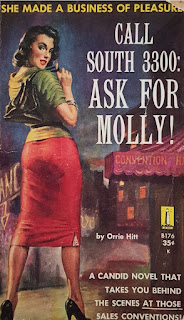
Orrie Hitt's Call South 3300: Ask For Molly!
Call South 3300: Ask For Molly! is a 1958 sleaze novel by Orrie Hitt, one of the most prolific and interesting writers that genre produced.
Slade Martin is the sales manager of the All-Channel TV company. They make TV sets. They were one of the most successful companies in the industry but they’ve been on a downward spiral. The general manager, spends all his time at the golf course. Their sets are outdated and look stodgy. Sales are plummeting. Slade knows that he’s the only man in the company who can turn the business around. The first step is to get a big order from a distributor named Kane. The upcoming sales convention will be the opportunity. Slade has an idea how he can get that order. All he needs is the right girl to butter up Kane.
The obvious choice would be the new girl in Accounting, Ann Frank. Ann is a gorgeous classy blonde. Slade is pretty obsessed by her. He’s an inveterate womaniser but this girl is something special.
Slade is sleeping regularly with his secretary Betty but it doesn’t mean anything to him. She has a nice body, that’s all. He’d much rather have Ann.
There are things he doesn’t know about Ann. The first time Ann slept with a boy it was like a whole new world opening up for her. She really really likes sex. In fact she likes it so much that she does it professionally. Ann is a call girl, working for Molly. She only keeps the job at All-Channel because she’s fallen for Slade.
Slade goes ahed with his plan to get that big order from Kane. He doesn’t actually expect her to sleep with Kane, she’s just supposed to string him along, but Ann takes the assignment more seriously than that. There’s a $500 bonus in it for her if she gets that order out of Kane and to Ann there’s no difference between turning tricks for Molly and turning tricks for the All-Channel TV company.
Things get very complicated. Ann and Slade sleep together but to Ann’s horror she feels nothing. She was thinking in terms of marrying him but to her it seems dishonest to marry a man and then pretend to be experiencing sexual bliss when she feels nothing.
Ann doesn’t feel anything when she sleeps with Slade but she feels a whole lot when she sleeps with bad boy Eric. Eric is a creep and a loser and couldn’t hold down a job under any circumstances and Ann understands that but he drives her wild in bed. She has no illusions about him. She plans to turn Eric into a kept man.
But nothing works out the way they’d expected for Ann or Slade, or for Betty, or for Eric.
This is full-on melodrama. It’s melodrama with sleaze but this was 1958 so while there’s plenty of sex going on we don’t get any graphic descriptions of the sex. We don’t get any descriptions of it at all. There’s an atmosphere of sleaze and lust and thwarted passion and twisted love but when the characters enter the bedroom we have to imagine what they might be getting up to.
None of these characters is especially likeable but they’re not unlikeable either. They’re a mixture of good and bad, strength and weakness, cynicism and romantic ideals. And of course this was the 1950s so it’s taken for granted that prostitution is wicked. Having said that Hitt offers us a surprisingly sympathetic portrayal of a call girl. She’s not a mere bad girl.
The novel certainly takes a jaundiced view of business ethics. And kind of dirty trick is justified if it increases sales. The only strategy that All-Channel TV doesn’t consider is making better TV sets. In fact this book deals with two different businesses, respectable businesses like manufacturing TVs and prostitution. Prostitution comes across as being the more honest business. Ann at least takes pride in her work as a call girl. She makes $100 a trick (which in 1958 would have made her a very expensive high-class call girl) but she gives her customers their money’s worth. The only dishonest acts she performs are on behalf of All-Channel TV. Compared to the people running that company Molly (the madam for whom Ann works) is a model of honesty and integrity. Molly never asks Ann to do anything crooked.
The one puzzle that is never solved in this novel is why Ann can’t get aroused when she has sex with a guy who wants to marry her. We can of course offer our own speculations on that subject but Hitt leaves it an unanswered question.
Call South 3300: Ask For Molly! is fairly typical Orrie Hitt, and that’s no bad thing. Highly recommended.
This novel has been published in a paperback edition from Stark House which includes three Beacon Books sleaze classics (the others being N.R. de Mexico’s Marijuana Girl and Elaine Dorian’s Sex Cure).
Friday, January 14, 2022
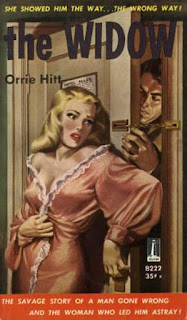
Orrie Hitt’s The Widow
Orrie Hitt (1916-1975) was one of the many authors who made a living in the 50s and 60s writing paperpack sleaze novels. Hitt wrote of lot of those novels. The sleaze fiction of that era is actually somewhat varied. Some sleaze novels are sex melodramas, some are risqué romances, some are juvenile delinquent potboilers and many cross the line into noir fiction territory. Some of them can be regarded as the literary descendants of James M. Cain’s 1930s novels such as Double Indemnity and The Postman Always Rings Twice.
In fact the dividing line between the noir fiction and the sleaze fiction of that era is largely artificial. If it got published by Gold Medal people will consider it noir and if it got published by Midwood people will consider it sleaze.
Orrie Hitt’s The Widow dates from 1959, and it has a definite James M. Cain atmosphere. Jerry Rebner was once an ordinary happily married young man with a future. That all ended when his wife was killed in an auto accident. Since then he’s been a drifter. As long as he can earn enough money to keep himself supplied with liquor and women (and the more liquor and women the better) he can stop himself from remembering. Jerry is not quite an anti-hero but he’s no hero either. He’s become a loser and his self-pity has made him selfish. He doesn’t want love from women, just sex.
Now he’s been fired from his job working Mr Sparks as a construction worker and he’s working for a lousy forty bucks a week in a hotel in a place called The Dell, working for a Mrs Sprague. He washes dishes and scrubs floors. He could earn a lot more money as a construction worker. He took this job for one reason. Her name is Linda.
Linda is married to Frank Sprague, Mrs Sprague’s son. Frank is only interested in two things - drinking beer and working on his hot rod. Linda has long since ceased to love him. She does however have her reasons for staying with him. Linda is young and beautiful and Jerry is pretty interested in her. Mostly he’s interested in her for the reason he’s interested in women in general. He wants to go to bed with her. This time however it might be just a little bit more than just sex.
Persuading Linda to go to bed with him doesn’t prove to be too difficult. The fact that she’s a married woman doesn’t bother him. In his experience the sex is always particularly good with married women, if they’re unhappily married. Maybe there was a time when Jerry might have been bothered by the morality of bedding married women but those days are long gone. Since his wife was killed he just lives for immediate sensual gratification.
There is a complication. Norma Sparks, the daughter of his former employer. Norma is even more gorgeous than Linda. Norma is a model. A nude model. Jerry has seen the pictures of her in a men’s magazine. He likes what he saw. He wants some of it. Trying to get involved with Norma when he’s already involved with Linda isn’t a very smart thing to do but after seeing those nude pictures he doesn’t care.
There’s a much bigger complication. Sex can be a huge motivating factor but the lure of money can be even stronger. And there’s a lot of money which seems to be there for the taking.
Sleaze novels can be very noirish but since they’re not quite pure noir you can never be sure just how dark they’re going to get. You might get a happy ending or a tragic ending. At times these novels seem like they’re heading towards crime fiction territory but they don’t always go all the way in that direction. But sometimes they do. I’m certainly not going to give you any hints as to where this one ends up.
As is the case with most 1950s/early 1960s sleaze fiction there’s no graphic sex whatsoever. We know the characters are having sex but there are no descriptions of the sexual acts at all. The sleaze factor comes from the idea that people might actually have recreational sex, and that married women might have sex with men other than their husbands.
The noir atmosphere is stronger. Jerry is a guy entirely driven by his desire for sex and booze. He cannot think ahead at all. Since his wife’s death his horizons are limited to the next thirty seconds. His judgment is atrocious and he assumes that everyone else approaches life the way he approaches it. He assumes that all women are as driven by lust as he is. Now, for the first time in years, he has to consider that a woman might have needs that cannot be satisfied in the bedroom but this glimmer of awakening just makes his judgment even more questionable.
The Widow has been re-issued by Stark House in their series of noir reprints, in an edition that also includes another Orrie Hitt sleaze classic, Wayward Girl (which is a much sleazier juvenile delinquent melodrama that also has a definite noir vibe).
There’s certainly a very sleazy desperate atmosphere to The Widow. It’s likely to appeal more to noir fans than to sleaze fans. Recommended.
Labels:
1950s,
H,
noir fiction,
orrie hitt,
vintage sleaze
Saturday, August 22, 2020
Orrie Hitt's Wayward Girl
Orrie Hitt (1916-75) was one of the many prolific writers of American sleaze fiction of the ’50 and ’60s. He wrote around 150 such books. Wayward Girl dates from 1960 when the genre was at the height of its popularity.
Wayward Girl tells the story of Sandy Greening, a sixteen-year-old prostitute and gang member. Sandy was raped when she was fourteen and she liked it (this is of course a very politically incorrect book). After that she couldn’t get enough of men. Especially when she discovered she could take money out of having sex, thus combining business with pleasure.
She runs with the Blue Devils and they’re about to have a rumble with their hated rivals, the Black Cats. The Black Cats gang-raped one of the Blue Devil debs. That’s bad enough, but the rape occurred on Blue Devil turf. That’s much more serious. It’s a rumble which ends with one of the Black Cats dead.
Sandy doesn’t like killings but that doesn’t stop her from sleeping with the gang member who did the killing. And sex with Tommy Forbes is real nice. He’s a violent thug but that’s why the sex is real nice.
Sandy’s luck is about to change. She usually gets five dollars a trick (just enough to sustain her heroin habit) but this time the guy is willing to give her twenty-five bucks. Life is good. Or it would be, except that he’s an undercover cop. So instead of twenty-five bucks she gets six months in reform school. But this is one of the new enlightened reform schools where they really want to help the girls. She’s assured that everybody there wants to help her. They’ll teach her a skill (apart from the one that landed her in the reform school) and how to live a decent life and she’ll be able to get married and have kids and make a better America (that’s what they actually tell her).
Up to this point the book reads disturbingly like a social work treatise but don’t worry, the cynical twists are just around the corner and the sleaze factor is about to be ramped up.
Miss Hunt is the house-mother in charge of the cottage to which Sandy is assigned. Miss Hunt really wants to help her girls. She’s pretty young herself, in her early twenties, and she’s kind and idealistic. Only she looks at Sandy sorta funny. You know, the way men look at women. She tells Sandy that Sandy has really nice breasts. They’re so nice that Miss Hunt wants to touch them. And she likes to see Sandy naked. And to kiss her. And to do other things to her. Sandy is horrified but Miss Hunt is the one who will decide if she gets parole or not.
In fact the school is a hot-bed of lesbianism. Miss Hunt assures Sandy that this is OK, girls need loving and if they don’t get the kind of loving they prefer any kind of loving is better than nothing. And lots of the girls like this strange sort of loving.
One of the school’s enlightened ideas is to send the girls to nice families for weekends. Lots of families are willing to take the girls. Middle-aged couples like the Ridgeways. Mr Ridgeway is a middle-aged man but he’s really keen to help wayward girls. I mean, having sex-crazed sixteen-year-old girls spend a weekend with nice middle-aged men whose wives don’t understand them - what could possibly go wrong?
So while at the reform school Sandy actually has sex more often than she did when was a prostitute on the outside. The only difference is that now she doesn’t get paid for it.
Sandy is in the biggest trouble she’s ever been in. She’s trapped. She can’t escape the sexual attentions of either Miss Hunt or Mr Ridgeway and then when she gets there’s going to be problem of Tommy Forbes and the Blue Devils. She can’t escape either her past or her present nightmares.
Compared to Gang Girl by Robert Silverberg (written under the pseudonym Don Elliott) the sex in Wayward Girl is less graphic, the rapes take place offstage so to speak and the violence is toned down a little. The whole tone is rather different as well. The heroine is more of a conventional victim of circumstances rather than being the depraved monster of Gang Girl. The two novels do however have a number of things in common - the casual senseless brutality of gang life, the atmosphere of sleaze and a honest acceptance of the reality of female sexual pleasure in casual sex. Which was not the sort of thing that was considered respectable at the tie, but then these novels are not concerned with respectability.
Both books also belong to the same milieu as the exploitation movies of the same era - glorying in trashiness and depravity while covering themselves by appearing to deplore such things and occasionally treating their subject matter with an honesty and directness not found in the mainstream of either cinema or literature. And like exploitation movies, they’re great fun. Not clean wholesome fun, but fun nonetheless.
Wayward Girl has been re-issued by Stark House in their series of noir reprints, in an edition that also includes another Orrie Hitt sleaze classic, The Widow.
Wayward Girl is obviously recommended to sleaze fans but noir fans may find themselves enjoying it as well.
Subscribe to:
Posts (Atom)