The Wind-Up Doll, published in 1964, is the sixth of Carter Brown’s Rick Holman mysteries.
Australian author Alan Geoffrey Yates (1923-1985) wrote more than two hundred novels and seventy-five novellas using the pseudonym Carter Brown. His books sold well over a hundred million copies. One of his many series characters is Hollywood troubleshooter/private eye Rick Holman. The studios, and the stars, employ Rick whenever they need a very very discreet private eye to get a star out of an awkward spot and avoid scandal.
Toni Astor is a rising movie star. She is twenty-one years old but really she’s twenty-one going on twelve. She was adopted by her aunt Naomi who steered her on the road to stardom. Toni is about to get married for the second time, to the latest pop singer sensation Larry Gold. Her manager has hired Rick to do some digging into the singer’s background. He just wants to make sure Toni doesn’t make a second disastrous marriage.
Rick gets to meet Toni’s cousin Lisa. The two cousins hate each other.
There have been some shady goings-on regarding the careers of both Toni Astor and Larry Gold. Both the film and music businesses are awash with crooked producers, managers, financiers and talent agencies and the careers of both Toni and Larry are complicated webs of dubious deals. And there are complicated webs of family jealousies and family hatreds.
And then the accident happens. A fatal accident. Seventy-foot falls into empty swimming pools usually are fatal.
The police are satisfied that it was an accident. Rick is not so easily satisfied. There are so many potential financial and personal motivations that might be temptations for murder. The problem is trying to make sense of those webs of personal and financial entanglements.
Toni is a nice enough girl but she’s immature and unstable and she knows how to make use of her considerable sexual allure. She certainly qualifies as a dangerous dame who should not be trusted too far. Her cousin Lisa and her mother Naomi seem just as dangerous and just as unpredictable.
Most of those involved in managing Toni’s career are either borderline gangsters or people who are accustomed to sailing very close to the wind when it comes to the law.
As you would expect in a Carter Brown novel there’s quite a bit of sleaze. There’s glamour as well and Brown knows that sleaze and glamour is always an irresistible cocktail.
The plot is nicely twisty.
And as you expect in a Carter Brown story the plot motors along at a brisk pace and there’s some fine hardboiled dialogue.
The Wind-Up Doll might not be great literature but it is great pulp crime fiction and it’s highly recommended. And the Signet paperback edition has a great Robert McGinnis cover.
I enjoy all of Carter Brown’s stuff but the Rick Holman books are rapidly becoming my favourites. Sex, scandal and murder in Hollywood always works for me. I’ve also reviewed one of the later books in this series, Where Did Charity Go?
pulp novels, trash fiction, detective stories, adventure tales, spy fiction, etc from the 19th century up to the 1970s
Showing posts with label carter brown. Show all posts
Tuesday, September 15, 2026
Saturday, August 8, 2026
Carter Brown’s The Hong Kong Caper
The Hong Kong Caper, published in 1962, was the second of Carter Brown’s Andy Kane novels. Andy Kane featured in only three novels which is a pity because he’s a great character. The Hong Kong Caper is a partial rewrite of his 1957 novel Blonde, Bad, and Beautiful.
Andy Kane is based in Hong Kong. This was during the days of British rule in Hong Kong. It was a rather wild and wicked city. It’s a perfect setting for a Carter Brown thriller.
Andy Kane is not quite a private eye. He’s an entrepreneur with varied business interests, some of them legal. He’s a smuggler and an adventurer. The Hong Kong Police know all about him but they don’t consider him to be a particular menace to society. He might be a smuggler but he’s never touched dope and ordinary smuggling is not considered to be a big deal.
Glamorous brunette singer Natalie Dove offers Andy a proposition. It sounds like a tall tale. A Chinese Nationalist leader making his escape by air in 1944, carrying a million dollars in a briefcase, the plane crash-landing in Kwan-Po Bay, the pilot surviving but ending up in prison and passing on the story to a fellow prisoner. The pilot was Natalie’s brother. And she has a map showing the location of the sunken briefcase.
Andy stopped believing in treasure maps about the time he started wearing long pants. But then he gets another offer that seems vaguely connected. And then a third offer, once again with the story about the million dollars. This time the story is told by a glamorous blonde, Tess Donavan.
Andy still doesn’t believe it but he has been offered several thousand dollars up front. He does believe in money. So he figures he’ll play along.
After the murder and several encounters with very nasty hoodlums and an interesting conversation with Sub-Inspector Cross regarding a Chinese secret society Andy starts to get more interested. And he does owned a powered junk and a couple of sets of scuba gear. The briefcase should be in shallow water - no more than 12 feet deep.
The whole thing would be easy except that it’s in Red Chinese waters. Andy has entered Red China illegally before but it’s always a risky proposition.
Of course with two gorgeous dangerous dames involved you know things will get lively. Especially if the two dames hate each other. Plus each of the women has a partner in on the deal and the two guys don’t seem likely to be very trustworthy. And one man has already been murdered.
This is I guess a kind of caper story. There’s plenty of action involving guns, knives and spears. And Red Chinese patrol boats, and pirates.
Andy Kane is more morally compromised than Carter Brown’s other series characters. He’s basically a charming rogue. Combined with the exotic setting this makes The Hong Kong Caper great slightly disreputable fun and I have no idea why Brown apparently lost interest in the character. Perhaps he was increasingly focused on the American market and wanted to concentrate on thrillers with American settings.
I thoroughly enjoyed The Hong Kong Caper and I warmly recommend it.
I’ve reviewed quite a few of Carter Brown’s Al Wheeler mysteries including No Harp for My Angel as well as one of his Danny Boyd PI thrillers, The Savage Salome and one of the delightfully sleazy Mavis Seidlitz lady PI books, The Bump and Grind Murders. And also one of his books featuring Hollywood troubleshooter Rick Holman, Where Did Charity Go?
Andy Kane is based in Hong Kong. This was during the days of British rule in Hong Kong. It was a rather wild and wicked city. It’s a perfect setting for a Carter Brown thriller.
Andy Kane is not quite a private eye. He’s an entrepreneur with varied business interests, some of them legal. He’s a smuggler and an adventurer. The Hong Kong Police know all about him but they don’t consider him to be a particular menace to society. He might be a smuggler but he’s never touched dope and ordinary smuggling is not considered to be a big deal.
Glamorous brunette singer Natalie Dove offers Andy a proposition. It sounds like a tall tale. A Chinese Nationalist leader making his escape by air in 1944, carrying a million dollars in a briefcase, the plane crash-landing in Kwan-Po Bay, the pilot surviving but ending up in prison and passing on the story to a fellow prisoner. The pilot was Natalie’s brother. And she has a map showing the location of the sunken briefcase.
Andy stopped believing in treasure maps about the time he started wearing long pants. But then he gets another offer that seems vaguely connected. And then a third offer, once again with the story about the million dollars. This time the story is told by a glamorous blonde, Tess Donavan.
Andy still doesn’t believe it but he has been offered several thousand dollars up front. He does believe in money. So he figures he’ll play along.
After the murder and several encounters with very nasty hoodlums and an interesting conversation with Sub-Inspector Cross regarding a Chinese secret society Andy starts to get more interested. And he does owned a powered junk and a couple of sets of scuba gear. The briefcase should be in shallow water - no more than 12 feet deep.
The whole thing would be easy except that it’s in Red Chinese waters. Andy has entered Red China illegally before but it’s always a risky proposition.
Of course with two gorgeous dangerous dames involved you know things will get lively. Especially if the two dames hate each other. Plus each of the women has a partner in on the deal and the two guys don’t seem likely to be very trustworthy. And one man has already been murdered.
This is I guess a kind of caper story. There’s plenty of action involving guns, knives and spears. And Red Chinese patrol boats, and pirates.
Andy Kane is more morally compromised than Carter Brown’s other series characters. He’s basically a charming rogue. Combined with the exotic setting this makes The Hong Kong Caper great slightly disreputable fun and I have no idea why Brown apparently lost interest in the character. Perhaps he was increasingly focused on the American market and wanted to concentrate on thrillers with American settings.
I thoroughly enjoyed The Hong Kong Caper and I warmly recommend it.
I’ve reviewed quite a few of Carter Brown’s Al Wheeler mysteries including No Harp for My Angel as well as one of his Danny Boyd PI thrillers, The Savage Salome and one of the delightfully sleazy Mavis Seidlitz lady PI books, The Bump and Grind Murders. And also one of his books featuring Hollywood troubleshooter Rick Holman, Where Did Charity Go?
Friday, May 30, 2025
Carter Brown's The Bump and Grind Murders
The Bump and Grind Murders is a 1964 Carter Brown crime thriller.
The phenomenally popular and prolific English-born Australian pulp writer Carter Brown created a dozen or so series characters, one of the lesser-known being female private eye Mavis Seidlitz who featured in a dozen books between 1955 and 1974.
Brown could be described as a Hardboiled Lite writer with a slightly tongue-in-cheek approach. On the basis of The Bump and Grind Murders I’d say that the Mavis Seidlitz novels were among his most lighthearted and tongue-in-cheek. And also among the sleaziest.
While all fictional lady PIs owe a debt to Honey West I’d have to say that Mavis Seidlitz bears very very little resemblance to Honey West. Honey is tough, resourceful, brave and competent and she’s a smart cookie. Mavis isn’t very tough, she’s accident-prone, she’s ditzy and she’s staggeringly incompetent. The Honey West novels combine solid PI action with touches of humour and a huge dash of sexiness. The Bump and Grind Murders has a reasonably solid plot but it’s played mostly for laughs.
Mavis makes every mistake a PI could make and invents some brand new mistakes that nobody else had ever thought of.
The only thing Mavis and Honey West have in common is an extraordinary tendency to end up without any clothes on.
Mavis is a partner in a detective agency with Johnny Rio. The agency is hired by a nerdy guy named Hatchik to protect his girlfriend. The girlfriend, Irma, is a stripper at the Club Berlin. Hatchik has tried to persuade Irma to give up her stripping job but Irma takes her art very seriously. The Club Berlin’s gimmick is that everything is German-themed and the strippers use German-sounding stage names. Irma is Irma Der Bosen, which apparently means Irma the Bosom. Once Mavis gets a look at Irma’s superstructure she decides that the name is extraordinarily appropriate.
Mavis will of course go undercover at the club, as a stripper. Her act involves having her clothes fall off accidentally. She has a partner, a guy called Casey, who helps to ensure that her clothes fall off.
There is tension between the girls at the club. The manager is slightly sinister and there’s a really sinister guy with a scar hanging around. Then of course there’s a murder, but Irma is not the victim.
The plot gets a bit crazy and that’s partly due to Mavis’s amazing ability to misunderstand everything that is going on. She discovers that the club is being used as a front by a spy ring and that there’s an undercover CIA agent working there.
The strip club setting works well, adding some seedy glamour.
Brown perhaps makes Mavis (who is the first-person narrator) just a bit too ditzy but this does the advantage that we’re dealing with a kind of unreliable narrator -if it’s possible to misunderstand something and leap to the wrong conclusions Mavis will do just that. That makes the plot a bit more fun. And Mavis can be amusing at times.
Towards the end Brown throws in a bunch of plot twists and the fact that the narrator doesn’t have a clue what’s going on around her does increase the surprise factor a little.
Classical strip-tease was of course all about the tease and the sleaze factor in this book is a bit like that - it isn’t anywhere near as sleazy as we expect to to be, even when Mavis gets naked.
Carter Brown had zero literary pretensions. His books were pure entertainment, a bit trashy, but always fun. The Bump and Grind Murders is recommended.
The phenomenally popular and prolific English-born Australian pulp writer Carter Brown created a dozen or so series characters, one of the lesser-known being female private eye Mavis Seidlitz who featured in a dozen books between 1955 and 1974.
Brown could be described as a Hardboiled Lite writer with a slightly tongue-in-cheek approach. On the basis of The Bump and Grind Murders I’d say that the Mavis Seidlitz novels were among his most lighthearted and tongue-in-cheek. And also among the sleaziest.
While all fictional lady PIs owe a debt to Honey West I’d have to say that Mavis Seidlitz bears very very little resemblance to Honey West. Honey is tough, resourceful, brave and competent and she’s a smart cookie. Mavis isn’t very tough, she’s accident-prone, she’s ditzy and she’s staggeringly incompetent. The Honey West novels combine solid PI action with touches of humour and a huge dash of sexiness. The Bump and Grind Murders has a reasonably solid plot but it’s played mostly for laughs.
Mavis makes every mistake a PI could make and invents some brand new mistakes that nobody else had ever thought of.
The only thing Mavis and Honey West have in common is an extraordinary tendency to end up without any clothes on.
Mavis is a partner in a detective agency with Johnny Rio. The agency is hired by a nerdy guy named Hatchik to protect his girlfriend. The girlfriend, Irma, is a stripper at the Club Berlin. Hatchik has tried to persuade Irma to give up her stripping job but Irma takes her art very seriously. The Club Berlin’s gimmick is that everything is German-themed and the strippers use German-sounding stage names. Irma is Irma Der Bosen, which apparently means Irma the Bosom. Once Mavis gets a look at Irma’s superstructure she decides that the name is extraordinarily appropriate.
Mavis will of course go undercover at the club, as a stripper. Her act involves having her clothes fall off accidentally. She has a partner, a guy called Casey, who helps to ensure that her clothes fall off.
There is tension between the girls at the club. The manager is slightly sinister and there’s a really sinister guy with a scar hanging around. Then of course there’s a murder, but Irma is not the victim.
The plot gets a bit crazy and that’s partly due to Mavis’s amazing ability to misunderstand everything that is going on. She discovers that the club is being used as a front by a spy ring and that there’s an undercover CIA agent working there.
The strip club setting works well, adding some seedy glamour.
Brown perhaps makes Mavis (who is the first-person narrator) just a bit too ditzy but this does the advantage that we’re dealing with a kind of unreliable narrator -if it’s possible to misunderstand something and leap to the wrong conclusions Mavis will do just that. That makes the plot a bit more fun. And Mavis can be amusing at times.
Towards the end Brown throws in a bunch of plot twists and the fact that the narrator doesn’t have a clue what’s going on around her does increase the surprise factor a little.
Classical strip-tease was of course all about the tease and the sleaze factor in this book is a bit like that - it isn’t anywhere near as sleazy as we expect to to be, even when Mavis gets naked.
Carter Brown had zero literary pretensions. His books were pure entertainment, a bit trashy, but always fun. The Bump and Grind Murders is recommended.
Tuesday, February 25, 2025
Carter Brown’s The Dame
Carter Brown’s The Dame, published in 1959, is one of his many Lieutenant Al Wheeler hardboiled mysteries. In fact it was the fourteenth of the 52 Al Wheeler novels (Carter Brown wrote 215 novels and 75 novellas which sold a total of around 120 million copies).
Lieutenant Al Wheeler from the sheriff’s office has to investigate the murder of glamorous movie star Judy Manners, only he gets to her luxury beach house to find her very much alive. There is a corpse, a naked woman, but it’s not the movie star.
The dead blonde was Judy’s secretary Barbara.
Judy thinks that she was the killer’s real target and that Barbara was killed by mistake. Al thinks it’s an interesting theory but he’s not convinced one way or the other.
Judy is married to fellow movie star Rudi Ravell. Rudi is as dumb as a rock but he’s handsome (and he knows it) and he has an eye for the ladies. He also has a very jealous wife.
Judy and Rudi were about to star in a new movie. The business deals behind the movie, involving a producer named Harkness and a financier named Luther, are perhaps not entirely honest and above-board. But then very little in Hollywood is honest and above-board.
There’s another dame involved, Camille Clovis. She lives expensively and has no job. She is almost certainly a kept woman, but kept by whom?
Any of the men could be sleeping with any of the women. That’s the way it goes with movie people.
Which means shady business dealings or sexual jealousy could be equally plausible motives. And everyone mixed up in the case has a motive for murdering someone.
Al is keen to get to grips with some hard evidence. He’s also keen to get to grips with the lovely Camille. He wouldn’t mind getting to grips with Judy Manners as well - that legendary 40-inch bust of hers certainly got his attention. The truth is that Al Wheeler has a very keen interest in the female of the species, and when when he’s on a case he finds plenty of opportunities to pursue that interest.
Maybe the crazy old guy who maintains the cemetery in the dusty little one-horse town of Oakridge can provide a clue. The old guy has some bitter memories and they involve some of the people mixed up in this murder case.
There could be a question of mistaken identity, or possibly several questions of mistaken identity. Al seems to be dealing with people who shoot first and ask questions later.
Carter Brown wrote pulp fiction with the emphasis on pulp. But he wrote very enjoyable pulp fiction. And he wrote well. There’s plenty of hardboiled dialogue and atmosphere, and plenty of sleazy atmosphere as well.
Al Wheeler is a likeable wise-cracking rogue. He might seem to be focused mainly on skirt but he has good cop instincts. He has a reputation for getting results and treading on toes in the process. As long as he keeps getting results he can get away with treading on toes and chasing dames.
The Dame is trashy fast-paced light entertainment and it’s highly recommended.
I’ve reviewed a number of the Al Wheeler books - No Harp for My Angel, Eve it's Extortion and Booty for a Babe as well as his Danny Boyd PI novel The Savage Salome and his Hollywood trouble-shooter Rick Holman thriller Where Did Charity Go? and they’re all fun.
Lieutenant Al Wheeler from the sheriff’s office has to investigate the murder of glamorous movie star Judy Manners, only he gets to her luxury beach house to find her very much alive. There is a corpse, a naked woman, but it’s not the movie star.
The dead blonde was Judy’s secretary Barbara.
Judy thinks that she was the killer’s real target and that Barbara was killed by mistake. Al thinks it’s an interesting theory but he’s not convinced one way or the other.
Judy is married to fellow movie star Rudi Ravell. Rudi is as dumb as a rock but he’s handsome (and he knows it) and he has an eye for the ladies. He also has a very jealous wife.
Judy and Rudi were about to star in a new movie. The business deals behind the movie, involving a producer named Harkness and a financier named Luther, are perhaps not entirely honest and above-board. But then very little in Hollywood is honest and above-board.
There’s another dame involved, Camille Clovis. She lives expensively and has no job. She is almost certainly a kept woman, but kept by whom?
Any of the men could be sleeping with any of the women. That’s the way it goes with movie people.
Which means shady business dealings or sexual jealousy could be equally plausible motives. And everyone mixed up in the case has a motive for murdering someone.
Al is keen to get to grips with some hard evidence. He’s also keen to get to grips with the lovely Camille. He wouldn’t mind getting to grips with Judy Manners as well - that legendary 40-inch bust of hers certainly got his attention. The truth is that Al Wheeler has a very keen interest in the female of the species, and when when he’s on a case he finds plenty of opportunities to pursue that interest.
Maybe the crazy old guy who maintains the cemetery in the dusty little one-horse town of Oakridge can provide a clue. The old guy has some bitter memories and they involve some of the people mixed up in this murder case.
There could be a question of mistaken identity, or possibly several questions of mistaken identity. Al seems to be dealing with people who shoot first and ask questions later.
Carter Brown wrote pulp fiction with the emphasis on pulp. But he wrote very enjoyable pulp fiction. And he wrote well. There’s plenty of hardboiled dialogue and atmosphere, and plenty of sleazy atmosphere as well.
Al Wheeler is a likeable wise-cracking rogue. He might seem to be focused mainly on skirt but he has good cop instincts. He has a reputation for getting results and treading on toes in the process. As long as he keeps getting results he can get away with treading on toes and chasing dames.
The Dame is trashy fast-paced light entertainment and it’s highly recommended.
I’ve reviewed a number of the Al Wheeler books - No Harp for My Angel, Eve it's Extortion and Booty for a Babe as well as his Danny Boyd PI novel The Savage Salome and his Hollywood trouble-shooter Rick Holman thriller Where Did Charity Go? and they’re all fun.
Tuesday, December 24, 2024
Carter Brown’s The Wanton
English-born Australian writer Alan Geoffrey Yates (1923-1985) wrote 215 novels and 75 novellas and sold around 120 million books. He created a dozen or so series characters. The best-known is Lieutenant Al Wheeler who works for the Pine County Sheriff’s Office.
Carter Brown’s books are fast-moving, action-packed, fairly hardboiled and moderately sleazy. They’re also hugely entertaining.
The Wanton, published in 1959, was the sixteenth of his Al Wheeler mysteries.
Al isn’t too happy when the telephone rings. He was just getting to grips with a gorgeous blonde. It’s one of his favourite hobbies.
There’s been a suicide in the Randall family, one of the wealthiest and most socially prominent families in the county. The family patriarch, Lavinia, has a son and two daughters. It’s the younger daughter Alice who is hanging naked from the branch of a tree. Al quickly points out that the young woman could not possibly have climbed the tree in order to hang herself, which means she didn’t hang herself. She has also been recently branded with the letter “W” which also tends to cast doubt on the idea of suicide.
The mother Lavinia Randall, her other daughter Justine, her son Francis, Francis’s wife Melanie, the butler and the family lawyer Carson were all present at the Randall home at the time so they’re all potential suspects but there’s another suspect as well, sleazy nightclub wonder Duke Amoy. Duke was having affairs with both Melanie and Alice and maybe Justine as well (Duke was popular with the ladies).
Lavinia Randall is horrified by the thought that scandal might besmirch the family name and there’s plenty of potential for scandal here. The younger Randall women seem to be rather fond of men. As Al’s investigation proceeds other family scandals come to light. Where there’s scandal there’s likely to be blackmail. Fear of scandal, blackmail, sexual jealousy - several of the suspects could have very plausible motives along those lines.
And while most of these people have alibis all the alibis are dubious.
There will be further murders. And further brandings.
Given the sexual habits of the Randall women Al considers the idea that the “W” stands for Wanton. There’s a certain type of murderer who might well be inclined to brand a woman that way.
Al has his theories but proving them is another matter. It’s hard work but he finds time to have a little bedroom fun with one of the younger Randall women. Al is that sort of guy. Passing up an offer from a woman would be like going into a bar and not having a drink. And this particular woman has plenty to offer.
As usual Al is under pressure from the Sheriff and he also has to deal with Lavinia Randall’s attempts to interfere with his investigation (driven by her horror of scandal). None of this bothers Al too much.
There’s plenty of greed, decadence and depravity among the social elite on display in this case. Respectable families are not always quite so respectable when you start probing into their intimate affairs and their pasts.
The plot is solid enough. The pacing is brisk. Al Wheeler isn’t a paragon of virtue but he’s likeable. The various characters are colourful enough to keep things interesting. There’s a certain amount of sleaze. There are those who will tell you that Carter Brown’s books are trashy and of course they’re right but Brown knew how to write good entertaining fun trash. It’s my kind of trash and I enjoyed this one and I’m going to highly recommend it.
Carter Brown’s books are fast-moving, action-packed, fairly hardboiled and moderately sleazy. They’re also hugely entertaining.
The Wanton, published in 1959, was the sixteenth of his Al Wheeler mysteries.
Al isn’t too happy when the telephone rings. He was just getting to grips with a gorgeous blonde. It’s one of his favourite hobbies.
There’s been a suicide in the Randall family, one of the wealthiest and most socially prominent families in the county. The family patriarch, Lavinia, has a son and two daughters. It’s the younger daughter Alice who is hanging naked from the branch of a tree. Al quickly points out that the young woman could not possibly have climbed the tree in order to hang herself, which means she didn’t hang herself. She has also been recently branded with the letter “W” which also tends to cast doubt on the idea of suicide.
The mother Lavinia Randall, her other daughter Justine, her son Francis, Francis’s wife Melanie, the butler and the family lawyer Carson were all present at the Randall home at the time so they’re all potential suspects but there’s another suspect as well, sleazy nightclub wonder Duke Amoy. Duke was having affairs with both Melanie and Alice and maybe Justine as well (Duke was popular with the ladies).
Lavinia Randall is horrified by the thought that scandal might besmirch the family name and there’s plenty of potential for scandal here. The younger Randall women seem to be rather fond of men. As Al’s investigation proceeds other family scandals come to light. Where there’s scandal there’s likely to be blackmail. Fear of scandal, blackmail, sexual jealousy - several of the suspects could have very plausible motives along those lines.
And while most of these people have alibis all the alibis are dubious.
There will be further murders. And further brandings.
Given the sexual habits of the Randall women Al considers the idea that the “W” stands for Wanton. There’s a certain type of murderer who might well be inclined to brand a woman that way.
Al has his theories but proving them is another matter. It’s hard work but he finds time to have a little bedroom fun with one of the younger Randall women. Al is that sort of guy. Passing up an offer from a woman would be like going into a bar and not having a drink. And this particular woman has plenty to offer.
As usual Al is under pressure from the Sheriff and he also has to deal with Lavinia Randall’s attempts to interfere with his investigation (driven by her horror of scandal). None of this bothers Al too much.
There’s plenty of greed, decadence and depravity among the social elite on display in this case. Respectable families are not always quite so respectable when you start probing into their intimate affairs and their pasts.
The plot is solid enough. The pacing is brisk. Al Wheeler isn’t a paragon of virtue but he’s likeable. The various characters are colourful enough to keep things interesting. There’s a certain amount of sleaze. There are those who will tell you that Carter Brown’s books are trashy and of course they’re right but Brown knew how to write good entertaining fun trash. It’s my kind of trash and I enjoyed this one and I’m going to highly recommend it.
The Wanton is included in an excellent Stark House three-novel edition, bundled with The Dame and The Desired.
Sunday, June 16, 2024
Carter Brown's Where Did Charity Go?
Australian author Alan Geoffrey Yates (1923-1985) wrote more than two hundred novels as well as around seventy-five novellas under the name Carter Brown. His books sold well over a hundred million copies. He created several series characters, including Hollywood troubleshooter/private eye Rick Holman who features in thirty-five books. Where Did Charity Go? is a 1970 entry in the Rick Holman series.
It begins with Rick being told he’s about to be offered a job and if he knows what’s good for him he won’t take it. He gets a beating to make sure the message gets through.
He takes the job anyway. Big-time Hollywood star Earl Raymond has mislaid his daughter Charity. He wants her found. The story told to Rick by Raymond isn’t consistent with the story told to him by Raymond’s personal assistant Sarah Manning. And the stories keep changing. Maybe Charity just ran away from home. Maybe she was kidnapped. Maybe it’s a fake kidnapping. Maybe it’s a real kidnapping. Rick doesn’t like the sound of any of it but five grand with the promise of another five grand if he’s successful is enough to persuade him to take the case anyway.
It’s a complicated family situation. Earl Raymond divorced his wife Mary to marry glamorous movie star Claudia Deane. Rick has four women to to deal with - the first Mrs Raymond, Claudia Deane, Sarah Manning and Charity. And then Daniela enters the picture. That makes five women. And there are all sorts of jealousies and romantic and sexual complications.
Rick can’t trust any of these women. He can’t trust Earl Raymond either. Perhaps Rick would have been wise to avoid sleeping with any of these women, but he sleeps with at least three of them. Rick is that kind of guy.
Every time Rick starts to figure things out he discovers something that doesn’t add up. Like the dead body at the cabin. In fact nothing really adds up.
The problem is that no-one seems to have a motive that would explain anything that has happened. It’s only when motives start to emerge that Rick finally starts to see some chance of solving the case. And the motives could be motives for murder, or just as easily be motives for double-crosses.
The plot is solid enough with reasonable twists.
Rick isn’t really a typical hardboiled protagonist. He’s not a two-fisted hero type. He carries a gun but he prefers to use his brains to get himself out of trouble, rather than his gun or his fists. He doesn’t care too much about justice or any of that kind of thing and he hopes to keep the police in the dark for as long as possible. He’s not crooked but he does like money. And he does like the ladies. Seducing Rick is not exactly hard work for a woman.
Rick is not a tortured hero or an anti-hero. He’s an easy-going guy and he enjoys his work, especially if attractive women are involved. He’s no alcoholic but he likes a drink. He’s not what you’d call a model member of a society so he’s no sleazebag and he’s definitely not a loser.
This is typical Carter Brown stuff. It ain’t literature. It’s very pulpy and it belongs towards the trashy end of the pulp spectrum. Brown however understands this type of writing perfectly. He includes all the right ingredients and he keeps things moving.
Where Did Charity Go? was never going to win critical plaudits but it delivers the pulp goods. Highly recommended.
I’ve also reviewed a number of Carter Brown’s Lieutenant Al Wheeler crime thrillers - The Stripper, No Harp for My Angel, Booty for a Babe and Eve it's Extortion. They’re all trashy but highly entertaining.
It begins with Rick being told he’s about to be offered a job and if he knows what’s good for him he won’t take it. He gets a beating to make sure the message gets through.
He takes the job anyway. Big-time Hollywood star Earl Raymond has mislaid his daughter Charity. He wants her found. The story told to Rick by Raymond isn’t consistent with the story told to him by Raymond’s personal assistant Sarah Manning. And the stories keep changing. Maybe Charity just ran away from home. Maybe she was kidnapped. Maybe it’s a fake kidnapping. Maybe it’s a real kidnapping. Rick doesn’t like the sound of any of it but five grand with the promise of another five grand if he’s successful is enough to persuade him to take the case anyway.
It’s a complicated family situation. Earl Raymond divorced his wife Mary to marry glamorous movie star Claudia Deane. Rick has four women to to deal with - the first Mrs Raymond, Claudia Deane, Sarah Manning and Charity. And then Daniela enters the picture. That makes five women. And there are all sorts of jealousies and romantic and sexual complications.
Rick can’t trust any of these women. He can’t trust Earl Raymond either. Perhaps Rick would have been wise to avoid sleeping with any of these women, but he sleeps with at least three of them. Rick is that kind of guy.
Every time Rick starts to figure things out he discovers something that doesn’t add up. Like the dead body at the cabin. In fact nothing really adds up.
The problem is that no-one seems to have a motive that would explain anything that has happened. It’s only when motives start to emerge that Rick finally starts to see some chance of solving the case. And the motives could be motives for murder, or just as easily be motives for double-crosses.
The plot is solid enough with reasonable twists.
Rick isn’t really a typical hardboiled protagonist. He’s not a two-fisted hero type. He carries a gun but he prefers to use his brains to get himself out of trouble, rather than his gun or his fists. He doesn’t care too much about justice or any of that kind of thing and he hopes to keep the police in the dark for as long as possible. He’s not crooked but he does like money. And he does like the ladies. Seducing Rick is not exactly hard work for a woman.
Rick is not a tortured hero or an anti-hero. He’s an easy-going guy and he enjoys his work, especially if attractive women are involved. He’s no alcoholic but he likes a drink. He’s not what you’d call a model member of a society so he’s no sleazebag and he’s definitely not a loser.
This is typical Carter Brown stuff. It ain’t literature. It’s very pulpy and it belongs towards the trashy end of the pulp spectrum. Brown however understands this type of writing perfectly. He includes all the right ingredients and he keeps things moving.
Where Did Charity Go? was never going to win critical plaudits but it delivers the pulp goods. Highly recommended.
I’ve also reviewed a number of Carter Brown’s Lieutenant Al Wheeler crime thrillers - The Stripper, No Harp for My Angel, Booty for a Babe and Eve it's Extortion. They’re all trashy but highly entertaining.
Sunday, March 31, 2024
Carter Brown’s The Savage Salome
Carter Brown’s hardboiled PI thriller The Savage Salome was published in 1961.
Carter Brown was a hugely successful English-born Australian pulp crime writer. He wrote 215 novels and 75 novellas and sold around 120 million books. He’s probably best-known for the Lieutenant Al Wheeler hardboiled cop thrillers but he created a number of other series characters including private eye Danny Boyd. The Savage Salome was the tenth of his 33 Danny Boyd novels.
Danny Boyd is hired by opera singer Donna Alberta to find the man who murdered her beloved Niki. Niki was her dog. Danny thinks this sounds nuts but he gets more interested when he finds out that money is no object to this crazy soprano lady. He gets even more interested when he finds out that if he takes the case he’ll get tickets to see her in a new production of Richard Strauss’s Salome. Danny knows nothing of opera but apparently in this production Salome will do the Dance of the Seven Veils and she’ll remove all seven veils. The first thing Danny noticed about Donna Alberta is that she has everything a woman should have and it’s all in the right places and in the right quantities. Danny figures that he’ll find watching her shed that final veil very artistically satisfying.
Then a man rather than a dog gets murdered. The murderer has to be one of a small group of people connected with this opera. Soprano Donna Alberta, mezzo-soprano Margot Lynn, tenor Rex Tybolt and impresario Earl Harvey are all possible suspects. Donna Alberta’s manager Kasplin and her private secretary Helen Mills are equally plausible suspects. Not to mention Harvey’s weird sister Marge and his trigger-happy goon Benny.
There’s a whole complicated web of sexual jealousies. There are jilted lovers, and there are thwarted lovers. Helen Mills for example is hopelessly in love with Donna Alberta.
There’s also a blackmail angle.
Danny is fired from the case and then rehired by a different client. Danny is pretty sure he knows the identity of the murderer. Maybe he’s too sure. And he can’t find any solid evidence. The second murder is more puzzling.
Danny is a pretty cocky guy. He expects women to fall at his feet, and often they do. He’s tough enough wen he needs to be but he’s a guy who would prefer to talk his way out of trouble rather than use his fists. Danny’s one great passion in life is women. Especially if they’re well-developed in the bust department. It’s possible that Danny would be well advised to spend more time thinking about the case and less time thinking about dames.
Danny is also pretty hip. He’s the first person narrator and his slightly beat-influenced way of expressing himself is a bit jarring at first but after a while it starts to work.
I don’t think there’s anything particularly noir about this tale but it is hardboiled and there are plenty of wisecracks. The operatic setting is fun. Personally I’m inordinately fond of mysteries with show business, movie business or theatrical settings.
The plot is serviceable enough.
You can always rely on a Carter Brown story to be entertaining. It has to be admitted that his novels are rather trashy. He was an author with zero literary ambitions. He aimed to write books that people would buy, and they did buy them in huge quantities.
Personally I like trashy slightly sleazy PI thrillers and I enjoyed this one. The Savage Salome is highly recommended.
I’ve reviewed several of the Al Wheeler novels (all of which are fun) - Eve it's Extortion, Booty for a Babe, No Harp for My Angel and The Stripper.
Carter Brown was a hugely successful English-born Australian pulp crime writer. He wrote 215 novels and 75 novellas and sold around 120 million books. He’s probably best-known for the Lieutenant Al Wheeler hardboiled cop thrillers but he created a number of other series characters including private eye Danny Boyd. The Savage Salome was the tenth of his 33 Danny Boyd novels.
Danny Boyd is hired by opera singer Donna Alberta to find the man who murdered her beloved Niki. Niki was her dog. Danny thinks this sounds nuts but he gets more interested when he finds out that money is no object to this crazy soprano lady. He gets even more interested when he finds out that if he takes the case he’ll get tickets to see her in a new production of Richard Strauss’s Salome. Danny knows nothing of opera but apparently in this production Salome will do the Dance of the Seven Veils and she’ll remove all seven veils. The first thing Danny noticed about Donna Alberta is that she has everything a woman should have and it’s all in the right places and in the right quantities. Danny figures that he’ll find watching her shed that final veil very artistically satisfying.
Then a man rather than a dog gets murdered. The murderer has to be one of a small group of people connected with this opera. Soprano Donna Alberta, mezzo-soprano Margot Lynn, tenor Rex Tybolt and impresario Earl Harvey are all possible suspects. Donna Alberta’s manager Kasplin and her private secretary Helen Mills are equally plausible suspects. Not to mention Harvey’s weird sister Marge and his trigger-happy goon Benny.
There’s a whole complicated web of sexual jealousies. There are jilted lovers, and there are thwarted lovers. Helen Mills for example is hopelessly in love with Donna Alberta.
There’s also a blackmail angle.
Danny is fired from the case and then rehired by a different client. Danny is pretty sure he knows the identity of the murderer. Maybe he’s too sure. And he can’t find any solid evidence. The second murder is more puzzling.
Danny is a pretty cocky guy. He expects women to fall at his feet, and often they do. He’s tough enough wen he needs to be but he’s a guy who would prefer to talk his way out of trouble rather than use his fists. Danny’s one great passion in life is women. Especially if they’re well-developed in the bust department. It’s possible that Danny would be well advised to spend more time thinking about the case and less time thinking about dames.
Danny is also pretty hip. He’s the first person narrator and his slightly beat-influenced way of expressing himself is a bit jarring at first but after a while it starts to work.
I don’t think there’s anything particularly noir about this tale but it is hardboiled and there are plenty of wisecracks. The operatic setting is fun. Personally I’m inordinately fond of mysteries with show business, movie business or theatrical settings.
The plot is serviceable enough.
You can always rely on a Carter Brown story to be entertaining. It has to be admitted that his novels are rather trashy. He was an author with zero literary ambitions. He aimed to write books that people would buy, and they did buy them in huge quantities.
Personally I like trashy slightly sleazy PI thrillers and I enjoyed this one. The Savage Salome is highly recommended.
I’ve reviewed several of the Al Wheeler novels (all of which are fun) - Eve it's Extortion, Booty for a Babe, No Harp for My Angel and The Stripper.
Sunday, December 11, 2022
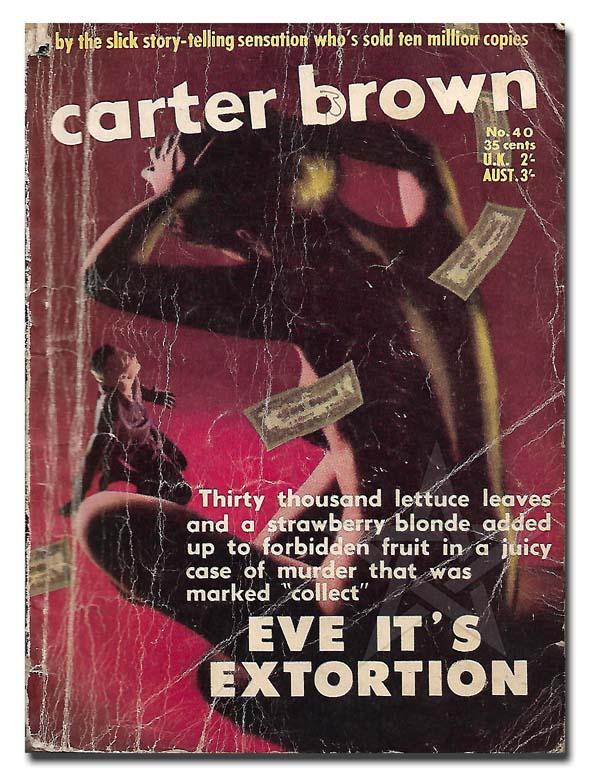
Carter Brown's Eve it's Extortion
Eve it's Extortion is a 1956 Al Wheeler crime thriller by Carter Brown.
Alan Geoffrey Yates (1923-1985) was an English-born Australian writer who wrote well over 200 novels (some source claim more than 300) under a variety of pseudonyms. He is best remembered for the crime novels he wrote as Carter Brown. He is believed to have sold around 120 million books.
The Carter Brown novels are set in the United States but since the author lived in Australia the novels are set in the America of pulp fiction and Hollywood movies rather than the real America. In some ways that makes them more fun.
Al Wheeler (who narrates the tale) is a Homicide cop but he’s on special duty, working directly under the Police Commissioner. It’s not that the Commissioner has a high opinion of him. In fact he has a very low opinion of Al. He just wants to keep him close so he can keep an eye on him. Al has a reputation of being an unorthodox cop who takes very little notice of orders. He keeps his job as a Detective Lieutenant because he keeps solving difficult cases.
This time the case is very routine. It’s a special favour for a friend of the Commissioner’s, an insurance investigator named Moss. Moss is worried about a life insurance claim. It seems straightforward on the surface. The guy who was insured, Farnham, was killed by a hit-run driver. But it just doesn’t smell quite right to Moss.
Al talks to Farnham’s widow Eve. She’s very glamorous, maybe too glamorous to have been married to a loser and a lush like Farnham. Farnham was such a loser that Eve had to walk as a waitress in a crummy joint and she didn’t like that at all. Al figures she’s the kind of woman who might well murder a loser husband whose life was insured for a vast amount of money but she has a rock-solid alibi.
Eve happens to mention that a couple of days before her husband died a locater from a debt collection agency called on her and told her that her husband owed a lot of money.
The locater was a woman named Edna Bright and she looks like just as much of a potential femme fatale as Eve Farnham.
In the course of his investigation Al meets the head of the debt collection agency, a guy named Cole. He also meets Cole’s wife Natalie. Natalie is femme fatale number three. Natalie tells Al how much she despises her husband. She proves it by sleeping with Al. Al has a pretty relaxed attitude towards such things. If a cute dame like Natalie is willing then Al is willing as well. Besides, he might get more information out of her this way.
Just about every character in this book is a plausible suspect. These are not particularly honest people and that life insurance policy was worth a huge amount of money. Al just has to figure out how many of them might have stood to gain, legally or illegally, by Farnham’s demise. There’s also been a good deal of bed-hopping going on, which offers even further motives.
It’s a pretty decent plot and Al does at least some real detecting.
The Carter Brown novels are not to be taken too seriously. They’re fun, lightweight and fast-paced with plenty of mayhem (none of it graphic) and plenty of sex (also not graphic). There’s a good deal of humour and the humour works pretty well.
There are lots of dames and they’re not the types of dames who defend their virtue all that strenuously. Apart from the three femmes fatales there’s Annabelle, Al’s boss’s secretary, a glamorous southern belle with a yearning for a rich husband. Al has made various attempts to seduce her and he certainly hasn’t given up hope.
Al Wheeler doesn’t take life too seriously. He likes being a cop but he always makes time for recreation, especially with glamorous dames. He also always finds time to have a drink or six. He’s a bit of a rogue but a likeable one and despite being undisciplined and irresponsible he’s a pretty good cop. He’s not especially hardboiled although he’s no pushover when the going gets tough. He’s somewhat cynical but he isn’t bitter and he’s no thug.
The Carter Brown novels are pure entertainment but they’re well-crafted and clever and Eve it's Extortion is a fine entry in the Al Wheeler series. Highly recommended.
Alan Geoffrey Yates (1923-1985) was an English-born Australian writer who wrote well over 200 novels (some source claim more than 300) under a variety of pseudonyms. He is best remembered for the crime novels he wrote as Carter Brown. He is believed to have sold around 120 million books.
The Carter Brown novels are set in the United States but since the author lived in Australia the novels are set in the America of pulp fiction and Hollywood movies rather than the real America. In some ways that makes them more fun.
Al Wheeler (who narrates the tale) is a Homicide cop but he’s on special duty, working directly under the Police Commissioner. It’s not that the Commissioner has a high opinion of him. In fact he has a very low opinion of Al. He just wants to keep him close so he can keep an eye on him. Al has a reputation of being an unorthodox cop who takes very little notice of orders. He keeps his job as a Detective Lieutenant because he keeps solving difficult cases.
This time the case is very routine. It’s a special favour for a friend of the Commissioner’s, an insurance investigator named Moss. Moss is worried about a life insurance claim. It seems straightforward on the surface. The guy who was insured, Farnham, was killed by a hit-run driver. But it just doesn’t smell quite right to Moss.
Al talks to Farnham’s widow Eve. She’s very glamorous, maybe too glamorous to have been married to a loser and a lush like Farnham. Farnham was such a loser that Eve had to walk as a waitress in a crummy joint and she didn’t like that at all. Al figures she’s the kind of woman who might well murder a loser husband whose life was insured for a vast amount of money but she has a rock-solid alibi.
Eve happens to mention that a couple of days before her husband died a locater from a debt collection agency called on her and told her that her husband owed a lot of money.
The locater was a woman named Edna Bright and she looks like just as much of a potential femme fatale as Eve Farnham.
In the course of his investigation Al meets the head of the debt collection agency, a guy named Cole. He also meets Cole’s wife Natalie. Natalie is femme fatale number three. Natalie tells Al how much she despises her husband. She proves it by sleeping with Al. Al has a pretty relaxed attitude towards such things. If a cute dame like Natalie is willing then Al is willing as well. Besides, he might get more information out of her this way.
Just about every character in this book is a plausible suspect. These are not particularly honest people and that life insurance policy was worth a huge amount of money. Al just has to figure out how many of them might have stood to gain, legally or illegally, by Farnham’s demise. There’s also been a good deal of bed-hopping going on, which offers even further motives.
It’s a pretty decent plot and Al does at least some real detecting.
The Carter Brown novels are not to be taken too seriously. They’re fun, lightweight and fast-paced with plenty of mayhem (none of it graphic) and plenty of sex (also not graphic). There’s a good deal of humour and the humour works pretty well.
There are lots of dames and they’re not the types of dames who defend their virtue all that strenuously. Apart from the three femmes fatales there’s Annabelle, Al’s boss’s secretary, a glamorous southern belle with a yearning for a rich husband. Al has made various attempts to seduce her and he certainly hasn’t given up hope.
Al Wheeler doesn’t take life too seriously. He likes being a cop but he always makes time for recreation, especially with glamorous dames. He also always finds time to have a drink or six. He’s a bit of a rogue but a likeable one and despite being undisciplined and irresponsible he’s a pretty good cop. He’s not especially hardboiled although he’s no pushover when the going gets tough. He’s somewhat cynical but he isn’t bitter and he’s no thug.
The Carter Brown novels are pure entertainment but they’re well-crafted and clever and Eve it's Extortion is a fine entry in the Al Wheeler series. Highly recommended.
I’ve reviewed three other Carter Brown novels featuring Al Wheeler - Booty for a Babe, No Harp for My Angel and The Stripper.
Wednesday, May 5, 2021
Carter Brown's Booty for a Babe
English-born Australian crime fiction writer Alan Yates (1923-1985) wrote round 300 novels under the name Carter Brown. He not only wrote a lot of books, he sold a lot of books - around 120 million of them. And like so many bestselling authors of his era he then faded into obscurity. His most popular series character was LA homicide cop Lieutenant Al Wheeler.
Booty for a Babe is a fairy early Al Wheeler book, appearing in 1956.
His boss has decided that Wheeler is too unconventional and too irresponsible to be a Homicide lieutenant. But he does manage to crack some very difficult cases so he’s been put on special assignment. When a case comes up that is as unconventional as he is then it’s Al’s baby. And such a case has now come up.
Professor Todt has been murdered at a science fiction fan convention at a fancy hotel. He was shot, but he wasn’t shot in a normal way. He was found with a tungsten dart in his heart. There were eighty witnesses and none of them saw a thing.
Al finds the world of science fiction fandom rather bewildering. Professor Todt had a theory about time. He thought time could be stopped, if only the alien Delfs could be persuaded to stop it. This wasn’t the plot for a science fiction story. The professor really believed this theory. Al is even more disturbed when it becomes likely that the motive for the murder had something to do with the professor’s crazy theory.
Al also has to deal with a ditzy redhead named Flavia, who runs the convention. And an even ditzier blonde named Annabelle Starr, one of the fans. He thinks they’re both crazy but he also thinks it’s worth trying to get them into bed. They might provide some valuable clues, but even if they don’t it would still be worth trying to get them into bed.
There’s also Nicky Spain, who’s a shady businessman, but he had some involvement with the professor. Which doesn’t make sense - shady businessman and crazy professors don’t usually have much in common. Spain is staying in the hotel with his girlfriend Carlotta, and she could be worth bedding as well.
The further the case goes the crazier it gets. It seems that alchemy could be involved as well.
Wheeler is a cop who always has a drink on one hand a blonde in the other. It’s not that he’s a heavy drinker. He doesn’t take a drink first thing in the morning. He has a shower and breakfast first. Sometimes it’s nearly lunch time before he starts drinking.
Apart from drinking and chasing skirt Al’s investigative methods mostly involve picking someone who might respond to pressure and putting that person under as much pressure as possible. His methods are exactly ethical but they do produce results. He’s also pretty good at setting traps for suspects, even when he has no idea if they’re guilty or not.
This is a somewhat tongue-in-cheek hardboiled PI thriller with quite a bit of humour and some plot elements that sound like they’d be more at home in a pulp sci-fi novel. It works because the author has style and energy and he makes it work. Al Wheeler is cheerfully immoral but he has a kind of vulgar charm. There’s nothing remotely subtle about him.
The plot is serviceable but it’s the fun to be had along the way that is the attraction.
I have no idea why the title was chosen, except that I guess the publisher thought it sounded cool.
The Carter Brown books are not to be taken too seriously but they are enormous fun. Booty for a Babe is highly recommended.
I’ve reviewed two other Carter Brown novels - The Stripper and No Harp For My Angel.
Booty for a Babe is a fairy early Al Wheeler book, appearing in 1956.
His boss has decided that Wheeler is too unconventional and too irresponsible to be a Homicide lieutenant. But he does manage to crack some very difficult cases so he’s been put on special assignment. When a case comes up that is as unconventional as he is then it’s Al’s baby. And such a case has now come up.
Professor Todt has been murdered at a science fiction fan convention at a fancy hotel. He was shot, but he wasn’t shot in a normal way. He was found with a tungsten dart in his heart. There were eighty witnesses and none of them saw a thing.
Al finds the world of science fiction fandom rather bewildering. Professor Todt had a theory about time. He thought time could be stopped, if only the alien Delfs could be persuaded to stop it. This wasn’t the plot for a science fiction story. The professor really believed this theory. Al is even more disturbed when it becomes likely that the motive for the murder had something to do with the professor’s crazy theory.
Al also has to deal with a ditzy redhead named Flavia, who runs the convention. And an even ditzier blonde named Annabelle Starr, one of the fans. He thinks they’re both crazy but he also thinks it’s worth trying to get them into bed. They might provide some valuable clues, but even if they don’t it would still be worth trying to get them into bed.
There’s also Nicky Spain, who’s a shady businessman, but he had some involvement with the professor. Which doesn’t make sense - shady businessman and crazy professors don’t usually have much in common. Spain is staying in the hotel with his girlfriend Carlotta, and she could be worth bedding as well.
The further the case goes the crazier it gets. It seems that alchemy could be involved as well.
Wheeler is a cop who always has a drink on one hand a blonde in the other. It’s not that he’s a heavy drinker. He doesn’t take a drink first thing in the morning. He has a shower and breakfast first. Sometimes it’s nearly lunch time before he starts drinking.
Apart from drinking and chasing skirt Al’s investigative methods mostly involve picking someone who might respond to pressure and putting that person under as much pressure as possible. His methods are exactly ethical but they do produce results. He’s also pretty good at setting traps for suspects, even when he has no idea if they’re guilty or not.
This is a somewhat tongue-in-cheek hardboiled PI thriller with quite a bit of humour and some plot elements that sound like they’d be more at home in a pulp sci-fi novel. It works because the author has style and energy and he makes it work. Al Wheeler is cheerfully immoral but he has a kind of vulgar charm. There’s nothing remotely subtle about him.
The plot is serviceable but it’s the fun to be had along the way that is the attraction.
I have no idea why the title was chosen, except that I guess the publisher thought it sounded cool.
The Carter Brown books are not to be taken too seriously but they are enormous fun. Booty for a Babe is highly recommended.
I’ve reviewed two other Carter Brown novels - The Stripper and No Harp For My Angel.
Wednesday, June 10, 2020
Carter Brown's No Harp for My Angel
Alan Yates (1923-1985) was an English-born Australian writer of crime fiction under the name Carter Brown and he was one of the most prolific authors of all time. He wrote round 300 novels. In his lifetime he was also one of the world’s most successful novelists, selling around 120 million books. He’s one of those writers who enjoys immense success followed by almost complete obscurity. His best-known series character was Lieutenant Al Wheeler, a homicide cop in LA. No Harp for My Angel, published in 1956, is one of the earlier Al Wheeler mysteries.
Al Wheeler is enjoying his vacation in Florida. Especially when he meets cute green-eyed redhead Julie Adams. Julie warns him that her boyfriend, a guy named Johnny Lynch, is really big, really mean and really jealous. To Al that just makes Julie seem even more desirable. He’s just that kind of guy.
Of course this is before Al meets Zero. Zero is Lynch’s henchman. Julie had described Zero to him as being about seven feet tall and built like a gorilla. She wasn’t exaggerating. Al wakes up in the local police headquarters to discover that he’s about to be booked for drunk driving and crashing a car into plate-glass window. The last thing Al can remember is Zero picking him up like he was a kitten. Lieutenant Ben Jordan (an old buddy) offers Al a proposal. He wants Al to pose as a big noise Chicago racketeer and he wants Al to annoy Lynch so that Lynch will do something stupid. Al thinks this is a terrible idea but Ben persuades him by threatening to book him on all those charges outstanding from the car incident. Never trust an old buddy, especially when the old buddy is a cop.
Lieutenant Jordan is worried about those missing dames. Four of them. All nice girls from nice families. Rich families. Girls disappear from time to time, but not these kinds of girls. And all four girls had been gambling in Johnny Lynch’s club, the Paradise. It’s a thin connection but it’s the only lead Jordan has, plus he’s pretty curious about Lynch and about all the hoodlums in town are scared of him. Nobody had even heard of Lynch until few months earlier.
Al certainly gets Lynch’s attention. That’s good. He also attracts the attention of a Syndicate guy from Chicago. That’s maybe not so good. Al definitely has no trouble getting the attention of women. He has Julie throwing herself at him and he has Dawn doing the same thing. Dawn is the best friend of one of the missing girls and she’s been persuaded by Al and Lieutenant Jordan to act as a decoy.
Having Lynch and maybe the Mob wanting to kill him is troublesome enough but an even bigger problem is trying to make sure Julie and Dawn don’t kill each other. Specially after Dawn ties up Julie with her own girdle and a bedsheet. These two girls don’t like other girls messing with their man, and they both consider Al to be their man.
As you may have gathered Al Wheeler likes women. He likes them a lot. He also likes booze. He like women so much you might wonder how he finds time for anything else.
I’d describe this book as Hardboiled Lite. It has a hard-boiled flavour but without the grim overtly pessimistic edge. There’s a slight tongue-in-cheek flavour as well, enough to disqualify it as noir fiction. It’s fast-moving fun. There’s some violence but nothing graphic.
Apart from his early encounter with Zero most of the violence Al encounters is at the hands of Dawn (who slugs him after discovering Julie in his bedroom). Oh, and Julie tries to drown him. These women are hard to handle. Al doesn’t hit women. Well, OK, he does, but only when he has to. I mean if a dame is about to walk into your bedroom and you’v got another dame stashed in the what can you do? You knock her unconscious. But gently.
The tongue-in-cheek tinge is not enough to detract from an exciting tale of mystery and suspense but it does give the novel the feel of a hardboiled romp. I mentioned in an earlier Carter Brown review that he reminds me just a little of Peter Cheyney’s Lemmy Caution books (such as Never a Dull Moment and I’ll Say She Does!) and I stand by that. The emphasis is on fun, with plenty of guns, dames and wisecracks.
No Harp for My Angel might be pulpy trash but it’s incredibly entertaining. Highly recommended.
Al Wheeler is enjoying his vacation in Florida. Especially when he meets cute green-eyed redhead Julie Adams. Julie warns him that her boyfriend, a guy named Johnny Lynch, is really big, really mean and really jealous. To Al that just makes Julie seem even more desirable. He’s just that kind of guy.
Of course this is before Al meets Zero. Zero is Lynch’s henchman. Julie had described Zero to him as being about seven feet tall and built like a gorilla. She wasn’t exaggerating. Al wakes up in the local police headquarters to discover that he’s about to be booked for drunk driving and crashing a car into plate-glass window. The last thing Al can remember is Zero picking him up like he was a kitten. Lieutenant Ben Jordan (an old buddy) offers Al a proposal. He wants Al to pose as a big noise Chicago racketeer and he wants Al to annoy Lynch so that Lynch will do something stupid. Al thinks this is a terrible idea but Ben persuades him by threatening to book him on all those charges outstanding from the car incident. Never trust an old buddy, especially when the old buddy is a cop.
Lieutenant Jordan is worried about those missing dames. Four of them. All nice girls from nice families. Rich families. Girls disappear from time to time, but not these kinds of girls. And all four girls had been gambling in Johnny Lynch’s club, the Paradise. It’s a thin connection but it’s the only lead Jordan has, plus he’s pretty curious about Lynch and about all the hoodlums in town are scared of him. Nobody had even heard of Lynch until few months earlier.
Al certainly gets Lynch’s attention. That’s good. He also attracts the attention of a Syndicate guy from Chicago. That’s maybe not so good. Al definitely has no trouble getting the attention of women. He has Julie throwing herself at him and he has Dawn doing the same thing. Dawn is the best friend of one of the missing girls and she’s been persuaded by Al and Lieutenant Jordan to act as a decoy.
Having Lynch and maybe the Mob wanting to kill him is troublesome enough but an even bigger problem is trying to make sure Julie and Dawn don’t kill each other. Specially after Dawn ties up Julie with her own girdle and a bedsheet. These two girls don’t like other girls messing with their man, and they both consider Al to be their man.
As you may have gathered Al Wheeler likes women. He likes them a lot. He also likes booze. He like women so much you might wonder how he finds time for anything else.
I’d describe this book as Hardboiled Lite. It has a hard-boiled flavour but without the grim overtly pessimistic edge. There’s a slight tongue-in-cheek flavour as well, enough to disqualify it as noir fiction. It’s fast-moving fun. There’s some violence but nothing graphic.
Apart from his early encounter with Zero most of the violence Al encounters is at the hands of Dawn (who slugs him after discovering Julie in his bedroom). Oh, and Julie tries to drown him. These women are hard to handle. Al doesn’t hit women. Well, OK, he does, but only when he has to. I mean if a dame is about to walk into your bedroom and you’v got another dame stashed in the what can you do? You knock her unconscious. But gently.
The tongue-in-cheek tinge is not enough to detract from an exciting tale of mystery and suspense but it does give the novel the feel of a hardboiled romp. I mentioned in an earlier Carter Brown review that he reminds me just a little of Peter Cheyney’s Lemmy Caution books (such as Never a Dull Moment and I’ll Say She Does!) and I stand by that. The emphasis is on fun, with plenty of guns, dames and wisecracks.
No Harp for My Angel might be pulpy trash but it’s incredibly entertaining. Highly recommended.
Monday, August 15, 2011
Carter Brown's The Stripper
Carter Brown (whose real name was Alan Geoffrey Yates) may well be the biggest-selling Australian author of all time, with sales reckoned in the tens of millions or possibly even hundreds of millions. He was also one of the most prolific writers in history, with 317 novels to his credit.
He was born in Britain but moved to Australia in 1948 and became an Australian citizen. He wrote in most pulp genres but is best known for his crime novels. They were set in the US but this was a US that the author only knew from movies and books. In some ways this makes them more fun.
He was rather similar to the British crime writer Peter Cheyney in that he enjoyed immense success in Europe. He was not quite so successful in the United States but still managed to sell a lot of books there. He also resembled Cheyney in his distinctly tongue-in-cheek approach to the hardboiled genre.
Police detective Al Wheeler, working for the Sheriff’s department in a fictional California town, was one of his most popular heroes. The Stripper combines a lurid title with equally lurid subject matter. An apparent suicide leads Wheeler to a burlesque joint and a lonely hearts club. A girl called Pattie Keller jumps to her death from an office building but the strange thing is she’d already decided not to jump when she seemed to fall. And a huge quantity of a powerful analgesic is found in her body, a quantity sufficient to cause extreme nausea and dizziness. The death starts to look potentially suspicious.
Pattie’s sister is Deadpan Dolores, a famous and very successful strip-tease artiste. Pattie had been a member of a lonely hearts club and when it turns out that both the dating agency and the burlesque club are owned by the same person Wheeler decides this is too much of a coincidence.
Pattie’s last date arranged by the agency had been with a shy awkward florist but then Wheeler spots the florist in the burlesque joint doing some serious partying with two very glamorous strippers. The investigation will lead Wheeler to a white slaving racket. It will also lead him to the beds of a assortment of beautiful women. Al Wheeler has no problem combining business with pleasure.
There’s plenty of delightful hardboiled dialogue and a certain amount of sleaze. This is not a story we’re mean to take too seriously. The emphasis is on fun. Like Cheyney’s books it treads a fine line between light-hearted crime action and outright parody. It’s all very very pulpy and highly entertaining.
Subscribe to:
Posts (Atom)