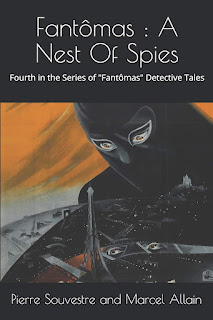
Fantômas: A Nest of Spies (originally published in 1911 as L'Agent Secret) is the fourth of the original series of Fantômas novels.
Fantômas is a diabolical criminal mastermind created by French writers Marcel Allain (1885–1969) and Pierre Souvestre (1874–1914). They wrote thirty-two Fantômas novels between 1911 and 1913. Allain wrote several more Fantômas novels in the 1920s. There have been Fantômas movies and Fantômas comics.
Fantômas is to French popular culture what Dr Mabuse is to German pop culture, or what Professor Moriarty is to British pop culture.
Fantômas has two deadly enemies - Inspector Juve and crusading journalist Jérôme Fandor. Juve and Fandor have devoted years of their lives to the project of bringing Fantômas to justice. But Fantômas is like Dr Fu Manchu. Nayland Smith can foil Fu Manchu’s plans and destroy his criminal operations but we know that he will never succeed in destroying Fu Manchu or bringing him to justice. Fu Manchu will always slip away, and he will always rebuild his organisation. And, in the same way, Fantômas will always manage to escape Juve’s clutches.
When this fourth novel opens Fantômas has been quiet for a while. Perhaps he has left France. Perhaps he is dead. Perhaps, after suffering defeat at the hands of Juve and Fandor, he has decided to retire from crime.
This fourth novel begins with a French artillery captain who has fallen hard for a very pretty girl, known to her friends as Bobinette. Captain Brocq has in his keeping certain top secret documents, vital to national security and all that stuff, and he finds to his dismay that one of the documents seems to have vanished. It was there a moment ago, just before Bobinette gathered up some letters of hers that Brocq had been, indiscreetly, keeping. Could Bobinette have gathered up the secret document by mistake along with the letters? That must be the explanation. The other explanation, that Bobinette stole the document, is unthinkable. A sweet young girl like Bobinette could not possibly be a spy. Either way Captain Brocq has to get that document back so he sets off in pursuit of his pretty mistress. And the hapless captain then loses his life in bizarre circumstances.
Inspector Juve is called in to investigate.
Journalist Jérôme Fandor is also taking an interesting in the case. He and Juve are old friends, their friendship being strengthened by their past shared struggles against the arch-criminal Fantômas. Juve sees the hand of Fantômas in the murder of Captain Brocq and it’s true that the bizarre murder method is the sort of thing that would appeal to Fantômas. Fandor however believes it’s just a simple case of espionage, although of course espionage is rarely simple.
There certainly is a vast espionage plot at the back of Captain Brocq’s murder. A number of young French officers have been ensnared by pretty but unscrupulous women. They are drawn into the web of espionage gradually. At first the information they’re selling seems so trivial as to be completely harmless. But soon they are being called upon to sell vital secrets.
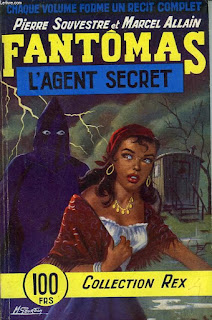
Juve and Fandor conduct parallel investigations and at times it has to be said that they find themselves at cross purposes. In addition to the police involvement the military intelligence services (the Second Bureau) are investigating the case. The police and the military intelligence people dislike and distrust one another and are constantly getting in each other’s way. Juve doesn’t like the Second Bureau anyway but in this case he suspects that they’ve been infiltrated by foreign spies or possibly even infiltrated by Fantômas’s organisation.
One of the conventions of pre-First World War crime and spy fiction is that you can’t be a proper great detective or a proper great villain unless you are a master of disguise. The detectives and the villains assume a bewildering range of disguises and nobody ever manages to penetrate those disguises. It’s a convention that some modern readers find off-putting, while others find that it adds a certain period charm. In this novel Allain and Souvestre have their characters assuming so many disguises that one can’t help suspecting that at times they’re being a bit tongue-in-cheek.
The disguises are however vital to the story. It is essential that the relevant authorities should be totally bewildered and it’s essential that even Juve and Fandor should become hopelessly confused. And even Fantômas occasionally gets taken in by disguises assumed by the good guys.
And Fantômas doesn’t just adopt disguises - at times he wears a sinister mask and cloak.
The tone of the novel is one of breathless excitement with an endless succession of unlikely and bizarre events, impossibly narrow escapes and hopeless misunderstandings. Juve and Fandor both manage to get themselves arrested.
There are romantic complications as well. There are several romance sub-plots and naturally the course of true love is beset by endless misunderstandings and deceptions.
The plots of the Fantômas novels are ludicrously contrived. They’re incredibly pulpy. They’re much less sophisticated in a literary sense than Sax Rohmer’s Fu Manchu novels. The Fantômas novels probably had more influence on the world of comics than on the world of pulp fiction. They were a definite influence on the adult-oriented comics that became popular in Europe in the early 1960s (such as the Italian fumetti Neri comics) and a definite indirect influence on 60s movies such as Barbarella and Danger: Diabolik. You could possibly even argue that they had an indirect influence on the Bond movies, especially as the Bond films moved further and further away from realism.
The Fantômas stories are among the foundational texts of modern pop culture. For that reason it is essential to read at lest a couple of them. And once you get into the swing of them they’re great fun.
I also very highly recommend the 1964 Fantômas movie.
pulp novels, trash fiction, detective stories, adventure tales, spy fiction, etc from the 19th century up to the 1970s
Showing posts with label edwardian detective stories. Show all posts
Saturday, July 16, 2022
Friday, May 27, 2022
Nick Carter, The Cypher Letter
The Cypher Letter is a Nick Carter mystery.
Nick Carter is a fictional character with an intriguing history. He began life as a Sherlock Holmes-style detective in dime novels between 1886 and 1915. The character was revived in pulp magazines in the 1920s and again in the 1930s (this time as a hardboiled detective). In the 1960s he was revived yet again as a James Bond-style secret agent in the long-running Killmaster series of novels which were still being published as late as 1990. There have been various Nick Carter movies and radio serials.
The Nick Carter stories have always been credited to Nick Carter as author but in fact many different writers wrote Nick Carter adventures over the years.
I have no idea when The Cypher Letter was written but the fact that it takes place in New York but there’s not a single mention of cars or telephones leads me to suspect that it’s a pretty early story, possibly from the 1890s.
Nick Carter’s wife has come across a cypher letter the significance of which is unknown. At the same time Nick’s pal, Inspector Byrnes, has received an anonymous letter which claims that a serious crime has been committed in the Kempton mansion. These two letters do not appear to be connected but of course they are.
Old Archibald Kempton is blind but he’s extremely rich. He lives with this two daughters (who bear no resemblance to one another in looks or personality).
A child has been kidnapped but it’s not obvious how that ties in. Nick spots a smooth-talking gent leaving the Kempton mansion and suspects he could be worth following. The gent is Mortimer Guernsey and Nick’s suspicion that he is mixed up in this case proves to be well-founded.
Nick does some shadowing of suspects and he gets shadowed in turn, and that nearly costs him his life.
This early version of Nick Carter is very much an American Sherlock Holmes. Holmes was a master of disguise, so Nick Carter is a master of disguise. There’s a Sherlock Holmes stories about cyphers so here we get a Nick Carter story about cyphers. The disguise stuff is really overdone, to the point where at times it seems that disguise is the only detective technique of which Nick is aware.
The plot is outrageously melodramatic with some very far-fetched elements and lots of unlikely coincidences. And of course hair’s-breadth escapes from certain death.
This incarnation of Nick Carter is definitely not hardboiled nor is he a tough guy but he is just a bit more of an action hero than Holmes. He definitely has an American flavour.
This very short novel is interesting mostly for historical reasons. It’s a glimpse into the world of the American dime novel. And of course it gives us a sampling of the first version of a character who just kept bouncing back in different forms, and a character who was one of the first popular American fictional detectives. If you’re a serious student of the history of crime fiction you need to sample at least one Nick Carter story. Apart from that historical interest it doesn’t have all that much to recommend it although you might get some amusement from the outlandishly melodramatic plot. So maybe worth a look but with quite a few reservations.
This book seems to be obtainable only in a print-on-demand form which is riddled with distracting typographical errors.
Nick Carter is a fictional character with an intriguing history. He began life as a Sherlock Holmes-style detective in dime novels between 1886 and 1915. The character was revived in pulp magazines in the 1920s and again in the 1930s (this time as a hardboiled detective). In the 1960s he was revived yet again as a James Bond-style secret agent in the long-running Killmaster series of novels which were still being published as late as 1990. There have been various Nick Carter movies and radio serials.
The Nick Carter stories have always been credited to Nick Carter as author but in fact many different writers wrote Nick Carter adventures over the years.
I have no idea when The Cypher Letter was written but the fact that it takes place in New York but there’s not a single mention of cars or telephones leads me to suspect that it’s a pretty early story, possibly from the 1890s.
Nick Carter’s wife has come across a cypher letter the significance of which is unknown. At the same time Nick’s pal, Inspector Byrnes, has received an anonymous letter which claims that a serious crime has been committed in the Kempton mansion. These two letters do not appear to be connected but of course they are.
Old Archibald Kempton is blind but he’s extremely rich. He lives with this two daughters (who bear no resemblance to one another in looks or personality).
A child has been kidnapped but it’s not obvious how that ties in. Nick spots a smooth-talking gent leaving the Kempton mansion and suspects he could be worth following. The gent is Mortimer Guernsey and Nick’s suspicion that he is mixed up in this case proves to be well-founded.
Nick does some shadowing of suspects and he gets shadowed in turn, and that nearly costs him his life.
This early version of Nick Carter is very much an American Sherlock Holmes. Holmes was a master of disguise, so Nick Carter is a master of disguise. There’s a Sherlock Holmes stories about cyphers so here we get a Nick Carter story about cyphers. The disguise stuff is really overdone, to the point where at times it seems that disguise is the only detective technique of which Nick is aware.
The plot is outrageously melodramatic with some very far-fetched elements and lots of unlikely coincidences. And of course hair’s-breadth escapes from certain death.
This incarnation of Nick Carter is definitely not hardboiled nor is he a tough guy but he is just a bit more of an action hero than Holmes. He definitely has an American flavour.
This very short novel is interesting mostly for historical reasons. It’s a glimpse into the world of the American dime novel. And of course it gives us a sampling of the first version of a character who just kept bouncing back in different forms, and a character who was one of the first popular American fictional detectives. If you’re a serious student of the history of crime fiction you need to sample at least one Nick Carter story. Apart from that historical interest it doesn’t have all that much to recommend it although you might get some amusement from the outlandishly melodramatic plot. So maybe worth a look but with quite a few reservations.
This book seems to be obtainable only in a print-on-demand form which is riddled with distracting typographical errors.
Tuesday, May 8, 2018
The Invisible Bullet & Other Strange Cases of Magnum, Scientific Consultant
Max Rittenberg (1880-1965) was an interesting figure in the development of the detective story. Born in Australia of German and Russian Jewish ancestry he moved to Britain and had a short but prolific carer as a writer of detective stories. After giving up fiction writing he concentrated on his very successful career in advertising and public relations.
His two series of detective short stories are interesting and were at the time somewhat pioneering. His tales of Dr Xavier Wycherley (collected in The Mind-Reader) are among the earliest examples of detective stories featuring a psychologist hero. There are hints of the paranormal but essentially these are psychological detective stories.
His other series detective was Magnum, an early exemplar of the scientific detective. Magnum is a bad-tempered conceited and arrogant middle-aged scientist who dabbles in crime solving if a case interests him or (more often) if he’s offered enough money to make it worth his while. He has a shy young Welsh assistant named Meredith who does all the detail work (for which Magnum has no patience) while Magnum concentrates on the big ideas.
The stories date from the period just before the First World War and many of the solutions involve technological wizardry rather than pure science. Coachwhip have published all the Magnum stories in The Invisible Bullet & Other Strange Cases of Magnum, Scientific Consultant.
If you’re expecting really elaborate scientific puzzles you might be disappointed.The scientific elements are often fairly straightforward although the plots themselves do have some very clever ideas. In many cases the scientific elements simply add a touch of the exotic to otherwise unremarkable if competent crime tales. At times it seems that Rittenberg is actually more interested in the psychology of the people involved in his stories, and in the social implications, than in the actual science. Given that Rittenberg’s field was public relations rather than science this is perhaps not surprising.
The Mystery of the Sevenoaks Tunnel isn’t all that scientific but it has a nicely ingenious solution. A man has been killed falling from a railway carriage. It appears to be an accident but his life was heavily insured and the insurance company believes it was a case of suicide, which means they don’t have to pay up on the policy. Magnum believes the key to the puzzle is that the man was carrying a bottle of medicine and it’s medicine that has only one purpose - to treat sleeping sickness. An entertaining enough tale.
The Queer Case of the Cyanogen Poisoning is much better. A wealthy family is being slowly poisoned. That much is obvious. Unfortunately even though every item of food and drink with which they come into contact has been analysed no trace of poison can be fond. Even the air in their house has been analysed, with similarly negative results. And yet the stubborn fact remains that they are being poisoned. The solution in this tale is pretty clever.
The Bond Street Poisoning Bureau is a different kind of poisoning tale. A sinister character known as Kahmos is operating a kind of one-man Murder, Inc in London, making a very lucrative living poisoning inconvenient relatives for clients who need their inheritances sooner rather than later. Magnum makes use of some very high-tech gear (by 1913 standards) to crack this case but actually laying hands of Kahmos proves to be more tricky. There’s nothing overly clever here but there’s some decent sinister atmosphere and a rather enjoyable pulp fiction vibe as well (assuming you like that sort of thing).
The theft of gold bullion en route to the Bank of England would be a very serious matter,
but in The Mystery of the Vanishing Gold something worse is happening - the gold ingots are just shrinking! And the Bank of England is being threatened - either pay fifty thousands for the secret of the vanishing gold or it will continue to happen. It’s a promising setup for a story that doesn’t quite deliver the goods.
The Secret of the Radium Maker tells of a struggling young inventor who has discovered a way of extracting radium from pitchblende at a cost far below that of existing processes. This discovery is worth a fortune, assuming that the process actually works. Magnum is called in to verify the discovery. An OK story at best.
The Invisible Bullet is a true impossible crime story. A man is shot to death in a fourth-floor gymnasium. It can’t be suicide - he was shot twice through the back. The murder weapon cannot be found. The murderer could not possibly have escaped from the gymnasium. The solution is a matter of logical reasoning from the evidence with science playing no real role but it’s still a very fine story and it’s a genuine impossible crime mystery that compares favourably to similar stories by much more celebrated golden age practitioners of the craft.
Stories of phoney spiritualists are a dime a dozen but The Rough Fist of Reason has some genuinely original features, and a definite sting in the tail. Magnum investigates a medium who produces some extraordinarily convincing spirit photographs, and the puzzling aspect is that Magnum is able to establish that there has been absolutely no photographic trickery. Magnum of course is still convinced the photos are phoney but proving it will be a real challenge. The one slight weakness of this story (and also of The Invisible Bullet) is that luck perhaps plays too big a part in the uncovering of the vital clue but The Rough Fist of Reason is still an extremely good story.
Science can revolutionise many areas of human endeavour, including fraud, as we discover in The Three Ends of the Thread. It all starts with a document outlining a secret new process for tanning leather, a document that disappears under impossible circumstances. A well-executed little tale with some lovely twists.
The Empty Flask is another ingenious case of a poisoning that leaves no physical evidence whatsoever and it’s another rather neat story.
The Secret Analysis is a routine spy tale of limited interest.
The Mystery of Box 218 concerns an apparent robbery. The director of the Holborn Safe Deposit are convinced that their security is foolproof and yet a pearl necklace worth fifteen thousand pounds has been reported stolen from a safety deposit box there. The directors want the mystery solved but mostly they want to avoid any publicity so they turn to Magnum rather than the police. Magnum does employ some scientific apparatus in this case but mostly he relies on good old-fashioned detecting, taking note of a strange discrepancy in the evidence of an apparently reliable witness. This is a fairly well constructed and entertaining story.
The Message of the Tide starts with a neat enough idea - a message in a bottle floating in the Thames, a message telling of a man being held captive. Magnum’s scientific approach allows him to discover roughly where the bottle was dropped into the river. Unfortunately the rest of the story is not terribly interesting and it’s rather undeveloped, a weakness that afflicts a number of the Magnum stories.
The Secret of the Tower House concerns the mysterious death of a couple of dogs. It’s the symptoms displayed by the dogs before their demise that causes the worry. Of even greater concern is the source of the infection and the explanation is certainly creepy and a bit grisly. An OK story.
Dead Leaves is a moderately interesting story involving a missing will.
The Three Henry Clarks is not a bad little tale. A man named Henry Clark sets off for Scotland Yard to request help but dies very suddenly in the street outside. Magnum finds that he has been poisoned. A terrible crime but nothing unusual, except that it follows hard on the heels of the sudden mysterious death of another Henry Clark. And while Magnum and Detective-Inspector Callaghan are pondering this mystery news comes of the sudden demise of a third Henry Clark. It’s a fine setup for a story although it turns out to be not quite as ingenious as one might have hoped.
Cleansing Fire is interesting not so much for its plot as for the very surprising identity of the culprit. Magnum is investigating a suspected case of arson on behalf of an insurance company. The insurance company is convinced that it is arson and that it was a deliberate act on the part of the factory owner. Magnum is by no means entirely convinced on either point.
The solution to the puzzle is the result of some fairly determined sleuthing by Magnum, even including a spot of breaking and entering. It’s the motivation of the act that is the big surprise here.
Red Herrings tells of an ingenious scheme to kidnap the Home Secretary. As is the case with quite a few of the stories it’s the setup for the crime that is most impressive.
One thing you have to bear in mind is that Rittenberg was writing these stories before the First World War. This is pre-golden age stuff and while the plots are often ingenious they don’t have the extreme complexity of full-blown golden age mysteries. They’re still mostly very enjoyable and sometimes quite clever and Magnum is a fun larger-than-life hero with some amusing quirks. Recommended.
His two series of detective short stories are interesting and were at the time somewhat pioneering. His tales of Dr Xavier Wycherley (collected in The Mind-Reader) are among the earliest examples of detective stories featuring a psychologist hero. There are hints of the paranormal but essentially these are psychological detective stories.
His other series detective was Magnum, an early exemplar of the scientific detective. Magnum is a bad-tempered conceited and arrogant middle-aged scientist who dabbles in crime solving if a case interests him or (more often) if he’s offered enough money to make it worth his while. He has a shy young Welsh assistant named Meredith who does all the detail work (for which Magnum has no patience) while Magnum concentrates on the big ideas.
The stories date from the period just before the First World War and many of the solutions involve technological wizardry rather than pure science. Coachwhip have published all the Magnum stories in The Invisible Bullet & Other Strange Cases of Magnum, Scientific Consultant.
If you’re expecting really elaborate scientific puzzles you might be disappointed.The scientific elements are often fairly straightforward although the plots themselves do have some very clever ideas. In many cases the scientific elements simply add a touch of the exotic to otherwise unremarkable if competent crime tales. At times it seems that Rittenberg is actually more interested in the psychology of the people involved in his stories, and in the social implications, than in the actual science. Given that Rittenberg’s field was public relations rather than science this is perhaps not surprising.
The Mystery of the Sevenoaks Tunnel isn’t all that scientific but it has a nicely ingenious solution. A man has been killed falling from a railway carriage. It appears to be an accident but his life was heavily insured and the insurance company believes it was a case of suicide, which means they don’t have to pay up on the policy. Magnum believes the key to the puzzle is that the man was carrying a bottle of medicine and it’s medicine that has only one purpose - to treat sleeping sickness. An entertaining enough tale.
The Queer Case of the Cyanogen Poisoning is much better. A wealthy family is being slowly poisoned. That much is obvious. Unfortunately even though every item of food and drink with which they come into contact has been analysed no trace of poison can be fond. Even the air in their house has been analysed, with similarly negative results. And yet the stubborn fact remains that they are being poisoned. The solution in this tale is pretty clever.
The Bond Street Poisoning Bureau is a different kind of poisoning tale. A sinister character known as Kahmos is operating a kind of one-man Murder, Inc in London, making a very lucrative living poisoning inconvenient relatives for clients who need their inheritances sooner rather than later. Magnum makes use of some very high-tech gear (by 1913 standards) to crack this case but actually laying hands of Kahmos proves to be more tricky. There’s nothing overly clever here but there’s some decent sinister atmosphere and a rather enjoyable pulp fiction vibe as well (assuming you like that sort of thing).
The theft of gold bullion en route to the Bank of England would be a very serious matter,
but in The Mystery of the Vanishing Gold something worse is happening - the gold ingots are just shrinking! And the Bank of England is being threatened - either pay fifty thousands for the secret of the vanishing gold or it will continue to happen. It’s a promising setup for a story that doesn’t quite deliver the goods.
The Secret of the Radium Maker tells of a struggling young inventor who has discovered a way of extracting radium from pitchblende at a cost far below that of existing processes. This discovery is worth a fortune, assuming that the process actually works. Magnum is called in to verify the discovery. An OK story at best.
The Invisible Bullet is a true impossible crime story. A man is shot to death in a fourth-floor gymnasium. It can’t be suicide - he was shot twice through the back. The murder weapon cannot be found. The murderer could not possibly have escaped from the gymnasium. The solution is a matter of logical reasoning from the evidence with science playing no real role but it’s still a very fine story and it’s a genuine impossible crime mystery that compares favourably to similar stories by much more celebrated golden age practitioners of the craft.
Stories of phoney spiritualists are a dime a dozen but The Rough Fist of Reason has some genuinely original features, and a definite sting in the tail. Magnum investigates a medium who produces some extraordinarily convincing spirit photographs, and the puzzling aspect is that Magnum is able to establish that there has been absolutely no photographic trickery. Magnum of course is still convinced the photos are phoney but proving it will be a real challenge. The one slight weakness of this story (and also of The Invisible Bullet) is that luck perhaps plays too big a part in the uncovering of the vital clue but The Rough Fist of Reason is still an extremely good story.
Science can revolutionise many areas of human endeavour, including fraud, as we discover in The Three Ends of the Thread. It all starts with a document outlining a secret new process for tanning leather, a document that disappears under impossible circumstances. A well-executed little tale with some lovely twists.
The Empty Flask is another ingenious case of a poisoning that leaves no physical evidence whatsoever and it’s another rather neat story.
The Secret Analysis is a routine spy tale of limited interest.
The Mystery of Box 218 concerns an apparent robbery. The director of the Holborn Safe Deposit are convinced that their security is foolproof and yet a pearl necklace worth fifteen thousand pounds has been reported stolen from a safety deposit box there. The directors want the mystery solved but mostly they want to avoid any publicity so they turn to Magnum rather than the police. Magnum does employ some scientific apparatus in this case but mostly he relies on good old-fashioned detecting, taking note of a strange discrepancy in the evidence of an apparently reliable witness. This is a fairly well constructed and entertaining story.
The Message of the Tide starts with a neat enough idea - a message in a bottle floating in the Thames, a message telling of a man being held captive. Magnum’s scientific approach allows him to discover roughly where the bottle was dropped into the river. Unfortunately the rest of the story is not terribly interesting and it’s rather undeveloped, a weakness that afflicts a number of the Magnum stories.
The Secret of the Tower House concerns the mysterious death of a couple of dogs. It’s the symptoms displayed by the dogs before their demise that causes the worry. Of even greater concern is the source of the infection and the explanation is certainly creepy and a bit grisly. An OK story.
Dead Leaves is a moderately interesting story involving a missing will.
The Three Henry Clarks is not a bad little tale. A man named Henry Clark sets off for Scotland Yard to request help but dies very suddenly in the street outside. Magnum finds that he has been poisoned. A terrible crime but nothing unusual, except that it follows hard on the heels of the sudden mysterious death of another Henry Clark. And while Magnum and Detective-Inspector Callaghan are pondering this mystery news comes of the sudden demise of a third Henry Clark. It’s a fine setup for a story although it turns out to be not quite as ingenious as one might have hoped.
Cleansing Fire is interesting not so much for its plot as for the very surprising identity of the culprit. Magnum is investigating a suspected case of arson on behalf of an insurance company. The insurance company is convinced that it is arson and that it was a deliberate act on the part of the factory owner. Magnum is by no means entirely convinced on either point.
The solution to the puzzle is the result of some fairly determined sleuthing by Magnum, even including a spot of breaking and entering. It’s the motivation of the act that is the big surprise here.
Red Herrings tells of an ingenious scheme to kidnap the Home Secretary. As is the case with quite a few of the stories it’s the setup for the crime that is most impressive.
One thing you have to bear in mind is that Rittenberg was writing these stories before the First World War. This is pre-golden age stuff and while the plots are often ingenious they don’t have the extreme complexity of full-blown golden age mysteries. They’re still mostly very enjoyable and sometimes quite clever and Magnum is a fun larger-than-life hero with some amusing quirks. Recommended.
Saturday, October 28, 2017
The Flying Death
The Flying Death is one strange little book. Samuel Hopkins Adams (1871-1958) was a famous American muckraking journalist in his day although be’s better known to fans of Edwardian crime fiction for his excellent Average Jones stories.
The Flying Death begins with Dr Dick Colton being ordered to Montauk for a rest cure. However he’s not going to get much rest. Apart from the murder and mayhem he will also find love, and that is rarely restful.
He is staying at Third House, the inhabitants of which are a varied lot. There’s Professor Ravenden, a slightly dotty but very eminent entomologist. His daughter Dolly is rather more disturbing to Dr Colton, being very beautiful and altogether the most wondrous specimen of young womanhood he’s ever set eyes on. Dr Colton falls instantly in love. More disturbing in some ways is Helga, equally young and beautiful but gifted (if that’s the right word) with the second sight. Helga had been involved romantically with Dick’s brother Everard until the Colton family vetoed the match. Now Dick decides it would be a fine idea to invite Evarard to Third House. Making things more complicated is Helga’s relationship to newspaper reporter Harris Haynes, since nobody seems to know what exactly that relationship is. Nobody, including Haynes and Helga. The stage is set for some romantic melodrama, all done in a very Edwardian (but rather charming) style.
The action itself kicks off with a shipwreck. Most of the crew of the stricken schooner are saved but one man is brought ashore dead. The only problem is that he can’t be dead, or at least he can’t be dead in the way he appears to have died. It’s simply impossible.
Other murders follow, and they’re all in their own ways equally impossible.
Haynes decides to take charge of the investigation, being convinced that the police would be no use at all. Haynes has been a crime reporter for years so he does know a thing or two about investigating crime and there will be some actual detecting done in this story.
There are some clues but they seem to lead to further impossibilities. There are for instance the tracks on the beach, leading to one of the dead bodies. There’s no doubt about what the tracks are. They are the tracks of a pteranadon, and a rather large one. The fact that pteranadons have been extinct for a hundred million years or so is however a minor problem.
There’s also the matter of the unfortunate pioneer aeronaut, yet another impossible crime.
The most promising suspect appears to be a Portuguese juggler/magician whose act includes some rather impressive knife-throwing feats. Alas even more impossibilities will arise in connection with this suspect.
As you might have gathered Adams throws everything but the kitchen sink into this tale. And it works. He was a newspaperman and he knew how to give the public what it wanted.
In a story from this era that involves both crime and the suggestion of possible supernatural or science fictional explanations you can never be quite sure how the author will play things. Will he produce a perfectly rational solution at the last moment, or will he throw caution to the wind and go for a solution of a truly fantastic kind? Needless to say I have no intention of spoiling the story by telling you which option Adams chooses.
Stylistically the book is very much of its era, which (when combined with the outrageous plot) adds to the charm.
Adams keeps things moving along at a decent clip, both on the mayhem and the romance fronts. Romance in a detective story can have the effect of slowing things down too much but Adams doesn’t allow that to happen.
Is this actually a detective story? You’ll have to wait until the end to find out. Whatever it is it’s a great deal of fun. Highly recommended.
The Flying Death begins with Dr Dick Colton being ordered to Montauk for a rest cure. However he’s not going to get much rest. Apart from the murder and mayhem he will also find love, and that is rarely restful.
He is staying at Third House, the inhabitants of which are a varied lot. There’s Professor Ravenden, a slightly dotty but very eminent entomologist. His daughter Dolly is rather more disturbing to Dr Colton, being very beautiful and altogether the most wondrous specimen of young womanhood he’s ever set eyes on. Dr Colton falls instantly in love. More disturbing in some ways is Helga, equally young and beautiful but gifted (if that’s the right word) with the second sight. Helga had been involved romantically with Dick’s brother Everard until the Colton family vetoed the match. Now Dick decides it would be a fine idea to invite Evarard to Third House. Making things more complicated is Helga’s relationship to newspaper reporter Harris Haynes, since nobody seems to know what exactly that relationship is. Nobody, including Haynes and Helga. The stage is set for some romantic melodrama, all done in a very Edwardian (but rather charming) style.
The action itself kicks off with a shipwreck. Most of the crew of the stricken schooner are saved but one man is brought ashore dead. The only problem is that he can’t be dead, or at least he can’t be dead in the way he appears to have died. It’s simply impossible.
Other murders follow, and they’re all in their own ways equally impossible.
Haynes decides to take charge of the investigation, being convinced that the police would be no use at all. Haynes has been a crime reporter for years so he does know a thing or two about investigating crime and there will be some actual detecting done in this story.
There are some clues but they seem to lead to further impossibilities. There are for instance the tracks on the beach, leading to one of the dead bodies. There’s no doubt about what the tracks are. They are the tracks of a pteranadon, and a rather large one. The fact that pteranadons have been extinct for a hundred million years or so is however a minor problem.
There’s also the matter of the unfortunate pioneer aeronaut, yet another impossible crime.
The most promising suspect appears to be a Portuguese juggler/magician whose act includes some rather impressive knife-throwing feats. Alas even more impossibilities will arise in connection with this suspect.
As you might have gathered Adams throws everything but the kitchen sink into this tale. And it works. He was a newspaperman and he knew how to give the public what it wanted.
In a story from this era that involves both crime and the suggestion of possible supernatural or science fictional explanations you can never be quite sure how the author will play things. Will he produce a perfectly rational solution at the last moment, or will he throw caution to the wind and go for a solution of a truly fantastic kind? Needless to say I have no intention of spoiling the story by telling you which option Adams chooses.
Stylistically the book is very much of its era, which (when combined with the outrageous plot) adds to the charm.
Adams keeps things moving along at a decent clip, both on the mayhem and the romance fronts. Romance in a detective story can have the effect of slowing things down too much but Adams doesn’t allow that to happen.
Is this actually a detective story? You’ll have to wait until the end to find out. Whatever it is it’s a great deal of fun. Highly recommended.
Sunday, August 27, 2017
Ashton-Kirk Investigator
John T. McIntyre (1871-1951) was a Philadelphia-born American writer who achieved considerable success only to fade into obscurity shortly after his death. He wrote hard-boiled novels, including several in the private eye genre. Early in his career he wrote four novels featuring amateur detective Ashton-Kirk, the first of them (in 1910) being Ashton-Kirk Investigator.
Ashton-Kirk Investigator is very much in the Sherlock Holmes mould. Ashton-Kirk is a wealthy well-educated young man with a fondness for foul-smelling Greek tobacco and a considerable reputation as an amateur sleuth. He often collaborates with the police and almost invariably solves case that have baffled the official detectives. And in common with so many Victorian and Edwardian fictional detective he is also a master of disguise!
Despite its adherence to the Sherlock Holmes school of detective fiction this novel is of some interest to golden age detection fans as well. It’s not fair-play but Ashton-Kirk’s methods make sense and there are clues which do point in the direction of the solution.
The story involves the murder of a renowned but rather shady numismatist. Stories involving collectors of art and assorted artifacts would become one of the staples of the golden age.
Ashton-Kirk gets involved in this case through a beautiful young lady. The lady is to be married soon but her husband-to-be seems to have recently become very distracted and worryingly reluctant to set a date for the wedding. The young man will soon have much bigger problems to deal with.
The plot has some nice touches. The murdered numismatist was also an indefatigable collector of portraits of Revolutionary Way hero General Anthony Wayne. This obsession, and the reason behind it, will become quite important to the unraveling of the mystery. Other important questions concern a fine violinist whose talent is undimmed but who is now reduced to eking out a living as a street musician, a school for the deaf, modern German drama, the Pitman method of shorthand, candle grease and aeroplanes. McIntyre is certainly throwing lots of ideas into the mix and mostly it works.
Ashton-Kirk is a not a professional police detective but he is a bit more than an amateur. He refuses even to call himself a detective but prefers to be known as an investigator. He is more in the nature of a consulting detective in the Sherlock Holmes mode than an amateur in the golden age mode. He employs several other investigators and his business is well-organised and efficient. His methods of detection involve a good deal of pure reasoning but also a considerable amount of leg work and careful routine investigations - certainly far more so than most detectives of his era.
The police and other public officials such as the Coroner are portrayed fairly sympathetically. They’re honest, they do their best and they’re not entirely lacking in competence, they simply are not in a position to devote the same amount of time and effort to the case as an independent investigator.
There are multiple suspects and they all manage to behave in a manner that is going to invite even more suspicion. There are no hints here of scientific methods of detection and alibis play no part in the story. The major weakness, and one found in a number of writers of the period, is one I can’t say anything about other than that it limits the range of viable suspects. The story isn’t as elaborate as those that typify the later golden age, relying more on some amusing and outlandish details rather than on intricate and tightly connected plotting.
I’m not sure that I’d bother rushing out to buy the other Ashton-Kirk novels but it’s a worthwhile read for those who share my fondness for Victorian/Edwardian detective fiction. Entertaining.
Tuesday, June 13, 2017
Average Jones by Samuel Hopkins Adams
Samuel Hopkins Adams (1871-1958) was a colourful American muckraking journalist who also wrote successful fiction in a number of genres, including detective stories. His most notable effort in the latter category was his 1911 short story collection Average Jones.
The hero of these stories is actually a wealthy young man by the name of A.V.R.E. Jones who has inevitably acquired the nickname Average Jones. Like many young men in his position his otherwise comfortable life is marred by one great affliction. He is bored. He is an intelligent man who has never found anything that has really captured his interest. One day as he is taking at ease in his New York club his newspaper proprietor friend Waldemar suggests that he should consider becoming a crank. This is in his view virtually a guarantee of a happy and contented life. He points to the example of an acquaintance who collects scarab beetles and another who collects medieval musical instruments. Their hobby-horses give them unending pleasure and intellectual stimulation. Waldemar even has a hobby-horse in mind for his young friend. He has often thought that an obsession with curious and/or fraudulent advertising could prove to be a satisfying and possibly even remunerative career.
Jones is bored enough to act on Waldemar’s suggestion. He sets himself up in an opulent office and embarks on his new career as New York’s resident expert on peculiar advertisements. This will lead him into a second unexpected career, as an amateur detective. Perhaps not entirely unexpected - it stands to reason that behind an eccentric or bogus advertisement it’s quite likely there will be a crime.
Waldemar has shown shrewd judgment in choosing a hobby for Jones. For a young man being rich, intelligent and easily bored can be a dangerous combination and could easily lead him into a life of dissipation and viciousness. What Jones needs is an occupation that will offer both mental stimulation and the ability to do some good in the world, and to feel that he is doing something worthwhile.
Jones has a bit of a personal motivation as well. His wealth comes from an inheritance from his uncle, a notoriously corrupt and grasping businessman. The old man used his will as his final means of expressing his contempt for humanity. The will leaves his entire vast fortune to Jones on the condition that he must complete five years’ continual residence in new York City. The old man reasons that five years in New York will be enough to corrupt the morals of any man and he is confident that his nephew will subsequently squander his fortune. Jones is an easy-going fellow but he does like the idea of proving his uncle wrong by not making a mess of his life.
The newspaperman Waldemar is a kind of ideal self-portrait of the author - they are both men who make a good living from muckraking journalism but also have a genuine zeal for exposing corruption and sharp practice. Waldemar clearly hopes that Jones will absorb at least a little of that same zeal from his new hobby.
These stories were published in 1911 and therefore pre-date the age of the fair-play detective story. In this earlier era the rules of the game were simpler but there were still some rules, these being essentially that however outlandish the plot it should have at least some tenuous plausibility and more importantly that the reader should feel that the detective really could have solved the puzzle based on the clues available to him. Adams adheres to these rules quite faithfully.
The B-flat Trombone introduces us to our detective. His first case comes about by accident. An odd and rather bizarre crime stirs a memory in Jones, a memory of one of the first eccentric advertisements that came to his attention. There has to be a connection and he is determined to find that connection, between an advertisement seeking a trombone player and an explosion which propels a crooked politician from a third floor window. It’s a complicated but extremely clever crime, the main weakness of the story being that the reader is almost certain to see the connection before the detective does. The ingenuity of the idea is still admirable and the story is very entertaining.
The Red Dot is even more ingenious but this time the reader will find himself facing a tougher challenge. In fact in this case the clues that lead Jones to the solution are all clearly laid out. The outrageousness of the plot is an absolute delight. It starts with a young chemist whose dogs have been poisoned but not with any of the more commonly encountered poisons. Other dogs have met similar fates elsewhere in the country. Dogs aren’t the only animals involved - moths also lay a part in the story. Much suffering might have been averted but for the weather.
Open Trail isn’t particularly challenging as a mystery but there is high adventure that takes Jones to the wilds of Baja California. Gold mines can be lucrative but there’s even more money in water, in the right circumstances. Quite an entertaining tale.
In The Mercy Sign a young scientific assistant disappears. A cardboard box with the label Mercy is the chief clue that helps Jones avert a diplomatic incident. This is a classic example of the sort of outrageous plotting that was popular in detective stories of this era and it’s great fun.
The Blue Fires of the story of the same name are stones. Not very precious stones but a couple’s happiness depends on them and they have been stolen. Bed knobs, torn curtains and milk vendors play key roles in this case. The solution is very far-fetched but it’s fun.
Pin-Pricks is a story of persecution. A man has no idea why anyone would want to persecute him, and in such a strange way, by means of coded messages using pin-pricks in old advertising material. Codes of some kind were a staple of pre-golden age detective fiction but Adams finds a new twist. In this story Average Jones discovers that it is possible to be a professional stamp eraser. A basic knowledge of fishing is also always useful to a detective.
Big Print tells the story of the celebrated Harwick Meteor, and the disappearance of a young boy. Objects falling from outer space might not seem to have an obvious connection with vanishing 14-year-old boys but remember that Jones has that theory that detective work is all about seeing patterns in apparent coincidences. This is a charmingly over-the-top romp.
The Man Who Spoke Latin is a very quirky tale. Lots of people speak Latin but in early 20th century New York it’s decidedly unusual to encounter a man who speaks no other language but Latin. Even more unusual is that he claims to be the only man who speaks Latin with the correct accent of Cicero’s day. It’s enough to arouse our detective’s curiosity. It’s a story that could almost have been too offbeat for its own good but it works.
The One Best Bet throws Jones into the middle of a struggle between a reforming politician and a gambling boss and Jones finds that photography can be a deadly pastime. Not one of the stronger stories in the collection.
The Million-Dollar Dog involves a very wealthy dog, an heiress, a crooked judge and several hundred small black beetles.
Average Jones is an engaging detective hero. He might be wealthy, well-educated and cultivated but he lacks the extreme affectations of a Lord Peter Wimsey or a Philo Vance. He feels no need to bludgeon others into admiration of his obvious intelligence. He does have one amusing quirk - you can tell that his mind is working at top speed when he starts to speak even more slowly than usual. Jones also has his own theory of detection which is that the successful detective is a man who has the ability to discern a pattern in what would appear to be others to be merely a chain of curious coincidences.
Curious advertisements provide more than just clues in these tales - the advertising columns are also among the chief tools employed by Jones in gathering his evidence.
Adams has a bit of an axe to grind in regard to political corruption but unlike so many politically motivated writers he never lets this get in the way of telling a good and clever story.
This is a strong collection of consistently interesting stories with an emphasis on quirkiness and a somewhat tongue-in-cheek flavour. Highly recommended.
Wednesday, March 29, 2017
Arthur B. Reeve's The Silent Bullet
American mystery fiction author Arthur B. Reeve (1880-1936) is sometimes regarded as the creator of the first scientific detective, Craig Kennedy. He wasn’t really the first but he was a pioneer of that sub-genre. The Silent Bullet was his first short story collection, published in 1911.
Craig Kennedy is a professor of chemistry who takes a keen interest in crime. He is exasperated not only by the non-scientific approach still adopted by the police but also by the non-scientific approach of the average criminal! Science and technology have the potential to revolutionise both crime and crime-fighting. Eventually he succumbs to temptation and starts helping the police on cases in which his knowledge is likely to be useful. It isn’t long before Kennedy finds himself becoming a rather busy amateur detective.
Inevitable Reeve’s work gets compared to R. Austin Freeman’s Dr Thorndyke stories. The similarities are obvious but there are some major differences as well. Dr Thorndyke is both a physician and a lawyer. His methods as a detective are what you would expect given his training - he relies on absolutely meticulous investigations of crime scenes and to a great extent on careful post-mortem examinations and pathology tests. The tools of his trade are microscopes and scalpels. Craig Kennedy is more inclined to see the big picture and to form elaborate theories which he then proceeds to test. And Kennedy loves gadgets. He has a vast collection of wondrous and ingenious devices which he employs in his investigations. Most of them are powered by electricity. It’s no fun having a gadget unless it works by electricity!
Reeve’s stories are often more outlandish than Freeman’s but Craig Kennedy’s gadgets are usually scientific plausible. Many of them actually existed at the time, or were theoretical possibilities about to become actualities. For example Kennedy uses an early version of a lie detector test in several cases. Reeve was not interested in totally imaginary technologies. That’s not to say that the science is always absolutely sound in his stories but his intention was certainly to remain within the realm of the possible. Reeve was very enthusiastic about science and that enthusiasm comes through very strongly in his stories. At times there’s a Gee Whizz tone that you certainly don’t find in Freeman.
In the title story Professor Kennedy has to solve the murder of a financier. The man was shot in a crowded office but no-one heard the shot and no-one saw a gun discharged. The murdered man was at the centre of some rather tortuous financial dealings and some complicated romantic entanglements. Kennedy solves the mystery by revealing no less than four startling advances in scientific detection, all in the space of a single short story! It’s a tour-de-force and they’re all pretty plausible scientifically. This is great stuff.
The Scientific Cracksman is amusing for the motive of the criminal and for Kennedy’s attitude towards it. A wealthy industrialist is found dead. His safe has been opened but nothing has been stolen? Or at least that’s how things appear. Again Kennedy relies on the latest scientific gizmos and the very latest methods.
Kennedy speculates about the kinds of murder methods that could be used by criminals if they made an effort to keep up with the times and in The Bacteriological Detective he finds himself up against just such a criminal. Death by natural causes can in fact be murder. This is a clever little story.
The Deadly Tube is great fun. A famous society beauty is suing a doctor who has been treating with with X-rays. She claims that the treatment has ruined her looks. Dr Gregory is puzzled by this because he is well aware of the dangers of X-rays and he is obsessively cautious in his methods. Craig Kennedy is convinced that Dr Gregory could not have been at fault but he still has to deal with the fact that the damage to the woman’s skin tissues was caused by X-rays.
How do you go about exposing a phony medium? There are many way of proceeding but Craig Kennedy’s is the most original - in The Seismograph Adventure he uses a seismograph. There’s also some very entertaining stuff about poisons and inks. An excellent story.
The Diamond Maker is a rather bland story. A jeweller dies, apparently of pneumonia, but the insurance company that insured his life is not entirely happy about the circumstances especially in the light of the spectacular robbery of the man’s safe. Before he died the jeweller was talking in his delirium of an immense fortune, far in excess of the value of the diamonds in his safe. The solution to this one is just a bit too obvious.
The Azure Ring is another of the weaker stories, about the mysterious deaths of two young people who were about to be married. It’s one of those “poisoning by an unknown poison” stories but not a terribly inspired example of the breed.
“Spontaneous Combustion” deals, obviously, with a case of suspected spontaneous human combustion. It also deals with a family dispute and a missing will. Kennedy makes use of a newly discovered scientific technique to solve this mystery. It’s a pretty decent story.
The Terror in the Air is one of my favourite stories in this collection. An inventor/aviator named Norton is trying to win the Brooks Prize, the prize being for anyone who can bring an aircraft to a complete standstill in the air for five minutes. Norton thinks he can do it by means of a gyroscope but so far his attempts have led to the deaths of two pilots.
Craig Kennedy suspects that the fatal flying mishaps may not have been quite so accidental. In fact, as you’d expect, there’s a nefarious plot behind it all and it’s a splendid excuse for all manner of 1911-era technological wizardry to be displayed. This was a time when things like radio and aviation were in their infancy and were terribly terribly exciting. Reeve manages to make this story as thrilling today as it was in 1911.
The Black Hand pits Kennedy against Italian gangs in New York. They have kidnapped the daughter of a famous tenor. The Black Hand gangs are ruthless and efficient and few people have the courage to stand up to them but Craig Kennedy has technology on his side. This story is most notable for the light it sheds on the lives of Italian immigrants in New York at the beginning of the 20th century and on the Italian criminal underworld.
The Artificial Paradise deals with South American revolutionaries, psychedelic drugs (specifically mescal which was only just becoming known to science at the time) and a startling medical technique that allows Kennedy to solve the case in a very unexpected way. This is a rather disappointing and far-fetched tale with no real mystery in it.
The Steel Door involves a gambling hell in London. There’s no mystery in this one at all. The one problem facing Craig Kennedy is how to help the police by finding a way to get through the massive steel door that protects the gambling club. There’s a bit of a sub-plot about a young man headed for ruin through his passion for roulette. Not a very interesting story.
This is an uneven collection but the good stories certainly outnumber the not-so-good ones. Compared to the other scientific detective stories of the same era Reeve’s Craig Kennedy stories have a distinctive flavour of their own. Some of them stretch scientific credibility while others are completely plausible but they all share a sense of excitement about the possibilities opened up by science and technology. The mysteries themselves are generally unremarkable and fairly obvious and they’re definitely not fair-play (fair play being a concept that would not be generally embraced for at least another decade). On the other hand the weird and wonderful and incredibly varied gadgets that Kennedy uses provide a great deal of entertainment and the outlandishness of the best of the stories is great fun.
This collection that might well be enjoyed as much by science fiction fans as mystery fans and devotees of steampunk might enjoy them as well. I found them to be on the whole very entertaining. Recommended.
Friday, October 21, 2016
E.W. Hornung's The Crime Doctor
The Crime Doctor is a 1914 collection of linked short stories by E.W. Hornung, a writer best known for his very successful stories of the gentleman-thief Raffles. The crime doctor is a Doctor John Dollar and he has come up with a theory that all crime is a form of madness and can therefore be treated the way madness would be treated.
Doctor Dollar claims that his theory is based on his own first-hand experiences. A mild brain injury some years earlier had caused him to develop certain very specific criminal tendencies. He claims to have cured himself and now he hopes to cure others.
As we reach the later stories it becomes increasingly obvious that this is more an episodic novel than a collection of linked short stories although one or two of the stories (such as A Schoolmaster Abroad) can stand on their own.
The first story, The Physician Who Healed Himself, give us Doctor Dollar’s backstory while also revealing the unconventional methods he uses to promote his revolutionary new theory on the treatment of crime.
The Life-Preserver deals with a murder committed during a suffragette riot. An habitual criminal has been condemned to death for killing a policeman during the disturbances but the notorious Lady Vera Moyle claims to have evidence that the man is innocent.
In A Hopeless Case Doctor Dollar is persuaded, against his better judgment, to try to cure the thief who figured in the previous story and he discovers that curing some criminals can be a very great challenged indeed.
A Schoolmaster Abroad takes Doctor Dollar to Switzerland. Serious accusations have been made against a Swiss doctor who happens to be the man who cured Doctor Dollar of his criminal tendencies. The accusations involve a young man of good family who has rather suddenly become wild and unpredictable and is proving to be quite a handful for his tutor. Doctor Dollar claims to dislike having to act as a detective but that is what he must do in this tale.
One Possessed is probably the highlight of the book. A highly decorated army officer retired after long service in India is desperately anxious about his Anglo-Indian wife’s erratic behaviour. There is certainly a tragic secret here but perhaps not the obvious one. If the solution is a little outlandish it’s also highly entertaining.
In the later stories (or chapters if you prefer to treat the book as a novel) we return to the events and characters introduced in The Life-Preserver. The manner in which the various floating plot strands are brought together is reasonably effective if a little contrived, and the ending is perhaps really too contrived.
The premise of the book is quite clever and taps into the zeitgeist of the times. At the beginning of the 20th century psychological theories were all the rage and seemed to hold the promise of opening up a brave new enlightened world in which human happiness would attain unheard of heights and most human misery would be eliminated by scientific progress.
Doctor Dollar has all the zeal of a prophet. Interestingly enough although he might sound like a starry-eyed idealist and even a bleeding heart his compassion for those who break the laws has its limits. While he believes in trying to cure some offenders he thinks that habitual criminals should be ruthlessly exterminated!
Mercifully Doctor Dollar is not a Freudian so we’re spared that misfortune.
The Crime Doctor has some historical interest as an early example of the psychologist-as-detective sub-genre (although it was preceded by the rather more interesting Luther Trant, Psychological Detective stories which appeared in 1909-10). The Crime Doctor is a mixed bag but it has its moments. It has to be said that Doctor Dollar does not do a great deal of actual detective work. Worth a look if the subject matter appeals to you.
Tuesday, July 19, 2016
The Wisdom of Father Brown
The Wisdom of Father Brown was the second of G. K. Chesterton’s Father Brown short story collections, appearing in 1914.
The Father Brown stories have remained enduringly popular and highly respected examples of the art of the detective story but they have also provoked rather sharply polarised responses from readers and critics.
One of the most frequent criticisms leveled at the detective story as a form is that it is contrived and unrealistic. Real life murderers rarely commit the incredibly elaborate murders that one finds in detective fiction. Real life amateur detectives are very rarely conveniently on hand when a crime is committed. Real private detectives spend most of their time on routine cases and rarely encounter the more spectacular kinds of crime. Real crimes are usually solved because real criminals are either too stupid, too arrogant or too reckless to have any hope of evading capture. There is no need for the brilliant leaps of intuition or the amazing deductive powers that are possessed by fictional detectives. Real crimes also tend to lack the pleasing symmetry or the delightful irony of fictional crime.
Why any of this should be a problem is in itself a mystery. After all surely the purpose of art and literature is not merely to reflect reality but to improve upon it. Reality is distressingly unstructured. Reality tends to lack clear-cut beginnings, middles or endings. In narrative terms it’s a shapeless formless mass. That’s why skilled storytellers make sure their stories do have clear-cut beginnings, middles and ends. A totally realistic detective story would be as crushingly dull and unsatisfying as any other attempts at literary realism.
It has to be said that Chesterton took disdain for realism to something of an extreme. The Father Brown stories make no compromises whatsoever with realism.
The other thing that can put people off Chesterton is that he always has an agenda. This is something that I don’t generally approve of in crime fiction - or at least I think it is something that has to be done sparingly and unobtrusively. Chesterton though is quite blatant about his agendas. Sometimes the agenda is a Catholic one, but not always. Somehow Chesterton seems to have the ability to get way with this practice, perhaps because his agendas are so very different from those we are accustomed to in modern crime fiction.
Father Brown himself is presented to us as a man who is remarkable only for his ordinariness and his apparent foolishness. He is a gentle, hopelessly innocent, bumbling and entirely helpless little man who seems to be so inept that one wonders how he has possibly survived. Of course we find out that he has a razor-sharp mind and is far from helpless.
We also discover that he has an extraordinary knowledge of crime and of evil in general. In fact Chesterton was inspired to create the character when he heard a couple of undergraduates expressing the view that a priest could not possibly understand anything about evil. Chesterton was vastly amused by this - after all a priest spends a good deal of his life listening to other people’s sins, sins that would doubtless shock even the most worldly and cynical undergraduate. A priest would of course also get to know rather a lot about not just the psychology but also the mechanics of crime - to Chesterton the idea of a priest as a detective therefore suddenly seemed like a rather wonderful idea.
The Head of Caesar is a tale of blackmail with some original twists. A wealthy young woman has done something foolish and impulsive - she has stolen a coin to give to her lover. The coin happens to be an extremely valuable Roman coin and it happens to belong to her brother. The head of Caesar on the coin bears a striking resemblance to her lover, which is what prompted her impulsive romantic notion. Now she is being blackmailed - but how could anyone have known of her theft?
The Paradise of Thieves is delightfully whimsical. An English financier and his family on holiday in Italy are captured by brigands, along with Father Brown and an excitable Futurist poet. It all seems impossibly romantic for the 20th century. Had the story been slightly more light-hearted, or slightly less light-hearted it would have foundered. Chesterton however strikes the perfect balance.
The Duel of Dr Hirsch is an intriguingly odd story. A French pacifist intellectual named Hirsch has invented a powerful new weapon. There is reason to suspect he is a traitor and he is to fight a duel with an army officer named Dubosc. Father Brown knows the duel will never take place. It all hinges on the fact that not only was the information in the supposedly treasonous letter wrong, it was too wrong.
The Man in the Passage is a story about murder in the theatre, always a good subject for a detective story. There are a handful of suspects, all delightfully colourful and larger-than-life, and then there’s the mysterious man in the passage whose appearance no two witnesses can agree upon. It’s a one-trick story but still enjoyable. It’s also very unusual among Edwardian detective stories in featuring a court-room scene with the sudden bombshell revelation by a vital witness that would figure in so many subsequent court-room dramas.
The Mistake of the Machine takes on the issue of the rise of scientific methods of detection, in this case the then relatively new-fangled technology of lie detector machines. You won’t be surprised to learn that Father Brown does not approve of such machines. What’s interesting is that some of his principal objections to this technology really are quite devastating.
The Purple Wig deals with a family legend concerning the ears of the Dukes of Exmoor. The current duke wears a long purple wig to cover his ears. If you want to hide a deformity why choose something like a purple wig which will draw attention to that which is hidden?
The Perishing of the Pendragons also deals with a family curse, as well as a retired admiral, a series of shipwrecks, a strange wooden tower and a map of islands in the South Seas. Father Brown and Flambeau are in Cornwall, being regaled with tales of daring Cornish sea captains who could teach Sir Francis Drake a thing or two. The Pendragons, heirs of this great nautical tradition, live on an island in a river mouth. The most notable feature of the island is a bizarre wooden tower. The tower worries Father Brown and it’s not the only thing that worries him. He is so worried he decides to do some gardening, in the middle of the night. Flambeau thinks it’s madness but there is method in the little priest’s madness.
The God of the Gongs brings Flambeau and Father Brown to a dreary seaside town where the priest makes a grim discovery underneath a bandstand. This is murder and Father Brown realises that a man does not always chose to be lone to commit murder. This is a particularly sinister murder. This is a breathtakingly politically incorrect story.
The Salad of Colonel Cray is the tale of two retired soldiers one of whom imagines himself to be pursued by an Indian secret society. The two old soldiers have been burgled. Their silver has been stolen, even their silver cruet set. This is annoying, the colonel being especially fond of salads and being very particular about them. Father Brown realises that the theft of the cruet set is the key to the mystery.
The Strange Crime of John Boulnois involves jealousy, of several kinds. There is also a murder, the murder weapon being a sword. The solution seems obvious but Father Brown can see a less obvious solution.
The Fairy Tale of Father Brown is whimsy taken as far as it can be taken. Flambeau tells his friend a story of an old crime, a German prince slain by a bullet in impossible circumstances. Father Brown imagines how this impossible crime may have been committed - how a man who could not possibly have been could in fact have been killed by a bullet.
There have been several attempts to bring Chesterton's priestly sleuth to the screen (both the big screen and the small screen). The 1954 Father Brown movie with Alec Guinness was modestly successful. The 1974 TV series starring Kenneth More was infinitely superior.
The Father Brown stories are not quite like anything else in detective fiction. Chesterton’s lightness of touch allows him to carry off these odd little tales with effortless charm. The Wisdom of Father Brown is highly recommended.
Thursday, June 16, 2016
Ernest Bramah's Max Carrados Stories
Ernest Bramah (1868-1942) wrote science fiction and humorous stories but is best remembered today for his detective stories. He published three collections of short stories recounting the exploits of the blind detective Max Carrados, the first collection appearing in 1914.
Bramah himself is a rather shadowy figure about whom very little is known. He was reclusive to an extreme degree although he was also apparently a rather kindly and amiable man.
Although he was still writing Max Carrados stories in the 1920s these tales belong very much to the tradition of late Victorian and Edwardian crime fiction. They are not true fair-play mysteries since fair-play puzzle-plot mysteries had not yet emerged as the dominant strand in crime fiction. That’s not to say that Victorian and Edwardian detective stories do not adhere to certain rules; they simply adhere to different rules. The first rule was that the solution to the mystery should be reasonably plausible. More importantly, when the solution is explained the reader should be satisfied that the detective really could have solved the mystery with the information at his disposal.
In Victorian and Edwardian times murder had not yet been established as an essential ingredient in crime fiction so the cases investigated by Carrados include robberies, frauds and other non-lethal crimes. That’s not to say that these stories are lacking in bloodshed or necessarily cozy - The Knight's Cross Signal Problem deals with a railway accident but if it wasn’t an accident it could well be a case of mass murder.
Bramah’s Max Carrados tales are in fact rather neatly plotted. Carrados is a detective who relies on logic rather than intuition. He does rely to some extent on physical clues but his usual method when faced with a perplexing case is firstly to consider whether there might in fact be any possible explanations. He then looks for the physical clues, with the advantage that he already knows roughly what it is that he is searching for.
A blind detective might sound like a cheap gimmick that is unlikely to be convincing. In practice the conceit is pulled off fairly well. While Max’s ability to read large print by means of the feel of the printer’s ink on his fingers might stretch credibility a little this particular ability plays no real role in the stories - it’s mostly a means of establishing the idea that a blind man can develop his other senses to a particularly acute degree.
And Max does have eyes, although they’re not his own. He has trained his manservant Parkinson to be his eyes. Parkinson has been trained to be quite exceptionally observant. More importantly, he has been taught to observe without drawing any conclusions of his own. It’s his eyes that Max Carrados needs, not his brain. Parkinson is in fact an intelligent and sensible fellow but it is crucial that he should not attempt to interpret his observations. Max needs to be free to draw his own inferences without having anyone else’s interpretations clouding the issue. This well thought-out use of Parkinson as the detective’s surrogate eyes is typical of the care Bramah puts into his stories.
The Max Carrados collection I own is the 1970s Dover paperback The Best Max Carrados Detective Stories which includes ten out of the more than two dozen stories Bramah wrote featuring his blind detective. I also have a couple of the other Max Carrados stories in various anthologies and I’ll discuss these as well.
The Coin of Dionysius introduces us to Max Carrados, and also to his regular collaborator, a private enquiry agent named Carlyle. Carlyle is faced with an urgent case involving a valuable Greek coin of possibly dubious authenticity. He is referred to the well-known and highly respected coin collector Max Carrados for an opinion on that matter. Carlyle is understandably more than sceptical when he finds that he has been referred to a blind man. His scepticism takes rather a knock when Carrados proceeds to solve the case for him.
The Knight's Cross Signal Problem involves a horrific railway disaster caused by a train failing to stop on a danger signal. The signal itself was checked and was in perfect operating order. The signal had to be either red (in which case the engine driver is at fault) or green in which case the signalman had to be at fault. There are no other explanations. Somehow Max Carrados has to find an impossible explanation. This is typical of these stories, with the physical clues merely confirming Carrados’s deductions. A fine story.
Ernest Bramah himself was a keen coin collector so it’s not surprising that his detective hero is a coin enthusiast nor is it surprising that coins figure in a number of stories. The Mystery of the Vanished Petition Crown deals with the theft of a very rare and valuable coin but the theft was clearly impossible. Fortunately whenever Max Carrados has a sleepless night he amuses himself by devising perfect crimes which of course he will never put into practice. He does however assume that if he can think of a way to carry out an undetectable theft than a real criminal might well have had the very same idea.
While murder cases are comparatively rare for Max Carrados The Holloway Flat Tragedy certainly involves murder, although it’s an unusual murder case - Carlyle and Carrados are employed by the victim prior to the event. This is an ingenious and densely plotted story and it almost qualifies as a fair-play mystery since the reader is likely to share Carrados’s suspicions and has at least a chance of coming close to solving the puzzle. The Mystery of the Poisoned Dish of Mushrooms again involves murder, or at least it might. You never know with mushrooms.
The Disappearance of Marie Severe is a kidnapping case. The solution is perhaps a little contrived but it’s clever enough.
The Last Exploit of Harry the Actor opens with Max and Carlyle visiting the Lucas Street Depository. Carlyle has some items to place in his safety deposit box there. The depository has the reputation of being the most secure in London, in fact it is considered to be absolutely impregnable. After taking note of the impressively elaborate security precautions in place Max advises his friend to remove his valuables from there as quickly as possible. Despite the unquestionably tight security he is certain that something is very wrong. He is particularly concerned about the man with the false moustache. How does a blind man know that another man wears a false moustache? As Max explains it,l it is perfectly obvious. A clever story with a nicely amusing twist at the end.
The Ghost at Massingham Mansions is, obviously, a ghost story. Max Carrados does not believe in ghosts. Nor does Louis Carlyle for that matter, but the events at Massingham Mansions are certainly difficult to explain. This is a delightfully amusing tale told with superb lightness of touch.
The Ingenious Mr Spinola concerns a card-playing automaton and takes a very unexpected turn at the end making it more than just another story about gambling sharks. We also find out just how dangerous it can be to play cards against a blind man. An excellent story.
Those ten stories come from the Dover collection The Best Max Carrados Detective Stories. All are very good and a few are superb.
The following two I found in a couple of anthologies. The Secret of Headlam Height is an odd man out among the Max Carrados stories being a competent if not startling spy story set right at the outbreak of the First World War. The Game Played in the Dark offers the opportunity for Max Carrados to demonstrate just how highly developed his other senses are. This is a thriller rather than a mystery story, in which the odds seem to be stacked against Carrados but he knows that in fact the odds are very much in his favour. On the whole I prefer the stories of pure detection but this one is rather deftly handled.
The Max Carrados stories are certainly more than just gimmickry. While Max’s blindness plays a part in many of them there’s plenty of solid detection. There’s some gentle humour as well. It all adds up to great entertainment. Highly recommended.
Monday, September 16, 2013
Luther Trant, Psychological Detective
The first Luther Trant detective stories of Edwin Balmer and William B. MacHarg were published in 1909, followed by several more in 1910 in a collection called The Achievements of Luther Trant. They are of exceptional interest in being the first detective stories in which psychology is used in an objective and rigidly scientific way to solve crimes. Coachwhip Press have collected all the Luther Trant stories under the title of Luther Trant, Psychological Detective.
Luther Trant is a young psychologist at an American university. Under the direction of the celebrated Dr Reiland he has been conducting experiments to measure imperceptible physical changes that occur in the body under the stress of great emotion. These techniques are intended for use in diagnosing mental disorders but Trant has come to the conclusion that these same techniques could be used in criminal investigations. These tests can provide conclusive proof as to whether a subject is telling the truth, and can also provide incontrovertible evidence that a subject has a strong emotional response to other pieces of evidence for a crime. These tests can measure physical changes over which a subject has no control and they are accurate even in the case of subjects who have trained themselves to give away no visible evidence of such emotions.
Trant believes these techniques could revolutionise police work. So far however police forces had shown no interest in these developments, even in Germany where the scientific study of psychology is particularly advanced. American psychologists had been making great strides in the first few years of the 20th century but the police have reacted with indifference.
In the first of these stories, The Man in the Room, Luther Trant gets an unexpected opportunity to put his theories to a practical test when the university treasurer is found dead, having apparently committed suicide to avoid exposure over irregularities in the university accounts. Trant is able to establish that the treasurer’s death was not suicide but murder, and he is able to identify the murderer.
Trant’s spectacular success in this case gains him considerable publicity and encourages him to strike out on his own as a consulting detective. His reputation grows by leaps and bounds as he solves a series of cases that have baffled the policemen and he soon gains a crucial ally in the person of Inspector Walker.
Trant’s cases are extremely varied and encompass other crimes besides murder. While Trant’s arsenal of scientific devices are his chief advantage over conventional detectives he is also (being scientifically trained to a high degree) a man with a keen and incisive and very logical mind. He is in fact a natural detective, but one with an important technological edge over all other detectives in the United States in 1909. Trant does not use psychology intuitively - he relies on his instruments and his observations to furnish him with absolutely objective scientific evidence.
While R. Austin Freeman while also at about this time taking a more scientific approach to detective fiction Luther Trant’s methods, while being every bit a scientific as Dr Thorndyke’s, make use of quite different areas of science.
This might sound a little dull but that would be a very unfair supposition. The authors have a lively style which strikes a perfect balance between literary polish and a free and easy and quite exciting style.
The stories are not only an original variation on the detective story as it existed at the time, they were also perfectly timed, psychology being a field that was attracting more and more public interest at that time. The authors are careful not to repeat themselves by having their psychological detective use the same methods in every case. Luther Trant seems to have a bottomless bag of scientific gadgets and manages to make use of a slightly different method in each case. The overall psychological approach remains constant but the authors ring the changes with considerable dexterity.
Luther Trant is no dry and dusty academic. He is an athletic and lively young man possessed of abundant energy and immense enthusiasm. He also has a very zeal for his work. He believes that the unscientific methods of the past have led to countless convictions of innocent men and women while allowing numerous guilty parties to escape scot-free. He is a crusader but he is neither humourless nor fanatical. He is also rather likeable.
The stories are of a consistently high quality with The Empty Cartridges and The Chalchihuitl Stone being especially impressive. The latter story is the only one that takes us into the realm of what today would be called the paranormal but in 1909 many paranormal phenomena were still considered to be scientifically quite plausible. The Red Dress deals cleverly with the effects of emotion on the testimony of eye-witnesses. The Man Higher Up has some of the element of the thriller genre. The Fast Watch sees Luther Trant uses psychology to break an unbreakable alibi. And in The Chalchihuitl Stone he tackles an impossible crime.
These are highly entertaining and well thought-out detective stories and Coachwhip Press deserves our gratitude for making these forgotten gems of the detective story art available to us. They are paired with The Chronicles of Addington Peace (which is also quite a good collection) in one of Coachwhip’s excellent 2 Detectives volumes.
Luther Trant is a young psychologist at an American university. Under the direction of the celebrated Dr Reiland he has been conducting experiments to measure imperceptible physical changes that occur in the body under the stress of great emotion. These techniques are intended for use in diagnosing mental disorders but Trant has come to the conclusion that these same techniques could be used in criminal investigations. These tests can provide conclusive proof as to whether a subject is telling the truth, and can also provide incontrovertible evidence that a subject has a strong emotional response to other pieces of evidence for a crime. These tests can measure physical changes over which a subject has no control and they are accurate even in the case of subjects who have trained themselves to give away no visible evidence of such emotions.
Trant believes these techniques could revolutionise police work. So far however police forces had shown no interest in these developments, even in Germany where the scientific study of psychology is particularly advanced. American psychologists had been making great strides in the first few years of the 20th century but the police have reacted with indifference.
In the first of these stories, The Man in the Room, Luther Trant gets an unexpected opportunity to put his theories to a practical test when the university treasurer is found dead, having apparently committed suicide to avoid exposure over irregularities in the university accounts. Trant is able to establish that the treasurer’s death was not suicide but murder, and he is able to identify the murderer.
Trant’s spectacular success in this case gains him considerable publicity and encourages him to strike out on his own as a consulting detective. His reputation grows by leaps and bounds as he solves a series of cases that have baffled the policemen and he soon gains a crucial ally in the person of Inspector Walker.
Trant’s cases are extremely varied and encompass other crimes besides murder. While Trant’s arsenal of scientific devices are his chief advantage over conventional detectives he is also (being scientifically trained to a high degree) a man with a keen and incisive and very logical mind. He is in fact a natural detective, but one with an important technological edge over all other detectives in the United States in 1909. Trant does not use psychology intuitively - he relies on his instruments and his observations to furnish him with absolutely objective scientific evidence.
While R. Austin Freeman while also at about this time taking a more scientific approach to detective fiction Luther Trant’s methods, while being every bit a scientific as Dr Thorndyke’s, make use of quite different areas of science.
This might sound a little dull but that would be a very unfair supposition. The authors have a lively style which strikes a perfect balance between literary polish and a free and easy and quite exciting style.
The stories are not only an original variation on the detective story as it existed at the time, they were also perfectly timed, psychology being a field that was attracting more and more public interest at that time. The authors are careful not to repeat themselves by having their psychological detective use the same methods in every case. Luther Trant seems to have a bottomless bag of scientific gadgets and manages to make use of a slightly different method in each case. The overall psychological approach remains constant but the authors ring the changes with considerable dexterity.
Luther Trant is no dry and dusty academic. He is an athletic and lively young man possessed of abundant energy and immense enthusiasm. He also has a very zeal for his work. He believes that the unscientific methods of the past have led to countless convictions of innocent men and women while allowing numerous guilty parties to escape scot-free. He is a crusader but he is neither humourless nor fanatical. He is also rather likeable.
The stories are of a consistently high quality with The Empty Cartridges and The Chalchihuitl Stone being especially impressive. The latter story is the only one that takes us into the realm of what today would be called the paranormal but in 1909 many paranormal phenomena were still considered to be scientifically quite plausible. The Red Dress deals cleverly with the effects of emotion on the testimony of eye-witnesses. The Man Higher Up has some of the element of the thriller genre. The Fast Watch sees Luther Trant uses psychology to break an unbreakable alibi. And in The Chalchihuitl Stone he tackles an impossible crime.
These are highly entertaining and well thought-out detective stories and Coachwhip Press deserves our gratitude for making these forgotten gems of the detective story art available to us. They are paired with The Chronicles of Addington Peace (which is also quite a good collection) in one of Coachwhip’s excellent 2 Detectives volumes.
Tuesday, August 13, 2013
The Thorpe Hazell Mysteries: And More Thrilling Tales On and Off the Rails
The Thorpe Hazell Mysteries: And More Thrilling Tales On and Off the Rails is a collection of the crime stories of the Rev. Victor L. Whitechurch (1868-1933).
Insofar as he is known at all Whitechurch is known for his stories featuring amateur detective Thorpe Hazell. This collection contains all nine Thorpe Hazell stories plus nineteen other assorted crime stories. While the Thorpe Hazell stories are unquestionably detective stories the other tales collected here include adventure stories, thrillers and war stories as well as some others than can rightfully be claimed as detective stories. What they all have in common is that they all involve railways.
To describe Whitechurch as a train enthusiast would be a colossal understatement. His knowledge of the mysteries of locomotives, railway signaling, timetables and railway matters in general was prodigious. What is even more remarkable is that every story not only involves railways but manages to make some piece of arcane railway lore or some technical detail of railway operations the crucial factor upon which the whole story revolves. Whitechurch was known for his fanatical attention to accuracy, which makes his stories even more fascinating.
When he created his best-known character, Thorpe Hazell, his aim was to make him as dissimilar to Sherlock Holmes as he possibly could - an objective in which he succeeded fairly thoroughly. Thorpe Hazell is a quiet self-effacing individual who is not merely a vegetarian - he is a confirmed and spectacular dietary fanatic. He is also prone to engage in extraordinarily bizarre physical exercises at the most surprising moments.
While the Thorpe Hazell stories are fascinating I am personally inclined to say that his other railway adventure stories are even more interesting. They are certainly varied. They include wartime railway tales set during the Franco-Prussian War and the Boer War, and numerous stories of international intrigue. Whitechurch gives us momentous diplomatic triumphs made possible only by intimate and intricate knowledge of the workings of the railways. There are even attempted assassinations of more than one very significant historical figure. It is easy to forget that the late nineteenth century was an age in which terrorism was a constant threat. Anarchist bombings were a regular occurrence and anarchists made countless attempts at political assassinations, some of them successful. Attempted anarchist outrages form the centrepiece of a number of the stories in this collection.
Although many of these stories are not true detective stories there’s no question that Whitechurch could write very effective stories in this genre when he chose to and some of the stories here have (quite deservedly) found themselves included in anthologies of the best Victorian and Edwardian detective stories.
As you might expect Whitechurch’s detectives rely more on their technical knowledge than on leaps of intuition. Despite his eccentricities Thorpe Hazell has a very logical mind when it comes to anything that involves rail travel, and Whitechurch’s other heroes are eminently practical men rather than armchair philosophers or psychologists. Thorpe Hazell has little interest in the motivations of criminals, but he can demonstrate very impressively that some detail of the working of a particular railway makes the guilt of a particular person absolutely certain.
If you enjoy Victorian and Edwardian detective stories then you will most definitely want to consider the purchase of this volume. If you happen to have an interest in railways as well this book becomes an absolute must-buy. Coachwhip Publications are to be commended for making the works of yet another wonderful forgotten or almost forgotten crime writer available to us, and in a handsomely presented volume as well. Highly recommended.
Insofar as he is known at all Whitechurch is known for his stories featuring amateur detective Thorpe Hazell. This collection contains all nine Thorpe Hazell stories plus nineteen other assorted crime stories. While the Thorpe Hazell stories are unquestionably detective stories the other tales collected here include adventure stories, thrillers and war stories as well as some others than can rightfully be claimed as detective stories. What they all have in common is that they all involve railways.
To describe Whitechurch as a train enthusiast would be a colossal understatement. His knowledge of the mysteries of locomotives, railway signaling, timetables and railway matters in general was prodigious. What is even more remarkable is that every story not only involves railways but manages to make some piece of arcane railway lore or some technical detail of railway operations the crucial factor upon which the whole story revolves. Whitechurch was known for his fanatical attention to accuracy, which makes his stories even more fascinating.
When he created his best-known character, Thorpe Hazell, his aim was to make him as dissimilar to Sherlock Holmes as he possibly could - an objective in which he succeeded fairly thoroughly. Thorpe Hazell is a quiet self-effacing individual who is not merely a vegetarian - he is a confirmed and spectacular dietary fanatic. He is also prone to engage in extraordinarily bizarre physical exercises at the most surprising moments.
While the Thorpe Hazell stories are fascinating I am personally inclined to say that his other railway adventure stories are even more interesting. They are certainly varied. They include wartime railway tales set during the Franco-Prussian War and the Boer War, and numerous stories of international intrigue. Whitechurch gives us momentous diplomatic triumphs made possible only by intimate and intricate knowledge of the workings of the railways. There are even attempted assassinations of more than one very significant historical figure. It is easy to forget that the late nineteenth century was an age in which terrorism was a constant threat. Anarchist bombings were a regular occurrence and anarchists made countless attempts at political assassinations, some of them successful. Attempted anarchist outrages form the centrepiece of a number of the stories in this collection.
Although many of these stories are not true detective stories there’s no question that Whitechurch could write very effective stories in this genre when he chose to and some of the stories here have (quite deservedly) found themselves included in anthologies of the best Victorian and Edwardian detective stories.
As you might expect Whitechurch’s detectives rely more on their technical knowledge than on leaps of intuition. Despite his eccentricities Thorpe Hazell has a very logical mind when it comes to anything that involves rail travel, and Whitechurch’s other heroes are eminently practical men rather than armchair philosophers or psychologists. Thorpe Hazell has little interest in the motivations of criminals, but he can demonstrate very impressively that some detail of the working of a particular railway makes the guilt of a particular person absolutely certain.
If you enjoy Victorian and Edwardian detective stories then you will most definitely want to consider the purchase of this volume. If you happen to have an interest in railways as well this book becomes an absolute must-buy. Coachwhip Publications are to be commended for making the works of yet another wonderful forgotten or almost forgotten crime writer available to us, and in a handsomely presented volume as well. Highly recommended.
Tuesday, July 9, 2013
Astro, the Master of Mysteries
Astro, the Master of Mysteries is another entry in the occult detective genre and it’s another example of the surprising flexibility of that genre. It offers its own distinctive variation on the basic theme.
Gelett Burgess wrote the stories that comprise this collection some time before 1912 when they were first published in book form. They’re free-standing stories but there is a longer story arc as well, which is a fairly unusual feature for a collection of detective stories.
Astro is an astrologer, palm-reader, fortune-teller and psychic. He’s also a complete charlatan. You might think this would make him either a villain or at best a loveable rogue but in fact he’s very much the hero. You see, despite being a charlatan as a psychic Astro is a detective of genius. He uses the psychic angle to attract customers but when someone hires him to solve a mystery he always gives them their money’s worth. Very few crimes are capable of baffling Astro.
Any good fictional detective needs a sidekick. Astro’s is the beautiful Valeska. She is a slightly unusual sidekick, being already a skilled detective who is being trained by Astro in the mysteries of the art of crime-solving. There is considerable mutual respect between Astro and Valeska, and there’s a hint that there may be more than respect involved. That’s where the longer story arc (which occupies the entire collection of twenty-four stories) comes in but I won’t spoil it by saying any more. The relationship between Astro and Valeska is as interesting as the actual cases they take on, although the cases are pretty interesting in their own right.
Astro is something of a scientific enthusiast, but he tends to use science more as an illustration of his pet theories than as a crime-solving tool. His interest in science is however an indication of his very logical mind. This, along with a profound understanding of human psychology, is the secret of his success as a detective.
Occult detectives were very much in fashion in 1912, but Burgess also makes use of another element that was in vogue at that time - the fascination with the Mysterious East. Astro himself is Egyptian, although he also claims to be a Buddhist. Astro’s exotic origins are certainly useful to his pose as a psychic but his mind seems to be very much a rational western mind.
The stories themselves cover a wide range of crimes. In some cases there is no actual crime, merely a puzzle that is causing distress to one of Astro’s clients. In other cases there are very real crimes, even involving murder.
Astro, the Master of Mysteries is a very entertaining collection. The stories work well as detective stories in the manner of the time. They don’t have the intricate plotting of the later golden age of detective fiction nor do they adhere rigidly to the so-called rules of “fair play” that characterised the golden age. Nonetheless they’re clever and Astro’s business as a professional psychic gives the tales a unique flavour.
Fans of both straightforward crime fiction and occult detective stories should find a great deal to enjoy here. Highly recommended.
This collection is included in one of Coachwhip Press’s 2 Detectives volumes, paired with Max Rittenberg’s Dr Wycherley collection The Mind Reader.
Gelett Burgess wrote the stories that comprise this collection some time before 1912 when they were first published in book form. They’re free-standing stories but there is a longer story arc as well, which is a fairly unusual feature for a collection of detective stories.
Astro is an astrologer, palm-reader, fortune-teller and psychic. He’s also a complete charlatan. You might think this would make him either a villain or at best a loveable rogue but in fact he’s very much the hero. You see, despite being a charlatan as a psychic Astro is a detective of genius. He uses the psychic angle to attract customers but when someone hires him to solve a mystery he always gives them their money’s worth. Very few crimes are capable of baffling Astro.
Any good fictional detective needs a sidekick. Astro’s is the beautiful Valeska. She is a slightly unusual sidekick, being already a skilled detective who is being trained by Astro in the mysteries of the art of crime-solving. There is considerable mutual respect between Astro and Valeska, and there’s a hint that there may be more than respect involved. That’s where the longer story arc (which occupies the entire collection of twenty-four stories) comes in but I won’t spoil it by saying any more. The relationship between Astro and Valeska is as interesting as the actual cases they take on, although the cases are pretty interesting in their own right.
Astro is something of a scientific enthusiast, but he tends to use science more as an illustration of his pet theories than as a crime-solving tool. His interest in science is however an indication of his very logical mind. This, along with a profound understanding of human psychology, is the secret of his success as a detective.
Occult detectives were very much in fashion in 1912, but Burgess also makes use of another element that was in vogue at that time - the fascination with the Mysterious East. Astro himself is Egyptian, although he also claims to be a Buddhist. Astro’s exotic origins are certainly useful to his pose as a psychic but his mind seems to be very much a rational western mind.
The stories themselves cover a wide range of crimes. In some cases there is no actual crime, merely a puzzle that is causing distress to one of Astro’s clients. In other cases there are very real crimes, even involving murder.
Astro, the Master of Mysteries is a very entertaining collection. The stories work well as detective stories in the manner of the time. They don’t have the intricate plotting of the later golden age of detective fiction nor do they adhere rigidly to the so-called rules of “fair play” that characterised the golden age. Nonetheless they’re clever and Astro’s business as a professional psychic gives the tales a unique flavour.
Fans of both straightforward crime fiction and occult detective stories should find a great deal to enjoy here. Highly recommended.
This collection is included in one of Coachwhip Press’s 2 Detectives volumes, paired with Max Rittenberg’s Dr Wycherley collection The Mind Reader.
Subscribe to:
Posts (Atom)


