Friday, November 22, 2019

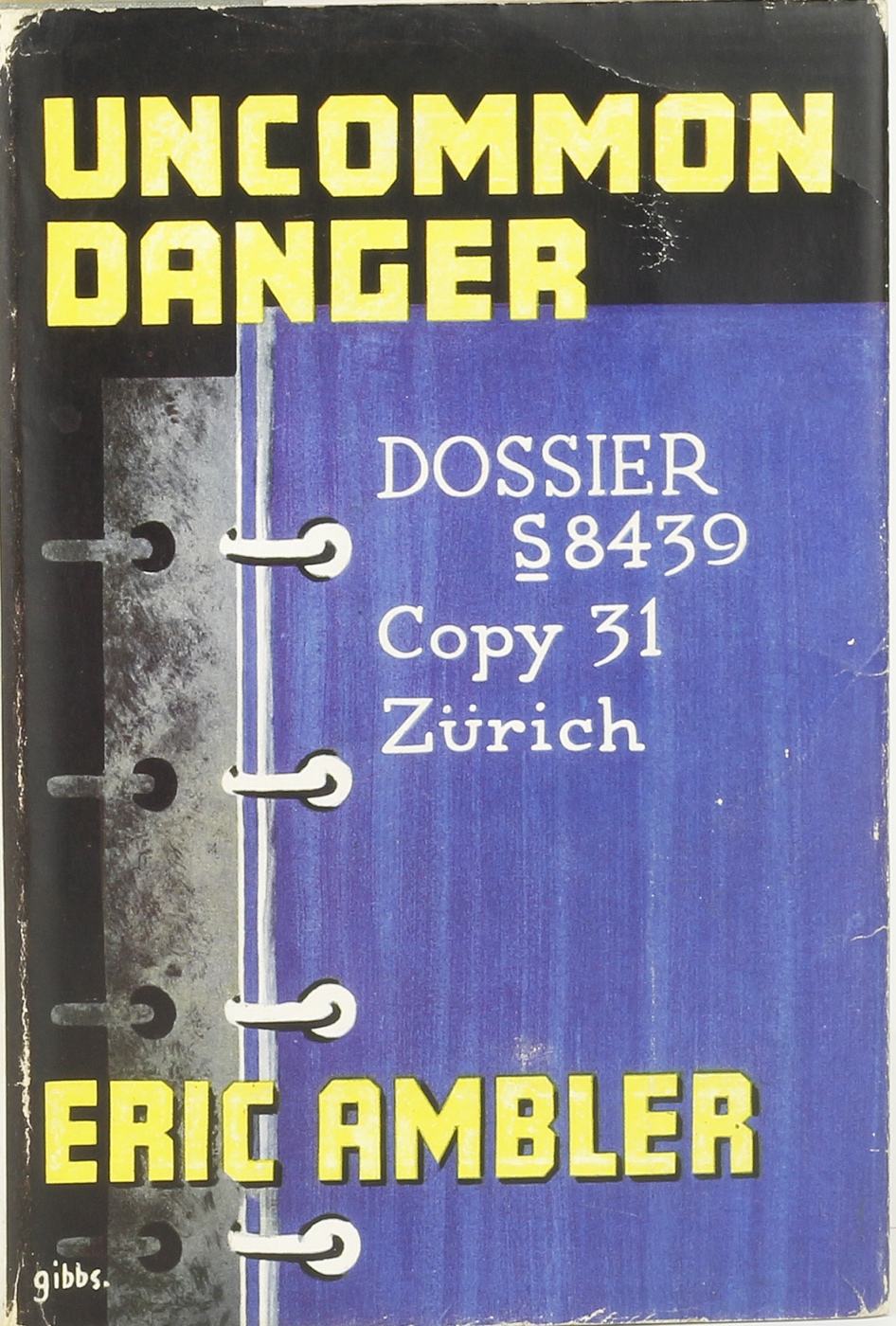
Eric Ambler's Uncommon Danger

Uncommon Danger (published in the United States as Background to Danger) was the second spy thriller written by Englishman Eric Ambler (1909-1998). It was published in 1937. Ambler is one of the most important figures in the evolution of spy fiction. During the 1930s Ambler and Graham Greene revolutionised the genre. In place of hearty British heroes like Bulldog Drummond Ambler gave us innocents caught up in the dangerous world of espionage. Not quite bumbling amateurs - Ambler’s protagonists are usually reasonably intelligent men but they find themselves hopelessly out of their depth and they must either sink or learn to swim.

The protagonist of Uncommon Danger is a half-Irish half-French reporter named Kenton. Kenton is a free-lancer. This is financially a rather precarious profession and his weakness for gambling makes it even more precarious. Not for the first time in his life he is broke. He heads for Vienna, hoping to borrow some money from an acquaintance who owes him a favour. On the train he encounters a man named Sachs who makes him a tempting proposition - all Kenton has to do is to carry a package over the frontier ands for this very simple task he will receive six hundred marks. Sachs claims to be a Jewish refugee and claims that the package contains securities. Kenton is not a complete fool and it is obvious to him that the story Sachs has been spinning is a tissue of lies from start to finish, but he needs those six hundred marks.

This simple task soon becomes very complicated, with people getting killed. And it’s obvious that there are several groups of people who want that package and they don’t mind how many more people they have to kill.

At this stage Kenton has no idea what is going on but when he’s struck a vicious blow over the head, is kidnapped and then tortured he figures that the people doing this things are probably bad guys. But is the other group tying to get the package the good guys or just another faction of bad guys? Are there any good guys? Are they spies or counter-spies or common criminals or something else?

The package is not just a McGuffin. The nature of the contents of the package is crucial in determining Kenton’s actions. Kenton is not a particularly political person and not even a particularly moral person but there are some things that do offend his moral sensibilities enough to cause him to dig his heels in and even risk his life. Kenton has reached the point in his life when he cannot evade responsibility.

For Ambler espionage and politics were very much entangled. In this story the confrontations between fascism and socialism and liberal democracy form an essential part of the background but there’s more to it than that. Politics is a game that is not played only by politicians - it is also played by Big Business and their ethical standards are even lower than those of politicians. There are also old-fashioned territorial disputes between nations. In this case a long-standing quarrel between Romania and the Soviet Union, complicated by internal Romanian politics. The players in the game that Kenton has stumbled into include oil tycoons and Soviet spies.

As in all of Ambler’s early work it would be a mistake to assume that the Soviets are necessarily going to be the bad guys and it would be an even bigger mistake to assume that respectable British businessman are going to be the good guys. Of course whether the various players are good guys or bad guys they’re all out to advance their own interests so Kenton is not at all sure if he can trust any of them.

This is an Eric Ambler novel so the fact that Kenton has been caught up in the world of spies does not mean that he is instantly transformed into James Bond. He’s a reporter. He is not a tough guy. He is afraid of guns. He does his best. Being a reporter who has spent his career covering central Europe he does at least have some understanding of politics and considerable understanding of human duplicity. Occasionally he even manages to keep a step ahead of the professional spies but he makes lots of elementary mistakes and he has no hope of survival without some help from people who actually know what they’re doing.

This was 1937, a very troubled time. Austria’s future is uncertain. Anschluss hasn’t happened but it’s on the horizon. Poland and Czechoslovakia are engaged in desperate diplomatic manoeuvrings. Everyone is trying to join an alliance, or escape from one. No-one knows whether alliance with Nazi Germany or the Soviet Union would be the safer option. Codreanu’s Iron Guard are awaiting their opportunity in Romania. And for ruthless industrialists there are opportunities for profit. They’re more unscrupulous even than the politicians.

The plot is complex and devious but Ambler doesn’t get bogged down in details. He’s more interested in the psychology of espionage and betrayal than in the minutiae. And he keeps the excitement level high. Terrific entertainment. Highly recommended.

Friday, November 15, 2019

Elspeth Huxley's Murder on Safari

Elspeth Huxley (1907-1997) was an English writer best known for her non-fiction books about her childhood in Africa. She also wrote a handful of murder mysteries the second of which, Murder on Safari, appeared in 1938.

The setting is, obviously, Africa. In fact it is certainly Kenya. This was the twilight of the British Empire although the British hadn't quite realised that yet. Danny de Mare is a white hunter (which is used throughout the book as his job description) and he’s currently leading a safari. The safari comprises the very wealthy Lady Baradale, her husband Lord Baradale, his daughter Cara and her fiancé Sir Gordon Catchpole. The other Europeans in the party are Rutley, Lady Baradale’s chauffeur/mechanic, Cara’s maid Paula, a second white hunter named Luke Engelbrecht and Mrs Chris Davis, a pilot who cuts as a spotter for the safari.

De Mare has informed Superintendent Vachell of the Chania Police that some very valuable jewels of Lady Baradale’s have been stolen from a safe in her tent. Since Luke Engelbrecht has now been fired de Mare suggests that Vachell could join the safari undercover, posing as a white hunter. Vachell adopts the suggestion.

Unfortunately Vachell’s masquerade isn’t very successful and in any case he has to reveal his identity when the first murder occurs. This first murder is ingenious and the second is fiendishly clever.

It’s fun seeing what is basically a country house murder translated to Africa. The camp is a hundred miles from the nearest town. The roads are bad and quite impossible when it rains (which it does frequently) so the camp is effectively isolated. This means that the killer must be one of the nine Europeans with the safari. There are no less than thirty-six African cooks, gun-bearers, porters, etc but Huxley knows her rules of detective fiction. It is simply accepted by everyone that the murderer cannot be one of the African servants.

The African setting is used very cleverly. Apart from the usual hazards facing a detective Vachell survives being trampled by a wounded buffalo, which turns out to be attempted murder (although obviously the buffalo is the weapon rather than the murderer). Instead of cigar ash and footprints in the shrubbery the clues are things like elephant droppings (which it turns out can provide a great deal of information). And instead of alibis being provided by cab drivers or waiters they are provided by things like herds of buffalo (which we discover really can provide an alibi).

The question of a motive for the murders is complicated by the fact that the participants in the safari are also indulging in an age-old indoor sport, jumping in and out of bed with each other with a fine disregard for the conventions of matrimony.

One interesting feature of this novel is that the Africans do not speak in an exaggerated pidgin English manner. They speak pretty much the way you’d expect people who had been educated in a mission school to speak - in reasonably correct English. Huxley does not give the impression of having any doubts about the morality of Britain’s imperial mission but she was brought up in Kenya so she was presumably quite familiar with the way Africans in Kenya spoke. The Africans do suspect that the murders may be connected with witchcraft, and in 1938 that was probably a fairly universal belief. If you’re the sort of person who anguishes over the lack of political correctness in 1930 novels you’ll be rather perplexed by this book - it’s really neither politically correct nor politically incorrect. Huxley just describes the Africa she knew without offering any judgements at all.

A golden age detective novel must of course stand or fall on its plotting, and most crucially on whether it delivers a satisfactory solution. There’s also the matter of fair play. To convince us that she is plying fair Huxley provides copious footnotes in the closing stages linking us to the important clues. And the clues are often extremely clever. There are however two flies in the ointment for me. Firstly, there’s an incredibly vital clue which I feel is fudged. At the end she pulls a rabbit out of a hat to explain it away. And it really is the most vital clue of all. Secondly, she utilises a certain plot device which I personally feel does not actually break the rules but is contrary to the spirit of the game. So I’m not persuaded that this story is absolutely one hundred percent fair play. But it has to be said that many readers are not bothered by this not uncommon device.

And to compensate for these minor flaws there are the very very clever murder methods. The best thing about them is that they’re not just clever - they could only work in Africa. Many of the clues could also only work in Africa. I always admire writers who don’t just use exotic settings to add colour but make the setting vital to the plot.

Murder on Safari is also an exceptionally entertaining read. Recommended.

Friday, November 8, 2019

A for Andromeda

A for Andromeda is a novelisation of one of the most famous science fiction television series of all time, a series that gave Julie Christie her first big break. The seven-part serial was screened on the BBC in 1961. Tragically the BBC, in its infinite wisdom, later destroyed the entire series apart from one of the seven episodes. The follow-up series, The Andromeda Breakthrough (in which Susan Hampshire replaced Julie Christie), survives and was also novelised  (I’ll be reviewing it soon).

The A for Andromeda TV series was co-written by astronomer and science fiction author Sir Fred Hoyle and John Elliot. The novelisation was credited to Hoyle and Elliot. It was written by Elliot but the idea and the story were Hoyle’s.

The audio of the entire TV series does survive and the missing episodes have been reconstructed using the audio and production stills (of which there were hundreds) so it’s possible to get a reasonable idea of what it was like and how it compares to the novelisation.

A new British radio-telescope has just been commissioned. And they’ve discovered something rather interesting. And rather startling. It’s a signal, from the region of the Andromeda constellation. A signal that appears to have meaning. It may even be a message. A message that has taken two hundred years reach us.

Dr Fleming, who was the first to realise that the signal was an intelligible message, has figured what the message is. It’s a set of instructions. In fact it’s a design, for a super-computer. And the message also contains the data to run through this computer.

Oddly enough the super-computer, once built, seems extraordinarily interested in how the human body works, about our biochemistry, our DNA, all that sort of stuff. It seems to be interested in producing a design for something else. Something biological. This is all starting to worry Dr Fleming. The more he thinks about it the more sinister implications he sees.

This is a first contact story but an intriguingly unconventional one. There’s no actual contact with aliens. The alien planet is 200 light years away and this book assumes that faster-than-light travel, or communication, really is impossible. There’s no possibility of actual communication. The only contact is the message containing the design for a computer, for a biological something, and lots of data. The aliens are not going to be arriving in spaceships. The only aliens in the story are the ones created by humans, following the alien design. Those aliens have no means of contacting their home planet. And are they truly alien? Are they human-like alien creations or alien-like human creations or some kind of alien-human hybrid? Are they alive or are they machines, or are they biological machines?

The book addresses the political, social and existential consequences of this and of hybridisation but it also explores the personal and psychological consequences. There’s a certain “trapped between two cultures” element as far as the heroine (or villainess depending on your point of view) is concerned.

This was 1961, a time when computers still used punch cards, but the primitiveness of the computers doesn’t matter. The ideas of human-machine interfaces and human-machine hybrids, are as provocative and as relevant as ever. This is a tale that deals with concepts like artificial intelligence, post-humanism, the fuzzy boundaries between biological and machine life, what it means to be human, what our ultimate destiny might be and the problem of the extent to which there can be genuine communication, and more importantly genuine trust, between human and alien and human and machine. This is a story that is really not even slightly dated.

While Elliot may have written the book it’s probably fair to assume that most of the interesting hard science fictional ideas were Hoyle’s. This is classic high-concept big-ideas science fiction.

While this is hard science fiction it’s also to some extent a spy thriller. It’s set in the late 60s, in a world in which the West is threatened and anxious and Britain is little more than an American satellite state. It’s also a world in which gigantic corporate cartels wield immense power and one of these cartels is extremely interested in that message from Andromeda. The government and the military are also very interested in the products of that alien design and they’re possibly less trustworthy even than the aliens. They’re certainly far more stupid and short-sighted.

A for Andromeda is smart provocative science fiction. Highly recommended.

Friday, November 1, 2019

L. Ron Hubbard's Typewriter in the Sky

Typewriter in the Sky is an intriguing and unconventional 1940 science fiction/fantasy/adventure novel by L. Ron Hubbard (1911-1986).

Yes, that L. Ron Hubbard. The inventor of Dianetics, the founder of the Church of Scientology. Everyone knows that Hubbard was a science fiction writer but it’s easy to fall into the trap of assuming that he was probably a bad science fiction writer and that nobody apart from Scientologists bothers to read his novels, or should bother to read them. And the fact that people tend to have very strong views on the subject of Scientology makes it very hard for them to approach anything he did without either idolatry or extreme hostility. In fact feelings on the subject can run so high that it might be advisable at this point for me to state that I am not a Scientologist, I know very little about Scientology and I have no particular axe to grind one way or the other.

The truth is that, leaving Scientology aside, on the evidence of Typewriter in the Sky Hubbard was a very good and very interesting science fiction writer. And he was also a highly successful one.

Typewriter in the Sky is a clever and very unconventional novel. The ideas that Hubbard is playing around with have become quite familiar having been used many times since. It has to be kept in mind that when Hubbard wrote this novel in 1940 those ideas were fresh and wildly original.

Horace Hackett is a pulp writer. Like most pulp writers he works in various genres but he is best known for his adventure stories. He has received a generous advance from his publisher Jules Montcalm for his latest potboiler. Being a writer he naturally spent the money immediately.

Hackett’s problem is that he has not actually written the novel. He has not even started writing it. He has not even given the matter any real thought. And now his publisher wants the manuscript and he wants it yesterday. If not yesterday, then he certainly wants it now. Montcalm confronts him in his apartment, where he’s idly chatting with his buddy Mike de Wolf, and demands to be given at the very least an outline of the plot. Hackett has to think fast and he bluffs his way through by making up an outlandish plot on the spot. Montcalm is particularly anxious to know about the villain. Since Hackett does not yet have a villain he bluffs again by constructing a villain, a Spanish admiral named Miguel de Lobo, based on his buddy Mike.

And then Mike suddenly finds himself wading ashore on a Caribbean island with dim memories of standing on the poop deck of his flagship which has just fought an unsuccessful action against English pirates. When confronted by a couple of pirates on the beach he dispatches them with his rapier. Which is odd because a moment ago he was unarmed. Mike is taken in by a beautiful young woman, the daughter of the English governor of the island, but the locals want to hang him as a damned Spanish Papist. In 1640 the English were not fond of Spanish Papists. For it seems that Mike is no longer in the year 1940 but the year 1640.

The other odd thing is a strange sound that he hears in the sky. It almost sounds like a typewriter.

A horrible realisation hits Mike. He is a character in a Horace Hackett pirate story. Being a fictional character is bad enough but being a character in a Horace Hackett novel is much worse - it means he is a fictional character in a very bad novel. Which explains why some of the historical details seem to be totally wrong - Hackett is a hack writer notorious for his lack of interest in historical accuracy. It also explains why Mike finds himself speaking in pulp fiction clichés - he’s talking like a character in a Horace Hackett novel. And then the worst point of all strikes Mike - he’s not just a fictional charter, he’s the villain, and he knows what happens to Horace Hackett’s villains.

It’s a good premise but what’s really impressive is how cleverly and how wittily Hubbard exploits it. The reader is in on the joke right from the start. Hubbard is not trying to bamboozle the reader - it’s poor Mike who is bewildered. He knows from the start that he’s become a fictional character but he doesn’t know the rules. Is he a mere puppet, dancing to Hackett’s tune? Does he have any actual control over the outcome of events? Can he determine his own destiny? Is he even speaking his own lines or just the lines that Hackett feeds him? Of course the question of how much control we have over our destinies applies to all of us to some extent, not just fictional characters. Maybe we’re all just playing parts written for us by a typewriter in the sky. The problem is that we’re never sure if we’re playing a rôle in a farce or a tragedy, or just a meaningless pulp tale cranked out by a hack writer.

Hubbard explores these existential questions but he never gets pompous or tedious about it. It’s clever and occasionally quite thought-provoking but the tone remains playful. Life is just a pulp fiction story so why get worked up about it?

The basic idea had been tentatively explored in experimental fiction but I think it’s true to say that Hubbard was the first to see its potential for a science fiction story. And although these ideas have been tackled many times since I don’t think they’ve ever been done with quite such lightness of touch.

Typewriter in the Sky is both an adventure story and a parody of adventure stories, both an existential tale and a science fiction tale, and it works equally well on all these levels. It’s amusing and intelligent and immense fun. Very highly recommended.

Monday, October 21, 2019

Charlie Chan Carries On

Charlie Chan Carries On was the fifth Charlie Chan novel by Earl Derr Biggers (1884-1933). It was published in 1930.

An elderly American man named Drake is found murdered in an up-market London hotel. Mr Drake had been part of an American around-the-world tour group organised by a Dr Lofton. Circumstances suggest that one of the members of the party must have been the murderer.

It’s a tough case for Chief Inspector Duff of Scotland Yard. No-one has a decent alibi and there are several shady characters in the party. A key attached to a watch chain seems likely to be an important clue but discovering just what it is that the key unlocks proves to be a baffling mystery.

With no real evidence there is no way to prevent the tour from continuing but Chief Inspector Duff isn’t giving up. His hunt for the killer will take him to France and Italy and it will take Detective-Sergeant Welby to Calcutta and thence to Yokohoma. And the tour part will leave a trail of corpses behind it.

But what has all this to do with Charlie Chan? Nothing at all. At least, nothing at all until a fateful day in Honolulu (well over halfway through the book) makes this a case for Detective Inspector Chan of the Honolulu Police Department. And a case with an unexpected very personal significance for Charlie. And it now becomes a classic shipboard mystery story. All the possible suspects are on board the ship steaming from Honolulu to San Francisco and Charlie has six days to discover which one is the killer.

Charlie is not sure whether to be pleased or appalled that he will have the assistance of Kashimo on the trip. Kashimo is a young Japanese Honolulu P.D. detective renowned for his ability to bungle the simplest tasks. Charlie tolerates him for two reasons. Firstly, his bungling is largely due to inexperience and excessive zeal. And secondly, for all his faults there is one aspect of police work at which Kashimo excels. When it comes to conducting a search he is very close to being a genius. He can find a clue that no other living policeman could find. And Kashimo will find just such a clue on this voyage.

I’m a huge fan of both shipboard mysteries and murder stories set in exotic locales and this one scores highly on both counts.

Charlie Chan Carries On was famed by Fox in 1931 with Warner Oland as Chan. Unfortunately this is now a lost film. One of the later Sidney Toler Chan films, the excellent Charlie Chan’s Murder Cruise, was also loosely based on the novel.

Despite their immense popularity in their day the Charlie Chan novels don’t (in my opinion) get as much respect as they deserve. Perhaps Biggers’ premature death in 1933 has something to do with this. Charlie Chan Carries On is not quite as good as The Black Camel but it’s still highly recommended.

Sunday, October 13, 2019

Graham Greene’s Our Man in Havana

Graham Greene’s Our Man in Havana was published in 1958, providing another example of Greene’s ability to set his stories in places that were just about to hit the headlines (in 1959 Castro came to power).

Our Man in Havana is a spy story. It is the cynical, humorous and absurd tale of Jim Wormold, not exactly one of the shining lights of the British Secret Intelligence Service. Mr Wormold lives in Havana. He sells vacuum cleaners. He is moderately successful but unfortunately he has a daughter. That’s not unfortunate in itself but the daughter, Milly, is at the age at which daughters become very very expensive. Even worse, Milly has now conceived a passion for horses. She must have one. There is simply no way Mr Wormold can afford the upkeep on a horse as well as a daughter.

So it seems like a stroke of good luck when Mr Wormold is approached by Hawthorne. Hawthorne works for MI6 and he’s in the process of setting up an espionage network in Cuba. Hawthorne believe that a vacuum cleaner salesman is the perfect cover for a spy. Mr Wormold knows nothing of the world of espionage and has no interest in politics but the $150 a month plus expenses that Hawthorne offers him interests him quite a bit. So Mr Wormold becomes MI6’s man in Havana.

Initially Wormold is a bit worried by the fact that he nothing about the world of spies and knows nothing about recruiting agents but then he realises that it doesn’t matter. The network of agents he’s supposed to recruit don’t have to actually exist. The information he sends back to London doesn’t have to be real. It just needs to sound convincing. Pretty soon he has a whole network of imaginary agents and he’s sending off detailed reports to London with lots of disturbing information, none of it rel. He’s even sent them drawings of high-tech weaponry at a new top-secret military installation. The fact that these sophisticated weapons look a bit like parts of a vacuum cleaner somehow gets overlooked in all the excitement.

The head of MI6, C, is convinced that Wormold is  the most valuable agent they’ve ever had. The more fanciful his intelligence reports become the more certain C is that they must be true.

Things are going very nicely for Mr Wormold. Until somebody starts trying to kill his agents. Which is very disturbing since those agents don’t actually exist. Fiction is becoming reality.

Graham Greene of course had been a real-life spy for the British. He knew the incompetence and stupidity of MI6 at first hand. He knew that much of the intelligence provided by spies was simply fantasies concocted by the spies. The more intelligence you provide the more likely it is that the intelligence agency for which you work will continue to pay you. The intelligence doesn’t have to be true. It just has to be the sort of thing that the intelligence agency wants to hear.

Greene had converted to Catholicism in 1926. After the Second World War, and probably not coincidentally after his stint with MI6, Greene’s politics became steadily more leftist although it’s important to keep in mind that he was an old school leftist with nothing in common with the leftism of today. And while his Catholicisjm seems to recede into the background a little it’s also important to remember that he saw no conflict whatsoever between left-wing politics and Catholicism.

When he wrote this novel Greene seems to have been going through one of his upbeat phases (he was prone to frequent bouts of extreme depression). Wormold is more sympathetic than most Greene protagonists (you can’t really call any of Greene’s protagonists heroes). He’s a timid little man but he’s not a hopeless alcoholic and he hasn’t given in to despair or nihilism. He knows little about raising children but he’s managed to be a reasonably good father. He’s a nice guy. He isn’t very honest but he has no wish to do any harm to anybody. He thinks the espionage stuff is all very silly but if MI6 are foolish enough to pay him money he’ll take it. Even when he gets himself into deep trouble he doesn’t give in to despair. Whether he can extricate himself from the mess might be extremely doubtful but at least he’s going to try.

Despite the fact that Wormold never does any actual spying Our Man in Havana manages to be an enjoyable and exciting spy thriller. It’s also superb satire, and very funny. Greene’s contempt for spies is palpable and as in The Quiet American there’s an awareness of how much harm can be done by bungling intelligence agencies but it’s combined with genuine amusement.

A wonderful book. Very highly recommended.

Monday, October 7, 2019

F. Van Wyck Mason’s The Singapore Exile Murders

The Singapore Exile Murders was the fourteenth of F. Van Wyck Mason’s long-running and very successful series of spy thrillers featuring Hugh North of G-2, a U.S. Army intelligence officer. It appeared in 1939. Van Wyck Mason was a very strong believer in the virtues of exotic settings.

Captain North is already in a tight spot when the book opens. The British flying boat on which he was travelling from Hongkong to Singapore has run into a severe storm, so severe that it is forced down and takes shelter in the lagoon of a tiny uninhabited island. The aircraft is damaged and once the storm has blown itself out the flight to Singapore will be resumed. The danger is past. Or is it? In fact one of the passengers is destined not to reach Singapore alive.

The unexpected stopover gives North a chance to study his fellow passengers and they’re a more than unusually interesting lot. There are hints that some of them may not be quite what they seem. The wealthy Dutch businessman Barentse seems rather anxious about a big deal he is planning and about which he is very close-mouthed. His part-Javanese dancer girlfriend strikes North as am exceptionally jealous and perhaps even dangerous woman. Joan Buckley appears to be a respectable American girl but there are things abut her that just don’t fit. The White Russian Urbaniev might well be, like most White Russians, involved in plots. The haughty middle-aged Lady Helen Twining-Twyffort has her secrets. And muck-raking columnist Irene Walsh seems to be even better at discovering people’s secrets than the professional intelligence officer North, and discovering people’s secrets can be a risky business.

North is on a case, trying to track down a cashiered U.S. Army officer named Melville who has access to very highly classified material. North is intrigued to note that several of his fellow passengers are linked in some way to Melville.

Murder on an aircraft is an idea that was not used as often as you might expect in the interwar years although of course there were a few celebrated detective novels on that theme.

The first half of the book focuses to a large extent on North’s efforts to find the murderer, since it seems a reasonable assumption that the murder of someone linked to Melville is likely to be the key to finding him. North does discover the identity of the killer and finds that his difficulties have only just begun. The book now becomes more of a spy thriller but with plenty of plot twists still left up its sleeves.

North is a thorough professional but he’s also a man who enjoys the good life. By the good life he means high quality liquor and high quality women, both of which he consumes in large quantities. He is therefore by no means disappointed that there are two beautiful women who seem to be very intimately involved in the case. There is the glamorous part-Javanese dancer Madé Sayu, whose talents run to more than dancing. And there is all-American girl Joan Buckley. One of them might be a foreign agent. In fact both might be spies. Or both might be innocent. Fortunately both make charming companions so North doesn’t mind that he has to get to know them better, strictly in the line of duty of course. He also has to bear in mind that beautiful lady spies can potentially be quite deadly.

Naturally, this being 1939, there’s no graphic violence or sex. There is at times though a slightly grimmer atmosphere than you might expect. There’s some action and plenty of suspense.

The political aspects are interesting. The story takes place during the Munich Crisis in 1938. A major war seems imminent and no-one knows how many countries might eventually be drawn in. For an intelligence agent it’s a time of extreme paranoia. There are spies from several different countries mixed up in the Melville business, including Britain and Japan. The United States is of course at peace with all these countries but when it comes to the world of espionage every nation has to be considered a potential enemy. It’s actually the British rather than the Japanese that North is particularly worried by.

Van Wyck Mason’s spy thrillers are rather more serious in tone than most of the spy fiction of the inter-war years. They’re certainly too serious and too realistic to be regarded as pulp fiction. On the other hand they don’t have the literary pretensions of a Graham Greene or an Eric Ambler story. They are actually quite close in feel to John P. Marquand’s Mr Moto novels (such as Thank You, Mr Moto) although Marquand is a bit more literary and a bit more stylish.

The Singapore Exile Murders is a fine spy thriller. Highly recommended.

You should also check out Mason’s earlier The Budapest Parade Murders and the truly excellent The Branded Spy Murders.