A for Andromeda was one of the most famous science fiction television series of all time, now tragically lost. The follow-up series The Andromeda Breakthrough, broadcast in 1962, does however survive. Both series were co-written by astronomer and science fiction author Sir Fred Hoyle and John Elliot. Novelisations of both series were produced. They were credited to Hoyle and Elliot but seem to have been written mostly by Elliot. It is the novelisation of The Andromeda Breakthrough, published in 1964, with which we are concerned at the moment.
This sequel picks up at exactly the point at which A for Andromeda leaves off. Unfortunately it’s difficult to say much about the plot of The Andromeda Breakthrough without revealing spoilers for A for Andromeda. Since I have no intention of giving away any spoilers I’m going to be very very vague about the plot.
The premise of A for Andromeda is that a message has been received from deep space. The message comprises instructions for building a computer far in advance of anything known on Earth. Once the computer is built it begins to construct something else - a young woman. Is she human or alien? Is she woman or machine? Can she, or the computer, be trusted? What are their intentions? The British Government is terribly excited since this project seems to offer the opportunity to restore Britain’s place in the world.
To the astonishment of the British Government the whole thing goes horribly wrong. As The Andromeda Breakthrough opens scientist Dr John Fleming is on the run with a strange young woman without any memories.
It’s not just the government that is after them. There’s also a sinister international business cartel and the agents of a small Middle Eastern nation.
While there are definite spy thriller elements to A for Andromeda those elements are much more prominent in the sequel, or at least they are in the early stages of the book. The spy thriller stuff is fairly exciting and there’s plenty of cynicism for spy fiction fans who enjoy that sort of thing.
By the halfway stage the hard science fiction elements have kicked in again. And they do represent a further development of the ideas in the first book - the problems of complete mutual incomprehension involved in contact with an alien civilisation, the near impossibility of knowing whether aliens can be trusted, the danger of actions being misinterpreted due to extreme cultural differences, the sheer alienness of the motivations of alien intelligences. The unusual indirect nature of the contact with the aliens is so very indirect exacerbates the difficulties. These are issues that fascinated many science fiction writers but The Andromeda Breakthrough deals with them in a reasonably thoughtful way. The fact that the aliens never actually appear in the story but act at second hand through human agents and an artificial intelligence adds an original twist.
There’s plenty of ambiguity in this tale. It’s not just the uncertainly about the motivations of the aliens and of their partly human creation. The fully human characters are pretty ambiguous as well. Dr Fleming is paranoid and he’s right to be paranoid but maybe he pushes it too far. He thinks he’s being rational but can’t accept that he’s become emotionally entangled. Professor Dawney, the biochemist given the opportunity to create life, is perhaps naïve and is perhaps inclined to allow her scientific excitement to cloud her judgment. The politicians and businessmen who get mixed up in the affair combine unscrupulousness with breathtaking incompetence, greed and foolishness. There’s enough complexity, both moral and philosophical, to keep things interesting and there’s enough action to keep things entertaining.
While The Andromeda Breakthrough, both as a TV series and as a novelisation, is not as highly regarded as A for Andromeda a case can be made that it’s been somewhat underrated. The TV series was released on DVD but it’s very hard to find these days. The novelisation is quite intriguing. Recommended.
My review of A for Andromeda can be found here.
pulp novels, trash fiction, detective stories, adventure tales, spy fiction, etc from the 19th century up to the 1970s
Friday, December 20, 2019
Saturday, December 14, 2019
Arthur W. Upfield's Bushranger of the Skies
Bushranger of the Skies, later reprinted as No Footprints in the Bush, is a 1940 Detective Inspector Napoleon Bonaparte mystery by Arthur W. Upfield. This time Bony, the half-Aboriginal half-European detective, gets uncomfortably closely involved in a case.
Somewhere in Central Australia Bony is on his way to the McPherson Homestead to deliver a letter to the local police sergeant, a man named Errey. It concerns some odd happenings in the area. While camped about twenty miles from the homestead he sees a dust cloud in the distance. It is obviously a car and since cars and few and far between on this unmade road Bony makes a reasonable guess that it is Sergeant Errey’s car. There’s nothing surprising in any of this. Bony is only mildly surprised when an aircraft appears from the west. He is however very surprised when the aircraft drops a bomb on his camp. He is even more surprised when the aircraft drops two more bombs on Sergeant Errey’s car, reducing it to a blazing wreck. This qualifies as very much more than an odd happening. And Bony is not overly keen on people trying to kill him.
The atmosphere at the McPherson Station is pretty strange. Old McPherson is a crusty character of Scottish extraction. Bony is sure that McPherson has a fair idea of the identity of the pilot of that monoplane but the old man obviously has some secrets he intends to keep to himself.
The usual Upfield formula was to adhere fairly closely to the classic golden age detection template but with an exotic setting somewhere in the Australian Outback and with an exotic detective. Upfield did however vary this formula on occasions, having Bony investigate a case in the big city or as in this book making the story more of a thriller than a tale of detection.
Both Bony and the reader know the identity of the pilot of the murder aeroplane very early on and we know roughly what his motivation is. What we (and Bony) don’t know is what he’s going to do next and how Bony is going to stop him. Bony doesn't quite know how he’s going to stop him either.
The culprit is a skilled bushman with a hundred and fifty thousands square miles of desolate country in which to hide, and he has allies in a local Aboriginal tribe and they’re even better at simply disappearing into the bush. Even with a team of police and aircraft and trackers it could take months to find the man. Bony, for reasons of his own, decides to do the job alone. He faces a further problem - he’s not the only one hunting this man. And Bony will have to find him first.
The difficulty facing a man like Bony, caught between two cultures and with strong loyalties to both, is a major underlying theme of all the Bony stories but in this novel it takes centre stage. All the central characters in this story are in their own ways in the same position as Bony, caught halfway between cultures. Bony has come to terms with his own situation but the other characters have not.
Upfield’s treatment of these problems might seem old-fashioned but that’s a superficial view. Once you put aside the fact that he uses terms that are now forbidden (such as half-caste) you’ll find that his views on these matters are perceptive and deeply sympathetic. He refuses to idealise either the whites or the Aboriginals or those of mixed race but he is fundamentally sympathetic to all three points of view and he is also fundamentally optimistic. Of course the book was written in a much more optimistic age. Perhaps the tragedy of our own times is the we’ve lost that optimism.
Upfield does perhaps spend too much time telling us what a remarkable chap Bony is and how clever he is, when in fact Bony makes a series of terrible errors and consistently underrates his opponent.
This is a manhunt battle of wills and wits tale. There is no detecting done at all. The suspense also doesn’t quite come off. The far-fetched and rather outrageous plot is the sort of thing that a Leslie Charteris could have pulled off effortlessly. Upfield doesn’t quite manage to bring it off. He doesn’t quite convince us to believe in the story, or in the villain. And Bony is not the Saint. He’s the wrong hero for this kind of tale.
One interesting aspect to the story is the assumption that the magic of Aboriginal magic men really does work. Bony believes it works and it’s pretty clear that Upfield expects the reader to believe it too. This is therefore a crime story with actual supernatural elements or at least paranormal elements. That’s a problem given that the the plot already stretches credibility to breaking point. There’s nothing wrong with supernatural thrillers but in this case the supernatural elements weaken the story.
Bushranger of the Skies is really not a success. There are much better Bony novels out there, such as the excellent Wings Above the Diamantina. This one is for Upfield completists only.
Somewhere in Central Australia Bony is on his way to the McPherson Homestead to deliver a letter to the local police sergeant, a man named Errey. It concerns some odd happenings in the area. While camped about twenty miles from the homestead he sees a dust cloud in the distance. It is obviously a car and since cars and few and far between on this unmade road Bony makes a reasonable guess that it is Sergeant Errey’s car. There’s nothing surprising in any of this. Bony is only mildly surprised when an aircraft appears from the west. He is however very surprised when the aircraft drops a bomb on his camp. He is even more surprised when the aircraft drops two more bombs on Sergeant Errey’s car, reducing it to a blazing wreck. This qualifies as very much more than an odd happening. And Bony is not overly keen on people trying to kill him.
The atmosphere at the McPherson Station is pretty strange. Old McPherson is a crusty character of Scottish extraction. Bony is sure that McPherson has a fair idea of the identity of the pilot of that monoplane but the old man obviously has some secrets he intends to keep to himself.
The usual Upfield formula was to adhere fairly closely to the classic golden age detection template but with an exotic setting somewhere in the Australian Outback and with an exotic detective. Upfield did however vary this formula on occasions, having Bony investigate a case in the big city or as in this book making the story more of a thriller than a tale of detection.
Both Bony and the reader know the identity of the pilot of the murder aeroplane very early on and we know roughly what his motivation is. What we (and Bony) don’t know is what he’s going to do next and how Bony is going to stop him. Bony doesn't quite know how he’s going to stop him either.
The culprit is a skilled bushman with a hundred and fifty thousands square miles of desolate country in which to hide, and he has allies in a local Aboriginal tribe and they’re even better at simply disappearing into the bush. Even with a team of police and aircraft and trackers it could take months to find the man. Bony, for reasons of his own, decides to do the job alone. He faces a further problem - he’s not the only one hunting this man. And Bony will have to find him first.
The difficulty facing a man like Bony, caught between two cultures and with strong loyalties to both, is a major underlying theme of all the Bony stories but in this novel it takes centre stage. All the central characters in this story are in their own ways in the same position as Bony, caught halfway between cultures. Bony has come to terms with his own situation but the other characters have not.
Upfield’s treatment of these problems might seem old-fashioned but that’s a superficial view. Once you put aside the fact that he uses terms that are now forbidden (such as half-caste) you’ll find that his views on these matters are perceptive and deeply sympathetic. He refuses to idealise either the whites or the Aboriginals or those of mixed race but he is fundamentally sympathetic to all three points of view and he is also fundamentally optimistic. Of course the book was written in a much more optimistic age. Perhaps the tragedy of our own times is the we’ve lost that optimism.
Upfield does perhaps spend too much time telling us what a remarkable chap Bony is and how clever he is, when in fact Bony makes a series of terrible errors and consistently underrates his opponent.
This is a manhunt battle of wills and wits tale. There is no detecting done at all. The suspense also doesn’t quite come off. The far-fetched and rather outrageous plot is the sort of thing that a Leslie Charteris could have pulled off effortlessly. Upfield doesn’t quite manage to bring it off. He doesn’t quite convince us to believe in the story, or in the villain. And Bony is not the Saint. He’s the wrong hero for this kind of tale.
One interesting aspect to the story is the assumption that the magic of Aboriginal magic men really does work. Bony believes it works and it’s pretty clear that Upfield expects the reader to believe it too. This is therefore a crime story with actual supernatural elements or at least paranormal elements. That’s a problem given that the the plot already stretches credibility to breaking point. There’s nothing wrong with supernatural thrillers but in this case the supernatural elements weaken the story.
Bushranger of the Skies is really not a success. There are much better Bony novels out there, such as the excellent Wings Above the Diamantina. This one is for Upfield completists only.
Saturday, December 7, 2019
Graham Greene’s The Third Man
The genesis of Graham Greene’s The Third Man is rather interesting. In 1948 The Fallen Idol, directed by Carol Reed and written by Graham Greene, had been very successful at the box office. Since it also proved to be a happy collaboration it’s no surprise that Reed and Greene were anxious to do another movie together. That movie would eventually become The Third Man, one of the greatest movies ever made. But at the time he agreed to do the film Greene had only a single sentence scrawled on the back of an envelope - the mere germ of an idea about a man who is surprised to see an old friend named Harry Lime pass him in the street - surprised because he’d attended Harry’s funeral a few days earlier.
Greene was an excellent screenwriter but felt that he could not write a totally original screenplay. He preferred to adapt one of his stories or novels. Since in this case he had no story to adapt he would have to write one. So he sat down and wrote a story. Now he had something on which to base a screenplay. The story (a bit more than novella length) was never intended to be published. It was merely a quarry from which he would mine the materials for his screenplay. When the film was released in 1949, to international acclaim, his publishers persuaded him to allow the novella to be published.
It is of course essentially a first draft of a story. The completed screenplay differed from the novella in a number of ways. In his preface Greene is at pains to point out that the changes were not forced upon him. Once he sat down to write the screenplay he realised that some changes would be needed and he made them. He did not however revise the novella, which is what makes it so interesting. You can see the way that Greene’s ideas about the story evolved. The changes are actually not all that great. Greene was naturally a very cinematic writer and most of the scenes in his books lend themselves to film.
But the subtle changes are interesting. In the book the central character is Rollo Martins, an English writer of pulp westerns (the fact that he is an Englishman who has never set foot in America is part of the joke). In the movie he becomes Holly Martins, an American writer of pulp westerns. The Rollo Martins of the book is in some ways even more of a failure in life than the film’s Holly Martins, although perhaps marginally less naïve and marginally less self-righteous.
The only condition producer Alexander Korda imposed on Greene and Reed was that he wanted the background to the film to be the four-power occupation of Vienna (the city being divided into British, French, American and Russian zones). This was no problem - the war-ruined city dominated by corruption, with almost everyone involved in some kind of black market, was ideal Greene territory. This is very much Greeneland.
Many of the most memorable scenes in the movie are here in the novella - the encounter on the Ferris Wheel, the chase through the sewers - and while they’re better in the film they work extremely well on the printed page.
Greene felt that the film was better than the book and he was right but the book is still in its own way classic Greene and it’s still pretty good. When comparing the novella and the movie you always have to keep in mind that the story was right from the start intended to be filmed. The novella is essentially an extended rather literary film treatment. So the set-pieces naturally work better in the movie - Greene was creating scenes that would have more impact on the screen than on the page.
Greene was fascinated by themes of betrayal but it’s interesting that both The Third Man and The Fallen Idol deal specifically with the betrayal of illusions, and our reluctance to believe that our illusions are being betrayed. Even more specifically, they deal with the betrayal of childhood illusions. Harry Lime was the boyhood idol of Rollo/Holly Martins. Letting go of the illusions of childhood is part of growing up so logically Martins should finally grow up when he realises that his hero is a fraud and a monster. But this is a Graham Greene story so things are not necessarily going to work out so neatly. Nothing works out neatly in Greeneland.
The Third Man was published in an edition that also included the short story The Basement Room on which the film The Fallen Idol was based. My review of the film version of The Third Man can be found at Classic Movie Ramblings.
The Third Man is essential reading for fans of the film and for Graham Greene fans. Highly recommended.
Greene was an excellent screenwriter but felt that he could not write a totally original screenplay. He preferred to adapt one of his stories or novels. Since in this case he had no story to adapt he would have to write one. So he sat down and wrote a story. Now he had something on which to base a screenplay. The story (a bit more than novella length) was never intended to be published. It was merely a quarry from which he would mine the materials for his screenplay. When the film was released in 1949, to international acclaim, his publishers persuaded him to allow the novella to be published.
It is of course essentially a first draft of a story. The completed screenplay differed from the novella in a number of ways. In his preface Greene is at pains to point out that the changes were not forced upon him. Once he sat down to write the screenplay he realised that some changes would be needed and he made them. He did not however revise the novella, which is what makes it so interesting. You can see the way that Greene’s ideas about the story evolved. The changes are actually not all that great. Greene was naturally a very cinematic writer and most of the scenes in his books lend themselves to film.
But the subtle changes are interesting. In the book the central character is Rollo Martins, an English writer of pulp westerns (the fact that he is an Englishman who has never set foot in America is part of the joke). In the movie he becomes Holly Martins, an American writer of pulp westerns. The Rollo Martins of the book is in some ways even more of a failure in life than the film’s Holly Martins, although perhaps marginally less naïve and marginally less self-righteous.
The only condition producer Alexander Korda imposed on Greene and Reed was that he wanted the background to the film to be the four-power occupation of Vienna (the city being divided into British, French, American and Russian zones). This was no problem - the war-ruined city dominated by corruption, with almost everyone involved in some kind of black market, was ideal Greene territory. This is very much Greeneland.
Many of the most memorable scenes in the movie are here in the novella - the encounter on the Ferris Wheel, the chase through the sewers - and while they’re better in the film they work extremely well on the printed page.
Greene felt that the film was better than the book and he was right but the book is still in its own way classic Greene and it’s still pretty good. When comparing the novella and the movie you always have to keep in mind that the story was right from the start intended to be filmed. The novella is essentially an extended rather literary film treatment. So the set-pieces naturally work better in the movie - Greene was creating scenes that would have more impact on the screen than on the page.
Greene was fascinated by themes of betrayal but it’s interesting that both The Third Man and The Fallen Idol deal specifically with the betrayal of illusions, and our reluctance to believe that our illusions are being betrayed. Even more specifically, they deal with the betrayal of childhood illusions. Harry Lime was the boyhood idol of Rollo/Holly Martins. Letting go of the illusions of childhood is part of growing up so logically Martins should finally grow up when he realises that his hero is a fraud and a monster. But this is a Graham Greene story so things are not necessarily going to work out so neatly. Nothing works out neatly in Greeneland.
The Third Man was published in an edition that also included the short story The Basement Room on which the film The Fallen Idol was based. My review of the film version of The Third Man can be found at Classic Movie Ramblings.
The Third Man is essential reading for fans of the film and for Graham Greene fans. Highly recommended.
Sunday, December 1, 2019
Rex Stout’s Over My Dead Body
Over My Dead Body was the seventh of Rex Stout’s Nero Wolfe mysteries. It was published in 1940.
A young woman, apparently from Montenegro, wants Wolfe to represent another young Montenegrin woman accused of stealing some diamonds. For some reason (which we will soon discover) Wolfe has a horror of anything remotely connected to the Balkans. He wants nothing to do with the case. Until he is informed of a certain fact which makes it impossible for him not to become involved.
The woman accused of the theft, Neya Tormic, is provided with an alibi in circumstances which occasion a good deal of surprise and even scepticism on the part of Wolfe and Archie Goodwin.
The first murder occurs soon thereafter. It won’t be the last.
The big question is why a British spy should be mixed up in all this. And a German spy as well. And why are the Feds so interested? Wolfe and Archie are not accustomed to G-men taking an interest in their case and they’re not very happy about it. Inspector Cramer of the Homicide Bureau is even less fond of the FBI and even less happy. Unfortunately, or perhaps fortunately, the G-men appear not to have a clue what they’re doing and as the tale unfolds they become steadily more ineffectual and bewildered.
And it’s not just spies. There’s a princess involved as well, and princesses are even more worrying than spies.
So this is a political thriller of sorts as well as a murder mystery. Fortunately Wolfe resists the temptation to focus too much on the political aspects. The Balkan angle adds colour and a touch of exoticism rather than being an excuse to belabour us with political lectures. Although Wolfe does display a vast contempt for bankers and international financiers.
In this book we find out some very surprising things about Wolfe’s past. It’s more than a little disconcerting to think of Wolfe as a father. Which he is. Possibly. In a way.
There’s nothing startling about the murder methods employed in this novel (even if one takes place in a fencing academy). There’s certainly nothing remotely impossible about any of the crimes. Alibis play a comparatively minor rôle. The motives are more important than the method. Indeed, the motives behind the alibis are more important than the alibis. Stout is often disparaged for his plotting abilities. He was certainly no Freeman Wills Crofts but he was actually quite competent in that area and the plot in this case is perfectly serviceable. In fact it’s quite good.
I’m more and more struck by the similarities between Nero Wolfe and Perry Mason. Both are willing to play fast and loose with legal niceties to protect the interests of their clients, even to the extent of concealing witnesses and concealing vital information from the police. They’re both fundamentally honest and they’re carful not to do anything actually illegal but both are aware that the odds are stacked against the individual so that it’s necessary for both an attorney and a private detective to take steps to protect a client from the overwhelming power of the police and the legal system.
Archie Goodwin is in fine form, relishing the various opportunities the case offers to hoodwink the police. And he gets to slug a witness which he enjoys very much indeed.
Over My Dead Body offers a decent plot, intriguing revelations about Nero Wolfe, international intrigue, sparkling dialogue and plenty of fun. Not the best of the Nero Wolfe mysteries but still extremely good. Highly recommended.
A young woman, apparently from Montenegro, wants Wolfe to represent another young Montenegrin woman accused of stealing some diamonds. For some reason (which we will soon discover) Wolfe has a horror of anything remotely connected to the Balkans. He wants nothing to do with the case. Until he is informed of a certain fact which makes it impossible for him not to become involved.
The woman accused of the theft, Neya Tormic, is provided with an alibi in circumstances which occasion a good deal of surprise and even scepticism on the part of Wolfe and Archie Goodwin.
The first murder occurs soon thereafter. It won’t be the last.
The big question is why a British spy should be mixed up in all this. And a German spy as well. And why are the Feds so interested? Wolfe and Archie are not accustomed to G-men taking an interest in their case and they’re not very happy about it. Inspector Cramer of the Homicide Bureau is even less fond of the FBI and even less happy. Unfortunately, or perhaps fortunately, the G-men appear not to have a clue what they’re doing and as the tale unfolds they become steadily more ineffectual and bewildered.
And it’s not just spies. There’s a princess involved as well, and princesses are even more worrying than spies.
So this is a political thriller of sorts as well as a murder mystery. Fortunately Wolfe resists the temptation to focus too much on the political aspects. The Balkan angle adds colour and a touch of exoticism rather than being an excuse to belabour us with political lectures. Although Wolfe does display a vast contempt for bankers and international financiers.
In this book we find out some very surprising things about Wolfe’s past. It’s more than a little disconcerting to think of Wolfe as a father. Which he is. Possibly. In a way.
There’s nothing startling about the murder methods employed in this novel (even if one takes place in a fencing academy). There’s certainly nothing remotely impossible about any of the crimes. Alibis play a comparatively minor rôle. The motives are more important than the method. Indeed, the motives behind the alibis are more important than the alibis. Stout is often disparaged for his plotting abilities. He was certainly no Freeman Wills Crofts but he was actually quite competent in that area and the plot in this case is perfectly serviceable. In fact it’s quite good.
I’m more and more struck by the similarities between Nero Wolfe and Perry Mason. Both are willing to play fast and loose with legal niceties to protect the interests of their clients, even to the extent of concealing witnesses and concealing vital information from the police. They’re both fundamentally honest and they’re carful not to do anything actually illegal but both are aware that the odds are stacked against the individual so that it’s necessary for both an attorney and a private detective to take steps to protect a client from the overwhelming power of the police and the legal system.
Archie Goodwin is in fine form, relishing the various opportunities the case offers to hoodwink the police. And he gets to slug a witness which he enjoys very much indeed.
Over My Dead Body offers a decent plot, intriguing revelations about Nero Wolfe, international intrigue, sparkling dialogue and plenty of fun. Not the best of the Nero Wolfe mysteries but still extremely good. Highly recommended.
Friday, November 22, 2019
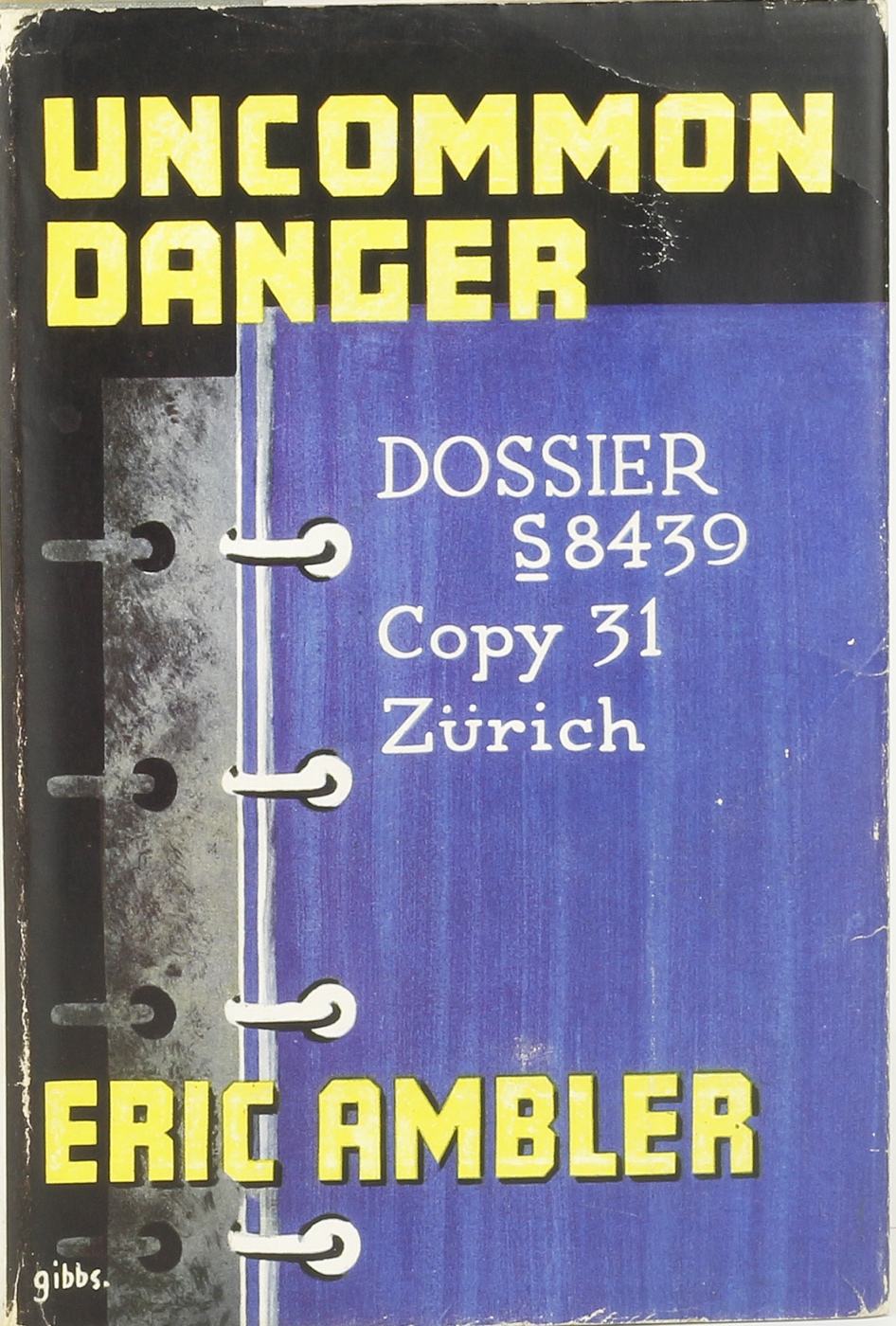
Eric Ambler's Uncommon Danger
Uncommon Danger (published in the United States as Background to Danger) was the second spy thriller written by Englishman Eric Ambler (1909-1998). It was published in 1937. Ambler is one of the most important figures in the evolution of spy fiction. During the 1930s Ambler and Graham Greene revolutionised the genre. In place of hearty British heroes like Bulldog Drummond Ambler gave us innocents caught up in the dangerous world of espionage. Not quite bumbling amateurs - Ambler’s protagonists are usually reasonably intelligent men but they find themselves hopelessly out of their depth and they must either sink or learn to swim.The protagonist of Uncommon Danger is a half-Irish half-French reporter named Kenton. Kenton is a free-lancer. This is financially a rather precarious profession and his weakness for gambling makes it even more precarious. Not for the first time in his life he is broke. He heads for Vienna, hoping to borrow some money from an acquaintance who owes him a favour. On the train he encounters a man named Sachs who makes him a tempting proposition - all Kenton has to do is to carry a package over the frontier ands for this very simple task he will receive six hundred marks. Sachs claims to be a Jewish refugee and claims that the package contains securities. Kenton is not a complete fool and it is obvious to him that the story Sachs has been spinning is a tissue of lies from start to finish, but he needs those six hundred marks.
This simple task soon becomes very complicated, with people getting killed. And it’s obvious that there are several groups of people who want that package and they don’t mind how many more people they have to kill.
At this stage Kenton has no idea what is going on but when he’s struck a vicious blow over the head, is kidnapped and then tortured he figures that the people doing this things are probably bad guys. But is the other group tying to get the package the good guys or just another faction of bad guys? Are there any good guys? Are they spies or counter-spies or common criminals or something else?
The package is not just a McGuffin. The nature of the contents of the package is crucial in determining Kenton’s actions. Kenton is not a particularly political person and not even a particularly moral person but there are some things that do offend his moral sensibilities enough to cause him to dig his heels in and even risk his life. Kenton has reached the point in his life when he cannot evade responsibility.
For Ambler espionage and politics were very much entangled. In this story the confrontations between fascism and socialism and liberal democracy form an essential part of the background but there’s more to it than that. Politics is a game that is not played only by politicians - it is also played by Big Business and their ethical standards are even lower than those of politicians. There are also old-fashioned territorial disputes between nations. In this case a long-standing quarrel between Romania and the Soviet Union, complicated by internal Romanian politics. The players in the game that Kenton has stumbled into include oil tycoons and Soviet spies.
As in all of Ambler’s early work it would be a mistake to assume that the Soviets are necessarily going to be the bad guys and it would be an even bigger mistake to assume that respectable British businessman are going to be the good guys. Of course whether the various players are good guys or bad guys they’re all out to advance their own interests so Kenton is not at all sure if he can trust any of them.
This is an Eric Ambler novel so the fact that Kenton has been caught up in the world of spies does not mean that he is instantly transformed into James Bond. He’s a reporter. He is not a tough guy. He is afraid of guns. He does his best. Being a reporter who has spent his career covering central Europe he does at least have some understanding of politics and considerable understanding of human duplicity. Occasionally he even manages to keep a step ahead of the professional spies but he makes lots of elementary mistakes and he has no hope of survival without some help from people who actually know what they’re doing.
This was 1937, a very troubled time. Austria’s future is uncertain. Anschluss hasn’t happened but it’s on the horizon. Poland and Czechoslovakia are engaged in desperate diplomatic manoeuvrings. Everyone is trying to join an alliance, or escape from one. No-one knows whether alliance with Nazi Germany or the Soviet Union would be the safer option. Codreanu’s Iron Guard are awaiting their opportunity in Romania. And for ruthless industrialists there are opportunities for profit. They’re more unscrupulous even than the politicians.
The plot is complex and devious but Ambler doesn’t get bogged down in details. He’s more interested in the psychology of espionage and betrayal than in the minutiae. And he keeps the excitement level high. Terrific entertainment. Highly recommended.
Friday, November 15, 2019
Elspeth Huxley's Murder on Safari
Elspeth Huxley (1907-1997) was an English writer best known for her non-fiction books about her childhood in Africa. She also wrote a handful of murder mysteries the second of which, Murder on Safari, appeared in 1938.
The setting is, obviously, Africa. In fact it is certainly Kenya. This was the twilight of the British Empire although the British hadn't quite realised that yet. Danny de Mare is a white hunter (which is used throughout the book as his job description) and he’s currently leading a safari. The safari comprises the very wealthy Lady Baradale, her husband Lord Baradale, his daughter Cara and her fiancé Sir Gordon Catchpole. The other Europeans in the party are Rutley, Lady Baradale’s chauffeur/mechanic, Cara’s maid Paula, a second white hunter named Luke Engelbrecht and Mrs Chris Davis, a pilot who cuts as a spotter for the safari.
De Mare has informed Superintendent Vachell of the Chania Police that some very valuable jewels of Lady Baradale’s have been stolen from a safe in her tent. Since Luke Engelbrecht has now been fired de Mare suggests that Vachell could join the safari undercover, posing as a white hunter. Vachell adopts the suggestion.
Unfortunately Vachell’s masquerade isn’t very successful and in any case he has to reveal his identity when the first murder occurs. This first murder is ingenious and the second is fiendishly clever.
It’s fun seeing what is basically a country house murder translated to Africa. The camp is a hundred miles from the nearest town. The roads are bad and quite impossible when it rains (which it does frequently) so the camp is effectively isolated. This means that the killer must be one of the nine Europeans with the safari. There are no less than thirty-six African cooks, gun-bearers, porters, etc but Huxley knows her rules of detective fiction. It is simply accepted by everyone that the murderer cannot be one of the African servants.
The African setting is used very cleverly. Apart from the usual hazards facing a detective Vachell survives being trampled by a wounded buffalo, which turns out to be attempted murder (although obviously the buffalo is the weapon rather than the murderer). Instead of cigar ash and footprints in the shrubbery the clues are things like elephant droppings (which it turns out can provide a great deal of information). And instead of alibis being provided by cab drivers or waiters they are provided by things like herds of buffalo (which we discover really can provide an alibi).
The question of a motive for the murders is complicated by the fact that the participants in the safari are also indulging in an age-old indoor sport, jumping in and out of bed with each other with a fine disregard for the conventions of matrimony.
One interesting feature of this novel is that the Africans do not speak in an exaggerated pidgin English manner. They speak pretty much the way you’d expect people who had been educated in a mission school to speak - in reasonably correct English. Huxley does not give the impression of having any doubts about the morality of Britain’s imperial mission but she was brought up in Kenya so she was presumably quite familiar with the way Africans in Kenya spoke. The Africans do suspect that the murders may be connected with witchcraft, and in 1938 that was probably a fairly universal belief. If you’re the sort of person who anguishes over the lack of political correctness in 1930 novels you’ll be rather perplexed by this book - it’s really neither politically correct nor politically incorrect. Huxley just describes the Africa she knew without offering any judgements at all.
A golden age detective novel must of course stand or fall on its plotting, and most crucially on whether it delivers a satisfactory solution. There’s also the matter of fair play. To convince us that she is plying fair Huxley provides copious footnotes in the closing stages linking us to the important clues. And the clues are often extremely clever. There are however two flies in the ointment for me. Firstly, there’s an incredibly vital clue which I feel is fudged. At the end she pulls a rabbit out of a hat to explain it away. And it really is the most vital clue of all. Secondly, she utilises a certain plot device which I personally feel does not actually break the rules but is contrary to the spirit of the game. So I’m not persuaded that this story is absolutely one hundred percent fair play. But it has to be said that many readers are not bothered by this not uncommon device.
And to compensate for these minor flaws there are the very very clever murder methods. The best thing about them is that they’re not just clever - they could only work in Africa. Many of the clues could also only work in Africa. I always admire writers who don’t just use exotic settings to add colour but make the setting vital to the plot.
Murder on Safari is also an exceptionally entertaining read. Recommended.
The setting is, obviously, Africa. In fact it is certainly Kenya. This was the twilight of the British Empire although the British hadn't quite realised that yet. Danny de Mare is a white hunter (which is used throughout the book as his job description) and he’s currently leading a safari. The safari comprises the very wealthy Lady Baradale, her husband Lord Baradale, his daughter Cara and her fiancé Sir Gordon Catchpole. The other Europeans in the party are Rutley, Lady Baradale’s chauffeur/mechanic, Cara’s maid Paula, a second white hunter named Luke Engelbrecht and Mrs Chris Davis, a pilot who cuts as a spotter for the safari.
De Mare has informed Superintendent Vachell of the Chania Police that some very valuable jewels of Lady Baradale’s have been stolen from a safe in her tent. Since Luke Engelbrecht has now been fired de Mare suggests that Vachell could join the safari undercover, posing as a white hunter. Vachell adopts the suggestion.
Unfortunately Vachell’s masquerade isn’t very successful and in any case he has to reveal his identity when the first murder occurs. This first murder is ingenious and the second is fiendishly clever.
It’s fun seeing what is basically a country house murder translated to Africa. The camp is a hundred miles from the nearest town. The roads are bad and quite impossible when it rains (which it does frequently) so the camp is effectively isolated. This means that the killer must be one of the nine Europeans with the safari. There are no less than thirty-six African cooks, gun-bearers, porters, etc but Huxley knows her rules of detective fiction. It is simply accepted by everyone that the murderer cannot be one of the African servants.
The African setting is used very cleverly. Apart from the usual hazards facing a detective Vachell survives being trampled by a wounded buffalo, which turns out to be attempted murder (although obviously the buffalo is the weapon rather than the murderer). Instead of cigar ash and footprints in the shrubbery the clues are things like elephant droppings (which it turns out can provide a great deal of information). And instead of alibis being provided by cab drivers or waiters they are provided by things like herds of buffalo (which we discover really can provide an alibi).
The question of a motive for the murders is complicated by the fact that the participants in the safari are also indulging in an age-old indoor sport, jumping in and out of bed with each other with a fine disregard for the conventions of matrimony.
One interesting feature of this novel is that the Africans do not speak in an exaggerated pidgin English manner. They speak pretty much the way you’d expect people who had been educated in a mission school to speak - in reasonably correct English. Huxley does not give the impression of having any doubts about the morality of Britain’s imperial mission but she was brought up in Kenya so she was presumably quite familiar with the way Africans in Kenya spoke. The Africans do suspect that the murders may be connected with witchcraft, and in 1938 that was probably a fairly universal belief. If you’re the sort of person who anguishes over the lack of political correctness in 1930 novels you’ll be rather perplexed by this book - it’s really neither politically correct nor politically incorrect. Huxley just describes the Africa she knew without offering any judgements at all.
A golden age detective novel must of course stand or fall on its plotting, and most crucially on whether it delivers a satisfactory solution. There’s also the matter of fair play. To convince us that she is plying fair Huxley provides copious footnotes in the closing stages linking us to the important clues. And the clues are often extremely clever. There are however two flies in the ointment for me. Firstly, there’s an incredibly vital clue which I feel is fudged. At the end she pulls a rabbit out of a hat to explain it away. And it really is the most vital clue of all. Secondly, she utilises a certain plot device which I personally feel does not actually break the rules but is contrary to the spirit of the game. So I’m not persuaded that this story is absolutely one hundred percent fair play. But it has to be said that many readers are not bothered by this not uncommon device.
And to compensate for these minor flaws there are the very very clever murder methods. The best thing about them is that they’re not just clever - they could only work in Africa. Many of the clues could also only work in Africa. I always admire writers who don’t just use exotic settings to add colour but make the setting vital to the plot.
Murder on Safari is also an exceptionally entertaining read. Recommended.
Friday, November 8, 2019
A for Andromeda
A for Andromeda is a novelisation of one of the most famous science fiction television series of all time, a series that gave Julie Christie her first big break. The seven-part serial was screened on the BBC in 1961. Tragically the BBC, in its infinite wisdom, later destroyed the entire series apart from one of the seven episodes. The follow-up series, The Andromeda Breakthrough (in which Susan Hampshire replaced Julie Christie), survives and was also novelised (I’ll be reviewing it soon).
The A for Andromeda TV series was co-written by astronomer and science fiction author Sir Fred Hoyle and John Elliot. The novelisation was credited to Hoyle and Elliot. It was written by Elliot but the idea and the story were Hoyle’s.
The audio of the entire TV series does survive and the missing episodes have been reconstructed using the audio and production stills (of which there were hundreds) so it’s possible to get a reasonable idea of what it was like and how it compares to the novelisation.
A new British radio-telescope has just been commissioned. And they’ve discovered something rather interesting. And rather startling. It’s a signal, from the region of the Andromeda constellation. A signal that appears to have meaning. It may even be a message. A message that has taken two hundred years reach us.
Dr Fleming, who was the first to realise that the signal was an intelligible message, has figured what the message is. It’s a set of instructions. In fact it’s a design, for a super-computer. And the message also contains the data to run through this computer.
Oddly enough the super-computer, once built, seems extraordinarily interested in how the human body works, about our biochemistry, our DNA, all that sort of stuff. It seems to be interested in producing a design for something else. Something biological. This is all starting to worry Dr Fleming. The more he thinks about it the more sinister implications he sees.
This is a first contact story but an intriguingly unconventional one. There’s no actual contact with aliens. The alien planet is 200 light years away and this book assumes that faster-than-light travel, or communication, really is impossible. There’s no possibility of actual communication. The only contact is the message containing the design for a computer, for a biological something, and lots of data. The aliens are not going to be arriving in spaceships. The only aliens in the story are the ones created by humans, following the alien design. Those aliens have no means of contacting their home planet. And are they truly alien? Are they human-like alien creations or alien-like human creations or some kind of alien-human hybrid? Are they alive or are they machines, or are they biological machines?
The book addresses the political, social and existential consequences of this and of hybridisation but it also explores the personal and psychological consequences. There’s a certain “trapped between two cultures” element as far as the heroine (or villainess depending on your point of view) is concerned.
This was 1961, a time when computers still used punch cards, but the primitiveness of the computers doesn’t matter. The ideas of human-machine interfaces and human-machine hybrids, are as provocative and as relevant as ever. This is a tale that deals with concepts like artificial intelligence, post-humanism, the fuzzy boundaries between biological and machine life, what it means to be human, what our ultimate destiny might be and the problem of the extent to which there can be genuine communication, and more importantly genuine trust, between human and alien and human and machine. This is a story that is really not even slightly dated.
While Elliot may have written the book it’s probably fair to assume that most of the interesting hard science fictional ideas were Hoyle’s. This is classic high-concept big-ideas science fiction.
While this is hard science fiction it’s also to some extent a spy thriller. It’s set in the late 60s, in a world in which the West is threatened and anxious and Britain is little more than an American satellite state. It’s also a world in which gigantic corporate cartels wield immense power and one of these cartels is extremely interested in that message from Andromeda. The government and the military are also very interested in the products of that alien design and they’re possibly less trustworthy even than the aliens. They’re certainly far more stupid and short-sighted.
A for Andromeda is smart provocative science fiction. Highly recommended.
The A for Andromeda TV series was co-written by astronomer and science fiction author Sir Fred Hoyle and John Elliot. The novelisation was credited to Hoyle and Elliot. It was written by Elliot but the idea and the story were Hoyle’s.
The audio of the entire TV series does survive and the missing episodes have been reconstructed using the audio and production stills (of which there were hundreds) so it’s possible to get a reasonable idea of what it was like and how it compares to the novelisation.
A new British radio-telescope has just been commissioned. And they’ve discovered something rather interesting. And rather startling. It’s a signal, from the region of the Andromeda constellation. A signal that appears to have meaning. It may even be a message. A message that has taken two hundred years reach us.
Dr Fleming, who was the first to realise that the signal was an intelligible message, has figured what the message is. It’s a set of instructions. In fact it’s a design, for a super-computer. And the message also contains the data to run through this computer.
Oddly enough the super-computer, once built, seems extraordinarily interested in how the human body works, about our biochemistry, our DNA, all that sort of stuff. It seems to be interested in producing a design for something else. Something biological. This is all starting to worry Dr Fleming. The more he thinks about it the more sinister implications he sees.
This is a first contact story but an intriguingly unconventional one. There’s no actual contact with aliens. The alien planet is 200 light years away and this book assumes that faster-than-light travel, or communication, really is impossible. There’s no possibility of actual communication. The only contact is the message containing the design for a computer, for a biological something, and lots of data. The aliens are not going to be arriving in spaceships. The only aliens in the story are the ones created by humans, following the alien design. Those aliens have no means of contacting their home planet. And are they truly alien? Are they human-like alien creations or alien-like human creations or some kind of alien-human hybrid? Are they alive or are they machines, or are they biological machines?
The book addresses the political, social and existential consequences of this and of hybridisation but it also explores the personal and psychological consequences. There’s a certain “trapped between two cultures” element as far as the heroine (or villainess depending on your point of view) is concerned.
This was 1961, a time when computers still used punch cards, but the primitiveness of the computers doesn’t matter. The ideas of human-machine interfaces and human-machine hybrids, are as provocative and as relevant as ever. This is a tale that deals with concepts like artificial intelligence, post-humanism, the fuzzy boundaries between biological and machine life, what it means to be human, what our ultimate destiny might be and the problem of the extent to which there can be genuine communication, and more importantly genuine trust, between human and alien and human and machine. This is a story that is really not even slightly dated.
While Elliot may have written the book it’s probably fair to assume that most of the interesting hard science fictional ideas were Hoyle’s. This is classic high-concept big-ideas science fiction.
While this is hard science fiction it’s also to some extent a spy thriller. It’s set in the late 60s, in a world in which the West is threatened and anxious and Britain is little more than an American satellite state. It’s also a world in which gigantic corporate cartels wield immense power and one of these cartels is extremely interested in that message from Andromeda. The government and the military are also very interested in the products of that alien design and they’re possibly less trustworthy even than the aliens. They’re certainly far more stupid and short-sighted.
A for Andromeda is smart provocative science fiction. Highly recommended.
Subscribe to:
Posts (Atom)